
How to Choose Between Peru and Bolivia for a First South America Trip
This post contains affiliate links. As an Amazon Associate, we earn from qualifying purchases.
Choosing between Peru and Bolivia for a first South America trip means weighing altitude, current government advisories, and how well the tourist trail is built. Peru drew 4,157,469 international visitors in 2025; Bolivia drew 1,145,165. Peru is the easier first trip. Bolivia pays you back more if you’ve already done one.
That visitor gap runs nearly four to one, and you’ll feel it in the logistics. Flights connect Lima, Cusco, Arequipa, and Puno’s Juliaca airport without much planning. Licensed operators and tourist bus networks fill Peru’s southern route. Bolivia has comparable landscapes with thinner scaffolding around them, which is central to how to choose between Peru and Bolivia for a first South America trip.
The decision breaks down in the order that actually ruins trips: the safety picture from the governments that publish it, the altitude math, how long each country needs, and the overland route that turns two countries into one. By the last section you’ll know which one to book.
Key Takeaways
- Peru is the easier first trip. Flights link Lima, Cusco, Arequipa, and Juliaca, and tourist bus networks cover the southern route without you arranging much.
- Altitude decides the opening of your trip. Cusco sits at 3,400 meters and La Paz at 3,640, so build the climb in rather than flying straight into it.
- Bolivia’s caution is national. Canada advises a high degree of caution countrywide and “Avoid all travel” to the Chapare Region, including Villa Tunari.
- Cusco and Machu Picchu sit outside every restricted zone on both the U.S. And Canadian advisories.
- Run the overland leg in one direction. Cusco to Puno to Copacabana to La Paz takes around a day and lets the altitude build for free.
What the Government Advisories Say Right Now About Both Countries
Canada’s advisory for Bolivia opens with a phrase that should shape your whole plan: exercise a high degree of caution.
Canada advises a high degree of caution across Bolivia and advises against all travel to the Chapare Region, including Villa Tunari. A 90-day nationwide state of emergency was declared on 20 June 2026 to clear roadblocks after weeks of protests interrupted fuel, food, and medical supply chains. Most major routes have reopened, though some roads remain damaged.
That wording applies nationwide. It covers La Paz, Sucre, Uyuni, and the entire tourist circuit. Canada carves out one hard exclusion: Avoid all travel to the Chapare Region, which sits on major highway routes between Santa Cruz and Cochabamba.
What most people get wrong: Reading “high degree of caution” as a soft warning. The same advisory tells you to confirm your route before departure, carry extra prescription medication, and expect detours. Roads damaged during the 2026 blockades can close with little notice.
Peru’s advisory is shaped differently. The U.S. Embassy Peru travel advisory rates the country Level 2 and names specific districts as Do Not Travel instead of cautioning about the whole country.
Where the Two Governments Disagree on Peru
Canada and the United States draw Peru’s no-go lines in different places. That matters if you’re routing through the southern highlands.
| Zone | U.S. Embassy (Sept 2026) | Canada (Nov 2026) |
|---|---|---|
| VRAEM | Do Not Travel | Avoid all travel |
| Abancay, Ayacucho, Huancavelica, Huancayo | Do Not Travel | Not restricted |
| Colombia-Peru border, Loreto Region | Do Not Travel | Not restricted |
| Cusco, Sacred Valley, Machu Picchu | Outside restricted zones | Outside restricted zones |
Canada’s restricted zone is narrower than the American list. Neither government restricts Cusco, the Sacred Valley, the Inca Trail, or Machu Picchu, which is where most first-timers spend their time.
Canada’s Peru page adds a detail the U.S. Page leaves out. States of emergency are in effect in Lima, Callao, and several other provinces to curb violent crime. Those declarations give security forces wider powers to restrict movement and detain people.
Both advisories also note that women traveling alone may face harassment, and Canada’s Peru page records that tour guides have been implicated in some sexual assault cases. I’ve never traveled solo as a woman, so I’ll point you at the advisories rather than pretend I know what that feels like.
Read both pages in full before you book anything.
Peru or Bolivia First? The Altitude Math That Decides It
Cusco sits at 3,400 meters, La Paz at 3,640, and Potosí at 4,067. Uyuni tours run above 4,500 meters. Lima sits at sea level.
That spread is the strongest argument for doing Peru first when you compare a how to choose between Peru and Bolivia for a first South America trip. You land at sea level, climb through Arequipa or Cusco, and reach Puno already partly adjusted. The Bolivian Altiplano then becomes a step up instead of a wall.
| Destination | Elevation | Day-one reality |
|---|---|---|
| Lima | Sea level | No adjustment needed |
| Cusco | 3,400 m | Two gentle days before hiking |
| La Paz / El Alto | 3,640 m | Arriving overland is easier |
| Potosí | 4,067 m | The hardest night of the trip |
| Uyuni tours | Above 4,500 m | Cold nights, real sleeping bag |
Flying directly into El Alto from sea level skips all of it. The overland route from Cusco builds acclimatization across 2,300 to 3,800 meters before you reach Lake Titicaca. That’s why the direction of travel matters more than the order of the stops.
Rule of thumb: Give yourself two gentle days above 3,400 meters before anything strenuous. Altitude sickness rarely announces itself on day one. It lands on day two, and by then you’ve already booked the hike.
Cold is the part that catches you out. At 4,500 meters on the salt flat, the temperature drops before the sun does, and the sleeping bag your hostel rents you was built for a hostel.
Which is why I plan high-altitude trips backwards now. I start with the elevation I’ll be sleeping at, not the sights I want to see.
How Many Days Does Each Country Actually Need?
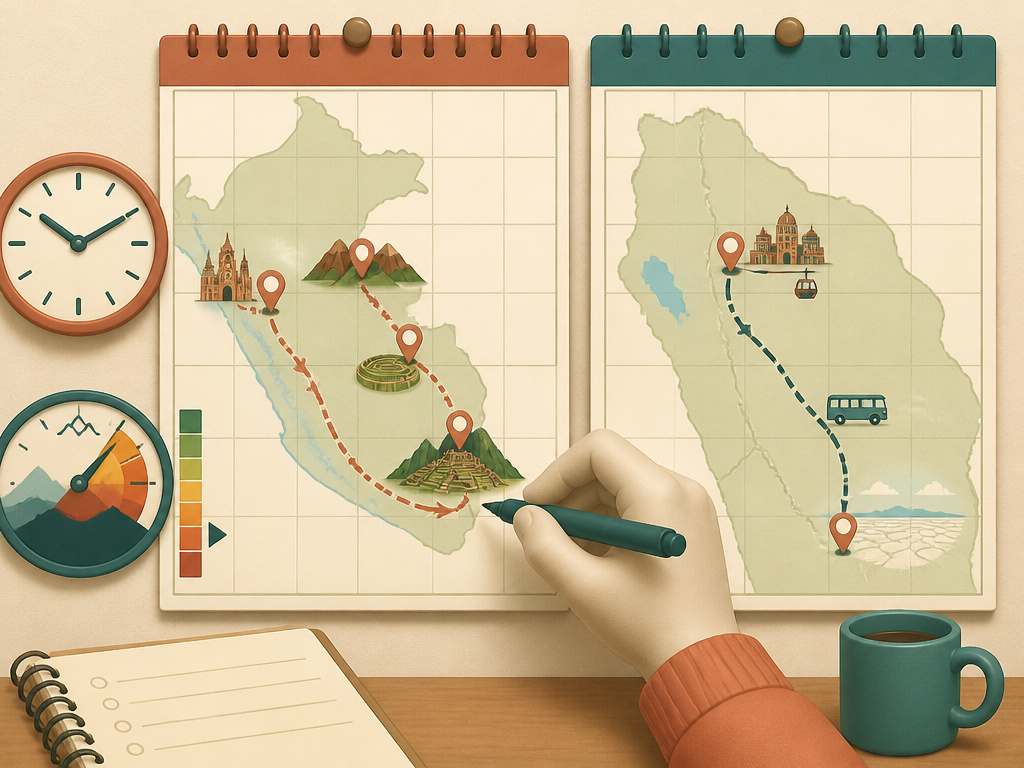
Ten days in Peru gets you Lima, Cusco, the Sacred Valley, and Machu Picchu. Ten days in Bolivia gets you La Paz, Uyuni, and a lot of bus time. The two countries reward different pacing, which is the heart of how to choose between Peru and Bolivia for a first South America trip.
Peru’s southern circuit is dense. You can hold a base in Cusco, take day trips into the Sacred Valley, and ride the train to Aguas Calientes without repacking more than twice. PeruRail and Inca Rail both run that service, and the daylight departures are worth the earlier start. If you’re planning a Peru itinerary from Lima to Machu Picchu, keep the long legs to two and let Cusco do the rest.
Bolivia’s circuit is thinner and wider. La Paz to Uyuni is a flight or an overnight bus, and the salt flat circuit itself runs three to four days. Sucre and Potosí add more if you have the time.
If visiting Machu Picchu is the reason you’re going, the southern circuit stays the default first route. It also sits outside every restricted zone on both advisories.
How Long to Hold a Cusco Base
Cusco is where first-timers either find their rhythm or burn out. Hold a base there rather than moving hotels every night, because every change eats a morning you could have spent in the valley.
Working out how many days in Cusco is really a question about altitude tolerance, not about how many ruins you can tick off. Arrive, sleep, and let your body catch up before you commit to anything with a start time.
The Overland Route That Turns Two Countries Into One Trip
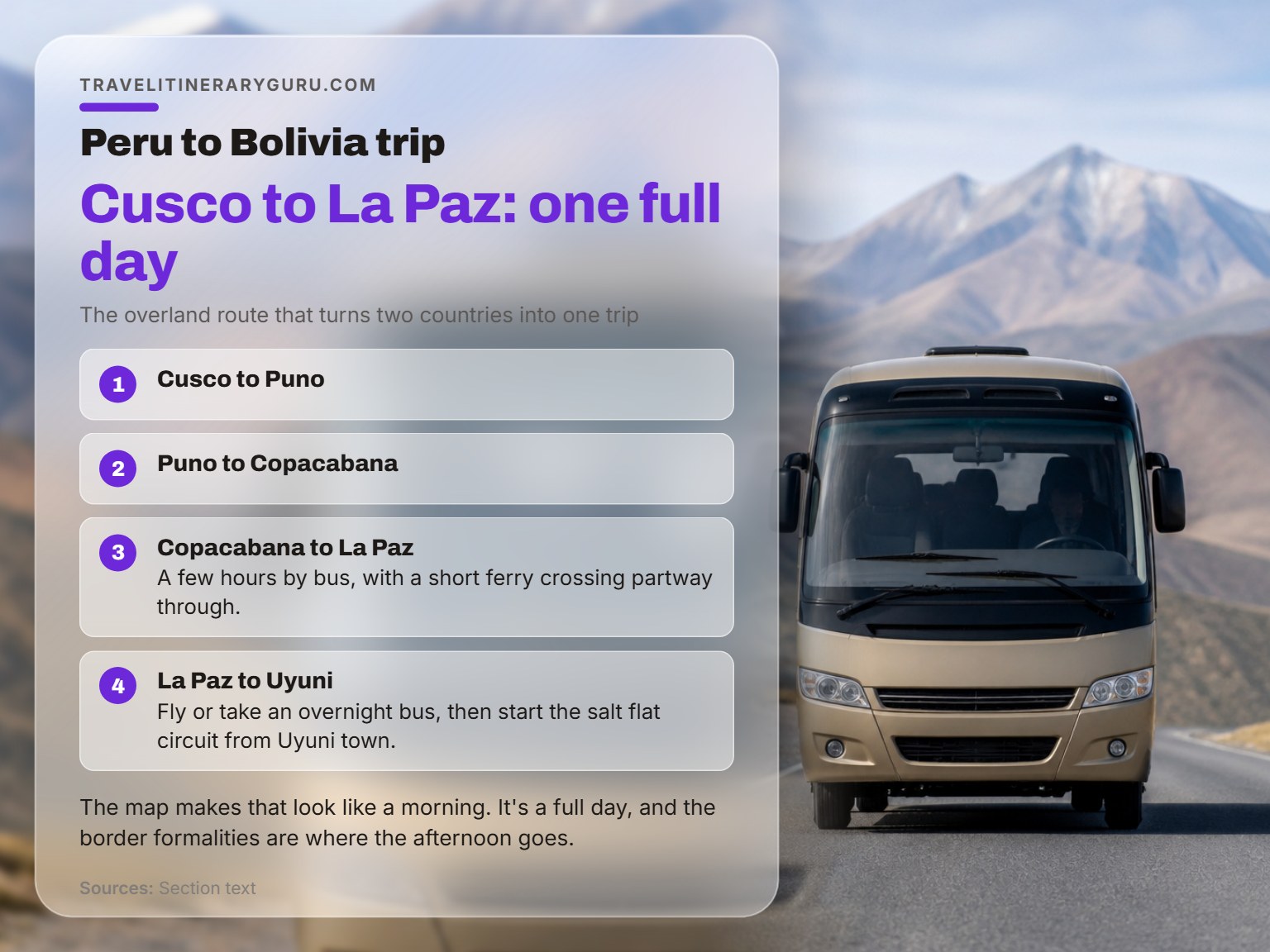
The tourist crossing at Kasani, between Puno and Copacabana, is the one to use. It’s the most straightforward land crossing between the two countries, and you can do it independently or on a hop-on hop-off service.
Before you start: Roadblocks are common in Bolivia and can strand you for hours. Carry extra water, food, fuel, medication, and warm clothing, and check with your airline before heading to the airport. Never cross a roadblock, even an unattended one.
The full run from Cusco to La Paz takes around a day. Here’s the sequence that works:
- Cusco to Puno. An overnight bus or a full day of driving, depending on whether you want to see the route or sleep through it.
- Puno to Copacabana. Cross at Kasani, then continue to the Bolivian shore of Lake Titicaca. Bolivia is one hour ahead of Peru, so your arrival time shifts.
- Copacabana to La Paz. A few hours by bus, with a short ferry crossing partway through.
- La Paz to Uyuni. Fly or take an overnight bus, then start the salt flat circuit from Uyuni town.
Peru Hop runs a hop-on hop-off network from Lima through Arequipa, Cusco, and Puno with hotel pickups, and Bolivia Hop covers the Copacabana and La Paz legs. Rome2Rio is the fastest way to check whether a leg is a bus or a flight before you commit.
The map makes that look like a morning. It’s a full day, and the border formalities are where the afternoon goes.
Skip this if: You’re set on doing the route in the rainy months. Bolivia’s dry season runs April to October, and the salt flat’s mirror effect needs water on the surface. Ask your operator what the flats look like the week you arrive.
What Does a First-Timer Actually Get Wrong About Bolivia?
Flying straight into El Alto from sea level is the mistake that flattens the first half of the trip. La Paz sits at 3,640 meters, and the airport sits above the city, so you land already high.
I’ll say this plainly: the Salar de Uyuni at sunrise beat Machu Picchu at sunrise for me. There were maybe fifteen other people on the salt flat that morning. At the Sun Gate there were hundreds.
The salt flat circuit from Uyuni town runs three to four days and spends most of its time above 4,500 meters. Altitude is what makes that circuit hard.
I’d rather send a first-timer to Uyuni than to the Inca Trail. The Inca Trail is booked out months ahead and crowded when you finally get there, and the Salkantay and Lares treks give you the same mountains with fewer people. Uyuni gives you something you can’t get anywhere else.
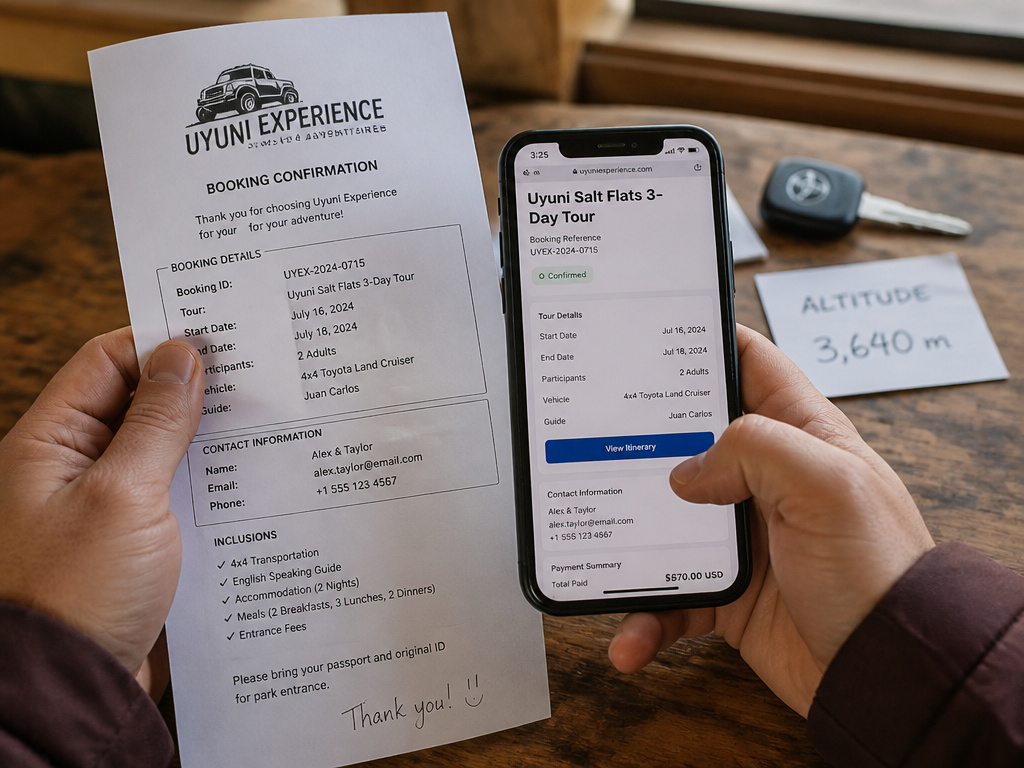
Easy to miss: Bolivia sets no official minimum safety standards for tour operators, and reputable ones are limited. The cheap Uyuni departure and the good one look identical on a booking page.
Book through a company with a physical office in Uyuni or La Paz, and confirm the vehicle before you pay.
What Changed With Bolivia’s Exchange Rate in 2026

Bolivia ended its long-standing fixed exchange rate in 2026, and the central bank now publishes a floating official rate instead. That changes how you carry money there.
The expat-run Bolivian Life travel guide advises bringing clean U.S. Dollar notes, and the note condition genuinely matters at the counter.
- Carry clean, undamaged U.S. Dollar notes. The exchange situation changed in 2026, so don’t assume last year’s advice still holds.
- Use ATMs inside banks or well-lit public areas. Both governments flag card and ATM fraud.
- Watch your card when someone else handles it. Card fraud occurs in both countries.
- Avoid street moneychangers in Peru. Counterfeit sol and dollar bills are a growing problem there.
On cost, the honest answer is that the two countries are closer than their reputations suggest. The Bolivian Life guide, which is an editorial blog rather than a government source, argues that day-to-day costs are close and that Peru’s headline experiences are the pricier ones. Treat that as opinion.
Where Peru gets expensive is the big-ticket items: Machu Picchu entry, the train to Aguas Calientes, and Inca Trail permits.
Choosing Between Peru and Bolivia for a First South America Trip: The Verdict
If you want a single answer and you’ve never been to South America: Peru.
The buses run, the altitude builds gradually, and the headline sights earn their reputation. You’ll pay for the convenience in crowds.
Bolivia is the better second trip. Fewer visitors, stranger landscapes, and a stronger sense of everyday Andean life.
Here’s the split by traveler type:
- First South America trip, two weeks or less: Peru. Flights, buses, and licensed operators absorb the planning burden.
- Second or third trip to the continent: Bolivia. The salt flat, Potosí, and Sucre reward someone who’s already handled altitude once.
- You want the salt flat more than the citadel: Bolivia, and arrive overland rather than flying into El Alto cold.
- You want food, museums, and a walkable city: Peru. Lima’s food scene is the reason a lot of people go back a second time.
If you have the time, do both overland. The countries meet at Lake Titicaca, and the Kasani crossing is straightforward enough to do independently.
I once tried to do Peru, Bolivia, and Chile in three weeks. I spent roughly forty hours in transit and saw three places properly. Now I plan one country per trip, and the continent isn’t going anywhere.
Distances here are deceptive on a map. Cusco to La Paz overland is a full day, and a Patagonia trip is measured in days of driving rather than kilometers. Bolting Patagonia onto an Andean itinerary is how you end up exhausted.
If you’re open to a different country entirely, Colombia deserves a look. I now recommend it over Peru about half the time for a first South America trip. Cartagena’s old town is walkable, the coffee region around Salento is gorgeous, and Avianca’s domestic network makes moving around easy. A Colombia itinerary built around Cartagena, Medellín, and Salento covers the highlights without rushing.
These decisions follow the same shape everywhere. Choosing between Spain and Portugal for a first Europe trip is a question of pace and rail links. Thailand vs Vietnam for a first Asia trip is a question of comfort against intensity. Peru and Bolivia are the same exercise, with altitude raising the stakes.
Frequently Asked Questions
Is Peru or Bolivia better for a first South America trip?
Peru, for most first-timers. Flights connect the main southern cities, licensed operators are everywhere, and you can build altitude gradually by starting in Lima. Bolivia rewards travelers who have already handled altitude once and want fewer crowds.
How many days do you need in each country?
Build the trip around the fixed blocks rather than a total. Bolivia’s salt flat circuit takes three to four days on its own, and the Cusco to La Paz overland leg takes around a day. Everything else fits around those two anchors.
Is Bolivia safe for tourists right now?
Canada advises a high degree of caution across Bolivia and advises against all travel to the Chapare Region. A 90-day nationwide state of emergency was declared on 20 June 2026 after protests interrupted supply chains. Most major routes have reopened, but some roads remain damaged and conditions can change quickly.
Do you need a visa for Bolivia?
U.S. Citizens no longer need a visa for Bolivia after a late-2025 change, and can stay up to 90 days a year. Check your own country’s requirements, because the rules differ by passport.
Can you visit both countries in one trip?
Yes, and the overland route makes it easy. Cross at Kasani between Puno and Copacabana, then continue to La Paz. The whole leg takes around a day, and the altitude you gained in Peru carries over.
Which is cheaper, Peru or Bolivia?
Day-to-day costs are closer than the reputations suggest. The Bolivian Life guide argues they’re close, with Peru’s headline experiences costing more. That’s an editorial blog rather than a government source, so treat it as opinion.
The Bottom Line
Here’s the trigger that flips the answer. If your trip is shorter than two weeks, pick one country and stop negotiating with yourself. Splitting that time across a border costs you a transit day in each direction.
If you’re booking this week, the first step is boring. Pull up both government advisories, read the regional sections, and check the dates on them. An advisory from last year tells you nothing about the roads that closed in June.
I’ll be honest about the limits of this advice. I plan mid-range and budget trips, so if you’re looking at high-end lodges and private guides, my judgment there is thin. And I’ve never traveled solo as a woman, which is why I sent you to the advisories instead of guessing.
One last thing, and I’ll defend it: for a first South America trip, Machu Picchu is not the reason to go. The Sacred Valley towns, the food in Lima, and a salt flat at sunrise will stay with you longer. Book the citadel, sure. Just don’t build the whole trip around a photo you’ve already seen a thousand times.
