
How to Plan a Patagonia Trip: One Route, Two Countries
This post contains affiliate links. As an Amazon Associate, we earn from qualifying purchases.
Planning a Patagonia trip comes down to one route, not a list of every place you have heard of. Patagonia spans two countries and roughly 2,700 km of Argentine territory alone, so pick a single corridor, match it to the days you actually have, and plan around weather. If you are wondering how to plan a Patagonia trip, the most common mistake is trying to see all of it at once.
The how to plan a Patagonia trip distance math is what breaks most itineraries. Puerto Natales sits 115 km from Torres del Paine on Route Y-290, about 1 h 30 min in good conditions. Punta Arenas to Puerto Natales is 250 km on Route 9. Neither is a hard day. Stack four of those days back to back and you have a forced march, not a vacation.
What follows is the route logic, the season reality, and the self-sufficiency rules that the tourism brochures leave out.
Key Takeaways
- Pick one corridor. The Southern Patagonia circuit takes 10 days per patagonia.gob.ar. The Long Patagonian Circuit takes 20 days minimum.
- Dirt-road planning speed is 45-70 km/h, not highway speed. CIEP published that figure; ignore it and your day plans collapse.
- Governments disagree on winter. patagonia.gob.ar says October-April; chile.travel says check weather day by day; the Southern Patagonia circuit page says “all year long” with caveats. All three are true for different trips.
- Fill fuel whenever possible and carry 1-2 full days of provisions. CIEP lists both as core requirements, not suggestions.
- Book park accommodation, refugios, campsites, and tickets before you book flights. Torres del Paine rules are seasonal.
How Many Days Do You Actually Need in Patagonia?
The honest how to plan a Patagonia trip answer depends on how many regions you are trying to stitch together. One region needs at least 7 days. The classic southern Patagonia route (Torres del Paine plus El Calafate plus Perito Moreno) needs 10 to 14 days. A broader trip that folds in northern Patagonia, Ushuaia, wildlife, or the Carretera Austral needs three weeks or more.
If you have less than a week, do not try to cross the whole region. Pick one base and stay there.
I get it, the temptation to bolt on “just one more stop” is real. But a 10-day trip that tries to cover Torres del Paine and Perito Moreno and the Carretera Austral is a trip where you spend more time in transit than on the ground. Save the Carretera Austral for another year.
Patagonia is a huge region shared by Argentina and Chile, with different landscapes, gateway cities, seasons, travel styles, costs, and logistics. A good trip starts by choosing the right Patagonia for the time you actually have.
That quote is from the Patagonia Tourism official travel guide, and it is the single most useful sentence in the entire planning stack.
The Two Government Circuit Templates
Patagonia.gob.ar publishes two ready-made circuits that map cleanly onto the two most common trip lengths.
| Circuit | Minimum Days | Season | Anchor Cities |
|---|---|---|---|
| Southern Patagonia | 10 days | All year long | Ushuaia, El Calafate |
| Long Patagonian Circuit | 20 days | October-April | Route 3 + Route 40 loop |
The Southern Patagonia circuit is the one most first-timers actually want. It hits the End of the World at Ushuaia and the glaciers out of El Calafate. All three are developed tourist centers with real service infrastructure.
The Long Patagonian Circuit is a different animal. It runs the length of Route 3 and Route 40 in your own vehicle, and patagonia.gob.ar suggests 20 days minimum just for the traditional destinations. Want to go deeper? The page says a longer duration will be necessary. That is government-speak for “add a week.”
When Should You Go? Three Sources, Three Answers
This is where the planning gets genuinely messy, because the official sources do not agree with each other.
Patagonia.gob.ar’s Long Patagonian Circuit page says the ideal window is October to April and warns that at other times of the year, roads are likely to be difficult due to ice and snow. That is the strictest position.
Chile.travel’s Torres del Paine page does not restrict the season at all. Instead it advises checking weather conditions day by day, because storms can keep you inside your accommodation.
Patagonia.gob.ar’s Southern Patagonia page splits the difference. It says “all year long,” then adds that certain excursions may not be available during the winter months for safety reasons.
All three positions are correct. They just describe different trips.
What most people get wrong: Treating “all year long” as permission to show up in July with summer gear. The Southern Patagonia circuit page does not promise your excursions will run. It promises the circuit exists. Those are different claims.
The Month-by-Month Reality
Here is how the seasons actually break down across the two main regions.
| Window | What Works | What Does Not |
|---|---|---|
| October-April | Ideal for the Long Patagonian Circuit per patagonia.gob.ar; other sources allow year-round travel with caveats. | Nothing specific. |
| June-mid-December | Southern Right Whale watching at Puerto Pirámides. | Some winter excursions may not run for safety reasons. |
| November-March | O’Higgins Glacier cruise out of Bahía Bahamondes. | Other activities may still run year-round per some sources. |
| March-April | Red-deer rutting viewing at Parque Luro, 35 km from Santa Rosa. | Other activities have their own windows. |
Two of those windows are worth building a trip around. The Southern Right Whale season at Puerto Pirámides runs June to mid-December, which is the one solid reason to consider a shoulder-season visit. The O’Higgins Glacier cruise only runs November to March, so if that boat is on your list, your dates are locked.
The rutting deer window at Parque Luro is a niche draw, but it is genuinely unique. It happens March to April, 35 km from Santa Rosa. If you are driving on National Route 5, it is a legitimate stop.
Driving, Flying, or Bus: What Actually Works
Three ways to move through Patagonia, and the right one depends on how much you want to control versus how much you want to be handled.
Driving your own vehicle gives you the most flexibility and the most responsibility. National Route 3 and National Route 40 are the two backbone highways. Route 40 alone runs 2,700 km of Patagonian territory and extends to a total of 5,000 km. If you are coming from Buenos Aires, National Route 5 is fully paved to Santa Rosa — that is the one section where you can stop worrying about gravel.
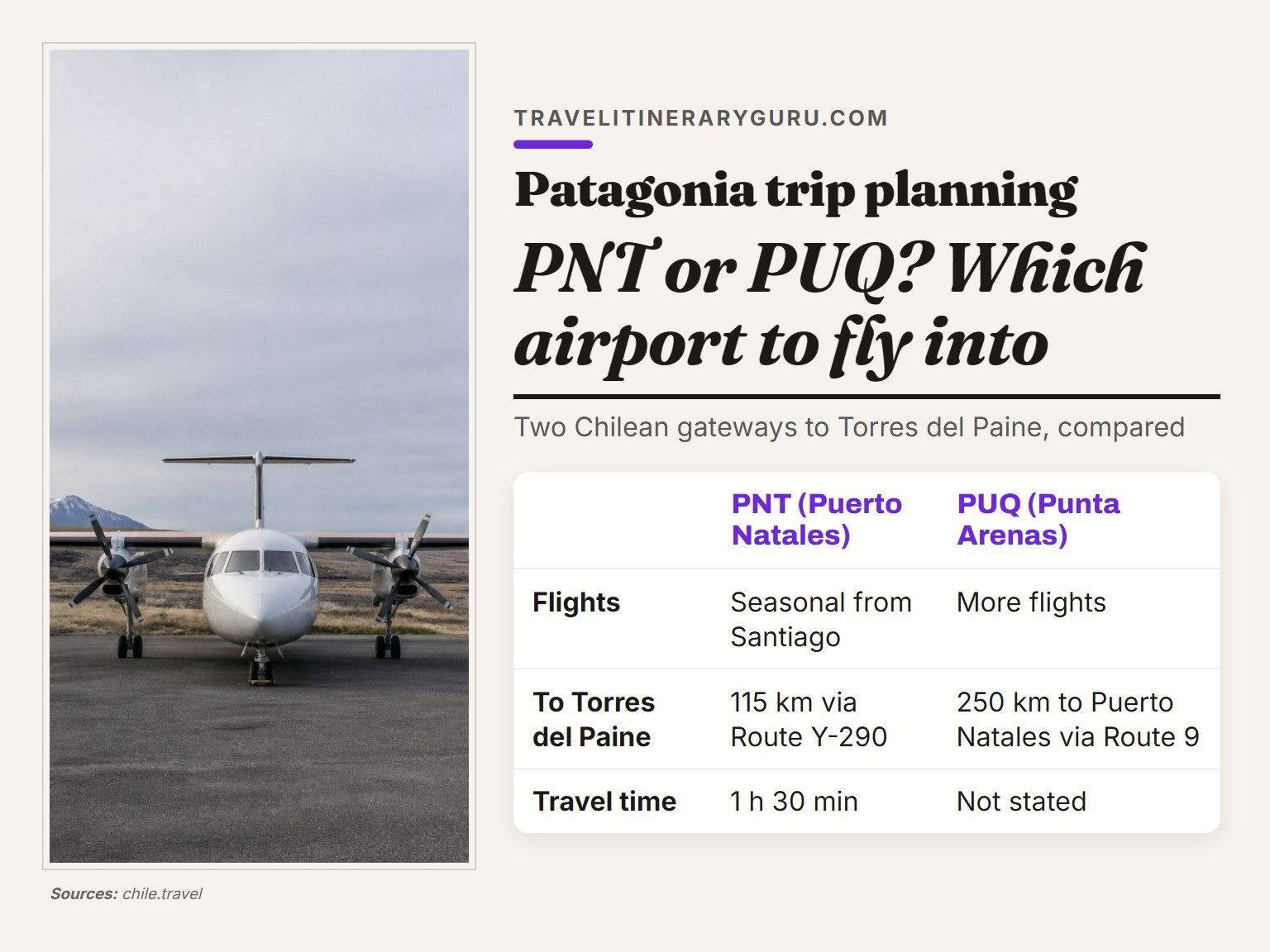
Flying is the fast option, with a catch. Aerolíneas Argentinas, LADE, Sky Airline, Flybondi, and Jet Smart all serve southern Argentina. But intra-Patagonia routes may not be available year-round, and Puerto Natales airport (PNT) only has seasonal flights from Santiago. Punta Arenas (PUQ) has more flights and is the fallback.
Buses are the underrated middle path. Multiple companies connect Patagonian localities, which means you can string together several destinations in one trip without renting a car.
Easy to miss: Puerto Natales airport code is PNT with seasonal service only. If your dates fall outside that window, consider flying into Punta Arenas and covering the 250 km on Route 9 by road. Build that into your arrival day.
The Self-Sufficiency Rules Nobody Puts in the Brochure
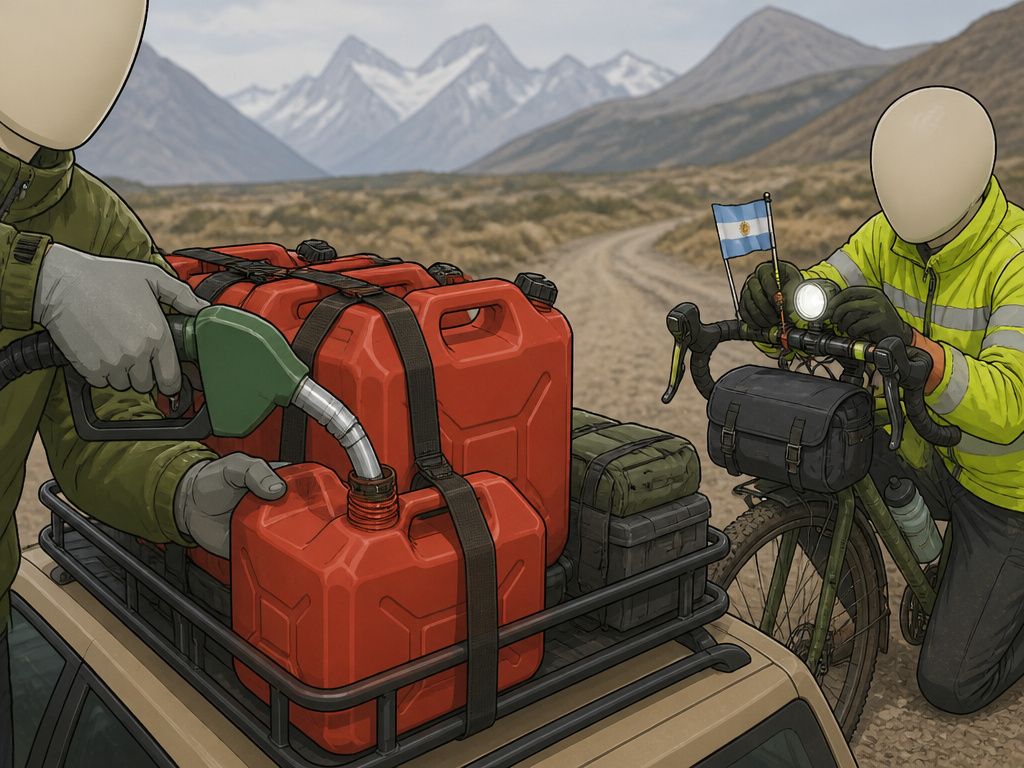
CIEP, the Centro de Investigación en Ecosistemas de la Patagonia, published a binational circuit guide that reads less like a tourism brochure and more like a backcountry manual. Its opening claim is blunt: self-sufficiency is the fundamental philosophy for travel in Patagonia.
That word is doing a lot of work. Here is what it actually requires.
- Fill up with fuel whenever possible. Not when the gauge gets low. Whenever you see a station.
- Carry enough provisions for at least one or two complete days. Food supplies are limited in most communities.
- Plan for communication blackouts. Phones and internet are hit or miss. CIEP notes you will likely encounter more local wildlife than people.
- Budget for slower travel than you expect. Travel times are always longer than expected and vary with climate, road conditions, and mechanical issues.
The single most useful number in the entire planning stack is CIEP’s dirt-road planning speed: 45-70 km/h (30-45 mph). That is the figure CIEP recommends for itinerary math on unpaved sections.
I learned the “three activities max” rule the hard way years ago, on a different trip where I scheduled five and ended up skipping half of them. Patagonia punishes that mistake harder than most places, because the 175 km leg between Lago Ghio and Lago Posadas can take anywhere from 6 hours to 2 or 3 days depending on conditions.
If You Are Driving Your Own Vehicle
CIEP is strict on this point. It strongly suggests driving a 4×4 vehicle equipped with chains. That is a stronger recommendation than patagonia.gob.ar gives, which describes arriving in your own vehicle via RN3 or RN40 with no drivetrain specification and notes that winter roads are often snowy.
I would follow CIEP for gravel sections. The national tourism authority describes the road. CIEP describes what happens on it.
Before you start: Rain forms large puddles on dirt roads where depth is impossible to discern. Road signs are infrequent in many sections. Both hazards are worse in low light, so plan to be off the gravel before dusk.
If You Are Bike Touring
CIEP has a full chapter on this, and it is not gentle. There are no bike lanes in Patagonia, and the road shoulders are narrow to non-existent.
The recommended kit, per CIEP: reflective clothing, small flags, flashing front headlights, and reflectors. Always keep to your right and be prepared to get off the road entirely to avoid collisions. On hills and curves, you need to be visible from both directions.
The preparation step most riders skip: completely take apart and reassemble your bicycle before the trip, even if it is rented. CIEP recommends this to learn the parts and prepare for problems on the route. It is also the only way to know your spare parts actually fit.
What to Do When the Weather Cancels Your Plan
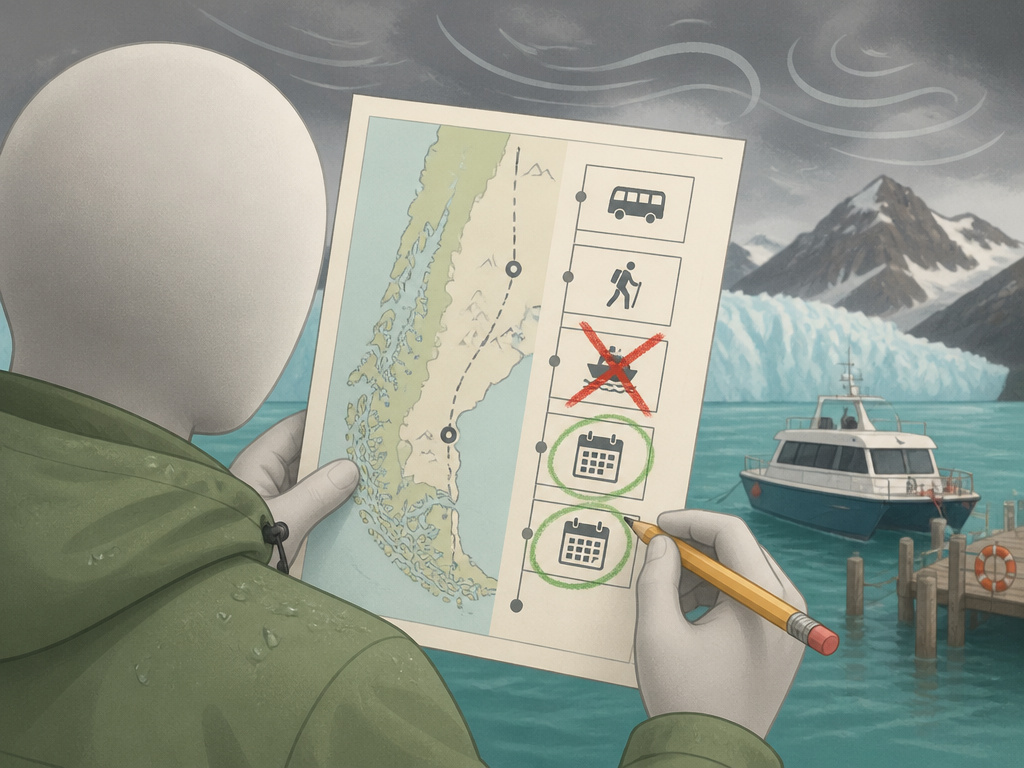
Weather is the boss in Patagonia, and the O’Higgins Glacier cruise is the clearest example. Strong winds or storms can cause cancellations of the passage. That is not a weather advisory; it is a hard rule.
CIEP’s advice is specific: if you really want to experience the glacier, plan a two-day grace period in your itinerary to accommodate the possibility of cancellation. The cruise itself is 91 km round trip from Bahía Bahamondes dock, running 10 hours (8 hours if you board at Candelario Mansilla).
Two days of slack on a single activity is a lot. It is also the difference between seeing the glacier and going home with a story about the boat that did not run.
Skip this if: You are prone to sea-sickness and have not brought medication. CIEP recommends bringing sea-sickness medication for the O’Higgins cruise, and a 10-hour crossing is not the place to find out.
The same logic applies to El Chaltén. A smart plan includes extra nights there specifically so you can wait for a better weather window. Clouds can hide Fitz Roy all day, and wind can turn a moderate walk into a hard one. If your El Chaltén days are locked, you are gambling.
Guided Tours or Self-Sufficiency? The Real Split
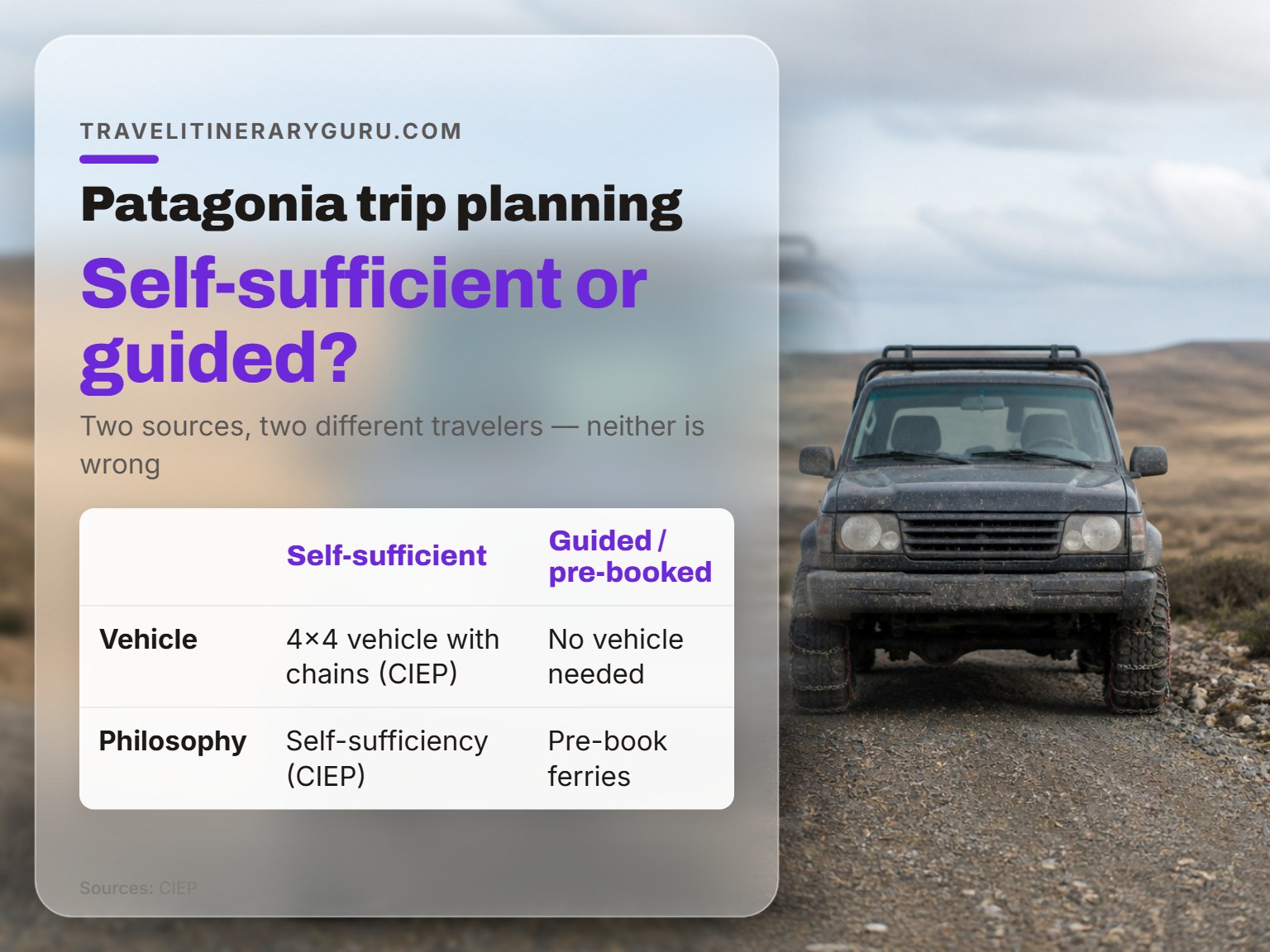
This is where the sources genuinely disagree, and it is worth being honest about it.
CIEP frames self-sufficiency as the fundamental philosophy. It lists required competencies: basic mechanics, survival skills, first aid. That is CIEP’s standard for the binational circuit.
Patagoniatourism.org takes a different default. It recommends booking small-group specialty tours and pre-booking ferries and park passes. That is a different trip with a different risk profile.
Neither is wrong. They are describing two different travelers.
| Approach | Best For | Trade-Off |
|---|---|---|
| Self-sufficient | Experienced drivers, confident riders, flexible schedules | You carry the risk. No support if something breaks. |
| Guided / pre-booked | First-timers, tight schedules, travelers without mechanical skills | Less flexibility. You move on the operator’s clock. |
| Hybrid | Most people, honestly | Book the hard logistics, self-drive the easy legs. |
The hybrid is what I would actually do. Pre-book the O’Higgins cruise and Torres del Paine accommodation, because those need attention. Self-drive the sections where you want to stop when something looks interesting.
If you are building a longer trip that strings together several regions, the same logic applies to a multi-city trip — book the constrained pieces first, leave the rest loose.
Getting There: Airports, Airlines, and the La Pampa Transit
Many travelers arriving from outside Patagonia pass through La Pampa. National Route 5 is fully paved to Santa Rosa, which makes it a natural rest stop. If your timing lands in March or April, the red-deer rutting at Parque Luro is 35 km from the city.
From Buenos Aires, flights depart to all Patagonian tourist destinations with high daily frequency. The airlines currently serving southern Argentina are Aerolíneas Argentinas, LADE, Sky Airline, Flybondi, and Jet Smart. Check availability for your specific dates, because intra-Patagonia routes may not run year-round.
The airport choice matters more than people expect. PNT (Puerto Natales) is seasonal from Santiago. PUQ (Punta Arenas) has more flights and is the safer bet if your dates are flexible. If you are flying into Chile first, Santiago is worth a couple of nights before you head south, mostly to reset before the long haul.
If you are coming from Argentina’s side, Buenos Aires is the natural jumping-off point, and the domestic flight network out of Ezeiza and Aeroparque is genuinely good.
Where the Long Patagonian Circuit Actually Goes
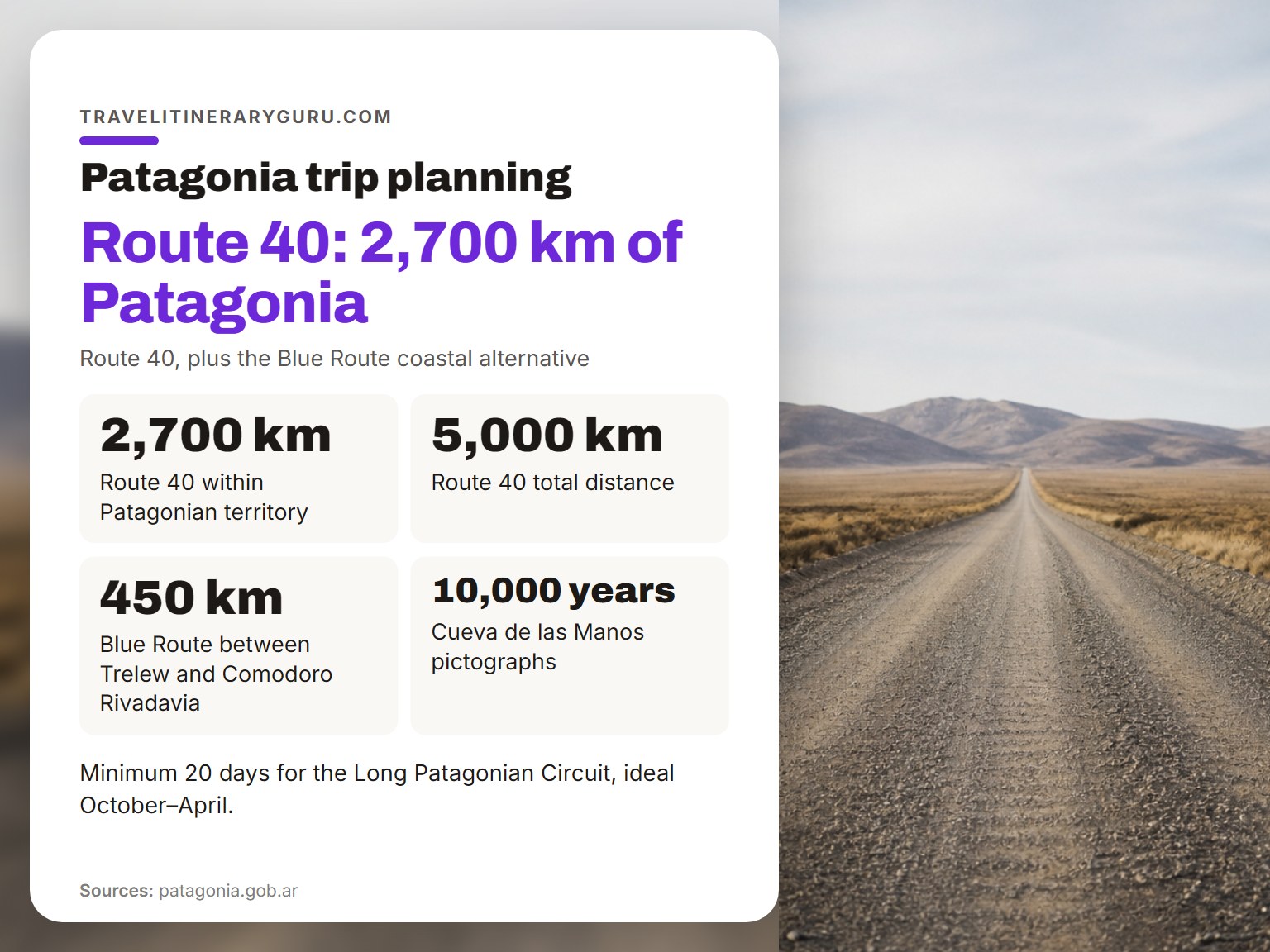
If you have the 20 days, this is the route that rewards you. Route 40 runs 2,700 km of Patagonian territory and extends to 5,000 km total. It is Argentina’s longest highway, and it starts at Cape Virgenes in Santa Cruz.
The named stops, per patagonia.gob.ar: Tres Lagos, Gobernador Gregores, Perito Moreno, Los Antiguos, and Cueva de las Manos. That last one is a World Heritage Site on the Pinturas River with pictographs dating back more than 10,000 years.
North of there, the route passes through Esquel and Trevelin, where you can board the La Trochita train (the Old Patagonian Express). Los Alerces National Park is another World Heritage Site in the area. Then Cholila, Epuyén, El Hoyo, El Maitén, and Lake Puelo, where the wineries and rural estancias start.
The climb to El Bolsón is approximately 120 km. From there, San Carlos de Bariloche sits on Lake Nahuel Huapi and bills itself as the National Capital of Adventure Tourism.
The coastal alternative is the Blue Route, which stretches 450 km between Trelew and Comodoro Rivadavia. It passes through Patagonia Azul Provincial Park and the Cabo Dos Bahías and Rocas Coloradas protected areas. If marine fauna is your thing, this is the more interesting road.
If you are doing the southern half on foot rather than in a vehicle, the logistics change completely. The national park tour approach works well for Torres del Paine, where the park rules and ranger instructions are strict and worth reading before you arrive.
The Antarctica Extension
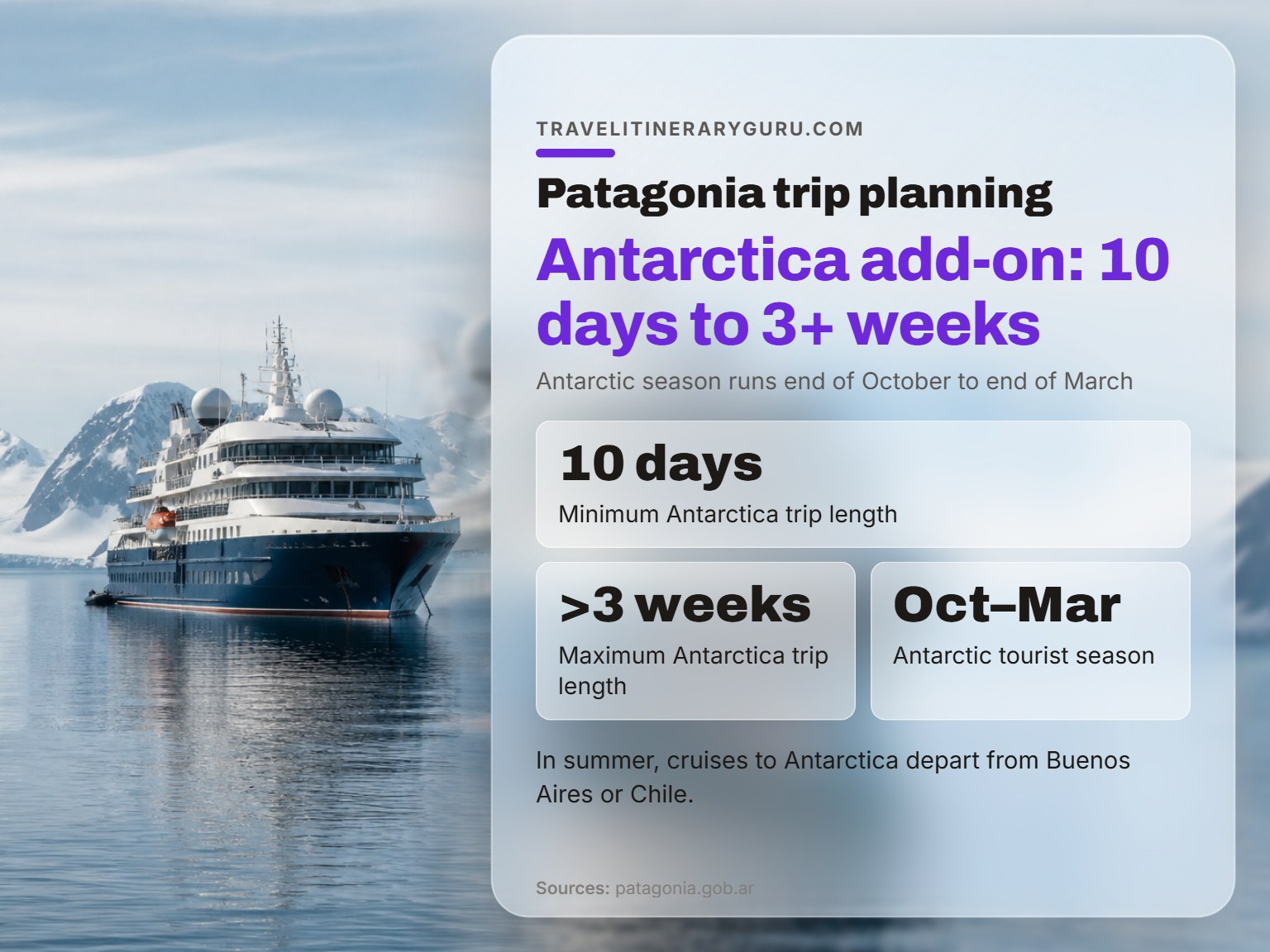
Here is the part that surprises people: in summer, it is possible to reach Antarctica by cruise from Buenos Aires or Chile. The Antarctic tourist season begins at the end of October and ends at the end of March.
Trip lengths vary widely, from a minimum of 10 days to more than three weeks. That is a serious add-on, not a side trip. If you are already committing three weeks to Patagonia, tacking on Antarctica means committing five or six.
For most first trips, I would skip it. Get Patagonia right first.
Frequently Asked Questions
How far in advance should I book a Patagonia trip?
Book Torres del Paine accommodation, refugios, campsites, and tickets before you book flights. Those have hard seasonal caps and the park rules change. Flights are more flexible, especially if you route through Punta Arenas (PUQ) rather than Puerto Natales (PNT), which only has seasonal service.
Is winter a bad time to visit Patagonia?
It depends which circuit you are running. Patagonia.gob.ar’s Long Patagonian Circuit page says October-April is ideal and warns that roads are likely to be difficult outside that window. The Southern Patagonia circuit page says “all year long” but notes certain excursions may not run in winter for safety reasons. Chile.travel does not restrict season at all and advises checking weather day by day.
Do I need a 4×4 to drive in Patagonia?
CIEP strongly suggests a 4×4 vehicle equipped with chains. Patagonia.gob.ar describes arriving in your own vehicle via RN3 or RN40 without specifying drivetrain. Follow CIEP if you are driving gravel sections or traveling outside October-April.
How long does the O’Higgins Glacier cruise take?
It is a full-day excursion, 10 hours round trip from Bahía Bahamondes dock, covering 91 km. If you board at Candelario Mansilla, it is 8 hours. The cruise runs November-March and strong winds or storms mandate cancellations, so CIEP recommends a two-day grace period in your itinerary.
Can I combine Patagonia with Antarctica?
Yes, in summer. Cruises depart from Buenos Aires or Chile, and the Antarctic tourist season runs from the end of October to the end of March. Trip lengths range from a minimum of 10 days to more than three weeks. Budget it as a full separate trip, not an extension.
What is the most common Patagonia planning mistake?
Trying to see all of Patagonia in one rushed trip. Pick one clear route, not a list of every place you have heard of. If you have less than a week, choose one base and do not try to cross the whole region.
The Bottom Line
The single rule that will save your trip: if your itinerary has more than three major activities per day, cut it. Patagonia’s distances are real, the gravel slows you down, and the weather does not care about your schedule.
One specific threshold worth committing to memory. If your trip is 10 days and you want Torres del Paine and Perito Moreno, do not add the Carretera Austral. Save it for another year. The Carretera Austral is a trip, not a stop.
And here is the concession most guides skip: all of this advice assumes you are comfortable with some self-sufficiency. If you are not, that is fine. Book a small-group specialty tour, pre-book your ferries and park passes, and let someone else handle the logistics. The trip is still worth taking. It just looks different.
For a first Patagonia trip, the honest recommendation is the Southern Patagonia circuit over 10 to 14 days, with a two-day weather buffer built in and one full day with nothing scheduled. If you can only manage a week, pick one base. El Chaltén is the easiest to build around because many routes start from town.
Start with the route. Then book the constrained pieces. Then leave the rest loose.
