
How to Plan a Colombia Itinerary: 10 Days or 3 Weeks?
This post contains affiliate links. As an Amazon Associate, we earn from qualifying purchases.
To plan a Colombia itinerary, pick the region first and match your month to that region’s rain window, then allow 3 to 4 days each in Bogota and Cartagena, 4 to 5 in Medellin, and 4 to 5 minimum in the Coffee Region. Ten days covers the highlights. Three weeks is what the Amazon or the Pacific coast adds.
That rain window matters to how to plan a Colombia itinerary because the sources disagree on whether Colombia runs a single wet season. ProColombia says Bogota and Medellin get two wet periods a year, while the Caribbean coast and the Llanos get one long sunny stretch and one wet one; Rough Guides says Colombia has two rainy seasons countrywide, April to May and October to November. Plan around a national dry season and at least one leg of your trip sits in a downpour.
What follows is the region-by-region rain map, the day counts that hold up, the booking order with real lead times, and the places where ProColombia and Rough Guides flatly disagree.
Key Takeaways
- Pick the region before the month. Colombia runs at least four different rain patterns, so a national dry-season plan breaks the moment you cross between regions.
- Allow 3-4 days in Bogota and Cartagena, 4-5 in Medellin and the Coffee Region. Tayrona takes 2-3 days and the Amazon takes 4 minimum.
- Start planning 4-6 months out, and 6+ months if you’re traveling December to February. Admin lands at the 2-3 month mark; activities at 1-2 months.
- Book the Amazon and Tayrona first. Amazon lodges need 3-4 months for December to February or July to August, and Tayrona sometimes closes for indigenous ceremonies.
- Pack for three climates in one bag. Bogota holds 10-17 C while the Caribbean coast runs 28-32 C, and high mountain areas drop below 5 C.
How to Plan a Colombia Itinerary Around Four Rain Patterns
Colombia’s rainfall splits by region, and that split decides which month you fly. ProColombia’s own Colombia weather pages put Bogota and Medellin on a bimodal pattern, which means two wet periods a year rather than one.
Colombia’s rainfall follows two distinct patterns. Bogota and Medellin receive two wet periods per year, while the Caribbean coast and the Llanos receive one prolonged sunny period and one wet period. The Amazon-Orinoco region runs a rainy season from March to July, and the Pacific coast sees rain in practically every month.
The Caribbean and the Llanos work on the opposite logic. Each gets one long sunny stretch and one wet stretch, so a single dry-season assumption breaks when you cross regions.
Rough Guides takes a different line: two rainy seasons countrywide, April to May and October to November, with showers landing in the afternoon.
| Question | ProColombia (colombia.travel) | Rough Guides |
|---|---|---|
| Does Colombia have two rainy seasons? | Only Bogota and Medellin. Caribbean and Llanos run one wet period. | Yes, countrywide: April-May and October-November |
| When is the rainy season? | April-May and October-November, plus March-July in Amazon-Orinoco | April-May and October-November |
| What counts as high season? | Dry season: December-March and July-August | December-February only |
| Best time for most travelers? | Depends on the region | July-September shoulder season |
Both sources are answering real questions. ProColombia describes regional climate, with Bogota and Medellin on a bimodal pattern and the Caribbean and Llanos unimodal. Rough Guides describes two rainy seasons countrywide, April to May and October to November, and the two don’t have to match.
I’ve come around on treating Colombia as four weather systems rather than one country. It changes the order you visit things in, and it saves you from a wet week on a beach.
Where this goes sideways: Applying Bogota’s two-rainy-season pattern to the Caribbean coast. Rough Guides puts Cartagena’s dry window at December to April, while ProColombia describes the Caribbean as one long sunny stretch and one wet one, so a July beach week built on the Bogota model lands in the wet stretch.
Pick the region first. The month follows.
Bogota Runs 10-17 C While the Coast Runs 28-32 C
Bogota holds between 10 and 17 C all year, while Cartagena, Santa Marta, Barranquilla, and San Andres sit at 28 to 32 C. Pack for one and you’re miserable in the other.
Altitude does the work here. Colombia sits close to the equator, so temperature tracks elevation rather than season, and a single day can span a cool mountain city and a hot coastal one.
- Bogota: 10-17 C, cool and damp all year
- Caribbean coast: 28-32 C, with coastal zones cited near 30 C
- High mountain areas such as the Sierra Nevada de Santa Marta and PNN Los Nevados: below 5 C at the top
- El Cocuy National Park: peaks above 5,300 m, best in the December-March dry season
The cold in Bogota is a damp cold. Step out of the El Dorado terminal after dark and it’s through a light jacket within a minute, which a beach-heavy packing list never accounts for.
Six items cover three climates:
- A lightweight rain jacket, because afternoon showers are common in the mountains
- Two or three layers you can shed, since one day can start cool and finish hot
- Comfortable shoes for cobblestones and hiking trails
- Sun protection, which matters more at altitude
- Bug spray for the tropical legs
- Modest clothing for churches and rural areas
I pack for the coldest stop on the route and layer up from there. That’s the whole method.
How Many Days Does Each Place Actually Need?
Ever wonder why 10 days in Colombia feels rushed while 10 days in one city feels generous? Distance is the answer, and Colombia’s mountain roads are the reason.
Rough Guides’ Colombia planning guide puts hard numbers on each stop, and they hold up better than most itinerary advice.
| Destination | Days to allow | Why |
|---|---|---|
| Bogota | 3-4 | Museums, La Candelaria, the food scene |
| Cartagena | 3-4 | Walled city, Getsemani, Rosario Islands day trip |
| Medellin | 4-5 | Includes a day trip to Guatape or Santa Fe |
| Coffee Region | 4-5 minimum | Farms, Cocora Valley, small towns |
| Tayrona | 2-3 | Beach hiking inside the park |
| Amazon (Leticia) | 4 minimum | Travel time plus excursions |
Three days is the floor in Cartagena and five is the ceiling. Past five, you’re sitting in a beautiful city waiting for your flight.
The 10-Day Version
Ten days covers the best-known stops, and Rough Guides treats it as the practical minimum. Fly into Bogota, work through the Coffee Region, and finish on the Caribbean.
The Two-Week Version
Two weeks buys a slower pace and one more region. Budget your time in Cartagena carefully at this length, because three days is the floor and I’ve watched five-day bookings run out of steam by day three.
The Three-Week Version
Three weeks is the number Rough Guides gives for adding the Amazon or the Pacific coast. Coffee lovers should add 4-5 extra days in the Coffee Region on top of whatever base route they’ve picked.
If pace matters more to you than the count, a slow travel itinerary built around fewer stops usually beats a longer list of cities.
The Booking Order, With the Lead Times That Matter
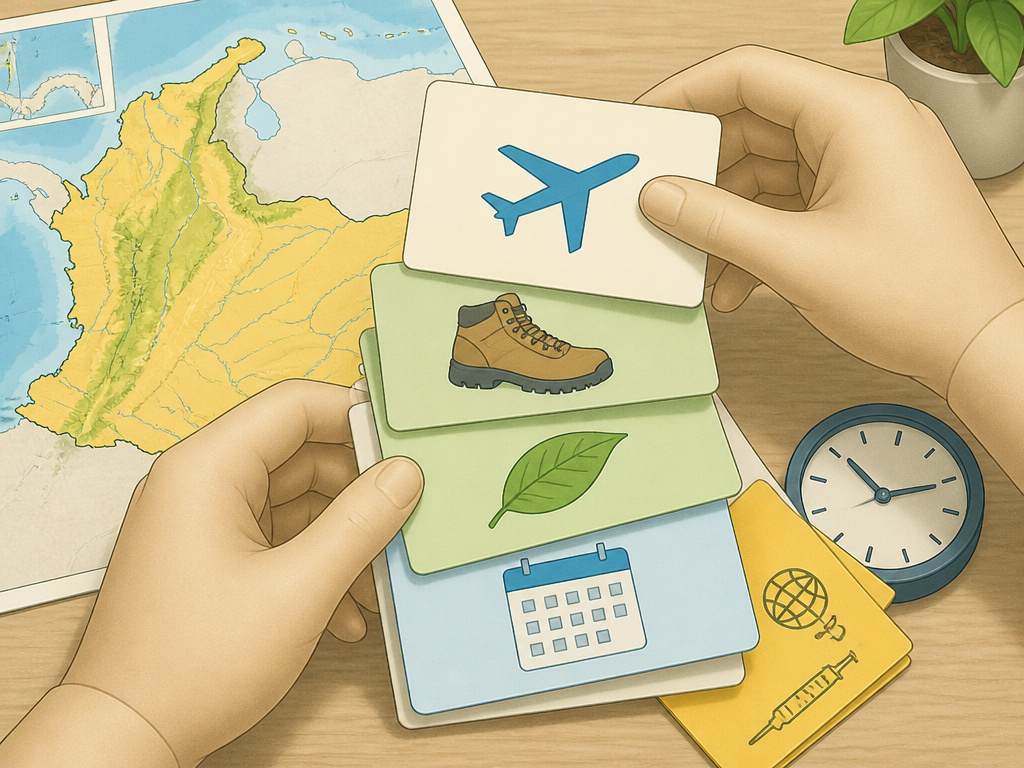
Four bookings decide whether this trip works: international flights, Amazon lodges or Tayrona permits, the Lost City trek, and the internal hops between cities.
Before you start: Three things on this route carry real risk. Amazonia routes require a yellow fever certificate before boarding, so the shot has to happen at least 10 days out. El Cocuy sits above 5,300 m, and Rough Guides advises allowing time to acclimatize rather than pushing straight up. Rainy-season road conditions in the Andes call for an alternate route, not a tighter schedule.
- 4-6 months out: set the parameters. Decide the month, the length, and the rough route. Rough Guides starts here, and pushes it to 6+ months for December to February or Carnaval.
- 4-6 months out: build the wish list before narrowing it. Skipping this is how you end up with a route that misses the one thing you actually came for.
- 2-3 months out: handle admin. Visa checks, vaccinations, insurance. Leaving this to the final week is what costs people the Amazon leg.
- 2-3 months out: lock the big bookings. International flights and accommodation. For December to February, Rough Guides moves this to 4+ months.
- 1-2 months out: book activities. Lost City trek in high season needs 2-3 months; Cocora Valley guided tours need 1-2 weeks in peak season.
- 2-4 weeks out: last details. Insurance, connectivity, and packing.
Domestic hops run on Avianca, LATAM Airlines, and SATENA, with El Dorado in Bogota as the country’s busiest hub. Rough Guides puts Miami to Cartagena at about 3 hours and New York to Bogota at about 6 hours, with American Airlines, Avianca, and JetBlue flying from Miami, New York, and Fort Lauderdale.
One place the sources split: ProColombia says to book domestic fares one to two months ahead, while Rough Guides says to book flights at least two to three months ahead for better deals in high season. Booking at the earlier end costs you nothing but a calendar reminder.
If you want the underlying structure rather than the Colombia version, the same sequence is how you build a travel itinerary for anywhere.
I once built a 14-page planning doc for a self-guided city tour and left it in the hotel room on day two. The trip improved immediately. Now I research hard for three weeks and write down five anchor points.
Five anchors. Everything else is negotiable.
Do You Need a Visa or a Yellow Fever Certificate?
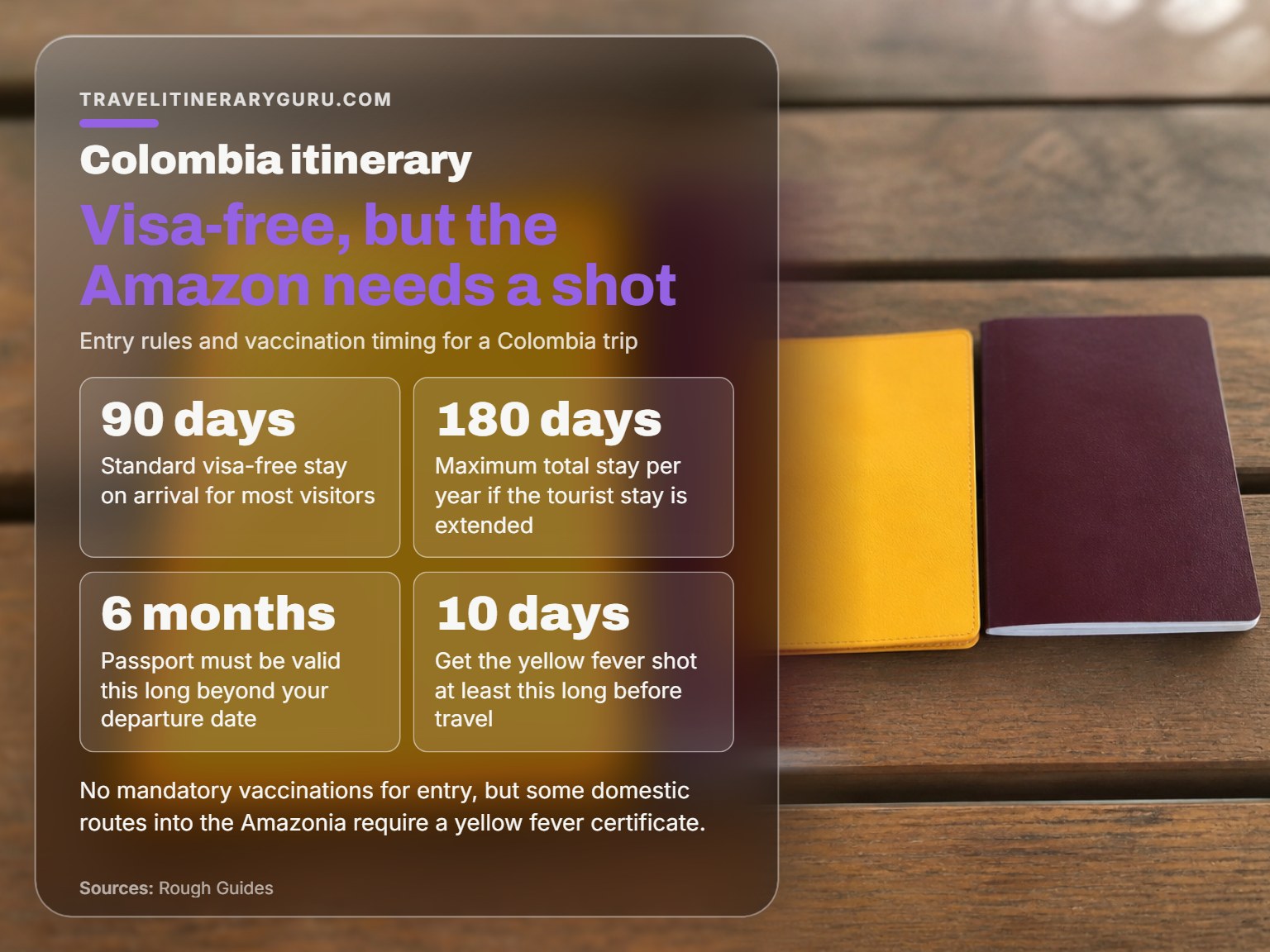
ProColombia states that most countries in the world don’t require a visa for Colombia, and Rough Guides adds that most visitors get a 90-day stay on arrival, but the Amazon leg is a separate conversation.
ProColombia states that most countries in the world don’t require a visa for Colombia. Rough Guides adds the detail that the standard stay is 90 days, extendable to 180 days total per year, and that your passport should be valid for at least six months beyond your planned departure date.
There’s a regional wrinkle. ProColombia notes that citizens of some countries in the region can enter on an identity document, with no passport required.
Vaccinations work the same way, with one hard gate. ProColombia says there are no mandatory vaccinations for entry, but recommends yellow fever for certain areas, and its transport and mobility guidance adds that some domestic routes require vaccination certificates, such as yellow fever for the Amazonia. Rough Guides puts the timing at least 10 days before travel, and recommends hepatitis A for everyone.
Easy to miss: The certificate requirement sits at the route level, not the country level. ProColombia lists yellow fever certificates as a condition on some domestic routes into the Amazonia, and Rough Guides advises getting the shot at least 10 days before travel, so it has to be done before you fly, not after you land.
Sort the admin at the 2-3 month mark. It’s the least enjoyable part of planning and the only part that can cancel a leg outright.
The Regions Where the Standard Advice Fails
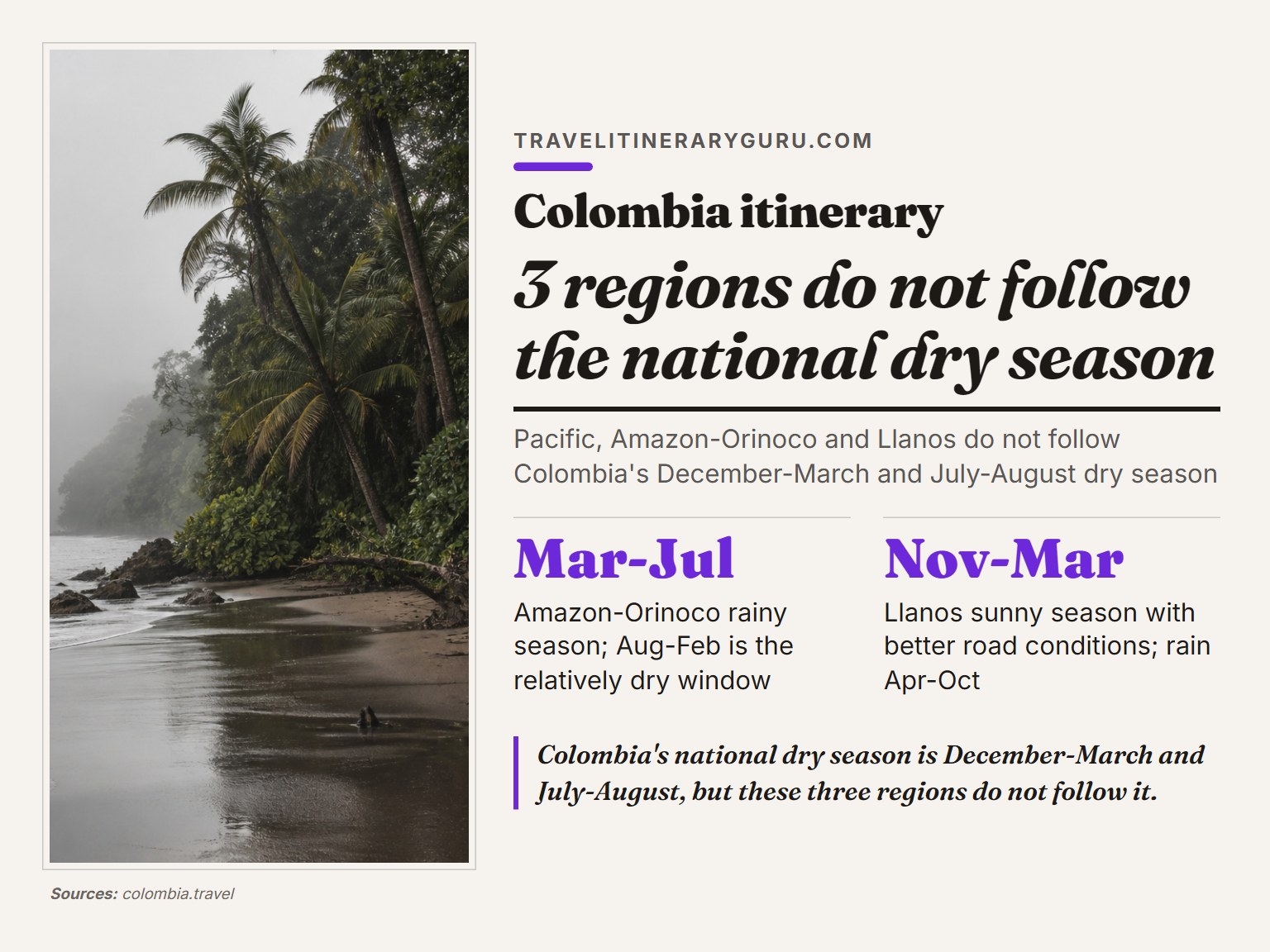
Three regions ignore the national dry season entirely.
The Pacific coast is the clearest case. ProColombia describes Nuqui, Bahia Solano, and Buenaventura as sitting in one of the wettest areas in the world, with rain in practically every month and December to March only relatively drier.
- Pacific coast: rain in practically every month; December-March is only relatively drier
- Amazon-Orinoco: rainy March-July; August-February is the relatively dry window
- Llanos: sunny November-March with better road conditions; rain April-October
Cano Cristales is its own case. Rough Guides says the river’s color displays between June and November, and access requires a guided tour, so it doesn’t slot into a dry-season route at all.
Cocora Valley runs on a daily clock rather than a seasonal one. The wax palms reach up to 60 meters, and views are clearest before 9 AM, which means the 2 days Rough Guides allocates there start early.
Rough Guides puts Los Nevados at its best from June to August. El Cocuy is best in the December to March dry season, and its peaks reach over 5,300 meters.
Don’t put the Pacific coast on a December-to-March route and expect a beach week. ProColombia says the rain is present in practically every month there, and December to March is only relatively drier, so a fixed seven-day beach plan is a coin flip.
I’d leave the Pacific coast off a first trip. It rewards a flexible schedule, and a first trip rarely has one.
One Country, Two Anchors, and a Blank Afternoon

The itinerary that survives contact with reality has two fixed points a day and a lot of empty space between them.
I tried to do Peru, Bolivia, and Chile in three weeks once. I spent roughly 40 hours on buses and planes and saw three places properly. Now I plan one country per trip.
Distances in South America are deceptive on a map. Lima to Cusco is a short flight, but Cusco to La Paz overland is a full day, and Patagonia’s internal distances get measured in days of driving.
Why One Country Beats Three
For a first South America trip, I recommend Colombia over Peru about half the time. Cartagena’s old town is walkable, the coffee region around Salento is gorgeous, and the internal flights are cheap. If you’re weighing alternatives, the Peru itinerary from Lima to Machu Picchu is the other route worth mapping before you commit, and choosing Peru or Bolivia is a different calculation again.
The Two-Anchor Day
Two anchor activities per day, and unstructured space around them. Anchors give the day a spine. The blank space is where the trip actually happens.
I won’t book a walking tour for a city you can cover on foot in a day. You end up being herded past the things you came to see.
Build the Blank Afternoon In
If your itinerary doesn’t include one full day with nothing scheduled, you built it wrong. That’s also why a multi-city route with four stops beats one with seven.
I once built an itinerary around a single restaurant recommendation with no backup. The place was closed for a private event and we scrambled for hours. Now every anchor has a second option attached to it.
Two anchors. One blank day. That’s the shape.
Frequently Asked Questions
How many days do you need in Colombia?
10-day trip covers the best-known stops, and Rough Guides treats two weeks as the more relaxed version. If you’re adding the Amazon or the Pacific coast, three weeks is the number that source gives. Coffee lovers should add 4-5 days in the Coffee Region on top of the base route.
What is the best time of year to visit Colombia?
The two main sources split on this. ProColombia lists the dry season as December to March and July to August. Rough Guides names December to February as high season and calls July to September the better shoulder for most travelers, because the weather holds and the crowds thin out.
Which cities should a first-timer include?
Bogota, Cartagena, and Medellin form the spine, with the Coffee Region as the fourth. Rough Guides allocates 3-4 days to Bogota and Cartagena, 4-5 to Medellin including day trips, and 4-5 minimum to the Coffee Region.
Do you need vaccinations for Colombia?
ProColombia states there are no mandatory vaccinations for entry. Yellow fever is recommended for certain areas, and Rough Guides advises getting that shot at least 10 days before travel if the Amazon is on your route. Hepatitis A is recommended for everyone.
How far in advance should you book flights?
ProColombia says to book domestic fares one to two months out. Rough Guides puts flight booking at two to three months ahead for better deals, and earlier still for December to February. Flying mid-week is often cheaper, and an open-jaw route into Bogota and out of Cartagena avoids a backtrack.
Should you visit the Amazon or the Pacific coast?
Both push the trip to three weeks, the figure Rough Guides gives. The Amazon runs 4 days minimum out of Leticia, and ProColombia puts its wet season at March to July. ProColombia describes the Pacific coast as one of the wettest regions in the world, with rain in practically every month, so it suits a flexible schedule rather than a fixed one.
The Bottom Line
How to plan a Colombia itinerary is really a question about which month you can travel, not which cities you want to see. Get that order right and every other decision gets easier.
If your trip is 10 days or fewer, pick two regions and stop. Adding a third is what turns a vacation into a forced march through bus terminals.
This week, do one thing: name your month, then check that month against the region you want. If they don’t match, change the region.
Fair warning. The advice above skews mid-range and budget, because that’s where I plan trips. For a high-end Colombia trip, the lead times move earlier rather than later, and my experience there is thin.
One last thing. I’d rather see you book three days in Cartagena with the fourth left empty than seven days with something booked every morning. The blank day is the part you’ll remember.
