
How to Plan a Slow Travel Itinerary: Nights Per Base
This post contains affiliate links. As an Amazon Associate, we earn from qualifying purchases.
To plan a slow travel itinerary, choose fewer overnight bases and give each one more nights. Destination Canada’s published ratios imply about three to five nights per base; Vagabond Tourist sets a floor of five or more. Vagabond also budgets a full day for every move between bases.
Those two numbers disagree, and the disagreement is the whole planning problem, which is why learning how to plan a slow travel itinerary matters. Pick the low end and you’ll book a trip that looks efficient on paper and feels rushed on the ground. Pick the high end and a two-week trip shrinks to two stops.
Neither number is wrong. The right one depends on how far apart your bases are and how you’re moving between them.
What follows: the base math, the real cost of a move, the buffer-day argument, and the numbers that actually apply once you’re behind a wheel or on a train.
Key Takeaways
- Pick fewer bases than feels comfortable. The most common beginner mistake is booking too many out of fear of missing something.
- Budget a full day per move, not the hours on the bus. Half a day of arrival friction applies even to a four-hour journey.
- Protect one unscheduled day per base. Sources disagree on the ratio. None of them say zero.
- Check tyres, fluids and lights before a long drive. Queensland’s transport department publishes the full list.
- Slow travel isn’t automatically cheaper. Fewer moves cut costs at most line items. The pace itself doesn’t set the price.
How Many Nights Per Base? Two Credible Answers
Destination Canada publishes the only concrete nights-per-base ratios in this space, and they’re tied to Canadian geography rather than to slow travel as a philosophy.
Destination Canada’s published ratios imply roughly three to five nights per base: seven to fourteen days is a useful starting point for one region, a seven-day trip takes one or two bases, and ten to fourteen days takes two to four places. Vagabond Tourist sets a higher floor, treating five or more nights as the minimum for a base.
Both sets of numbers come from people who plan trips for a living. They just answer different questions.
| Source | Published Rule | What It Implies |
|---|---|---|
| Destination Canada | 7 days = 1-2 bases; 10-14 days = 2-4 places | About 3-5 nights per base |
| Vagabond Tourist | 5+ nights per base, minimum | Anything shorter is a connector stop |
| The Roam Well | Fewer bases, more time in each | No number published |
Destination Canada’s own worked example is the tell. A 10-day trip connecting Quebec City, Montreal and Ottawa by rail should leave two or three full days in each city. That’s about three nights per city, which sits below the Vagabond floor.
So which number do you use? If your bases sit close together and frequent rail connects them, three nights holds up. If each base is a long haul from the next, five nights is the safer floor. A multi-city trip built on three-night stops only works when the stops are genuinely close.
What One Move Between Bases Actually Costs
A four-hour bus ride can eat an entire day.
Vagabond Tourist is blunt about the arithmetic: account for half a day of arrival friction between each stop regardless of how short the journey looks on paper, and budget one full day per move rather than the hours in transit.
Here’s what that day actually contains:
- The travel hours themselves
- Half a day of arrival friction: check-in, working out how the local transport runs, finding food
- The repack at both ends
- The evening you don’t do anything ambitious because you’re wrecked
Wandering A takes a different line. It puts no fixed time budget on a move at all, and instead says to map your travel days before you book lodging so the transfer time is visible. That’s a fair position, and it’s the one to take if you already know your own tolerance for moving.
Where this goes sideways: Booking a museum ticket for the afternoon you arrive. You’ll be at the station in the morning, in the room by early afternoon, and standing in front of the collection later with no attention left.
I built a Google Doc for a self-guided tour of Lisbon once. Left it in the hotel room on day two. The trip improved within an hour.
The lesson was about how to plan a slow travel itinerary format. Research and itinerary are two different documents, and I’d been carrying the wrong one. Now I research hard, then write down a few anchor points and forget the rest. The anchors give me confidence. The blank space gives me the trip.
The reason is simple. When you balance sightseeing and travel honestly, the transit hours turn out to be the half of the equation people leave off the page.
Buffer Days: One Per Base, One Per 7-10 Days, or None
One source quantifies the buffer day. Two don’t, and the difference matters more than it looks.
The Roam Well recommends at least one day with no fixed plans, ideally for every 7 to 10 days of travel. Wandering A says leave one half-day or full day without a fixed plan in every base. Destination Canada says leave some room in your itinerary, gives no ratio, and frames the whole thing as an attitude rather than a scheduled block.
Book the buffer day before you book anything optional. An open day absorbs a missed connection, a rainy day, or a cold that flattens you. A booked day absorbs nothing.
The three positions on how to plan a slow travel itinerary aren’t really in conflict. The Roam Well is handing you a maintenance ratio for a long trip. Wandering A is giving you a per-base rule. Destination Canada is describing a posture.
An open day works best with one low-stakes thing on it. A self-guided walking tour of the neighbourhood you’re staying in is the right size, because you can abandon it halfway with no loss.
I once spent an afternoon building a shareable itinerary for a group trip. Nobody opened it. The group chat used a screenshot of a handwritten list instead.
Now I share a simple document with times and addresses only. People actually read it.
Which Comes First, the Meeting or the Open Afternoon?

Trade.gov plans backwards from every leisure source here.
The Trade.gov itinerary planning guide is written for business travel, and its density limit reflects that: two or three definite appointments per day, confirmed well in advance and spaced comfortably, beats a crowded agenda. It also asks you to plan an extra day to rest and deal with jet lag before your scheduled appointments start.
The Roam Well and Wandering A sequence the opposite way. They treat open hours as the thing that must be booked and fixed commitments as the thing that fills in around them.
Does the appointment ceiling transfer to a leisure trip? No source bridges the two, and I’m not going to invent the bridge. What I will say is that the jet lag day transfers, and most leisure itineraries skip it.
One trade.gov detail does transfer cleanly: lunchtimes lasting two to four hours are customary in many countries. A slow itinerary that books a museum slot after a long lunch is a plan that fails quietly.
I plan fixed commitments first and then defend the gaps around them. That’s the business-travel order, not the leisure-blog order, and it survives a delayed train. What I won’t do is book a second thing on the same day as a move.
If you’re building days around meals rather than around sights, a self-guided food tour is the honest structure. The food is the sight, and nothing gets squeezed.
I underweight food and nightlife in my own itineraries, so take that one from someone who learned it late.
Driving Caps, Rail Schedules, and Numbers With Expiry Dates
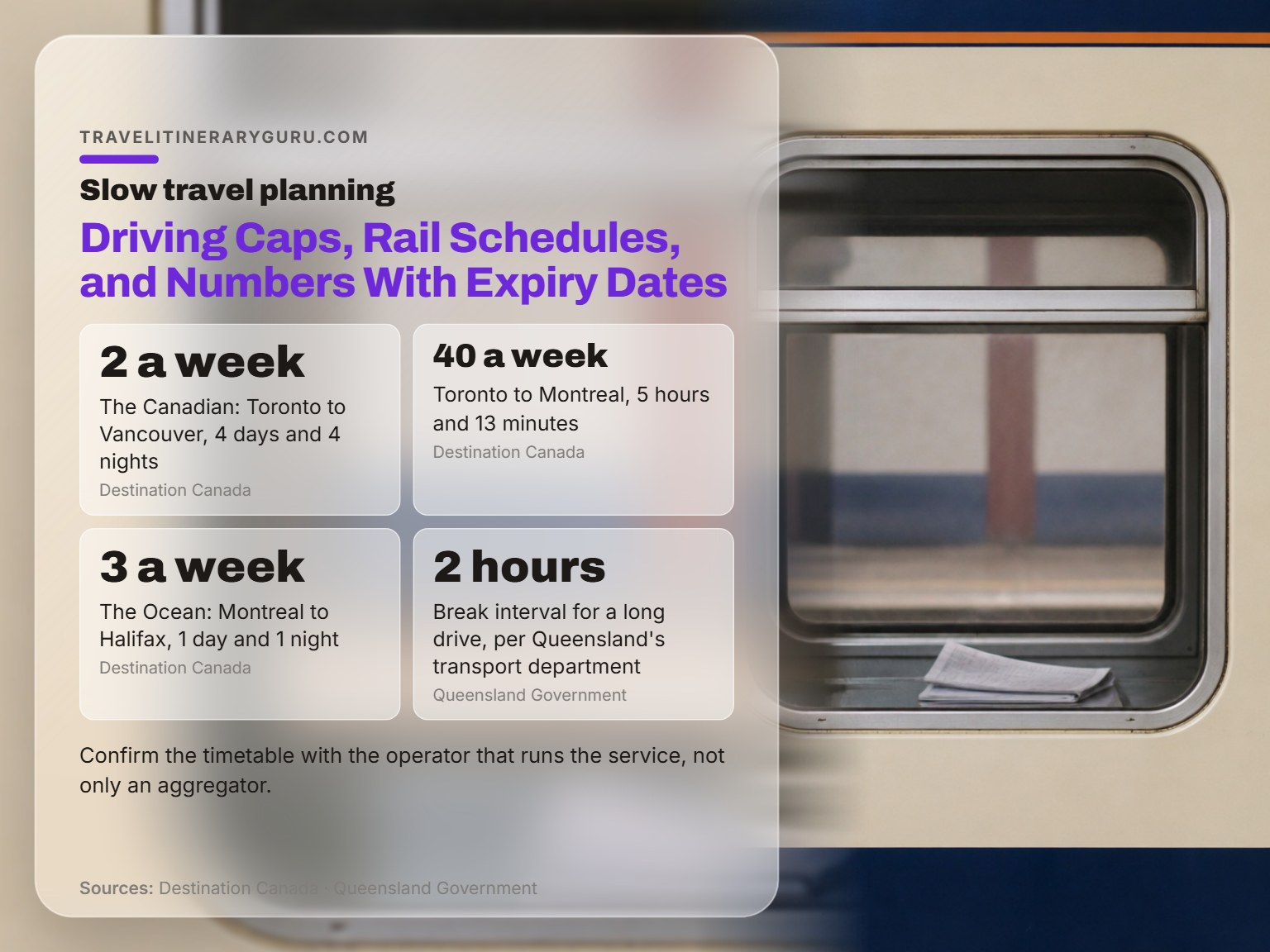
Two hours is the break interval Queensland’s transport department publishes for a long drive, and the same page caps the day at 8 to 10 hours behind the wheel.
Before you start: Driver fatigue is the main hazard on a long day. Take a break every 2 hours and keep the day under 8-10 hours of driving. Check tyres including the spare, because one that looks fine in the driveway can fail at highway speed two hours in. Check brake, coolant, oil, clutch, transmission, power-steering and water fluids before you leave, plus lights, wipers, battery, fan belt tension, coolant hoses, tow bar and fuel.
One thing to know about that page: it predates a decade of fatigue research. The 8-10 hour cap is the only daily driving cap in this source set. Treat it as a floor for caution rather than a target.
Wandering A gives no daily driving cap at all. Its advice is to keep the route flexible until you know which stops are worth the extra miles. That’s a fair position for a short trip and a risky one for a long one.
The pre-departure checklist is worth running even if you’re only driving between two bases:
- Tyres, including the spare
- Brake, coolant, oil, clutch, transmission, power-steering and water fluids
- Lights, wipers and battery
- Fan belt tension and coolant hoses
- Tow bar and fuel
Rail gives you harder numbers, because a train either runs or it doesn’t.
The Canadian: 4 Days, 4 Nights, 2 Departures a Week
The Canadian runs Toronto to Vancouver in 4 days and 4 nights, with key stops at Jasper, Edmonton and Winnipeg, and 2 departures a week. Destination Canada recommends 10 to 14 days for that route with stopovers.
Four nights is the number that matters. A 4-day crossing means 4 nights of sleeping in a moving room, and no amount of scenery changes that arithmetic.
Toronto to Montreal: 5 Hours 13 Minutes, 40 Departures a Week
Toronto to Montreal takes 5 hours and 13 minutes, with stops at Cobourg, Belleville, Kingston, Brockville and Cornwall. It runs 40 times a week, and Destination Canada recommends 4 to 7 days with stopovers.
The Ocean: 1 Day, 1 Night, 3 Departures a Week
Montreal to Halifax runs 1 day and 1 night, stopping at Sainte-Foy, Campbellton, Miramichi, Moncton and Truro, 3 times a week. Recommended trip length: 7 to 10 days with stopovers.
Departure counts matter more than durations. A train that runs 2 times a week is a fixed constraint on your route. A train that runs 40 weekly departures is not.
Confirm the timetable with the operator that runs the service rather than with an aggregator. An aggregator is faster for rough door-to-door times, but it won’t tell you that a Wednesday service doesn’t exist in February.
If your route crosses continents rather than provinces, the same logic scales up. A round the world route lives or dies on how many times you move.
The Zigzag Test That Catches a Bad Route Before You Book

Wandering A’s pre-booking test is a single map with three layers on it.
Put your bases, your likely travel days, and a few optional ideas on one map. Then look for two warning signs.
Warning Sign One: The Zigzag
A route that doubles back over ground you already covered. It usually means you picked bases by reputation rather than by geography.
Warning Sign Two: A String of One-Night Stays
One-night stays aren’t automatically a mistake. Wandering A’s own framing is that neither warning sign is always wrong, and both deserve a reason. If you can’t write the reason down, the stop is filler.
The order that works:
- Write down each base and one sentence on why it exists. Skip this and the weakest base survives on momentum.
- Fill each base with a rough day-by-day before you add another stop. If you can’t fill 5 days, it’s a connector stop wearing a base’s clothes.
- Map the travel days before you book lodging, so a route that looks compact doesn’t quietly eat half the trip.
- Protect one unscheduled day per base. Without it, the first delayed train wrecks the rest of the week.
- Book, then re-check as departure gets close.
That last step has five parts, and none of them are optional:
- Entry conditions for your passport and route
- Travel advice for the region
- Transport operations, confirmed with the operator
- Cancellation terms on your bookings
- Seasonal closures
For international travel, use a current official source for entry requirements. Use a current official source for entry requirements, and check close to departure rather than at booking time.
| What It Looks Like | What Caused It | The Fix |
|---|---|---|
| Exhausted by day four | Transit day and sightseeing day stacked | Split them; budget a full day per move |
| Every city blurs together | Too many bases, none filled five days | Cut the weakest base |
| The trip happened in stations | Zigzag route returning over old ground | Map bases before booking |
| The plan collapsed on day two | No unscheduled time | Protect one day per base |
| You missed the one thing you wanted | Arrival day overbooked | Plan one reliable thing |
If you want the full sequence from scratch, this is the same order I use to build a travel itinerary for any trip length.
Does Slow Travel Actually Save Money?

Fewer moves do cut costs. Whether that makes a slow trip cheap is a different question.
Vagabond Tourist’s position is that fewer moves means lower costs at almost every line item, and that on a tight monthly travel budget it’s the difference between a comfortable month and a stressed one.
The Roam Well’s position is that slow travel isn’t automatically cheaper. It competes with a faster itinerary rather than replacing it.
Both can be true at once.
Fewer check-ins and fewer transfers reduce spend on rooms and transport. But the pace doesn’t set the price of anything, and a slow week in an expensive city costs more than a fast week in a cheap one.
The same split shows up on sustainability. Destination Canada frames the journey itself as part of the experience. The Roam Well points out that a slow trip built on several short domestic flights between bases isn’t automatically more sustainable than a faster trip that takes one long-haul flight and then stays put.
My read: the savings are real, but they come from the structure rather than the philosophy. Fewer bases means fewer transit nights, fewer last-minute bookings, and fewer meals eaten wherever happens to be nearest the station.
Frequently Asked Questions
How many nights should I stay in each place?
Destination Canada’s ratios work out to roughly three to five nights per base. Vagabond Tourist sets a floor of five or more. If your bases sit close together and rail connects them well, three nights is workable. If each one is a long haul from the next, go higher.
Can a long weekend be slow travel?
Wandering A says yes, as long as you choose one base and resist filling every hour. Vagabond Tourist’s framework would call that too short, since it treats five nights as the minimum for a base. Both describe real trips. The difference is whether you’re measuring pace or measuring nights.
Do I need to book everything in advance?
No. Wandering A is explicit that you don’t need to book everything, and that unplanned time is the thing worth protecting. Trade.gov takes the opposite view for business travel, where appointments get confirmed well in advance. Match the approach to the trip you’re actually taking.
Is slow travel better for families?
The core principles apply either way. The Roam Well notes that family trips tend to need more buffer time than the same itinerary would for one adult, which mostly means building in more slack rather than cutting stops.
What’s the biggest mistake beginners make?
Picking too many bases out of fear of missing something. That recreates exactly the complexity slow travel is meant to remove, and it usually shows up as a trip spent in transit.
The Bottom Line
If your trip is under 7 days, book one base. Destination Canada’s own guidance says one or two bases is plenty for a 7-day trip, and Wandering A’s long-weekend answer lands in the same place.
That’s the whole rule.
Your first step this week: open Google Maps and drop a pin on every base you’re considering. If the line between them doubles back, cut one. Do it before you look at lodging, because once you’ve seen a nice apartment in the third city, the route stops being a question.
One concession worth making. If your real goal is maximum geographic coverage in limited time, slow travel is the wrong tool. Vagabond Tourist says to optimize for cheap overnight transport instead, and that’s honest advice for that specific goal. A long trip of it and you’ll remember the train stations better than the cities.
Fair warning, though: I’d rather see one city properly than several cities from a train window. The math of transit time against experience time doesn’t favor the packed itinerary.
