
How to Choose Between Spain and Portugal for a First Europe Trip
This post contains affiliate links. As an Amazon Associate, we earn from qualifying purchases.
You can learn how to choose between Spain and Portugal for a first Europe trip by picking one rail corridor and committing to it. Portugal is the smaller, milder, generally cheaper country, and you can see a lot of it in one week without rushing. Spain is bigger and needs more time, or a focus on one region such as Andalusia or Catalonia.
That’s the how to choose between Spain and Portugal for a first Europe trip, compressed. The rest of this article is the part that actually trips people up: the entry rules, the fire season, the rail gaps that no map shows, and the reason your “Spain and Portugal” trip quietly becomes a Spain trip with a Lisbon layover.
Portugal’s Atlantic coast runs milder than Spain’s interior. Summers come in warm rather than scorching, and winters are cool and fairly wet, especially in the north. Inland Spain swings harder. Madrid and Seville can be brutally hot in July and August, and Madrid turns genuinely cold in winter.
Spring and autumn are the best seasons for touring cities in both countries. That’s not a hedge. It’s the one how to choose between Spain and Portugal for a first Europe trip decision that changes the entire quality of the trip.
What follows: the entry mechanics, the rail corridors that actually work, the two safety realities that never make the comparison articles, and a straight answer on which country wins for the trip you’re actually planning.
Key Takeaways
- Pick one corridor, not one map. Lisbon to Porto is about 3 hours by train; Lisbon to the Algarve is about 3 hours too. Portugal’s compactness is the reason it works in a week.
- The 90/180 clock counts both countries as one. Portugal and Spain are both in the Schengen area, so there are normally no border checks between them and your time in each adds up together.
- Book the first morning as a soft landing. No non-refundable tour on arrival day. Jet lag plus a fixed start time is how people waste a paid ticket.
- Summer fire risk is real and coastal. High temperatures and bushfires regularly hit mainland Portugal in summer, including near coastal and tourist areas.
- Skip the cross-border car hire. Dropping a rental in a different country than you picked it up triggers a large one-way fee. Check before you book, or take the train.
What Are the Entry Rules for a First Europe Trip to Portugal or Spain?
Start with the clock, because it governs everything else. The Smartraveller Portugal travel advice is blunt about the mechanics: Portugal sits in the Schengen area, and a short stay is capped at 90 days or less within any 180-day window.
Schengen rules permit a visa-free stay of up to 90 days in any 180-day period across the whole Schengen area. Portugal and Spain are both member states, so days spent in each country count against the same single allowance. There are normally no border checks between the two.
That last sentence is the one that catches planners out. A week in Seville and a week in Lisbon are 14 days off the same 90-day budget, not 7 days off two separate ones.
If you’re travelling on an Australian passport, the EU’s Entry/Exit System now applies. You’ll register biometric details (fingerprints and a photo) on arrival for any short stay of 90 days or less. There’s no cost for EES registration and no action needed before you reach the border. Expect possible delays at border crossings while the system beds in.
The UK government’s Portugal entry requirements page adds the practical detail. On your first entry into a Schengen country you may be asked to register at a special booth before you reach the immigration desk. You may also need to give a fingerprint or photo when you leave. Children aged 11 or younger skip the fingerprint scan but can still be asked for a photo.
Easy to miss: Children aged 17 and under travelling to Portugal alone, or with an adult who isn’t their parent or legal guardian, must carry a letter of authorisation. It has to name the responsible adult in Portugal and their passport number. Arrive without it and entry will be delayed and may be refused.
There’s an optional shortcut worth knowing about. The EU’s “Travel to Europe” mobile app lets you complete an entry questionnaire before you fly. It’s optional, but it can save time at the desk.
| Traveller | EES requirement | What to prepare |
|---|---|---|
| Adult, short stay | Fingerprints and photo on arrival | Nothing before the border |
| Child 11 or younger | No fingerprint scan, photo may be taken | Nothing before the border |
| Child 17 or under, unaccompanied | Standard EES plus authorisation letter | Letter naming adult and passport number |
| Long-term Schengen resident | Exempt from EES in all Schengen countries | Proof of residence status |
The Rail Corridors That Actually Work (and the One That Doesn’t Exist)
I plan Europe around rail corridors, not maps. If a city isn’t on a direct train line, it usually isn’t worth the detour, and Iberia has one gap that breaks more itineraries than any other.
There is still no direct train between Lisbon and Madrid. Most people fly or take the bus. The flight runs about 1 hour 15 minutes. A high-speed line from Lisbon towards Madrid, via Évora, Elvas and Badajoz, is being built in stages, but direct trains aren’t expected until around 2030. The plan is roughly five hours by then, cut to about three hours once the full line finishes, targeted for 2034.
So the “two capitals by rail” idea that works everywhere else in Europe simply doesn’t work here yet. Build your route around that fact instead of discovering it three weeks out.
Inside Portugal, the network is genuinely useful. Trains link Lisbon, Porto and the Algarve in about 3 hours each. Drive the country north to south and you’re looking at roughly 6 hours total, which tells you how compact it is.
I once booked a tight connection, after years of doing this for a living. The first flight ran late, my client missed the second, and I now refuse to book tight connections. If you’re routing through a hub to reach Iberia, allow extra time between connections.
For the wider picture, the same logic applies to any multi-city Europe trip — the corridor decides the itinerary, not the wish list.
Where Portugal Fits in a Week
Portugal is the country you can actually finish. A 7-day Portugal itinerary built on the Lisbon to Porto spine gives you two real cities, a wine valley, and a coastline, with the travel days absorbed rather than subtracted.
That’s the structural advantage. You’re not choosing Portugal because it’s smaller. You’re choosing it because smaller means the trip has fewer transit hours in it.
Where Spain Earns Its Extra Time
Spain rewards a different approach: pick a region and go deep. A 10-day Spain itinerary works because it commits to a corridor instead of trying to sweep the country.
Spain’s famous sights often need tickets booked well ahead. Famous sites like the Alhambra in Granada and the Sagrada Família in Barcelona need tickets booked well ahead.
What most people get wrong: Treating travel days as free time. A train from Lisbon to Porto takes about 3 hours, plus time for the station, boarding and the walk to the hotel. Plan the arrival city accordingly, or you may arrive somewhere beautiful and spend it recovering.
Which Country Wins on Cost, and Where That Advice Breaks Down
Portugal is generally a little cheaper, especially for eating out and hotels, though Lisbon has become pricier. That’s the honest version, and it comes with a caveat the comparison articles skip.
Lonely Planet doesn’t make a cost claim at all in its own Spain versus Portugal piece. It positions Portugal on culture and Spain on scale. So if you’re building a decision purely on cost, you’re leaning on one source’s read, not a consensus. Treat it as a tiebreaker, not a thesis.
For the numbers behind that, the daily travel costs framework is worth running before you commit, because the cost gap between the two countries may be smaller once Lisbon enters the picture.
Here’s the piece I’d actually act on. Swapping Lisbon for Porto on a 7-day Portugal route cut my daily costs, and the food was better. Often fewer tour groups and better meals. The same pattern often holds with second cities over capitals.
The second city is often calmer, cheaper and less picked-over. You may lose the headline landmark but gain an actual neighbourhood to walk around in.
Skip this if: You’ve wanted to see a specific headline sight your whole life. Go see it. The second-city swap is a tool for people who don’t have one fixed must-do.
Driving, Tolls and the Cross-Border Trap
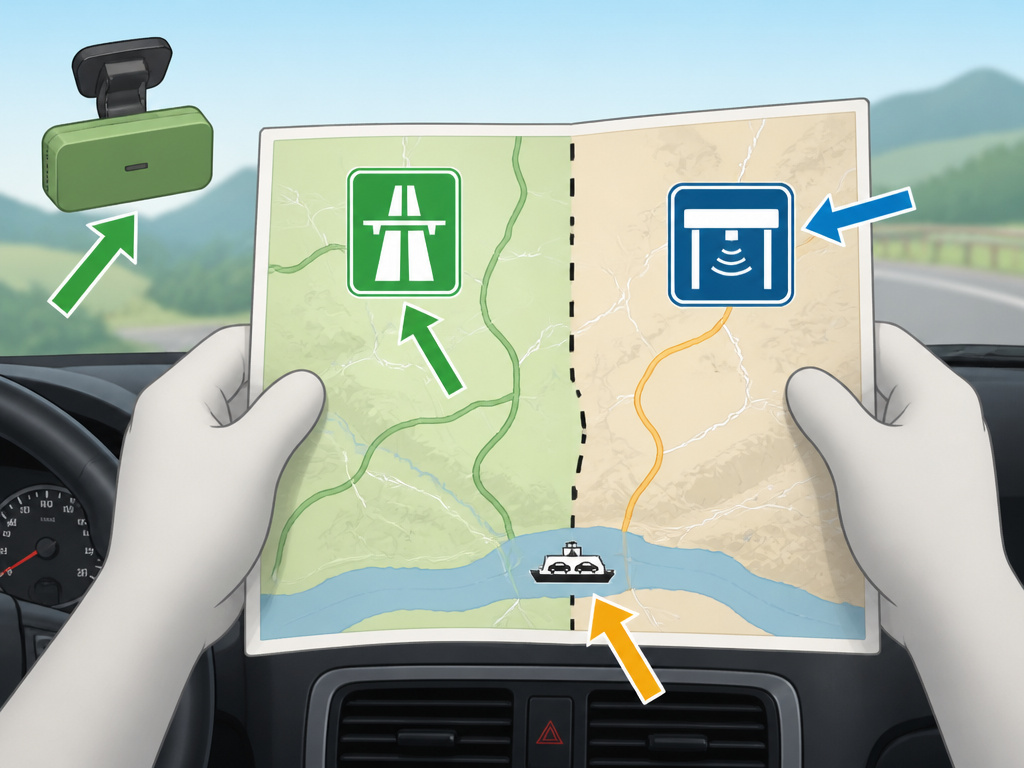
Most of Portugal’s motorways are tolled, some with booths and some with electronic tolls only. Many Spanish motorways are free. That asymmetry matters more than it sounds.
Several Portuguese motorways, including the A22 in the Algarve, have been toll-free since January 2025. That detail is worth checking against current information. Electronic-only stretches have no booth to pay at, so you need a transponder.
The bigger trap is cross-border hire. If you pick a car up in one country and drop it in the other, expect a large one-way fee. Check before you book. The Algarve to Seville run is about 2 hours on toll-free motorways, and FlixBus runs direct buses from Faro to Seville several times a day in about 2.5 hours. A little ferry crosses the Guadiana from Vila Real de Santo António to Ayamonte in about 15 minutes.
| Route | Best option | Time |
|---|---|---|
| Lisbon to Porto | Train | About 3 hours |
| Lisbon to Algarve | Train | About 3 hours |
| Lisbon to Madrid | Flight or bus | Flight about 1h15m |
| Faro to Seville | Bus or car | Bus about 2.5 hours |
| Vila Real de Santo António to Ayamonte | Ferry | About 15 minutes |
Summer Fires, Winter Floods and the Beach Rules Nobody Reads
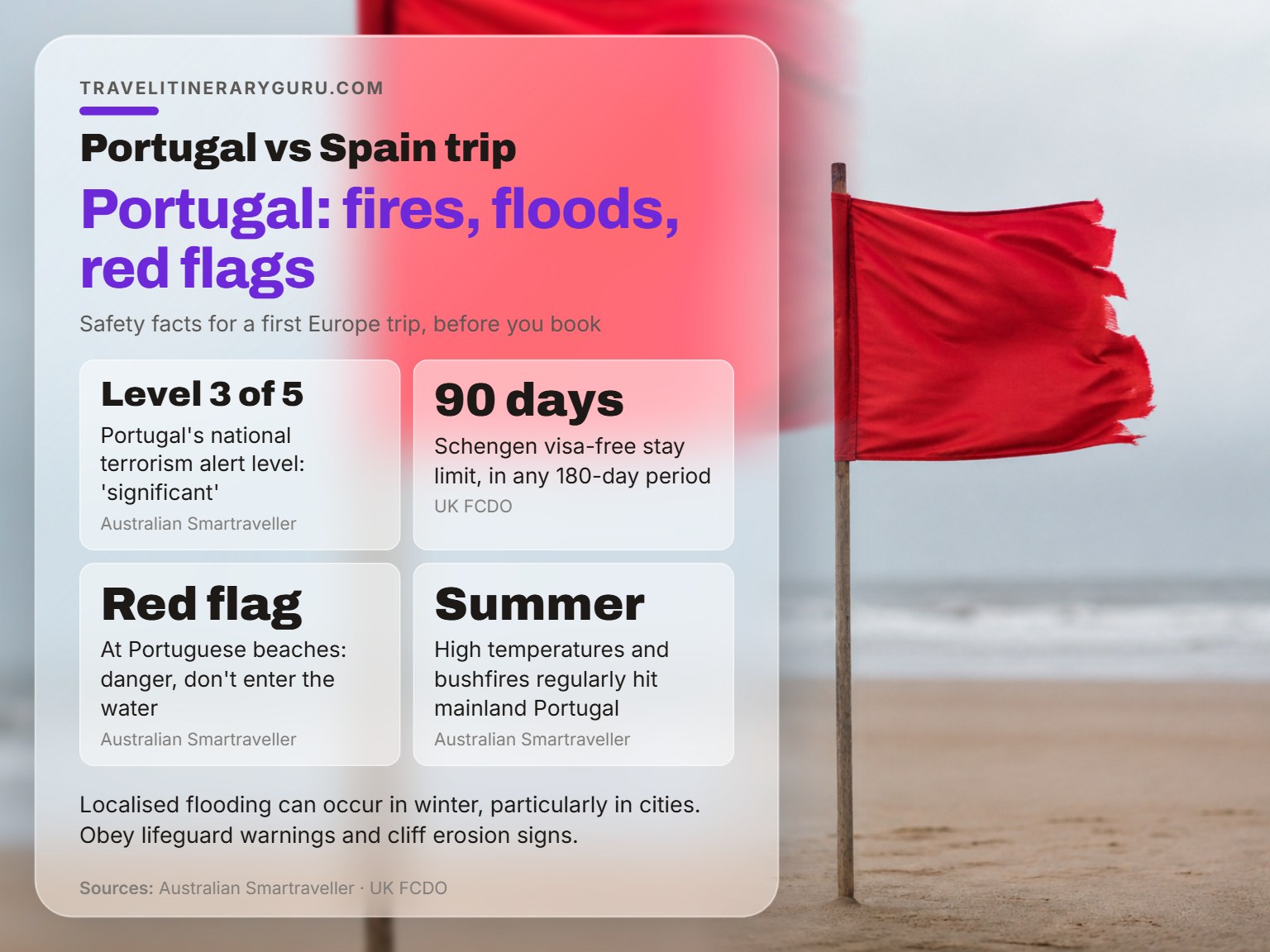
Portugal’s terrorism alert level sits at ‘significant’, level 3 out of 5. That’s a data point absent from every lifestyle comparison of the two countries, and it’s the kind of thing you should know before you go rather than after.
High temperatures and bushfires regularly impact mainland Portugal during the summer months, including near coastal and tourist areas. Localised flooding can occur in winter, particularly in cities. Portugal often suffers forest fires in summer, and the country, especially Madeira and the Azores, sits in a seismically active zone that can produce earthquakes and volcanic activity.
Beach safety is the one where people actually get hurt. People have drowned at Portuguese beaches and in rivers. Obey lifeguard warnings. A red flag means danger, don’t enter the water. Pay attention to signs about cliff erosion.
The part nobody mentions: The Atlantic is not the Mediterranean. Portugal’s water runs cooler than Spain’s, which is exactly why the Costa del Sol exists as an alternative for swimmers. Lonely Planet calls Portugal’s beaches wilder still, with dunes and cliffs dropping to wide scoops of sand. Both descriptions are true, and they point in opposite directions depending on whether you want to swim or to look.
Theft is a low-grade, constant annoyance rather than a dramatic risk. Bag snatching, pickpocketing and theft from cars and accommodation occur. Keep valuables out of sight. Spanish authorities flag the same tourist areas specifically: Lisbon, Porto, Estoril, Cascais, Sintra, the Algarve, Figueira da Foz and Valença do Minho. Drink spiking is a risk too, so don’t accept drinks from strangers or leave yours unattended.
Strikes and public demonstrations are common and can disrupt buses, trains, metro, ferries and flights. Avoid demonstrations and public protests, monitor the media, and follow local authority advice.
What Does a First-Timer Actually Do About Health Cover?
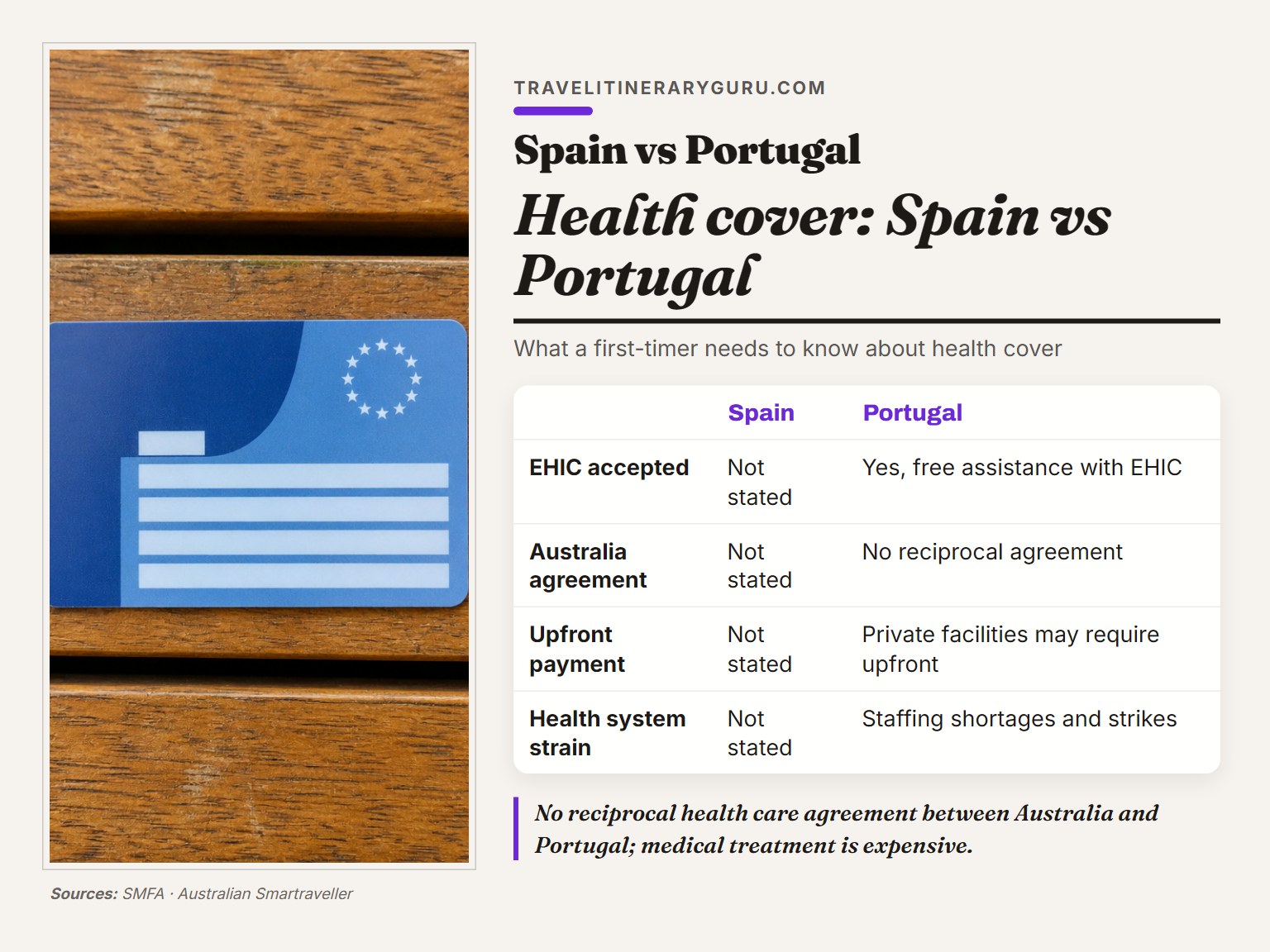
Health cover is the section most first-trip guides skip, and it’s the one that can end a trip early.
Portugal’s health system is experiencing ongoing staffing shortages and strikes, so expect delays for non-urgent care. Private medical facilities in Portugal may require payment upfront, and medical treatment is expensive.
There is no reciprocal health care agreement between Australia and Portugal. Spanish citizens have a better deal: travel with the European Health Insurance Card and public hospital care is free. If you hold an EHIC, that’s your route. If you don’t, travel insurance isn’t optional.
Should You Visit Spain and Portugal in the Same Trip?
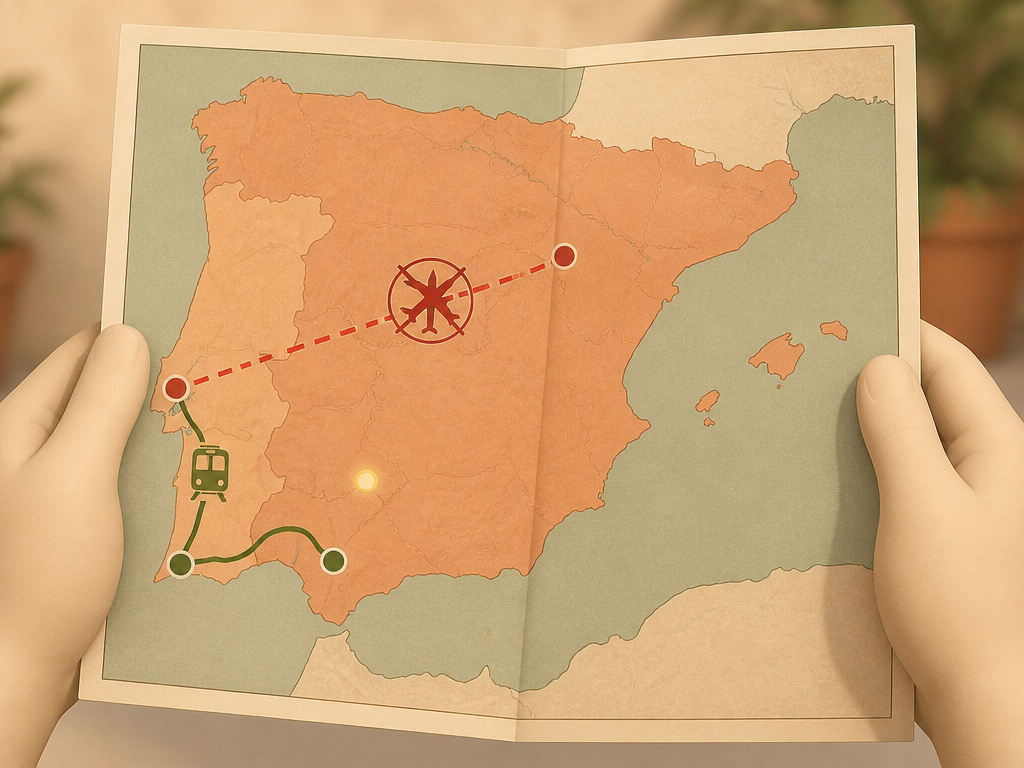
Yes, if you pair the right two regions. The Algarve and Seville is the easiest combination in Iberia. Seville is about 2 hours from Faro by car or tour.
The mistake is trying to pair capitals. Lisbon and Madrid have no direct rail link, so that combination costs you a flight and two airport transfers. The Algarve and Seville costs you a two-hour drive.
If you’re weighing this against other first-trip decisions, the same logic that governs choosing between two countries applies here: pick the pairing that removes transit, not the one that adds a flag to your list.
My own rule is to keep a Europe trip focused, connected by rail, with at least one small town that doesn’t appear on any top-10 list. That’s where the actual trip happens. Every “8 countries in 14 days” itinerary I’ve audited ends up being mostly train station time.
When Should You Go?
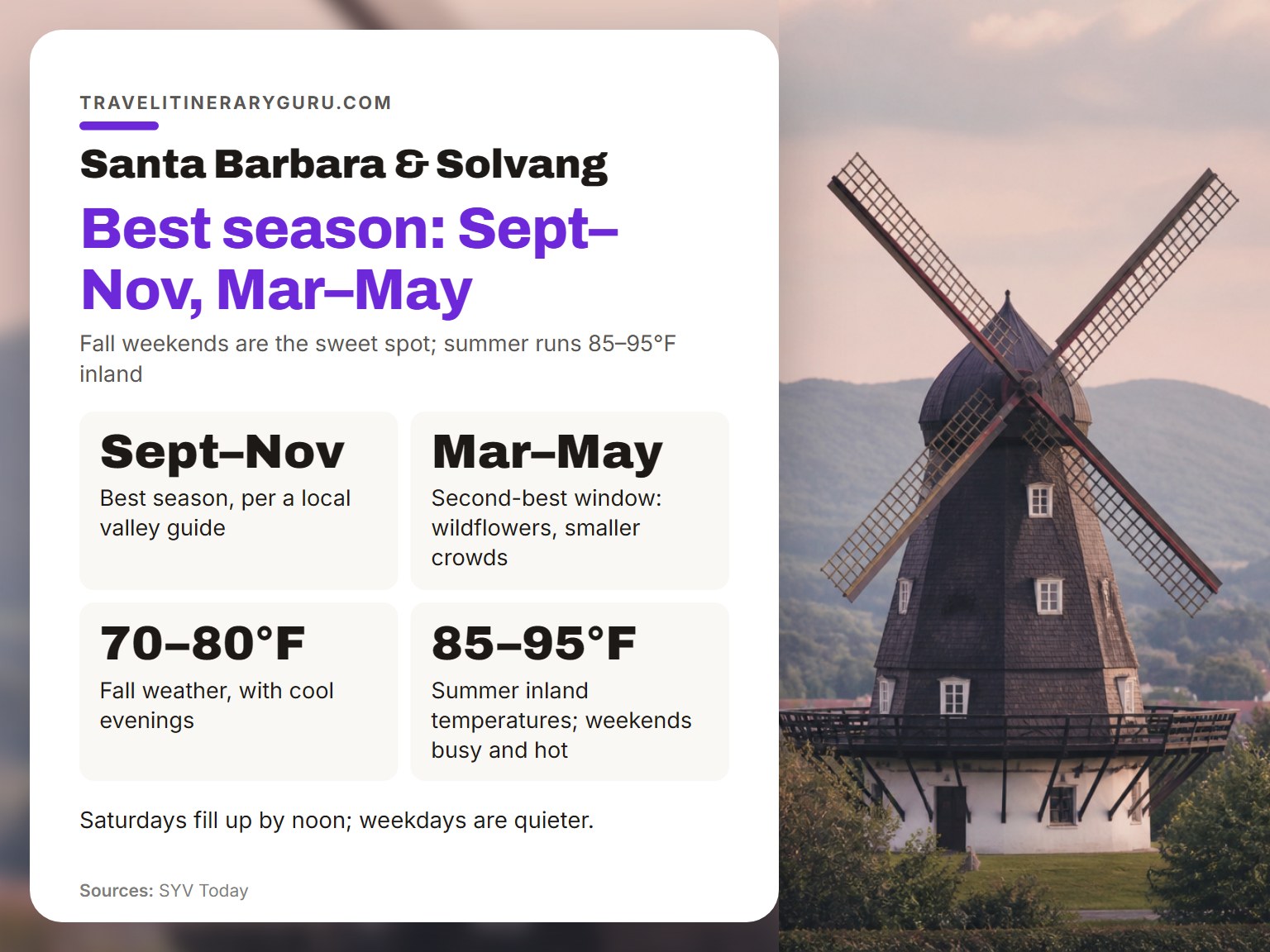
Spring and autumn are the best seasons for touring cities in both countries. That’s the short answer.
The longer one is about crowds and heat. If you’re building around visiting Europe off-season, Iberia is one of the better places to apply it, because the shoulder months are genuinely pleasant rather than merely tolerable.
The Algarve is the sunniest part of Portugal. If your trip is beach-led rather than city-led, that’s the region to build around, and the shoulder seasons still work.
Frequently Asked Questions
Do I need a visa for Portugal or Spain on a first Europe trip?
If you’re visa-free for the Schengen area, you can travel for up to 90 days in any 180-day period across both countries combined. Your time in Spain and Portugal counts against the same allowance. Check your own nationality’s rules before booking, since the answer varies.
Is there a direct train from Lisbon to Madrid?
No. There is still no direct train between the two capitals, so most people fly or take the bus. The flight takes about 1 hour 15 minutes. A high-speed line via Évora, Elvas and Badajoz is being built in stages, with direct trains not expected until around 2030.
Is Portugal cheaper than Spain?
Generally a little cheaper, especially for eating out and hotels, though Lisbon has become pricier. That’s one source’s read rather than a settled fact, and Lonely Planet doesn’t make a cost claim at all. Use cost as a tiebreaker, not the deciding factor.
Is Portugal safe for a first-time visitor?
Smartraveller advises exercise normal safety precautions. The terrorism alert level is ‘significant’, level 3 out of 5. Petty theft is the realistic risk in tourist areas, and beach drownings are a documented danger. Obey lifeguard warnings and treat a red flag as absolute.
What’s the biggest mistake first-timers make?
Trying to do both countries properly in one week. Portugal works in a week without rushing; Spain usually needs more time or a single-region focus. Pick one, or pair the Algarve with Seville and accept that you’ve seen a slice of Spain, not Spain.
When is the best time to visit Portugal and Spain?
Spring and autumn. Summers bring high temperatures and bushfire risk to mainland Portugal, including near coastal and tourist areas, and inland Spain gets very hot in July and August. Winters are cool and wet in northern Portugal.
The Bottom Line
One rule most guides skip: if your trip is short, don’t split it across both countries unless you’re pairing the Algarve with Seville. That pairing works because the two are about 2 hours apart. Every other cross-border combination costs you a flight and a half-day.
If you have more time, the calculus flips. Take the Portugal trip as your base, add a Spanish region by air, and budget the transit honestly.
I’ll be honest with you about where my advice runs thin. I’m not a food critic, and I can’t tell you why the sauce works at any of the places I’d send you. I can tell you a restaurant is good and near your route.
Your first step this week: pick your corridor, then check whether your dates land in fire season or flood season. That single check is worth doing before you pack.
