
How to Plan a Multi-City Europe Trip by Train
This post contains affiliate links. As an Amazon Associate, we earn from qualifying purchases.
Planning a multi-city Europe trip by train comes down to three decisions: how far ahead you book, which trains force a seat reservation, and how much transit you cap per move. Get those right and the route holds together. Get them wrong and you’ve booked six travel days and four actual experiences.
That last number is the one that catches people. A route that looks efficient on a map can turn into a rail commute with luggage, where the scenery is a blur of tunnels and the only thing you remember about a city is its station concourse. Knowing how to plan a multi-city Europe trip by train means accepting that fewer stops often make for a better journey.
The rest of this walks through the booking windows, the reservation tiers, the pacing limits, and the one structural change that saves a full transit day on almost any itinerary.
Key Takeaways
- Book reservations up to 3 months ahead through Interrail, but point-to-point tickets on some operators open on a different clock entirely.
- High-speed and night trains require a reservation and a fee; regional trains usually don’t, which makes them your flexibility lever.
- Cap most train legs at four to five hours and allow at least two nights in each place, or the trip stops being a trip.
- Avoid the first two weeks of December if you can. That’s the annual timetable change, and delays spike while networks adjust.
- Book a one-way line, not a loop. Flying into one city and out of another usually costs the same and buys back a day.
Why the Grand Tour Route Stopped Making Sense
The London-Paris-Switzerland-Italy march is a classic itinerary running on modern infrastructure, and it shows. You spend the middle days crossing the Alps in tunnels, and the costs stack up because you’re booking high-speed legs in reservation-heavy countries in Europe.
The alternative is a line, not a loop. Fly into Rome, out of Milan. Fly into Amsterdam, out of Prague. I stopped booking round-trip flights into the same city, and the change did more for my how to plan a multi-city Europe trip by train than any app or pass ever has. An open-jaw fare avoids the dead last day you’d otherwise spend riding back to the airport you started from.
That single change also opens up more routing options, because you’re no longer anchored to a return leg.
Wikivoyage’s European train travel planning guide makes the case plainly: trains run more frequently than planes, arrive in city centres rather than airports a hundred kilometres out, and skip the security queue that eats two hours at the other end.
The map is not the itinerary
Here’s where most plans go sideways. A 10-day route by train looks tidy on paper until you count the actual travel days. I audited one of my own early itineraries and found consecutive days with a 5-to-6-hour segment. That’s not a trip. That’s a commute with a suitcase.
Now I cap transit at about four to five hours per move and build in a full zero-day every fourth day. A rest day isn’t wasted time. It’s the day you actually see the place you paid to fly to.
How Far Ahead Can You Actually Book European Train Tickets?
The honest answer to the how to plan a multi-city Europe trip by train question is that it depends which ticket you’re buying, and the sources genuinely disagree on this. That’s not a dodge. It’s a useful thing to understand before you start.
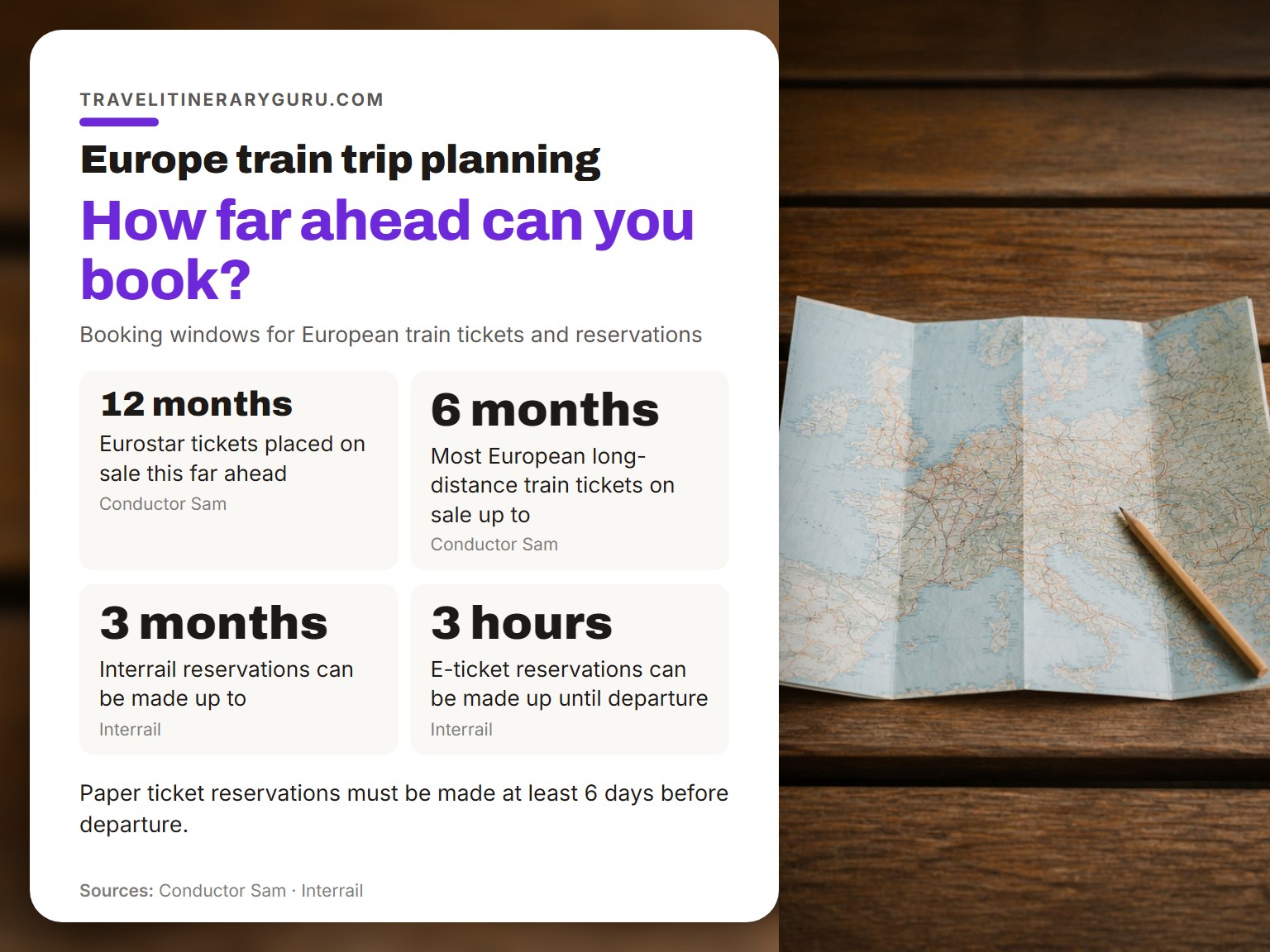
Interrail states reservations can be made up to three months in advance, with e-ticket reservations bookable until 3 hours before departure and paper ticket reservations requiring at least 6 days of lead time. National Rail gives different figures for point-to-point tickets: 60 days generally, 120 days for Eurostar, and 90 days for trains in France and some sleepers from Paris to Spain and Italy.
Conductor Sam adds a third position: Eurostar places tickets on sale 12 months ahead, German ICE trains can be booked up to a year ahead for journeys within Germany and to and from Belgium, Switzerland and the Netherlands, and most European long-distance tickets go on sale up to 6 months ahead.
These aren’t contradictions so much as different scopes. Pass reservations and point-to-point tickets open on separate clocks, and conflating them can lead to confusion.
| Ticket Type | Booking Opens | Source |
|---|---|---|
| Interrail pass reservation | 3 months ahead | Interrail |
| Eurostar point-to-point | 120 days ahead | National Rail |
| German ICE (domestic + BE/CH/NL) | Up to 1 year ahead | Conductor Sam |
| France and Paris sleepers | 90 days ahead | National Rail |
| Most long-distance European tickets | Up to 6 months ahead | Conductor Sam |
Where this goes sideways: Booking a pass reservation and a point-to-point ticket as if they share a window. They don’t. You’ll wait three months for a Eurostar seat that opened four months ago.
Which Trains in Europe Actually Need a Reservation?
Reservations come in three tiers, and knowing which tier a train sits in decides whether your itinerary is flexible or locked.
Tier one: reservation required. High-speed trains and night trains require a reservation and an associated fee as a general rule. Popular services including the Eurostar, TGV and AVE are covered by the Interrail Pass but still require a seat reservation. Travelerset puts it more bluntly: reservations are mandatory on night trains and most high-speed trains, and often required in France, Italy and Spain.
Tier two: recommended, not mandatory. Some trains fall here, and it’s worth reserving if you have somewhere to be or want to sit with your travel companions.
Tier three: no reservation. Most trains in the Interrail Pass network don’t require a seat reservation, and regional trains usually don’t. Many regional and intercity services in Germany, Austria, Switzerland and the Netherlands fall into this group.
There’s also a fourth category: trains that need a supplement on top of everything else. Some trains also need a supplement, such as the EuroCity Brenner trains, the Bernina Express in Switzerland and EIP trains in Poland.
The part nobody mentions: Seat reservations aren’t included in a pass. Wikivoyage flags that many trains in some countries require sometimes expensive reservations that the pass doesn’t cover, so your “unlimited travel” pass may have extra costs.
The regional fallback is a constraint, not a feature
Interrail frames regional trains generously: if all reservations are booked, you may be limited to regional lines, which avoid reservation fees. Fair enough. But read that sentence again from the other direction. The fallback only exists because your first choice was unavailable.
Travelerset’s advice lines up with treating it as a deliberate strategy instead: if you want maximum flexibility with a pass, plan around trains that don’t require a reservation, and routes through Germany, Austria, Switzerland and the Netherlands make that easier.
That’s the version I’d build around. Design the route so the reservation-free legs are the backbone, and treat the high-speed hops as the exceptions you book deliberately.
Where the Timetable Data Goes Missing
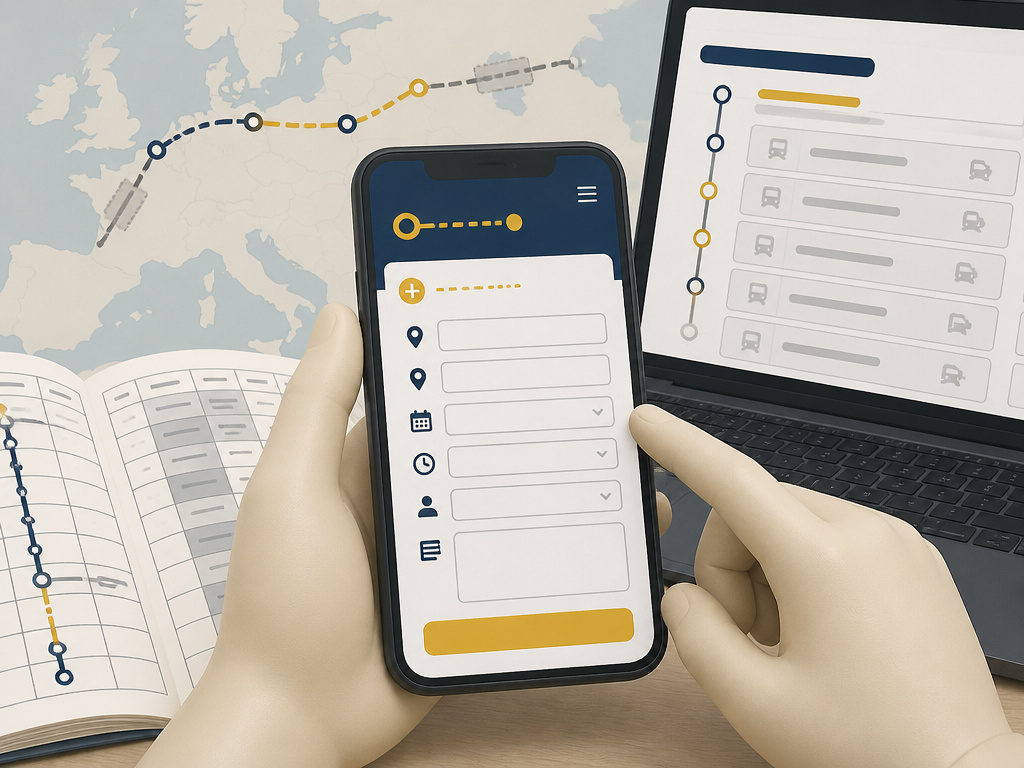
Interrail’s own timetable page admits it’s not 100% accurate, because not all European railways choose to share their timetable data. That’s the operator telling you, in writing, not to trust it completely.
The gaps are specific. TCDD in Türkiye shows only long-distance trains. Some countries were added to the timetable recently and may not show accurate data, sometimes available only a few weeks in advance.
When you hit one, you add the journey manually in the Rail Planner app. Use correct, full station names and train times, because the ticket inspector checks those details. If a train is delayed, enter the originally scheduled departure time rather than the actual one.
Wikivoyage and National Rail both point to more complete alternatives: the Deutsche Bahn journey planner, the European Rail Timetable (published, and covering ships to North Africa, Israel and the Mediterranean islands as well as trains), and The Man in Seat 61, Mark Smith’s site with train times, fares and trip reports.
For app-based planning, Öffi has good coverage of most of Europe and handles both public transport and long-distance trains. I’ve come around on it for the local legs, where a national rail planner won’t help you get from a station to a hotel.
Skip this if: You’re only riding two or three high-speed legs between major hubs. The timetable gaps mostly bite on regional and cross-border routes, not the Paris-to-Amsterdam corridor.
The Pacing Rule That Decides Whether the Trip Works
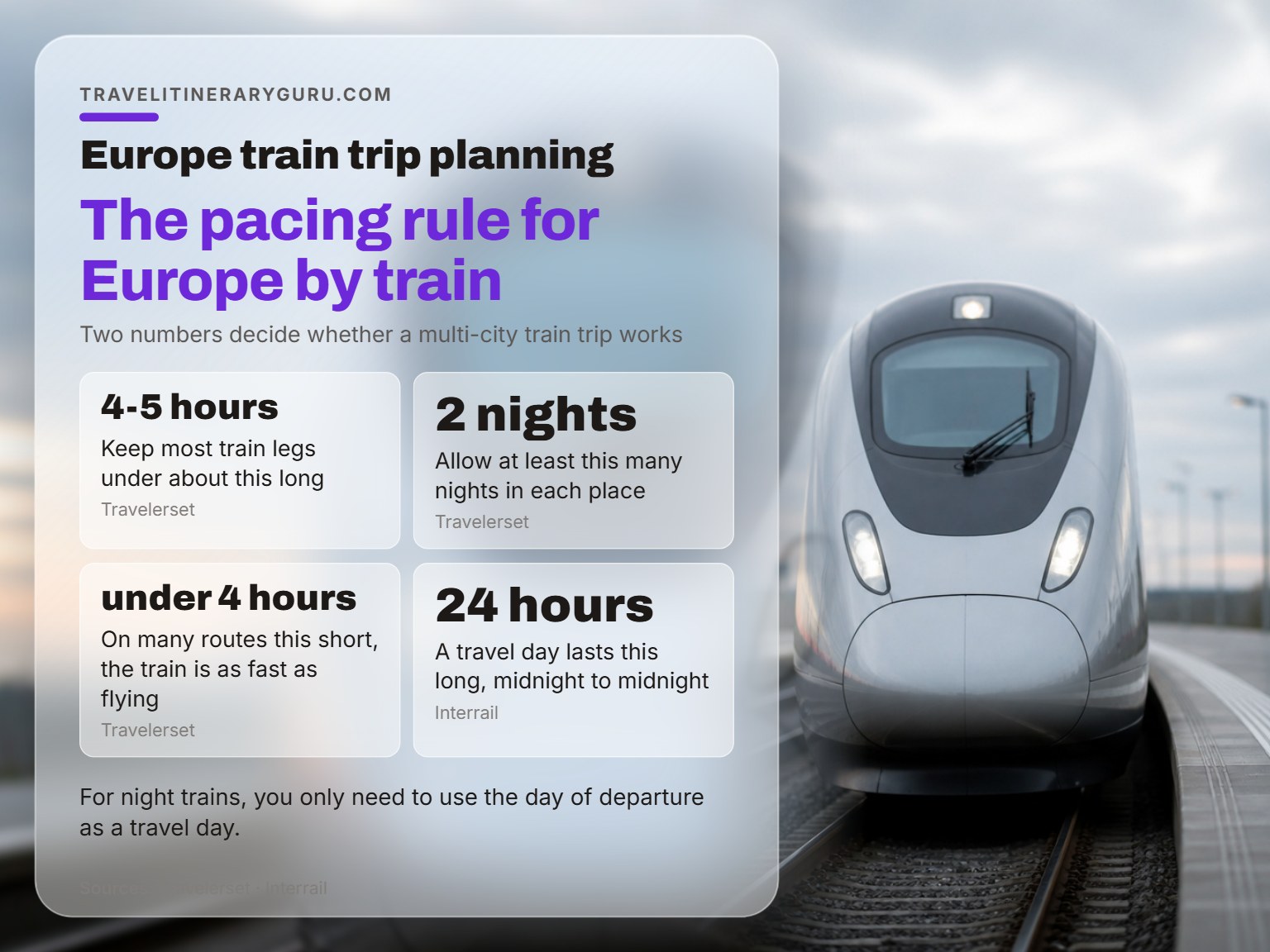
Two numbers do most of the work here. Keep most train legs under about four to five hours, and allow at least two nights in each place. Travelerset’s framing is the one I’d steal: start with a realistic route, not a ticket.
The reason is arithmetic. A four-to-five-hour leg plus station time plus hotel check-in eats most of a day. Do that repeatedly and you’ve spent nearly half the trip in transit.
On many routes under about four hours, the train is as fast as flying once you count airport transfers and waiting time. That’s the crossover point. Past it, you’re trading scenery for a security queue.
What the overnight train actually costs you
The night train revival is genuinely good news, and I’ll champion it as a structural tool. A sleeper or couchette turns a long journey into a night’s accommodation and saves both a hotel night and a daytime travel day.
But I’ve taken the overnight train between major European cities several times now. I rarely slept well, and the best experience was in a private sleeper on a route with no transfers. The arrival day is a wash. You’re not sightseeing, you’re finding a cafe and staring at a wall.
The math only works if you genuinely sleep on trains, which most people don’t. Travelerset’s caveat is the practical version: sleep quality varies, so if you’re sensitive to noise or motion, plan a quiet first day after arrival.
There’s also a counting quirk worth knowing. A travel day normally lasts 24 hours, from midnight to midnight, but for night trains you only need to use the day of departure. That one detail can save you a travel day on a pass.
| Transit Length | Real Cost | What to Do |
|---|---|---|
| Under 3 hours | Half a day, mostly recovered | Fine as a daily move |
| 4-5 hours | Most of a day | Cap these; don’t stack them |
| 6+ hours daytime | A full day gone | Split it or fly it |
| Overnight | One wrecked arrival day | Only if you sleep on trains |
Common mistake: Booking a 6-hour daytime leg to “save a hotel night” by arriving late. You’ll pay for the hotel anyway and see nothing en route.
The December Window Nobody Warns You About
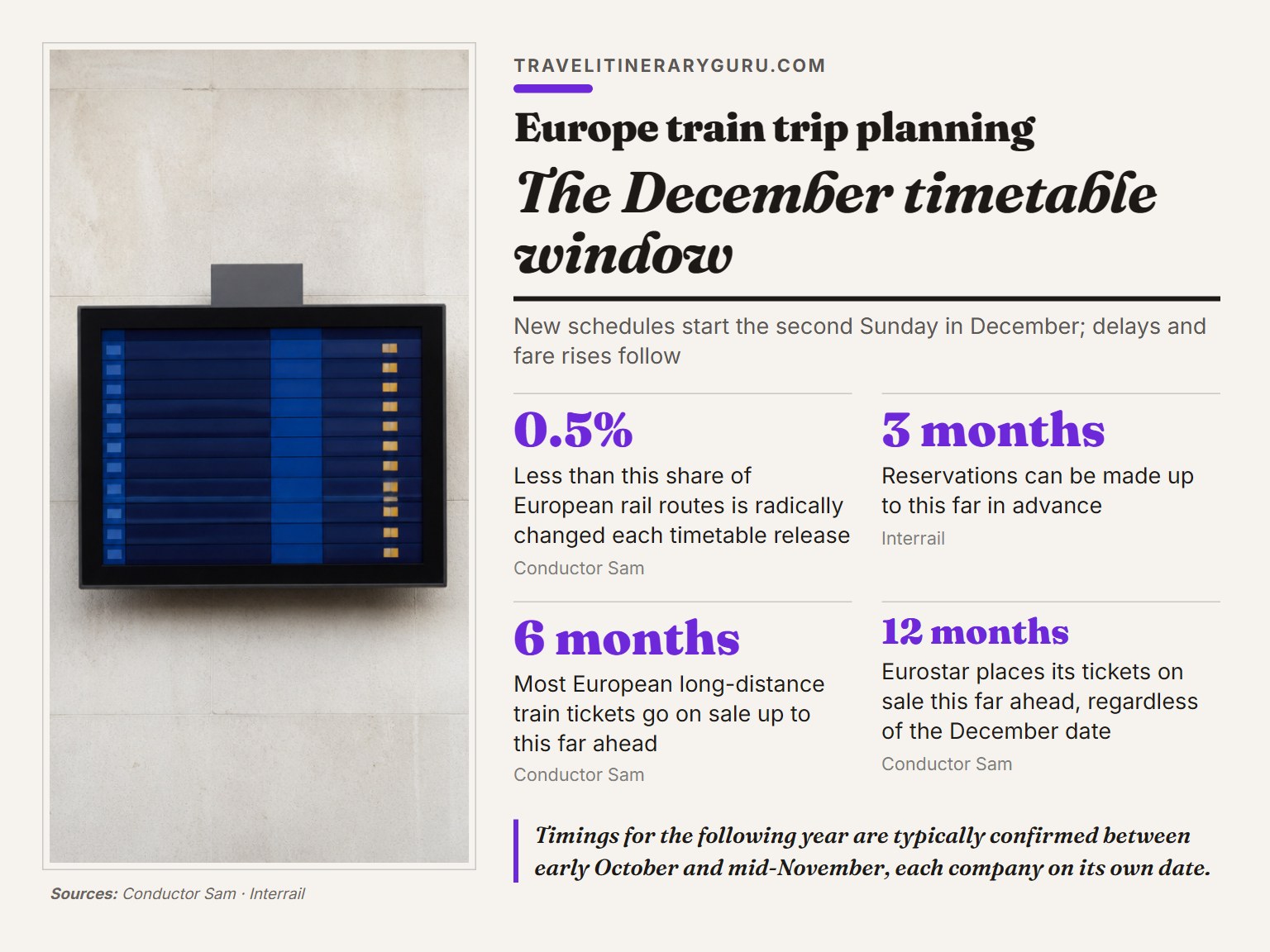
The first two weeks of December are a recurring disruption window. Networks experience extra delays as systems and regular passengers adapt to the new timetable regime, and fare increases land around the same period.
The cause is structural. Updated schedules come into force from the second Sunday in December, and the timings for travel in the following year are typically confirmed between early October and mid-November, with each company picking its own date.
Conductor Sam’s reassurance is worth holding onto: less than 0.5% of European rail routes are radically transformed on each timetable release. So if you’re planning more than a year out, you can build a solid route before the annual timetable even exists.
What you can’t do is know the exact departure times. When looking more than 3 months ahead, knowing the timings with certainty and having full awareness of the optimum train is genuinely trickier, because ticket agents double as the most accurate timetable guides and engineering works shift things around.
Pass or Point-to-Point: The Decision That Sets Your Budget
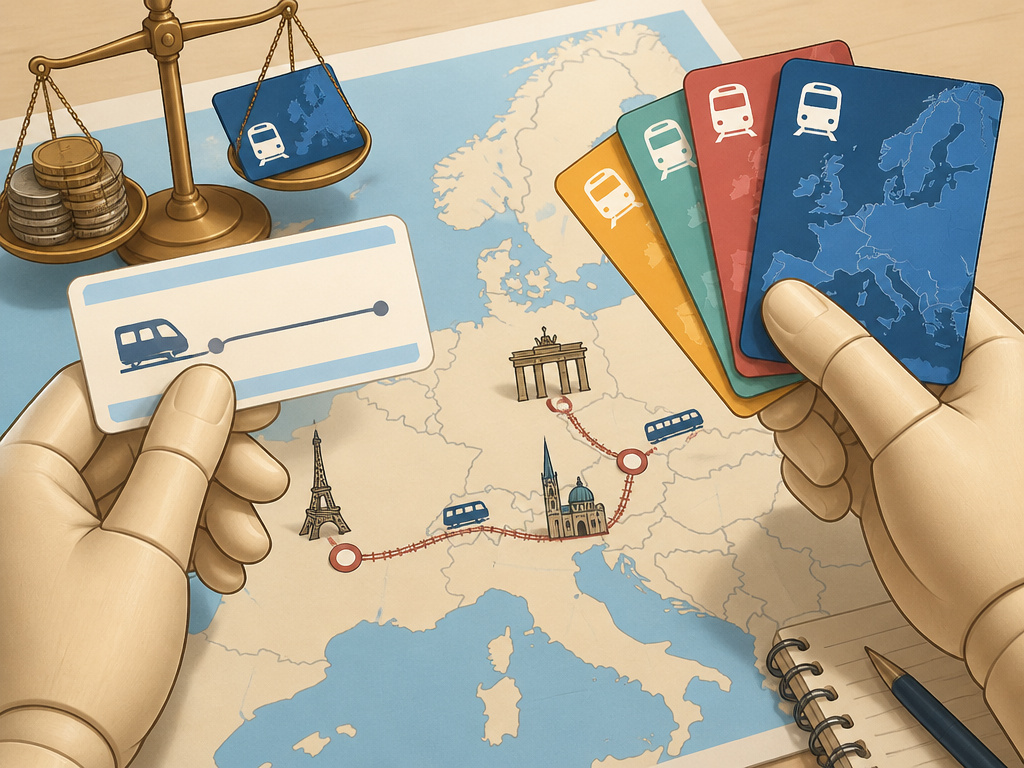
This one has a clean answer, and it’s driven by journey count rather than trip length.
Point-to-point tickets bought early are usually cheaper for trips with a few long high-speed legs. A pass tends to make sense for many journeys, flexible plans, or routes built on regional and intercity trains where no reservation is needed.
Wikivoyage lands in the same place: if you plan a longer journey with many stops, especially if you don’t like a fixed itinerary, a rail pass may be the best choice.
| Factor | Point-to-Point Wins | Pass Wins |
|---|---|---|
| Journey count | A few long legs | Many journeys plus day trips |
| Booking timing | You book weeks or months out | You decide on the day |
| Train types | Mostly high-speed with advance fares | Mostly regional and intercity |
| Countries | France and Italy, high reservation fees | Germany, Austria, Switzerland, Netherlands |
| Flexibility | Plans are fixed | Plans may change |
If you’re weighing the trade-offs in more detail, there’s a solid comparison of bus vs train travel in Europe pros and cons that covers where the bus genuinely beats the rail network.
Splitting tickets and the one-way line
Two structural moves save real money and real days. The first is splitting your journey. If you don’t see attractive fares for the whole trip, book two separate tickets, for example London to Paris and then Paris to your final destination. Wikivoyage’s CityStar example is the extreme version: a Vienna-to-Istanbul trip built from a discounted Hungarian railways ticket across the middle section plus cheap domestic tickets at each end, saving as much as €200 off a single ticket.
The second is the one-way line I mentioned earlier. It’s the same principle applied to flights rather than trains, and it’s the change that made the biggest difference to how my itineraries actually feel on the ground.
Planning the Route Before You Book Anything
Start with a map, not a booking site. A printed map of Europe still works, and the European Rail Timetable publishes a railway map that shows scenic routes and high-speed lines together, which is the combination you actually need.
Then sequence your destinations by minimum travel time rather than by what you most want to see, so you’re not zig-zagging or doubling back. Conductor Sam’s point about arranging destinations into a logical sequence is the one most people skip, and it’s the difference between a route and a wish list.
Use the national rail operators’ journey planners, such as Deutsche Bahn’s, to check realistic journey times and the number of changes before you commit. Do that before you buy a pass, not after.
For the sequencing side, there’s a fuller walkthrough of trip route planning that covers the loop-versus-line decision in more depth.
Three route shapes that work
A 10-day trip through Paris, Lyon, Geneva or Lausanne and Milan runs mostly high-speed, with reservations needed in France and Italy. A two-week route through Amsterdam, Cologne, Munich, Salzburg, Vienna and Prague mixes intercity and high-speed, and many legs need no reservation at all. A three-week London to Rome line via Paris, Zurich, Lucerne, Venice and Florence includes Eurostar, which always requires a booking.
Notice the pattern. The reservation-light routes run through the countries where regional and intercity trains don’t require booking. That’s not a coincidence, and it’s the lever to pull if flexibility matters more to you than speed.
Easy to miss: The Eurostar booking requirement applies regardless of whether you hold a pass. It’s one of the trains where the pass covers the journey but not the seat.
Frequently Asked Questions
Can I plan a multi-city Europe trip by train without booking everything in advance?
Yes, but with limits. Regional trains usually don’t require reservations, so a route built on them can stay open. High-speed and night trains do require them, and in France, Italy and Spain they’re often mandatory. If you want spontaneity, design the route around reservation-free legs and accept that the fast trains need locking in.
How far in advance should I book train reservations in Europe?
Interrail takes reservations up to three months ahead. E-ticket reservations can be made until three hours before departure, while paper ticket reservations need at least six days. Point-to-point tickets follow different clocks: 60 days generally, 120 days for Eurostar, and 90 days for France and some Paris sleepers.
Do I need a reservation for every train in Europe?
No. Most trains in the Interrail Pass network don’t require a seat reservation, and regional trains usually don’t. High-speed and night trains do, and some services fall in between where a reservation is recommended but not mandatory. Supplement-only trains such as the Bernina Express and EuroCity Brenner services are a separate category again.
How many cities can I realistically cover in two weeks by train?
Fewer than you think. With at least two nights per place and most legs capped at four to five hours, a two-week trip comfortably covers five or six stops. The common failure is planning eight cities and spending the trip in transit. Build in a zero-day every fourth day and the count drops further, but the trip works.
What happens if a train isn’t in the Interrail timetable?
You add it manually in the Rail Planner app using full station names and correct times, and the ticket inspector will check those details. If the train is delayed, enter the originally scheduled departure time. For more complete data, check the national railway company’s website, the Deutsche Bahn journey planner, or The Man in Seat 61.
Is it cheaper to buy a rail pass or point-to-point tickets?
Point-to-point tickets bought early usually win for a few long high-speed legs. A pass tends to win for many journeys, flexible plans, or routes built on regional and intercity trains where no reservation is needed. Remember that seat reservations aren’t included in a pass, so factor those fees in on high-speed-heavy routes.
The Bottom Line
One rule most guides skip: if your itinerary has many train legs over five hours, stop and rebuild the route before you book anything. That’s the threshold where a trip turns into a commute, and no amount of good planning downstream fixes it.
Your first step this week is the one-way line. Pick your entry city and your exit city, then check the open-jaw fare before you look at a single train. I’ve watched this work time and again, and it costs you nothing to check.
This all changes if you’re travelling with someone who has mobility concerns or gets genuinely wrecked by overnight travel. In that case the calculus flips entirely: slower pacing, more rest days, and zero tolerance for the six-hour leg. Accessibility is a planning skill, not a limitation.
And if you’re considering a night train to save a hotel night, be honest with yourself about whether you actually sleep on trains. Most people don’t.
