
10-Day East Coast Itinerary Without a Car: Rail and Parks
This post contains affiliate links. As an Amazon Associate, we earn from qualifying purchases.
A 10-day East Coast itinerary without a car runs on Amtrak’s Northeast Corridor between Boston, New York, Philadelphia, and Washington, plus the fare-free Island Explorer shuttle in Acadia National Park. The shuttle runs seven days a week through October 13, and reduced fall service starts August 18, so the park leg sets your dates.
That cutoff is the one fixed point in an otherwise flexible route. Amtrak runs multiple daily departures along the corridor, so the city legs bend around your schedule. The Acadia shuttle keeps its own calendar.
What follows: the rail spine and how long each leg really takes, the two published 10-day plans that disagree on sequence, the Acadia shuttle rules that catch people out, and the city transit that replaces a rental car.
Key Takeaways
- The Acadia shuttle stops October 13; plan the park leg before that or leave it out.
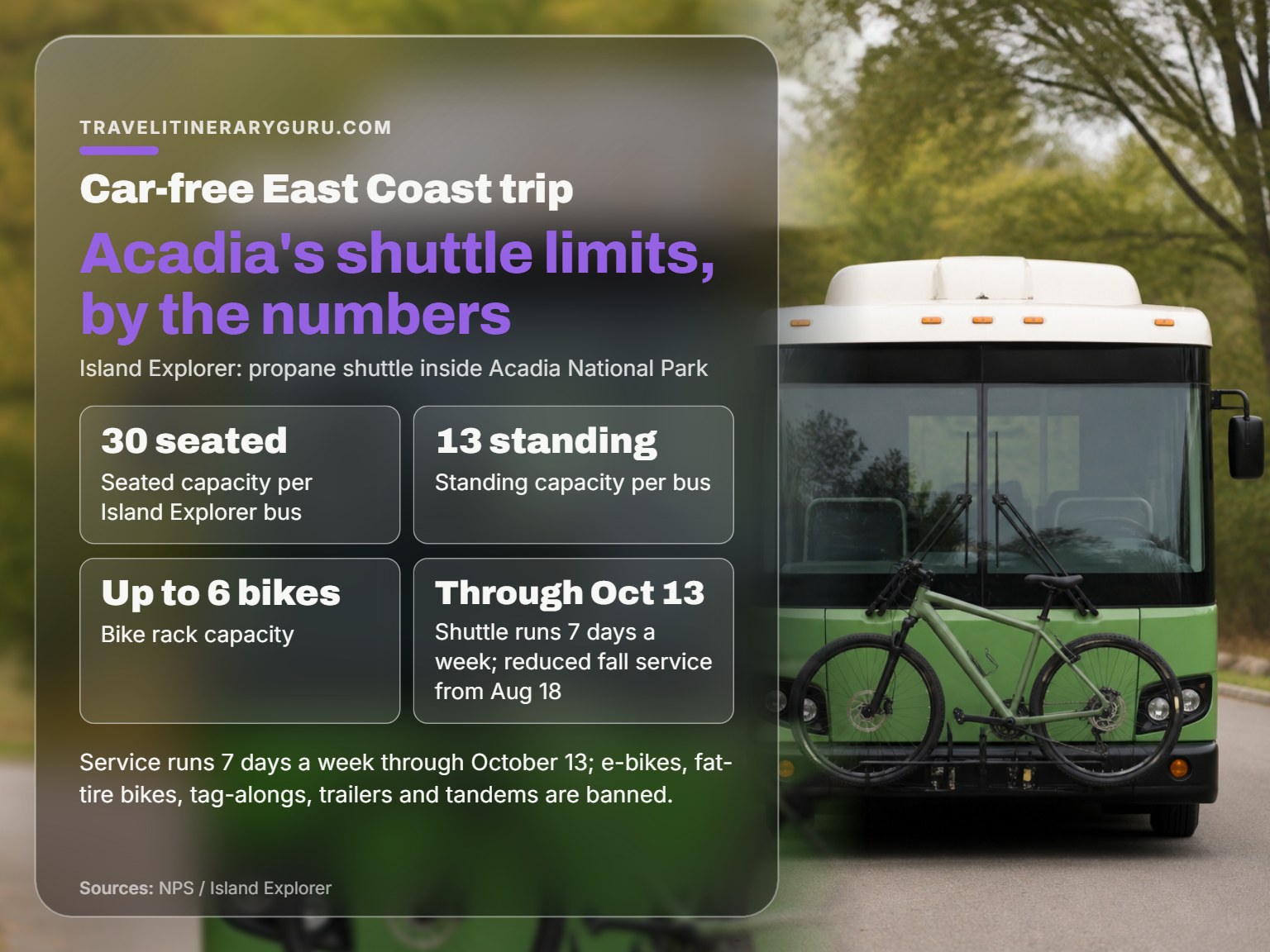
- Island Explorer buses hold 30 seated and 13 standing passengers and carry up to 6 bikes, but e-bikes, fat-tire bikes, and tag-alongs are banned.
- The fare-free bus doesn’t waive the park entrance pass.
- Acela covers Boston to Washington in about 7 hours; the Downeaster reaches Brunswick, Maine in 3 hours 25 minutes.
- Two credible 10-day plans disagree on sequence and days per city, so pick one and commit.
The Northeast Corridor Is the Spine of the Whole Route
Amtrak’s Northeast Corridor links Washington, DC, Philadelphia, New York City, and Boston, and Amtrak names all four among the corridor’s cities.
The Northeast Corridor carries Amtrak’s Acela and Northeast Regional services between Washington, Boston, Philadelphia, and New York. Acela covers the full Boston to Washington run in about seven hours, with multiple daily departures. Northeast Regional trains differ widely by service number, with durations ranging from one hour twenty-one minutes to seventeen hours fifty-eight minutes.
Those four cities are the easy part. The leg that leaves the corridor decides whether the trip works.
Station placement does the work. Moynihan Train Hall in New York, William H. Gray III 30th St. Station in Philadelphia, and Union Station in Washington all sit downtown, within walking distance of the neighborhoods you came to see. You step off the train inside the city, not at an airport an hour outside it.
That’s the whole argument for rail over a rental car here. Parking, tolls, and drop-off fees disappear, and so does the hour you’d lose at each end.
Amtrak also offers a Quiet Car on Acela, which is the closest thing to a sound specification you’ll get on a train. If you’re working through a 7-hour run, that’s the car to book.
The corridor is the reason a 10-day East Coast itinerary without a car works at all. Building a multi-city trip route around rail means treating transfer times as fixed costs, not as slack. I’ve planned enough of these to know the corridor isn’t the risk. The risk is the transfer you didn’t time.
How Long Each Rail Leg Actually Takes
I once built a multi-city route without checking the real travel time between two stops. A two-hour transfer turned into five, and the hotel I’d booked for that night sat empty.
Nothing was cancelled. The connection was simply longer than the timetable I’d skimmed, and Amtrak’s own schedule would have told me in ten seconds.
Northeast Regional service 66 runs daily and takes 17 hours 58 minutes end to end. Service 110 runs Monday through Friday and takes 1 hour 21 minutes. Both carry the same route name.
That gap is the most useful thing on the timetable. The route name tells you almost nothing about how long you’ll be on the train.
Acela vs Northeast Regional: Which One for Which Leg
Acela is the faster option on the corridor, with a 7-hour Boston to Washington run and multiple daily departures. Amtrak lists the full station set on its Acela service page.
Northeast Regional spreads across service numbers from 1 hour 21 minutes to 17 hours 58 minutes. For a 10-day trip, Acela wins the long legs and Northeast Regional wins the short ones.
| Service | Best For | The Catch |
|---|---|---|
| Acela | Boston to Washington in one sitting | About 7 hours; multiple daily departures |
| Northeast Regional | Short hops like Philadelphia to New York | Duration swings by service number |
| Downeaster | Boston to Brunswick, Maine | 3 hours 25 minutes; adjustment lands November 18, 2026 |
| Amtrak Thruway | Towns off the rail line | Chartered vehicle or motorcoach, not a train |
The Thruway rows matter more than they look. If your plan wants a stop that isn’t on the rail line, those are how you get there without a car.
If you’re bolting a train day trip onto the middle of the 10 days, read the service number first. An Acela train trip template shows how consecutive corridor legs stack up over three days.
How Should You Sequence a 10-Day East Coast Itinerary Without a Car?
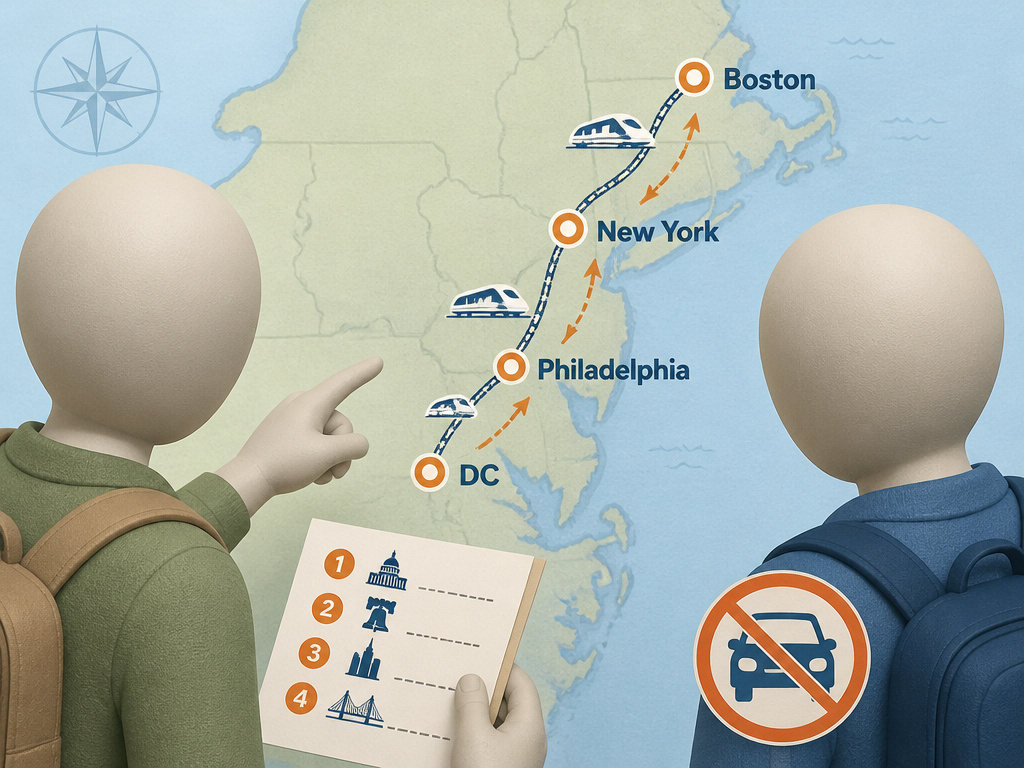
Does the order actually matter? Two published 10-day East Coast plans say yes, and they don’t agree with each other.
Geniustravelguru runs the trip New York to Philadelphia to DC to Boston, with 4 days in New York, 1 in Philadelphia, 3 in DC, and 3 in Boston, covering roughly 650 km across the four cities. Lonely Planet’s 10-day rail option runs the other direction, Washington to Philadelphia to New York and then north to Northampton, Brattleboro, and Burlington on Amtrak’s Vermonter, covering 611 miles (983 km).
The two distance figures describe different routes. Don’t merge them.
The New York-First Plan
Geniustravelguru’s order puts the biggest city first, when your energy is highest and your jet lag is worst, and ends in Boston. The 1-day Philadelphia stop is the weak point. One day in Philadelphia buys you a lunch and a walk.
The DC-First Plan
Lonely Planet’s order starts in Washington and ends in Vermont, which trades two of the four big cities for countryside. It gives DC 2 days, against Geniustravelguru’s 3.
So the two plans disagree on DC (3 days versus 2). Both are defensible, and they’re answering different questions.
Adding a city to a 10-day plan burns time in transfers. The extra stop rarely pays that back.
Here’s how I’d cut it:
- Four cities, no park: Geniustravelguru’s order, with Philadelphia bumped to 2 days.
- Four cities plus Acadia: the same order, then the Downeaster north from Boston.
- Countryside over cities: Lonely Planet’s Vermonter route, DC to Burlington.
- Short on time: drop Philadelphia and run Boston, New York, DC.
Other multi-city USA itineraries cover different pairings if neither of these fits.
I also fed this route into an AI itinerary generator out of curiosity. It returned a tidy list of stops with no travel times attached, which is the one thing that actually matters. I use those tools to brainstorm now, and check every leg myself.
The Acadia Leg Is Where Car-Free Plans Break
Acadia decides the whole trip.
The Island Explorer is a fare-free, propane-powered shuttle running inside Acadia National Park. Downeast Transportation Inc., a nonprofit, operates it under a cooperative agreement with the National Park Service.
Skip this if: your travel window ends after October 13. The shuttle runs 7 days a week through that date, and reduced fall service begins August 18. A late-October trip loses the car-free park leg entirely.
| Island Explorer Rule | The Number | If You Ignore It |
|---|---|---|
| Seated and standing capacity | 30 seated, 13 standing | You stand, or you wait for the next bus |
| Bike rack capacity | Up to 6 bikes | Racks fill on peak mornings |
| Banned bike types | E-bikes, fat-tire bikes, tag-alongs, trailers, tandems | You’re turned away at the rack |
| Season | 7 days a week through October 13 | No shuttle at all after that date |
| Fall service change | Reduced service from August 18 | Fewer buses across the same park |
Regularly scheduled buses stop at campgrounds, carriage road entrances, and many trailheads. Drivers also pick up passengers anywhere it’s safe to stop, so you don’t need to hunt for a formal bus stop.
Island Explorer buses carry a maximum of 30 seated and 13 standing passengers. On a peak-season morning at a popular trailhead, that ceiling arrives already full.
Six bike slots on a park shuttle is a small number. If your group is bigger than that, split across two buses and meet at the trailhead.
The National Park Service keeps its own transit details on the NPS Island Explorer shuttle guide, including the season dates and rack limits.
The Entrance Pass Rule That Catches First-Timers
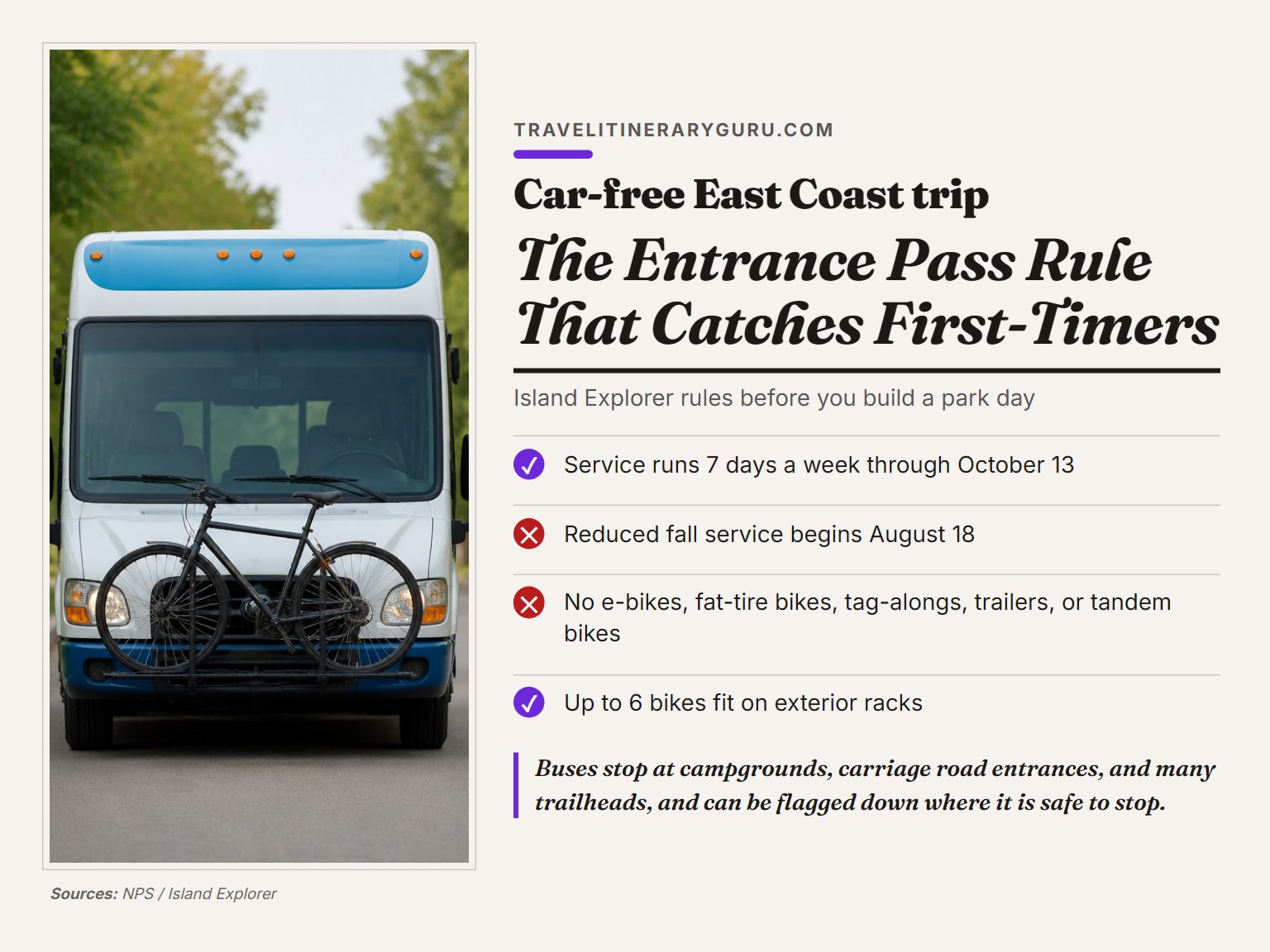
The Island Explorer is free to ride. Acadia National Park is not.
Riding the shuttle into the park doesn’t waive the entrance pass. Riding the shuttle into the park doesn’t waive the entrance pass, and the fare-free ride assumes you’ve already paid to enter Acadia.
That funding structure is worth understanding before you build a park day. The bus is free because park visitors already paid through entrance pass revenue, and the shuttle is how the park moves them without adding cars.
NPS recommends two specific car-free routes. The Acadia Mountain Trail has Island Explorer access to the trailhead, so you don’t park along the road. The Jordan Pond Path is the gentler option, pitched for relaxing views and for working off the popovers from Jordan Pond House.
The full list sits in the Car-Free Acadia trip idea from the National Park Service.
Here’s the order I’d work in:
- Check the season dates first. If your trip falls after October 13, the shuttle is gone and the park leg needs a different plan.
- Confirm your park entrance pass. The fare-free ride doesn’t cover entry, and you’ll be asked for it.
- Load a bike only if it clears the rules. E-bikes, fat-tire bikes, tag-alongs, trailers, and tandem bikes can’t go on the racks, and there are only 6 slots.
- Board at a campground, a carriage road entrance, or a trailhead, or flag the bus down where it’s safe to stop.
The part nobody mentions: reduced fall service starts August 18, but the shuttle keeps running 7 days a week until October 13. A mid-September trip gets fewer buses across the same park, so build slack into every park day.
Four Cities Without a Rental Car
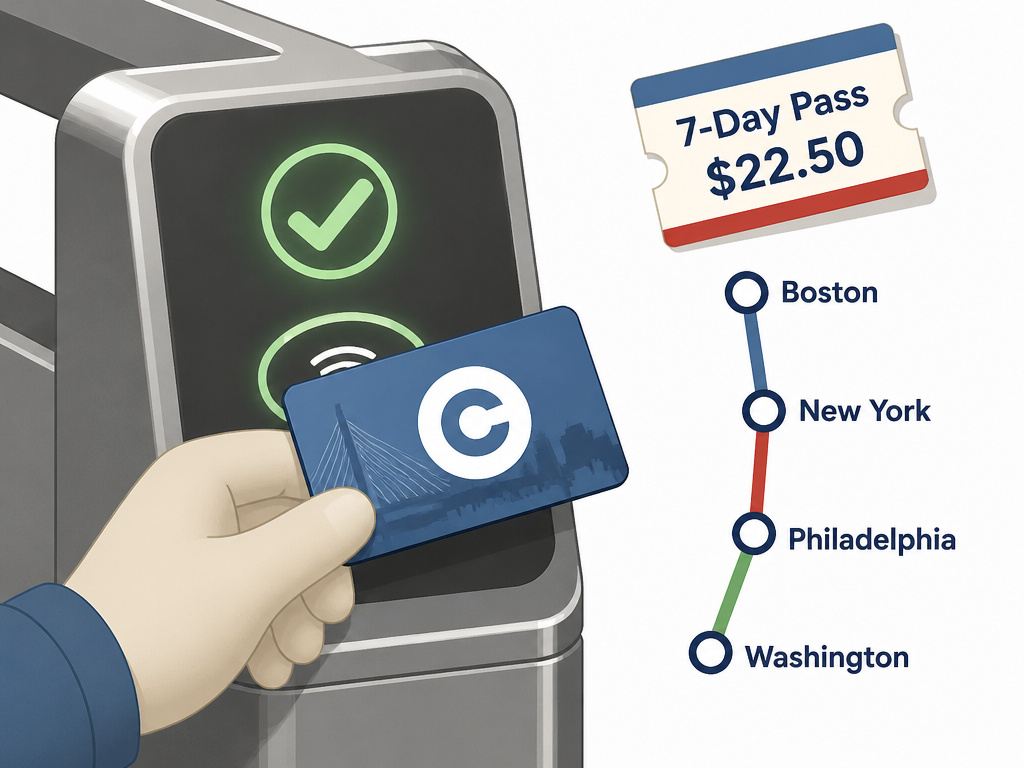
Each of the four corridor cities runs a transit system that reaches the sights you came for.
The MBTA subway one-way fare is $2.40 whether you use a CharlieCard, a CharlieTicket, contactless payment, or cash. There’s a reduced fare of $1.10 for eligible riders and a 7-Day Pass for $22.50 if you’re staying put for a few days.
Boston: The One Fare Structure Worth Learning
The MBTA’s structure matters because it removes a decision. You don’t need to work out which payment method is cheapest, because the one-way fare is the same across all four. Buy the 7-Day Pass for $22.50 if you’ll ride often, and stop thinking about it.
If you want a starting shape for each stop, a Washington DC itinerary built for two days covers the National Mall and the monuments without a car. A Boston itinerary does the same for the historic downtown. And three days in New York City is enough for two boroughs if you pick them in advance.
- Boston: MBTA subway, CharlieCard or contactless, 7-Day Pass for longer stays.
- New York: the Brooklyn Bridge walk that one popular plan lists at about 2 km and suggests for sunset.
- Philadelphia: William H. Gray III 30th St. Station is a downtown Acela stop.
- Washington: Union Station is an Acela stop downtown.
The Downeaster Date That Can Break a Late-Year Plan
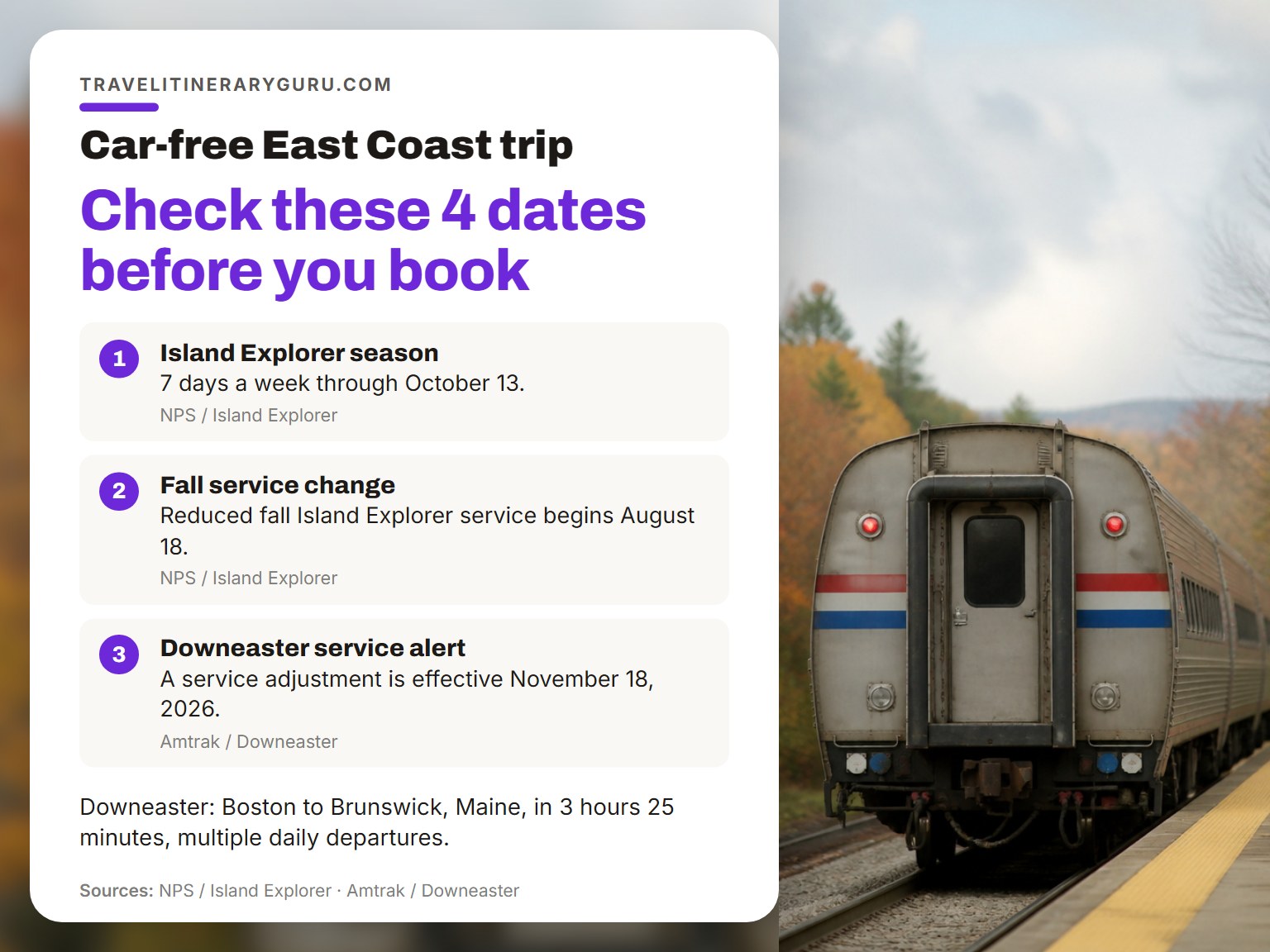
A service adjustment takes effect on the Downeaster on November 18, 2026.
The Downeaster runs round-trips daily between Boston and Brunswick, Maine, in 3 hours 25 minutes, with multiple daily departures. Onboard you get Cafe service, Wi-Fi, Coach Class, Business Class, and carry-on bicycle accommodation.
That adjustment matters because of what it does to planning. Check the service alert before you build the Maine leg into your dates.
Check the alert first. Then work through the rest of your dates in this order:
- Confirm the Island Explorer season. October 13 is the last day of 7-day-a-week service.
- Check the fall service change. Reduced service starts August 18.
- Check the Downeaster service alert. The November 18, 2026 adjustment changes late-year schedules.
- Read your service numbers. Two trains with the same route name can differ widely in duration.
Four checks, ten minutes, and you’ve removed the three ways this route quietly fails.
Frequently Asked Questions
Can you do a 10-day East Coast trip without a car at all?
Yes, on the corridor. Amtrak’s Northeast Corridor connects Washington, Philadelphia, New York, and Boston with multiple daily departures, and each station sits downtown. The car-free part gets harder outside those four cities, where you lean on Amtrak Thruway chartered vehicles or local transit.
How long does Acela take from Boston to Washington?
About 7 hours, with multiple daily departures. Individual service numbers vary: service 2150 runs Monday to Friday at 6 hours 54 minutes, while service 2152 runs Monday to Friday at 7 hours 11 minutes.
Is the Acadia shuttle really free?
Riding it costs nothing. Park entry doesn’t. The fare-free ride assumes you’ve already paid to enter Acadia.
Can you bring a bike on the Island Explorer?
Only if it clears the rules. Buses carry up to 6 bikes on exterior racks, and e-bikes, fat-tire bikes, tag-alongs, trailers, and tandem bikes aren’t allowed. The racks also fill on busy mornings.
When does the Island Explorer stop running?
Service runs 7 days a week through October 13. Reduced fall service begins August 18, so buses keep coming after that date, just less often.
Should you book Acela or Northeast Regional?
Acela for the long Boston to Washington leg, Northeast Regional for short hops like Philadelphia to New York. Read the service number on any Northeast Regional booking, since durations under that name range from 1 hour 21 minutes to 17 hours 58 minutes.
Before You Go
One threshold decides more of this 10-day East Coast itinerary without a car than any other: October 13. If your dates fall after it, the car-free Acadia leg is gone, and the honest move is to run the four-city corridor version instead of forcing a park day that no longer exists.
Your first step this week is small. Open Amtrak’s timetable, write down the service number and duration for each of your four legs, and only then book hotels. I’ve learned this the hard way so you don’t have to.
Here’s my concession to the planners who want it all: a November trip on this route is a different article. The Downeaster adjustment lands November 18, 2026, the Acadia shuttle is done, and what’s left is a very good four-city rail trip in cold weather.
And if you have to choose between Acadia and a fourth unhurried city day, I’d take the city day. A park you rush through is just a photograph with a bus ride attached.
