
How to Plan a Day Trip by Train: Step-by-Step
This post contains affiliate links. As an Amazon Associate, we earn from qualifying purchases.
To plan a day trip by train, build the trip around usable hours at the destination, not the shortest journey on the timetable. Book up to 12 weeks ahead on National Rail, confirm the last useful return before you commit, and recheck the plan at three points: when you shortlist, when you book, and the morning you travel.
The gap between the journey time on the screen and the day you actually get is where most day trips quietly fall apart, as it does on a day trip from London. That gap has a name in the planning world: usable time, and understanding how to plan a day trip by train means respecting it.
Key Takeaways
- Check the last practical return before anything else. The last advertised train may be too late, too early, or useless after a delay.
- A longer direct journey usually beats a shorter route with changes once you count platform walks and missed-connection risk.
- NJ TRANSIT charges a $5 cash surcharge if you board without a ticket when a machine or window was open at your station.
- Recheck the plan three times: at shortlist, at booking, and on the morning of travel. Timetables, fares, and attraction hours change.
- Record station-to-attraction distance, not just station-to-town. A station can sit close to a historic centre and be miles from the beach you came for.
What follows is the order I actually work in: pick the destination on usable time, verify the return, then recheck the whole thing three times before you go.
How Long Should You Actually Give a Day Trip by Train?
The honest answer is that the timetable lies to you by omission. A service listed at a given journey time is that much rail travel, and nothing else. It excludes the walk to your departure station, the platform hunt, the walk from the arrival station to your first stop, and every connection in between.
The independent planning guide at dayout.link makes the point directly: a train journey that appears short may use much more of the day once station access, platform-finding, and destination walking are included. That is the argument for a bigger buffer than most people allow.
A day trip’s real budget is usable time: the hours left at the destination after subtracting station access at both ends, platform-finding, every connection, the walk to the first stop, meals, and attraction entry. A route with several changes spends that budget on platform uncertainty rather than on the place itself.
That is why a longer direct journey can be easier than a shorter route with several changes, a lesson that applies to the how to plan a day trip by train question for any day trip from Paris. Fewer moving parts, fewer ways to lose time.
The practical move is to record outbound and return duration including realistic connection time, the change stations, planned connection time, and an alternative service. Write it down. A number in your head is a number you will argue with at the station.
The Return Train Is the Whole Trip
Before you book anything, find the last useful service home. Not the last advertised one. The last one you can actually catch after a delayed arrival, a slow dinner, or a museum that ran long.
Record the last useful service, the final connection, and a fallback route. If the fallback involves a bus you have never taken from a station you have never seen, that is not a fallback. That is a hope.
The day-trip version of that lesson is simpler, especially when you compare a how to plan a day trip by train for a day trip from New York City. Never make the last train the only train that works.
Common mistake: Treating the last advertised departure as your deadline. A single delayed inbound connection puts you on a platform watching it leave, and the next service may not exist until morning.
So the return check comes first. Everything else in the plan is negotiable; the way home is not.
Where the Journey Planner Stops Being Useful
Journey planners are excellent at schedules and fares, whether you are planning a day trip from Tokyo or anywhere else. They are not all built the same, and the difference matters for a day trip.
National Rail’s Journey Planner goes further than most. It flags an Overtaken Train: a faster train leaves the same station later and arrives at the destination before the service you selected. That turns the planner into a service-quality comparator, not just a timetable.
Amtrak’s tool is a different animal. Select a date or date range and two stations and you get a personalised timetable of every available option, whether train, connecting bus, or a combination of the two. It is a schedule and fare lookup.
NS (Nederlandse Spoorwegen) sits in the same family. The NS Reisplanner plans your journey door to door and shows which train to take, its departure time, the latest travel information, and the fare. E-tickets can be bought directly in the planner. No service-quality comparator.
Three operators, three different tools.
The 12-week window and the 3-letter code
National Rail lets you check journey times, compare prices, and book tickets up to 12 weeks ahead. That is the booking horizon, and it is longer than most people assume.
Stations can be entered by name or by 3-letter station code. London Victoria is VIC. Once you know your home station’s code, planning gets faster and you stop fighting autocomplete.
Route via, favourites, and alerts
You can customise a route with Route via / avoid, which is how you force a planner around a change you do not want or through a station you do want to see.
Results can be saved to favourites with the heart icon, and anything favourited shows up in My Travel. You can also set journey alerts for a chosen journey, which is the closest thing to a set-and-forget reminder that rail planning offers.
What the Results Page Actually Tells You
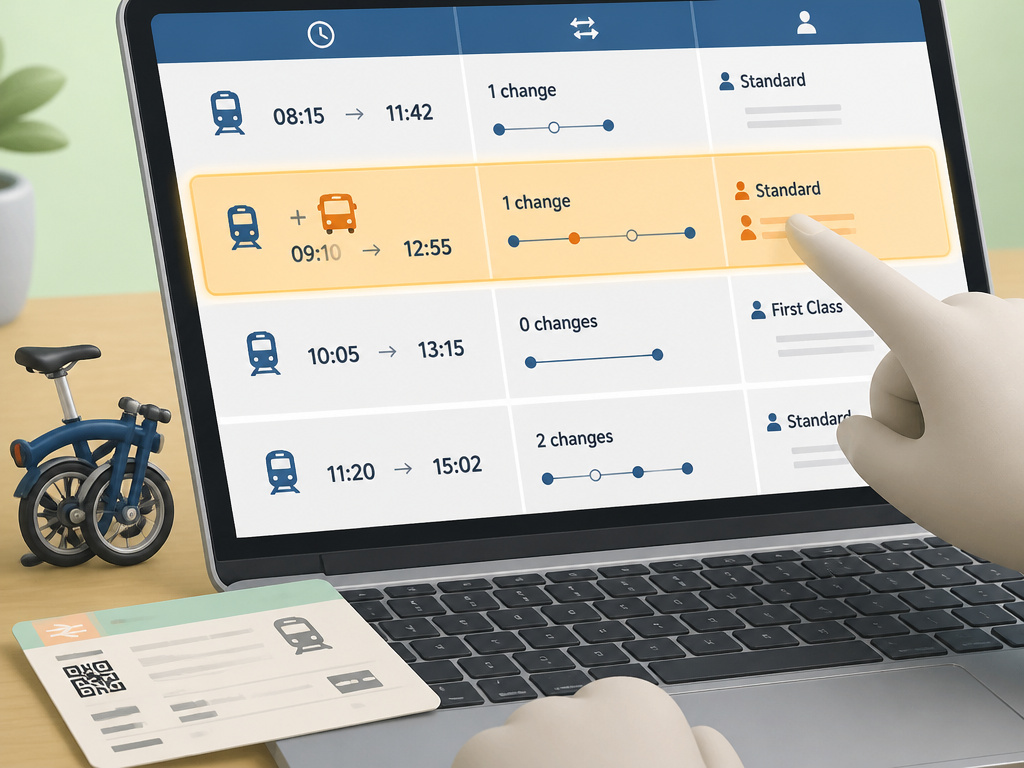
The first results page shows the first 5 options for your outward journey, with arrows to view earlier or later trains. Each option carries more information than most people read.
Here is what is on the screen, and what it is worth to a day tripper.
| Field on the results page | What it tells you | Why it matters for a day trip |
|---|---|---|
| Overtaken Train flag | A faster train leaves later, arrives earlier | You can leave later and still arrive sooner |
| Ferry / bus / rail replacement flag | Part of the journey is not a train | A hidden time sink in a naive timetable read |
| Direct or changes | Whether you stay on one service | Changes mean platform walks and missed-connection risk |
| Standard or First Class fare | Which cabin the fare covers | Useful when one leg is long and crowded |
| On-time or delay status | Current running state of the service | A delayed inbound eats your usable time |
| Cycle policies | Bikes allowed on that service and station | Folding bikes and standard bikes follow different rules |
The ferry, bus, and rail replacement flag is the one people skip. A journey can look like a clean rail run and quietly include a bus leg in the middle.
Easy to miss: A rail replacement leg adds boarding time, luggage handling, and a second chance to miss a connection. It is flagged on the results page, so read the row before you select the service.
Buying the Ticket: Three Operators, Three Rules
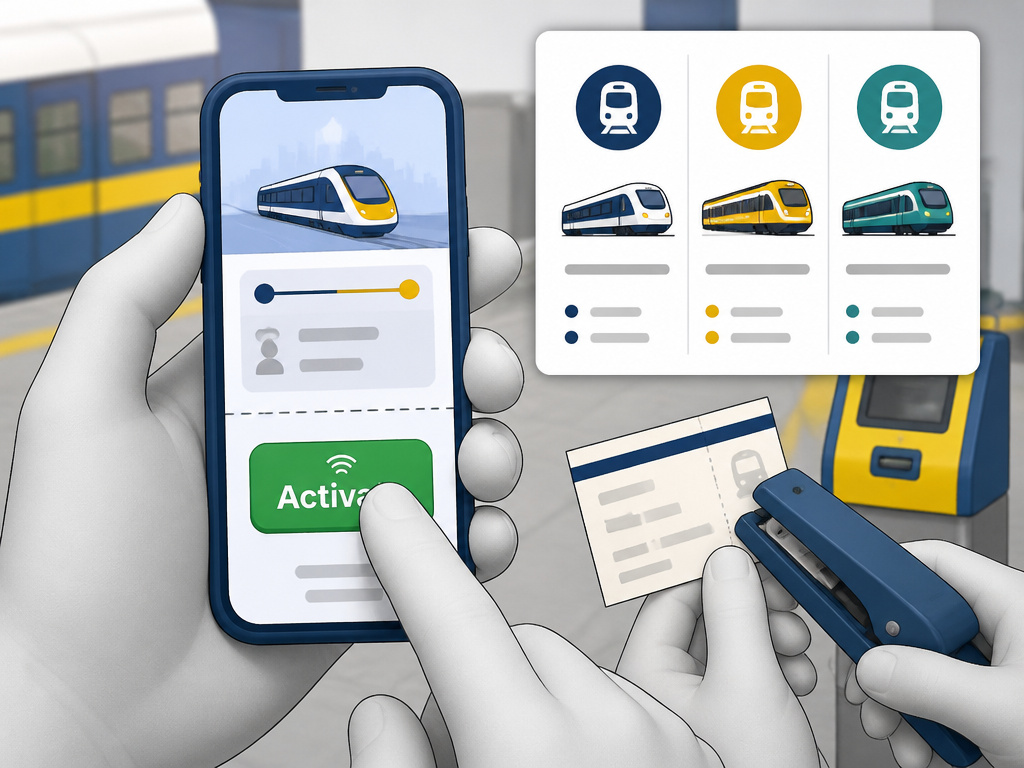
This is the part where operators genuinely disagree, and pretending otherwise gets people fined.
NJ TRANSIT states an absolute rule: always buy your ticket before boarding. Board without one when a ticket machine or window was open at your station and the conductor will charge a $5 cash surcharge on top of your fare. One-way and round-trip tickets expire 30 days from purchase and are non-refundable.
National Rail’s flow treats purchase as the final step after you select a service. No penalty framing, no onboard-purchase surcharge mentioned.
NS requires a valid ticket to travel, but permits e-ticket barcode scanning at gates rather than mandating pre-boarding purchase at a machine.
| Operator | Purchase timing | Enforcement |
|---|---|---|
| NJ TRANSIT | Buy before boarding | $5 cash surcharge if a machine or window was open |
| National Rail | Purchase after selecting a service | No onboard-purchase surcharge mentioned |
| NS | Valid ticket required; gate scanning permitted | Check in at a terminal or gate before boarding |
The lesson is not that one operator is right. It is that the rule belongs to the operator, not to rail travel in general. Read the operator’s own page before your first trip on a new network.
Mobile tickets and the activation trap
NJ TRANSIT’s mobile app is the easiest option: buy your ticket in the app. Then tap Activate while you are standing on the platform, right before you board. Not on the train.
The reason is stated plainly on their own page: cell service may be weak on board. An unactivated ticket in a dead zone is a ticket you cannot show.
Paper tickets are simpler. They do not need to be stamped. Hand them to the conductor on the train.
The 10-15 Minute Rule, and Why It Isn’t Universal
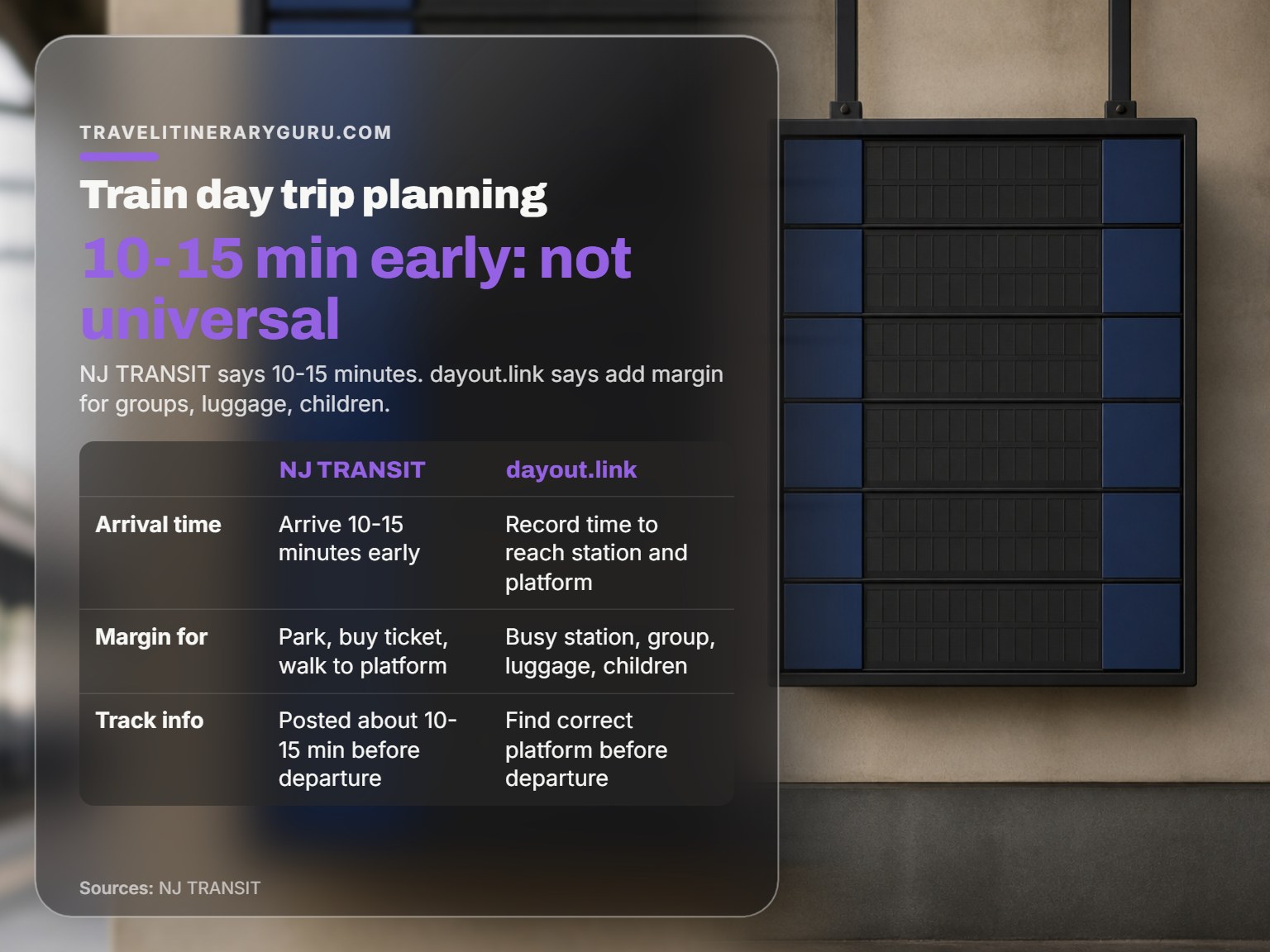
NJ TRANSIT says arrive 10-15 minutes early, to allow time to park, buy a ticket, and walk to your platform.
That number is real, and it is also operator-specific. The dayout.link guide argues the other direction: record the time to reach your departure station, find the correct platform, and walk to your first stop at the destination, then add a sensible margin for a busy station, a group, luggage, or children. For a family on a Saturday at a major hub, 10-15 minutes is optimistic.
Both numbers are correct for their own situation. Solo traveller at a suburban station: 10-15 minutes is generous. Four people, one suitcase, and a stroller at New York Penn on a Saturday: budget more.
Track numbers at major hubs like New York Penn Station, Hoboken, and Newark Penn Station are posted on digital screens and in the NJ TRANSIT App about 10-15 minutes before departure.
Worth knowing before you start: At stations with short platforms, you may need to walk to a specific car number to exit. That is announced onboard, not shown in the planner, so listening matters more than watching the screen.
Which Platform, Which Train, Which Car
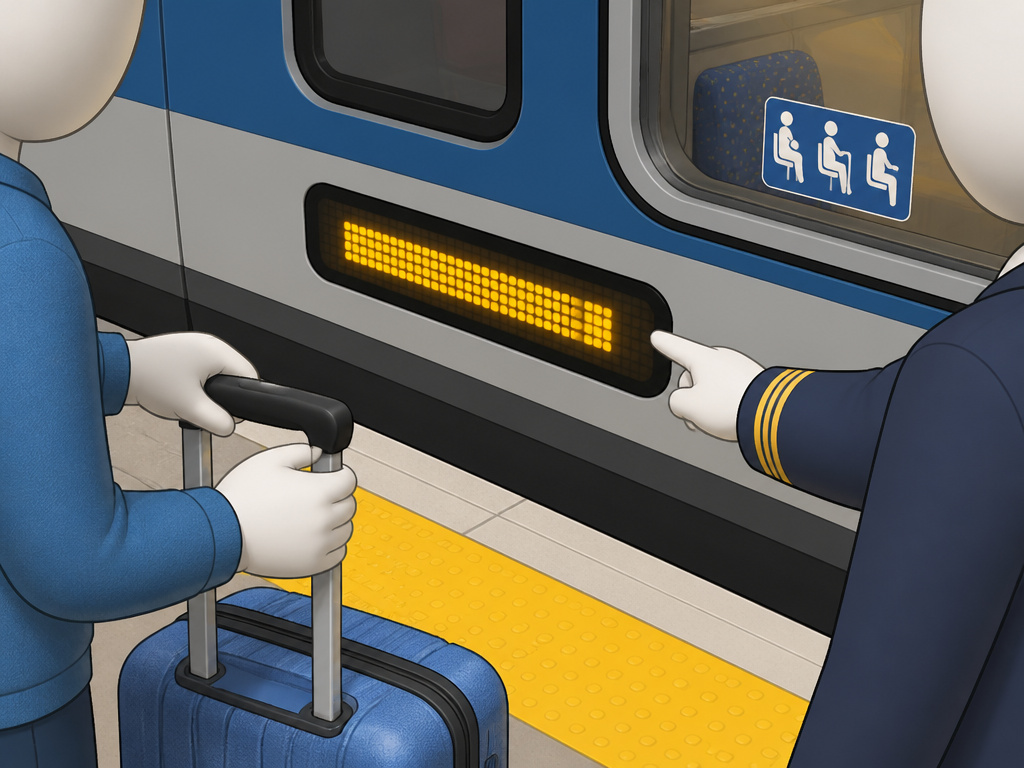
Multiple rail lines often share the same platform. The sign on the platform tells you less than the digital sign on the side of the train itself. Check that, or ask a uniformed crew member, before stepping aboard.
Stay behind the yellow line until the train comes to a complete stop. Let passengers exit first, then board, and watch the gap between the train and the platform.
Seating is unassigned. Take any open seat, but note that priority seating near the doors is reserved for seniors and riders with disabilities.
The first and last cars on weekday rush-hour trains are designated Quiet Commute cars. Silence your phone, skip the calls, and keep conversation to a whisper if you sit there.
It is the difference between stepping off at your stop and doing a luggage-assisted sprint down the aisle.
Bikes, Bags, and the Hoverboard Ban
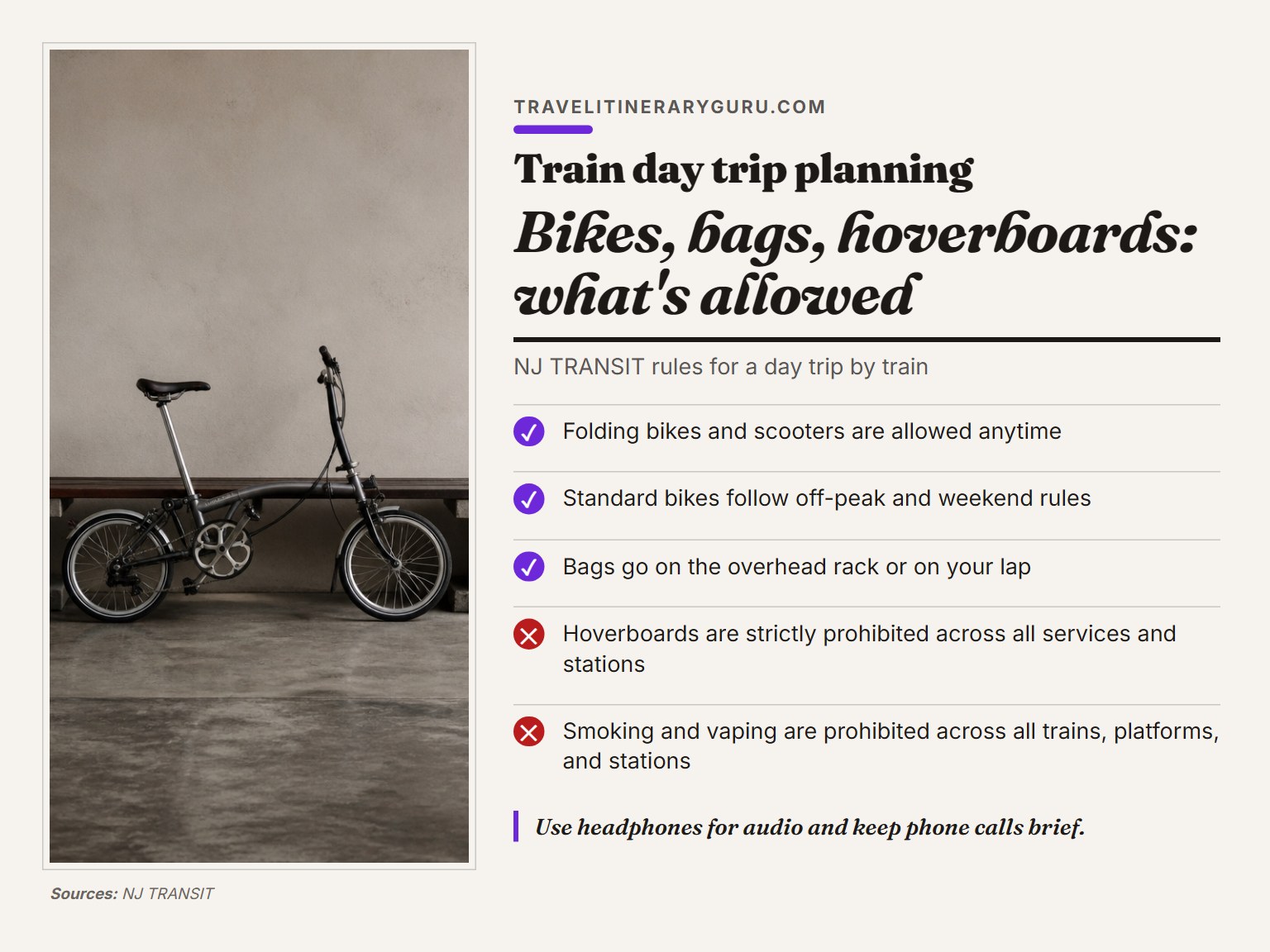
Folding bikes and scooters are allowed anytime. Standard bikes follow off-peak and weekend rules. If your day trip involves a bike at the far end, that distinction decides which train you can take.
Bags go on the overhead rack or on your lap. Do not block empty seats or aisles with luggage.
Hoverboards are strictly prohibited across all NJ TRANSIT services and stations. Not restricted. Prohibited.
Smoking and vaping are banned across all trains, platforms, and stations. Use headphones for audio and keep phone calls brief.
One more thing worth doing: set a Stop Alert in the app. Open the app, select your train, tap your destination station, and confirm the alert. Your phone notifies you when the stop is approaching, which is how you avoid the classic day-trip failure of waking up two stations past your destination.
Why the Plan Needs Three Rechecks
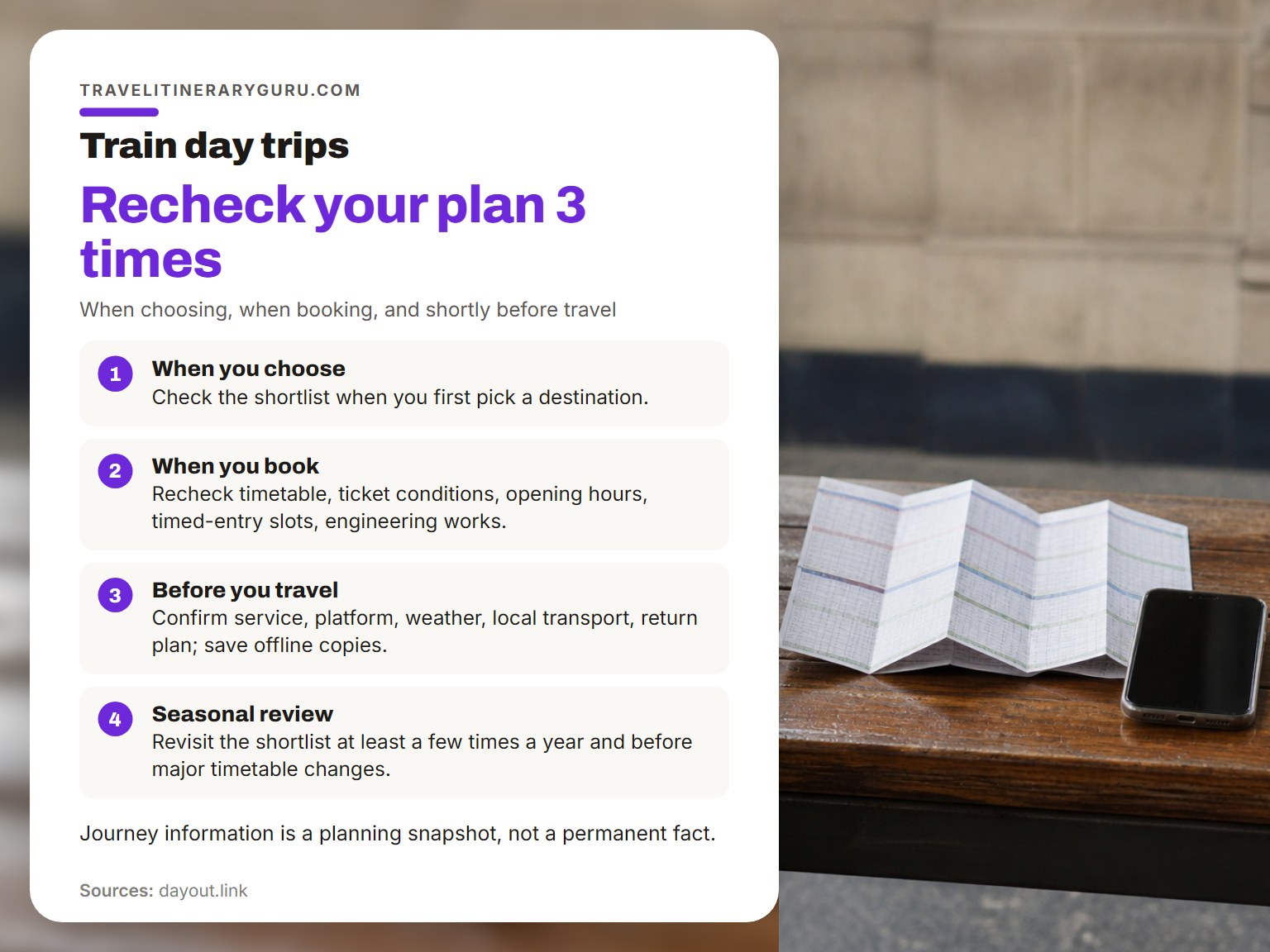
A shortlist should be reviewed at three useful points: when you first choose a destination, when you are ready to book, and shortly before travel.
At the booking checkpoint, recheck the timetable, ticket conditions, attraction opening hours, and available timed-entry slots. Look for planned engineering works or replacement transport in the operator’s current travel information.
At the pre-departure checkpoint, confirm the actual service, platform information when available, weather, local transport, and the return plan. Save offline copies of tickets, addresses, and the last practical route home. Offline copies matter because cell service is weak on the train, and your tickets live on your phone.
There is also a seasonal review. Revisit your shortlist at least a few times a year, and before major timetable changes or periods when holiday schedules may apply. Refresh journey times, ticket rules, station facilities, and attraction access rather than assuming last season’s notes still apply.
Treat journey information as a planning snapshot rather than a permanent fact. Timetables, fares, engineering works, station facilities, and attraction opening times all change.
What to Record Before You Commit
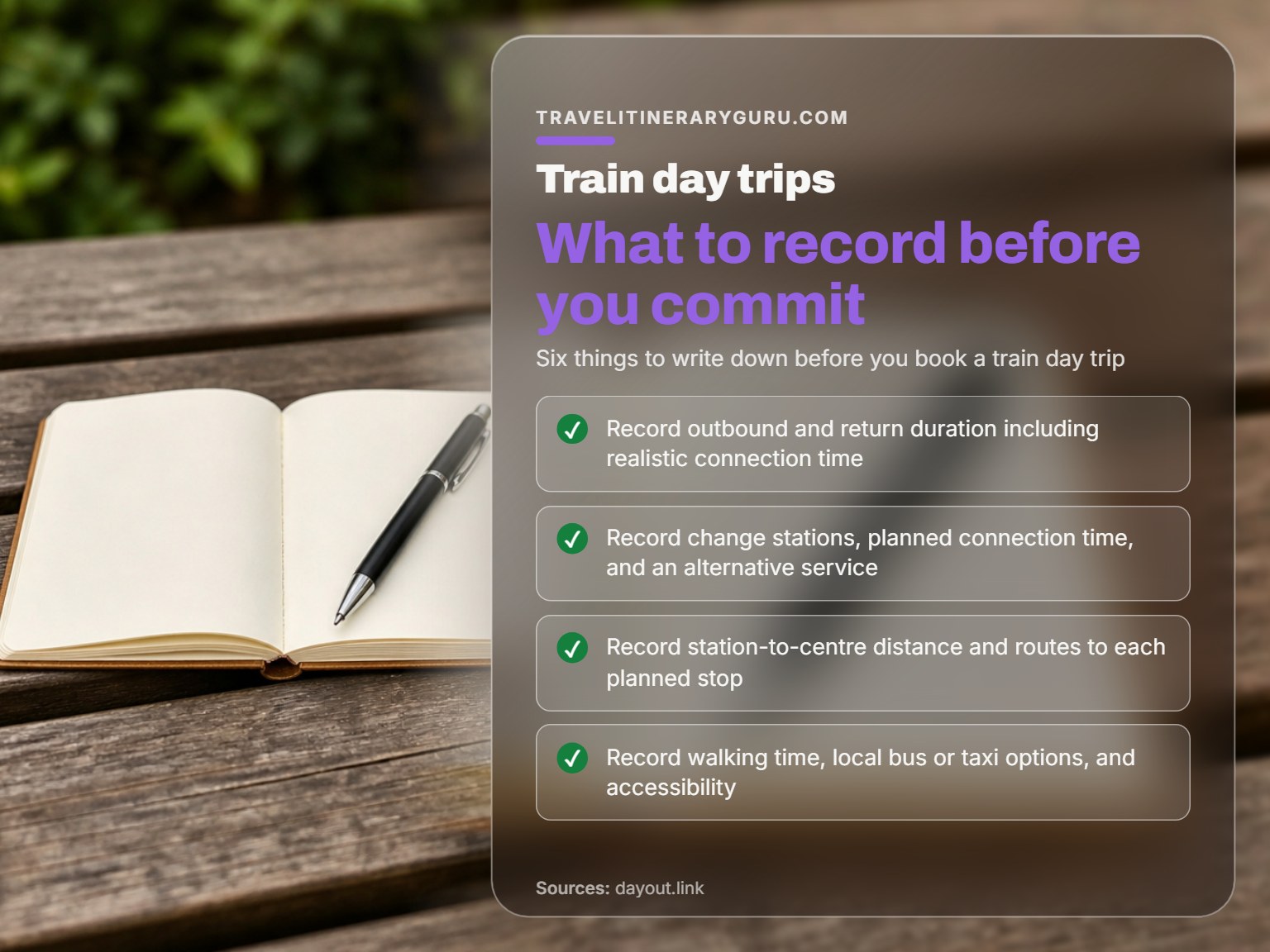
Here is what goes on it.
- Outbound and return duration, including realistic connection time
- Change stations, planned connection time, and an alternative service
- Station-to-centre distance and routes to each planned stop
- Walking time, local bus or taxi options, and accessibility considerations
- Advance or flexible ticket choices, validity, refund terms, and railcard eligibility
- The last useful service, the final connection, and a fallback route
The station-to-attraction distance is not the same as the station-to-town distance. A station can sit close to a historic centre and be a long way from a beach or an out-of-town attraction.
And the last useful service is not the last advertised one. Write down the train you would actually take if everything ran late.
If you are trying to keep the outing inexpensive, prioritise destinations with free things to do near the station: a public park, a market, a waterfront, or a self-guided walking route.
Which Destinations Survive the Shortlist
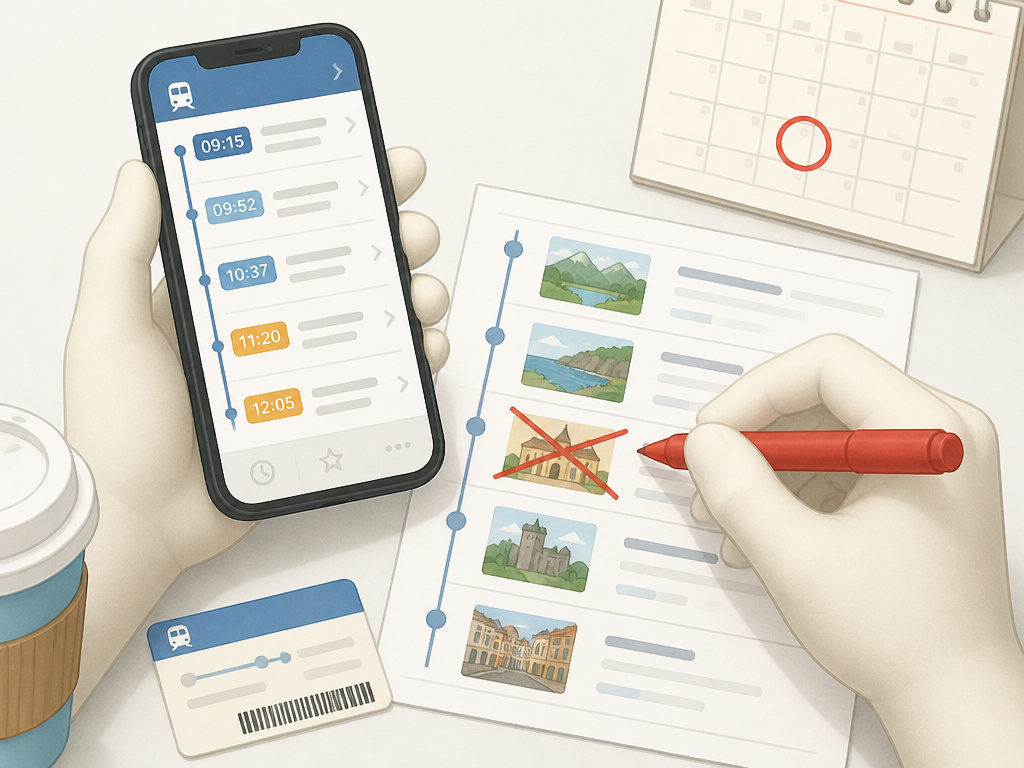
Remove any option that depends on an unrealistic connection or leaves too little time at the destination.
Check that the main attraction is open on your chosen day and that entry fits the train plan. A first or last admission time can determine which service works, and that is a constraint the timetable does not know about.
For popular exhibitions, tours, sporting events, or seasonal activities, confirm whether advance booking is required and whether late arrival affects entry. Then book the core activity first, and select trains that leave enough room for the station walk and a delayed arrival.
Book the thing that cannot move, then fit the trains around it.
Frequently Asked Questions
How far in advance can you book train tickets for a day trip?
National Rail allows booking up to 12 weeks ahead through the Journey Planner.
Do you need to buy your ticket before boarding?
It depends on the operator. NJ TRANSIT requires it, and charges a $5 cash surcharge if you board without a ticket when a machine or window was open at your station. National Rail treats purchase as the final step after selecting a service. NS requires a valid ticket but permits e-ticket gate scanning.
What does “Overtaken Train” mean on a journey planner?
It means a faster train leaves the same station later than the service you selected and arrives at the destination before it does. National Rail flags this on its results page. It is worth checking, because you can sometimes leave later and still arrive earlier.
How early should you arrive at the station?
NJ TRANSIT recommends 10-15 minutes early, which covers parking, buying a ticket, and walking to your platform. At major hubs, track numbers are posted about 10-15 minutes before departure, so arriving much earlier gains you nothing. For groups, luggage, or children, add more.
Why should you activate a mobile ticket on the platform?
Because cell service may be weak on the train. NJ TRANSIT’s own guidance is to tap Activate while standing on the platform right before boarding. An unactivated ticket in a dead zone is one you cannot show the conductor.
What happens if you miss the last useful train home?
You find the fallback route you recorded before you left. That is why the trip record includes a final connection and an alternative service. If you never wrote one down, you are improvising at a station at night, which is the worst time to start.
The Bottom Line
Here is the threshold that decides whether a day trip is worth booking. If the usable hours at the destination, after subtracting station access, platform-finding, connections, and the walk to your first stop, come in too low to justify the journey, do not book it. Overnight instead, or pick somewhere closer.
The first thing to do this week is not to book anything. Open the planner for one candidate destination and record the last useful return train. Write it down with today’s date. If that single number makes the trip feel tight, you have your answer, and you got it before you spent anything.
It is a half day with a long commute attached.
If you are travelling on a shoestring, the free-things-near-the-station filter in the shortlist section will do more for you than anything else here.
