
12 Multi-City USA Itineraries for First-Time Visitors
This post contains affiliate links. As an Amazon Associate, we earn from qualifying purchases.
There is no single best multi-city USA itinerary for first-time visitors, and the 12 multi-city USA itineraries for first-time visitors that are usable cluster into four shapes: a 7-day Northeast rail loop, a 10-day Southwest parks drive, a 14-day single-coast run, and a 15-day or 12-day cross-country rail trip. Everything else is a variation on those four, and the honest differences between them come down to mileage, season, and whether you need a car.
That last variable flips the whole plan. TravelerCenter states plainly that a car is “unnecessary, even a nuisance” in New York, Washington, Philadelphia and Boston, and “essential” for the national parks and California’s coast. One itinerary template cannot cover both ends of that sentence.
What follows separates the four shapes, gives you the real mileage and day counts from the sources, and shows you where the sources contradict each other. I’d rather hand you the disagreement than a clean list that falls apart in Flagstaff.
Key Takeaways
- Pick one region per week, not one country. Rough Guides advises first-timers wanting to see a lot to allow two to three weeks, and says a single week means one region only.
- Route 66 has no agreed duration. AmericaTraveller lists 14-21 days; Rough Guides recommends 10. Both are defensible.
- Open-jaw flights and loop routes are mutually exclusive. Booking into one city and home from another saves backtracking, but it does not work on a Route 66 or Grand Circle loop.
- Season decides which itinerary is even possible. AmericaTraveller caps the Grand Circle at June to early October and New England in the Fall at late September to mid-October.
- The government itinerary page is stale. The National Park Service trip itineraries index carries a “Last updated: January 28, 2020” stamp, so treat it as a starting point, not a current plan.
How Many Days Do You Actually Need?
The 12 multi-city USA itineraries for first-time visitors exist because the country’s scale forces them. Flying from New York to Los Angeles takes about six hours, according to TravelerCenter, which notes that is the same as crossing the Atlantic. The US spans six time zones, per Rough Guides.
Put those two facts together and the arithmetic gets blunt. A week that tries to touch both coasts spends most of itself in transit.
Four itinerary lengths cover the realistic range for a first US trip: seven days supports one region without a car, ten days supports a single driving loop, fourteen days supports one full coast or one rail corridor, and fifteen to sixteen days supports a cross-country rail journey with hotel stops along the way.
Rough Guides frames the same ladder from the traveler’s side. With only a week, stick to one region, the Northeast corridor, California, or an Arizona and Utah road trip. Under five days, you get to know one city and nothing else. Two to three weeks is what it takes to see a lot of the country without rushing it.
Here is where the sources split. Rough Guides says two to three weeks for a broad first trip. CapitolSkyline says you can comfortably visit 4-5 cities in two weeks. Those are not the same claim. One is about geography, the other about city count, and a traveler reading only the second will book five cities and spend the trip in airports.
The Four Itinerary Shapes, With Real Numbers
Mileage is the fastest way to tell whether an itinerary is honest. AmericaTraveller publishes distance and day counts for each route, and the spread is wide enough to be useful.
| Route | Distance | Days | Best Window |
|---|---|---|---|
| East Coast Cities | 450 mi | 10-12 | May-Jun, Sep-Oct |
| Pacific Coast Highway | 640 mi | 5-7 | Apr-Jun, Sep-Oct |
| Utah’s Mighty 5 | 820 mi | 7 | May, late Sep-Oct |
| Grand Circle | 2,100 mi | 15-16 | Jun-early Oct |
| Route 66 | 2,400 mi | 14-21 | May-Jun, Sep-Oct |
Read the first two rows together and the trap shows itself. The East Coast Cities route covers 450 miles in ten to twelve days because you are on trains and in cities. The Pacific Coast Highway covers 640 miles in five to seven. Same rough distance, half the time, because one is a corridor and one is a drive.
The Grand Circle is the outlier. AmericaTraveller lists it at 2,100 miles over 15-16 days, a real driving trip, not a city trip wearing hiking boots.
Common mistake: Booking a loop route and an open-jaw flight in the same plan. TravelerCenter notes open-jaw ticketing is incompatible with round-trip loops like Route 66 or the Grand Circle. You either fly home from where you landed, or you stop calling it a loop.
The Northeast by Rail: 7 Days, No Car
This is the easiest of the 12 multi-city USA itineraries for first-time visitors and the one most people overcomplicate. TravelerCenter lays out seven days as four nights in New York City, a stop in Philadelphia, and two nights in Washington, D.C. That is it. No rental car, no mountain passes, no elevation risk.
Amtrak lists the full Acela run from Boston to Washington at about 7 hours. Boston itself sits roughly 3 hours 30 minutes to 4 hours by train from the New York and Philadelphia area, which makes it a clean swap if you’d rather trade Philadelphia and Washington for New England.
One booking note that matters more than it sounds: TravelerCenter advises booking the Northeast Corridor early because fares rise as trains fill, and seats are guaranteed on reserved trains.
If you want the full step-by-step version of this shape, the first trip to the USA walkthrough covers the booking order and the transit legs in sequence. And if rail is the whole point rather than a convenience, the multi-city USA trip by train guide goes deeper on corridor timing.
The Southwest Loop: 10 Days, Car Required

Ten days is where the driving trips start, and the canonical version is hard to beat. TravelerCenter recommends flying to Las Vegas and driving the parks loop. Zion, Bryce Canyon, the Grand Canyon, Sedona, ending in Phoenix. That is a one-way drive, which means it pairs with an open-jaw ticket: into Las Vegas, home from Phoenix.
The distances inside that loop are bigger than they look on a screen. Bryce to the Grand Canyon South Rim runs about 4 hours 30 minutes to 5 hours, per TravelerCenter. Tusayan sits 6 miles south of the park gate, which is why it fills up first.
Two practical notes from the same source. Give yourself more time than the map suggests in national parks, because viewpoints, shuttles and traffic at entrance stations add up. And check nps.gov and recreation.gov for timed-entry or vehicle reservations in peak season before you commit to dates.
Red Rock Canyon requires a timed reservation in busy months. Red Rock Canyon requires a timed reservation in busy months.
Worth knowing before you start: Yellowstone has no public transport inside the park, per TravelerCenter. If your plan assumes you can park once and shuttle between geyser basins, it doesn’t work that way. You drive, or you book a tour.
The Two-Coast Question, Answered Honestly

This is the disagreement worth knowing about before you book anything, because the sources are not quietly differing. They are selling opposite products.
TravelerCenter’s position is direct: don’t try to see both coasts in a week. Pick one region and fly between regions. Its own route set reflects that, 7 days Northeast, 10 days Southwest, 14 days one coast.
VisitTheUSA and Amtrak Vacations take the other side. VisitTheUSA publishes 12 multi-city itineraries spanning multiple regions, and Amtrak Vacations sells cross-country rail journeys with both coasts in the routing. Amtrak’s “Great American – Majestic Landscapes” runs New York City to Chicago to Denver to Rocky Mountain National Park to San Francisco to Napa Valley, with 8 hotel nights and 6 onboard nights. “The All American” comes in 15-day and 12-day variants with 5 hotel nights and 4 onboard nights, using the Coast Starlight, Empire Builder and Capitol Limited.
Both positions are legitimate. They just answer different questions.
| Position | Held By | What It Assumes |
|---|---|---|
| Pick one region, fly between regions | TravelerCenter | You want depth per stop |
| Cross-country in 10-15 days is viable | VisitTheUSA, Amtrak Vacations | You want the country, not any one place |
I get why people want the second one. The train does the driving, you sleep on board, and you wake up in a different landscape. But the night counts tell the story: 6 onboard nights out of 14 means you are looking at America through a window for nearly half the trip.
Where this goes sideways: Treating Amtrak journey times as fixed. TravelerCenter flags them as approximate, drawn from typical schedules and general reference, and recommends checking with the operator before you travel. Build the plan around a range, not a minute.
Why the 12-Itinerary List Needs a Second Source

The 12-itinerary list that dominates search results originates from VisitTheUSA, which is brand-funded destination marketing rather than an independent planner. That does not make it wrong. It makes it promotional, and it means the list has no reason to tell you a route is a bad idea.
Two concrete gaps show up when you check it against other sources.
First, seasonality. AmericaTraveller caps the Grand Circle at June to early October and East Coast Cities at May to June and September to October. The 12-itinerary list presents its routes without seasonal windows at all. Take a Grand Circle plan into a January search and you’ll find out the hard way.
Second, currency. The National Park Service trip itineraries index, a genuine government source, carries a “Last updated: January 28, 2020” stamp. That is over six years stale. Park reservations, shuttle systems and entrance logistics have all changed since. Use the official National Park Service trip planner for route inspiration, then verify every operational detail on nps.gov and recreation.gov.
If you’re building the route yourself rather than picking one off a list, the multi-city route framework covers how to sequence stops so the transit legs don’t eat the trip.
Season, Elevation, and the Mistakes That Cost Days
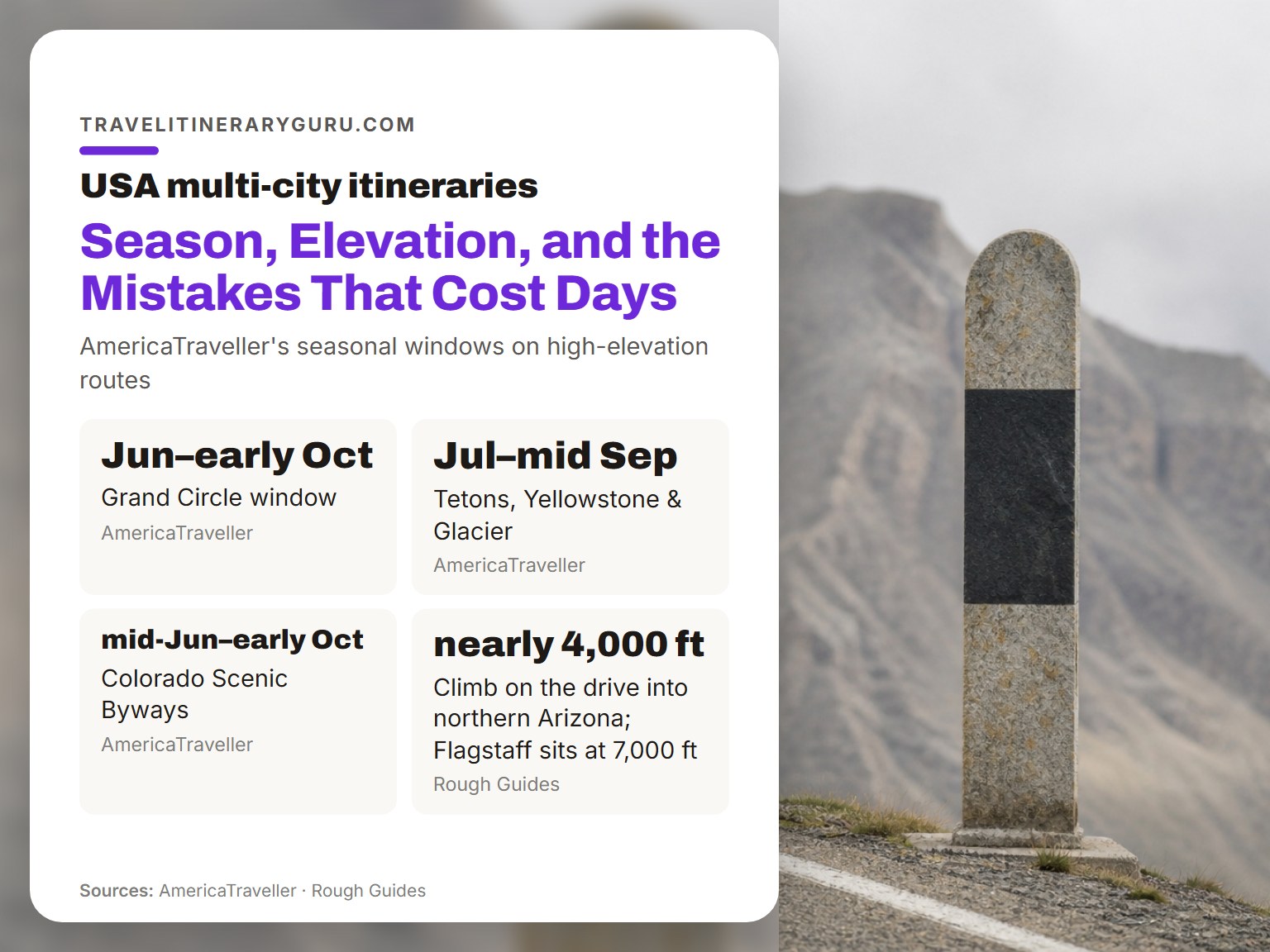
AmericaTraveller’s seasonal windows are the most useful column in its route list, and almost nobody reads them.
| Route | Window | What Closes |
|---|---|---|
| Grand Circle | Jun-early Oct | High passes, some park roads |
| Tetons, Yellowstone & Glacier | Jul-mid Sep | Beartooth and Going-to-the-Sun |
| New England in the Fall | Late Sep-mid Oct | Peak color, then nothing |
| Arizona Beyond the Grand Canyon | Mar-Apr, Oct-Nov | Summer heat at low elevation |
| Colorado Scenic Byways | Mid-Jun-early Oct | Trail Ridge Road, Independence Pass |
Colorado is the clearest case. AmericaTraveller lists the Colorado Scenic Byways route. Denver to Durango, 680 miles, 5 days, with a mid-June to early October window. That window is not about crowds. Trail Ridge Road and Independence Pass are the route, and they close.
Elevation is the second trap. Rough Guides notes the drive into northern Arizona climbs nearly 4,000 feet, and that Flagstaff sits at 7,000 feet. That is a real change in elevation, and it happens on a stretch that looks flat on a map.
Skip this if: You’re traveling December through March and your route depends on a mountain pass. AmericaTraveller’s own windows exclude those months on every high-elevation route it lists. Pick a coastal or southern route instead.
Booking Order and the Details That Save You

The order you book in matters more than the itinerary you pick.
Flights first, and specifically open-jaw ones where the route allows it. TravelerCenter recommends flying into New York and home from Washington, into Las Vegas and out of Phoenix, into San Francisco and out of San Diego. CapitolSkyline makes the same recommendation for the same reason: it saves backtracking time and costs.
Then the fixed-date items. Park reservations, timed entries, and any train you actually need a seat on.
Then everything else. The multi-city flight booking guide walks through the routing options, and the home base question is worth settling early,
Two small things from CapitolSkyline that pay off out of proportion to their size. Pack for 7 days and do laundry halfway, which is the difference between one carry-on and a checked bag you drag through six cities. And download offline maps plus the Uber and Lyft apps before you fly,
For the packing side specifically, the packing for a multi-city trip breakdown handles the laundry math. If you’re working to a number rather than a feeling, the USA trip budget guide covers the one-week case.
Where I’d Send a First-Timer
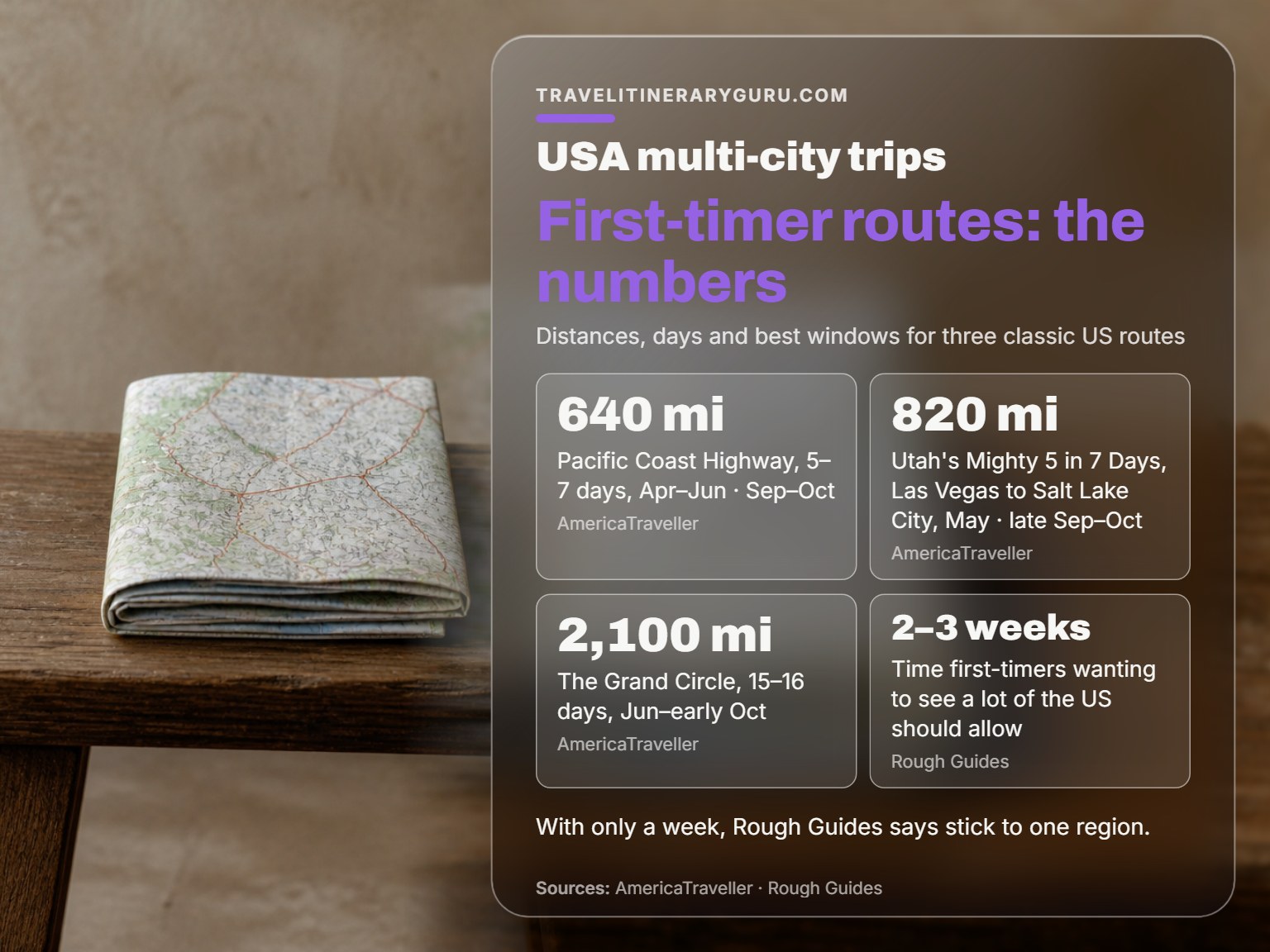
Look, the famous route is not automatically the right one. The Pacific Coast Highway gets the photos, and AmericaTraveller lists it at 640 miles over 5-7 days with an April to June and September to October window. That window is the one AmericaTraveller lists for the route.
My own preference runs to the less obvious routes. Utah’s Mighty 5 in 7 Days covers 820 miles from Las Vegas to Salt Lake City, hitting Zion, Bryce, Capitol Reef, Arches and Canyonlands, with a May and late September to October window. That is five parks in a week on a single route.
If you want one answer and you have two weeks: the 10-day Southwest loop with an open-jaw ticket. It gives you the parks, a one-way drive, and no cross-country flights.
If you have three weeks and want the country rather than a region, take the rail option and accept that you’ll see it through a window. Different trip. Also a good one.
Frequently Asked Questions
How many days do you need for a first US trip?
Rough Guides advises two to three weeks to see a lot of the country, and says a single week means one region only. Under five days, you get to know one city. Rough Guides advises that with only a week, stick to one region, and TravelerCenter lays out seven days in the Northeast by train.
Can you see both US coasts in one week?
TravelerCenter says no, and gives the reason: flying from New York to Los Angeles takes about six hours, the same as crossing the Atlantic. Amtrak Vacations sells cross-country itineraries, but its shortest versions run 10 to 12 days, not seven.
How long does Route 66 take to drive?
The sources disagree. AmericaTraveller lists Route 66 at 2,400 miles over 14-21 days. Rough Guides recommends 10 days for the same Chicago to Santa Monica run. Rough Guides also gives the total length as 2,448 miles, ending at the “End of the Trail” sign on Santa Monica Pier.
Do you need a car for a multi-city US trip?
It depends entirely on the region. TravelerCenter states a car is unnecessary in New York, Washington, Philadelphia and Boston, and essential for the national parks and California’s coast. The Northeast corridor runs on Amtrak. The Southwest and the coast do not.
Is the National Park Service itinerary page current?
No. The NPS trip itineraries index carries a “Last updated: January 28, 2020” stamp. Use it for route ideas, then verify reservations and shuttle details on nps.gov and recreation.gov before you book anything.
What is open-jaw ticketing and should you use it?
Open-jaw means flying into one city and home from another, into New York and out of Washington, into Las Vegas and out of Phoenix, into San Francisco and out of San Diego. Both TravelerCenter and CapitolSkyline recommend it. It does not work on loop routes like Route 66 or the Grand Circle, where you finish where you started.
The Bottom Line
One threshold decides most of this. If your trip is a week or less, pick a single region and stay in it. Rough Guides draws the line at a week for one region; TravelerCenter draws it at seven days for the Northeast by train. Below that, you’re booking a city, not a country.
If your trip is longer than a week, you have a real choice: one driving loop, one coast, or the cross-country rail run. All three work. They just produce different trips, and the night counts tell you which one you’re actually buying.
Book an open-jaw flight where the route allows it, and any timed park reservation you need.
Check whether your route is a loop or a line. TravelerCenter notes open-jaw ticketing is incompatible with round-trip loop itineraries like Route 66 or the Grand Circle.
