
How to Plan Your First Trip to the USA: 7-Step Order
This post contains affiliate links. As an Amazon Associate, we earn from qualifying purchases.
To plan your first trip to the USA, start with the paperwork: an ESTA under the Visa Waiver Program or a visa, plus a passport with at least 6 months of validity left. Then pick one region, keep driving days realistic, and book only the first night.
The paperwork half of that list is binary. Get it wrong and the trip ends at the check-in desk, before you’ve seen anything. That is why how to plan your first trip to the USA matters.
Trip length is where the how to plan your first trip to the USA question gets first-timers into trouble, because the continental USA is vast and a map flattens all of it.
What follows runs in the order I’d actually do it: entry documents, trip length, a route with realistic driving days, then the bookings. Seven steps, and the first two decide how much rework the rest costs you.
Key Takeaways
- Sort your entry document first. An ESTA covers stays under 90 days; a visa is required for anything longer, or if you’ve spent time in certain countries since 2011.
- Aim for 10 days, not 7. Lonely Planet’s guidance puts a single region at that length, especially when you’re flying in from overseas.
- Keep driving days realistic. Past that mark, the final hours of every day turn into something you’re just enduring.
- Book the first night only. Leave the rest open and let the trip tell you where it wants to go.
- Buy travel insurance before you fly. US medical costs are high enough that hospitals may ask for proof you can pay, and a home government won’t cover evacuation.
Sort Your Entry Document Before You Book Anything
Two documents decide whether you board: an approved ESTA or a visa, and a passport with enough validity left to satisfy the airline.
The Visa Waiver Program permits a maximum stay of 90 days for tourism or business. Entry under it requires an e-Passport meeting ICAO standards, and the passport must remain valid for at least six months beyond the planned departure date unless a country-specific agreement between the two governments grants an exemption.
More than 40 countries sit inside the Visa Waiver Program, and travellers from those countries still need to register ahead of the trip. You can apply for an ESTA online, and it has to be secured before boarding if you’re arriving by plane or boat.
Travel history matters as much as nationality, and the Visa Waiver Program official page sets out the statutory list. That list is short, and it catches people who assume a passport settles the question on its own.
Who Needs a Visa Instead of an ESTA
Under the VWP Improvement and Terrorist Travel Prevention Act of 2015, nationals of Visa Waiver Program countries need a visa if they were present in the DPRK (North Korea), Iran, Iraq, Libya, Somalia, Sudan, Syria, or Yemen on or after March 1, 2011.
The same rule applies to anyone present in Cuba on or after January 12, 2021. Dual nationals of Cuba, the DPRK, Iran, Iraq, Sudan, or Syria are ineligible for the program outright, whatever their travel history says.
Non-immigrant visa interviews have to be scheduled at a US embassy or consulate in your country of nationality or residence. That applies to renewals too, so don’t assume a previous visa makes the next one automatic.
For the administrative side, the US government’s guidance on planning a US tourist visit covers extensions and what to do if a passport or visa is lost or stolen mid-trip.
The Passport Rules People Skip
Infants and children each need their own passport. There’s no family exemption and no version of the trip where a child rides on a parent’s document.
A passport with insufficient validity left looks exactly like a valid one. Nothing on the cover warns you, and the problem only surfaces when the check-in agent scans it.
An approved ESTA or a valid visa doesn’t guarantee entry. US Customs and Border Protection officers at the port of entry make that call, and Smartraveller notes that a denied traveller may be held at the port of entry or a nearby detention facility, including in Hawaii, while return travel is arranged.
The two official sources don’t read the same way here. The State Department’s Visa Waiver Program page implies that an approved ESTA or visa is the authorisation needed to travel, while Smartraveller states flatly that approval doesn’t guarantee entry. Plan around the stricter version.
Entry requirements are strict, and US authorities have broad powers to decide eligibility. They can determine inadmissibility for any reason under US law, so carry documents proving you’re in the country legally.
What you need in hand before you fly:
- A passport valid for at least six months beyond your departure date, unless a country-specific agreement exempts you.
- An e-Passport meeting ICAO standards, identifiable by the cover symbol.
- An approved ESTA, or a visa if your travel history or dual nationality rules you out.
- A separate passport for every child travelling with you.
- Proof of legal status, carried on you rather than left in a hotel safe.
How Long Should a First Trip to the USA Actually Be?
Ten days is the number to hold in your head.
Lonely Planet’s guidance is that a region needs at least 10 days to be worth the flight, particularly when you’re arriving from overseas. A major metro such as New York City, Chicago, Los Angeles, or Washington, DC could fill a week on its own, day trips included.
With a week and a half, you can cover two or more cities plus a handful of outlying attractions. That’s also enough time for a couple of national parks inside one region, especially in California or the Southwest.
The legal maximum is a separate question. The Visa Waiver Program caps a stay at 90 days, and that ceiling has nothing to do with how much of the country you can realistically see.
What most people get wrong: Treating the 90-day legal cap as a trip-length target. Many cities in 10 days looks tidy on a spreadsheet, and airport time alone eats the middle of the trip.
| Trip length | What it realistically covers | Source |
|---|---|---|
| One week | One major metro, plus day trips | Lonely Planet |
| 10 days | One region in depth | Lonely Planet |
| A week and a half | Two or more cities and outlying attractions | Lonely Planet |
| Up to 90 days | The legal maximum under the Visa Waiver Program | US State Department |
If you want to see how a 10-day shape looks on paper before you commit, the multi-city USA itineraries collection is the comparison I’d start with.
The 4-Hour Driving Rule (and Why Nine-Hour Days Break Trips)
Somewhere west of Moab the conversation stops. The radio is still on, the road is straight, and the passenger seat has gone quiet in a way that has nothing to do with being tired.
I learned that on a long haul from Moab to Flagstaff. My wife didn’t say a word for the last stretch, and I couldn’t blame her. Now every USA route I build keeps driving days realistic, with nothing scheduled after arrival.
The trip quality roughly doubles. That’s not a small effect.
A full day of driving is a full day of travel. Everything you add past that comes out of the next morning.
Distances are the reason. Even inside a single region the gaps are long and public transport is thin, so when you compare a how to plan your first trip to the USA, an internal flight often makes more sense than a drive. That’s a legitimate planning choice, not a failure of ambition.
For route sketching I use mapping tools to sanity-check drive times, trail apps for anything involving a trailhead, and navigation apps for the day-of driving. Roadtrippers is the one that stops me writing an overly long day into a plan without noticing.
The trip route is where most of the real work happens, and it’s the part people rush.
I check for winter closures before I lock anything in. The passes I most want to drive are the ones that shut first, and a closed pass can add hours to a day that was already too long.
Scenic coastal drives get recommended to every first-timer, and I think they’re overrated: beautiful, crowded, and expensive. A quieter scenic byway is what I’d send you to instead. It’s stunning and quieter than you’d expect.
How Early Do You Really Need to Be at the Airport?
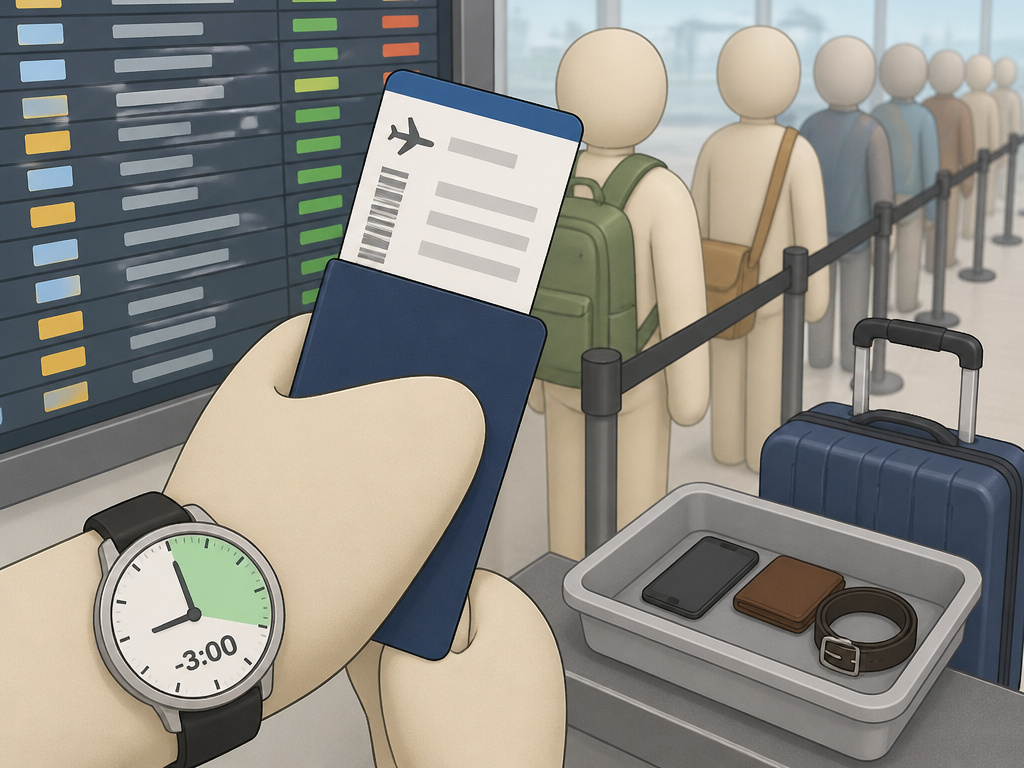
Three hours is the number to plan around.
Lonely Planet advises planning up to 3 hours to clear security if you’re flying out of a busy hub such as Houston, Chicago, or New York. That’s the only concrete figure any of the major sources gives.
Australia’s Smartraveller USA travel advice takes a different line. It advises allowing sufficient time without naming a number, and notes that customs and immigration queues can run long even for Global Entry and TSA PreCheck holders. That’s the part worth hearing twice.
The line at a hub moves in long flat stretches, then stops dead when one bag gets pulled for a second look. No amount of trusted-traveller status changes that.
Keep an eye on security wait times a few days before your flight so you know what’s normal, then watch closely on the day itself. Arrive with room to spare rather than with a plan that assumes everything runs on time.
For domestic flights you need a passport or a DHS-compliant photo ID that meets REAL ID requirements. Expect enhanced screening, including on domestic routes, and be aware that you can be denied boarding if you’re showing signs of illness.
The first-time flyer checklist is useful for people who haven’t flown long-haul before.
Do You Know Which US States Want an International Driving Permit?
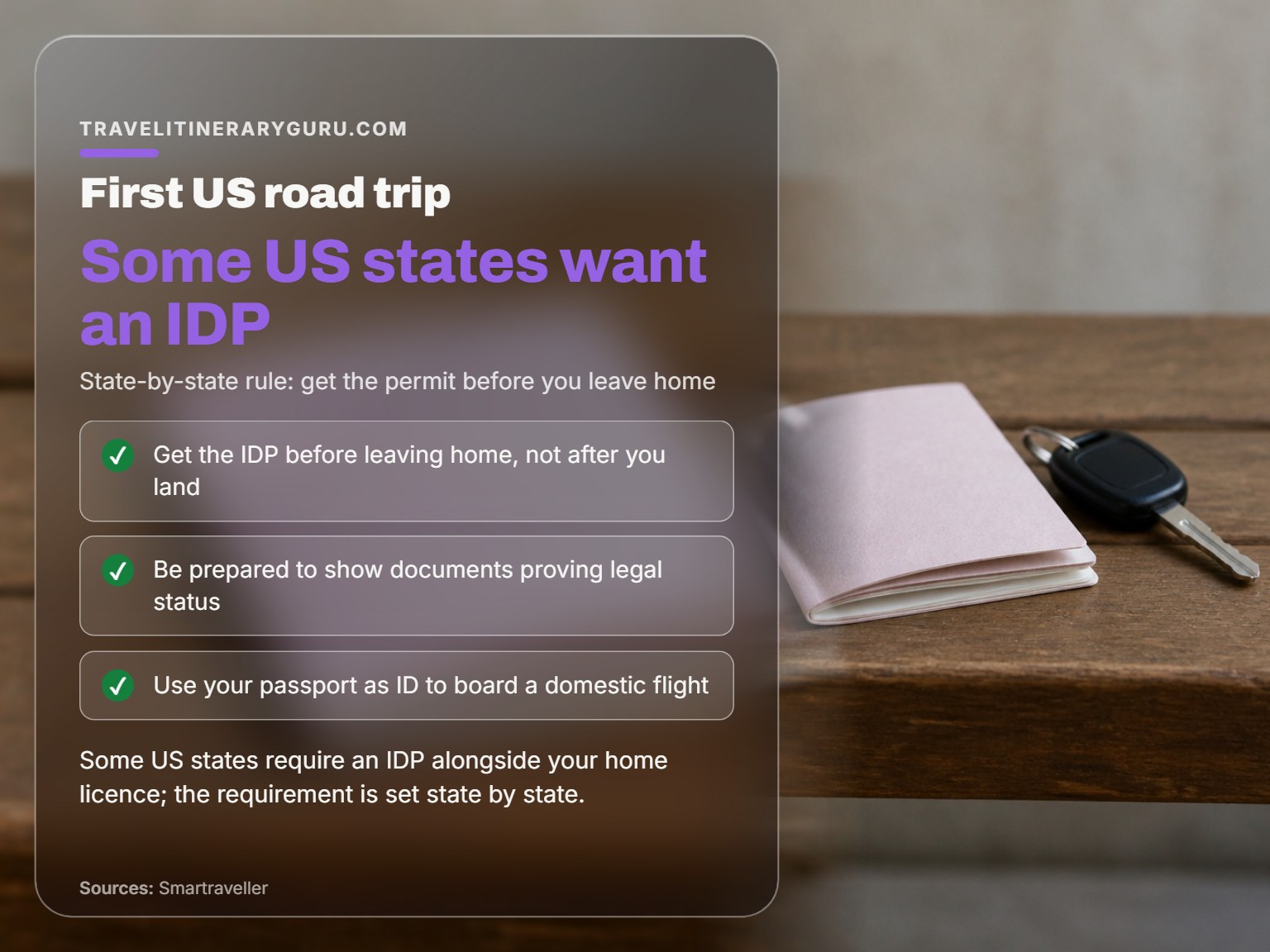
Some US states require an International Driving Permit on top of your home licence, and the requirement is set state by state. Get the permit before you leave home, not after you land.
Road rules vary between states too, so learn the local ones before you drive rather than during.
A few ground-level rules that don’t make it into planning guides:
- Tip 20% at sit-down restaurants. That’s the going rate, and it isn’t built into the price you see.
- Say hello when you walk into a shop. It reads as polite, and skipping it reads as rude.
- Keep politics out of small talk. Lonely Planet’s advice is blunt on this, and it’s good advice.
- Carry proof that you’re in the US legally. Authorities actively pursue, detain, and deport people who aren’t, and producing documents ends the conversation fast.
- Expect medical costs. Care in the US is expensive, and you may be asked to show proof of insurance or your ability to pay before you’re treated.
Easy to miss: Some US states want an International Driving Permit alongside your home licence. Arrive at a rental counter without one and the booking can be refused on the spot.
| What goes wrong | Why it happens | Fix |
|---|---|---|
| Refused at the rental counter | No International Driving Permit | Get the permit before you leave home |
| Asked to pay before treatment | No proof of insurance | Carry policy details and an emergency contact |
| Stopped and asked for documents | No proof of legal status | Carry your passport, not a photo of it |
| Denied boarding on a domestic flight | No REAL ID-compliant photo ID | Use your passport as the ID |
Smartraveller also states plainly that the Australian Government won’t cover evacuation costs. Whatever passport you carry, price the return of your own body into the insurance decision.
Build the Route Around One Region, Not Six Cities
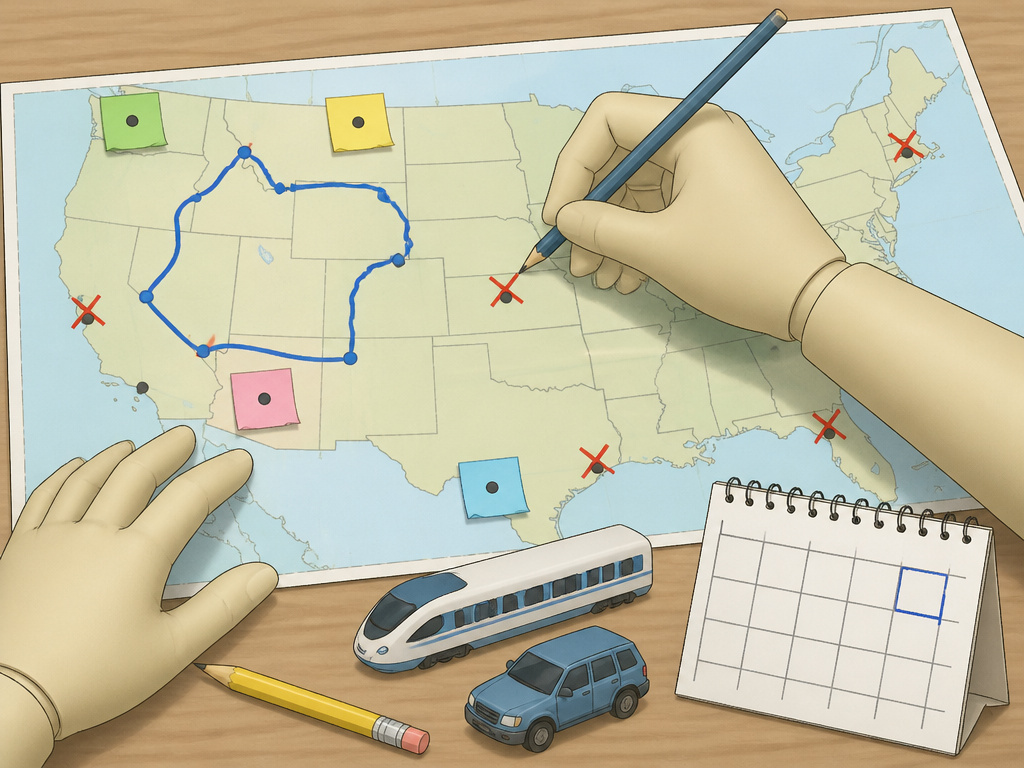
A national rail route map is the fastest way to understand how big the country is, and the fastest way to over-plan it.
I tried to plan a multi-city trip around a rail pass once and nearly drove myself mad. Fair warning: the pass has blackout dates and segment limits, so I ended up mapping every leg in a spreadsheet. It worked. Next time I’ll build in more buffer days.
Flexibility is the whole trick with rail. I had to reroute once because a segment was full, and that detour turned out to be the best part of the trip. Now I always leave one day unplanned.
I won’t build a first USA itinerary around more than one region, even for a two-week trip. The transit days eat the trip, and the traveller spends the whole time looking at the next thing instead of the thing in front of them. I’ve watched that happen too many times to keep recommending it.
If rail appeals, planning a multi-city USA trip by train is a different exercise from planning a drive.
Blue Highways vs Interstates
For scenery and small-town stops, the two-lane roads win. For a long transit day with a fixed arrival time, the interstate wins because it’s predictable. Mixing them badly is how you end up with a beautiful drive that puts you in a strange town after dark.
The New York vs Los Angeles question comes up often, and they suit genuinely different travellers.
Hawai’i needs its own check. After Hurricane Lowell, the Hawai’i Tourism Authority encouraged travellers planning to visit Kaua’i to postpone or choose another island. If Hawai’i is on your list, monitor the forecast and confirm directly with your airline, accommodation, cruise line, and activity providers before you commit.
The US government travel planning resource at Trade.gov names VisitTheUSA.com as the official travel site of the USA, covering all 50 states, five US territories, and hundreds of destinations. Popular park trails need booking months ahead, and the famous ones fill first.
The 7-Step Order for Planning Your First Trip to the USA
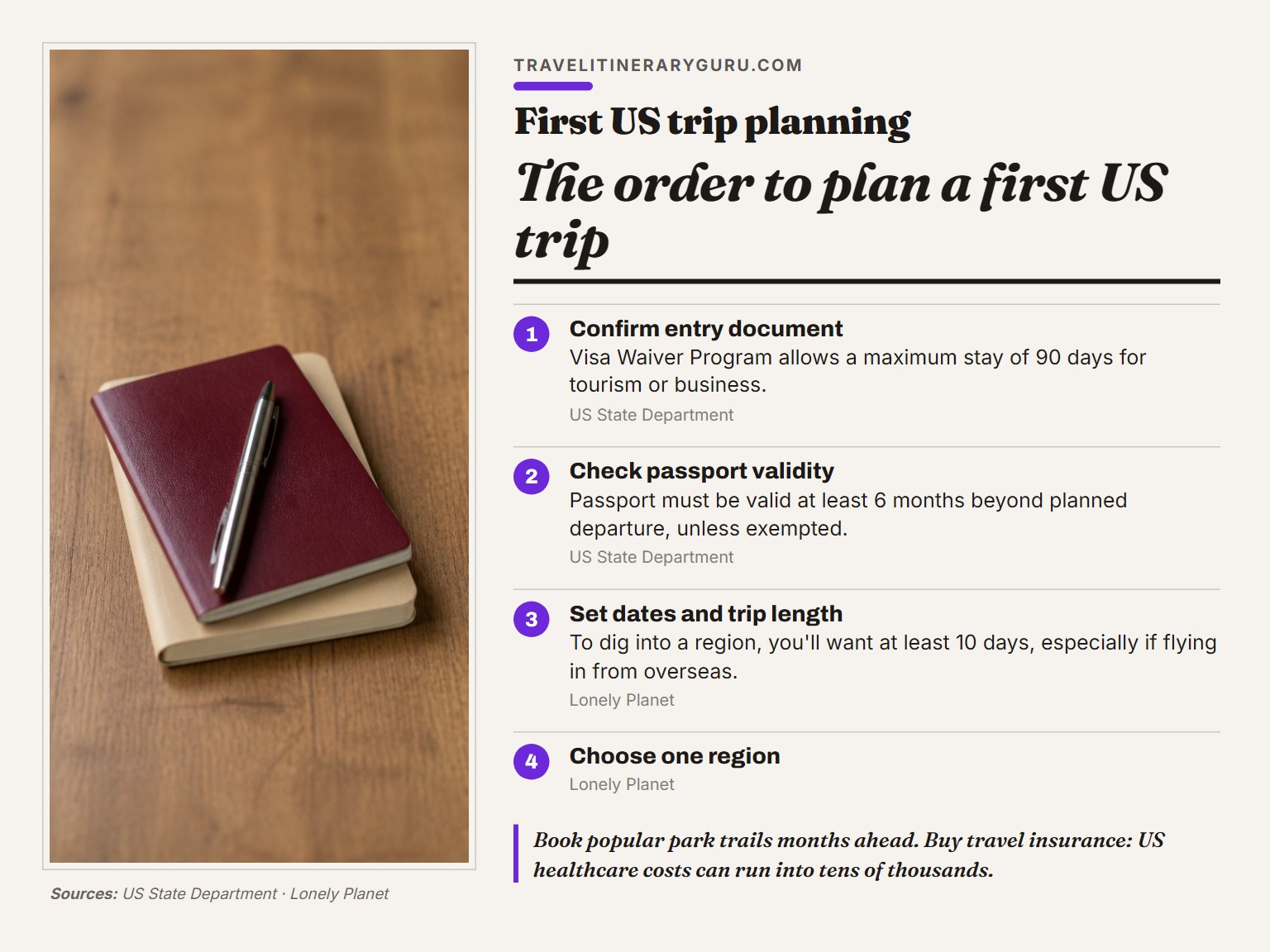
Documents before dates, dates before region, region before route. Get that sequence wrong and you’ll rebook something expensive.
- Confirm your entry document. Skip this and you can be turned away at check-in with no refund and no recourse.
- Check the passport validity window. Under six months left and the airline can refuse boarding before you reach US soil.
- Set your dates and your trip length. Picking dates first is how people end up with 10 days and a six-city wish list.
- Choose one region. Two regions in one trip means losing a full day to transit in each direction.
- Sketch the route with realistic driving days. Longer days push you into arriving after dark on unfamiliar roads.
- Book the first night, plus any park trails that need booking ahead. Booking all ten nights up front locks you into a plan you haven’t tested.
- Buy travel insurance and run a pre-trip checklist. Without it, a single clinic visit becomes the story you tell about the trip.
The travel itinerary you end up with is mostly a record of the order you made decisions in.
The pre-trip checklist I run before every international departure covers the boring items: documents, insurance, prescriptions, and a copy of everything stored somewhere other than your phone.
One thing I’ve changed my mind on. I used to plan every half-day. A slow morning in a local neighbourhood turned out to be the part of the trip people talked about afterward. Now I try to include at least one unstructured half-day.
Frequently Asked Questions
How long can I stay in the USA on an ESTA?
The Visa Waiver Program allows a maximum stay of 90 days for tourism or business. Anything longer needs a visa, and the 90 days is a legal ceiling with no relationship to how much you can actually see.
Do I need a visa if I’ve travelled to certain countries?
Sometimes, yes. Nationals of Visa Waiver Program countries need a visa if they were present in the DPRK, Iran, Iraq, Libya, Somalia, Sudan, Syria, or Yemen on or after March 1, 2011, or in Cuba on or after January 12, 2021.
Does an approved ESTA guarantee I’ll be allowed in?
No. An approved ESTA or valid visa doesn’t guarantee entry, because US Customs and Border Protection officers at the port of entry make that decision. If entry is denied, you may be held at the port of entry or a nearby detention facility, including in Hawaii, while return travel is arranged.
How much time should I allow at the airport?
Lonely Planet suggests planning up to 3 hours to clear security at busy hubs such as Houston, Chicago, or New York. Smartraveller advises allowing sufficient time without naming a figure, and notes that customs and immigration queues can be long even for Global Entry and TSA PreCheck holders.
Do my children need their own passports?
Yes. Infants and children each require their own passport, and there’s no family exemption.
Is travel insurance actually necessary?
Yes. Care in the US is expensive, you may be asked to show proof of insurance or your ability to pay before treatment, and Smartraveller states that the Australian Government won’t cover evacuation costs.
Before You Go
Do one thing this week: check your passport’s expiry date against your return date plus six months. That single number ends more first trips to the USA than anything else on this list, and it’s the cheapest problem to fix early.
Everything above assumes you’re travelling on a Visa Waiver Program passport or a standard tourist visa. If you’ve spent time in one of the listed countries since 2011, or you hold dual nationality from one of them, the entry document changes and every other decision waits behind it.
One concession, because it matters: I’m genuinely out of my depth on luxury travel. If this is a five-star honeymoon, take the structure here and get the hotel and dining recommendations from someone who does that work properly.
And the part I keep coming back to. The best days on a first USA trip have three planned anchor points and nothing else. Everything after that is improvising, which is where the trip actually happens.
