
New York vs Los Angeles for a First-Time USA Visit
This post contains affiliate links. As an Amazon Associate, we earn from qualifying purchases.
New York vs Los Angeles for a first-time USA visit splits on scale and motion: New York packs five boroughs into a walkable grid where 20 north-south blocks equal about a mile, while Los Angeles spreads across a basin where a car decides what you see. Choose New York for density and transit, Los Angeles for weather and space.
That block math is the most useful number in the New York vs Los Angeles for a first-time USA visit question. Five blocks uptown is roughly a quarter mile; the same five blocks crosstown, from First Avenue to Sixth Avenue, runs about a mile. Los Angeles has no equivalent shortcut, because its distances are measured in drive times that swing hour by hour.
What follows is the practical split: how each city moves, what the weather does to a ten-day plan, what the entry paperwork demands, and how many days each one actually deserves.
Key Takeaways
- Twenty blocks is one mile on Manhattan’s grid, but the same block count crosstown covers roughly four times the ground.
- Los Angeles Metro covers specific destinations well and the whole city poorly.
- New York’s coldest month averages a 40°F high; Los Angeles never drops below a 67°F average high at any point in the year.
- ESTA covers stays of up to 90 days, and approval still doesn’t guarantee entry at the border.
- Two anchors a day, nothing else scheduled. That pace works in both cities, and it’s the one planning rule I’d defend hardest.
Manhattan Runs 13.4 Miles. Los Angeles Runs on Drive Times.
Manhattan Island is about 13.4 miles (21.6 km) long and 2.3 miles (3.7 km) across at its widest point, according to NYC Tourism. You can walk the length of it in a long afternoon if your feet cooperate.
Manhattan follows a grid where avenues run north-south and streets run east-west. Fifth Avenue divides the island into east and west sides, and street addresses increase in increments of 100 per block moving away from Fifth Avenue. Twenty north-south blocks equal roughly one mile, while the same block count crosstown covers far more ground.
New York City is five boroughs. Manhattan and Staten Island are islands, Brooklyn and Queens sit on Long Island, and the Bronx is attached to the mainland. Bridges, tunnels and ferries do the connecting.
The grid is what makes Manhattan readable. Avenues run roughly north to south, streets run east to west, and Fifth Avenue splits the island into east and west. Addresses climb in increments of 100 per block as you move away from Fifth.
Los Angeles has no equivalent. Its official city area is 468.67 square miles, and the state tourism office describes the whole spread as “little more than 500 square miles.” Lonely Planet puts the city at 2,281 square miles, which looks like a metro-wide figure rather than a city limit. Treat any LA size claim with suspicion until you know which boundary it’s using.
Scale changes the plan. In New York you can chain four neighborhoods into one afternoon on foot. In Los Angeles, four neighborhoods in one afternoon is a driving day.
I’ve planned trips in both cities, and the biggest error I see is treating Los Angeles like a walking city because a map makes it look continuous. The official New York City visitor information page lays out the borough geography and the grid math in one place, and it’s worth ten minutes before you book anything.
Which City Fits a First-Time USA Trip Better?
Pick the wrong one and you’ll spend a week fighting the city instead of enjoying it. The honest split isn’t personality type. It’s how much time you have and how much you want to walk.
| Traveler Type | Better First Pick | Why |
|---|---|---|
| Solo or couple, five to seven days | New York | Compact grid, no car needed |
| Beach, theme parks, long drives | Los Angeles | Coast, Universal, Disneyland |
| Travelling with young children | Los Angeles | Open beaches, slower days |
| Museums and food, no driving | New York | Both are dense and transit-reachable |
| Warm weather in winter | Los Angeles | January highs average 68°F |
Choose New York for Density and Transit
New York rewards short trips because the grid compresses distance. A three-day visit can cover lower Manhattan, a major museum and one outer borough without a single taxi ride.
Choose Los Angeles for Weather and Space
Los Angeles rewards longer trips. The sprawl stops being an obstacle around day five and starts being the reason you came.
PicksAndTrips draws the line cleanly: New York for cities and culture, Los Angeles for beach and sunshine. Visit California pushes back on the culture framing by noting LA is second in population only to New York and carries its own cultural weight. Both are arguing from positioning rather than data, which is worth remembering when you read either one.
I’d push back on choosing by personality type. Time is the better filter. Under seven days, New York. Ten days or more, and Los Angeles finally pays you back for the flight.
The two cities’ own tourism pages also disagree with each other on the small stuff, and it’s worth seeing the disputes side by side before you trust any single number.
| Point of Disagreement | One Source Says | Another Says |
|---|---|---|
| Visa Waiver countries | NYC Tourism: 42 countries | Third-party ESTA guide: 41 |
| Los Angeles December highs | Discover LA: low 70s°F | Weather Spark: 67°F |
| LA city land area | City of LA: 468.67 sq mi | Lonely Planet: 2,281 sq mi |
| Car needed in Los Angeles | Lonely Planet: yes, most convenient | Time Out LA: not in some zones |
| ESTA validity | NYC Tourism: stays up to 90 days | Third-party guide: 2 years |
None of those gaps are scandals. They’re just what happens when a marketing page, a government office and a statistical model each answer a slightly different question.
How Do You Get Around Without Wasting Half the Trip?
The New York vs Los Angeles for a first-time USA visit decision comes down to transit more than any other single factor. Get it right and both cities open up. Get it wrong and you’ll spend the week in the back of a car.
NYC Tourism calls New York “an excellent walking city” and says walking is the best way to learn the neighborhoods. The same page then tells you that you’ll need subways, buses and cabs to cover real distances. Both are true, and the tension is the point: walk the neighborhood, ride between them.
The subway runs around the clock.
Before you start: Don’t hail livery cabs at the airport in New York, and don’t rent a bike from a company you can’t verify is licensed. An unlicensed operator has no meter, no insurance record and no recourse if the arrangement changes mid-ride. In Los Angeles, extreme heat pushes the county into Cooling Center mode, so check the alert map before a long outdoor day.
- Pick your base neighborhood before you pick a hotel. Skip this and you’ll spend the trip commuting between your bed and everything you actually came to see.
- Load Citymapper for New York and the Metro app for Los Angeles before you land. Without them you’ll default to rideshare, which is the fastest way to blow a daily budget.
- Decide the car question per city, not per trip. Renting in New York for the whole visit means paying for parking you’ll never use and a vehicle that sits idle.
- Buy transit passes at the machine or in the app. Unofficial sellers on the platform are the oldest scam in the system, and the pass they hand you won’t scan.
On Los Angeles, the sources genuinely disagree. Lonely Planet says the best and most convenient way to get around is with a car. Time Out LA counters that you might not need one if you stay inside a specific corridor. Both are describing real LA.
The car is mandatory for Malibu, the Pacific Coast Highway and Angeles Crest Highway. It’s optional for a Downtown, Santa Monica and Pasadena triangle.
Transit quality is disputed too. Time Out calls the system respectable; Lonely Planet calls it somewhat lackluster and nowhere near as extensive as New York or Chicago. The honest read: LA Metro covers specific destinations well and the whole city poorly.
The Late-Night Gap That Decides Your Hotel
New York’s subway runs 24 hours. LA’s rail system does not, so after midnight you’re on rideshare whether you like it or not.
A 4-day Los Angeles itinerary built inside the transit-viable zones looks nothing like one built around a rental car. Pick the version that matches your tolerance for driving in traffic.
The short version: walk the neighborhood, ride between neighborhoods, and know when the trains stop.
What the Weather Does to a Ten-Day Plan

The numbers behind that are worth knowing. Over a record running from 1980 to 2016, Los Angeles average highs range from 67°F in December to 84°F in August. New York runs from 40°F in January to 84°F in July.
- Rain separates them more sharply than temperature. LA’s wettest month averages 3.3 inches, and July and August average 0.0 inches.
- New York never drops below 2.2 inches in any month, and April is its wettest at 3.7 inches.
- Snow is the cleanest split. New York averages 6.1 inches in January and February. Los Angeles averages 0.0 inches every month of the year.
- Clear skies favor LA in every single month, from 58% in February to 90% in August and September. New York ranges from 48% to 63%.
- LA sees as few as 0.1 days of precipitation in July and as many as 5.4 in February. New York ranges from 6.7 days in February to 10.3 in July.
Discover Los Angeles describes the climate as mild Mediterranean year-round with warm days and low humidity. Weather Spark’s record puts LA’s December and January highs at 67°F to 68°F, which sits below the “low 70s” floor that description implies. The same Discover LA page also points visitors to county Cooling Centers during extreme heat, which is a useful admission that “year-round mild” has exceptions.
Where this goes sideways: Booking Los Angeles in February for the beach. That’s the wettest month at 3.3 inches, and the coast sits gray more often than not.
Weather Spark’s climate comparison of Los Angeles and New York City covers all twelve months, and its own methodology notes flag the limits of model-based reconstruction on a coarse grid.
Flexible dates matter more in New York, where when to visit New York City for good weather can swing a trip from pleasant to punishing.
ESTA, Entry, and the Paperwork Nobody Reads in Time
Entry paperwork is where first-time visitors lose the most planning time. Sort it first and the rest of the trip gets easier.
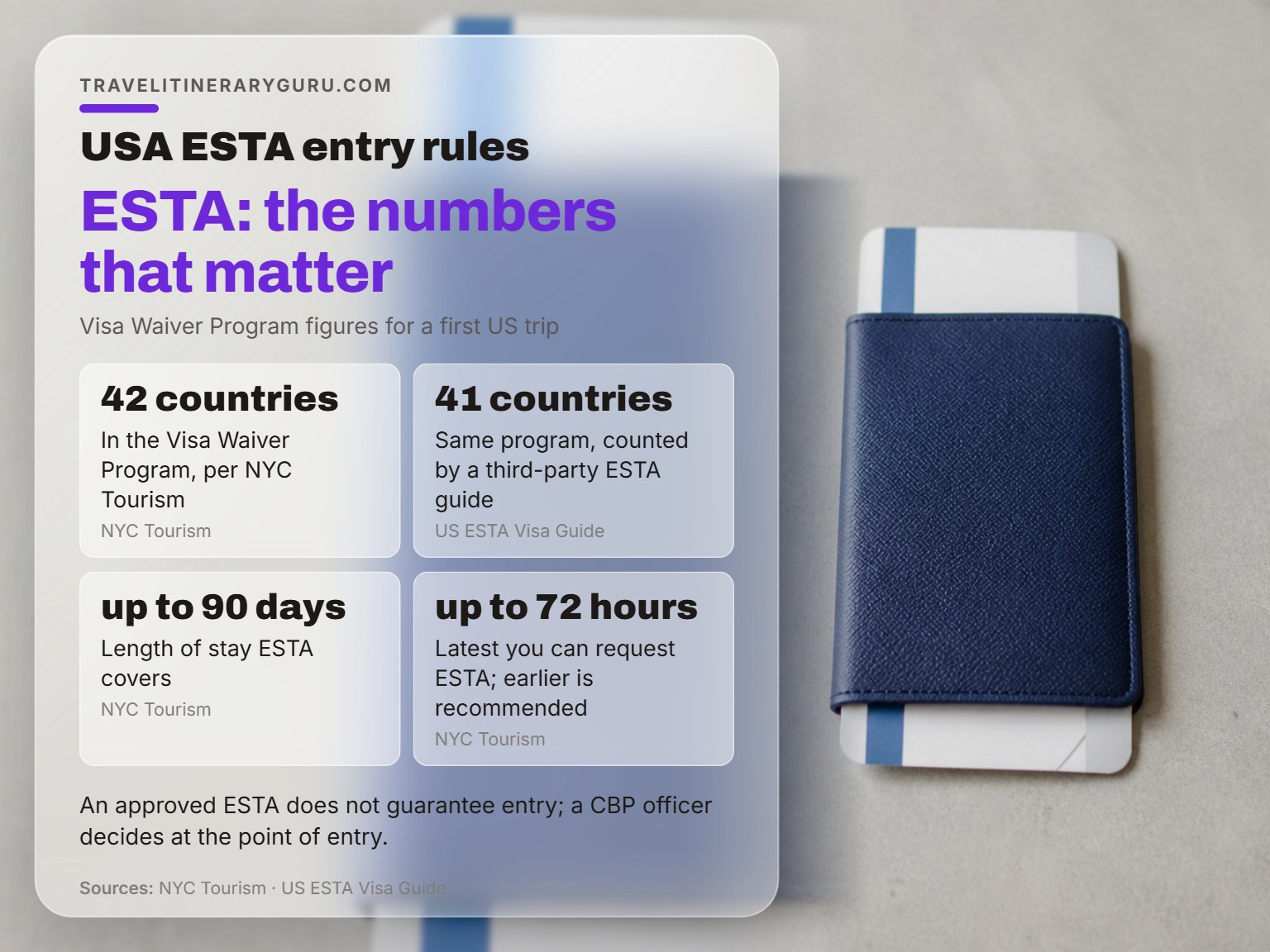
The Visa Waiver Program allows citizens of eligible countries to skip the visa and apply for ESTA instead. NYC Tourism counts 42 countries in the program, including Australia, Japan, South Korea, Singapore, the UK and EU members. A third-party ESTA guide puts the number at 41. Check the US State Department’s own list rather than either figure.
ESTA covers stays of up to 90 days. NYC Tourism says you can request one up to 72 hours before travel but recommends applying earlier. An approved ESTA doesn’t guarantee entry; a US Customs and Border Protection officer makes the final call at the point of entry.
One more split worth knowing. NYC Tourism describes ESTA as valid for stays of up to 90 days and stops there. A third-party guide says the authorization itself lasts two years, or until your passport expires, and covers multiple short visits. The two descriptions cover different things: one the length of a stay, the other the life of the authorization.
You also clear customs and immigration at your first US point of arrival, whether or not it’s your final destination. That matters if you’re connecting through JFK to reach LAX.
Documents worth sorting before you book anything non-refundable:
- A passport valid well past your return date, since the authorization ties to it
- An approved ESTA in hand before any non-refundable booking
- Proof of onward or return travel
- Travel and health insurance, which isn’t required for US visitors but is advised
- Your embassy or consulate contact if you’re arriving from abroad
Applying second is a gamble on processing time, and the failure mode is a non-refundable ticket you can’t use.
Planning your first USA trip starts earlier than most people expect, usually with the passport rather than the flight.
Where the Money Actually Goes in Each City
Two taxes, one tipping norm, and a car-sized variable. That’s the whole cost picture in both cities.
The Two Taxes That Surprise First-Timers
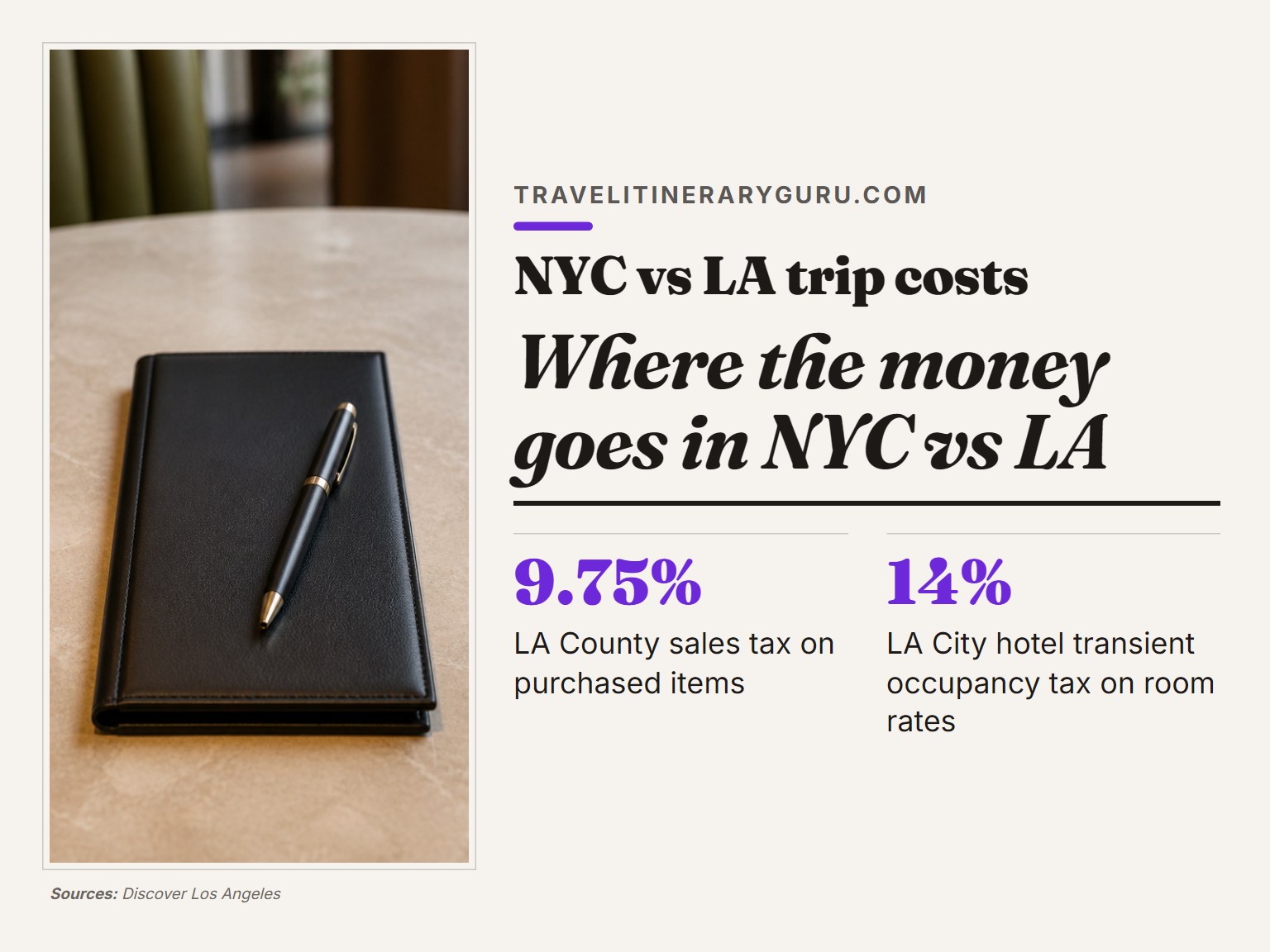
Los Angeles County charges 9.75% sales tax on purchased items. Hotel and motel rooms carry no sales tax in the county, but rooms inside the City of Los Angeles add a 14% transient occupancy tax on top of the rate. Sales tax is never included on a US menu price, which is the part that catches European visitors off guard.
The bigger variable is the car. Los Angeles parking garages charge by the day, hotel parking adds a nightly fee, and fuel is its own line. New York replaces all three with a transit pass.
One third-party ESTA guide puts a mid-range day in New York slightly below a mid-range day in Los Angeles once rental car, parking and fuel are counted. The same page then contradicts itself, saying hotel is cheaper in LA and transport is cheaper in New York, which works out roughly even across ten days. Its own ten-day totals land close to each other. Read that as: the two cities cost about the same, and the split depends on how you move.
Tipping is the other dispute. One source says 18% to 22% at restaurants plus a per-service tip at hotels. The same page elsewhere says 18% to 20% in both cities. Pick the higher end if you’d rather not think about it again.
- Whether you rent a car, which is the single biggest swing between the two cities
- Where you sleep, since LA hotel rates outside Beverly Hills and Santa Monica can undercut New York equivalents
- How you eat, because food trucks and neighborhood spots keep LA lunches cheap
- Attraction passes, which can cut attraction spending on a five-day program
The part nobody mentions: Sales tax is added at the register in the US. A menu price is never the price you pay, and that gap is what wrecks a first-day budget.
A USA trip budget built around two anchors a day comes out lower than one built around a checklist. Fewer scheduled things means fewer unplanned taxis.
How Many Days Does Each City Deserve?
The LAX-to-Hollywood drive gets quoted as if it’s a fixed number. Numbeo’s contributor data puts LA’s average one-way commute at 57.06 minutes across the whole city, which is a different measurement entirely. Both numbers describe something real, and neither predicts your specific Tuesday.
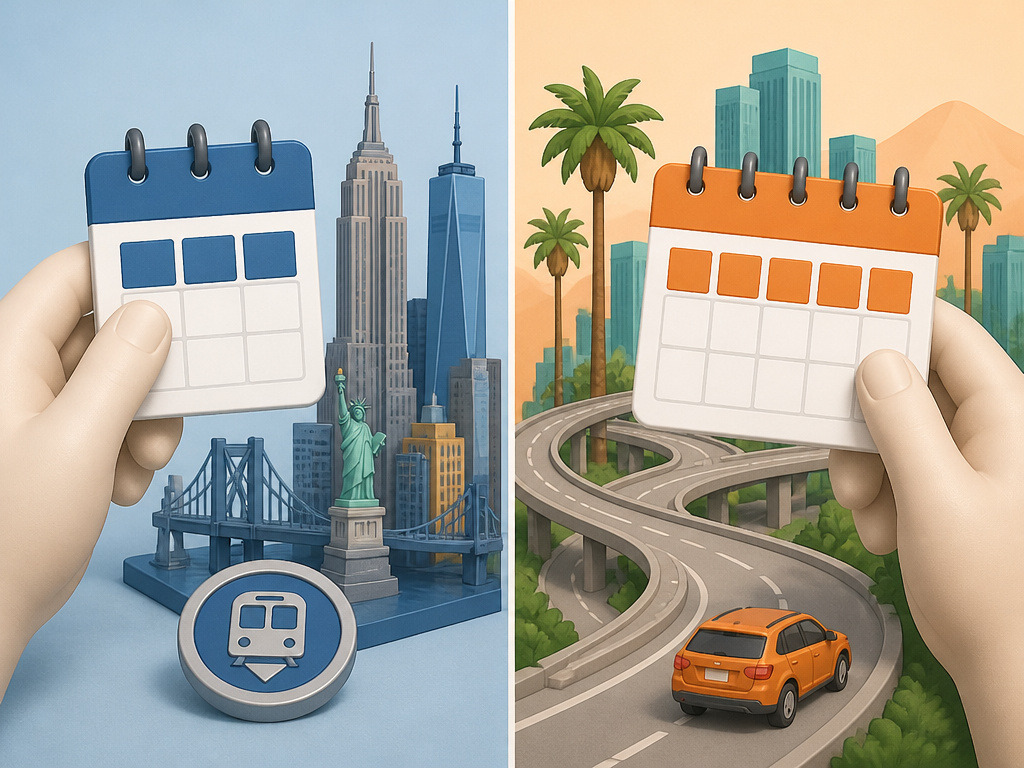
New York rewards short trips. Los Angeles punishes them.
A 3-day New York City itinerary can cover lower Manhattan, a museum and one outer borough without rushing. How many days to spend in New York City becomes a real question the moment you add a day trip.
How many days to spend in Los Angeles is a different calculation, because every LA day includes travel between areas.
- Three days minimum for New York, five if you want Brooklyn and a day trip
- Five days minimum for Los Angeles, seven if Disneyland or Joshua Tree is on the list
Where to Sleep, and Why Downtown Is Usually the Wrong Answer
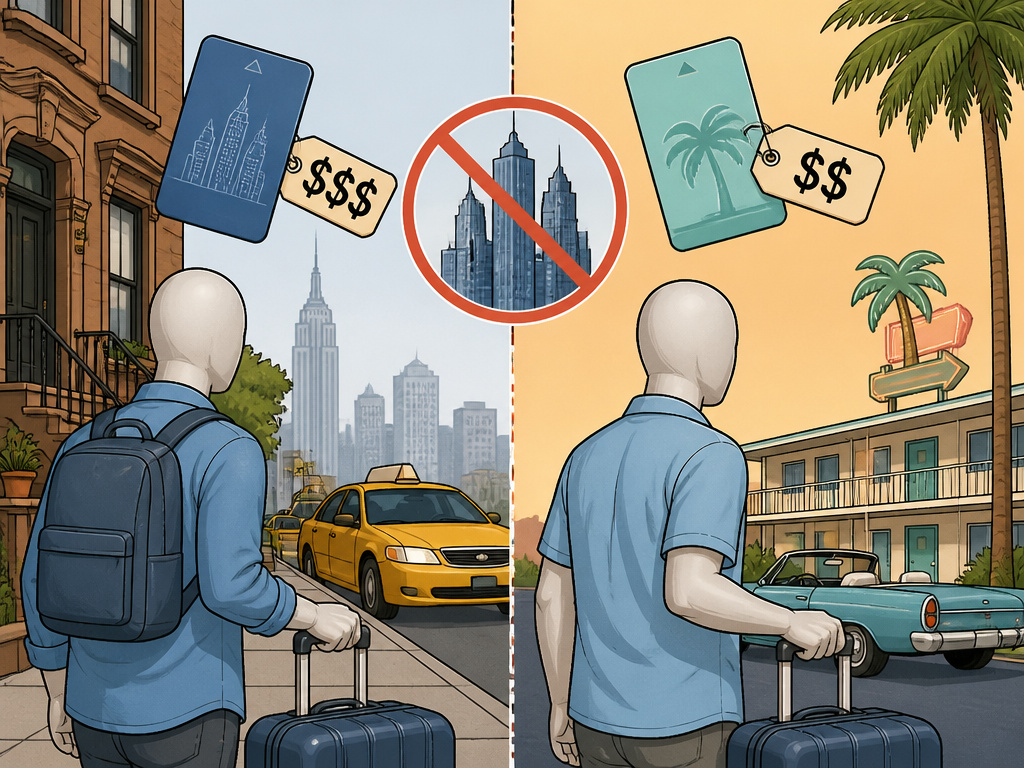
The downtown hotel is often the worst value in both cities. Downtown is frequently the least interesting part of a city, and it’s the part with the fewest reasons to walk out your door after dark.
In New York, Midtown Manhattan near Bryant Park or Herald Square balances access and rates. Brooklyn Heights gives you skyline views and quieter nights. The Upper West Side puts museums within walking distance.
In Los Angeles, accommodation decisions are driven by traffic. Santa Monica suits beach days, West Hollywood suits nightlife, and Downtown suits culture and sports. Staying central shortens the haul from the airport.
A Los Angeles travel guide for first-time visitors should start with the neighborhood question rather than the attraction list. Start with the City of Los Angeles visitor tips page, then work outward from there.
Frequently Asked Questions
Is New York or Los Angeles better for a first trip to the USA?
It depends on trip length more than anything else. Under seven days, New York wins because the grid compresses distance and you can cover a lot without a car. At ten days or more, Los Angeles starts to pay you back, because the sprawl becomes the experience rather than an obstacle.
Do you need a car in Los Angeles?
Not everywhere, and the sources disagree on this. Lonely Planet says a car is the best and most convenient option. Time Out LA points out you can skip one inside specific corridors like Downtown, Santa Monica and Pasadena. A car is genuinely required for Malibu, the Pacific Coast Highway and Angeles Crest Highway.
How many days do you need in each city?
Three days is a workable minimum for New York, five if you want Brooklyn and a day trip. Los Angeles needs five at minimum, and seven if Disneyland or Joshua Tree is on your list. Both cities benefit from one unscheduled afternoon.
Is ESTA enough for a first USA visit?
For citizens of eligible Visa Waiver Program countries, yes. ESTA covers stays of up to 90 days. Approval doesn’t guarantee entry, though, because a US Customs and Border Protection officer makes the final decision when you arrive.
Which city has better weather for a first-time visitor?
Los Angeles, by almost every measure. It has clearer skies than New York in all twelve months, fewer days of precipitation in every month, and no snow at all. New York’s advantage is four distinct seasons and a comfortable window from April through June and September through October.
Can you visit both cities on one trip?
Yes, and a 90-day ESTA window makes it straightforward. The practical constraint is internal travel time rather than paperwork. Give New York the shorter block and Los Angeles the longer one, and leave a buffer day between them.
Before You Go
Here’s the trigger I’d use. If your trip is seven days or fewer, book New York and stop deliberating. The city compresses distance, so a short trip works. If you have ten days or more, Los Angeles finally pays you back for the flight, because the sprawl stops being an obstacle and starts being the point.
One concession: everything above assumes you’re travelling solo or as a couple. Group trips break both cities in different ways, and
