
2-Day Boston Itinerary for First-Time Visitors: Two Days
This post contains affiliate links. As an Amazon Associate, we earn from qualifying purchases.
A 2-day Boston itinerary for first-time visitors works because the Freedom Trail is 2.5 miles and passes 16 historic sites, all walkable from a downtown hotel. You can cover the core of it in two days without a car, a rental, or a single rideshare, and the whole thing sits inside a 43-acre national park.
That 2.5-mile figure is the spine of a 2-day Boston itinerary for first-time visitors, and it’s also the reason so many first-timers get the pacing wrong. The National Park Service lists self-guided walking of the trail at anywhere from 2 to 12 hours depending on how many sites you actually enter. U.S. News Travel puts the same walk at “2 hours to half day.” Those two numbers don’t reconcile, and the gap between them is the entire planning problem.
So the plan below splits the difference honestly: one anchor per day, the trail split at Faneuil Hall, and a hard rule about not booking anything you can’t walk away from.
Key Takeaways
- Walk the trail east to west from Boston Common to the Charlestown Navy Yard. It ends at the USS Constitution, which is the payoff, not the starting line.
- Budget for the walk itself across the two days, and treat every site you enter as an addition to that time.
- Skip the paid guided tour unless you want the theater of it. The NPS runs a free Freedom Trail Audio Tour through its app.
- Check the day of the week before you commit. King’s Chapel closes its October-to-March schedule down to Fridays and Saturdays only.
- The trail is not a story. The Park Service says so directly, and it changes how you should walk it.
How Long Does the Freedom Trail Actually Take?
The Park Service and the travel press disagree here, and the disagreement is worth sitting with because it decides your whole schedule. NPS says 2 to 12 hours for a self-guided walk, noting that people who enter every historic site “can spend a full weekend.” U.S. News says 2 hours to half a day.
Both are describing the same 2.5 miles. The difference is what you do when you get there.
The Freedom Trail is a 2.5-mile red brick line connecting 16 historic sites across downtown Boston, the North End, and Charlestown. It runs from Boston Common to the Charlestown Navy Yard and sits inside Boston National Historical Park, a 43-acre unit of the National Park System.
Here’s the practical read. If you walk the line and read the plaques, you’re at the low end. If you go inside the Paul Revere House, climb Bunker Hill, and tour the USS Constitution, you’re at the high end. The trail itself is only “an opening sampler” of Boston’s history, per the National Park Service Freedom Trail walk guide. Treat it as a table of contents, not a book.
For a 2-day Boston itinerary for first-time visitors, that means one anchor per day. The rest is walking.
Day 1: Boston Common to Faneuil Hall
Start at Boston Common, the oldest public park in America, dating to 1634. That’s the trailhead, and it’s also where the first accessibility wrinkle shows up.
The stairs to the 54th Massachusetts/Robert Gould Shaw Memorial are the problem. NPS publishes the detour: head toward the Park Street MBTA station at Park and Tremont, then follow the sidewalk up Park Street toward Beacon Street. It skips the stairs entirely.
From there the trail runs through the Granary Burying Ground, King’s Chapel, the Old State House, and Faneuil Hall. Each is a short walk from the last. This is the densest stretch of the whole thing, and it’s where most of your day goes.
The Granary Burying Ground Entrance Nobody Uses
The main Tremont Street entrance to the Granary has stairs. The bypass is an at-grade entrance off Beacon Street, and it’s easy to miss because it sits at the end of an alley.
Walk past the main entrance, continue down Tremont to the intersection with Beacon, turn left, and take the first alleyway on the left. That alley ends at the accessible gate. I’ve watched people circle that block twice looking for it.
King’s Chapel and the Hours That Catch People Out
King’s Chapel is open May through September, Tuesdays through Saturdays, 10:00 am to 5:00 pm. From October through March it drops to Fridays and Saturdays only, 10:00 am to 4:00 pm.
That’s a big swing in open days depending on the month. If you’re visiting in November and you’ve built your Tuesday around King’s Chapel, you’ve built it around a closed door. The Freedom Trail Foundation 2025 brochure PDF lists the current hours, and it’s worth pulling up the night before rather than trusting a blog post from 2019.
The burying ground next door runs daily, 10:00 am to 4:00 pm, year-round. That one doesn’t move.
Easy to miss: The Old State House has stairs only, with no accessible entry at all. If anyone in your group needs step-free access, plan to view the exterior and keep walking. There’s no workaround.
Where Day 1 Ends
Faneuil Hall is the natural stopping point. It opened in 1741 and has served as an open forum meeting hall and marketplace for more than 270 years. The NPS visitor center is on the first floor; the Great Hall is on the second.
That’s a good place to stop because the trail changes character after it. You leave the dense downtown cluster and head into the North End, which is a different kind of walking.
Day 2: The North End to Charlestown
Day 2 is longer in distance and lighter in sites. That’s deliberate.
The Paul Revere House sits at 19 North Square. It was built around 1680, which makes it the oldest remaining structure in downtown Boston and the only official Freedom Trail site that’s a home. It’s also the one site on the trail where I’d tell you to actually go inside, because the interior is the point.
Hours shift by season. April 15 through October 31, it’s open daily 10:00 am to 5:15 pm. November 1 through April 14, daily 10:00 am to 4:15 pm. It closes Mondays during January through March, plus Thanksgiving, Christmas, and New Year’s Day. There’s an admission fee, and it’s independently operated, so your park pass doesn’t cover it.
From there the trail crosses to Old North Church, but not directly.
The Tileston Street Detour
Paul Revere Park to Old North Church requires a block detour via Tileston Street. This is published by the Park Service and it’s not optional if you want a step-free route.
It’s also just a nicer walk. The North End’s side streets are where the neighborhood actually lives, and Tileston puts you on one of them instead of the tourist artery.
Bunker Hill and the 294 Steps
Across the river in Charlestown, Bunker Hill Monument has 294 steps to the top and it’s free to climb. No ticket, no reservation.
That’s 294 steps up a stone spiral with no elevator. Many people who start it turn around at the landing, and there’s no shame in that. The view from the base is already good, and the monument grounds are free to walk regardless.
Getting there from the North End means crossing the river. The MBTA ferry runs from Long Wharf in Downtown Boston to the Charlestown Navy Yard, which is a better crossing than the bridge if the weather’s decent. The MBTA has five subway routes, Red, Orange, Blue, Green, plus the Mattapan Trolley, and a 1-day LinkPass covers 24 hours if you’re going to be hopping around.
The USS Constitution and the Gangway That Moves
The USS Constitution is the world’s oldest commissioned warship afloat, and tours are given by active-duty US Navy sailors.
Fair warning on access: the ship and the USS Cassin Young have stairs, ladders, and gangways that move with the tide. A gangway that moves with the tide can change steepness, and the crew adjusts it.
What the Two-Day Plan Costs You
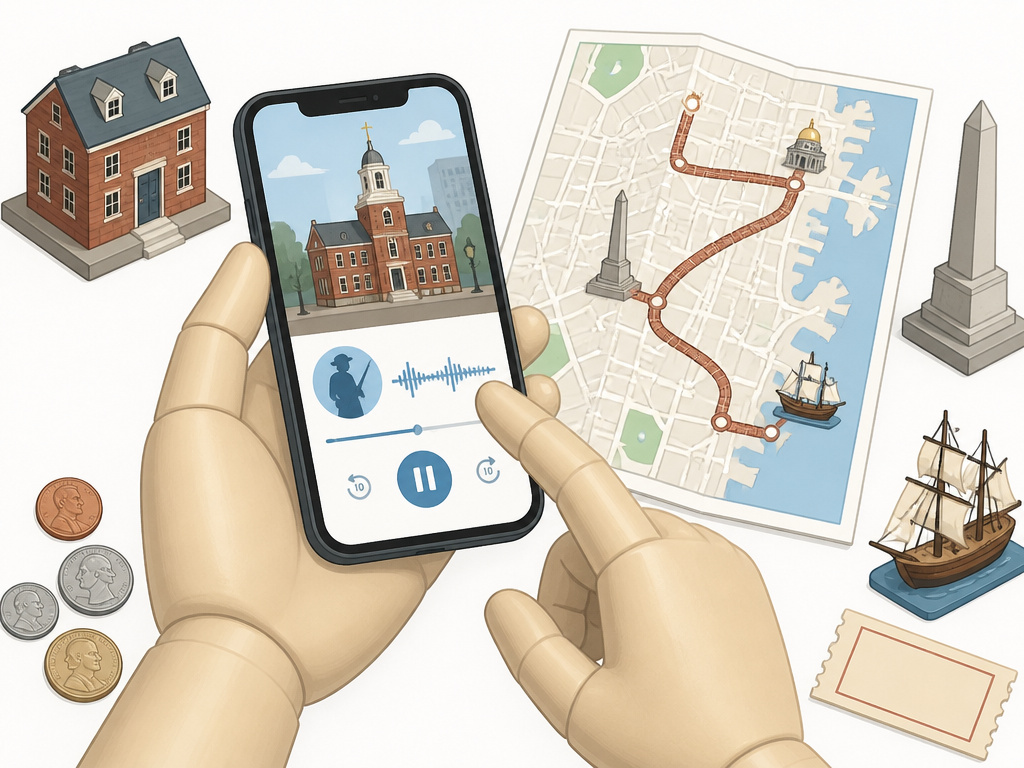
Sites on the trail are independently owned and operated and may charge admission fees, even though they sit inside a federal park.
| Site | Operator | Admission |
|---|---|---|
| Freedom Trail walk | NPS | No activity fee, no reservation |
| Paul Revere House | Independent | Admission fee |
| Old State House | Independent | Stairs only, no accessible entry |
| Bunker Hill Monument | NPS | Free to climb |
| USS Constitution | US Navy | Free tour |
There’s also a free audio tour. The National Parks of Boston built a free Freedom Trail Audio Tour, available online or through the NPS App.
Skip this if: you want a guide in period costume telling you what happened.
Where Sources Disagree on Guided Tours
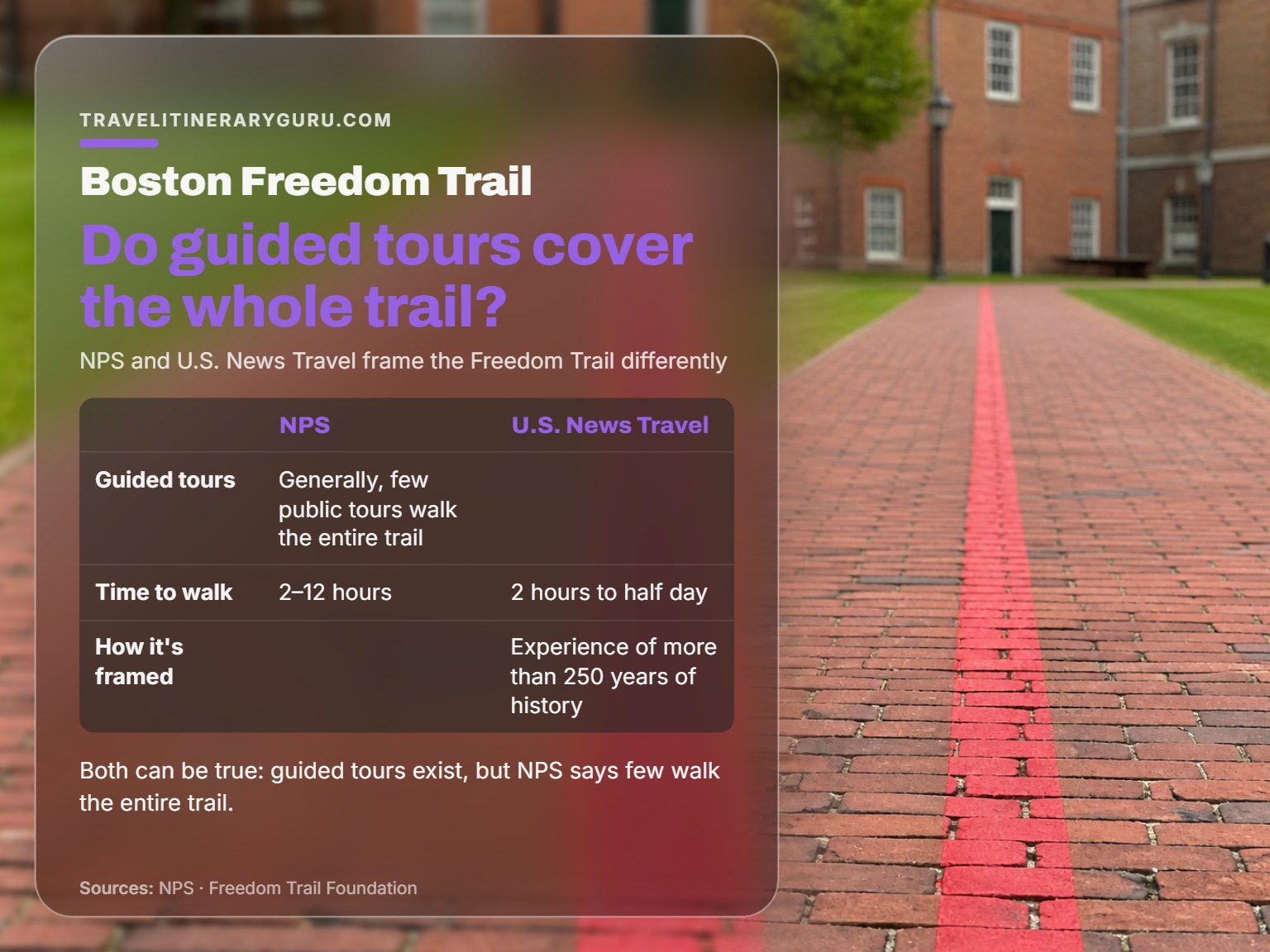
This one matters because it changes what you book.
NPS states plainly that “generally, few public tours walk the entire trail.” U.S. News Travel implies the opposite, noting that standard guided tours by the Freedom Trail Foundation are covered by the Go Boston Card. Both can be true at once: there are guided tours, and NPS states that generally few public tours walk the entire trail, while U.S.
The Park Service operates the trail, and NPS states that generally few public tours walk the entire trail, while U.S. News Travel implies standard guided tours by the Freedom Trail Foundation are covered by the Go Boston Card.
Worth knowing before you start: the trail “does not necessarily tell a narrative,” per NPS. It’s a sampler of sites, not a story arc.
When to Go, and What to Do With the Rest of Your Time

Peak season at Boston National Historical Park is May through October. That’s also when the Swan Boats run in the Public Garden, between mid-April and Labor Day.
The Public Garden is the first public botanical garden in the U.S. And has a six-acre pond. Boston Common next door is the oldest public park in America. Both are free to walk, and both sit at the start of the trail.
If you’ve got a third day, the honest answer is that how many days to spend in Boston is a different question with a different answer.
For a longer route that strings Boston together with other cities, the East Coast itinerary approach works well here because Boston is genuinely car-free. The Boston to DC train runs from South Station, and the Washington DC itinerary for a first visit pairs naturally with this one.
And if you want to go deeper on the history than the trail allows, there are hidden gems in Boston that the 16 official sites don’t cover.
Frequently Asked Questions
Do I need a reservation to walk the Freedom Trail?
No. The Park Service states there’s no reservation required and no activity fee to walk the trail. Individual sites may charge admission, and some are independently operated, so check each one you plan to enter.
How long does the Freedom Trail take to walk?
NPS lists 2 to 12 hours for self-guided walking, depending on how many sites you enter. U.S. News Travel says 2 hours to half a day. For a two-day trip, plan 4 to 6 hours of walking total and add 30 to 60 minutes per site you go inside.
Is the Freedom Trail accessible for wheelchairs or strollers?
Partly. NPS publishes specific detours for the Shaw Memorial stairs, the Granary Burying Ground, and the Paul Revere Park to Old North Church crossing. The Old State House and Copp’s Hill have stairs only, with no accessible entry. The USS Constitution has gangways that shift with the tide.
Can I bring a dog on the Freedom Trail?
Yes, with restrictions. The Park Service allows pets on the trail, though individual sites set their own rules, and the historic buildings generally don’t admit them.
What’s the best time of year for a first visit?
Peak season at Boston National Historical Park runs May through October. Summer is the busiest and the Swan Boats operate from mid-April through Labor Day. Spring and early fall give you the same walk with fewer people.
Should I book a guided tour or walk it myself?
NPS notes that few public tours walk the entire trail, while U.S. News Travel implies standard guided tours by the Freedom Trail Foundation are covered by the Go Boston Card, so check what a given tour actually covers. If you want the full 2.5 miles with context, the free NPS audio tour plus your own pace is the more reliable route.
The Bottom Line
Two days is enough for Boston if you stop trying to see everything. The trail is 2.5 miles and 16 sites, and the people who enjoy it most are the ones who pick four or five and actually go inside them.
One rule I’d hand you before you book anything: if a site closes at 4:00 pm and you’re planning to reach it at 3:30, don’t. King’s Chapel, the burying grounds, and the Paul Revere House all run on their own clocks, and the October-to-March schedules cut days, not just hours. Pull the Boston National Historical Park operating hours page the night before each day and build backward from closing time. The NPS Boston park trip planning page has the rest of the logistics.
The concession I’ll make: this plan assumes you’re staying downtown or near a T stop. If you’re out in the suburbs and commuting in, you lose time each way and the two-day math gets tight. In that case, pick one day on the trail and one day in a single neighborhood, and let the rest go.
The best day I’ve had in Boston wasn’t a trail day at all. It was a Tuesday morning in the North End before anything opened, when the bakeries were pulling bread and nobody was on the sidewalks yet. That’s the hour the trail can’t give you, and it’s free.
