
How to Plan a Day Trip With Kids: The 90-Minute Rule
This post contains affiliate links. As an Amazon Associate, we earn from qualifying purchases.
Most day trips with kids fail before the car leaves the driveway. Not because of bad luck, but because the plan was built around a destination instead of a radius, a schedule instead of a child, and a budget that forgot the parking. Knowing how to plan a day trip with kids means starting with the constraints, not the destination.
To plan a day trip with kids, cap the travel at 90 minutes each way, build the day around one anchor activity of about two hours, and leave gaps in the schedule so a tired child can fall apart for ten minutes without the whole day collapsing. Anything past 90 minutes each way wants to be an overnight, not a day trip.
That 90-minute number is a useful guide for how to plan a day trip with kids. Ninety minutes out and ninety back is three hours in transit, which still leaves a genuine four-to-five-hour window at the destination. Push it to two or three hours each way and the day inverts: most of it is spent strapped into a seat, and the time actually doing the thing shrinks.
The rest of this walks through the shape of a day that works, what goes in the bag, and the two places the standard advice quietly breaks.
Key Takeaways
- Cap travel at 90 minutes each way. Beyond that, the honest answer is an overnight trip, not a day trip.
- One anchor activity, not three. Two hours is plenty for young children, and cramming three or four destinations guarantees a fraught day.
- Pack the bag the night before. Morning-of packing is how the sunscreen stays on the counter.
- Leave on a high note. Watch your children, not the clock. The last hour you squeeze out is rarely worth what it costs.
- Check the return journey, not just the way out. Most day-trip budgets forget the drive home and the parking on both ends.
Why 90 Minutes Each Way Is the Line That Decides Everything
I built day trips for years around the destination first. Find the cool place, then figure out the drive. That order is backwards, and it took a client meltdown in a car park 140 minutes from home to teach me.
The arithmetic settles it. Ninety minutes out and ninety minutes back is three hours of travel. On a day trip that’s already a lot of time in transit, and it still leaves a real four-to-five-hour window at the destination. Stretch the travel to two or three hours each way and the day flips: the destination shrinks, the car seat time balloons, and you arrive with a child who’s already done being patient.
A 90-minute radius, one anchor activity, a real food plan, and a deliberate buffer for the meltdown that will come. Keep the driving short, the schedule loose, and the expectations modest.
Funday advises treating a place two or three hours away as a 24-hour trip or a weekend getaway instead, while the NPS notes most people live within one hour of a national park. That’s not a downgrade. It’s an honest read of what the day can hold.
The National Park Service makes a related point from the other direction: most people live within one hour of a national park. You don’t need a long drive to reach something worth the day.
If you’re weighing whether a destination earns the trip at all, a day trip by train changes the math, since you’re not the one driving and the return leg is a timetable rather than a decision.
What Does a Realistic Day Trip with Kids Actually Look Like?
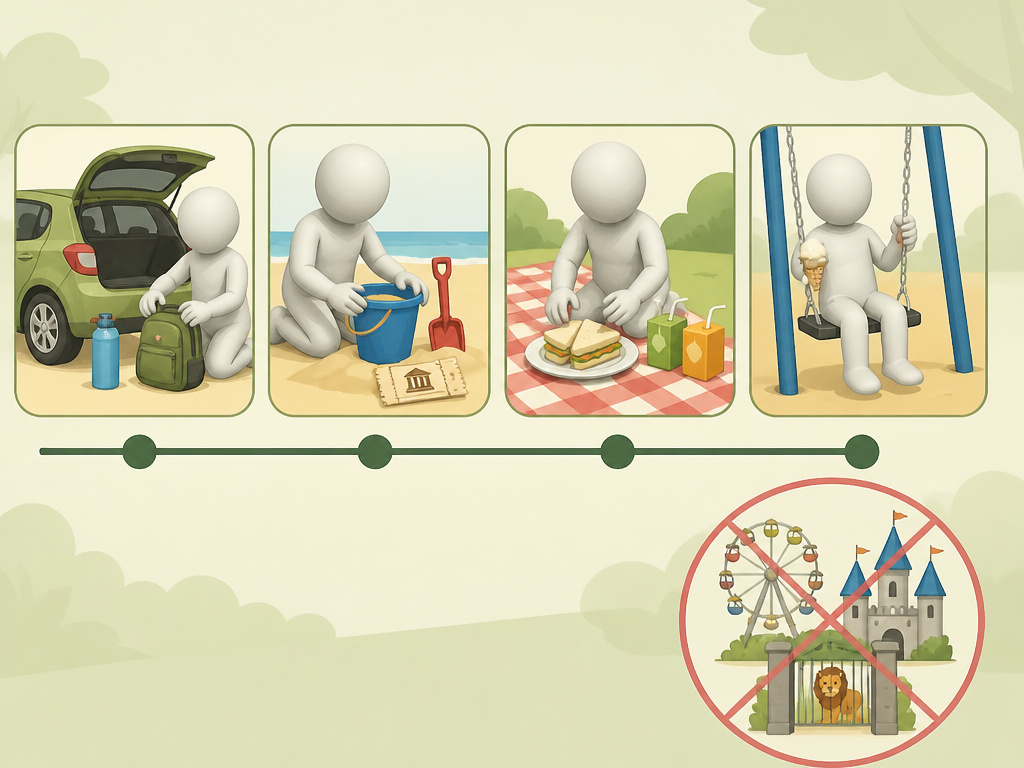
A common how to plan a day trip with kids shape runs four to five hours at the destination, anchored by one activity. Not three. One.
Here’s the structure, block by block. Arrive and settle for around 30 minutes: park, find the toilets, let everyone stretch and adjust to the new place. Do not rush this. A calm arrival sets the tone for everything after.
Then the anchor activity, around two hours. This is the one real thing you came to do, whether that’s the beach, the farm, the trail, or the museum. Two hours is plenty for young children, and the anchor is the entire point of the trip.
Then a meal or long snack break, around 45 minutes. Sitting down to eat is also rest. It resets everyone for the rest of the day.
Then one small second thing or free play, around an hour. Not a second major destination. Unstructured time: a playground, an ice cream, a wander. This is often where children have the most fun.
| Block | Time | What It Is | What It Is Not |
|---|---|---|---|
| Arrival and settle | ~30 min | Park, toilets, stretch | Rushing straight to the gate |
| Anchor activity | ~2 hrs | The one thing you came for | Three stops in one afternoon |
| Meal or long snack | ~45 min | Sitting down, actual rest | Eating in the car between stops |
| Free play or second thing | ~1 hr | Playground, wander, ice cream | A second major destination |
That’s the whole day. Four to five hours at the destination, with built-in rest. A day trip planned this loosely can go better than one planned to the minute.
The common mistake here is treating the second block as a slot to fill with more. It isn’t. One anchor is enough, and the free-play hour is where the day usually redeems itself.
Common mistake: Cramming three or four destinations into a single day. The trip becomes a rushed circuit of car parks and queues, and the child remembers none of it fondly.
Where the Meltdown Fits, and Why You Plan for It
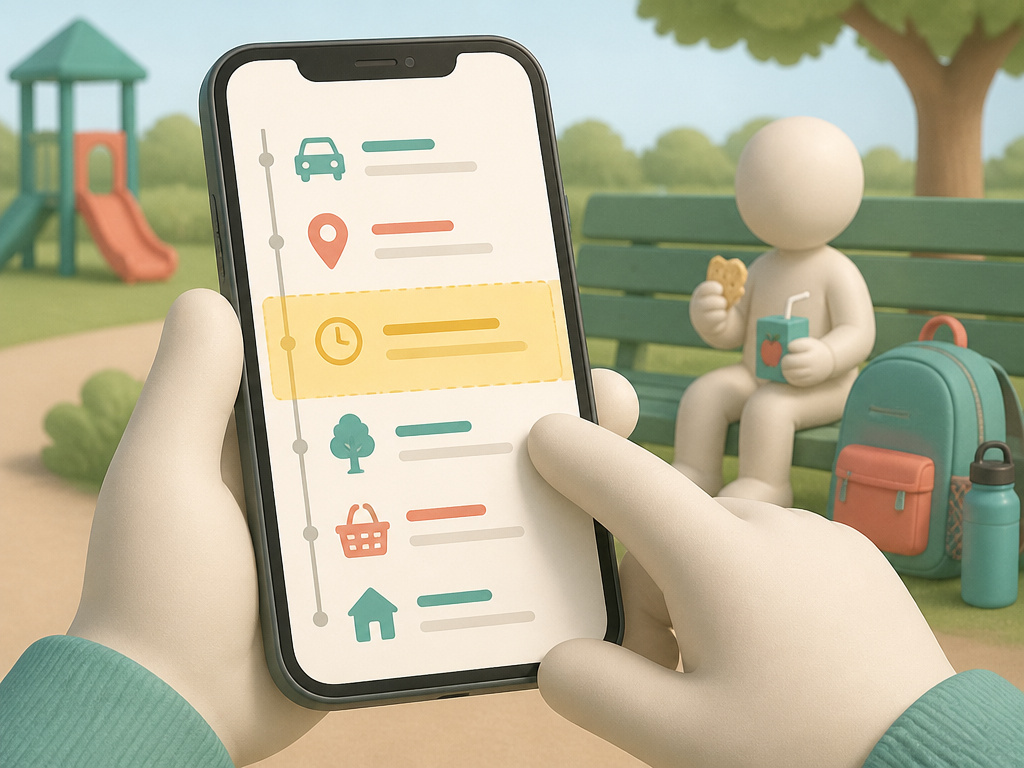
A child will hit a wall on a day trip. It’s not a question of whether, it’s when. The trips that go well are the ones planned with that certainty already baked in.
A meltdown buffer is mostly about what you don’t do. Don’t schedule the day so tightly that there’s no slack. Leave gaps with nothing in them, so when a child needs to stop, sit, or simply fall apart for ten minutes, the schedule absorbs it without the whole day collapsing.
Keep one easy, low-demand option in your back pocket, like a playground or a quiet green space, for when the anchor activity isn’t working. Watch for the early signs of a tired or overstimulated child and respond before the full meltdown, with a snack, a drink, or a sit-down.
And accept that some part of the day will go wrong.
This is where the NPS guidance and the itinerary-driven approach pull in different directions, and it’s worth naming the split. The NPS trip planning guide frames the day around preparation and risk assessment: weather, terrain, water hazards, park alerts, permits, reservations, and a backup activity. The itinerary-driven approach prescribes the fixed four-block schedule above. Neither is wrong. They’re answering different questions. The NPS is asking “what could go wrong and how do we prepare,” and the four-block shape is asking “what does the day look like hour to hour.” Use both: the shape for the plan, the risk assessment for the conditions.
If your day trip is pointed at a national park specifically, a national park day trip adds a layer the generic plan doesn’t cover, including permits and seasonal closures.
The Two Things That Break the Standard Plan
Tours You Cannot Exit
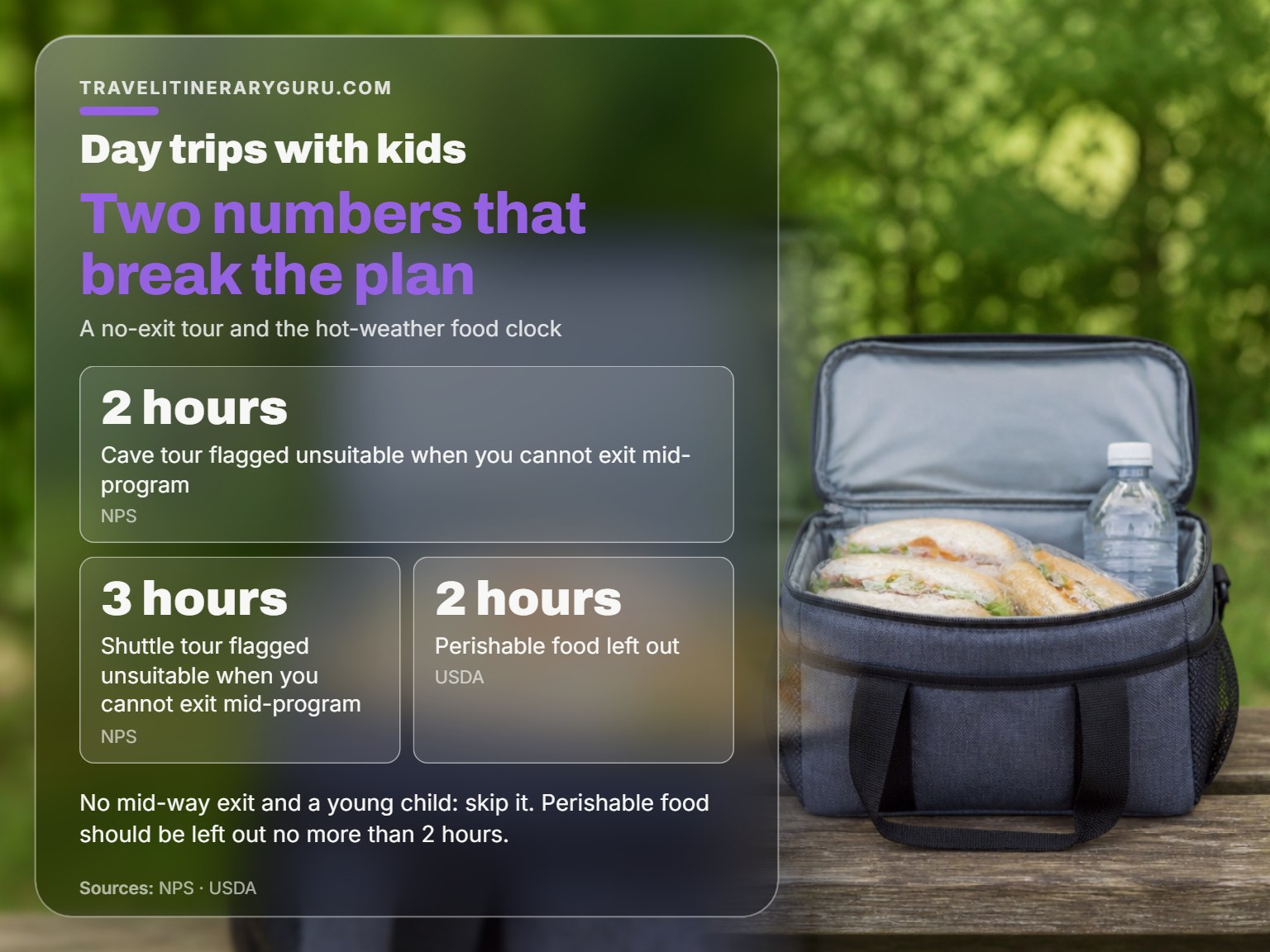
Some programs lock you in. A two-hour cave tour or a three-hour shuttle tour is unsuitable when you cannot exit mid-program with a young child. If exiting on your own isn’t convenient or possible, you may have to ride it out, and neither you nor your child will be pleased.
Before you book any guided program, ask one question: can we walk out the side door if we need to? If the answer is no, and your child is young, that’s a skip.
Skip this if: The program has no mid-way exit and your child is under five. Book the kid-specific program instead, or find one where you can leave.
Many parks run programs geared for kids, including story-hour gatherings and recreational trails, and a lot of them are free. Most parks also have a “For Kids” section on their website with specifics on what they offer.
The Hot-Weather Food Clock
The USDA guidance gives perishable food a two-hour window out of refrigeration. In hot weather, the USDA 2-hour rule collapses to one hour, while Funday states no time limit. That single change rewrites your lunch plan on a summer day.
If you’re packing perishable food for a hot-weather trip, it needs to be eaten within the hour, not left in a warm bag through the anchor activity. The NPS guidance for visiting national parks with kids is worth a read before any park day, especially on wildlife and trail scouting.
| Condition | Perishable Food Window | What To Do Differently |
|---|---|---|
| Cool weather | 2 hours | Standard cooler bag is fine |
| Hot weather | 1 hour | Ice in the cooler, or buy lunch on site |
| Any weather, no cooler | 2 hours max | Eat early, don’t leave food in the car |
Where this goes sideways: Packing perishables into a warm car boot for the anchor activity. By the time you eat, they’ve been out past the window and nobody’s appetite survives the smell.
What Actually Goes in the Bag (and What Doesn’t)
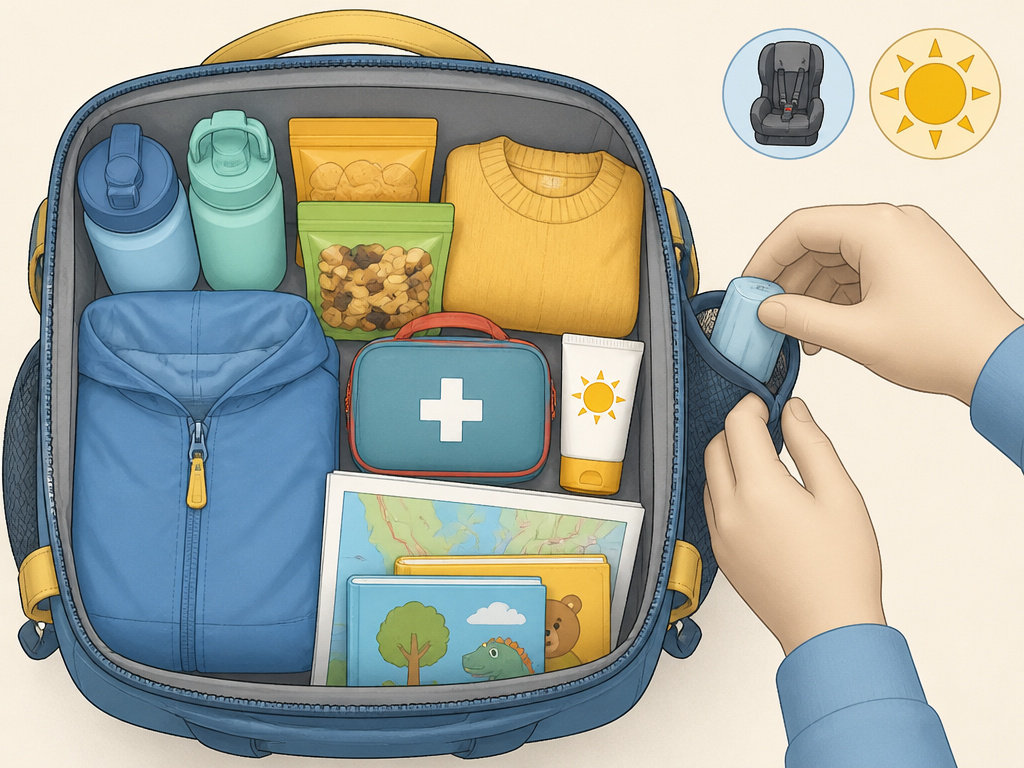
Pack the day-trip bag the night before, not on the morning of. Morning-of packing is when things get forgotten, and the forgotten thing is always the sunscreen.
The bag itself: water for everyone, and more snacks than you think you need. Weather layers, including a spare jumper and a light rain layer, whatever the forecast says. A full change of clothes for younger children and spare underwear for anyone recently toilet trained.
Sun protection means sunscreen applied before you leave, and reapplied at the destination. A small first-aid kit covers plasters, antiseptic wipes, and any medicines your child needs. Car entertainment is a couple of books, a small toy, and an audiobook or playlist queued up.
If you’re driving, check that every child’s car seat or booster is correctly fitted before you go. The NHTSA car seat guidance is a reliable reference.
Worth knowing before you start: The NPS 10 Essentials list is a defined 10-item first-aid and emergency kit, and a phone is not a substitute for any of them. Always carry a backup paper map; offline maps on the NPS app are convenience only.
That last point is a live disagreement in practice. The NPS position is that the battery may not last the whole trip, and you could damage or lose the phone. Always carry a backup paper map; the NPS app’s offline maps are convenience only.
The Cost Line Most People Forget
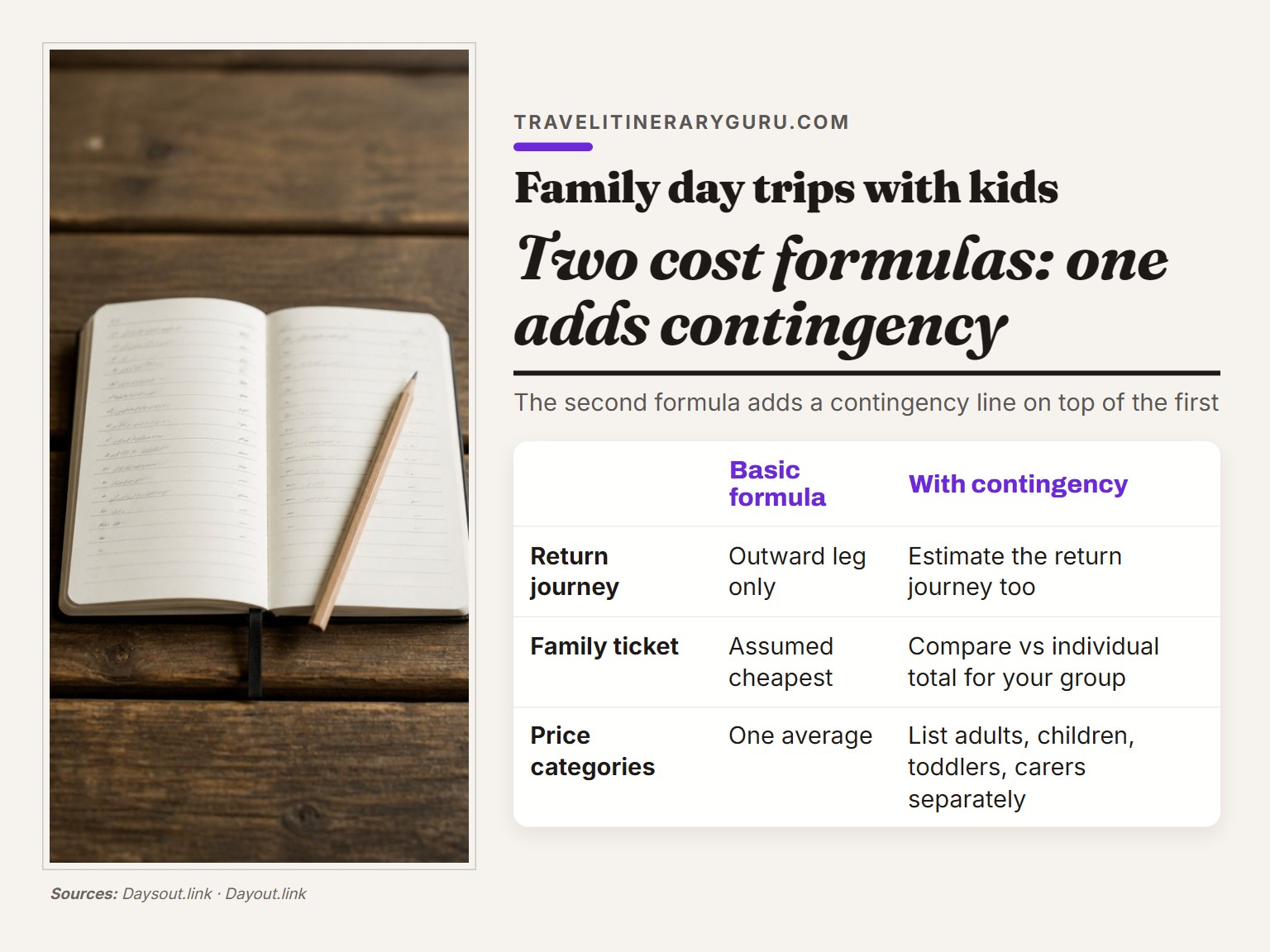
Two formulas circulate for estimating a family day out, and the difference between them matters.
The first: total day-out cost = admission + travel + parking or local transport + food and drinks + extras. The second adds a contingency on top: travel + admission + food and drinks + parking or local transport + extras + contingency.
That contingency line is the one that saves you. It covers a replacement snack, an unexpected bus fare, a wet-weather activity, or a small change to the return journey.
Two other things the formulas imply but don’t spell out. Estimate the return journey, not only the outward leg. And don’t assume a family ticket is always the cheapest option; compare it against the individual total for your group before you book.
If an attraction prices adults, children, toddlers, and carers separately, list each category rather than averaging.
When to Head Home
Knowing when to leave is as important as the planning. The goal is to leave on a high note, while the day is still good.
Resist the urge to extract every last hour. A day trip that ends with a tired, happy child in the car is one everyone remembers fondly. A day trip stretched two hours too long, ending in a meltdown in a car park, becomes the one nobody wants to repeat. The last hour you squeeze out is rarely worth what it costs.
Watch your children rather than the clock. When energy drops and patience thins, start winding down: one last thing, then the walk back to the car. Time the drive home so you arrive before a complete collapse, ideally with younger children napping along the way.
Plan the trip so the drive home doesn’t land on top of the dinner-and-bedtime rush. That single scheduling choice does more for the evening than anything else on this list.
If your day trip is a longer drive with more than one stop, the road trip with kids planning changes the return-leg math in ways a single-destination day doesn’t.
Frequently Asked Questions
How far should you drive for a family day trip?
Aim for no more than 90 minutes of travel each way. That’s three hours of travel total, which still leaves a genuine four-to-five-hour window at the destination. Beyond 90 minutes, the day is dominated by travel and children spend most of it in a car seat. If a place is two or three hours away, it’s better as an overnight trip than a day trip.
How do I plan a day trip itinerary with kids?
Keep it light. Plan one anchor activity of about two hours, not three or four destinations. A reliable shape is a calm 30-minute arrival, the two-hour anchor activity, a 45-minute meal break, and an hour of free play or one small second thing. Leave gaps in the schedule so a tired child doesn’t derail the whole day.
What should I pack for a family day trip?
Pack one bag the night before with water and plenty of snacks, weather layers and a rain layer, a full change of clothes for younger children, sun protection, a small first-aid kit, and entertainment for the car. If you’re driving, check every car seat and booster is correctly fitted before you leave.
When should we head home from a day trip?
Leave while the day is still going well, on a high note. Watch your children rather than the clock, and when you see energy dropping and patience thinning, start winding down. A trip that ends with a tired, happy child beats one stretched two hours too long that ends in a meltdown.
What are good day trip ideas for young children?
Nature and parks, water destinations like a beach or lake, and farms or animal parks all reliably engage young children, and most are low cost. Keep one or two indoor options, such as a children’s museum or aquarium, on your list for bad weather. Match the choice to your youngest child; if it works for them, it usually works for everyone.
How do I know if a guided program is safe for a young child?
Ask whether you can exit mid-program. A two-hour cave tour or a three-hour shuttle tour is unsuitable when you can’t leave with a young child partway through. If exiting on your own isn’t convenient or possible, you may have to ride it out, and neither you nor your child will be pleased. Choose a kid-specific program instead.
The Bottom Line
One rule covers most of this: if the place is worth more than 90 minutes of travel each way, it’s worth an overnight. If it isn’t, don’t go. That single filter eliminates the majority of bad day trips before they’re planned.
Your first step this week is small. Pick one destination within 90 minutes, plan it around a single anchor activity, and keep the rest of the day loose. Pack the bag the night before. Tell someone where you’re going and when you’ll be back, and if the plan changes, tell them that too, because if you change your route and your contact doesn’t know, search and rescue may have trouble finding you.
Most of this advice assumes a fair-weather day with a child who’s rested at the start. If your child is running a fever or slept badly, the calculus flips entirely, and the right call is a local park and an early lunch. The plan can wait a week.
