
How to Apply for a China Tourist Visa: Step-by-Step
This post contains affiliate links. As an Amazon Associate, we earn from qualifying purchases.
To apply for a China tourist visa, you file an online L-visa application through the Chinese Visa Application Service Center, wait out an online review (approximately 3–5 working days at the Toronto center), then submit your materials with a passport that has at least six months of remaining validity and blank pages, subject to fingerprint exemptions that vary by jurisdiction. Consular officers decide the rest.
That 3–5 working day figure comes from the Toronto center. Normal processing of the visa itself runs about one to two weeks, according to the CVASC application guide, which also explains how to apply for a China tourist visa. So the trip you booked for next month has a real clock on it.
The rest of this walks the how to apply for a China tourist visa path end to end: the passport math that trips people up, the documents that change depending on which jurisdiction you file in, the fingerprint rules and their dates, and where the process breaks.
Key Takeaways
- Check passport validity first. You need at least six months remaining, and for a multiple-entry visa the passport must outlast the visa validity plus the duration of stay.
- File online, then appear in person. The online review takes roughly 3–5 working days; approval of that review does not guarantee the visa.
- Do not cancel a form flagged “To be modified.” Revise it in place. Cancelling and resubmitting can trigger additional fees.
- Fingerprint exemptions are date-stamped and jurisdiction-specific. Toronto exempts short-term applications from December 19, 2025 through December 31, 2026; Kota Kinabalu lists different rules.
- Requirements vary by jurisdiction. The Shanghai government says so outright. Read the site for the office handling your application, not a general guide.
The Passport Math That Sinks Applications
Start with the arithmetic, because it is the single most common reason a form gets bounced before anyone looks at your itinerary.
The baseline is simple. Your passport needs at least six months of remaining validity and blank visa pages, per the Embassy of the PRC in Sweden; CVASC specifies 2 or more blank visa pages. That is the floor.
Multiple-entry applications need more. The CVASC guidance states that the passport’s remaining validity must cover the visa validity plus the duration of stay. Their worked example: a six-month multiple-entry visa with 30 days of stay per entry requires no less than seven months of remaining passport validity. Six months of passport may not be enough for a six-month multi.
A passport with six months of validity and a blank visa page meets the basic L-visa document requirement. A multiple-entry application adds a second test: the passport’s remaining validity must equal or exceed the visa’s validity period plus the duration of stay requested for each entry.
If you renewed your passport, bring both. The CVASC instructions say to bring the new passport and the previous one. And if that previous passport still holds a valid, unexpired Chinese visa or long-term residence permit, Toronto’s guidance is explicit: bring the original of that document too.
Where this goes sideways: filing with a passport that clears six months but not the multiple-entry arithmetic. The visa fee is still charged even if the visa is not approved or the number of entries, validity period, or duration of stay is changed.
What Documents Does an L Visa Actually Require?
This is where the how to apply for a China tourist visa sources genuinely disagree, and you need to know that going in.
The Embassy of the PRC in Sweden lists L-visa supporting documents as an air ticket booking record (round trip), proof of a hotel reservation, a travel plan, or an invitation letter issued by a relevant entity or individual in China, while CVASC drops the separate travel plan and the Shanghai government lists only an invitation letter. The CVASC version drops the separate “travel plan” element and asks for documents showing the itinerary, including the round-trip booking and hotel proof, or an invitation letter.
The Shanghai municipal government page lists only one item: an invitation letter issued by an entity or individual in China.
Three official sources, three different document sets. The resolution is in the Shanghai page itself, which states plainly that requirements vary by jurisdiction and points you to the China Online Visa Application or the website of the consulate handling your case. Read the page for your office. Not a blog. Not this article.
| Document | Who Requires It | Notes |
|---|---|---|
| Round-trip air ticket record | Sweden embassy; CVASC | Booking record, not a paid ticket |
| Hotel reservation proof | Sweden embassy; CVASC | Listed alongside the flight record |
| Travel plan | Sweden embassy only | Not listed in the CVASC version |
| Invitation letter | Sweden embassy; CVASC; Shanghai | Acceptable in place of the itinerary set |
If you go the invitation letter route, the content requirements are also not uniform. The MFA consular service network asks for the applicant’s full name, gender, and date of birth, while the Sweden embassy and CVASC both add passport number to that list. Two sources say it is required, one omits it, so check your own office’s page.
Beyond the applicant block, the letter also needs the planned visit (arrival and departure dates, places to be visited) and the inviting party’s details: name, contact telephone number, address, official stamp, and signature. The Sweden embassy lists the official stamp among the inviting party’s details the letter should contain.
Worth knowing before you start: If you have applied for a tourist visa to China repeatedly, the CVASC asks for a personal statement covering your reasons for revisiting, the places you plan to see this time, and the places you visited before. It is a short document, and the CVASC asks for it when you have applied for a tourist visa repeatedly.
How the Online Application and Review Window Work
You file the form online through the CVASC portal, upload electronic copies of your materials, and wait.
One mechanical detail catches people. After you finish the form, you must click the “Submit” button again on the fee confirmation page to formally complete the online submission. Skip that second click and your status reads “PENDING”, which means the submission process is incomplete.
The review window is approximately 3–5 working days, per the Toronto CVASC, a similar wait to applying for a Schengen visa.
Then there are the status states, and this is where a small mistake gets expensive. If your status shows “To be modified,” you revise or supplement the materials per the email or system notification. Do not cancel and resubmit. The CVASC warns that cancelling and resubmitting may incur additional fees.
When the status flips to “Online review completed,” you get an approval notification email. Print the Visa Application Confirmation attached to it and show up with your materials and payment.
Here is the sentence most people skim past: approval of the online review does not guarantee the visa will be approved. The consular officer still decides whether to issue the visa and on its validity, duration of stay, and number of entries, just as with a US B2 tourist visa.
Fingerprints, Exemptions, and the Dates That Differ

The default rule at Toronto CVASC is that you appear in person at the Visa Application Center to provide fingerprints, though exemptions apply and vary by jurisdiction. The Toronto CVASC states that applicants must be present in person for this.
Then come the exemptions, and they do not match across jurisdictions.
Toronto’s center exempts all short-term visa applications with a duration of stay up to 180 days from December 19, 2025 through December 31, 2026. It also exempts applicants who already gave fingerprints at the same embassy, consulate, or CVASC with the same passport within the past five years.
The Kota Kinabalu consulate lists a different set: applicants under 14 or over 70, and single- or double-entry short-term applicants staying under 180 days before December 31, 2025.
Note the age exemption. It appears in the Kota Kinabalu list. That is a reason to check your own office’s page.
The part nobody mentions: The exemption dates are not aligned. Toronto’s short-term exemption runs from December 19, 2025 through December 31, 2026; Kota Kinabalu’s single- and double-entry exemption runs before December 31, 2025. Do not assume the date you read on one consulate’s site applies at another.
Where to Submit, and What Breaks the Standard Path
Most applicants file through a Chinese Visa Application Service Center. The Sweden embassy routes all visa types except diplomatic, official, and courtesy visas through the Stockholm or Gothenburg Chinese Visa Application Service Centers.
Those three exception categories go elsewhere, and where depends on jurisdiction: the Sweden embassy directs diplomatic, official, and courtesy visa applicants to contact the Chinese Embassy in Sweden or the Chinese Consulate-General in Gothenburg after submitting online, while CVASC Toronto directs them to the Consulate-General in Toronto. Toronto’s center describes a different flow for the same categories: once the online review is approved, those applicants go directly to the Consulate-General in Toronto to submit documents in person. Where you submit depends on where you are.
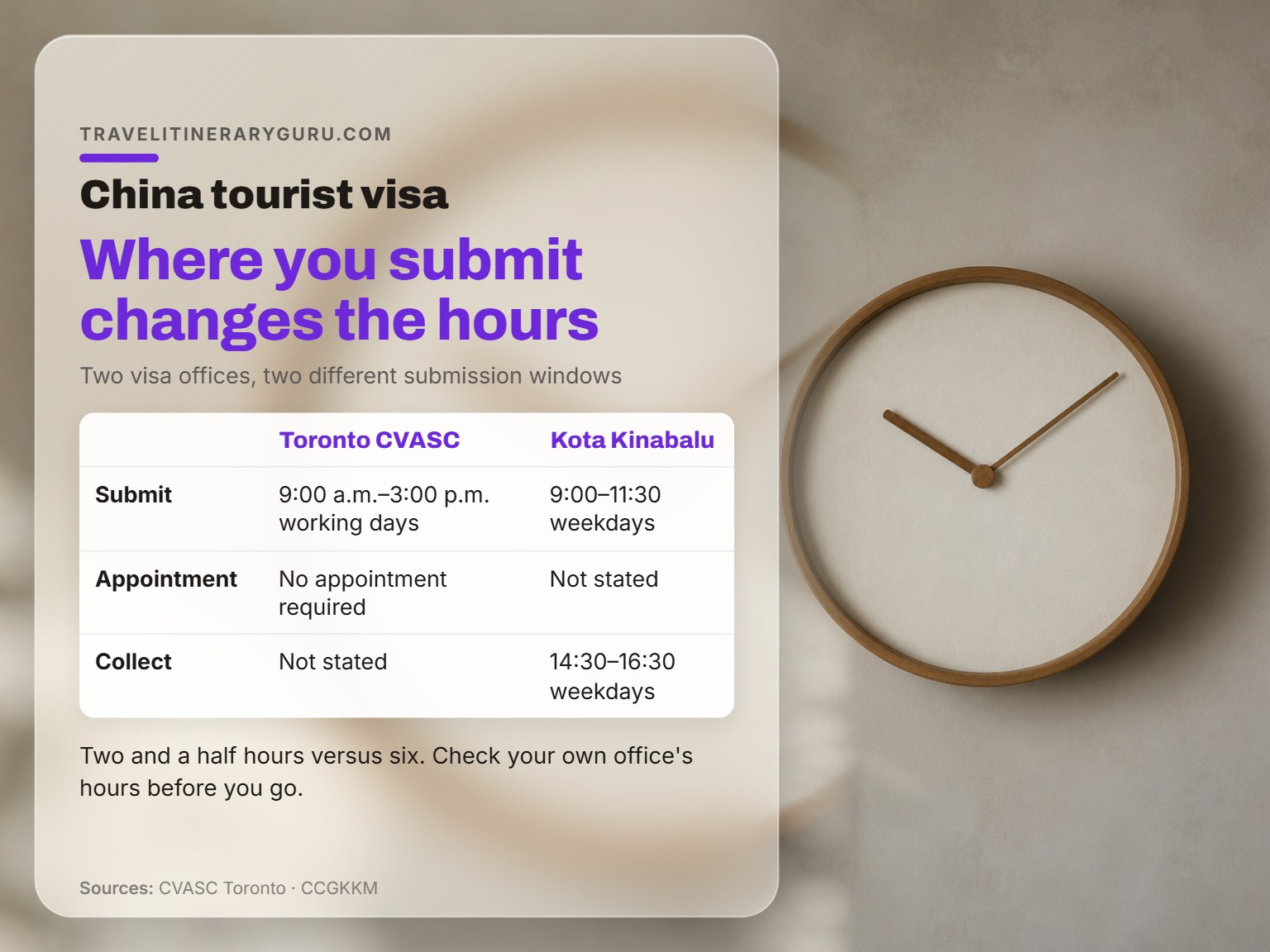
Submission hours differ too. Toronto CVASC accepts materials from 9:00 a.m. To 3:00 p.m. on working days, no appointment required, while the Chinese Consulate-General in Kota Kinabalu takes submissions on weekdays from 9:00 to 11:30, with collection from 14:30 to 16:30. Two and a half hours versus six. Check your own office’s hours before you go.
A few paths break the standard procedure entirely:
- Non-citizen applicants. If you are not applying in your country of citizenship, you must provide proof of legal stay, residence, work, study, or a valid visa for the country where you apply. Kota Kinabalu asks for the original and a photocopy.
- Former Chinese citizens now foreign nationals. First-time applicants submit the original Chinese passport and a copy of its information page. If you hold a prior Chinese visa on an old foreign passport, bring photocopies of that passport’s data page and the previous visa.
- Name changes. If the name on your current passport differs from the previous one, an official document of the name change is required.
- Children of Chinese descent. The CVASC lists a birth certificate showing both parents’ names, the original certificate of renunciation of Chinese nationality with a copy, and a statement from the parent or guardian.
Common mistake: Treating a visa service as a shortcut around the document list. The document requirements are the same regardless of who fills in the forms.
The Photo, the Fees, and the Fine Print
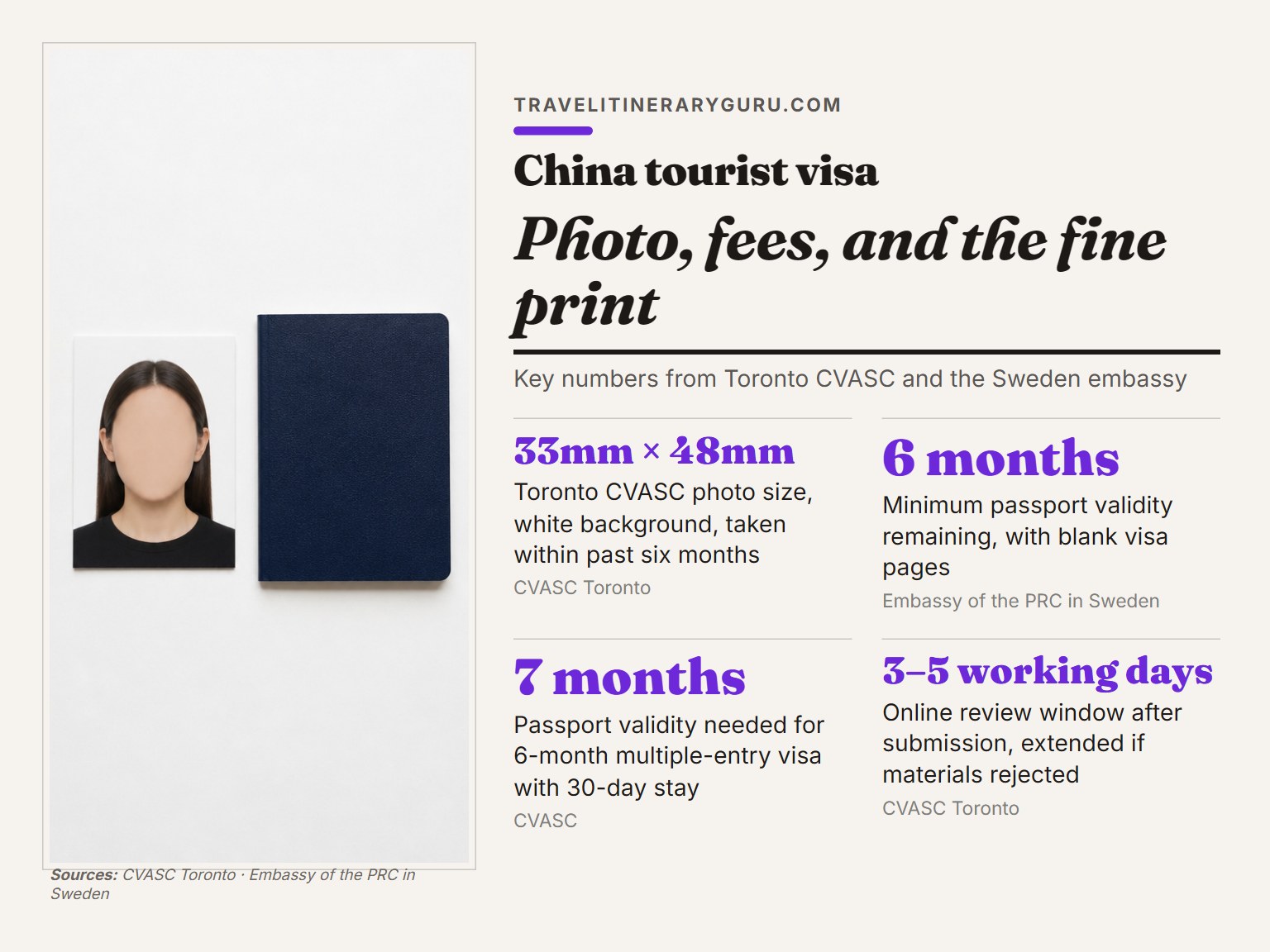
The photo spec is narrow. Toronto’s CVASC asks for 33mm by 48mm, white background, taken within the past six months, front-facing, no headwear or accessories. The Sweden embassy’s version is looser in wording: one recent, clear, front-facing passport photo with a white background. When one source gives you a measurement and another gives you a description, check your own office’s photo spec.
Fees are paid when you submit your materials in person at Toronto CVASC, where online payment is not available; the Sweden embassy does not specify a payment method. The total includes the visa fee, the visa service fee, tax, and a courier service fee if you want the return-by-mail service, a fee structure similar to the UK Standard Visitor Visa. If you do want mail return, bring a pre-paid return envelope with you.
And the refund rule is worth reading twice. If the application is not approved, is rejected, or the number of entries, validity period, or duration of stay is changed, the visa fee is charged but the service fee and tax are not refunded. You are paying for the processing, not the outcome.
False documents carry a harder penalty. The Sweden embassy states that false documents may result in visa refusal, visa cancellation, or denial of entry, and that the embassy is not responsible for financial losses tied to travel planning, flights, or hotels if the visa is denied. The CVASC adds that fraud or false information results in rejection of the individual application and disqualification of the travel or visa agency involved.
Frequently Asked Questions
How long does a China tourist visa take?
Plan for two clocks, not one. The online review runs approximately 3–5 working days at the Toronto center, and normal processing of the visa takes about one to two weeks per the CVASC guide. If a consular officer requests supplementary materials or an interview, the Sweden embassy notes that processing time may be extended accordingly, so it pays to review common visa interview questions beforehand.
Do I need an invitation letter or flight and hotel bookings?
It depends on your jurisdiction, and the sources do not agree. The Sweden embassy and CVASC accept either the itinerary set (round-trip booking, hotel proof, and in Sweden’s version a travel plan) or an invitation letter. The Shanghai government page lists only an invitation letter. Check the site for the office handling your application.
Can I skip the fingerprint appointment?
Only if you fall into an exemption. Toronto exempts short-term applications with a stay up to 180 days from December 19, 2025 through December 31, 2026, plus applicants fingerprinted at the same office with the same passport within five years. Kota Kinabalu exempts applicants under 14 or over 70. The lists differ, so read your own office’s page.
What happens if my online application status says “To be modified”?
Revise or supplement your materials in place, following the email or system notification. Do not cancel and resubmit. The Toronto CVASC warns that cancelling and resubmitting may result in additional fees, and your review clock restarts.
Can I pay the visa fee online?
Not at Toronto. All fees must be paid when you submit the application materials in person, and they cover the visa fee, service fee, tax, and a courier fee if applicable. If you want the passport returned by mail, bring a pre-paid return envelope to the center.
The Bottom Line
Here is the trigger that decides your timeline: if you are inside 30 days of departure and you have not started the online form, stop booking anything non-refundable. The 3–5 working day review plus the one-to-two-week processing window does not leave room for a bounce-back on a flagged document.
Your first step this week is one page, not the whole process. Open the website of the specific embassy, consulate, or visa center that will handle your application, and read its L-visa document list. Then check your passport’s expiry date against the multiple-entry arithmetic, not just the six-month floor.
I get why people reach for a visa service here, and I have used one when a process was genuinely byzantine. This one is not that. You are filling in a form, uploading scans, and showing up in person with a folder. The part that actually costs people trips is not the form. It is assuming the rules you read on one consulate’s page apply at the office down the street.
