
Visa Interview Questions and Answers: 5 Groups to Prepare
This post contains affiliate links. As an Amazon Associate, we earn from qualifying purchases.
Visa interview questions and answers fall into five groups: your identity, your visa category, your plan, the money behind it, and your history. Officers work from the application you already filed, and most interviews run 2-3 minutes, so short, specific, truthful answers beat rehearsed wording.
The application you already filed is the officer’s starting point. Answers get compared against the DS-160, any underlying petition, and previous visa applications, so consistency matters more than polish. An unfamiliar question is one of the five objectives wearing different words.
What follows: the five groups in order, the document habits that keep the conversation at the window short, and three places where official guidance pulls in different directions.
Key Takeaways
- Five groups cover nearly every question: identity, category eligibility, the plan, the money, and your history.
- Most interviews run 2-3 minutes, and officers form the decision largely on the first minute or two of impressions.
- Bring only your passport to the window unless the officer asks for more, but know where every supporting document sits in your folder.
- Do not bring family members to the interview; the officer wants to hear you answer for yourself.
- If refused, ask for the reason and the document list instead of arguing at the window.
Visa Interview Questions and Answers: The Five Groups Officers Use
Every question an officer asks is checking one of five objectives: identity, category eligibility, the plan, the money, and your history. VisaMind, which compiled applicant-reported officer questions into its guide, sorts them exactly that way, and the pattern holds across visa types even when the wording changes.
A nonimmigrant visa interview is an adjudicative process. Title 22 of the Code of Federal Regulations and the Foreign Affairs Manual require the applicant to appear in person, answer questions under oath, and present supporting evidence. Officers may compare those answers with the DS-160, an underlying petition, and previous applications.
The first group is the least interesting and the most dangerous. Identity questions sound like small talk, and they work as a consistency check against the form you signed.
| Question group | What the officer is verifying | Where the answer lives |
|---|---|---|
| Identity | That you are the person on the application | Passport, DS-160 |
| Category eligibility | That you qualify for this visa class | Petition, offer letter, program paperwork |
| The plan | What you will actually do in the U.S. | Itinerary, conference invitation |
| The money | How the trip gets funded | Bank statements, sponsor letter |
| Your history | Prior travel, refusals, any record | Previous passports, earlier applications |
The five groups don’t carry equal weight. Category eligibility and the plan do the heavy lifting for temporary visas, because that’s where the officer decides whether your purpose matches the class you applied for. Money and history are supporting checks, and either one can sink an application on its own.
Prepare all five anyway.
The five groups apply to any travel visa interview, though the emphasis shifts by category. Student cases lean on education and funding, visitor cases on the purpose of the trip, employment cases on the job and salary.
What most people get wrong: Treating the interview as a test of your answers. It’s a test of whether those answers match the paperwork the officer already holds, and a mismatch is what starts the follow-up questions.
How Long Is a Visa Interview, and Does Short Mean Bad?
Fermilab and UC San Diego put the interview at about 2-3 minutes, while DavidsonMorris describes it as normally lasting several minutes and longer for complex cases. Fermilab’s guidance for B-1 applicants states that you’ll get about 2-3 minutes of interview time, and UC San Diego’s international scholar office puts it the same way, adding “if you are lucky.”
DavidsonMorris describes it differently: normally several minutes, and longer for complex cases. Both descriptions can be right at once, because they’re describing different applicants at different posts.
What decides the outcome happens early. Fermilab says consular officers must make a decision, for the most part, on the impressions they form during the first minute or two, while UC San Diego trims that to the first minute. UC San Diego trims that to the first minute.
Think of it like a stock. The base is your paperwork, and it does most of the work before you say a word. What you add at the window is seasoning, and a little goes a long way.
Here’s what isn’t a signal:
- A short interview. Well-documented cases get the shortest ones.
- A friendly officer. Manner varies by post and by officer, not by the strength of your case.
- A question you didn’t rehearse. Unfamiliar wording is the same objective in different words.
- Silence while the officer types.
Know your facts cold and leave the phrasing loose. A memorized script falls apart on the first unexpected follow-up, and the officer will keep digging until it does.
UC San Diego’s academic visa interview preparation page makes the same point from the other direction: practice English conversation with a native speaker beforehand, but don’t prepare speeches.
Three Places Where Official Guidance Doesn’t Agree
Read enough official guidance and you’ll find it arguing with itself. I’ve read the Santo Domingo embassy page and the Fermilab PDF side by side, and they aren’t describing the same interview.
The contradictions are documented, and knowing which version applies at your post matters more than picking a favorite.
| Point | Position one | Position two |
|---|---|---|
| Interview length | 2-3 minutes (Fermilab, UC San Diego) | Several minutes, longer if complex (DavidsonMorris) |
| Documents at the window | Passport only, nothing else unless asked (Santo Domingo) | Bring proof of ties, ready to show (Fermilab) |
| Length of stay | B-1 entry up to six months; 90 days on Visa Waiver | More than a few weeks invites extra scrutiny |
Both are official.
The stay-duration row is the one that catches people. A B-1 visa stamp entry may last for up to six months, and a Visa Waiver entry lasts 90 days, per Fermilab. The national lab B-1 interview guidance then warns that indicating a need to stay more than a few weeks may result in additional scrutiny. The ceiling and the comfort zone are different numbers, and only one of them is written into the visa.
On the denial side, the guidance splits again. Fermilab tells applicants not to argue, to ask the officer for a list of documents that would overcome the refusal, and to try to get the reason in writing. UC San Diego says you’ll be informed of the reason and can reapply with additional evidence. Same direction, different level of detail.
The part nobody mentions: The document rule is set by the post, not by the visa class. Two applicants on the same visa at two consulates can get opposite instructions, and both are following official guidance.
Documents at the Window: Passport Only, or the Whole Folder?
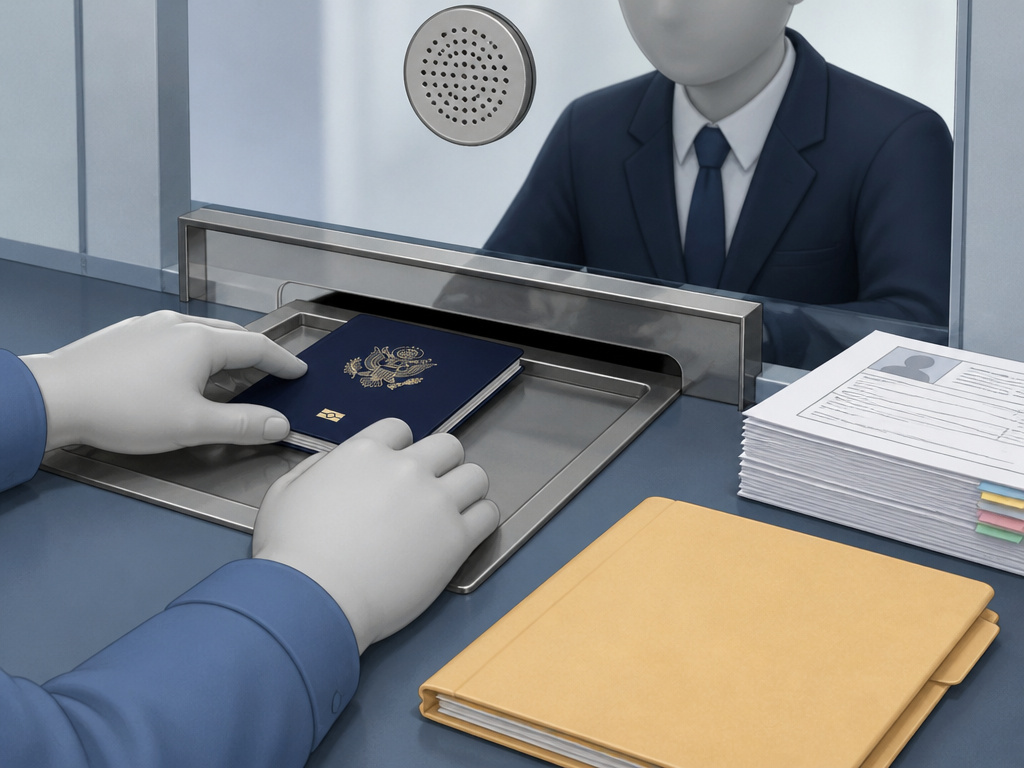
You reach the window with a folder two inches thick. The officer asks one question and slides a tray forward.
The U.S. Embassy Dominican Republic interview expectations page is specific about what goes in that tray: place only your passport there, and don’t provide additional documents unless you’re asked. The same page tells applicants to keep personal items and papers organized, avoiding clutter on the counter.
Keep the folder closed until you’re asked.
Fermilab’s guidance runs the other way. It tells applicants to be prepared to show documents proving ties to their home country, financial and personal, and to check with the consulate ahead of time about what’s needed. DavidsonMorris lands in the middle, advising applicants to be prepared to present supporting documents relevant to their category.
Whichever rule your post follows, build the travel documents checklist before you leave home rather than at the window. Originals, one photocopy set, and a folder that opens flat.
- Passport, plus any older passports carrying previous visas.
- The DS-160 confirmation page, printed rather than on your phone.
- Proof of ties: an employment letter, a lease or property document, recent pay stubs.
- Funding documents: bank statements, or a sponsor letter plus a letter of consent if someone else is paying.
- Trip paperwork: a conference invitation, an appointment letter, or program paperwork.
What to Do When the Officer Asks for Something You Left at Home
Santo Domingo’s guidance is to say so in one sentence and stop, while Fermilab advises being prepared to show documents proving ties, financial and personal. Fermilab explains why brevity matters here: an officer has to understand at a glance what a written document signifies, and lengthy written explanations can’t be read or evaluated quickly.
Handing over a thick folder to compensate for one missing page works against you. There’s a queue behind you and a decision to make, and a short, clear answer does more than a pile of paper.
What Is the Officer Really Testing When They Ask About Money and Family?
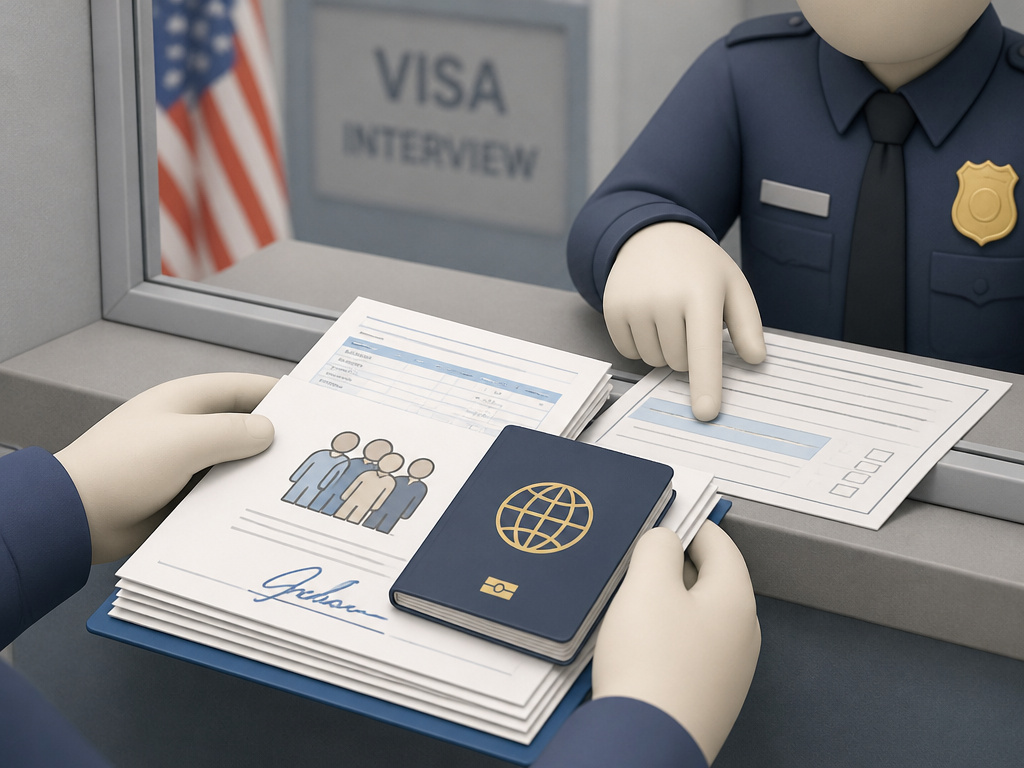
Money questions are the ones applicants underestimate. NNU Immigration explains what they’re for: employment and finances establish your circumstances outside the U.S., how the trip will be funded, and whether your proposed activities amount to permitted business activity or employment.
Money Questions: Funding a Trip Without Raising Doubt
If you’re applying for a US B2 tourist visa, funding questions carry a lot of the interview. BankBazaar notes that depending on the visa type you may need to show proof of sufficient funds, and that if someone else is covering your expenses you may need a letter of consent alongside the required documents.
Fermilab defines ties plainly: the job, the family, the financial prospects you own or will inherit, the investments. Those are the things that answer a money question without you having to argue.
Family Questions: Who Stays Behind, and Who Pays for Them
If your spouse and children are staying behind, Fermilab advises being ready to address how they’ll support themselves while you’re away. UC San Diego is blunter about the stakes: if the officer gets the impression that your family will need you to send money home to support them, your student visa application will almost certainly be denied.
Say it plainly, in one sentence.
If your family plans to join you later, Fermilab suggests having them apply at the same Consulate where your interview took place, while UC San Diego suggests the same post where you applied for your visa. Keeping the file in one place makes it easier to read.
I tell people to rehearse the family answer out loud before the appointment, because it’s the one question where a vague answer sounds like a plan to stay. If your spouse works, say so and move on.
If the Visa Is Refused: What to Do in the First 48 Hours
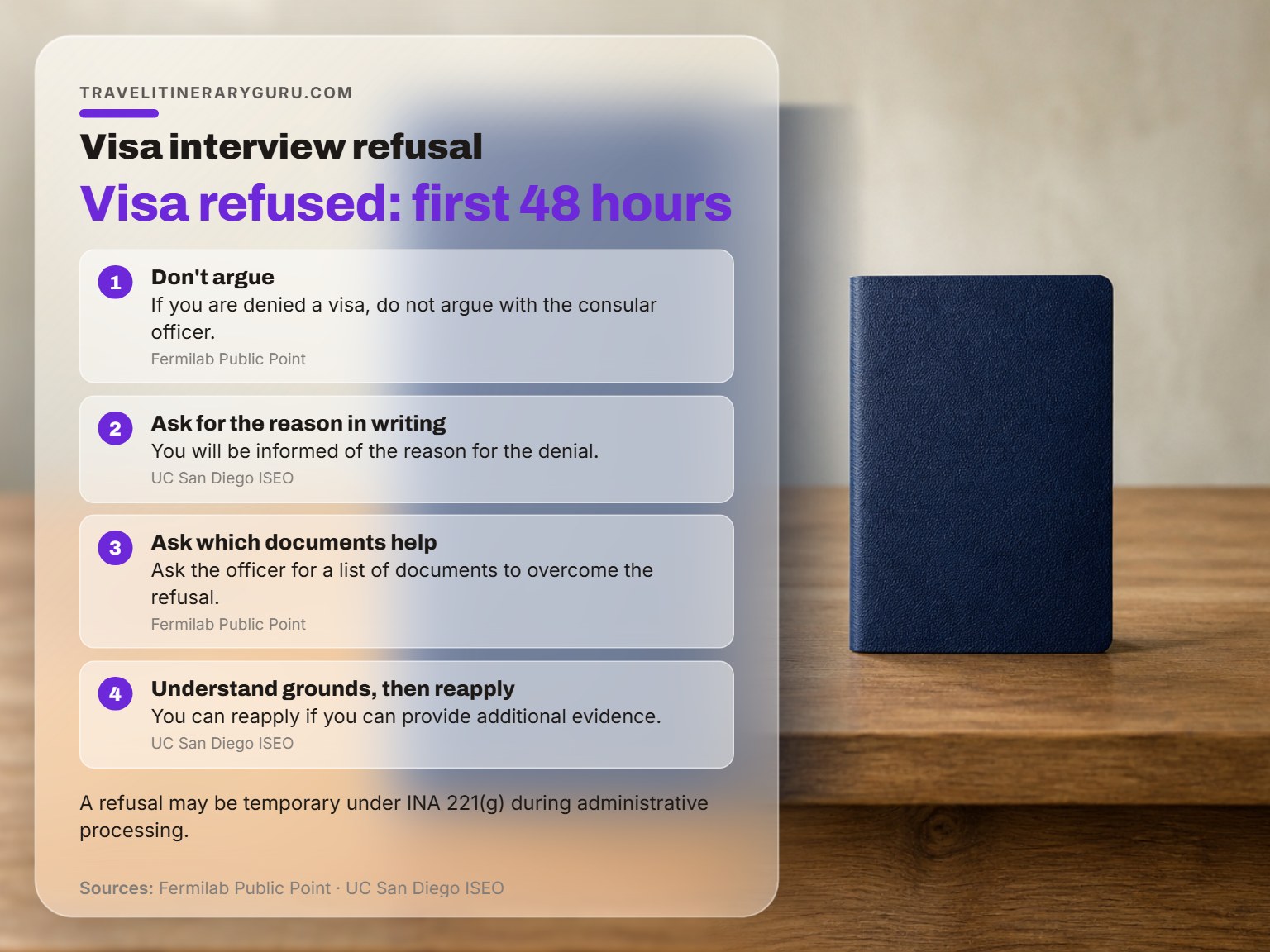
The refusal notice starts a process with its own steps. The order matters more than the speed.
Before you start: Don’t argue with the consular officer; Fermilab’s guidance is explicit that arguing costs you the information you need most. Don’t bring family members to the window, because a negative impression forms when you aren’t prepared to speak for yourself. Answer truthfully throughout, since the officer relies on your responses during the assessment.
- Don’t argue. Fermilab’s advice is to skip the argument entirely. Arguing costs you the one thing that helps a reapplication: information.
- Ask for the reason in writing. Fermilab recommends trying to get the denial reason in writing, and UC San Diego notes you’ll be informed of the reason. A reason you can read twice beats one you heard once through glass.
- Ask which documents would overcome the refusal. Fermilab suggests asking the officer for that list. Guessing at what was missing is how people reapply with the same gap.
- Understand the grounds before you file again. UC San Diego advises making sure you fully understand the grounds for the denial first. Reapplying without that understanding burns an appointment slot.
- Gather new evidence, then reapply. UC San Diego notes you can reapply if you can provide additional evidence. A second application that repeats the first gets the same answer.
Reapplying With New Evidence
A refusal isn’t always a final decision. DavidsonMorris explains that when more evidence or a security check is needed, a case may be refused temporarily under INA 221(g) while a review finishes, a situation known as administrative processing. That’s a different outcome from a refusal on eligibility grounds such as INA 214(b).
Either way, the clock runs. Refusals and administrative processing both stretch the visa processing time, which is why you build the trip around the visa rather than the other way around.
If you’re a university student or scholar, UC San Diego asks you to complete the Visa Delay or Denial eform in iServices before reapplying. The government page on visa refusals is where the refusal categories themselves are defined.
Before You Book Anything: The Order That Saves the Trip
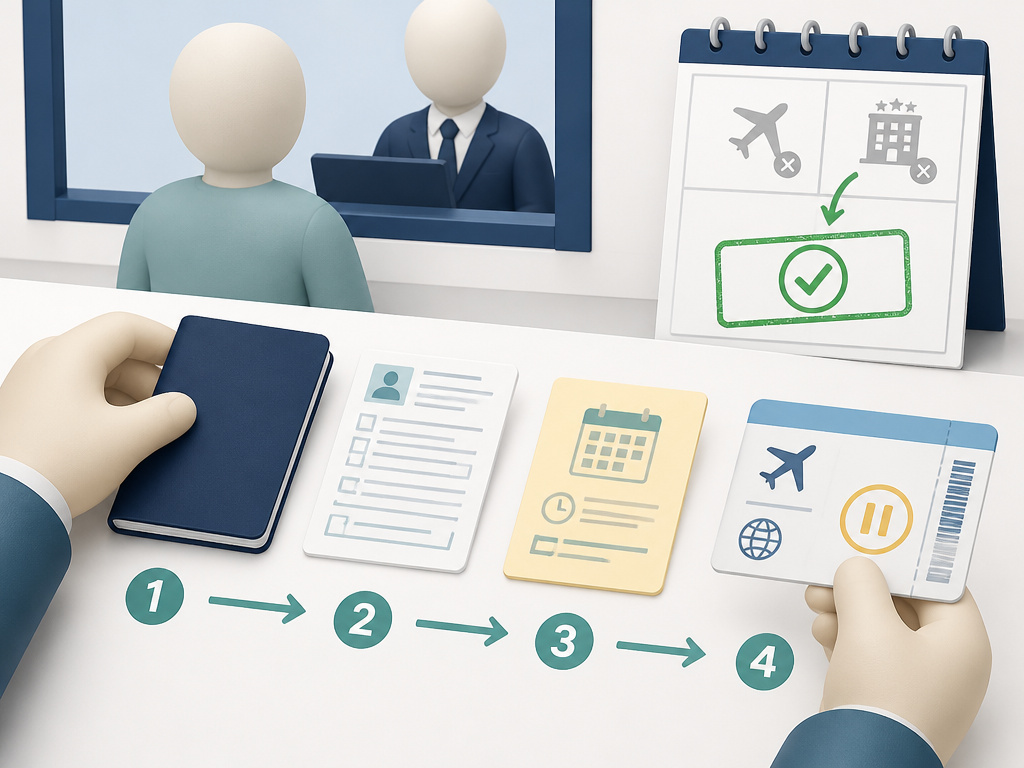
So what do you actually do with all of this? You build the trip in the order the visa allows, and that order runs backwards from how you’d plan a domestic trip.
BankBazaar’s guidance is the practical one: hold off on booking airline tickets and arranging accommodation until the visa is approved, but do the research and arrive with a clear plan. That means you can choose the neighborhood, price the flights, and know your itinerary without paying for any of it yet. If you’ll be staying at multiple addresses, be ready to name the one where you’ll spend the most nights.
The order that works:
- Passport first. Check its validity against the destination’s rule before you book anything.
- Application second. The DS-160 and the supporting paperwork come before the appointment.
- Interview third. Documents organized, answers short, family at home.
- Bookings last. Flights and hotels after the approval, not before.
The same conversation happens elsewhere with different paperwork. A Schengen visa application, a Canadian visitor visa, and a UK Standard Visitor Visa each run their own version of it. So does an Australian visitor visa.
If your case is straightforward, handle it yourself. IVisa and VisaHQ exist for people who would rather hand the form to someone else, and for a simple tourist application the form isn’t the hard part. Where a service earns its keep is a case with a wrinkle: a prior refusal, a business visa with a petition behind it, or a category where documents have to be assembled in a specific order. CIBTvisas works that end of the market.
I plan trips for a living, and the visa appointment is the one part of the process I can’t route around. Start with the State Department visitor visa interview page and work outward from there. Document lists and interview waivers change, and the official site is where that change shows up first.
Frequently Asked Questions
How long does a visa interview last?
Fermilab and UC San Diego put it at 2-3 minutes of interview time, while DavidsonMorris describes the interview as normally lasting several minutes and longer for complex cases. DavidsonMorris describes the interview as normally lasting several minutes, and longer for complex cases. The ranges differ because the applicants differ: a well-documented case moves faster than one that needs follow-up.
What should I bring to the visa interview?
Santo Domingo says to place only your passport in the tray, while Fermilab advises being ready to show proof of ties, financial and personal, and DavidsonMorris advises being prepared to present supporting documents relevant to your category. The U.S. Embassy in the Dominican Republic tells applicants to place only the passport in the tray and hold back additional documents unless asked. Fermilab advises being ready to show proof of ties, financial and personal, so bring the folder and keep it closed until you’re asked.
Do I need to speak English at the interview?
Fermilab says to expect the interview to be conducted in English and not in your native language, while UC San Diego says to anticipate the same. Fermilab says to expect English and suggests practicing conversation with a native speaker if possible, while UC San Diego says to anticipate English and adds the caution not to prepare speeches. UC San Diego adds one caution: practice the language, but don’t prepare speeches.
Can I bring my parents or spouse to the interview?
No. Fermilab says not to bring parents or family members with you to your interview, and UC San Diego says not to bring parents or family members with you to the interview. The officer wants to interview you, and a negative impression forms when you aren’t prepared to speak on your own behalf.
What happens if my visa is denied?
UC San Diego says you’ll be informed of the reason, while Fermilab advises asking the officer for the reason in writing and for a list of documents that would overcome the refusal. Fermilab advises against arguing and suggests asking the officer for a list of documents that would overcome the refusal, plus the reason in writing, while UC San Diego says you’ll be informed of the reason and can reapply with additional evidence. UC San Diego notes you can reapply if you can provide additional evidence, and asks its scholars to complete the Visa Delay or Denial eform in iServices first.
Is a short interview a bad sign?
No. VisaMind notes that interview length and officer manner aren’t signals, and that a short interview is common in well-documented cases. Fermilab says the decision rests on the impressions formed in the first minute or two, while UC San Diego trims that to the first minute, not on how long you stood at the window.
The Bottom Line
Everything above assumes a nonimmigrant visa interview at a consulate. VisaMind points out that the United States runs four different interviews under different rules: nonimmigrant visa, immigrant visa, adjustment of status, and naturalization. The question sets barely overlap, so identify which one you’re preparing for before you use any question list.
Your first step this week is small. Re-read the application you filed and correct anything that has changed since you submitted it, because the officer is working from that document and not from your memory of it.
Treat your case as complex if any of three things is true: you have a prior refusal, you have an arrest, caution, or conviction on record, or you’re the primary earner your family depends on. NNU Immigration notes that officers ask about arrests, cautions, convictions, and previous immigration violations, and UC San Diego is direct about the family-income problem. When one of those applies, the generic list stops helping and the specific issue becomes the whole interview.
No list of visa interview questions and answers replaces the two things that actually decide the outcome: consistency with your paperwork, and a short, clear answer delivered without a script.
