
How to Apply for a US B2 Tourist Visa Extension
This post contains affiliate links. As an Amazon Associate, we earn from qualifying purchases.
To apply for a US B2 tourist visa extension, file Form I-539 with USCIS before the admit-until date on your Form I-94, and send a written statement explaining why you need more time, how you will pay for it, and that you will leave. USCIS suggests filing at least 45 days before your stay expires.
That 45-day figure is a suggestion, not a rule. The instructions say “suggest,” the agency’s Extend Your Stay page says “recommend,” and USAGov says “if possible.” Three official pages, three soft verbs. The hard deadline is the I-94 date, and it does not move.
What follows covers the how to apply for a US B2 tourist visa extension question, the document set, the fee mechanics, and the two failure modes that quietly end people’s ability to come back: the I-94 date passing while you watch the visa stamp, and a missing document that turns a fixable application into a denial.
Key Takeaways
- File before the I-94 date, not the visa stamp date. The admit-until date in the lower right corner of your I-94 controls everything.
- The M-752 tip sheet is from 2009 and lists only three statement elements. The current I-539 instructions list four. Use the four.
- There are no appeal rights for a B-2 extension denial. A motion to reopen or reconsider does not stop unlawful presence from building.
- Families file on one paper form and pay one fee, with a Form I-539A for each extra person, if everyone is in the same status.
- Missing documents cause denial or delay. USCIS says so directly, and there is no second chance to add what you forgot.
What Is the Filing Deadline for a B2 Visa Extension?
The deadline is the admit-until date on your I-94 record. Not the expiration date printed on your visa stamp.
Those two dates have nothing to do with each other. A visa is a travel document that lets you ask to enter the country; it can stay valid for years after your stay ends, or expire while you are still lawfully here. Your permission to remain is set entirely by the I-94.
You can pull your record from CBP’s official I-94 website or the CBP Link mobile app. Do that first, before you do anything else. If the date looks wrong, correct the I-94 record before you file anything. Filing an extension against a bad I-94 date compounds the problem.
USCIS Form I-539 instructions require the application to be filed before the expiration date shown on the Form I-94. The agency suggests filing at least 45 days before the stay expires, and generally not more than six months before. A late filing may be excused only when the applicant demonstrates all five conditions in the regulatory test.
That is the technical version. Here is what it means in practice.
The 45-Day Window Is Advice, Not Law
I get why people treat 45 days as a hard cutoff when they compare a how to apply for a US B2 tourist visa extension. It shows up on three government pages and every immigration blog repeats it as gospel. But read the actual verbs: USCIS “suggests,” USAGov says “if possible.” No regulation says 45 days.
What the regulation does say is that USCIS must physically receive your application before your authorized stay ends. Mailing it the day before is not enough. If your I-94 expires June 30 and your paper application lands on July 2, you filed late, full stop.
The 45-day figure exists so you have room to fix problems. A missing item can lead to delays or a denial, and you need calendar days to respond.
What Happens If You File Late?
USCIS can excuse a late filing, but only if you demonstrate all five of these conditions when you file:
- The delay was due to extraordinary circumstances beyond your control.
- The length of the delay was reasonable.
- You have not otherwise violated your status.
- You are still a bona fide nonimmigrant.
- You are not in removal proceedings.
Miss any one of those and the excuse does not apply. “I lost track of the date” is not an extraordinary circumstance. The delay must be due to extraordinary circumstances beyond your control.
Common mistake: Watching the visa stamp expiration instead of the I-94 admit-until date. The visa can be valid for years and still give you zero extra days. If the I-94 date passes while you are waiting on the visa to expire, you are out of status.
What Documents Do You Need to Extend a B2 Visa?
USCIS Form M-752, the B-2-specific filing tips sheet, lists three elements for the written statement. Form M-752 lists three elements for the written statement, while the current Form I-539 instructions list four, adding how you plan to financially support yourself while in the United States. This is where a lot of filers trip.
Here is the full list, combined:
| Document | What It Must Show | Who Needs It |
|---|---|---|
| Form I-539 | Complete, signed, all required fields | Every applicant |
| Form I-539A | Signed by each co-applicant | Each extra family member |
| Passport copy | Photocopy of valid passport | Each person on the application |
| Form I-94 | Original arrival-departure record | Each person on the application |
| Financial support | Bank or financial records | The applicant |
| Written statement | Reason, temporariness, departure, finances | The applicant |
The passport has to be valid for the entire requested period of stay. Not just until you file, not just until a decision — the whole window you are asking for. That catches people whose requested period of stay runs past their passport’s expiration date.
Where this goes sideways: Sending a photocopy of the I-94 instead of the original. M-752 asks for the original Form I-94 for each family member included. A photocopy can lead to delays or a denial, and if you are close to the I-94 date, that can push you out of status while you wait.
The Written Statement: Three Elements or Four?
This is the single most confusing part of the B-2 extension, because two USCIS documents disagree.
Form M-752, last revised 05/28/09, lists three elements for the written statement:
- The reason for your request to extend your stay.
- Why the extended stay would be temporary, including departure arrangements such as a copy of a return plane ticket.
- Any effect the extended stay may have on your foreign employment or residency.
The current Form I-539 instructions, edition 08/28/24, list four. They keep all three above and add a fourth: how you plan to financially support yourself while you are in the United States.
M-752 is silent on the fourth. It has not been revised in over 15 years. If you build your statement from the older tip sheet alone, you will omit an element the current instructions require.
Write all four. The financial support question is easy to answer and expensive to skip.
How Do You Show Financial Support?
M-752 asks for a description of your means of financial support while visiting, with documentary evidence such as bank or financial records. That means two things: a description in the statement, and documents behind it.
Bank or financial records, a letter and records from whoever is supporting you if someone else is paying, and any proof of income that continues while you are abroad. The point is to show that you can afford the stay you are asking for.
One short paragraph in the statement plus the attached records handles it. A one-line claim with nothing attached does not.
How Much Does a B2 Visa Extension Cost?
As of November 5, 2026, the Form I-539 fee is $470 on paper and $420 online. The USCIS fee schedule, Form G-1055, edition 10/26/26, lists no separate biometrics fee for this form, and no added fee under Public Law 119-21, the 2025 law that created several new immigration fees.
That last point matters. A lot of people assume every immigration filing picked up a new surcharge in 2025. For Form I-539, it did not.
USCIS does not refund the fee if your request is denied, a detail worth knowing when you research how to apply for a US B2 tourist visa extension. That is worth saying plainly, because it changes the math on whether to file a weak application.
| Filing Method | Fee | Who Can Use It |
|---|---|---|
| Online | $420 | You only, no co-applicants |
| Paper (mail) | $470 | You, or a family filing together |
Can You File Online?
You can file online only for yourself, with no co-applicants. That is the trade-off. The online route is cheaper, but it does not support family filings.
A family can file together on one paper form and pay one fee, adding a Form I-539A for each extra person. This works only for you, your spouse, and your unmarried children under 21, and only if you are all in the same status.
There is a catch on the family filing that surprises people. If family members file together, everyone gets the same end date: the shortest period granted to any of them. If one family member asks for a shorter period than another, the whole family gets the shortest period granted to any of them.
Worth knowing before you start: If you file by mail, USCIS no longer accepts checks or money orders unless you qualify for an exemption. You pay by card with Form G-1450, or from a U.S. Bank account with Form G-1650. A check mailed in the old way does not meet the current payment requirements.
Who Cannot File a B-2 Extension?
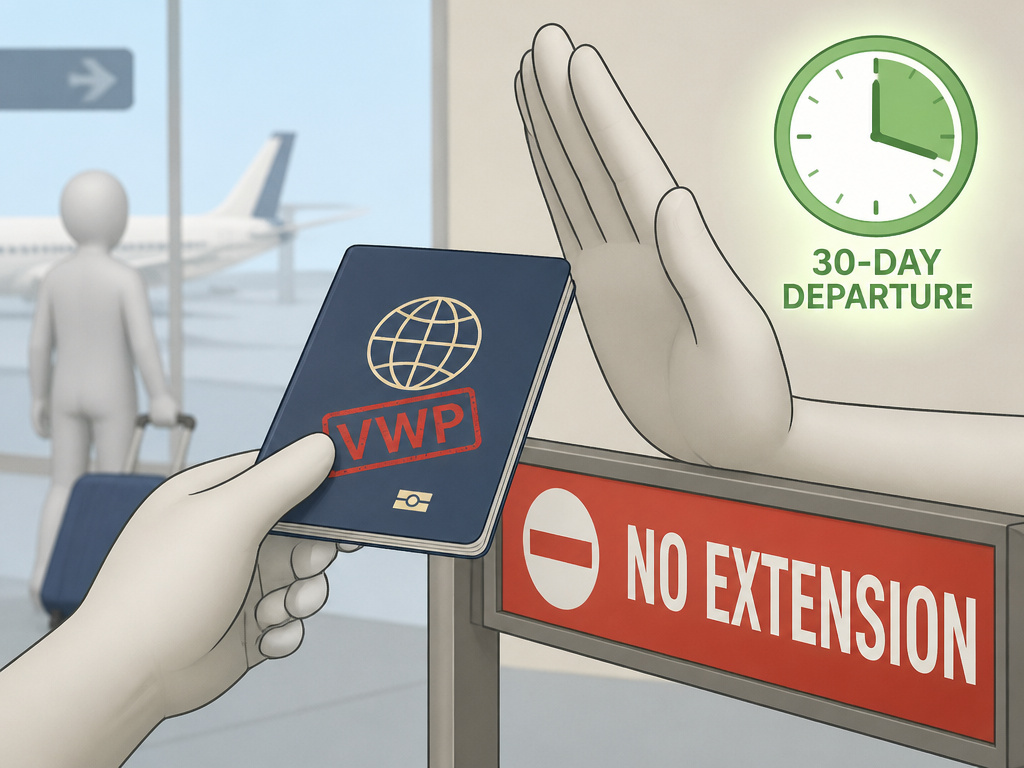
Not every visitor can extend. USCIS lists six categories that are barred outright, and one pair that is restricted.
The barred categories are the Visa Waiver Program, crew member (D visa), in transit through the United States (C visa), in transit without a visa (TWOV), fiancé(e) of a U.S. Citizen or dependent of a fiancé(e) (K visa), and informant on terrorism or organized crime (S visa).
J-1 and M-1 categories can only change or extend status subject to certain restrictions. The Form I-539 instructions cover the specifics.
For Visa Waiver visitors, there is one narrow exception. Under the regulations, if an emergency keeps you from leaving on time, USCIS may give you up to 30 days to depart. This is called satisfactory departure, and it is up to USCIS, not automatic. To ask for it, call the USCIS Contact Center.
If you leave within that window, the visit counts as completed without an overstay under 8 C.F.R. § 217.3(a). It is a limited window to depart, not a way to stay longer.
If you came in on the Visa Waiver Program and you are wondering how to apply for a US B2 tourist visa extension, the honest answer is that you cannot. The ESTA travel authorization has its own rules, and the extension path does not exist for that category.
What Happens While Your Extension Is Pending?
If you filed on time and the request is not frivolous, USCIS policy treats the time while your request is pending as a period of stay authorized. Unlawful presence generally does not build up while you wait.
That protection has conditions. It applies only if your request was timely and not frivolous, you did not work without permission, and you kept your status before filing. A frivolous request is one that does not meet the requirements for a timely, non-frivolous filing.
Two things do not change while you wait. You still may not work, because a visitor for pleasure may not take any employment under 8 C.F.R. § 214.1(e). You also may not enroll in a course of study. A B-1 or B-2 visitor who enrolls in a course of study violates status, and you cannot start classes until USCIS approves a change to F-1 or M-1 student status under 8 C.F.R. § 214.2(b)(7).
Easy to miss: A pending request is not an approval. Filing the application does not grant you anything. It protects you from unlawful presence while you wait, and that is all it does.
What If You Need to Leave Before a Decision?
You can leave. USCIS guidance says that leaving after your I-94 date, while a timely, non-frivolous request is pending, does not by itself trigger the 3-year, 10-year, or permanent bars. That protection does not apply if you worked without permission.
Keep proof of when you left. If you later apply for a new visa, you may need to show that your request was timely and not frivolous.
There is a separate rule for change-of-status requests. For a pending change of status, USCIS’s travel guidance says it generally treats the request as abandoned if you leave before a decision. An extension and a change of status are not the same thing, and the travel rules differ.
What If USCIS Denies the Request?
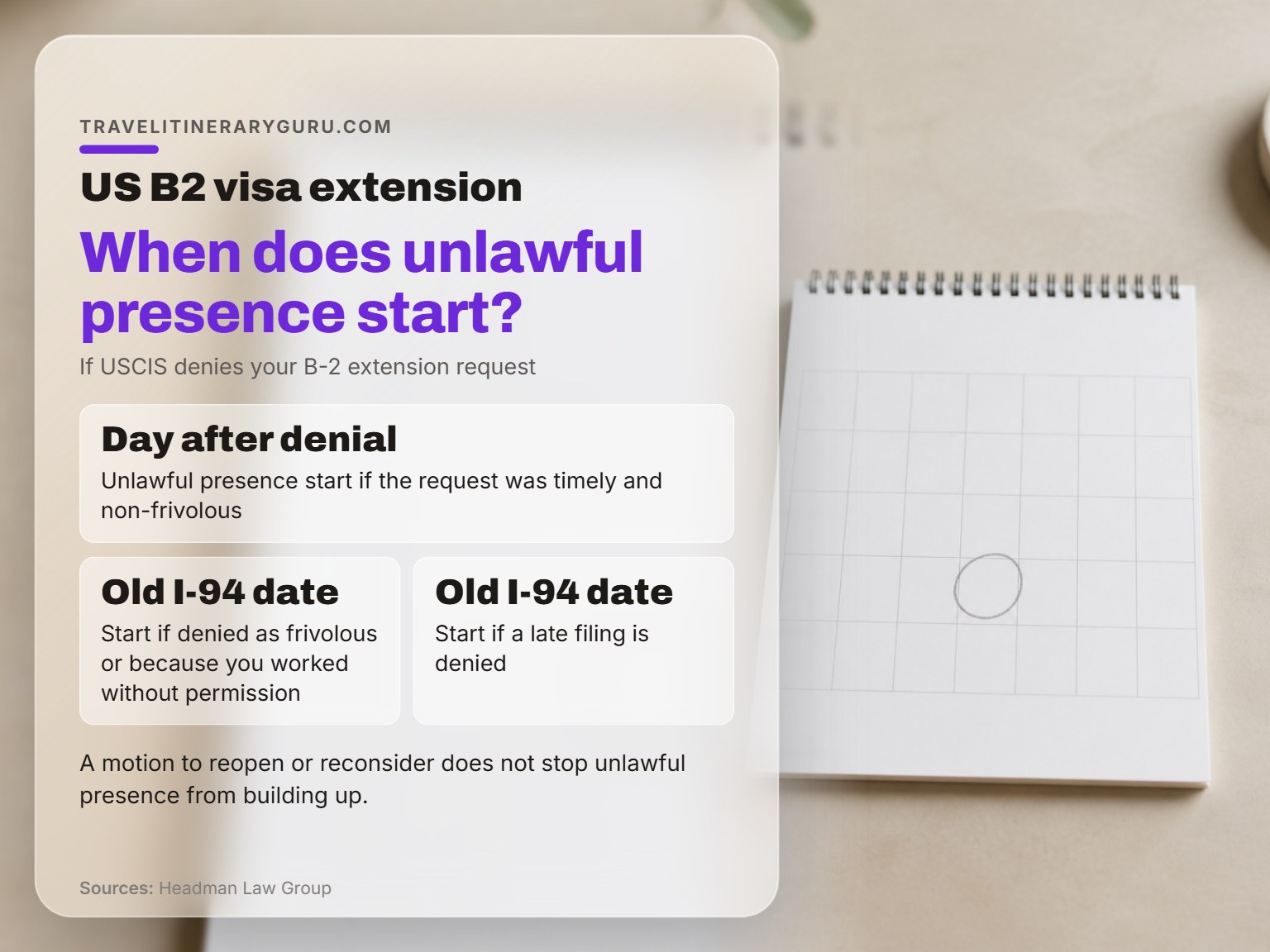
USCIS states there are no appeal rights for applications for extension of B-2 nonimmigrant stay, though a motion to reopen or reconsider can be filed. M-752 states that plainly, and it is the part filers most often miss.
You can file a motion to reopen or reconsider, but under USCIS’s unlawful presence guidance, a motion does not stop unlawful presence from building up. It is a request to look at the decision again, not a pause button.
If USCIS denies a timely, non-frivolous request, unlawful presence generally starts the day after the denial. If the request is denied as frivolous or because you worked without permission, it counts back to your old I-94 date. A late request that is denied also counts from the I-94 date.
Staying on after a denial carries a further risk. Under Notice to Appear guidance USCIS issued in February 2025, the agency generally defaults toward issuing a Notice to Appear after a denial when the person is removable, such as someone who is out of status. A Notice to Appear is issued when the person is removable, such as someone who is out of status.
| Denial Type | When Unlawful Presence Starts |
|---|---|
| Timely, non-frivolous | Day after the denial |
| Frivolous, or unauthorized work | Back to the old I-94 date |
| Late filing that is denied | Back to the old I-94 date |
What Are the Overstay Consequences?
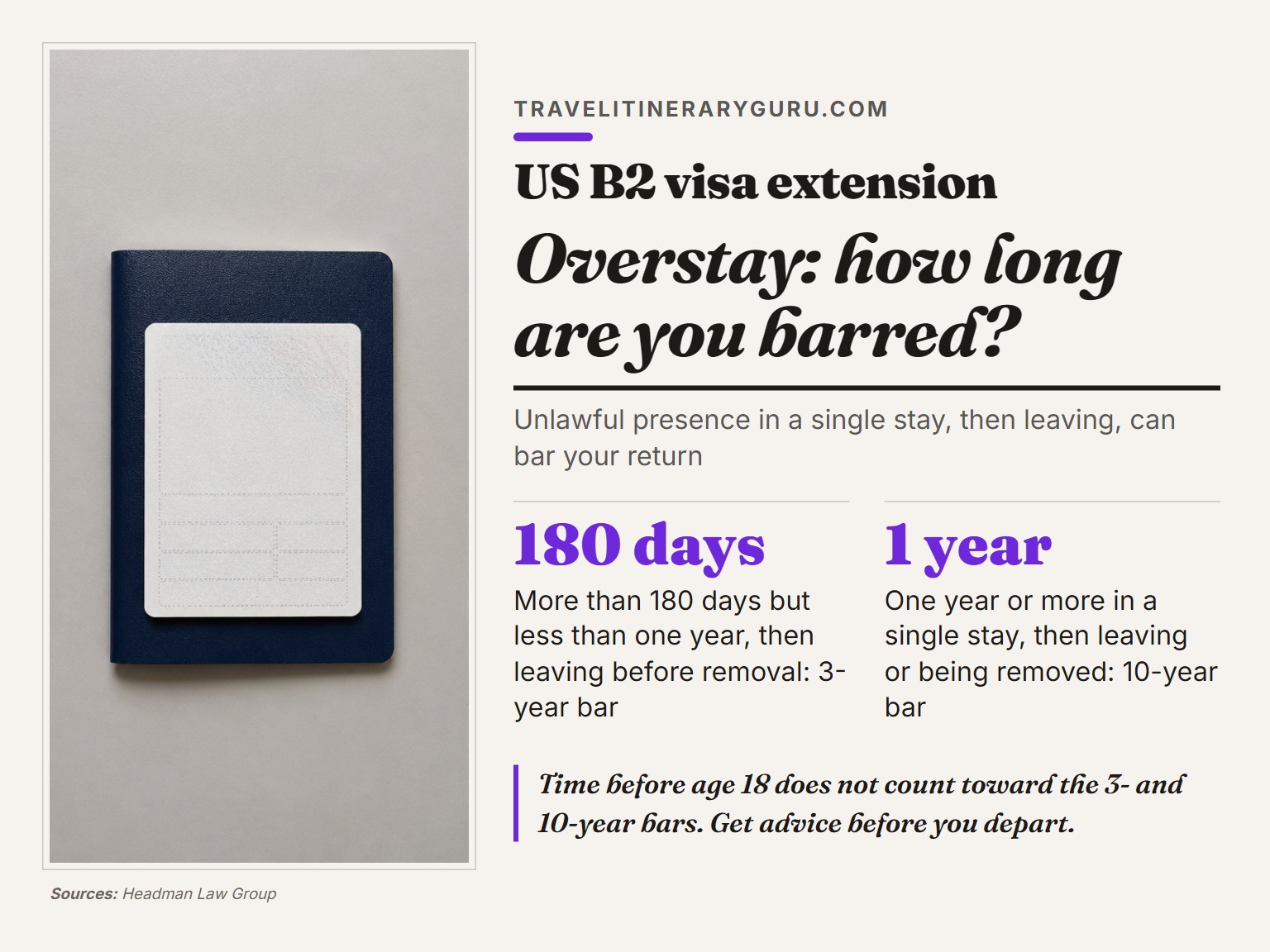
Staying past your authorized date causes two separate problems, and both outlast the trip.
First, your visa becomes void. Under section 222(g) of the Immigration and Nationality Act, a visa is canceled once you remain beyond your authorized stay. To come back as a visitor, you generally must apply for a new visa.
Second, unlawful presence can bar you from returning for years:
- More than 180 days but less than one year in a single stay, then leaving before removal proceedings begin: a 3-year bar.
- One year or more in a single stay, then leaving or being removed: a 10-year bar.
- More than one year in total, then leaving and later entering or trying to enter without being admitted or paroled: a permanent bar, with narrow exceptions.
Time before age 18 does not count toward the 3- and 10-year bars. Those two bars are triggered by leaving, so get advice before you depart if you have already overstayed.
If you fall out of status, USCIS cannot change your status except in certain limited circumstances beyond your control. The agency recommends leaving the United States to limit the possible impact on your ability to return in the future.
I have watched a friend discover this the hard way. She had a visitor visa and assumed the visa date was her deadline. Her I-94 said otherwise, and by the time she noticed, she was past it. The visa was void the moment she overstayed, and she had to rebuild her case for a new one from abroad. Read the I-94. Every time.
Does a Pending Extension Protect You From the Bars?
It can, if the request was timely and non-frivolous. Leaving after the I-94 date while a timely, non-frivolous request is pending does not by itself trigger the 3-year, 10-year, or permanent bars.
That protection is narrow. It does not apply if you worked without permission. It does not apply if the request was frivolous. And it does not turn a pending request into an approval.
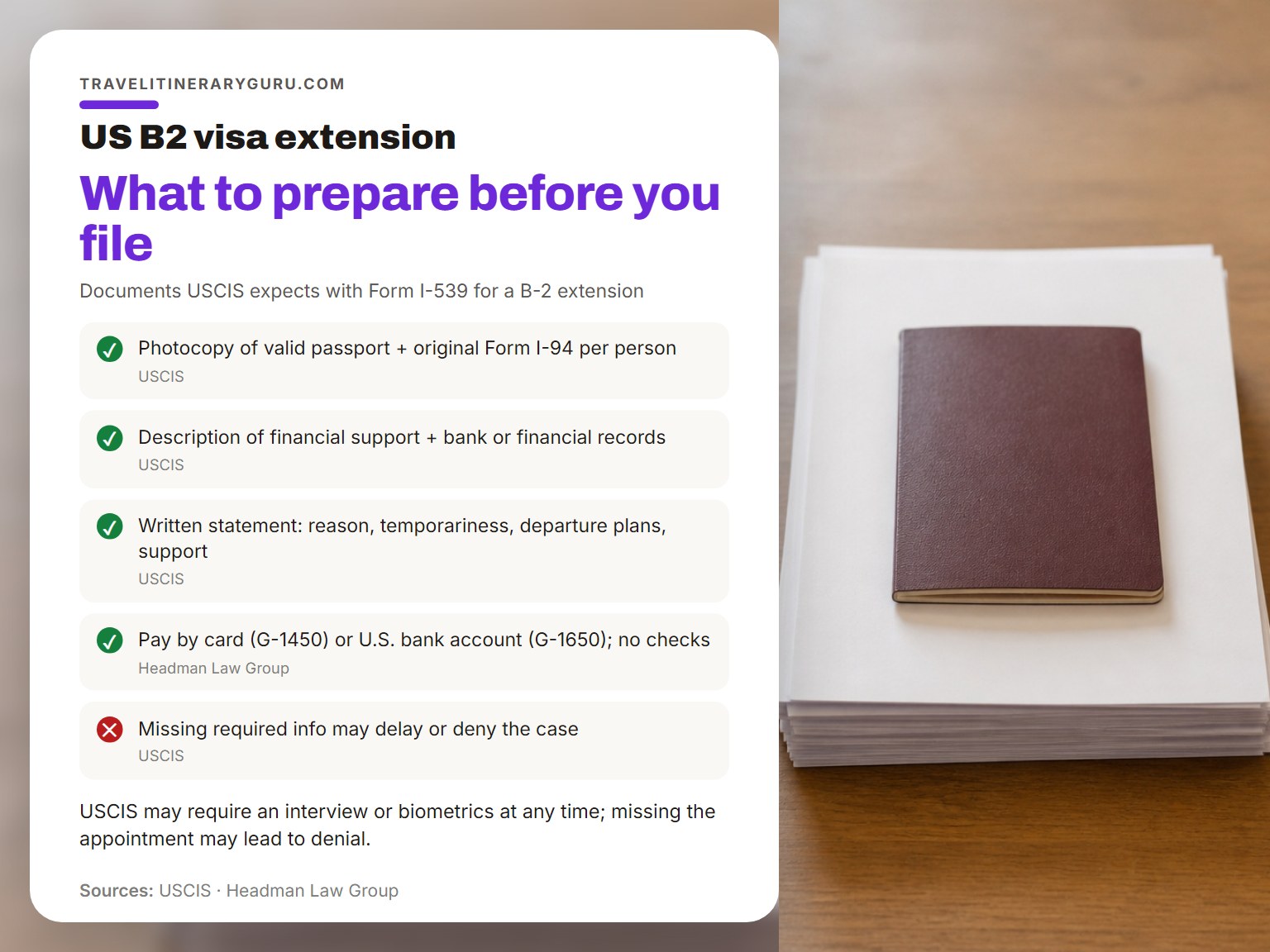
What Documents Should You Prepare Before Filing?
The extension is one piece of a larger document set. Passport validity rules for international travel matter here, because the passport must stay valid for the entire requested period of stay. If your passport expires in four months and you ask for six, you have a problem.
Before you file, work through the checklist:
- Pull your I-94 record and confirm the admit-until date.
- Check your passport expiration against the period you plan to request.
- Gather bank statements or financial records for the support description.
- Draft the written statement covering all four elements.
- Line up your departure arrangements, such as a copy of a return plane ticket.
- Prepare the payment method: Form G-1450 for card, Form G-1650 for bank account.
The part nobody mentions: USCIS may require you to appear for an interview or provide biometrics at any time. If you do not attend the biometric services appointment, USCIS may deny the application. Watch your mail and your online account after you file.
How Long Does the Whole Process Take?
USCIS does not publish a fixed adjudication time for Form I-539 extensions. The agency’s case processing times page is the only reliable source, and it changes. Check it directly rather than trusting what other people report.
What you can control is the front end. Filing early leaves room for a rejected form, a Request for Evidence, or a biometrics appointment. Filing close to the deadline does not.
Frequently Asked Questions
Can I extend my B2 visa stay in the US?
Yes, in many cases. File Form I-539 with USCIS before the admit-until date on your I-94 passes. You must have been lawfully admitted, kept your status, and have a passport valid for the entire requested period. Each extension can be for up to six months. Approval is not automatic; USCIS uses discretion.
How much does it cost to extend a tourist visa in 2026?
As of November 5, 2026, the Form I-539 fee is $470 on paper and $420 online. The USCIS fee schedule lists no separate biometrics fee and no added Public Law 119-21 fee for this form. A spouse and unmarried children under 21 filing together on paper pay one fee. Fees are not refunded if USCIS denies the request.
Can I stay in the US while my I-539 is pending?
Generally yes, if USCIS received your request before your I-94 date passed. Under USCIS policy, a timely, non-frivolous request puts you in a period of stay authorized, so you generally do not build up unlawful presence while it is pending. You still may not work or study while you wait.
Can I extend my stay on ESTA?
No. Visitors admitted under the Visa Waiver Program with an ESTA cannot extend their stay or change status. The narrow exception is satisfactory departure: if an emergency keeps you from leaving on time, USCIS may give you up to 30 days to depart. Call the USCIS Contact Center to ask for it.
What happens if my B2 extension is denied?
You cannot appeal. Once your I-94 date has passed, you generally start building up unlawful presence. If your request was timely and not frivolous, it starts the day after the denial. If it was denied as frivolous or because you worked without permission, it counts back to your old I-94 date.
My visa expires soon but my I-94 date is later. Do I need to extend?
No, not because of the visa. Your permission to stay is set by the admit-until date on your I-94, not by the visa stamp. A visa that expires during your stay does not shorten it. Check your I-94 on CBP’s official website to confirm your date.
The Bottom Line
If your I-94 date is more than 45 days out, you have room to do this properly, though USCIS only suggests filing at least 45 days before your stay expires. If it is under 45 days, file as soon as you determine your need. The single most common way people lose the ability to return to the United States is not a bad reason for extending — it is a missed date and a missing document.
One rule most guides skip: if you are already past your I-94 date, do not file as if nothing happened. The late-filing excuse requires all five conditions, and you need to state them explicitly in your filing. A late application that reads like an on-time one gets treated like a late one.
Start with one concrete action this week: pull your I-94 record and write down the admit-until date. Then check your passport expiration against the period you plan to request. Those two numbers decide everything else.
This all changes if you have a past overstay, a prior visa refusal, or a pending green card case. In that situation, the calculus is different, and a short consultation before you file is worth more than any checklist.
