
Los Angeles Travel Guide for First-Time Visitors
This post contains affiliate links. As an Amazon Associate, we earn from qualifying purchases.
A Los Angeles travel guide for first-time visitors starts with three choices: which airport exit you use, which neighborhood you sleep in, and whether you rent a car. The city packs its attractions into a little more than 500 square miles, so distance decides almost everything else.
The airport exit is the first decision in any Los Angeles travel guide for first-time visitors, and it lands before you’ve cleared baggage claim.
What follows covers the four things that shape a first Los Angeles trip: when to come, where to sleep, how to move, and which of the city’s free attractions to build a day around. Two of those have contested answers, and both are worth knowing before you book.
Key Takeaways
- Pick a neighborhood, not a downtown hotel. Santa Monica, Pasadena and Downtown L.A. Are the walkable exceptions; everywhere else you drive or ride.
- Fall is the window most guides name, though Frommer’s stretches the good weather from early autumn through late spring and singles out winter for lower hotel rates.
- A car wins on scenery, Metro wins on the core. Six Metro lines and two dedicated busways cover Downtown, Santa Monica, Pasadena and Universal Studios.
- Heat is the bigger hazard, not earthquakes. Temperatures can exceed 120F (49C) in some areas, and the Valley gets triple-digit days in late summer and early fall.
- Five major museums are always free, and three more open free on a set day each month.
What to Know Before You Land at LAX
Arrival day shapes more of a Los Angeles trip than any other single day, and LAX is where it starts.
Los Angeles International Airport is the largest international airport on the West Coast of the United States and a major international gateway for the country.
Neither one fixes the sprawl.
They’ll help with the airport. They won’t help with the city, which is too spread out to cover on foot.
The official Los Angeles visitor guide is the city’s own starting point, and it’s worth ten minutes before you commit to a hotel.
When Should You Visit Los Angeles?
September through November is the window locals call “local summer,” and it’s the one a Los Angeles travel guide for first-time visitors like Lonely Planet names as the best time to visit.
Days stay long through the fall, and the weather is often warmer than it is in June. Most kids are back at school by then, so the summer rush has thinned out.
Frommer’s takes a wider view. It puts the city at its best from early autumn through late spring, and it singles out winter for moderate temperatures, fewer crowds and lower hotel rates. Both positions are defensible, and they’re answering slightly different questions.
Two Windows, Two Different Reasons
Lonely Planet is optimizing for weather. Frommer’s is optimizing for weather plus crowds plus hotel rates. Time Out adds a third consideration: the Valley’s triple-digit days land mostly in late summer and early fall, and September and October often pack the most unexpectedly brutal ones.
| Source | Position | Reason Given |
|---|---|---|
| Lonely Planet | Fall, September to November | Locals call it “local summer”; warmer than June |
| Frommer’s | Early autumn through late spring | Winter brings fewer crowds and lower hotel rates |
| Time Out | Late summer is the risk window | September and October are hottest inland |
Which window is right? October is the safe bet.
The practical read: October gives you the warmth Lonely Planet describes with thinner crowds than summer. If your budget matters more than the beach, winter is the Frommer’s answer, and you’ll trade some evening warmth for it.
Rule of thumb: October for warm days and thin crowds. January for the lower hotel rates Frommer’s points to.
The Discover Los Angeles 5-day itinerary is a reasonable spine if you’d rather start from someone else’s plan and edit it down.
Do You Actually Need a Car in Los Angeles?
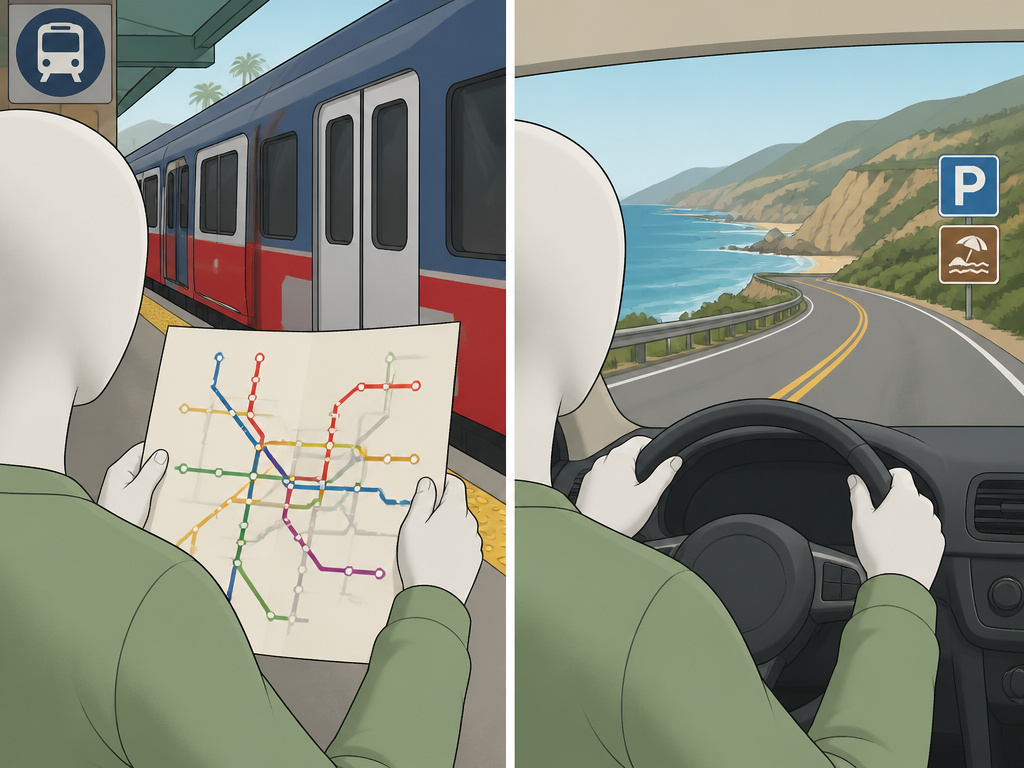
Two of the biggest names in travel writing say opposite things about this, and each one is right about a different half of the city.
Lonely Planet calls a car the best and most convenient way to explore Los Angeles and describes public transit as somewhat lackluster. Discover Los Angeles frames Metro rail and bus as convenient access to many popular destinations. Read both and you’d think they visited different cities.
Neither statement is wrong.
Where Metro Beats a Rental Car
Six Metro lines, two dedicated busways and a long list of bus routes cover more ground than most visitors expect. If your list runs through Downtown, Chinatown, Little Tokyo, Santa Monica, Culver City, Pasadena, Universal Studios, or the museums in Exposition Park and Miracle Mile, Metro may actually make more sense than a rental.
The E (Expo) Line is the clearest example. From its stops in Downtown L.A., it runs just under an hour to the western terminus in Santa Monica and drops you about three blocks from the beach.
Where a Car Is the Only Option
Some of the scenery has no transit equivalent at all. These three are car-only:
- Angeles Crest Highway for mountain switchbacks and long sightlines.
- Mulholland Drive. Short, best at dusk, and easy to pair with an evening in Hollywood.
- Pacific Coast Highway, where the drive is the point and the stops are optional.
Rent a car and you’ll pay for parking almost everywhere you go. Read the enforcement signs carefully, because street parking rules in Los Angeles are strict and confusing, and a garage is often the safer bet.
A 4-day Los Angeles itinerary covers the Metro-friendly core without a car at all. The Pacific Coast Highway is a different trip, and the California coast travel guide maps the stretches worth the drive.
I’ve planned this both ways, and the split is predictable. Metro for the core, a car for the edges. Renting a car you use twice is the most common waste I see in first-timer plans.
My own bias runs toward transit, which is why I’d rather you base yourself somewhere walkable and treat the car as a day-trip tool.
Where to Stay, and the Hollywood Name Trap
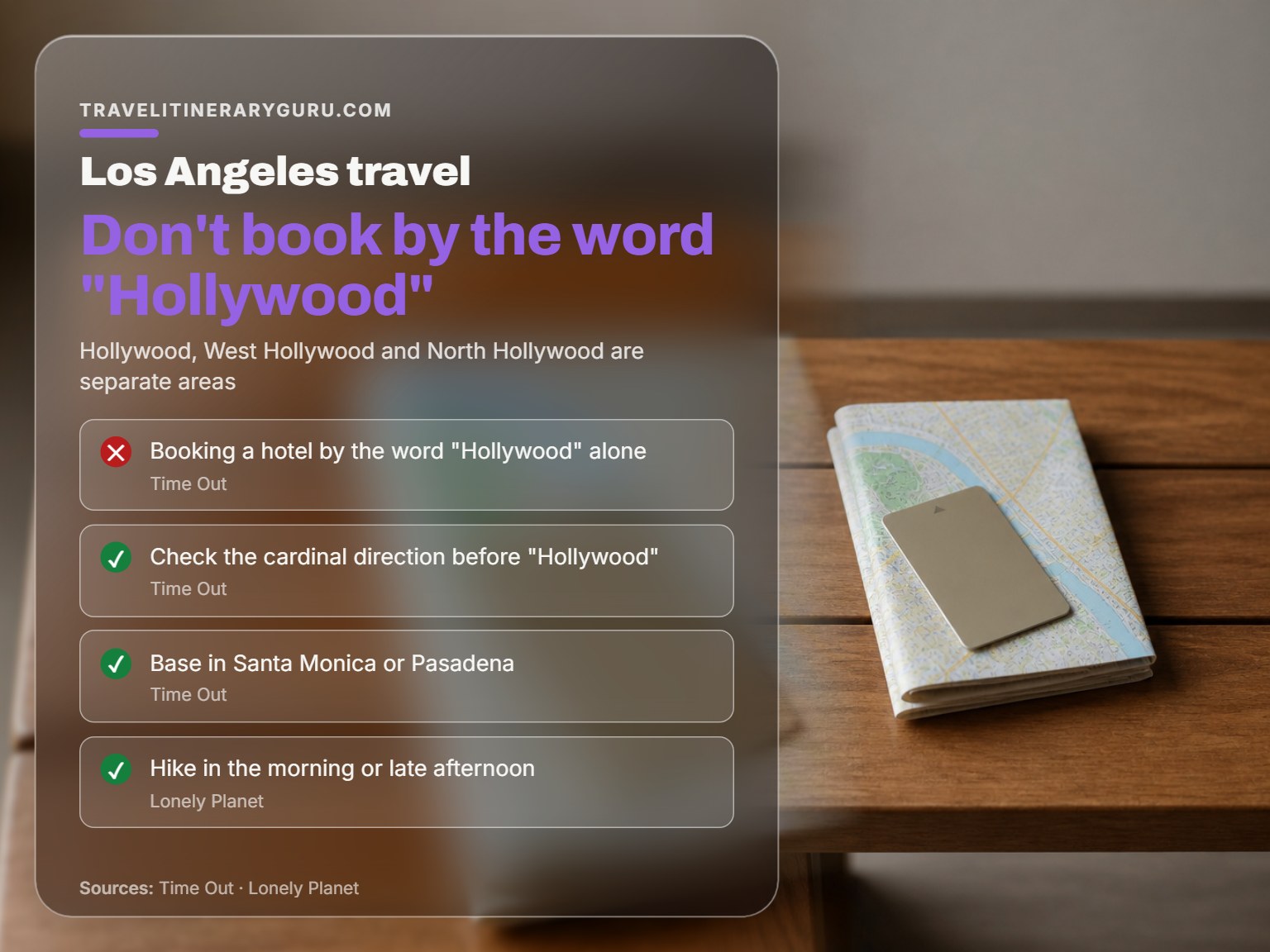
Booking the wrong Hollywood will wreck your mornings.
Hollywood, West Hollywood and North Hollywood are three separate areas, and they aren’t close to each other. A hotel listing that says “Hollywood” sounds like it puts you near the Walk of Fame. Wrong.
Downtown L.A. Is the other trap. Time Out’s read is that its parts are more compelling than its whole, and that it usually isn’t the best starting point for a tourist. The genuinely walkable pockets are Santa Monica, Pasadena and Downtown L.A. Itself, and the last one works only if you arrive with a specific plan.
New York and Los Angeles pull in different directions, and New York vs Los Angeles is the comparison most first-time US visitors end up making.
| What Goes Wrong | Why It Happens | What to Do Instead |
|---|---|---|
| Your “Hollywood” hotel is nowhere near the Walk of Fame | Hollywood, West Hollywood and North Hollywood are separate areas | Check the cardinal direction before booking |
| You booked a Downtown hotel for walkability | Downtown’s parts are stronger than its whole | Base in Santa Monica or Pasadena |
| You’re hiking at 1pm in August | Temperatures can exceed 120F (49C) in some areas | Go in the morning or late afternoon |
That’s the trap.
What most people get wrong: Booking by the word “Hollywood” alone. West Hollywood and North Hollywood are different places entirely, and only Hollywood itself sits beside the Walk of Fame.
The Free Half of Los Angeles
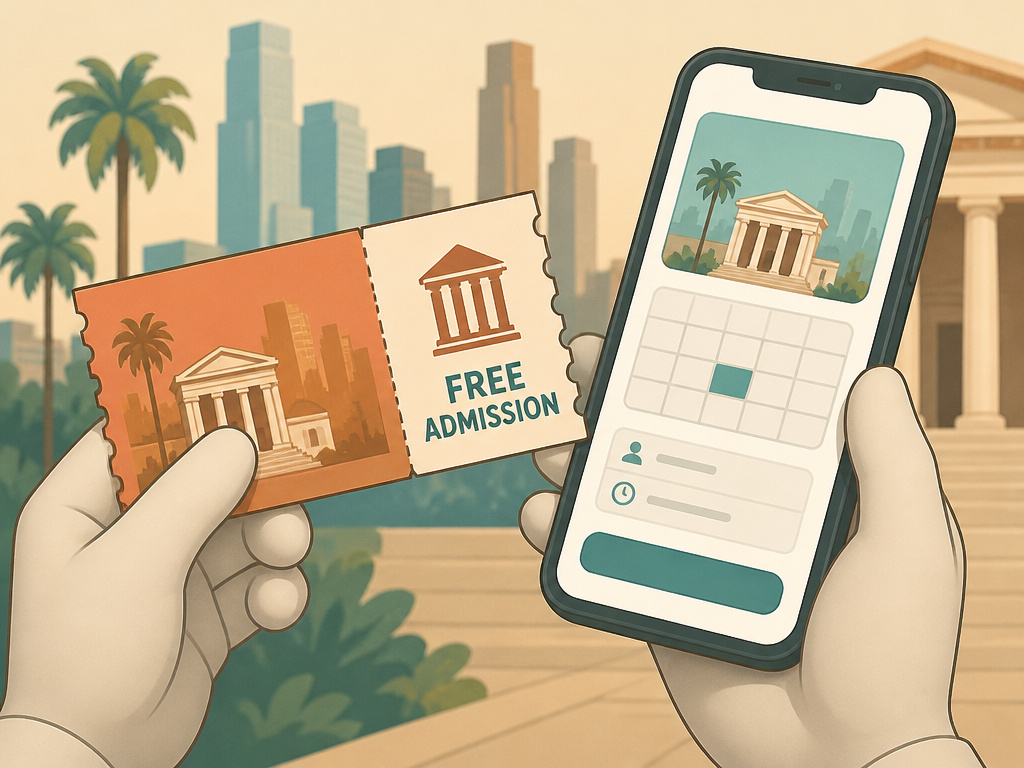
Five major Los Angeles museums cost nothing to enter, every single day.
The Broad, the Getty Center, the Getty Villa, the Hammer Museum and MOCA are always free. Parking is the catch.
Always Free, No Ticket Needed
- The Broad, where Yayoi Kusama’s Infinity Mirrored Room is free and sits at the top of any contemporary art list.
- The Getty Center and the Getty Villa. Two campuses, one free admission policy.
- The Hammer Museum and MOCA, both easy to fold into a Westside or Downtown afternoon.
Free Days at the Rest
Three more institutions open free on a schedule, and the schedule is the whole trick.
- LACMA on the second Tuesday of the month.
- The Skirball every Thursday.
- The Huntington on the first Thursday of the month, with an advance ticket.
The Huntington is the one that catches first-timers out, because the free day needs a ticket booked ahead. Museum Row on Wilshire Boulevard is the other useful piece of geography: a three-block stretch holding four cultural institutions, including LACMA and its Urban Light exhibit of 202 antique street lamps.
Griffith Observatory is the free stop most people forget, and it has public telescopes for viewing the Hollywood Sign, the basin and the night sky. I’ve stopped steering first-timers away from the obvious spots. The “trap” is usually worth it once, especially when the view is the point.
Worth knowing before you start: The La Brea Tar Pits are closed until July 2028 for a two-year renovation. Plan the Natural History Museum and its trio of T. Rex skeletons instead.
Visit California’s Los Angeles page keeps the current status of the big attractions, which matters more than usual when something closes for years. Most of the hidden gems in Los Angeles sit in the neighborhoods rather than on the boulevards, which is why a free museum day pairs well with a walk.
Heat, Tremors and Smoke: The Safety Layer
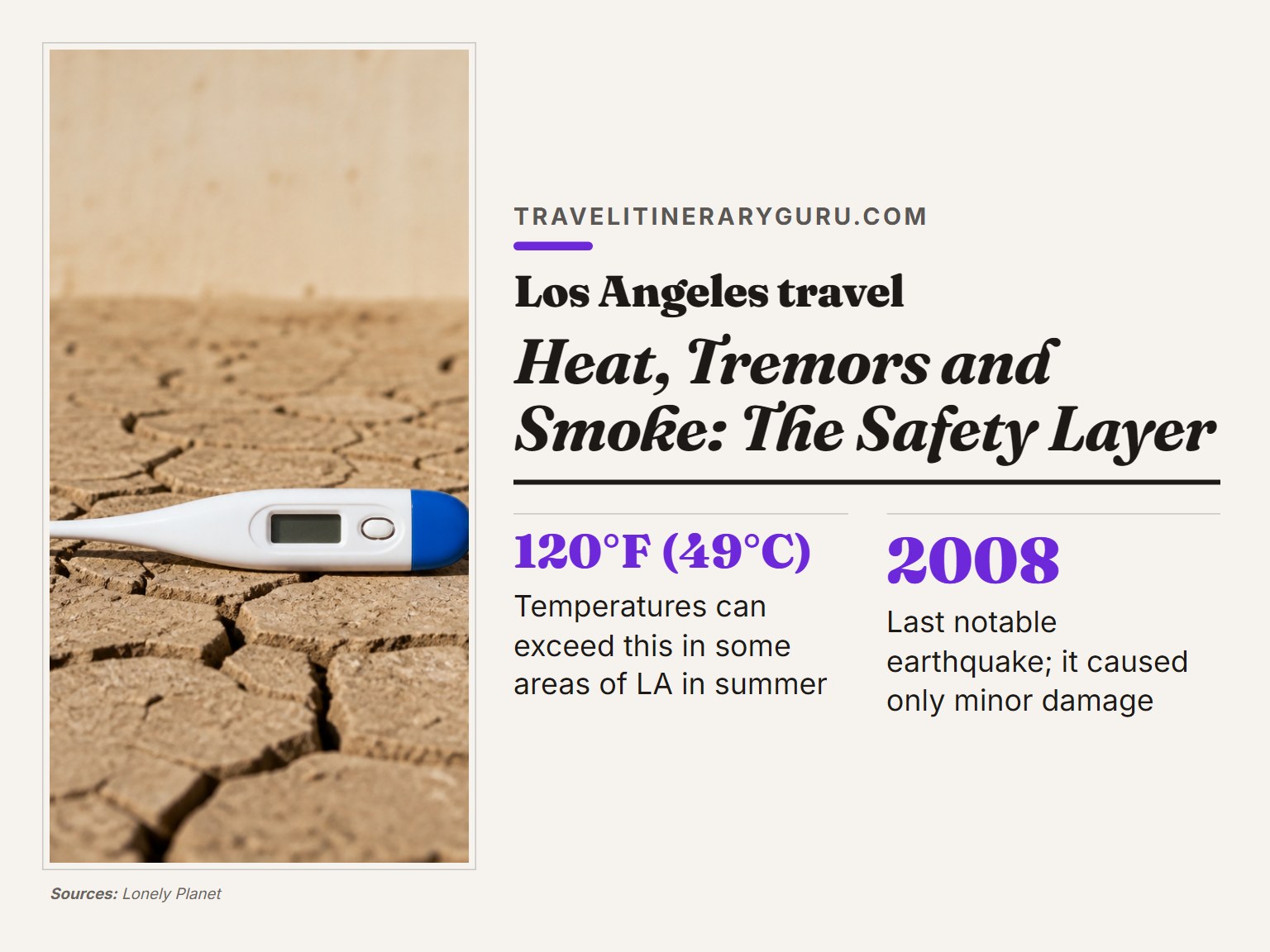
Extreme heat shows up in Los Angeles more often than earthquakes or wildfires, and it’s the hazard visitors plan for least.
Temperatures can exceed 120F (49C) in some areas of the city in summer. The Valley gets occasional but increasingly frequent triple-digit days, mostly in late summer and early fall, and September and October often pack the most brutally hot ones.
Before you start: Three hazards need a plan before you leave the hotel. Heat above 120F (49C) in some areas means hiking only in the morning or late afternoon, with high-factor sunscreen and water. Earthquakes average two to three tremors a year, and the correct response is Drop, Cover and Hold On under a table or desk, never a doorway. Wildfire smoke can wreck air quality even when you’re nowhere near a fire, so check reports and stay indoors if you have respiratory problems.
Earthquake Protocol in Four Steps
- Drop, Cover and Hold On. Get under a table or desk. Skip the doorway, which is not the safe spot the old advice claimed.
- Stay put until the shaking stops. Moving mid-tremor is how you end up under something falling.
- If you’re driving, pull over away from buildings and power lines and stay in the car. Stopping beneath a power line turns a minor tremor into a real problem.
- Opt in to city and county emergency alerts by phone and text, and keep your devices charged and updated while you travel.
The city averages two to three tremors a year, and the last notable one, in 2008, caused only minor damage. Earthquakes are the dramatic hazard. Heat ruins days.
Wildfires are the third piece, and they matter most when conditions are dry and windy. Keep up with fire reports, watch for evacuation orders, and remember that smoke and ash can wreck air quality even when you’re nowhere near the fire. If you have respiratory problems, stay indoors and use an air purifier where one is available.
Travel insurance with medical coverage earns its place here. The United States has no universal healthcare system, and the threat of natural disasters in California is a reason on its own.
When the heat gets serious, the mountains are the escape. A Big Bear Lake weekend trades the basin for elevation, which is the whole point in a triple-digit week.
How to Pace a Trip So You Actually See the City
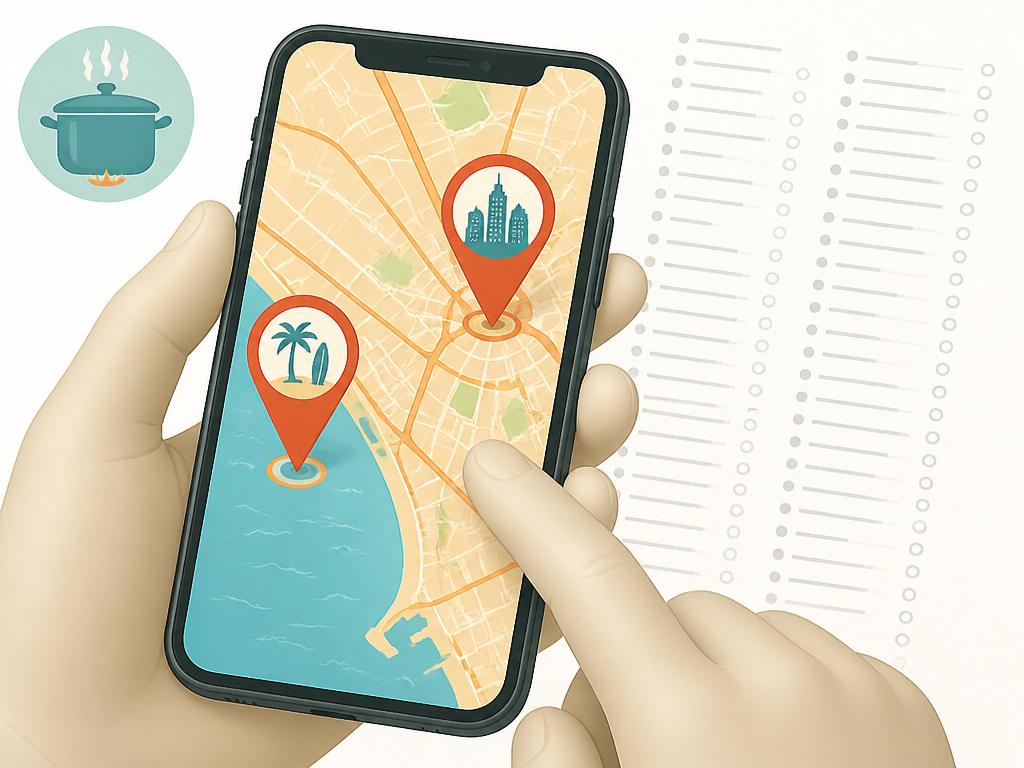
A traveler lands at LAX on a Tuesday with eleven things on a list and four days to do them. By Thursday, the list is winning.
Early in my planning career I built a ten-day trip with seven cities in it. My traveler spent most of those days in transit, and the photos were mostly of windows. Fewer stops with deeper exploration beats a rushed checklist every time, and Los Angeles punishes the checklist harder than most cities because the distances are real.
Two anchors a day.
Think of it as a braise rather than a stir-fry. You put two anchors in first, then let the rest of the day cook around them. Fair warning: the two-anchor rule is harder to hold than it sounds, and I got the pacing wrong for years.
An afternoon of nothing earns its place in a city this size, because that’s usually where the trip’s best hour comes from.
How long that takes depends entirely on what you’re trying to see, and how many days in Los Angeles is the question worth answering before you book flights. Two days outside the city changes the shape of the trip, and a Santa Barbara and Solvang itinerary heads north along the coast.
Where First-Timers Should Eat

Three Los Angeles food experiences cover most of it: a public market breakfast, a street taco, and one proper splurge.
Grand Central Market is the city’s largest and oldest public market, and it’s the best single introduction to the place. Go early, order the breakfast sandwich at Eggslut or a Korean lunch box at Shiku, and watch the room fill.
Sundays bring Smorgasburg L.A. To Row DTLA, an outdoor food market with vegan mushroom sandwiches at Champignon Eats and garlic noodles at Lobsterdamus. Row DTLA itself sprawls across 32 acres of a century-old industrial warehouse complex.
The Arts District is the foodie end of Downtown, with Pizzeria Bianco, Bestia, Michelin-starred Hayato and 715 Sushi, plus Death & Co. And the Angel City and Arts District Brewing Co. Taprooms.
For the splurge, n/naka holds two Michelin stars and serves a 13-course kaiseki. For the cheap end, El Ruso does street tacos and showed up on Netflix’s Taco Chronicles. Koreatown is the late-night answer, and it’s a lively spot to eat, drink and get pampered.
Go early.
Frequently Asked Questions
Is Los Angeles worth visiting for the first time?
Yes, and the reasons aren’t the ones the postcards advertise. The city packs shopping, dining and sightseeing into a little more than 500 square miles, and it’s second in population only to New York. Pick one base and stay in it.
Do I need a car to get around Los Angeles?
It depends which half of the city you’re seeing. Lonely Planet calls a car the best and most convenient option and describes transit as somewhat lackluster. Discover Los Angeles says Metro rail and bus give convenient access to many popular destinations. Both are describing real conditions in different parts of the region.
What’s the best time of year to visit Los Angeles?
Lonely Planet points to fall, specifically September through November, which locals call “local summer.” Frommer’s prefers early autumn through late spring and notes that winter brings moderate temperatures, fewer crowds and lower hotel rates. Time Out warns that the Valley’s hottest days land in late summer and early fall.
Is it safe to walk around Los Angeles at night?
Lonely Planet notes that some people avoid the trains at night because of crime and antisocial behavior, and suggests traveling in a group after dark. Many locals prefer rideshare to walking at night. Discover Los Angeles’s official safety guidance focuses on sticking to well-traveled and well-lit places rather than on transit specifically.
How many days do you need in Los Angeles?
Four days covers the Metro-friendly core without a rental car. Add time if you want the car-only scenery, and add a day or two if you’re building in a day trip. Distance is the real constraint.
What should I know about earthquakes in Los Angeles?
The city averages two to three tremors a year, and the last notable one, in 2008, caused only minor damage. Learn Drop, Cover and Hold On, shelter under a table or desk rather than a doorway, and if you’re driving, pull over away from buildings and power lines and stay in the car.
The Bottom Line
If you do one thing this week, book your hotel by neighborhood rather than by name. Santa Monica, Pasadena and Downtown L.A. Are the walkable exceptions, and everything else in the city is a drive or a ride away.
This all assumes you’re visiting for the first time and staying in one place. If you’re here for a specific event, or you’ve got family out in the Valley, the neighborhood advice mostly stops applying and the car question answers itself.
One threshold worth setting: if your list has more than two stops per day, cut it. Los Angeles traffic runs heaviest on weekdays, and a plan that ignores those windows loses an hour or more of daylight.
I’d rather see you skip one landmark and spend the afternoon in a neighborhood you can’t name yet. That’s usually the part people describe when they get home.
