
Hidden Gems in Los Angeles for First-Time Visitors
This post contains affiliate links. As an Amazon Associate, we earn from qualifying purchases.
Think you know LA? The hidden gems in Los Angeles for first-time visitors are almost never the ones on the listicles. They’re the small, specific, often free places that locals actually use, and most of them come with a catch: a single open day per month, a weekday-only window, or a parking situation that punishes anyone who shows up on a Saturday afternoon.
But there’s a problem. I’ve planned trips to LA for people who had three days and a rental car, and watched them burn the whole first afternoon circling Griffith Park looking for parking. The places below are worth your time. Getting to them is the part most guides skip.
What follows: the case for skipping the “hidden gem” label entirely, six specific spots with real addresses and hours, and the one question you should ask a bartender before you leave the hotel.
Key Takeaways
- Ask “where do you go on your day off?”, not “where should I eat?” The second question gets you the tourist answer out of politeness.
- Walt’s Barn opens one day a month, the third Sunday, 11am to 3pm. Plan the whole trip around it or skip it.
- The Japanese Garden is a working treatment plant with weekday-only public hours, so a weekend-only visitor can’t get in.
- Drive to Griffith Park on a weekend and you’ll regret it. The official guidance is to take the DASH shuttle instead.
- A place with its own hashtag isn’t hidden. It’s well-marketed, and the locals have already quietly stopped going.
What Counts as a Hidden Gem in Los Angeles?
Most of what gets called a hidden gem in LA is neither hidden nor a gem. It’s a well-photographed spot with a queue and a gift shop. The city’s own tourism arm lists over 250 cultural attractions, and the same dozen names cycle through every listicle.
The hidden gems in Los Angeles for first-time visitors share a pattern. They’re on public or institutional land, they’re free or nearly free, and they’re run by people who aren’t trying to build a brand. The City of Los Angeles says most of its Neighborhood Gems are free admission, and many are cared for and operated by City employees and departments. That’s the tell.
A genuine hidden gem in Los Angeles is a free or low-cost site on public land with limited, specific hours and no marketing apparatus. The operational constraint, one open day a month, weekday-only access, is what keeps the crowds out, not secrecy.
That constraint is also why first-time visitors miss them. A spot that opens one Sunday a month doesn’t fit a packed three-day itinerary, so it gets cut. Which is exactly the point.
The Day-Off Question That Beats Every Guidebook
I stopped asking locals “where should I eat?” years ago. Everyone gives you the tourist answer out of politeness, and you end up at the place with the laminated menu and the English translation.
Now I ask a different question: “Where do you go on your day off?” The answers are almost never in a guidebook, and about half the time it’s a place with no website at all.
I tested this in Chicago a few years back. I asked a barista near the Loop what she does on her day off, and she sent me to a taqueria in Pilsen with a hand-painted sign and six stools. Best meal of the trip. Not a single influencer in sight.
That same method works for the hidden gems in Los Angeles for first-time visitors, and it works better here than in most cities because the neighborhoods are so distinct. A server in Echo Park, a shopkeeper in Burbank, a bartender in Chatsworth, each one lives in a different version of the city, and each one knows a place you won’t find by scrolling.
Worth knowing before you start: A place with its own hashtag and a few thousand tagged posts isn’t hidden. It’s well-marketed. The real tell is when the business starts printing “as seen on TikTok” on the menu, that’s the moment the locals quietly stop going.
Six Spots Worth Building a Day Around
Each of these has a real address and a real reason to go. None of them require a reservation. All of them have a catch, and I’ve listed the catch with the spot.
Walt’s Barn (Carolwood Barn)
5202 Zoo Dr, Los Angeles 90027. Operated by the Carolwood Foundation, this is a small museum holding Walt Disney’s tools, train equipment, and miniature train depots.
The catch: it’s open on the third Sunday of the month only, from 11am to 3pm. Plan a weekday LA trip and you’ll drive past a locked gate. Check the Carolwood Foundation calendar before you commit a morning to it.
The Japanese Garden (SuihoEn)
6100 Woodley Ave, Van Nuys 91406. A garden tucked inside the San Fernando Valley, using reclaimed water throughout. It’s the “Garden of Water and Fragrance,” and it’s genuinely one of the prettiest half-hours you can spend in the Valley.
The catch is operational. The garden sits on the grounds of the Donald C. Tillman Water Reclamation Plant, and public hours are Monday through Friday, 8am to 5pm. Weekend-only visitors can’t get in, no matter what the tourism copy says about the garden being open year round. The two things are both true, and they contradict each other.
Rio de Los Angeles State Park
1900 San Fernando Road, Los Angeles. This one is my favorite of the six, and it’s the one almost no first-timer visits.
It used to be Taylor Yard, a 247-acre freight switching facility. Southern Pacific Railroad moved its service and maintenance functions there in 1923, and the yard kept operating until it closed by 1985. Today it’s hiking trails, native plants, and returning wildlife, managed in partnership with the City of Los Angeles Department of Parks and Recreation. Portions of the river nearby are still soft bottomed, or partially un-cemented.
The catch: it’s out past Dodger Stadium, surrounded by industrial blocks, and it looks like nothing from the road. Get directions from the Rio de Los Angeles State Park page; the nearest Metro Gold Line station is at Avenue 26, about 1.3 miles south of the park.
Amir’s Garden
A five-acre ornamental garden inside Griffith Park, created by Amir Dialameh in 1971 after a brushfire. It’s up a hill, it’s free, and it’s quiet in a way that Griffith Park proper never is.
The catch is the climb. It’s a real walk, not a stroll, and there’s no shuttle that drops you at the top.
The Self-Realization Fellowship Lake Shrine
17190 W Sunset Blvd, Pacific Palisades 90272. A 10-acre site with a lake, gardens, and the Mahatma Gandhi World Peace Memorial. Free, serene, and about as far from the Hollywood version of LA as you can get in twenty minutes of driving.
The Museum of Jurassic Technology
9341 Venice Blvd, Culver City 90232. I’m not going to describe what’s inside. That would ruin it. Go, pay the small admission, and let it unfold.
Why Griffith Park Breaks First-Time Visitors
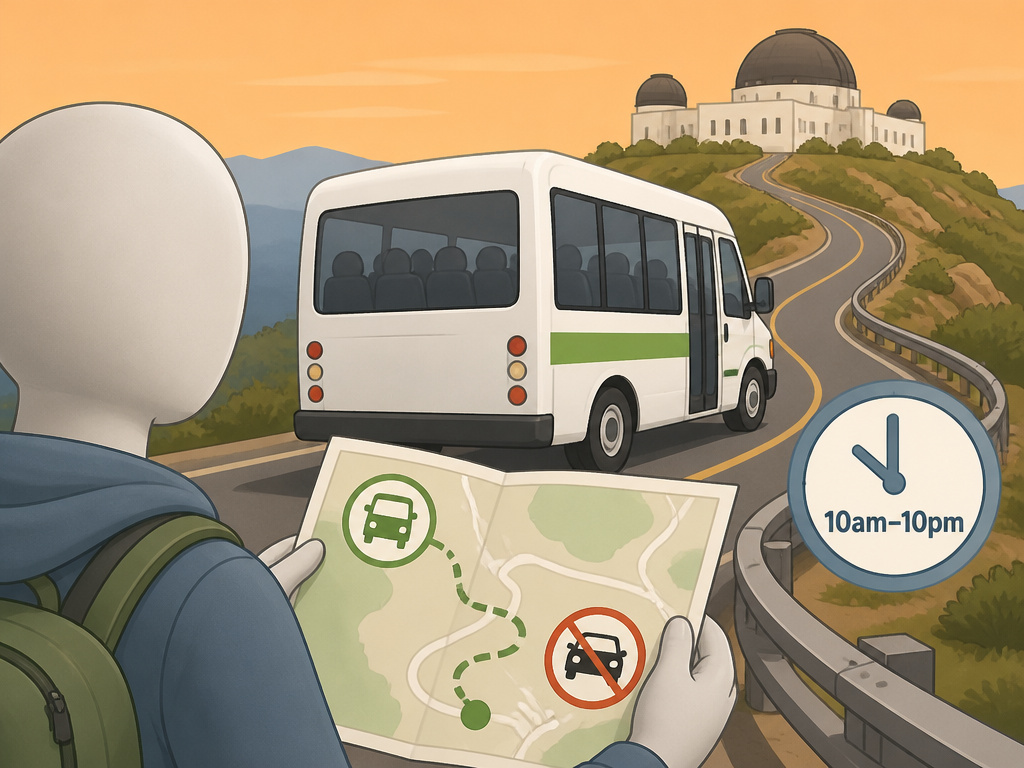
Griffith Park is where most LA itineraries go wrong, and it’s not the park’s fault. The official guidance from LA Parks is blunt: skip the car and take the shuttle. The official guidance from LA Parks is blunt: skip the car and take the shuttle.
Here’s the part that surprises people. The DASH Observatory/Los Feliz shuttle runs seven days a week, 10am to 10pm, every 15 to 20 minutes, and it runs even on days the Observatory building itself is closed. Most visitors assume the shuttle only operates when the attraction does. It doesn’t.
Common mistake: Driving to the Griffith Observatory on a Saturday and expecting to park nearby. You’ll spend your morning circling, miss your entry, and blame the city. Check the Griffith Park city park page for shuttle info instead; it drops you at the top.
One more thing about the Observatory. The city describes it as the most-visited public observatory in the world, with free admission, though the research brief notes no independent body verifies that claim. That’s a self-reported municipal claim, not a measured figure, no independent body verifies it. Treat it as marketing, not data. The free admission part is real, and that’s what matters.
The Fragile Spot Problem Nobody Warns You About
I’ve made this mistake myself. Years ago I posted a tiny ramen counter outside Tokyo with a photo and a location tag. Within a year it had a two-hour line and a ticketing system. The owner looked exhausted.
The math is brutal. One viral post can send more people to a tiny restaurant in a week than it sees in a normal month. That’s not discovery. That’s a stampede.
So I don’t post locations for very small places anymore, and I’d ask you to do the same. If you find something genuinely small and good on your trip, tell a friend. Don’t geotag it.
The part nobody mentions: Geotagging a fragile spot is how it gets ruined within a year. You’re not sharing a secret. You’re the reason it’s crowded next summer.
What to Skip, and What to Do Instead
A few honest calls, since you’re planning a real trip and not a photo scavenger hunt.
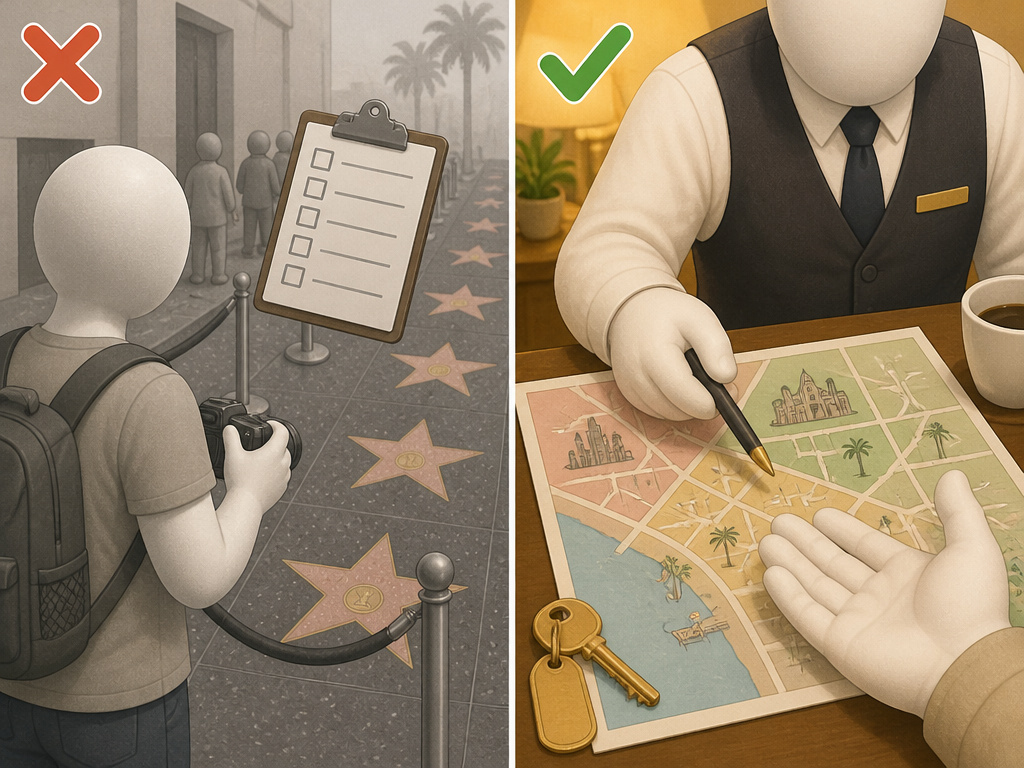
Skip the guided Hollywood walking tour. You can walk those blocks yourself, and the best discoveries happen when you get slightly lost and have to ask for directions. If you want structure, a Los Angeles travel guide will do more for you than an umbrella tour.
Skip the “top 10 must-see” checklist. If you’re checking off boxes, you’re not traveling. You’re commuting between photo ops. Build a 4-day Los Angeles itinerary around two neighborhoods a day instead of six landmarks.
Do ask your hotel’s front desk staff. They know the places that aren’t online, and they’ll tell you if you ask nicely. This is the single most underrated resource in travel, and it costs nothing.
Do learn how long you actually need. Most first-timers overpack their days and underpack their rest. If you’re not sure whether you’ve got the right number of days, work out how many days in Los Angeles you actually need before you book flights.
How to Get Around Without Losing a Day
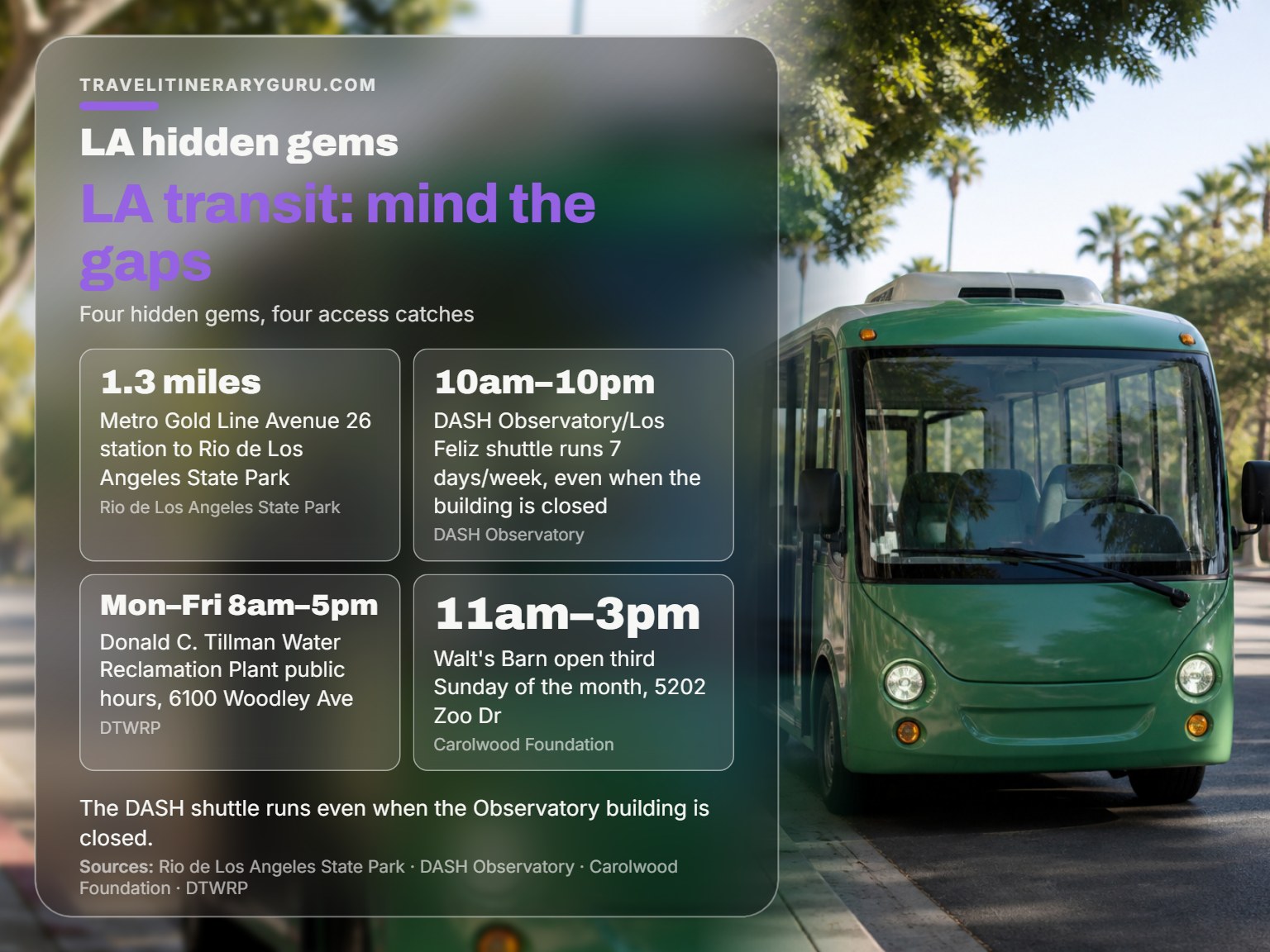
LA transit is better than its reputation, but only if you plan around the specific gaps.
| Destination | Best Access | The Catch |
|---|---|---|
| Griffith Observatory | DASH shuttle, 7 days/week | Runs 10am–10pm; parking is a trap |
| Rio de Los Angeles State Park | Metro Gold Line, Avenue 26 | Station is 1.3 miles south of park |
| Japanese Garden | Car, 6100 Woodley Ave | Weekday hours only, 8am–5pm |
| Walt’s Barn | Car, 5202 Zoo Dr | Third Sunday only, 11am–3pm |
If you’re pairing LA with a longer trip, the same logic applies statewide. A California bucket list built around two or three regions beats one built around twenty stops. And if you’re driving north, a California coast guide will save you from the mistake of trying to do the whole coast in one day.
Here’s the timing reality most guides skip. A “quick” Griffith Park stop takes far longer than you’d expect once you factor in the shuttle wait and the walk to Amir’s Garden. Budget for it or cut it.
Easy to miss: The DASH shuttle runs even when the Observatory building is closed. Most visitors plan around the attraction’s hours and miss the shuttle entirely.
When to Go, and When to Stay Home
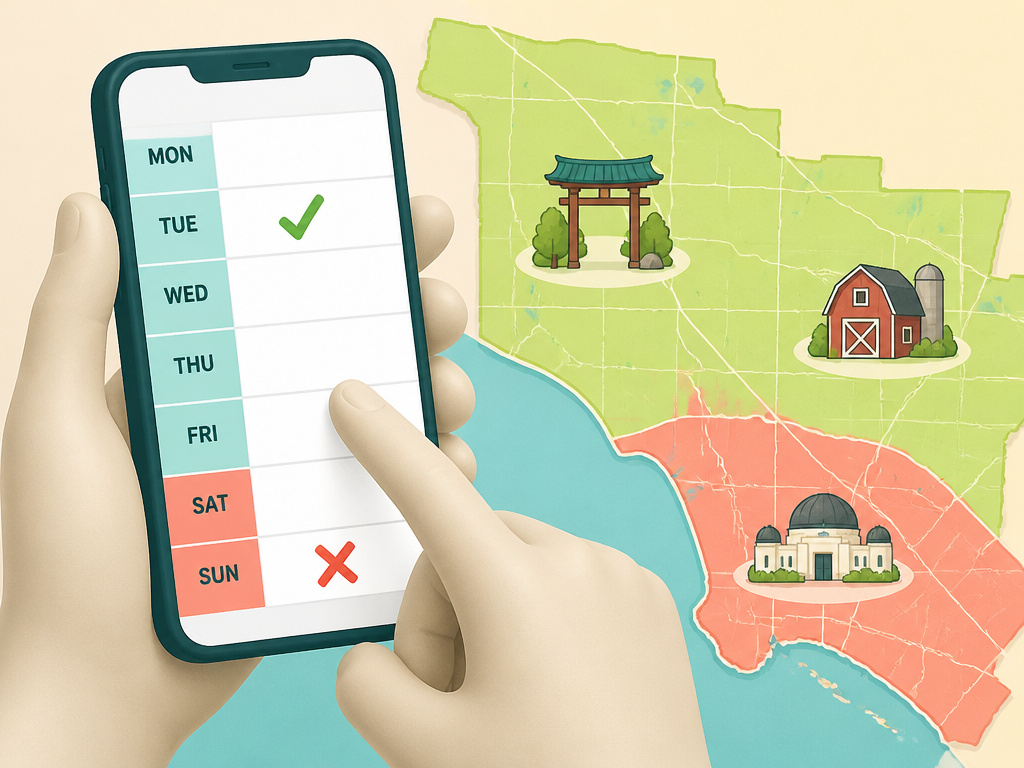
The timing question matters more in LA than in most cities, because the same spot can be a joy on a Tuesday and a misery on a Sunday.
| If you have… | Do this | Skip this |
|---|---|---|
| A weekday only | Japanese Garden, Rio de Los Angeles | Walt’s Barn |
| One Sunday | Walt’s Barn, then Griffith Park | Japanese Garden |
| A weekend, no car | Griffith Observatory via DASH | Rio de Los Angeles |
| Three days total | Two neighborhoods per day | The checklist approach |
For a longer southern California add-on, a Santa Barbara and Solvang itinerary makes a two-day reset from the LA pace. Just don’t try to squeeze it into a half-day.
Skip this if: You only have one weekend in LA and you want the icons. The spots above reward flexibility, and a packed weekend doesn’t have any. Do the Observatory, do the beach, and save the small stuff for trip two.
Frequently Asked Questions
Are these places actually free to visit?
Most of them, yes. The City of Los Angeles says most of its Neighborhood Gems are free admission, and the sites on public land. Rio de Los Angeles, Amir’s Garden, Griffith Observatory, cost nothing to enter. Walt’s Barn and the Museum of Jurassic Technology are the exceptions, and both charge a small admission.
What’s the single best hidden gem for a first-time visitor?
Rio de Los Angeles State Park, if you have a car and a free morning. It’s the one spot on this list that almost no first-timer visits, it’s free, and the Taylor Yard railroad history gives the walk a story. Just know that the Metro station is 1.3 miles away, so plan the last leg.
Why is the Japanese Garden closed on weekends?
It sits on the grounds of a working water reclamation plant, and public hours follow the plant’s weekday schedule: Monday through Friday, 8am to 5pm. Tourism copy that says the garden is “open year round” is technically true and practically misleading for weekend visitors.
Do I need a car to see these?
For Griffith Park and Amir’s Garden, no, the DASH shuttle covers you. For Rio de Los Angeles, Walt’s Barn, and the Japanese Garden, yes, or a rideshare. The bus network reaches Rio de Los Angeles, but the connections from downtown take a while.
How do I find spots like these myself?
Ask people who live there what they do on their day off, not where you should eat. Write the answers down in a notebook, because you’ll forget the name by dinner. And when you find something small and good, keep the location to yourself.
Before You Go
One rule most guides skip: if a place opens one day a month, decide now whether your trip includes that day. If it doesn’t, cut it from the list entirely and stop pretending you’ll “try to fit it in.” You won’t, and the planning energy is better spent elsewhere.
The day-off question is the whole method, and it takes about thirty seconds to use. Ask a bartender, a barista, or your hotel’s front desk what they do on their day off. Write the answer down. That’s your itinerary for tomorrow afternoon, and it’ll beat anything you found online.
I’ll be honest about the limits of this advice. If you’re traveling with young kids or on a tight schedule, the small, fragile spots are the wrong call, they reward flexibility you don’t have. Do the Observatory, do the beach, and come back when you can wander.
The magic is in the balance. Two icons, two neighborhood walks, one place nobody’s heard of. That’s a trip you’ll actually remember.
