
How to Find Accessible Restrooms While Traveling
This post contains affiliate links. As an Amazon Associate, we earn from qualifying purchases.
To find accessible restrooms while traveling, verify three things before you commit to a route: whether the facility is actually open (not just listed), whether it needs a key you don’t have, and whether the door width clears your equipment. Door width matters most: 38 inches, or 95 centimeters, is the width Ta11y cites for an accessible restroom door. Knowing how to find accessible restrooms while traveling means checking these details in advance.
That 38-inch figure comes from Ta11y’s accessibility guidance, not guesswork. Everything else here traces to the same kind of source: federal standards, transit authority pages, and national tourism boards.
The rest of this guide walks through what “accessible” legally requires, how locking systems differ by country, which apps and maps actually work, and the how to find accessible restrooms while traveling questions to ask before you leave the hotel.
Key Takeaways
- Door width is the first filter. Ta11y states that an accessible restroom door should be 38 inches (95 cm) wide.
- Keys don’t travel. A Radar key works in the UK. In Europe, you need a Euro Key. Holding one does not get you into the other.
- Listings lie by omission. A map entry tells you a toilet exists. It doesn’t tell you it’s open today, or that it’s behind a locked door only staff can open.
- Assistance is station-specific. At some transit stations, restrooms are self-service; at others, you ask the station manager at the faregate kiosk.
- Changing beds are not standard. A standard accessible toilet does not guarantee a changing-bed facility.
What Counts as an Accessible Restroom, Legally
The US Access Board’s Chapter 6 guidance on toilet rooms is the clearest public explanation of what “accessible” means in practice. It’s also the document most travel articles never open.
Here’s the short version. The ADA Standards don’t tell a building how many toilets to install. Plumbing codes do that. The ADA Standards say which of those toilets must be accessible. In new construction, access is required to all toilet rooms, including employee rooms.
The ADA Standards specify which toilet rooms must be accessible where provided, rather than how many fixtures a facility requires. In new construction, access applies to all toilet rooms, including employee facilities. Where single-user toilet rooms are clustered in one location, at least half for each use must comply.
That last clause is the one worth memorizing. If you’re standing in a cluster of four single-user toilets, say, a rest area with two men’s and two women’s single-stall rooms, at least half of each use must be accessible. Not all four. Half.
For portable units, the rule drops further. Access is required to at least 5% at each cluster. Construction-site portables used by construction personnel are fully exempt.
The Access Board publishes the full Access Board ADA toilet rooms guide if you want to read the how to find accessible restrooms while traveling exceptions yourself.
Why the Word on the Sign Matters
I see this advice a lot, and here’s why it falls apart on the ground: people search for “disabled toilets” and get a different result set than people searching for “accessible toilets.”
The caregiving guide publisher Carents makes the case directly. They argue “accessible” is the better term because it reflects that toilets need to suit all sorts of people with all sorts of needs, not just physical disabilities. That’s not a semantic nitpick. It changes what you find.
The practical version: search both terms. In the UK, the Great British Toilet Map uses “accessible.” In Germany, tourism listings still use “disabled.” If you only search one term, you miss half the results.
Carents also flags a detail that most guides skip. Adults with a stoma often rely on a mirror, a hook, and clean shelving. Those three features aren’t guaranteed by generic accessible standards. A toilet can be fully ADA-compliant and still have nowhere to hang a bag or change a pouch.
Common mistake: Trusting the label over the features. A toilet marked “accessible” may still lack a mirror, a hook, or shelving, the three things that actually matter for stoma care.
The Ta11y accessibility reference makes the same point about mirrors in its ta11y accessible public restrooms guide. Mirrors aren’t decorative. People with dietary or digestive disabilities use them to change ostomy bags or administer medication.
The Key Problem Nobody Warns You About
Accessible toilets across Europe and the UK are frequently locked. Carents notes many, but not all, are fitted with a special lock. That “not all” is doing a lot of work in that sentence.
Here’s where it gets genuinely annoying. The keys are regional.
| Region | Key System | Where It Works |
|---|---|---|
| United Kingdom | Radar key | UK only |
| Germany and much of Europe | Euro Key | Europe |
| Standard accessible toilets | None | Varies by facility |
| Some public facilities | Staff-held | Ask on arrival |
According to CBF Darmstadt / Germany Travel, the Euro Key originated in 1983 in Darmstadt, issued by the CBF Association at cost price on proof of disability. It’s a genuinely good system. It just doesn’t cross the Channel.
Visit London’s research brief notes there are more than 1,000 Radar key toilets in Greater London alone. That’s a lot of locked doors if you’re carrying the wrong key.
Where this goes sideways: Packing one key and assuming it covers your whole trip. A Radar key gets you into UK toilets; European accessible toilets need a Euro Key. If you’re crossing borders mid-trip, carry both or plan around it.
How to Find Restrooms Before You Leave the Hotel
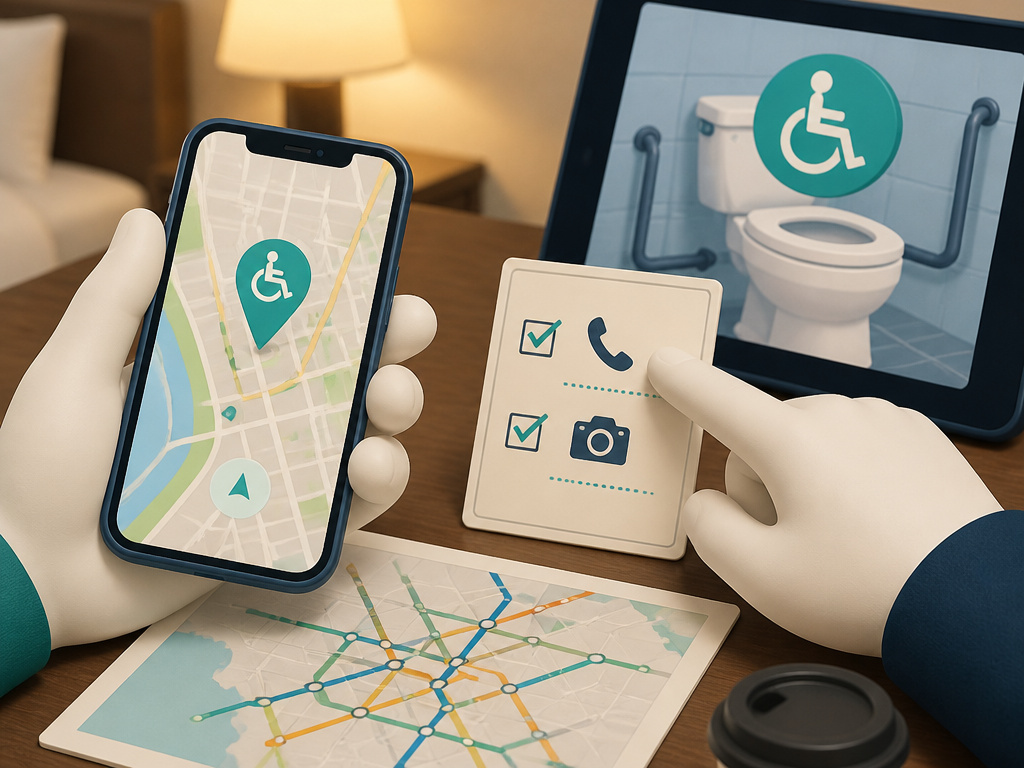
The best accessible restroom is the one you’ve already confirmed is open. Here’s the sequence I use.
- Check the operator’s own page first. Transit authorities and tourism boards publish their own restroom data. Third-party maps aggregate it, often without the caveats.
- Search both terms. “Accessible toilet” and “disabled toilet” return different results in most countries.
- Call ahead if the facility is critical. A five-minute call beats a twenty-minute detour to a locked door.
- Screenshot the location. Don’t rely on live signal in a subway station.
- Have a fallback. Restaurants, hotels, and department stores are usually the fastest backup.
Carents, citing the Great British Toilet Map, notes the map covers over 14,000 facilities across the UK. It includes all toilets the public can access without needing to be a customer. That’s a stronger inclusion criterion than most maps use.
For Germany, the national tourism board recommends wheelmap.org as the online map for finding accessible toilets. They also note that toilets for people with disabilities are plentiful in public spaces and visitor-focused facilities, but not yet universally available. The board’s advice is blunt: find out the location of the nearest accessible toilet before you take a tour.
What the Transit Authorities Actually Say
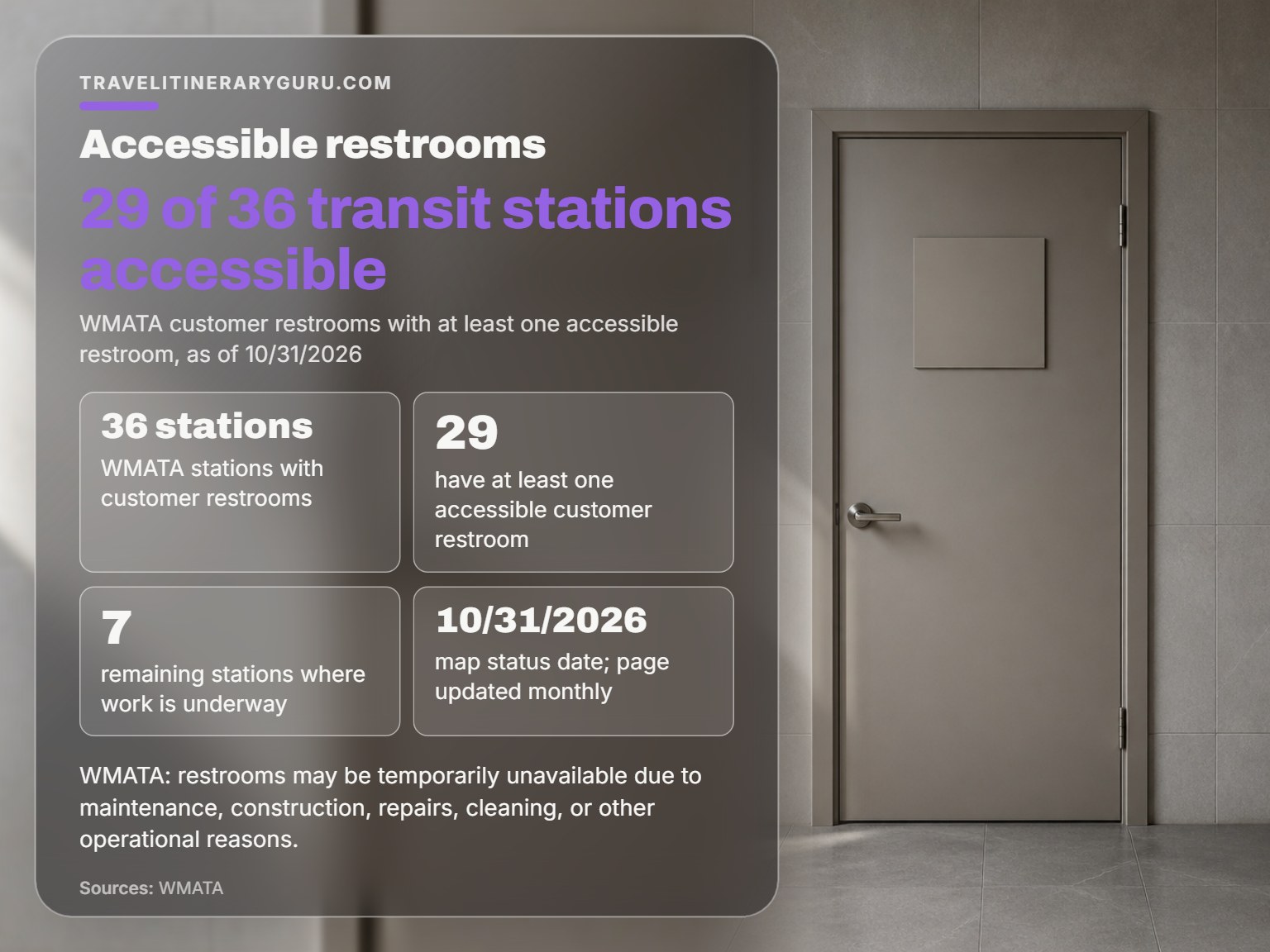
Transit is where the patchwork problem shows up worst. A city can have an accessible rail system and still have stations where you can’t get to a restroom without asking a stranger for help.
WMATA’s own restroom page is unusually honest about this. WMATA reports that of the 36 stations with customer restrooms, 29 currently have at least one accessible restroom. WMATA states that work is underway at the remaining 7. WMATA states that the map reflects status as of 10/31/2026 and the page updates monthly.
The variance doesn’t stop at station count. Access method varies too. At some stations, customer restrooms are available without assistance. At others, you request access from the station manager, generally located at the kiosk near the faregates.
The part nobody mentions: WMATA states that customer restrooms may be temporarily unavailable due to maintenance, construction, repairs, cleaning, or other operational reasons. UK map listings don’t carry an equivalent caveat. A listing is not a guarantee.
If you’re planning around transit stations, this matters for accessible public transit decisions generally: the station-level detail is what breaks itineraries, not the system-level promise.
Apps, Maps, and the Search Bar Problem
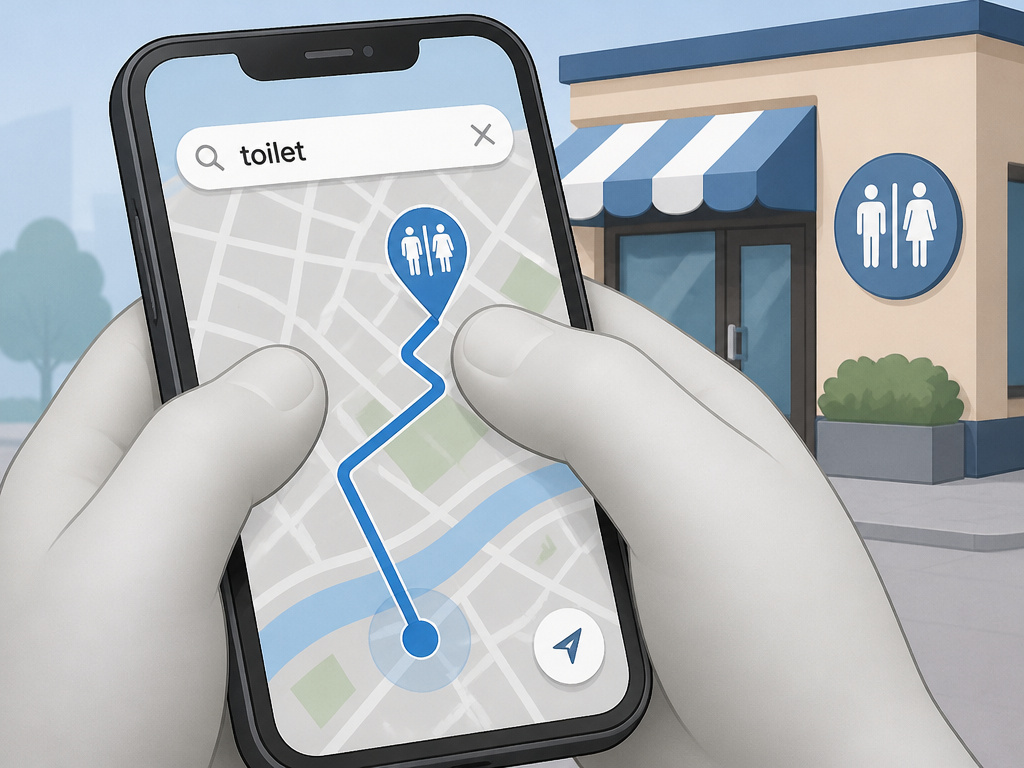
Google Maps doesn’t have a direct “toilets” or “WC” option in its services list. That’s a real limitation, and it catches people off guard.
The workaround is simple. Search “toilet” in the search bar rather than looking for a category filter. Google Maps will return nearby options.
A second approach: search for restaurants. Many restaurants will let you use their toilets without much friction. This is anecdotal advice from travel presenters, not a guarantee, but it’s a useful fallback when the map comes up empty.
For broader trip planning, the same logic applies when you find accessible hotel rooms. Confirm the specific feature you need, not the category label.
Radar Keys, Euro Keys, and the Locking Debate
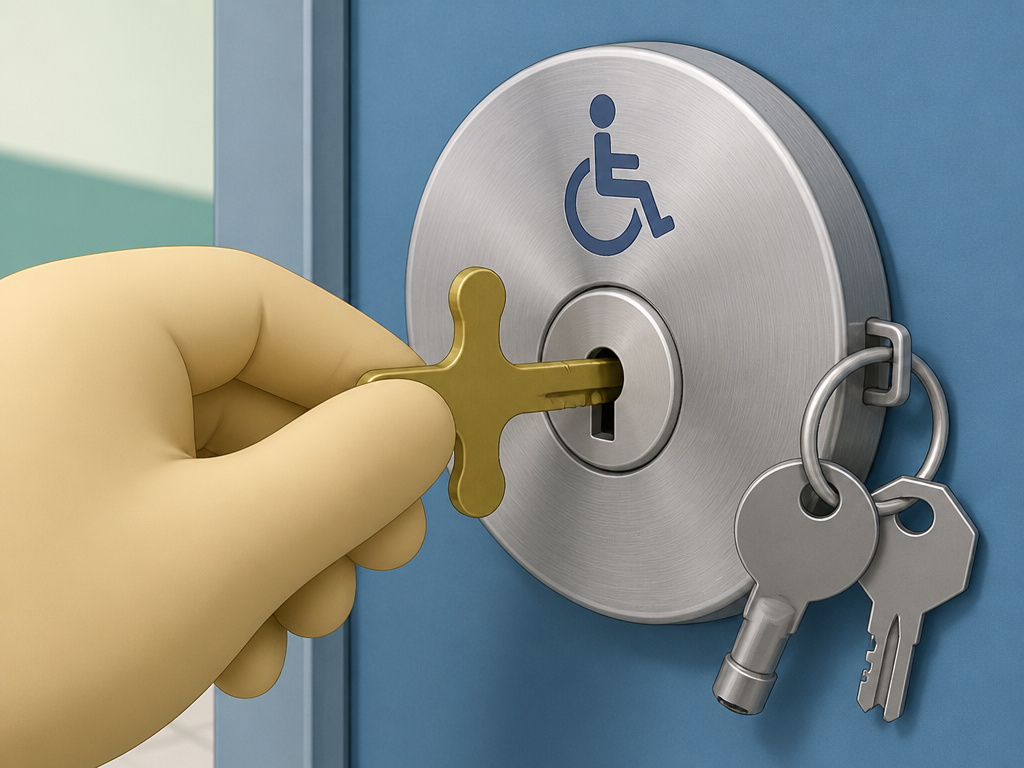
There’s an actual principle behind the locking, and it’s worth knowing because it explains why coverage is inconsistent.
Visit London describes it as the NKS principle: where authorities lock toilets to prevent misuse, they should use a standard lock. That’s a standard lock. The problem is adoption.
Visit London holds that where authorities lock toilets to prevent misuse, they should use a standard lock, while Carents notes many accessible toilets are locked but not all, implying inconsistent adoption of the standard-lock principle.
Worth knowing before you start: If you’re not a customer of the business, it’s up to the service provider whether they’ll let you use the toilet. A map listing tells you the facility exists, not that you have a right to enter it.
That last point is the one that catches travelers out. The Great British Toilet Map includes all toilets the public can access without needing to be a customer, that’s its inclusion criterion. But Visit London’s framing is more cautious: if you’re not a customer, access is discretionary.
The sources disagree: the Great British Toilet Map includes all toilets the public can access without needing to be a customer, while Visit London holds that if you’re not a customer of the business, it’s up to the service provider whether they’ll let you use the toilet.
When Standard Accessible Toilets Aren’t Enough
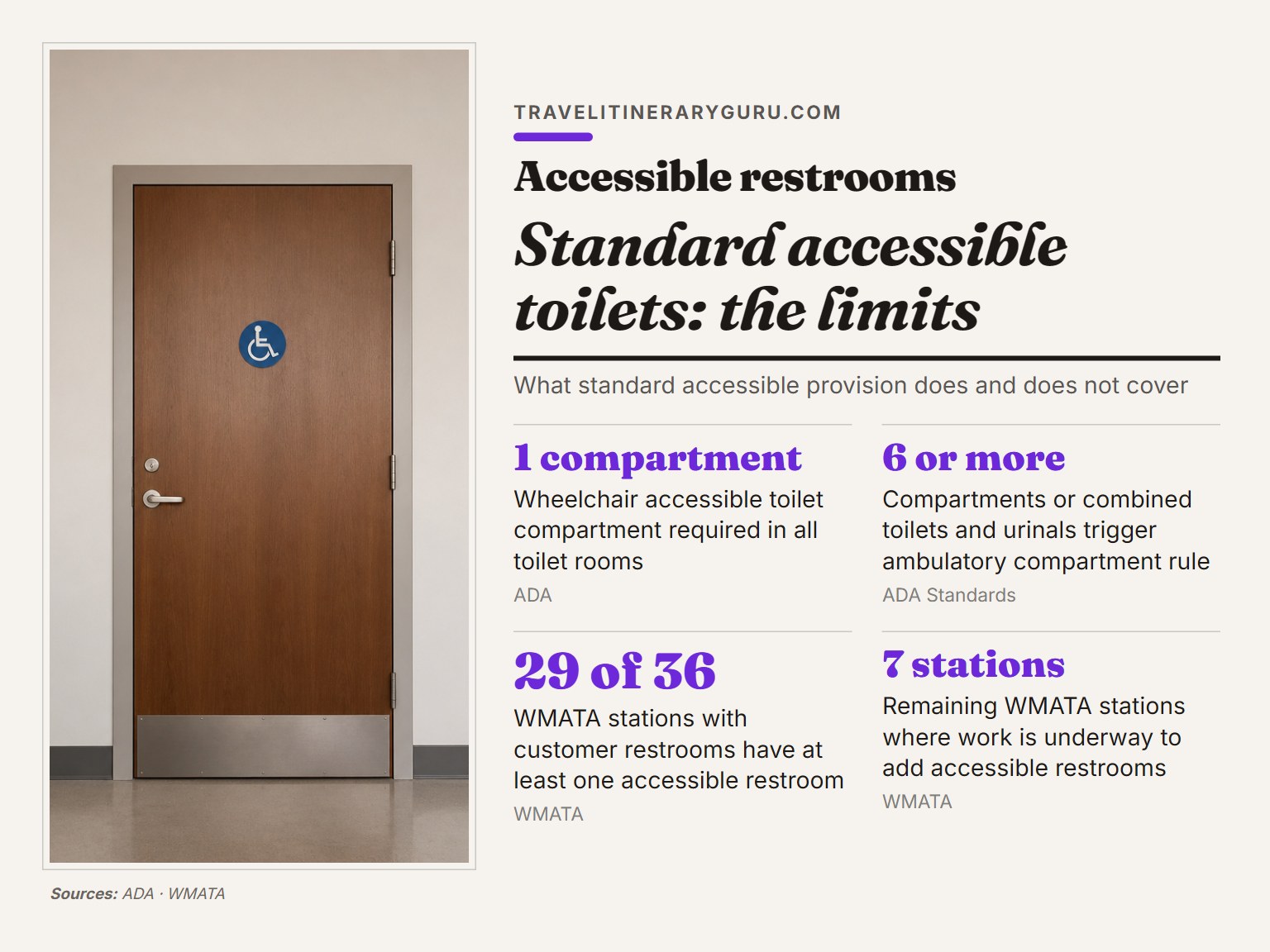
Standard accessible provision has a ceiling. Knowing where it sits saves you from planning around a facility that won’t do the job.
| Need | Standard Accessible Toilet | What You Actually Need |
|---|---|---|
| Wheelchair transfer | Usually covered | One wheelchair accessible compartment required |
| Changing bed | Not always provided | A dedicated Changing Places facility |
| Assistance from a companion | Cubicle must fit both | Wide or large cubicle |
| Stoma care | Mirror, hook, shelving | Confirm all three before relying on it |
| Raised seat or grab rail | Common in later-life facilities | Verify on the operator’s page |
Visit London is direct about the gap: changing-bed toilets aren’t always provided in standard accessible toilets, and the ADA Standards require only one wheelchair accessible toilet compartment, with changing beds not part of the standard accessible provision.
The Access Board’s standards reinforce the same limit from the other direction. The ADA Standards require only one wheelchair accessible toilet compartment in all toilet rooms. According to the ADA Standards, in restrooms serving both adults and children, providing compartments for both groups is advisable but not required.
Ta11y’s guidance goes further on the design question. Ta11y recommends providing a single-user, all-gender restroom whenever possible, because many people with disabilities cannot use multi-user public restrooms, especially people with mental health disabilities and people who require assistance; the Access Board, by contrast, holds that where multi-user toilet rooms are provided, accessible unisex rooms cannot serve as a substitute except in alterations where making multi-user rooms comply is not technically feasible.
The Access Board’s position on the same question is narrower: where multi-user toilet rooms are provided, accessible unisex rooms cannot serve as a substitute for access to multi-user rooms, except in alterations where making multi-user rooms comply isn’t technically feasible; Ta11y, by contrast, recommends providing a single-user, all-gender restroom whenever possible. Both positions are documented. They’re answering different questions: what’s legally required versus what’s actually usable.
If your trip involves a traveler with autism friendly travel needs or a special needs travel situation, the single-user preference is worth prioritizing in your planning.
What the Standards Don’t Cover
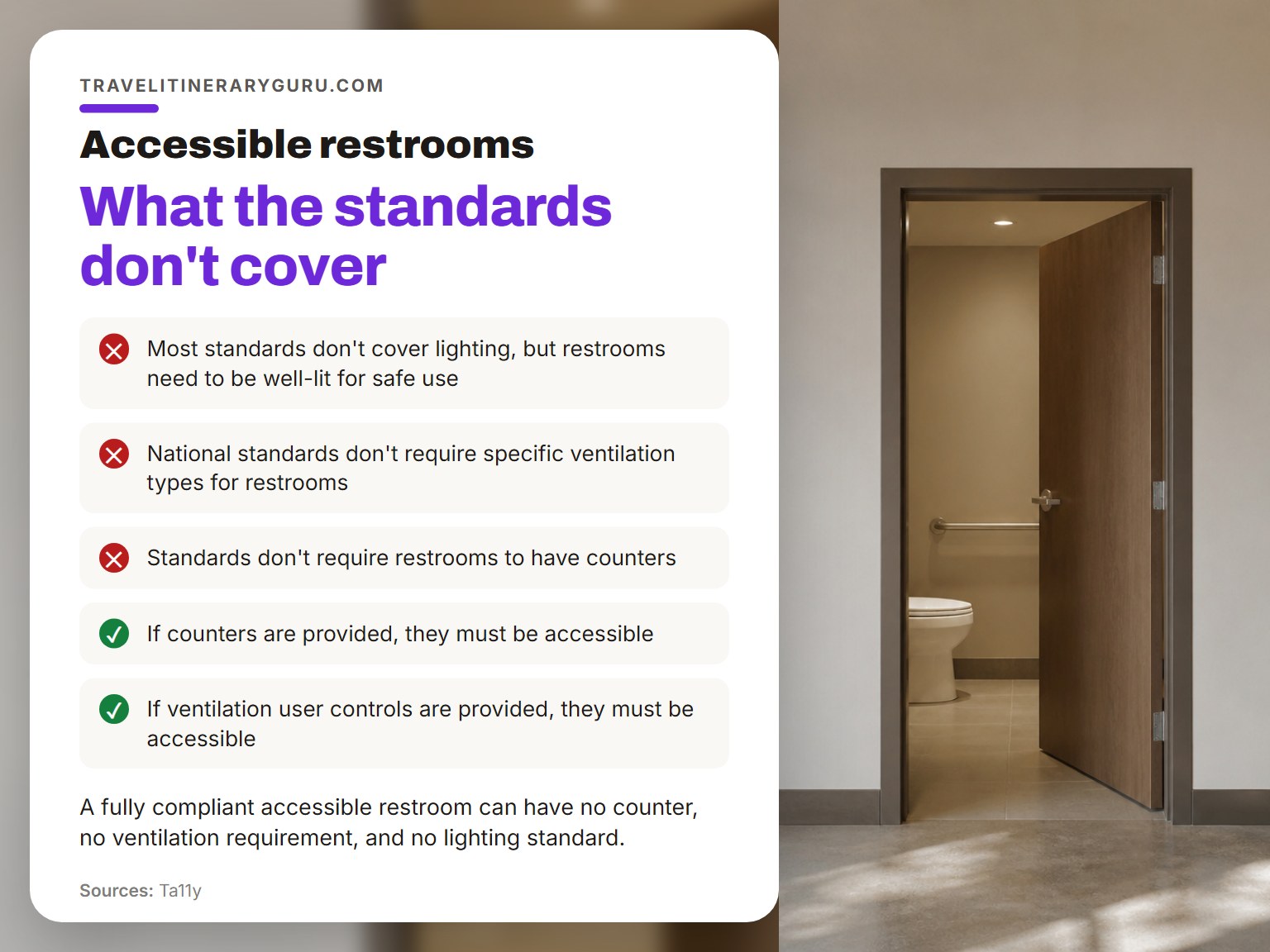
Three gaps in the standards catch travelers off guard. None of them are failures of the rules, they’re just outside the scope.
Lighting. Ta11y notes that most standards don’t cover lighting, but restrooms need to be well-lit for people with disabilities to use them safely, and that overly bright lights and reflective surfaces can make restrooms less accessible for some people; the ADA Standards specify which rooms must be accessible but do not address lighting requirements.
Ventilation. Ta11y notes that national standards don’t require specific ventilation types, but ventilation should be available for sanitary reasons and to help people with cognitive disabilities and sensory sensitivities use the restroom more comfortably; the ADA Standards do not require specific ventilation types. If user controls are provided, they must be accessible.
Counters. Standards don’t require restrooms to have counters. But if they have counters, the counters must be accessible. That’s a conditional rule, and it means a facility can be fully compliant with no counter at all.
Easy to miss: A fully compliant accessible restroom can have no counter, no ventilation requirement, and no lighting standard. Compliance is a floor, not a ceiling.
Questions to Ask Before You Commit
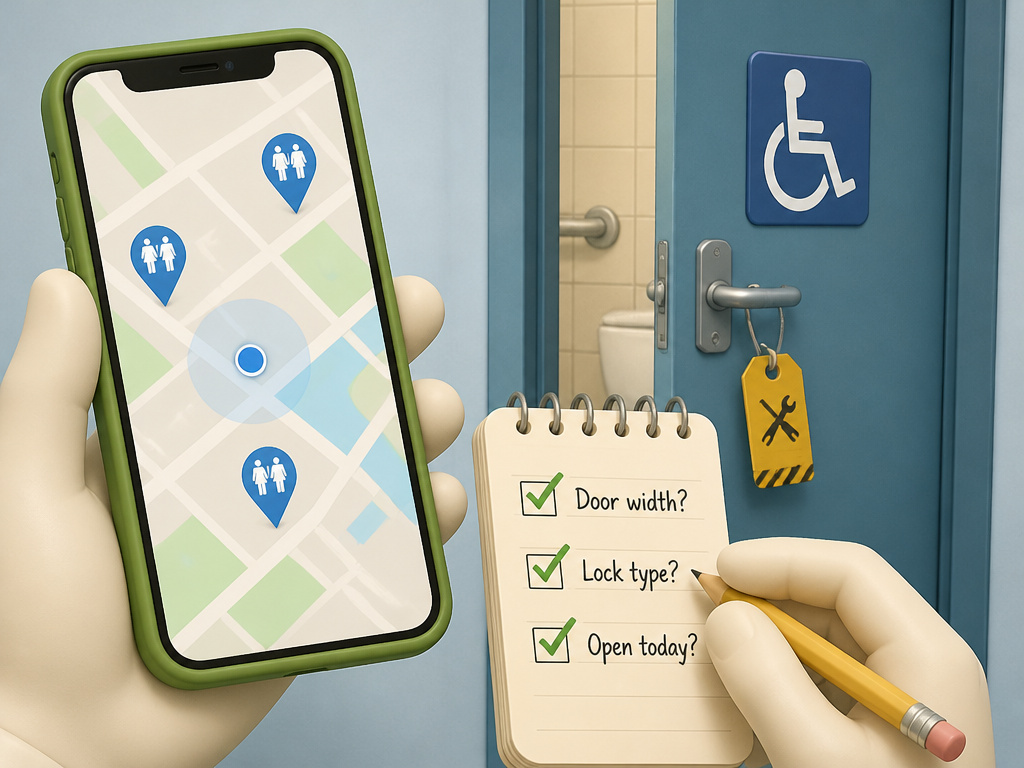
Websites lie. Phone calls don’t. That’s not cynicism, it’s just what the source material shows. WMATA’s own page admits restrooms may be temporarily unavailable. UK map listings present facilities as static. The gap between “listed” and “open” is real.
Call and ask three things:
- Door width. Ask for the number, not “is it accessible.”
- Lock type. Radar key, Euro Key, staff-held, or left open?
- Current status. Is the facility open today, or under maintenance?
For a longer trip, the same logic applies when planning a wheelchair accessible trip more broadly. Restroom access is one thread in the itinerary, not a separate problem.
If you’re traveling with a condition that makes restroom access critical, the planning considerations overlap heavily with chronic illness travel and seniors with limited mobility guidance. The verification steps are the same.
Frequently Asked Questions
Do I need a Radar key to use accessible toilets in the UK?
Not always, but often. Carents notes many accessible toilets are fitted with a special lock, though not all are. A Radar key covers the locked ones. You can find Radar key toilet locations by filtering the Great British Toilet Map by “Radar key.”
Will my Radar key work in Europe?
No. Radar keys are specific to the UK. In Europe, you need a Euro Key, which originated in 1983 in Darmstadt and is issued by the CBF Association at cost price on proof of disability. If you’re crossing borders, carry both.
How do I find accessible restrooms near a train station?
Check the operator’s own page first. WMATA, for example, publishes a station-by-station map showing which locations have accessible customer restrooms, updated monthly. Third-party maps aggregate this data but often drop the temporary-unavailability caveat.
What if the accessible restroom is locked and I don’t have a key?
Ask the station manager or a staff member. At WMATA stations, for instance, customers may request restroom access from the station manager, generally located at the kiosk near the faregates. At businesses, access is discretionary if you’re not a customer.
Are changing beds available in standard accessible toilets?
Not reliably. Visit London notes that changing-bed toilets aren’t always provided in standard accessible toilets. If you need a changing bed, use a dedicated Changing Places facility rather than assuming a standard accessible toilet will have one.
How wide does an accessible restroom door need to be?
Ta11y states that an accessible restroom door should be 38 inches, or 95 centimeters, wide. Below that, many wheelchairs and mobility devices won’t clear the frame.
The Bottom Line
One rule most guides skip: if a restroom is critical to your day, call the facility the morning you need it. Not the day before. The morning of.
Here’s the trigger. If you’re planning a route where a specific restroom is the only option within a 30-minute window, that restroom is a single point of failure. Call it. Ask for door width, lock type, and whether it’s open today. If any of those three answers is unclear, build in a fallback before you leave.
For everything else, a restroom you’d use if it’s convenient, a map listing is fine. The stakes are low, and the map is usually right.
The concession: this all changes if you’re traveling with someone who needs assistance in the restroom. Then the single-user question becomes the whole game, and the Access Board’s multi-user rules stop mattering as much. Ta11y’s guidance to provide single-user, all-gender restrooms whenever possible is where I’d start, and where I’d push hardest if you’re booking a venue.
Fair warning: I’ve overplanned restroom logistics before. Built a whole spreadsheet of facilities along a route, complete with backup tabs. My wife still brings it up at dinner. The spreadsheet didn’t help. The two phone calls I made did.
