
How to Travel With a Child Who Has Special Needs
This post contains affiliate links. As an Amazon Associate, we earn from qualifying purchases.
I see this advice a lot, and here’s why it falls apart on the ground: the internet tells you to call the airline 48 hours ahead for everything, and that’s not what the rule says. If you want to know how to travel with a child who has special needs, you generally don’t need advance notice for most accommodations, but a specific list of services triggers a 48-hour notice and a one-hour pre-flight check-in. Everything else comes down to paperwork, screening prep, and packing double.
That gap between “call ahead for everything” and the how to travel with a child who has special needs question is where trips get derailed. Parents who over-notice waste hours on hold. Parents who under-notice get turned away at the gate for a powered wheelchair on a small regional jet. The rest of this walks through the actual notice list, what TSA does differently for kids, and the supply math that keeps a delay from becoming an emergency.
Key Takeaways
- Most accommodations need no advance notice. Under the Air Carrier Access Act, you can request wheelchair assistance or seating accommodations at the airport.
- A short list of services triggers 48-hour notice plus a one-hour pre-flight check-in, including powered wheelchair transport on aircraft with fewer than 60 seats.
- TSA screens children 12 and under differently than passengers 13 and older, and officers will not remove a child from a mobility aid.
- Bring at least twice the supplies you think you need, per guidance from Le Bonheur Children’s Hospital.
- Photograph your equipment before check-in. It’s the cheapest insurance against a damage claim you can’t win.
What the 48-Hour Notice Rule Actually Covers
The US Department of Transportation lists exactly eight services that can require up to 48 hours advance notice and check-in at least one hour before the flight, while Australia’s Department of Infrastructure recommends notifying the airline as early as possible, ideally at least 48 hours before travel, as blanket advice for all assistance needs. That’s the whole list. No airline can demand notice for anything outside it.
The 48-hour advance notice and one-hour check-in requirement applies to a defined set of services: respirator hook-up to aircraft electrical power, hazardous materials packaging for a wheelchair battery, onboard medical oxygen if the airline offers it, powered wheelchair transport on aircraft with fewer than 60 seats, an onboard wheelchair on aircraft without an accessible lavatory, groups of ten or more passengers with disabilities traveling together, stretcher transport, and incubator carriage.
Two of those catch families off guard. The “fewer than 60 seats” threshold means a regional jet leg can flip the rule on mid-itinerary, even when the mainline flight didn’t. And the group provision applies to any ten or more passengers with disabilities traveling together, which matters for school groups and extended-family trips.
Here’s where the sources split, and you should know it before you book. The DOT says passengers are generally not required to provide advance notice for disability-related accommodations. Australia’s Department of Infrastructure recommends notifying the airline as early as possible, ideally at least 48 hours before travel, as blanket advice for all assistance needs. Those aren’t the same rule. One is a legal floor with a short exception list. The other is a best practice that assumes the airline will coordinate better with warning.
My read: follow the stricter one when you’re crossing borders. The DOT floor protects you on US domestic flights. It won’t help you when a foreign carrier’s ground crew has never seen your equipment.
Where Codeshares Break the Rule
When you compare a how to travel with a child who has special needs, the operating carrier’s rules govern, not the marketing carrier’s. If you booked through a US airline but the regional partner flies the leg, that partner’s special assistance desk handles your wheelchair, your seating, and your boarding. Australia’s guide flags this directly, and it’s the single most common source of “but I called ahead” arguments at the gate.
Call the operating airline. Get a name. Write it down.
Which Services Require Notice vs. Which Don’t
| Service or Accommodation | Advance Notice Required? | What to Do |
|---|---|---|
| Wheelchair or guided assistance to board | No | Call ahead to arrange, but not required |
| Seating accommodation for disability needs | No | Request at booking or at the gate |
| Loading and stowing an assistive device | No | Call ahead to confirm the procedure |
| Powered wheelchair on aircraft under 60 seats | Yes, up to 48 hours | Notify at booking and reconfirm |
| Onboard wheelchair, no accessible lavatory | Yes, up to 48 hours | Confirm the aircraft type first |
| Medical oxygen onboard, if offered | Yes, up to 48 hours | Verify the airline offers the service |
| Stretcher transport | Yes, up to 48 hours | Book through the medical desk |
| Group of 10+ passengers with disabilities | Yes, up to 48 hours | One coordinator calls for the group |
The practical takeaway: you can walk up to the counter and ask for a wheelchair escort. You cannot walk up and ask for a powered wheelchair to be loaded onto a regional jet with fewer than 60 seats.
Easy to miss: The 48-hour clock runs from departure, not from booking. Notifying the airline well in advance doesn’t satisfy a rule that’s measured in the final 48 hours. Reconfirm 48 hours before departure, every leg.
How TSA Screens Children With Disabilities
TSA has modified screening procedures for children who appear to be 12 years old and younger. Standard procedures apply at 13 and older. That age line matters more than most parents expect, because a 13-year-old with a medical device moves through the same process as an adult.
Tell the TSA officer up front if your child has a disability, medical condition, or medical device. That one sentence changes the whole interaction. Officers will consult you about the screening, and they will not remove your child from a mobility aid, wheelchair, or scooter.
A few specifics worth memorizing:
- You may carry your child through the walk-through metal detector. Infants and small children can be carried through, and if the alarm sounds, additional screening follows.
- Children who can walk unassisted may go through the metal detector separately from you.
- If your child can hold the required position for 5 seconds, they may be screened through advanced imaging technology.
- You may not be screened by advanced imaging technology while carrying an infant or child.
- If a child 12 or under alarms on the imaging machine, they get a second pass or an alternative resolution method to reduce the need for a pat-down.
For questions about what to expect, call TSA Cares at (855) 787-2227 at least 72 hours before travel. That’s the official window. AskTSA also runs live assistance from 8 a.m. To 6 p.m. ET, 365 days a year, for questions that come up mid-trip.
Worth knowing before you start: Request private screening at any point in the process. You don’t need a reason and you don’t need to justify it. For a child who gets overwhelmed by noise and crowds, a private room is often the difference between a calm checkpoint and a meltdown.
Formula, Medication, and the Liquids Rule
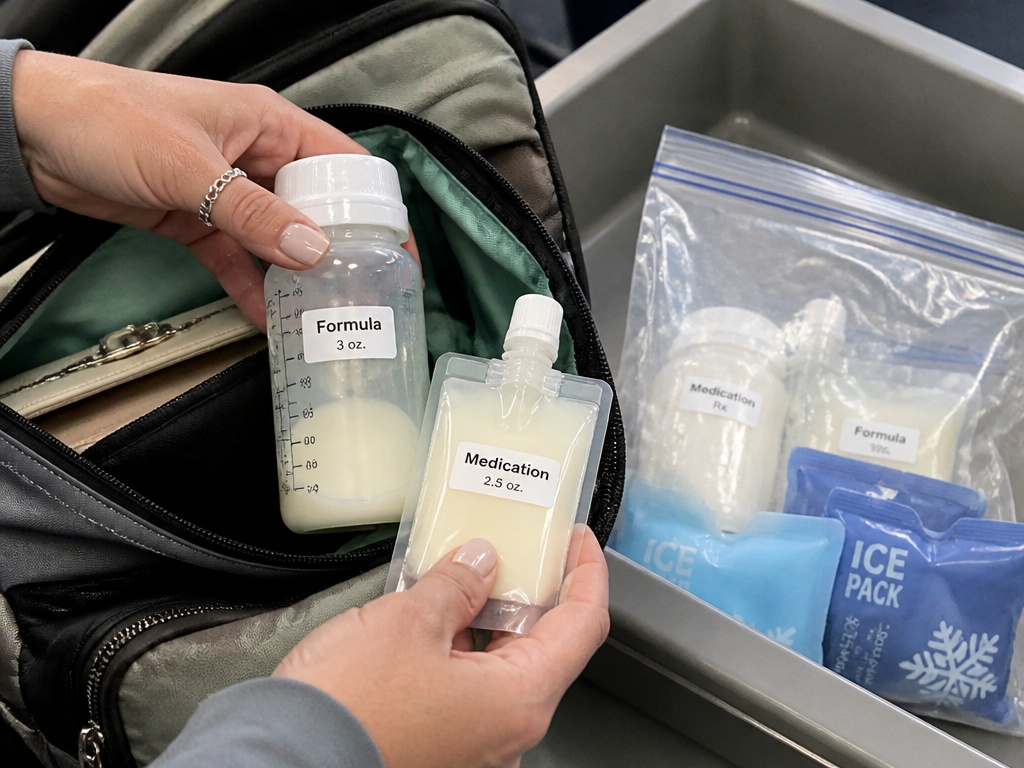
Formula, breast milk, toddler drinks, and baby or toddler food, including puree pouches, are allowed in carry-on in quantities over 3.4 oz (100 ml). Cooling accessories (ice packs, freezer packs, gel packs, liquid-filled teethers) are allowed regardless of whether breast milk is present. Your child doesn’t need to be traveling with you to bring breast milk and cooling accessories.
These items don’t need to fit in a quart-sized bag. TSA treats them as medically necessary liquids. Inform the officer at the start of screening, remove them from your carry-on for separate screening, and expect that TSA may test the liquids for explosives or prohibited items. Screening never involves placing anything into the liquid itself.
Two packaging habits cut the friction. Use clear, translucent bottles when you can. And know that liquids in plastic bags or pouches may get routed to alternate screening like explosive trace detection or vapor analysis.
If you don’t want your items X-rayed or opened, tell the officer. TSA X-ray machines aren’t harmful to food or medicines, but you’re allowed to ask for a different path.
Where this goes sideways: Packing medication in a checked bag. A delayed bag means a missed dose, and the airline has no obligation to reunite you with it before your connection. Carry every medication your child needs in the cabin, in original labeled containers.
Packing Twice the Supplies, and Why It Isn’t Overkill
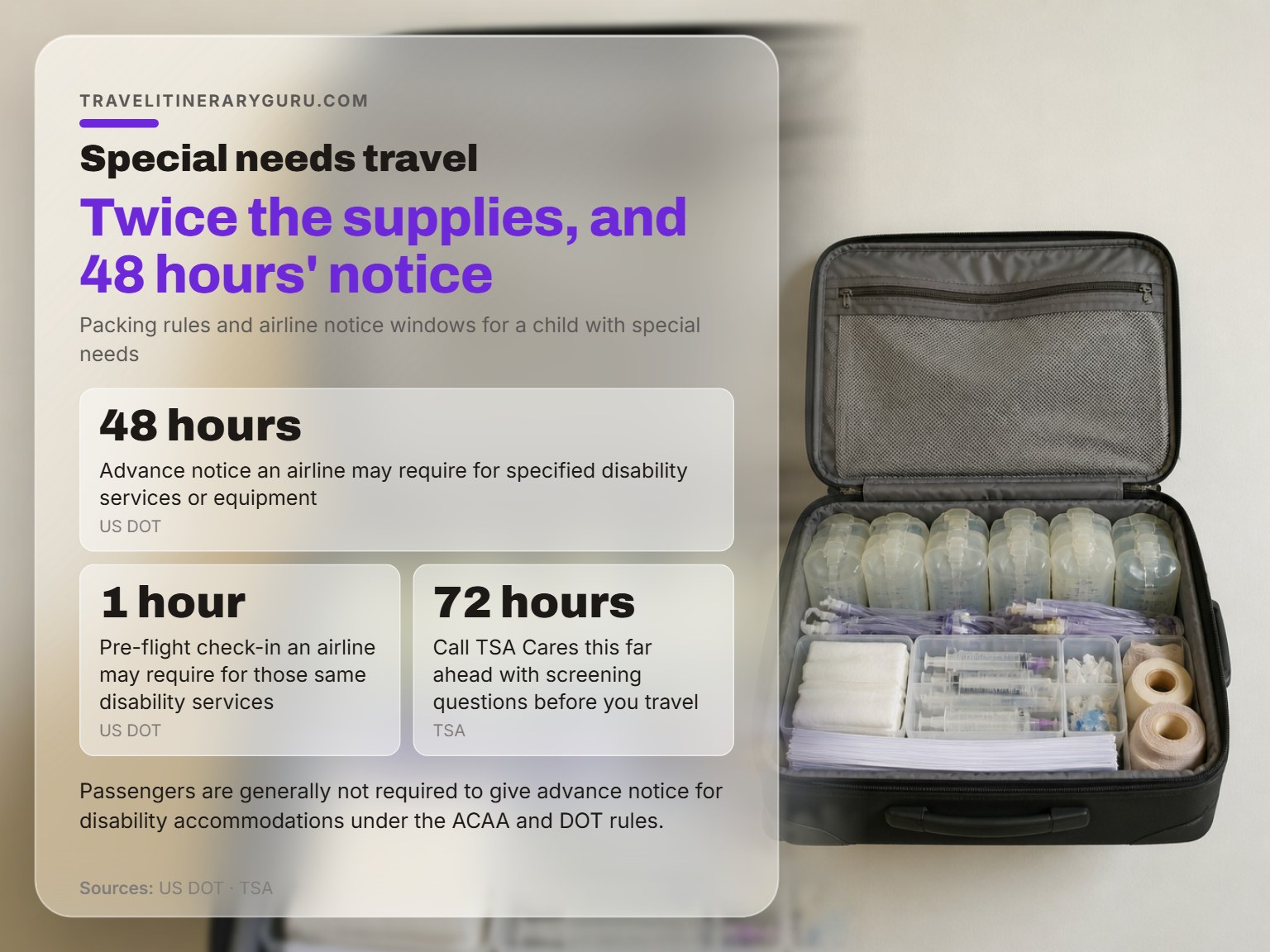
Le Bonheur Children’s Hospital recommends bringing at least twice as many supplies as you think you’ll need. That means double the formula, feeding bags, tubing, extension sets, syringes, buttons, replacement tubes, tape, and skin-care supplies. For a medically complex child, this isn’t hoarding. It’s a hedge against the delay you can’t predict.
I once built a spreadsheet so detailed it had a tab for backup tabs. My wife still brings it up at dinner. But the one column I never regretted was the supply count. The trip where we blew through every spare feeding bag happened on a weather delay, not a medical event.
Three documents belong in your carry-on, printed, not just on your phone:
- A medical history summary with your child’s diagnoses and current medications. Electronic patient portals go down, and a dead phone at a foreign gate is a dead phone.
- Contact numbers for your child’s specialists and primary care team.
- The location and phone number of the nearest children’s hospital or emergency department at your destination, looked up before you leave.
Equipment, Seating, and the CRS Rule Most Parents Don’t Know
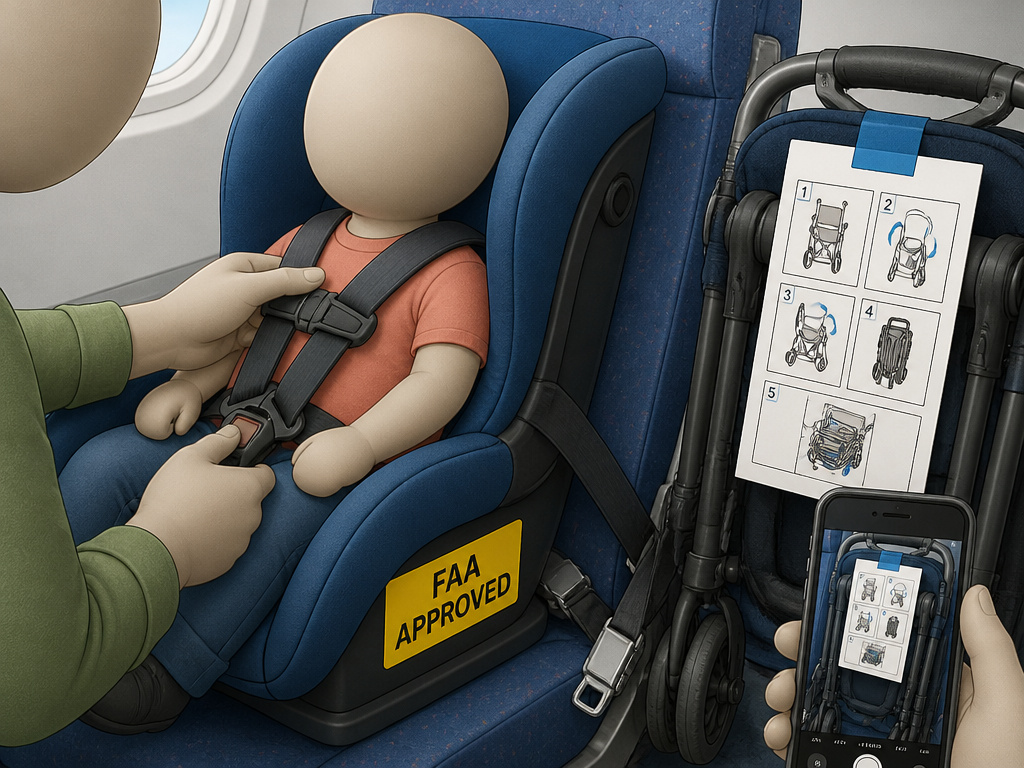
Airlines must allow a child under the age of 18 to use an approved child restraint system that’s properly labeled and appropriate for the child’s weight, when the child is properly secured in it. That’s an FAA rule, not a courtesy. If you’ve been told your child can’t use a car seat on board, that’s wrong.
For adults who need the support of a restraint system, the path is different.
Two habits save arguments at the gate. Photograph your mobility equipment before check-in, ideally with your child in it, so you have a condition record if damage happens. And write down the disassembly, assembly, and stowage steps for any device the crew may not recognize. Airline personnel aren’t trained on every piece of equipment that comes through the door.
What most people get wrong: Assuming the gate agent knows your equipment. A one-page printed instruction sheet, taped to the device, has saved me more conversations than any phone call. Hand it over, smile, and let the paper do the arguing.
If you’re planning the broader logistics of an accessible itinerary, the same notice windows and equipment rules apply across trains, transfers, and hotels. Accessible travel planning starts with the same question you asked the airline: what does this operator actually guarantee, and what’s just a nice-to-have?
Screening Logistics for Strollers, Car Seats, and Toys
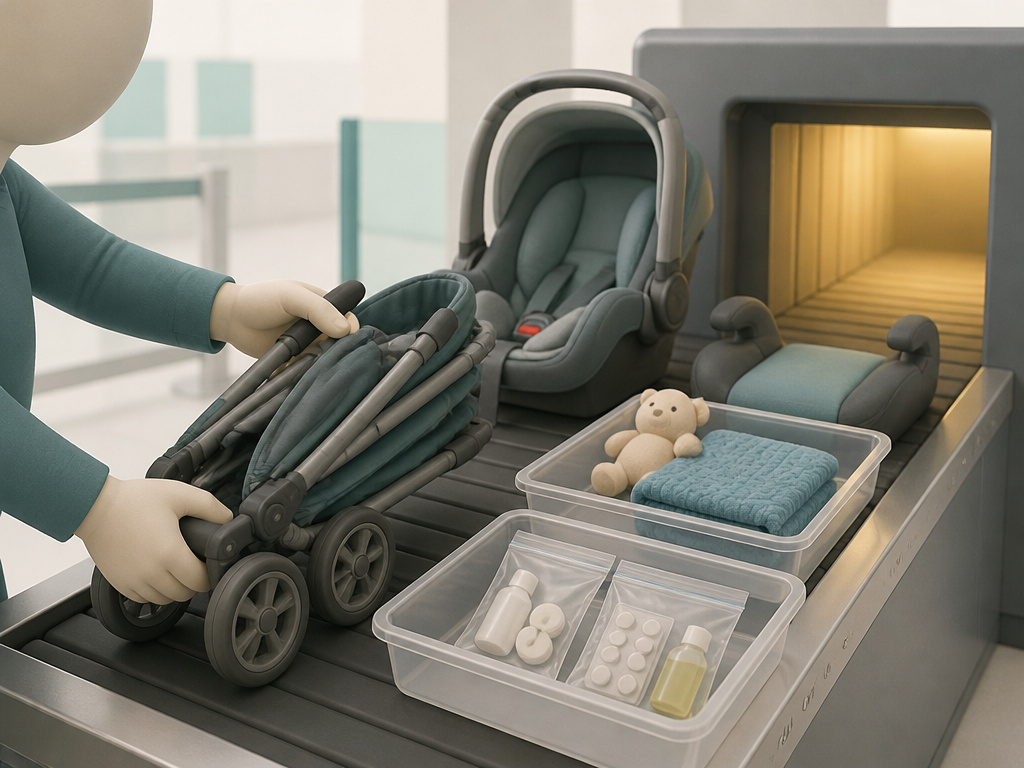
Everything goes on the X-ray belt. Children’s toys, bags, blankets, strollers, umbrella strollers, baby carriers, car seats, booster seats, and backpacks must be screened by X-ray. If you’re pushing a stroller, empty the pockets and baskets first — those items go in a carry-on or on the belt.
Equipment that doesn’t fit through the X-ray machine gets a visual and physical inspection instead. That’s usually faster than it sounds, but it happens at the checkpoint, not at the gate, so budget the time.
If you’re traveling with a service animal, the airline’s own policies govern the process, and they vary more than most families expect. Service dog policies differ on documentation, relief areas, and advance notice, so confirm with the operating carrier before you book.
One more habit worth building: packing for a family trip with kids goes faster when you pack by routine, not by category. Morning meds, midday meds, night meds, each in its own labeled pouch, beats a single bag of everything.
The Documentation That Actually Gets You Through
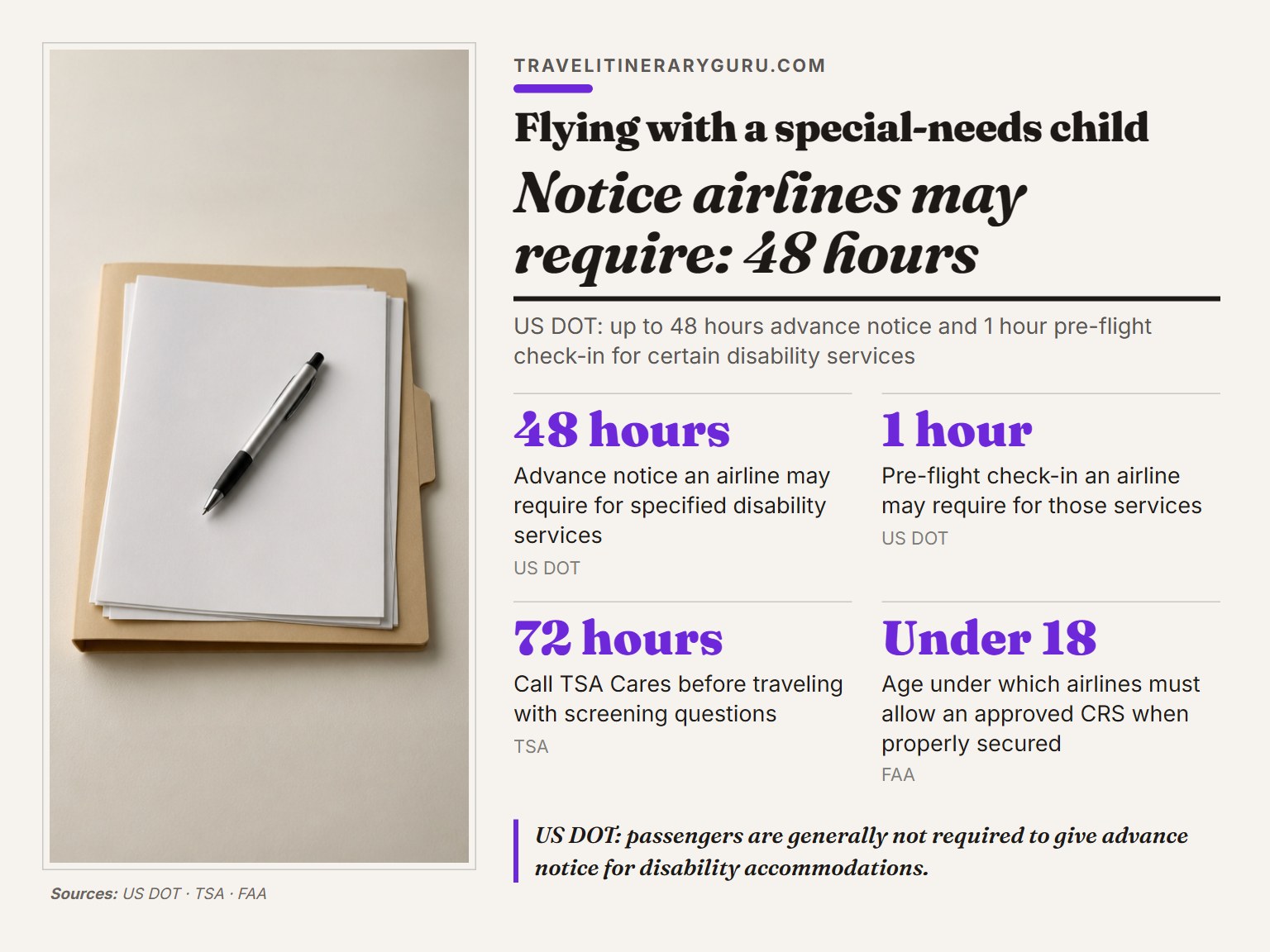
The FAA’s special needs passenger guidance covers the CRS rule and the adult exemption process, but it doesn’t tell you what to carry. That part comes from practical experience and from guidance like the DOT disability travel tips page, which is the source for the 48-hour rule.
Here’s what belongs in a single folder you can hand to any agent:
- A printed medical history summary and medication list.
- Written disassembly and stowage instructions for any assistive device.
- Photographs of the equipment in working condition, dated.
- Contact numbers for specialists and the nearest children’s hospital at your destination.
- Accreditation documents for an assistance animal, if you’re traveling with one.
If a refusal happens, ask for it in writing. Australia’s guide recommends this explicitly, and it’s the difference between a complaint that goes somewhere and one that doesn’t. For international travel, remember that the Air Carrier Access Act covers US flights. It doesn’t follow you to a foreign carrier’s ground operation, and support at your destination has to be confirmed separately.
Frequently Asked Questions
Do I need to call the airline 48 hours ahead for a wheelchair?
Not for wheelchair or guided assistance to board, deplane, or connect. That’s a request you can make without advance notice. The 48-hour rule applies to a specific list that includes powered wheelchair transport on aircraft with fewer than 60 seats and onboard wheelchair provision on aircraft without an accessible lavatory.
What age does TSA stop using modified screening for children?
TSA uses modified screening procedures for children who appear to be 12 years old and younger. Standard screening applies at 13 and older. If your child has a medical device or condition, tell the officer regardless of age.
Can my child use a car seat on the airplane?
Yes, if the child is under 18, the restraint system is approved and properly labeled, and it’s appropriate for the child’s weight. The airline must allow it when the child is properly secured.
How much formula or breast milk can I bring through security?
Quantities over 3.4 oz (100 ml) are allowed in carry-on for formula, breast milk, toddler drinks, and baby or toddler food. They don’t need to fit in a quart-sized bag. Tell the officer at the start of screening, remove the items for separate screening, and expect that TSA may test the liquid.
What if my child needs to be carried through the metal detector?
You may carry your child through the walk-through metal detector. Infants and small children can be carried through, and if the alarm sounds, additional screening is required. TSA officers will not remove your child from a mobility aid, wheelchair, or scooter.
Should I bring twice as many supplies as I think I need?
Yes. Le Bonheur Children’s Hospital recommends at least double the formula, feeding bags, tubing, extension sets, syringes, buttons, replacement tubes, tape, and skin-care supplies. Travel delays happen, and surplus supplies are what keep a delay from becoming a medical problem.
The Bottom Line
Under 60 seats flips the powered wheelchair rule on.
This all changes if you’re crossing borders. The DOT floor protects you on US domestic flights, but a foreign carrier’s ground crew operates under its own rules, and support at your destination has to be confirmed separately.
