
How to Plan a Wheelchair-Accessible Trip: Step-by-Step
This post contains affiliate links. As an Amazon Associate, we earn from qualifying purchases.
How to plan a wheelchair-accessible trip is mostly a paperwork job: give every carrier 48 hours’ notice, verify room measurements by phone, and carry a written equipment sheet. In Canada that notice is a legal trigger for the carrier’s obligation; in the US it generally isn’t required at all.
The paperwork half is the easy half. Door width, bathroom clearance, and whether the accessible entrance is the front door or the loading dock behind the kitchen decide whether the room works at all. Those three numbers almost never appear on a booking site.
What follows walks the notice rules for each mode, the three phone questions that catch a bad room before you pay, and the equipment prep that keeps a chair running when you’re nowhere near your own repair guy.
Key Takeaways
- 48 hours is the notice Canadian carriers need before they’re required to arrange most accessibility services; 96 hours applies when documents like a medical certificate are needed.
- In the US, advance notice generally isn’t required under the Air Carrier Access Act, though calling ahead is still the smart move.
- A 48-hour window that spans a weekend or holiday may not count as two full business days, and the carrier may not have to provide the service.
- Ask for door width in inches, bathroom clearance, and the real entrance before you pay for a room.
- Service the chair and carry spare parts, because tyres and tubes may not be available where you’re going.
How to Plan a Wheelchair-Accessible Trip Around the 48-Hour Rule
Forty-eight hours is the number that decides whether a carrier has to arrange anything for you at all.
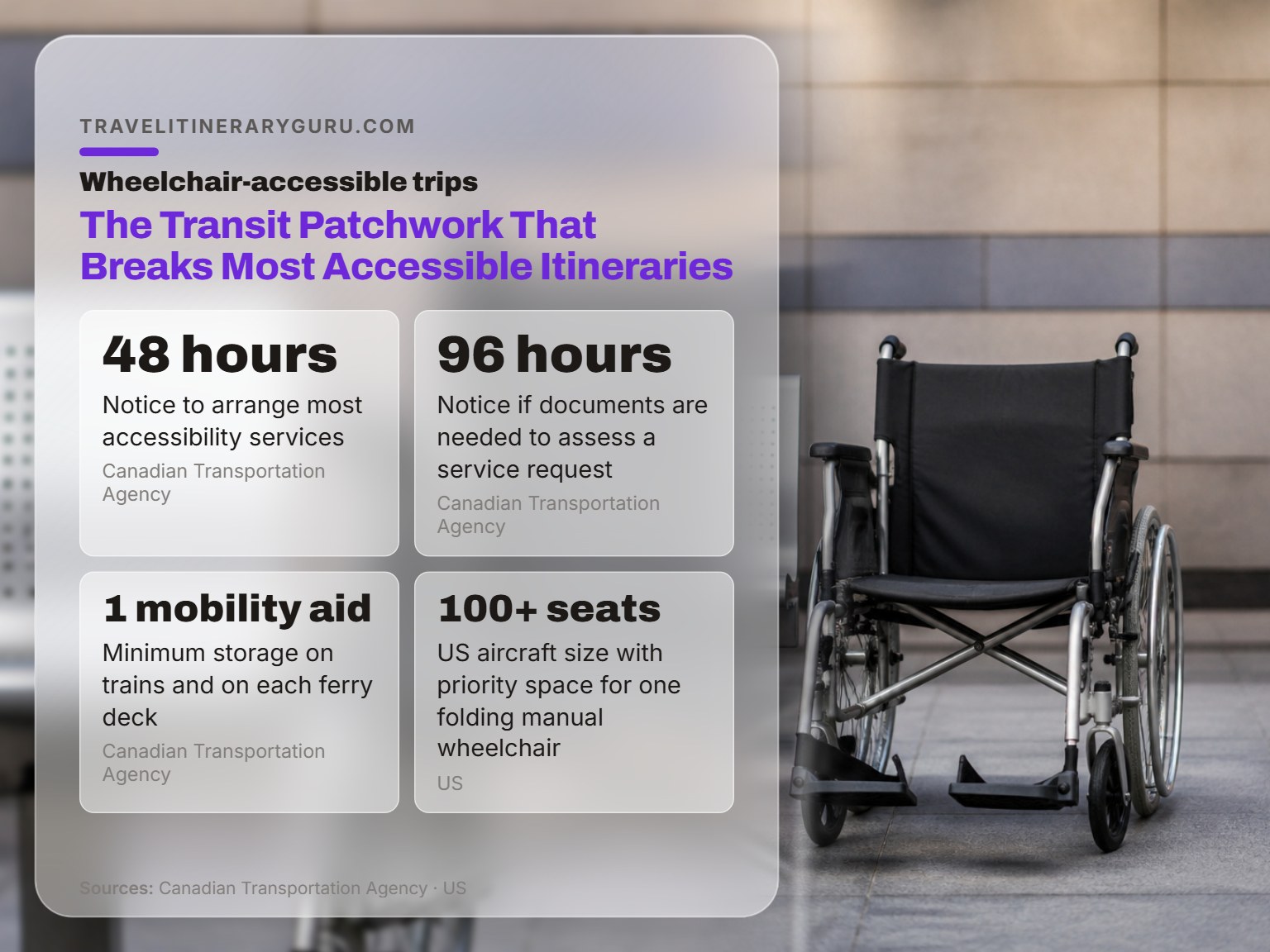
Under the Canadian Transportation Agency’s rules, a carrier must arrange most accessibility services when given at least 48 hours’ notice. A 96-hour window applies when documents such as a medical certificate are needed to assess the request. A 48-hour period that spans a weekend or holiday may not count as two full business days.
The Canadian Transportation Agency publishes those thresholds in its Take Charge of Your Travel guide. One clarification matters more than the rest: the 48-hour clock is the trigger for the carrier’s obligation, not a deadline for you to submit anything.
US rules run the other way. Under the Air Carrier Access Act, the Department of Transportation’s position is that passengers are not generally required to give advance notice for disability-related accommodations. Notice is advice, not a requirement.
| Where you’re travelling | Advance notice rule | Set by |
|---|---|---|
| Canada, cross-border carriers | 48 hours to require most services; 96 hours if documents are needed | Canadian Transportation Agency |
| United States | No advance notice generally required for accommodations | US Department of Transportation |
| Either, if the window spans a weekend | The period may not count as two full business days | Canadian Transportation Agency |
Two jurisdictions, two answers to the same question. If your itinerary crosses a border, plan around the stricter rule. Giving notice early costs you nothing, and discovering you needed to costs you the service.
Why the Accessible Room Checkbox Means Almost Nothing
The checkbox is marketing.
A room gets flagged as accessible by whoever fills in the property’s own form, and nobody audits the answer. I’ve booked rooms with roll-in showers that turned out to be grab bars bolted to a tub with a wall. You can see the bars clearly. You can’t reach past the wall to use them.
So I call the property directly and ask three questions.
The Three Questions I Ask Every Property
- Door width in inches. Not “wide enough for a wheelchair.” A number.
- Bathroom clearance around the toilet, measured rather than eyeballed.
- Which door is the accessible entrance. Front door, or the service corridor behind the kitchen.
The number of times a front desk has said “let me go measure” and come back with silence is not zero. That silence is your answer.
I still call even when the filter looks right. Accessibility filters are better than most, but a five-minute call to the actual property beats an hour of reading filters filled in by someone who has never used a wheelchair.
It’s the same reason accessible hotel rooms are hard to book online. The listing is a lead. The phone call is the fact.
What Do You Actually Need to Tell the Airline, and When?
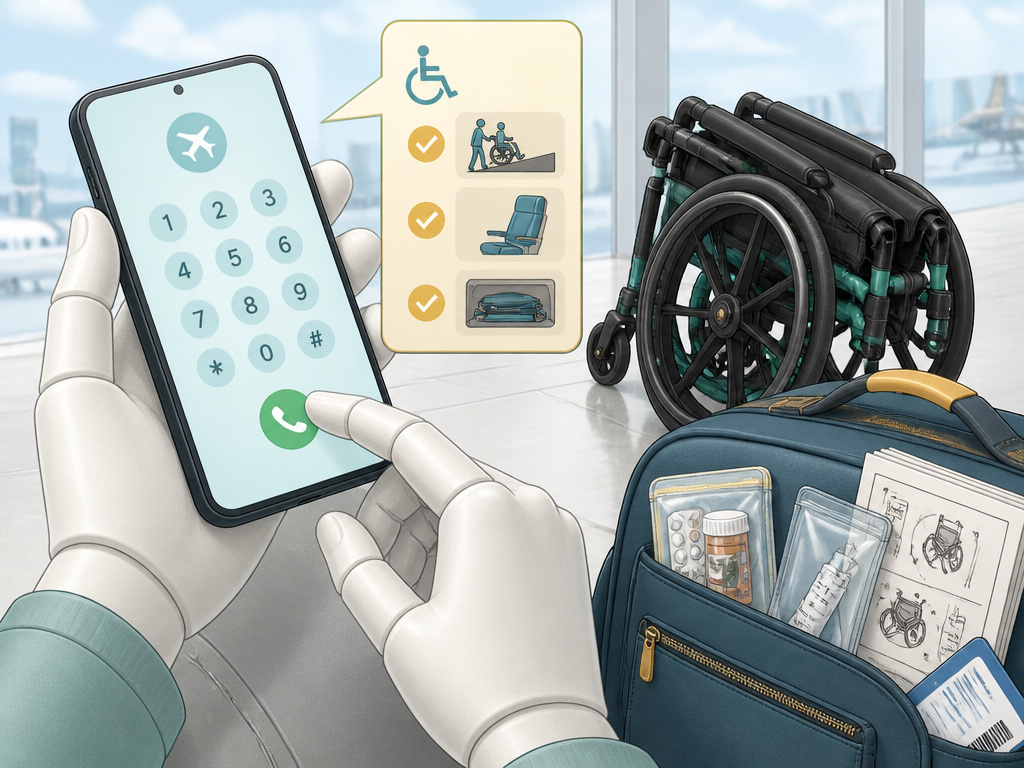
Airline rules in the United States run on a different logic than Canada’s carrier rules.
Under the Air Carrier Access Act, passengers are generally not required to give advance notice for disability-related accommodations. That doesn’t mean you shouldn’t call.
Before you start: The transfer between your own chair and a boarding chair is a risky moment, so ask for help before anyone lifts. Carry medicine or other assistive devices like syringes as a carry-on item. Settle the battery packaging question with the airline in advance.
The Department of Transportation says it’s a good idea to call ahead to arrange three specific things:
- Wheelchair or guided assistance to board, deplane, or make a connection
- A seating accommodation that meets your disability-related needs
- Loading and stowing of your assistive device
The DOT disability travel tips page lists all three as call-ahead items rather than legal requirements. Calling is still how you avoid standing at a gate explaining your chair to someone who has never seen one.
Getting Your Wheelchair Into the Cabin
On aircraft with 100 or more seats, airlines must hold a priority space for at least one folding manual wheelchair. The catch is that you have to request to pre-board to use it.
Once the chair is stowed, you can ask the flight crew to retrieve it if you need it during the flight. That’s a request, not an entitlement, so ask before the seatbelt sign comes on.
Carry medication and assistive devices like syringes as carry-on. They can’t be counted toward your carry-on baggage limit, which matters because checked bags get separated from passengers at exactly the wrong moment.
Bring photocopies of your chair’s assembly and disassembly instructions, and take a photo of the chair before the flight to record its condition. Confirm your needs with every airline on the itinerary, not just the one you booked with. Confirm accessibility needs with all airlines involved in the journey.
If your route crosses a border, bookmark the State Department accessibility travel page alongside the carrier rules. The two sets of paperwork are separate.
The Transit Patchwork That Breaks Most Accessible Itineraries
The “accessible route” to Prague Castle is a stretch of uneven stone. It’s listed as accessible. It rattled my teeth loose.
Cobblestone can transmit every gap straight up through the frame. After a few blocks, your forearms are done.
European public transit accessibility varies wildly by city. London’s Tube has step-free access at some stations. Amsterdam’s trams vary in accessibility. Rome’s transit accessibility varies.
So I check each station individually on the operator’s site before I commit to a route. A common mistake is assuming a city’s accessible transit means every station on the line is accessible.
It’s a patchwork, not a system.
| Mode | Guaranteed by rule | Still on you |
|---|---|---|
| Train, Canada | Storage for at least one mobility aid | Confirming the specific train has it |
| Ferry, Canada | Storage for at least one mobility aid on each deck | Asking the company about deck equipment limits before booking |
| Aircraft, 100+ seats, US | Priority space for at least one folding manual wheelchair | Requesting to pre-board so you can use it |
| Aircraft, any size, US | Medication and assistive devices don’t count toward your carry-on limit | Keeping them in the cabin, not checked |
Where this goes sideways: Planning a route from a system map. Step-free access is a per-station fact, not a line-level one, so the accessible entrance you need may be three blocks from the one you planned around.
Checking accessible public transit station by station is the only method I trust. I plan accessible restrooms into the route the same way I plan meal stops, because the alternative is asking a cafe you’ve never been in.
A crowdsourced accessibility map is a reasonable first pass for a neighbourhood. Treat every pin as a lead rather than a fact, since entries are user-reported and go stale. Another accessibility app is stronger for venues that have been reviewed recently.
Terminals owe you information too. Canada’s federal standards body recommends that providers publish details on facilities, equipment, services, accessibility policies, and the sensory environment in accessible formats, and give advance warning of planned disruptions. That guidance is voluntary rather than law. Accessibility Standards Canada’s planning guidance for the accessible travel journey is the document to quote when a provider claims it has nothing to share.
The same guidance covers smaller things, like accessible public telephones at arrival and departure areas, boarding gates or train platforms, baggage claim, and near exits.
I also cap the day at a limited number of major activities. I learned that after a trip where we rushed through everything and enjoyed nothing.
How Do You Vet a Tour or a Trail Before You Pay?
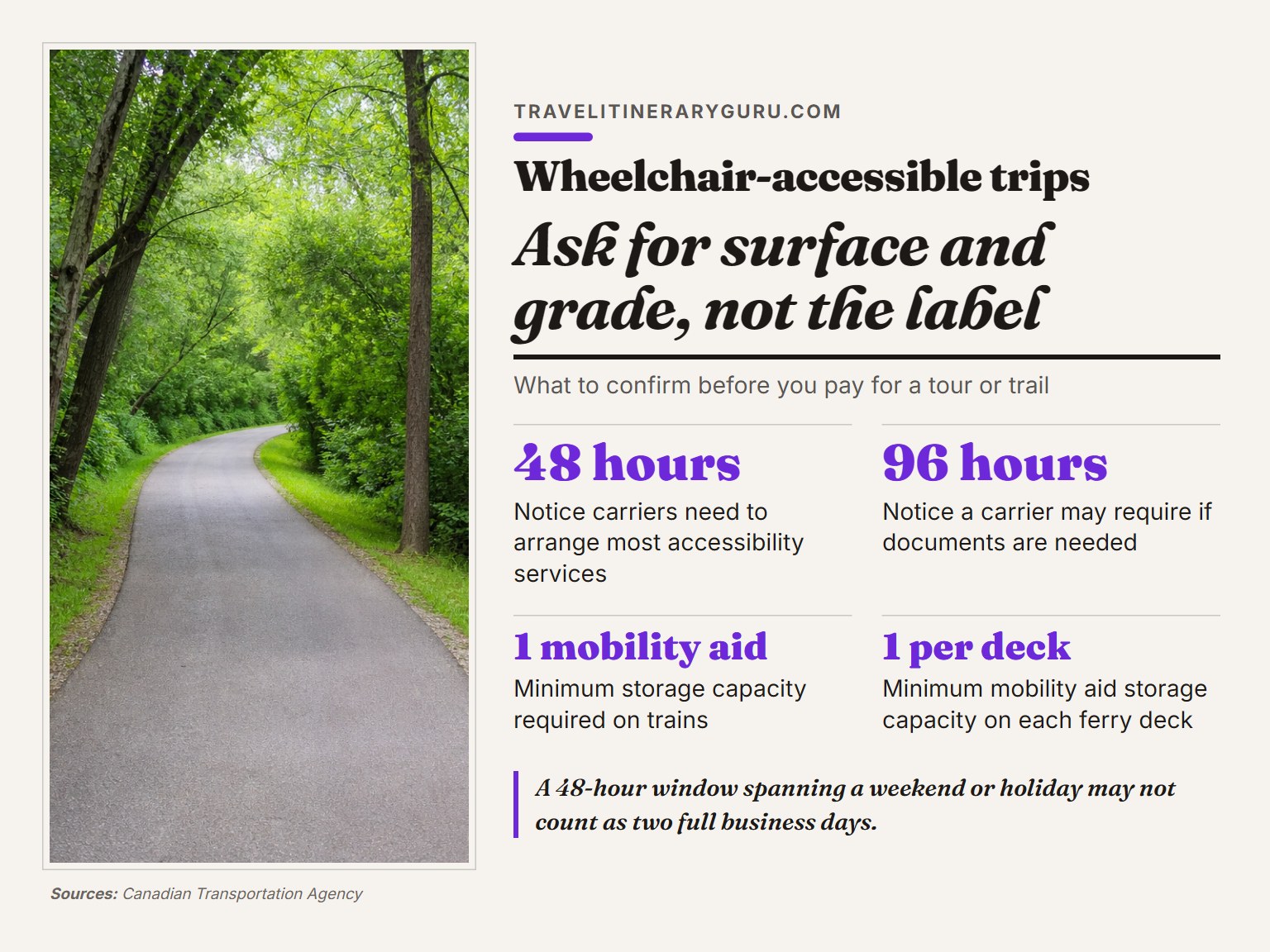
A trail rated “wheelchair accessible” tells you almost nothing.
One park’s accessible trail was a paved loop. Another park’s accessible trail was a gravel path with a grade. Same label, two completely different days.
So I stopped reading the rating and started asking for the surface and the grade.
Reading a Trail Rating Like a Skeptic
- Surface type. Paved, packed gravel, boardwalk, or grass.
- Grade percentage, not the word “accessible.”
- Whether the accessible shuttle is a separate vehicle, and how far ahead you have to request it.
- Whether the accessible entrance is staffed when you actually arrive.
The shuttle detail catches people. At some parks the accessible shuttle is a separate vehicle you have to request in advance. Show up expecting to roll onto the regular one and you’ll watch it pull away with your group.
Ask for the surface type and the grade. “Wheelchair accessible” is a label; “paved, gentle grade, half-mile loop” is a fact. If a venue can’t give you the second version, it hasn’t checked.
The accessible national parks guides are a starting point, but read the surface description rather than the rating. Google Street View is the cheapest check available: look at the entrance before you commit to anything.
A local guide solves most of this. Accessible guided tours run by people who live in the city will tell you which route is actually flat. A specialist travel company can help you plan at an extra cost if you are anxious about travelling and can afford it, which Scope, a UK disability charity, flags as an option.
The Equipment Prep List That Saves a Trip
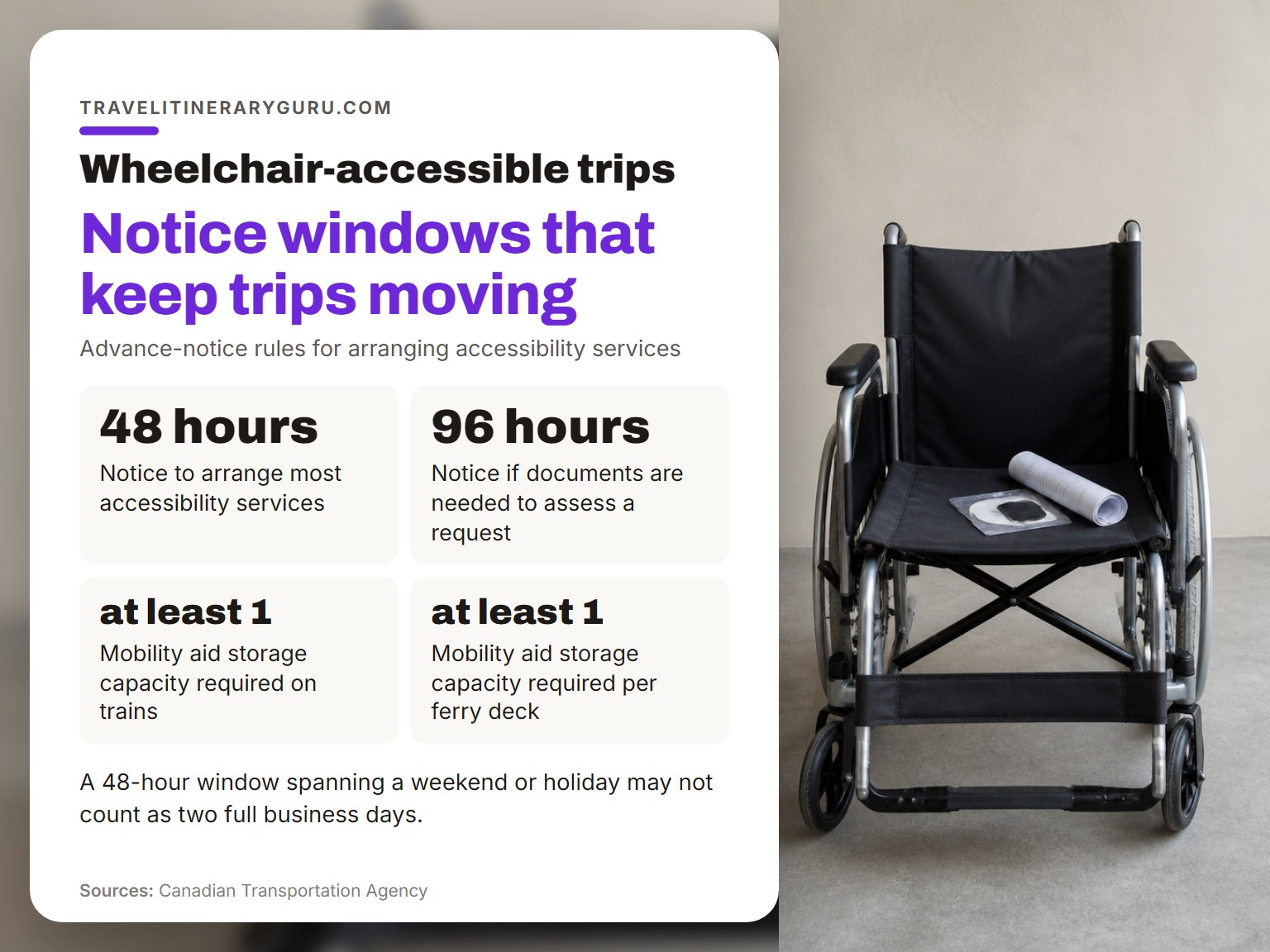
Three things end accessible trips early: a chair that breaks, a part you can’t source, and a document you left at home.
Most of how to plan a wheelchair-accessible trip is admin. This section is the part that keeps you moving.
- Service the chair before you go. Scope advises getting mobility equipment serviced before travel so it’s in working order. A worn part is a small problem at home and a serious one in a city where you don’t know a repair shop.
- Carry spare parts. Scope notes that tyres, tubes, and patch kits may not be available where you’re going. A flat tyre with no spare can end the day.
- Write down local repair providers. Note one or two mobility equipment repairers near where you’re staying before you leave. Finding one in the moment costs you a day.
- Check your power adaptors. Check what power adaptors you need to charge your electronic equipment.
- Carry the paperwork. Written disassembly and reassembly instructions, photocopies of them, and a photo of the chair taken before the flight.
The part nobody mentions: A carrier may ask for written instructions on how to disassemble and reassemble your mobility aid, and may refuse the aid if it exceeds the boarding device’s capacity or doesn’t fit the baggage compartment. On flights, it can also refuse if carrying the aid would jeopardize safe operation of the airplane. If that happens, the carrier has to offer an alternative trip at the lesser fare.
The same prep applies to limited mobility travel where no wheelchair is involved. A portable shower chair is worth packing when the bathroom layout is unknown, though it won’t fix a tub wall you can’t clear.
Frequently Asked Questions
Do I need to give advance notice to get wheelchair assistance on a flight?
It depends where you’re flying. In the United States, the Department of Transportation’s position is that passengers are generally not required to give advance notice for disability-related accommodations. In Canada, carriers are required to arrange most services when they receive at least 48 hours’ notice.
How much notice does a Canadian carrier need?
At least 48 hours for most accessibility services. If the carrier needs documents, such as a medical certificate, to assess the request, it may require 96 hours. Watch the calendar, because a 48-hour window that spans a weekend or holiday may not count as two full business days.
Can an airline refuse to carry my mobility aid?
Yes, in three situations. The aid may be refused if it exceeds the boarding device’s capacity, if it doesn’t fit the baggage compartment, or, on flights, if carrying it would jeopardize the safe operation of the airplane. If that happens, the carrier has to offer an alternative trip at the lesser fare.
Where does my wheelchair go on the plane?
On aircraft with 100 or more seats, airlines must hold priority space for at least one folding manual wheelchair in the cabin. You have to request to pre-board to use it. You can ask the flight crew to retrieve a stowed device if you need it mid-flight.
Does medication count toward my carry-on limit?
No. Medication and assistive devices like syringes carried on board cannot be counted toward your carry-on baggage limit. Keep them in the cabin rather than in checked baggage, because checked bags get separated from passengers.
The Bottom Line
Here’s the threshold that decides more trips than any other: if your notice window lands on a weekend or a holiday, add a business day. A 48-hour window that doesn’t contain two full business days may not trigger the carrier’s obligation at all.
So the first thing to do this week, before you book anything, is call the property you’re considering and ask for door width in inches, bathroom clearance, and which door is the accessible entrance. Write the answers down. If the desk can’t give you numbers, you have your answer.
One concession: everything above assumes a carrier covered by the Canadian or US rules. Smaller operators, some ferries, and plenty of tour companies sit outside those frameworks. There, your only option is asking early and getting the answer in writing.
That’s how to plan a wheelchair-accessible trip in one line: give notice early, verify by phone, carry the paperwork. The filters are self-reported by the property. The person standing in the room with a tape measure has nothing to gain from a wrong answer.
