
Amtrak Delays and How to Plan Around Them
This post contains affiliate links. As an Amazon Associate, we earn from qualifying purchases.
Plan around Amtrak delays by assuming they will happen, not by hoping they won’t. Amtrak’s own data shows no long-distance route met the 80% on-time standard in 2024, so the practical move is to pad your connections, book everything on one reservation, and know what Amtrak actually owes you when a train runs late.
The gap between the timetable and the platform is where trips fall apart. That 80% figure is the Federal Railroad Administration’s on-time standard, and Amtrak reports it plainly on its own performance page. No long-distance route cleared it last year, which is why Amtrak delays and how to plan around them matter so much.
What follows is the planning system I use: how to read a route’s real on-time odds before you book, how much buffer a connection actually needs, and what Amtrak’s own pages commit to when a train runs late.
Key Takeaways
- No long-distance route hit 80% on-time in 2024. The Southwest Chief managed 33%. The City of New Orleans was best at 79%.
- Amtrak doesn’t guarantee connections under 60 minutes — and 90 minutes between an arriving long-distance train and a Northeast Corridor local.
- Book every leg on one reservation. Community guidance from Travels With Kev says separate tickets remove Amtrak’s obligation to rebook you, while Amtrak’s guarantee is silent on how you booked.
- Freight interference caused 850,000 minutes of delay in 2024, and freight railroads have been legally required to give Amtrak preference for over 50 years.
- Delay alerts only reach you if you have a reservation. Subscribers without one won’t be notified of cancellations or major disruptions.
How Bad Are Amtrak Delays, Really?
Bad enough that the honest answer is: worse than the marketing suggests, and better than the horror stories. Amtrak publishes its own route-level numbers, and they’re sobering.
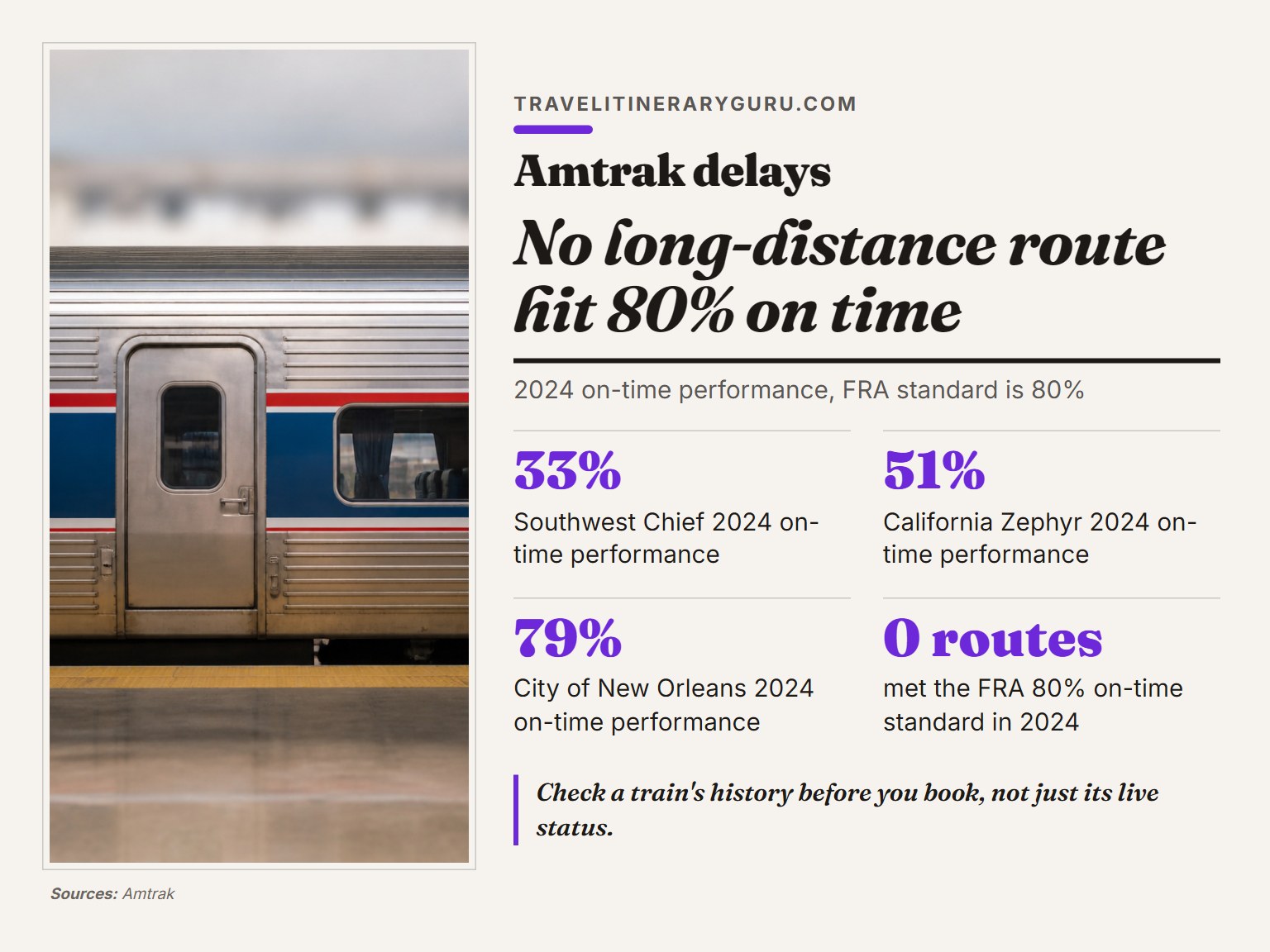
The FRA on-time standard is 80%. No long-distance route met it in 2024. The best performer, the City of New Orleans, came in at 79%. The worst, the Southwest Chief, landed at 33%.
That spread matters more than the average. A route at 79% is a different Amtrak delays and how to plan around them problem than a route at 33%, and you can check which one you’re booking before you pay.
The FRA sets an 80% on-time standard for passenger rail. Amtrak’s 2024 data shows no long-distance route reached it, with percentages ranging from 33% on the Southwest Chief to 79% on the City of New Orleans.
I get why people treat all Amtrak routes as equally risky. The evening news clips make every delay sound catastrophic. But the numbers say otherwise, and they’re sitting right there on Amtrak’s own site.
The cause is mostly freight. Amtrak owns most of the track in the Northeast Corridor. Almost everywhere else, the rails belong to freight companies. When a freight train runs ahead of yours, you wait.
Why Do Freight Trains Delay Amtrak So Often?
Freight interference is the single biggest cause, and the scale is bigger than most travelers realize. Amtrak reports that freight trains delayed passengers more than 1.2 million minutes last year. Freight interference specifically accounted for 850,000 of those minutes in 2024.
Here’s the mechanism. Freight railroads have been legally required to give Amtrak preference for over 50 years. Amtrak states enforcement of that law is extremely difficult. So the preference exists on paper and gets ignored on the rails.
Worth knowing before you start: A route that crosses multiple freight railroads carries more delay risk. The Texas Eagle runs over BNSF, UP, and CN track. The Lake Shore Limited crosses CSX and NS. Each handoff is another chance for a delay.
This is the part that never makes it into the glossy route guides. A scenic route is often a scenic route precisely because it runs on freight-owned track through open country, and that’s the same track where your train sits and waits.
Which Routes Have the Worst On-Time Records?
The route you pick decides most of your Amtrak delays and how to plan around them exposure. Amtrak’s 2024 numbers break down cleanly, and the pattern is hard to miss.
| Route | 2024 On-Time | Host Railroads |
|---|---|---|
| Southwest Chief | 33% | BNSF |
| Floridian | 36% | CSX, NS |
| Silver Meteor | 42% | CSX |
| Auto Train | 48% | CSX |
| California Zephyr | 51% | UP |
| Coast Starlight | 53% | UP |
| Empire Builder | 55% | BNSF |
| Cardinal | 55% | NS, CSX |
| Texas Eagle | 56% | BNSF, UP, CN |
The multi-host routes cluster in the bottom half. That’s not a coincidence. Every dispatcher change is a new set of priorities, and passenger trains rarely win those.
If you’re weighing a scenic long-distance route against a shorter regional one, the shorter one usually wins on reliability. That’s a real trade-off, and it’s worth naming out loud.
How Much Buffer Time Do You Actually Need?
Buffer is the whole game. Amtrak’s own policy sets the floor, and it’s higher than most people assume.
Amtrak recommends arriving at the station at least 30 minutes before departure. Auto Train passengers should arrive at least two hours before departure. If you need help with baggage, a bike, tickets, or other services, or you’re departing from a large or busy station, Amtrak says arrive even earlier.
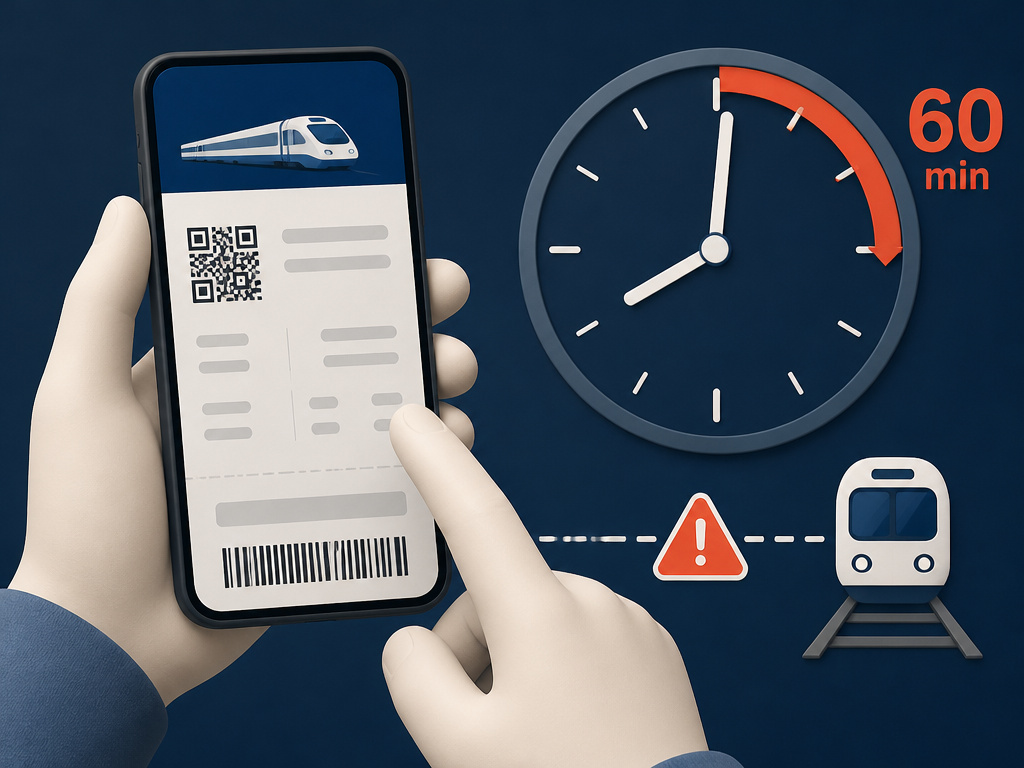
For connections, Amtrak doesn’t normally guarantee connections of less than 60 minutes. Between an arriving long-distance train and a local Northeast Corridor train, the threshold is 90 minutes.
Where this goes sideways: Building a same-day connection from a long-distance train to a flight. One three-hour delay and the whole trip collapses. I’ve watched this happen to travelers who booked a tight connection and spent the next day rebooking everything.
That 60-minute threshold is a floor, not a target. If your connection is less than 60 minutes, you’re outside what Amtrak will normally guarantee.
What Does a “Guaranteed Connection” Actually Guarantee?
Less than the name implies, and Amtrak’s own pages don’t fully agree on the answer. This is the part worth reading twice.
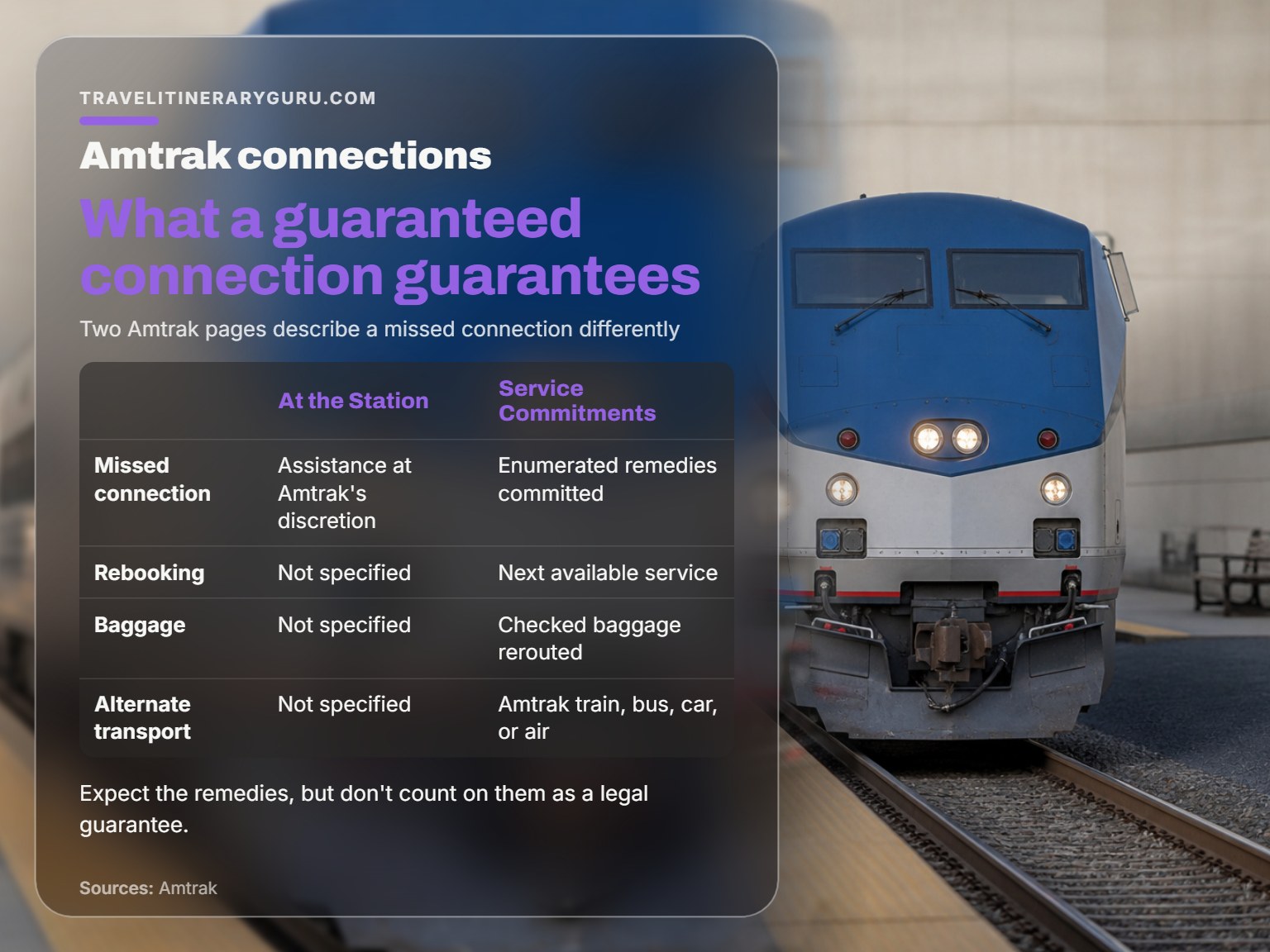
Amtrak’s At the Station page states it plainly: a guaranteed connection does not ensure the connection will always be made. If you miss a guaranteed connection, Amtrak will provide assistance at Amtrak’s discretion.
Amtrak’s Customer Service Commitments page reads differently. It commits to specific remedies: rebooking on the next available service, rerouting checked baggage, sourcing alternate transportation (Amtrak train, bus, car, or air), complimentary food and drinks, and an Amtrak-contracted hotel or sleeper-car accommodation overnight.
| Source | What It Says About a Missed Connection |
|---|---|
| At the Station page | Assistance provided at Amtrak’s discretion |
| Customer Service Commitments | Enumerated remedies: rebooking, baggage rerouting, alternate transport, food, overnight accommodation |
I get why this sounds like a contradiction. It is one. Two Amtrak pages describe the same situation in two different registers, and neither one reconciles the other.
The practical read: Amtrak’s Customer Service Commitments page commits to enumerated remedies, while Amtrak’s At the Station page describes assistance as discretionary, so expect the remedies but don’t count on them as a legal guarantee. Plan as if the connection might not happen, and treat any help you get as a bonus.
Common mistake: Booking connecting segments as separate tickets. Community guidance from Travels With Kev says separate bookings remove Amtrak’s obligation to rebook you. Keeping all connecting trains on one reservation is what triggers protection.
Can You Predict a Delay Before You Book?
Yes, and the tools are better than Amtrak’s own status page for this purpose. The trick is looking at history instead of live status.
RailCommute recommends the independent juckins.net Amtrak Status History site over Amtrak’s live train-status tool for pre-trip delay prediction, while Amtrak provides its own train-status tooling for checking current status. You search by train number and a time window to see average delay in minutes and on-time percentage.
That’s a different question than “where is my train right now.” It’s “how does this train usually behave,” and it’s the question that should drive your planning.
For a multi-city train trip, that historical view changes how you sequence the legs. You put the least reliable train first, when you have slack, and the most reliable one last, when you’re racing a flight.
Do Delay Alerts Actually Reach You?
Only if you have a reservation, and that’s a gap most travelers miss. Amtrak’s delay-alert system has a real limitation.
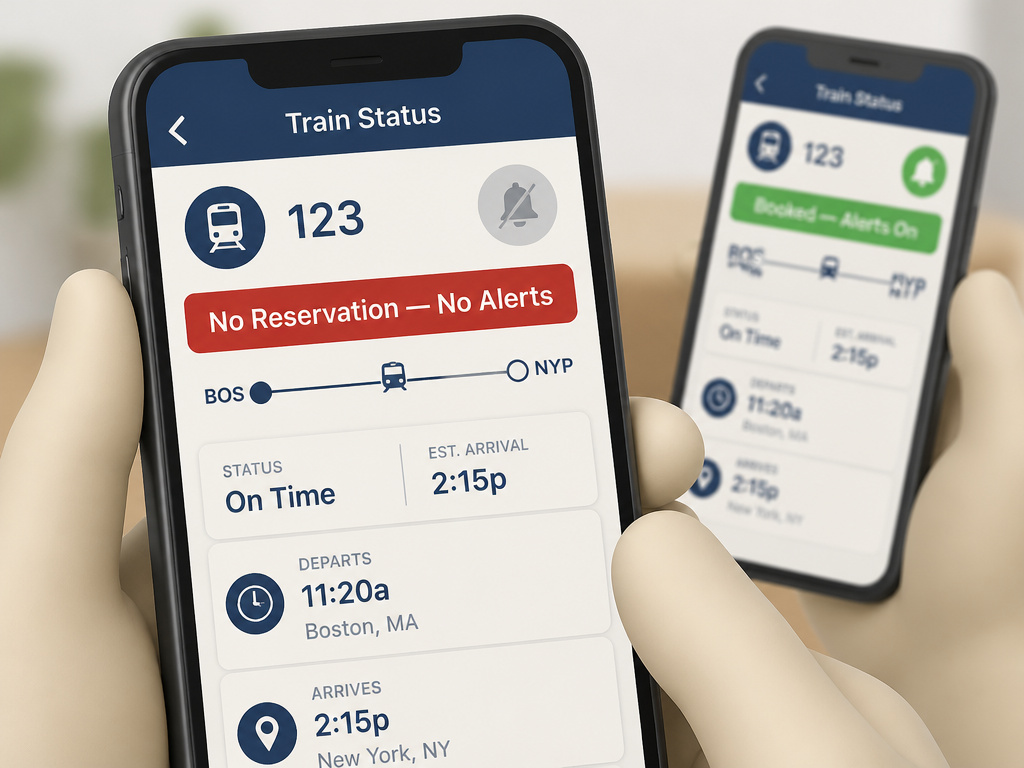
Delay-alert subscribers without a reservation will not be notified if a train is cancelled or hits a major disruption. Only reservation-holders are contacted separately.
So signing up for alerts on a train you haven’t booked is close to useless. If you’re monitoring a route before you commit, check the train’s status directly instead.
Easy to miss: The notification gap only bites people who are still deciding. Once you’ve booked, you’re covered. Before you’ve booked, you’re on your own.
What Is Amtrak’s Policy on Compensation for Delays?

Vague, on purpose, and worth understanding before you need it. Amtrak’s Commitments page says compensation “may be offered” in the form of Guest Rewards points, a Transportation Voucher, or a refund.
Customer Relations monitors for significant delays. But “significant” is undefined, and no numeric threshold is published. The Commitments page also distinguishes between delays within Amtrak’s control and those outside it for hotel accommodation.
That control distinction is the one to remember. A mechanical failure is one thing. A freight train blocking the line for three hours is another, and the remedies may differ.
For an itinerary change forced by a delay, the practical move is to ask at the station and follow up with Customer Relations. Don’t assume the remedy; ask for it.
How Do You Plan a Trip Around a Route You Know Runs Late?
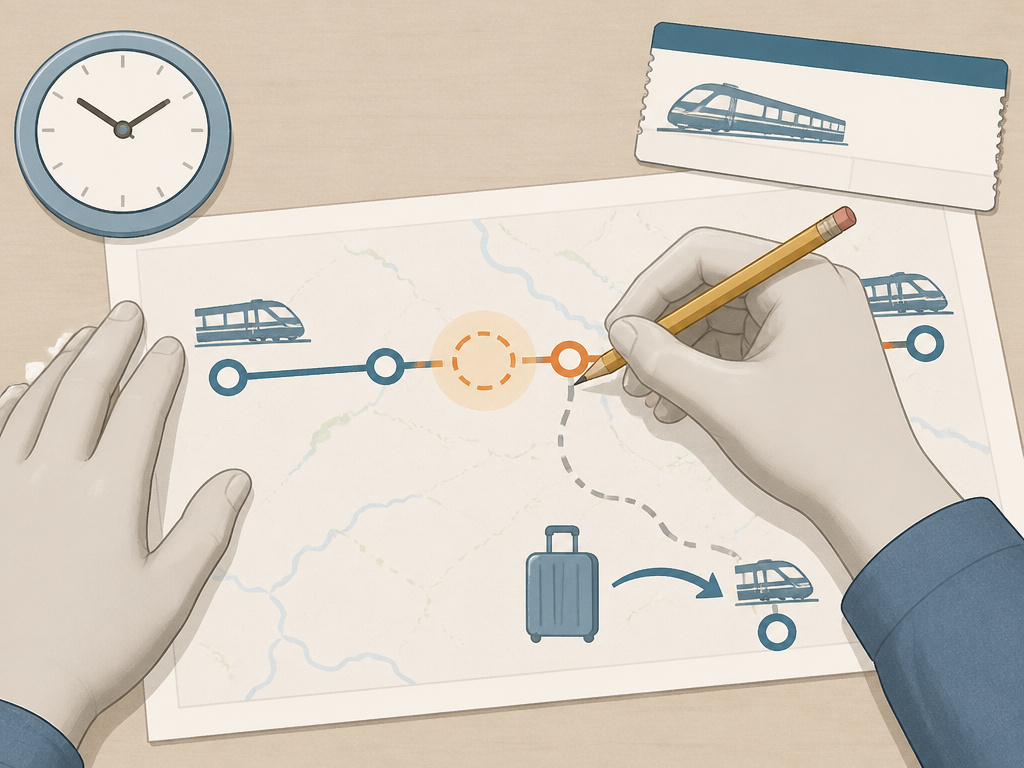
You plan the trip so the train isn’t the only thing holding it together. This is where itinerary design beats schedule optimization.
If your whole trip hinges on one on-time arrival, you’ve built a plan with no buffer. An itinerary without buffer is like a recipe with no slack.
Amtrak’s own guidance on checking bags matters here too, since rerouting checked baggage is one of the remedies Amtrak commits to for a missed connection.
What Changes When You Book With a Rail Pass?
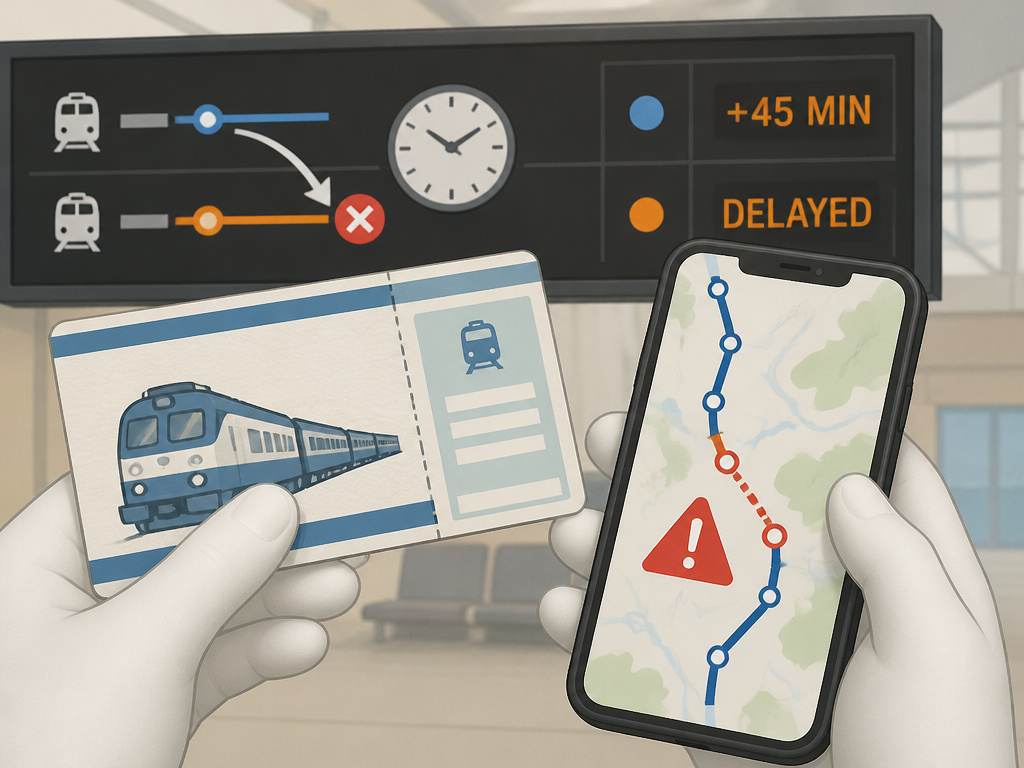
A pass changes the booking logic, and it changes your delay exposure along with it. This is where a rail pass forces you to think about connections differently.
That’s worth more than the fare difference on a route you know runs behind.
Can You Check Amtrak’s Schedule Changes Before You Travel?
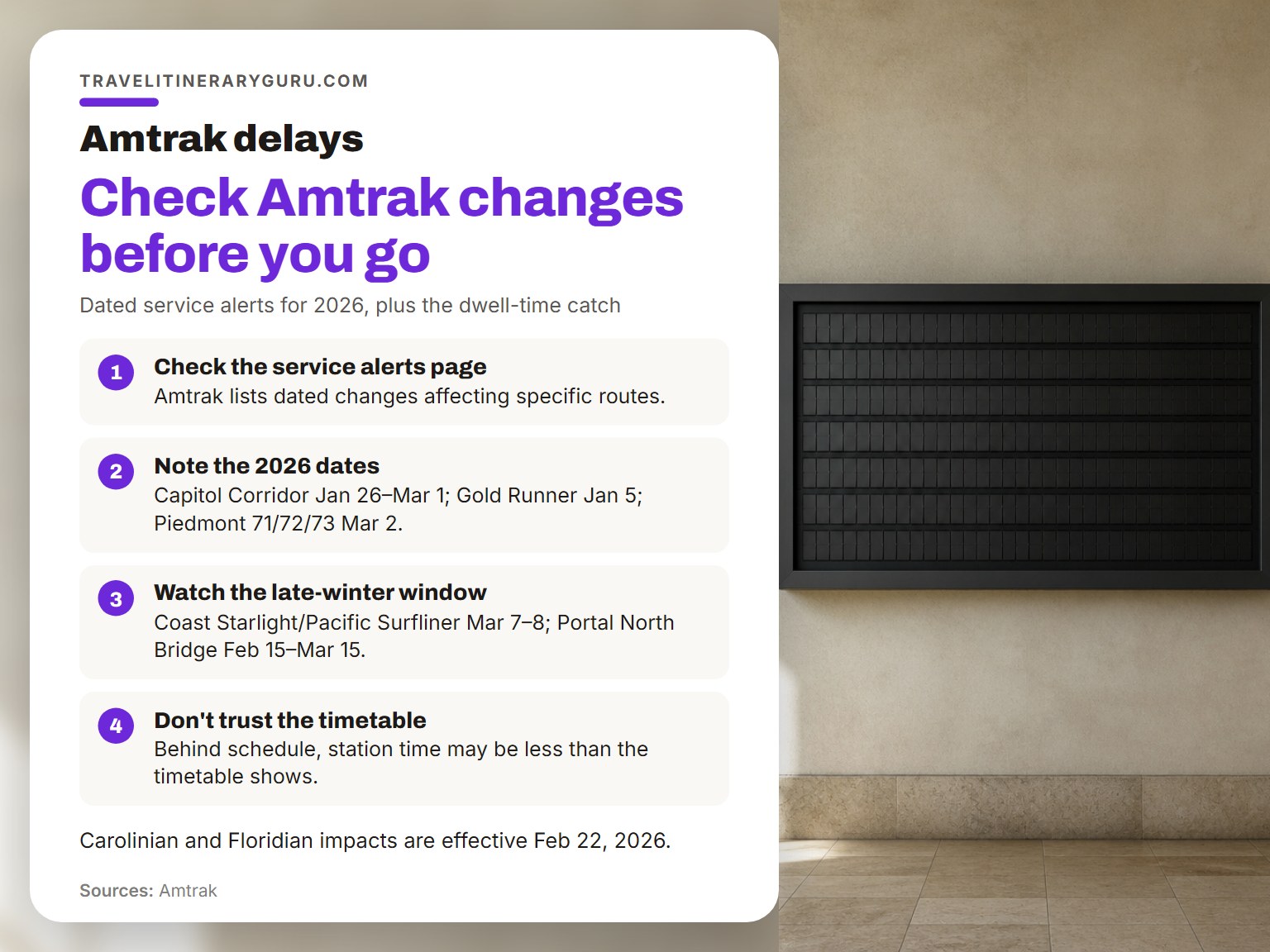
Yes, and you should, especially for 2026. Amtrak’s service alerts page lists dated changes that affect specific routes.
Capitol Corridor temporary service reductions are scheduled for Jan 26 to Mar 1, 2026. Gold Runner reductions are effective Jan 5, 2026. Piedmont Trains 71, 72, and 73 have schedule changes effective Mar 2, 2026.
Coast Starlight and Pacific Surfliner changes are scheduled for Mar 7 to 8, 2026. Portal North Bridge infrastructure work affecting Northeast Corridor service runs Feb 15 to Mar 15, 2026. Carolinian and Floridian impacts are effective Feb 22, 2026.
The part nobody mentions: When a train is behind schedule, the time it spends in the station may be less than the timetable shows. Your connection math based on the timetable can fail before you ever board.
That last point is the one that catches people. A train running late doesn’t just arrive late. It may also leave your connection point sooner than the schedule suggests, because Amtrak is trying to make up time.
Frequently Asked Questions
How early should I arrive at an Amtrak station?
Amtrak recommends arriving at least 30 minutes before scheduled departure. Auto Train passengers should arrive at least two hours before departure. If you need help with baggage, a bike, or tickets, or you’re at a large or busy station, Amtrak says arrive even earlier.
Does Amtrak guarantee connections?
Amtrak doesn’t normally guarantee connections of less than 60 minutes. Between an arriving long-distance train and a local Northeast Corridor train, the threshold is 90 minutes. Even a guaranteed connection isn’t a promise the connection will be made.
What happens if I miss a guaranteed connection?
Amtrak’s Customer Service Commitments page lists remedies: rebooking on the next available service, rerouting checked baggage, sourcing alternate transportation, complimentary food and drinks, and overnight accommodation. Amtrak’s other page describes this assistance as discretionary.
How do I check if my train is usually late?
RailCommute recommends the juckins.net Amtrak Status History site over Amtrak’s live status tool for pre-trip prediction, while Amtrak provides its own train-status tooling for checking current status. You search by train number and time window to see average delay and on-time percentage. Amtrak’s own status tool is better for checking where a train is right now.
Will I get a delay alert if I don’t have a reservation?
No. Delay-alert subscribers without a reservation will not be notified if a train is cancelled or hits a major disruption. Only reservation-holders are contacted separately. If you’re still deciding, check the train’s status directly.
Does Amtrak offer compensation for delays?
Amtrak says compensation “may be offered” as Guest Rewards points, a Transportation Voucher, or a refund. Customer Relations monitors for significant delays, but “significant” is undefined and no numeric threshold is published.
The Bottom Line
One rule most guides skip: Amtrak does not normally guarantee connections of less than 60 minutes. Build at least 90 minutes between a long-distance arrival and a local Northeast Corridor train, since Amtrak does not normally guarantee connections of less than 90 minutes there.
Your first step this week is simple. Before you book, look up your route’s 2024 on-time percentage on Amtrak’s performance page. If it’s below the FRA’s 80% on-time standard, plan that leg as if it will run late.
This all changes if you’re on a Northeast Corridor route. Amtrak owns most of that track, the freight interference problem mostly disappears, and the delay math looks completely different. The 33% routes and the 79% routes aren’t the same planning problem, and treating them the same is how trips fall apart.
I’d rather see you build a trip with slack in it than a perfect schedule that shatters on day one. The spreadsheet can be rebuilt. The trip is harder.
