
How to Handle a Tour Itinerary Change: Know Your Rights
This post contains affiliate links. As an Amazon Associate, we earn from qualifying purchases.
You handle a tour itinerary change by checking whether it meets the legal definition of a major change, then choosing between accepting it or cancelling for a full refund. In the US, a price increase counts as major only if it tops 10% of what you paid; in the UK, the trigger is 8%.
That gap between 10% and 8% is where most of the confusion lives. Two travellers, same complaint, two different answers, depending entirely on which side of the Atlantic the operator is regulated. Knowing how to handle a tour itinerary change starts with that same split, much like handling a cruise itinerary change.
What follows: the four US triggers, the wider European definition, the deadlines that decide your refund, and what actually works when the operator tells you the change is minor — the same building blocks you’d use to build a travel itinerary step by step.
Key Takeaways
- A date change the operator knows about more than 2 days before the scheduled flight date is major, under 14 CFR § 380.33(a)(1).
- Any delay of more than 48 hours is a major change.
- Accepting a refund waives your legal rights. The operator has to tell you that, and it’s not a bluff.
- Ireland gives you a menu of three remedies. In the US, if you are notified of a major change before departure, you get a full refund if you decide to cancel; if you choose not to cancel, the operator is not required to make partial refunds.
- Read the contract before you pay. The DOT says the operator or travel agent should give you a contract to sign at the time of purchase, and you should read it before paying any money.
What Counts as a Major Change to a Tour Itinerary
The US rule is a closed list of four items. Nothing outside that list is a major change, no matter how much it ruins your trip.
Under 14 CFR § 380.33 itinerary change refunds, the four triggers are a change in departure or return date, a change in the origin or destination city for any flight leg, substitution of a hotel not named as an alternate in your contract, and a price increase exceeding 10% of what you originally paid.
A major change under 14 CFR § 380.33 covers four specific triggers: a departure or return date change, an origin or destination city change for any flight leg, substitution of a hotel not named as an alternate in the operator-participant contract, and a cumulative price increase exceeding 10 percent of the original amount paid.
Two of those carry automatic qualifiers. A date change the operator knew about more than 2 days before the scheduled flight date is a major change. Any delay of more than 48 hours is a major change.
What the US list does not include matters just as much. A reordered itinerary, where you visit the same cities in a different sequence, is not a major change. Neither is a shortened trip. Neither is a hotel downgrade, as long as the replacement was named as an alternate.
I get why that feels arbitrary. It is arbitrary. It’s also the rule you’re arguing against, and knowing how to handle a tour itinerary change tells you which fights are worth having.
The 48-Hour Delay Rule and the Flight-Delay Exception
A date change caused by a flight delay is not a major change, which is one reason to book a flexible flight ticket. That exception has a ceiling: once the delay passes 48 hours, it becomes one.
So a delay of 48 hours or less that pushes your departure is not a major change. The line sits at more than 48 hours.
Both the regulation and the DOT’s consumer guidance say that any delay of more than 48 hours is a major change.
Why the US List Is Closed and Ireland’s Isn’t
Ireland’s consumer body defines a significant change more broadly. Under CCPC guidance, a significant change includes changes to travel dates, a shortening of the trip, and changes to the quality of accommodation provided.
That last one is the practical difference. In the US, a hotel swap is only major if the new hotel wasn’t named as an alternate in your contract. In Ireland, a downgrade in accommodation quality is a significant change on its own.
| Change Type | US (14 CFR § 380.33) | Ireland (CCPC) |
|---|---|---|
| Date change | Major, with flight-delay exception | Significant change |
| Shortened trip | Not enumerated | Significant change |
| Hotel substitution | Major only if not a named alternate | Quality change counts |
| City reorder | Not a major change | Not a significant change |
If your trip is regulated under Irish rules and the operator downgrades your hotel without calling it significant, the CCPC treats changes to the quality of accommodation provided as a significant change, while the US rule covers only substitution of a hotel not named as an alternate.
Where this goes sideways: Assuming a “minor” label settles it. The operator’s characterisation doesn’t determine your rights; the regulation does. Under the UK PTR guidance, notification of a significant change must be given with a stated reasonable response period, so respond within that period and cite the specific trigger.
The Price-Increase Threshold Isn’t the Same in Two Countries
Here’s where the two regimes split cleanly, and where a lot of bad advice online gets it wrong.
The US threshold is more than 10% of what you originally paid, based on the total of all increases billed. The UK threshold is more than 8%. Same consumer problem, two different numbers, and you cannot merge them when you compare a how to handle a tour itinerary change.
The UK Package Travel Regulations 2018 guidance sets the 8% trigger at regulation 11, paragraph 35. That’s the number UK package holiday travellers should hold in their head, not the American one.
There’s a second rule layered on top in the US: no price increases are allowed during the last 10 days before departure, under § 380.33(b).
But the DOT also notes that all charter flights and ground arrangements are subject to change, and that signing a contract doesn’t guarantee your fare won’t rise. The US rule also says no price increases are allowed during the last 10 days before departure.
I’ve learned this the hard way with budget tracking. If you’re tracking an aggregate price increase against the US 10% threshold, check the total of all increases billed.
What You’re Actually Owed When the Change Is Major
The remedy depends on which regime applies and when you found out.
US rules provide that if the operator notifies you of a major change before departure, you get a full refund if you decide to cancel. If you choose not to cancel, the operator isn’t required to make partial refunds.
Ireland gives you three. Under CCPC rules, you must be offered a replacement holiday of equivalent or superior quality, a lower-grade holiday with the price difference refunded, or a full refund. You can negotiate for the one you’d prefer.
That’s a real difference. In the US, a shortened trip is not enumerated as a major change. In Ireland, a shortened trip is a significant change, and the traveller must be offered a replacement holiday of equivalent or superior quality, a lower-grade holiday with a refund of the price difference, or a full refund.
The Mid-Trip Remedy Most Travellers Don’t Know About
If you only find out about the change after the trip has begun, the US DOT public charter flight guide spells out a remedy that isn’t in the regulation text itself.
You can reject the changed flight or hotel, make and pay for your own alternative arrangements, and insist on a refund for the original component when you get home.
The refund covers the original component.
The part nobody mentions: A refund for a changed component covers the original component, not your replacement costs.
The Refund-as-Waiver Clause
Under § 380.33(c), the operator must notify you that accepting a refund constitutes a waiver of your legal rights.
It’s a required disclosure: acceptance of a refund constitutes a waiver of your legal rights.
Which is why the order of operations matters. If you think you have a claim beyond the refund, don’t cash the refund first and argue later. Ask for the remedy you actually want before you accept anything.
What Happens If You Ignore the Change Notice
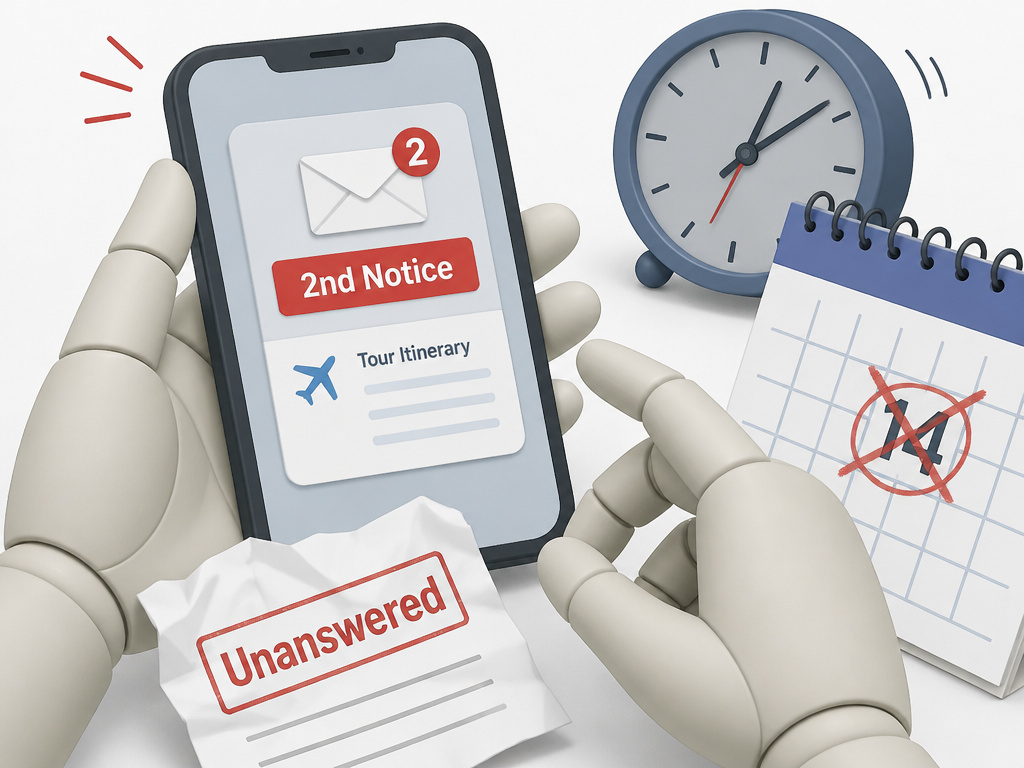
The UK regime has a rule the US doesn’t, and it cuts both ways.
Under the UK guidance at paragraph 36, notification of a significant change must be given without undue delay on a durable medium, in a clear, comprehensible and prominent manner, with a stated reasonable response period. If you ignore the first notice, the organiser must send a further notice. Failure to respond to that second notice terminates the contract.
Refunds after that deemed termination are due no later than 14 days after termination.
So silence isn’t acceptance on the first notice. It takes two notices and a missed deadline to end the contract. But once that happens, the termination is real, and you’re relying on the organiser to pay within 14 days.
The US has no second-notice requirement. If you choose not to cancel after a major change, you simply don’t get a partial refund. There’s no termination clock running.
Skip this if: You’ve already accepted the change in writing. Once you confirm acceptance, the response window closes and the operator’s obligation to offer a remedy ends.
When the Operator Cancels Instead
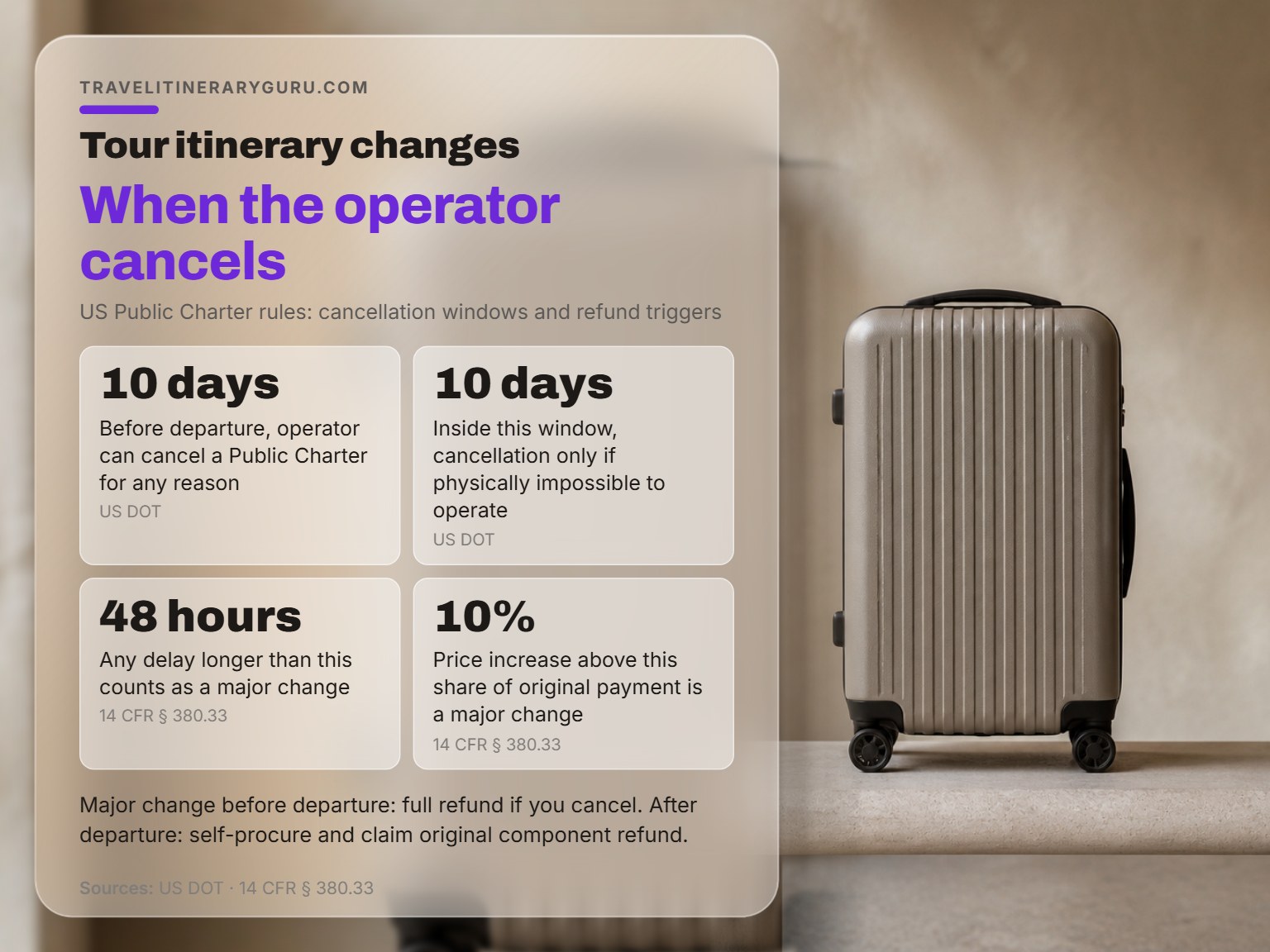
The rules flip when the operator is the one pulling the plug.
In the US, the charter operator or airline can cancel a Public Charter for any reason up until 10 days before departure. Inside that final 10 days, cancellation is only permitted if it’s physically impossible to operate the flight.
Ireland frames it differently. The organiser has the right to cancel because of factors beyond their control, and you’re still entitled to a refund or a replacement package. You negotiate which.
Then there’s the operator contract layer, which can sit on top of all of it. EF Explore America‘s booking conditions state that if a tour is cancelled or postponed due to a Force Majeure Event, travellers receive a Future Travel Voucher for all monies paid, less the cost of any purchased travel protection plan. Not a cash refund. A voucher, pro-rated for missed portions if the tour was interrupted mid-stream.
That’s a contractual term, not a regulatory one, and it’s the kind of thing you only discover by reading the contract before you sign it. The DOT says the operator or your travel agent should give you a contract at the time of purchase. Read it before you pay any money.
Go Ahead Tours, by contrast, documents change causes that include minimum enrolment not being met for an excursion. That’s a commercial trigger, not force majeure, and it appears in no regulation above. It’s also a reason to ask direct questions before you book.
The Group Leader Problem
Some operators route the change right through someone who isn’t you.
EF’s terms let the Group Leader change the requested tour itinerary, travel dates, and price on the group’s behalf, including adding travel protection. The person who signed the enrolment form isn’t necessarily the person who can object to a change.
If you’re travelling on a group tour, find out who holds that authority before departure, and consider a shareable travel itinerary so everyone sees the same version. It changes who you complain to and, in some cases, whether you have standing to complain at all.
Frequently Asked Questions
Is a flight delay a major change to my tour itinerary?
Not by itself. Under 14 CFR § 380.33(a)(1), a date change resulting from a flight delay is excluded from the major-change definition. The exception lifts once the delay passes 48 hours, at which point it becomes a major change.
Can I get a partial refund if I accept a major change?
In the US, no. The DOT is explicit: if you choose not to cancel after a major change, the operator isn’t required to make partial refunds. You either cancel for a full refund or accept the change as-is. Ireland works differently, offering a lower-grade holiday with the price difference refunded as one of three options.
What if I only find out about the change after the trip has started?
You can reject the changed flight or hotel, arrange and pay for your own alternatives, and claim a refund for the original component when you get home. The refund covers the original component, not what you spent replacing it.
How long does an operator have to refund me in the UK?
Refunds after a deemed termination are due no later than 14 days after termination. That clock only starts once the second notice has gone unanswered past its stated response period.
Does travel insurance cover a tour itinerary change?
Sometimes, with limits. The DOT notes that charter cancellation insurance often won’t pay if you must cancel because of a preexisting condition. Check the policy exclusions before you assume a change is covered.
What’s the deadline for a formal complaint in Ireland?
Formal complaint in writing must go to the holiday organiser or travel agent within 28 days of your return. If the cost is under €2,000, the small claims procedure is an option.
The Bottom Line
One rule most guides skip: if your price increase lands at 9% and you’re on a US charter, you have no major-change claim. At 11%, you do. The threshold is the whole argument, and it’s worth doing the arithmetic before you call anyone.
Your first move this week is a document check. Find the operator-participant contract, locate the major-change clause, and confirm whether your hotel was named as an alternate. That single fact decides whether a substitution is actionable or not.
The advice above assumes a US charter or a UK/Irish package. If you booked through a group leader who holds change authority for the whole group, the calculus shifts, because you may not be the party who can object.
And a concession: I am genuinely bad at spontaneous travel. When a plan falls apart mid-trip, my instinct is to rebuild the spreadsheet rather than enjoy the detour. If you’re wired the same way, the mid-trip self-procurement remedy will feel wrong. Take it anyway. You can claim the original component back, and the alternative is eating the loss.
