
How to Check Bags on Amtrak: Step-by-Step
This post contains affiliate links. As an Amazon Associate, we earn from qualifying purchases.
To check bags on Amtrak, confirm your train and both endpoint stations accept checked baggage, then arrive at least 30 minutes early with each bag tagged for its destination city. Two bags travel free, each up to 50 pounds and 75 linear inches. Anything beyond that carries a flat per-bag fee.
Amtrak’s policy page leads with that caveat for a reason. Checked baggage service exists at many stations and on many trains, but not all of them, and a station without it can’t take your bag no matter how early you show up. That one line decides more trips than the weight limit does.
Three things break this plan: a route with no baggage car, a container Amtrak refuses at the counter, and a connection too tight to move luggage between trains. The rest of this walks through each one, along with the weight and size numbers, the three trainside stations, and the call-in window for firearms.
Key Takeaways
- Verify the route before you book. Checked baggage isn’t offered on every train or at every station, and a station without the service can’t accept a bag at all.
- Two bags ride free, each up to 50 lbs and 75 linear inches (L+W+H). Extra bags and oversized bags in the 76-100 linear inch band each carry a flat per-bag fee.
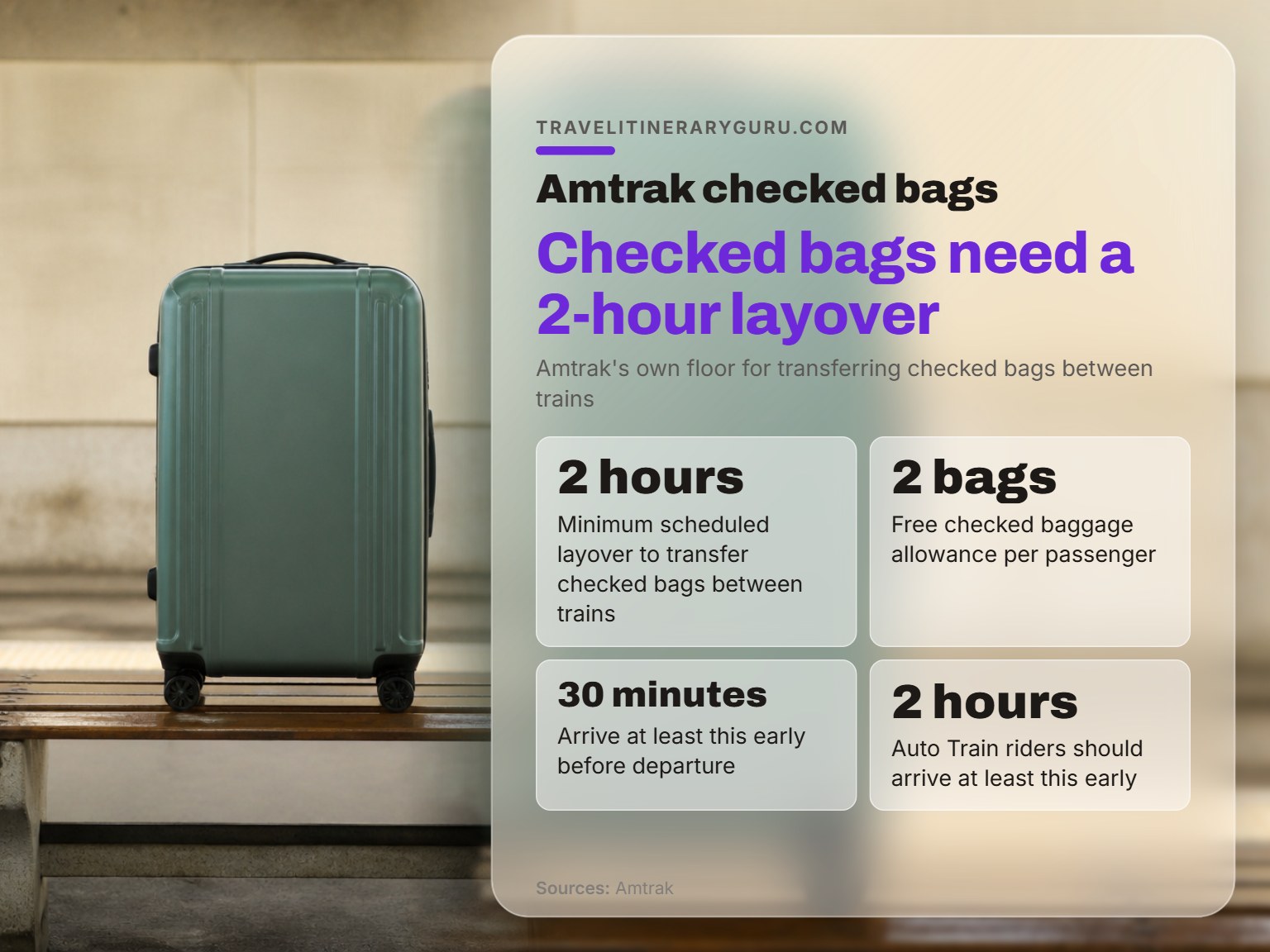
- Arrive at least 30 minutes early, and at least 2 hours early for the Auto Train. Moving checked bags between trains requires a scheduled layover of 2 hours or more.
- Plastic bins, woven fabric zipper bags, and trash bags get refused. So does anything with a sharp edge poking through the container.
- Firearms need a phone call at least 6 hours before departure to 800-USA-RAIL. No online reservations, and no firearms on Amtrak Connection buses.
Which Amtrak Trains Actually Offer Checked Baggage?
Checked baggage service is a station-by-station feature. Amtrak runs baggage cars on many trains, but not all of them, and the station at either end of your trip has to be equipped to handle a checked bag.
Checked baggage service depends on the train and on both endpoint stations. A bag measuring up to 75 linear inches, calculated as length plus width plus height, and weighing up to 50 pounds, travels free. A station without the service cannot accept a bag at all, regardless of the passenger’s ticket class.
The Amtrak checked baggage policy is explicit about the caveat. Amtrak’s guidance is to verify both your train and your origin and destination stations before you travel, and the station pages on amtrak.com list which services each one offers.
I check how to check bags on Amtrak before I book anything else.
A route that can’t take a bag changes what I pack, and it changes it before I’ve committed to a ticket.
Pets are a separate question entirely, handled under pets on Amtrak rather than the baggage car. Bikes have their own page of rules too, and bikes on Amtrak is the one people forget to check.
If your itinerary has no checked baggage service, Amtrak may still move the bag on a different train or bus to the same destination. Firearms are excluded from that workaround, and the bag travels on that other train’s schedule rather than yours.
The Free Allowance: 2 Bags, 50 Pounds, 75 Linear Inches
Two bags. Fifty pounds each. Seventy-five linear inches.
I treated carry-on-only as a personality trait rather than a packing decision. Then I took a trip through several climate zones with one bag and did laundry along the way to keep it working. I check a bag now when it buys me comfort, and on Amtrak the free allowance makes that an easy call.
Linear inches are the measurement that catches people. Add the bag’s length, width, and height as packed, and the total has to land at 75 or below. A standard wheeled suitcase clears it. A long duffel or a hard case built for gear doesn’t.
| Rule | The number | Notes |
|---|---|---|
| Free checked bags | 2 per passenger | Applies per traveler |
| Weight per bag | 50 lbs | Per bag |
| Size per bag | 75 linear inches (L+W+H) | Measured as packed |
| Oversized bags | 76-100 linear inches | Flat fee per bag |
| Firearm hard case | 62 x 17 x 7 in max | Weight capped at 50 lbs |
| Ammunition | 11 lbs (5 kg) combined | Original container or fiber, wood, or metal box |
Beyond the free allowance, each additional bag carries a flat fee, and oversized bags in the 76-100 linear inch band land in the same tier. Amtrak’s checked bags rules treat those two categories identically.
If a bag measures past 75 linear inches as packed, it’s an oversized bag. Repack it or accept the oversized tier. Arguing at the counter doesn’t change the tape measure.
If you’re buying for this, a softside spinner is the shape I’d pick. Soft sides absorb the stacking that happens in a baggage car better than a hard shell does.
A 50-pound bag lifts fine at the handle and badly at arm’s length.
That’s the position you’ll be in on a platform, so pack to a weight you can actually carry.
How to Check Bags on Amtrak at the Station, Step by Step
You’re at the counter with two bags, a boarding time coming up, and an agent who has done this a thousand times.
- Arrive at least 30 minutes before departure. That’s Amtrak’s own buffer, and it’s a floor. Miss it and the bag rides with you whether you planned for that or not.
- Bring ID, and be 18 or older. Amtrak requires both to check baggage, including for firearms and station storage. No ID means no checked bag.
- Check the destination tag before the bag leaves your hand. The city on the tag is what routes it, and a blank or wrong tag is worth catching at the counter.
- Hand the bag over and take the claim check. At a standard counter the agent handles it. At a trainside station you walk the bag to the baggage car yourself.
- Put the claim check somewhere that isn’t the bag. A jacket pocket or a wallet works. A backpack riding in the baggage car doesn’t.
- Hand the claim check back at the far end to collect your luggage. On trainside routes, the train crew tells you where the claim point is.
The baggage car door shuts with a hollow, final-sounding thunk.
That’s the last you see of the bag until the far end.
What to Have Ready at the Counter
Have your ID out and your destination city in mind. The luggage tags you already own aren’t required for a standard checked bag, since the carrier supplies the tag, but a second tag with your name and phone number inside the bag costs nothing and survives a torn handle tag.
Keep the claim check on you for the whole trip. It’s a small paper stub, and it’s the only thing that gets your bag back at the destination.
Trainside Checked Baggage: Three Stations, Different Routine
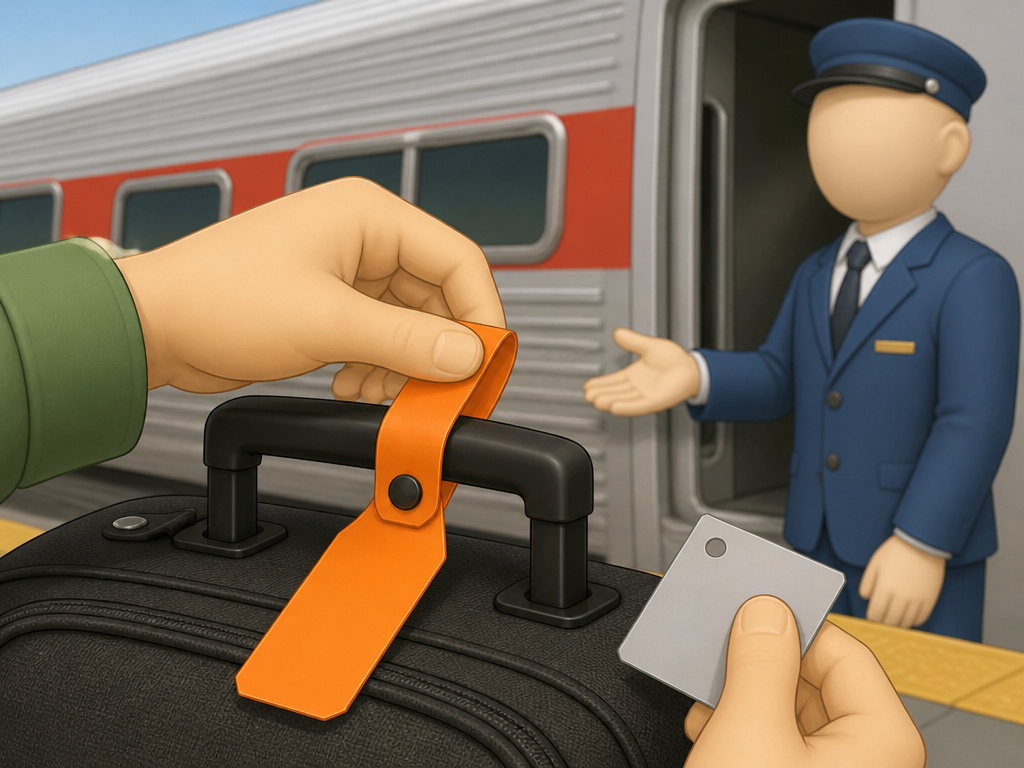
Columbus, Wisconsin; Mount Pleasant, Iowa; and Winona, Minnesota are the only three stations where Amtrak offers trainside checked baggage service.
Trainside means you do the work the platform crew normally does. Tag the bag yourself with a baggage tag for the destination city, then walk it to the baggage car and hand it to an Amtrak crew member there. You get a claim check in return.
Arriving works the same way in reverse. The train crew tells you where to claim your luggage, and you hand the claim check to the crew member to get the bag back.
Where this goes sideways: Standing on the platform waiting for someone to come take your bag. At a trainside station nobody comes to you, and the bag doesn’t move until you walk it to the baggage car yourself.
What Trainside Service Changes
It moves the tagging step to you and puts you face to face with the baggage car. I don’t mind it. The bag never leaves your sight until it’s already loaded.
The trade is that you’re doing this on a platform, with a train boarding, in whatever weather the station has. Give yourself the full 30 minutes at these three stations.
Extra Bags, Oversized Bags, and the Containers Amtrak Rejects
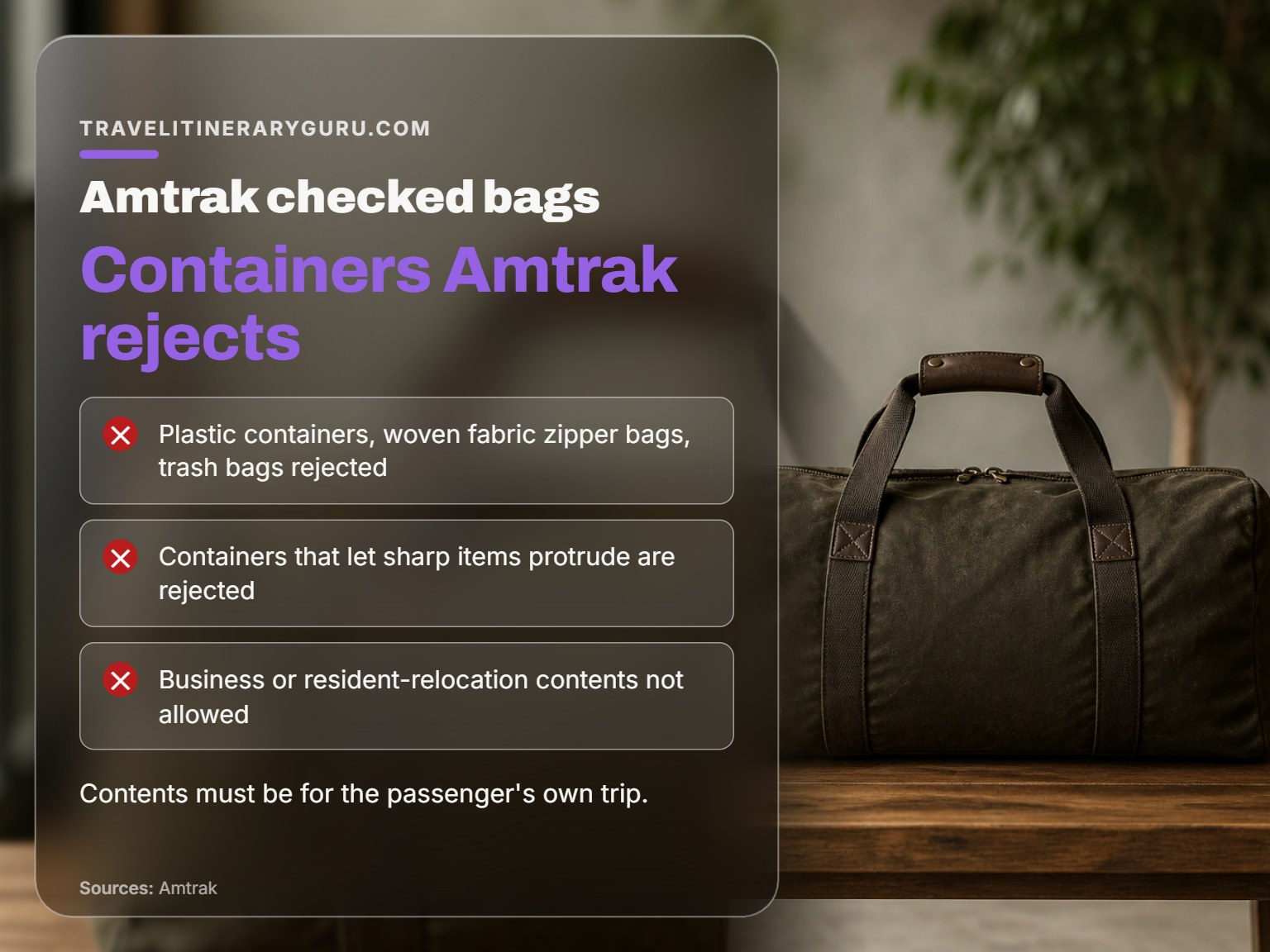
The container gets bags refused more often than the contents do.
Amtrak’s packing your luggage guidance names the items it won’t accept: plastic containers, woven fabric zipper bags, trash bags, and anything a sharp item could poke through. Business or resident-relocation contents are refused too, because the contents have to be for your own trip.
- Plastic storage bins. The kind you’d buy for a move.
- Woven fabric zipper bags. The reusable grocery-store type.
- Trash bags. Even doubled up.
- Anything with a sharp edge protruding. A tripod foot, a tool handle, a ski pole tip.
- Household goods, business inventory, or relocation contents.
The fix is a real suitcase or a heavy duffel with a closed zipper and nothing poking out. A closed duffel works fine as long as nothing protrudes. If you’re moving house, Amtrak isn’t the carrier for it.
A luggage tracking device inside the bag is the cheapest insurance here. A tracking device tucked into an interior pocket won’t stop a bag from being misrouted, but it tells you where the bag is while the claim is still open.
What most people get wrong: Assuming a soft-sided bag needs no protection. A duffel with a protruding handle strap gets refused at the counter, and the refusal lands after you’ve already stood in line.
Can You Check a Firearm on Amtrak?
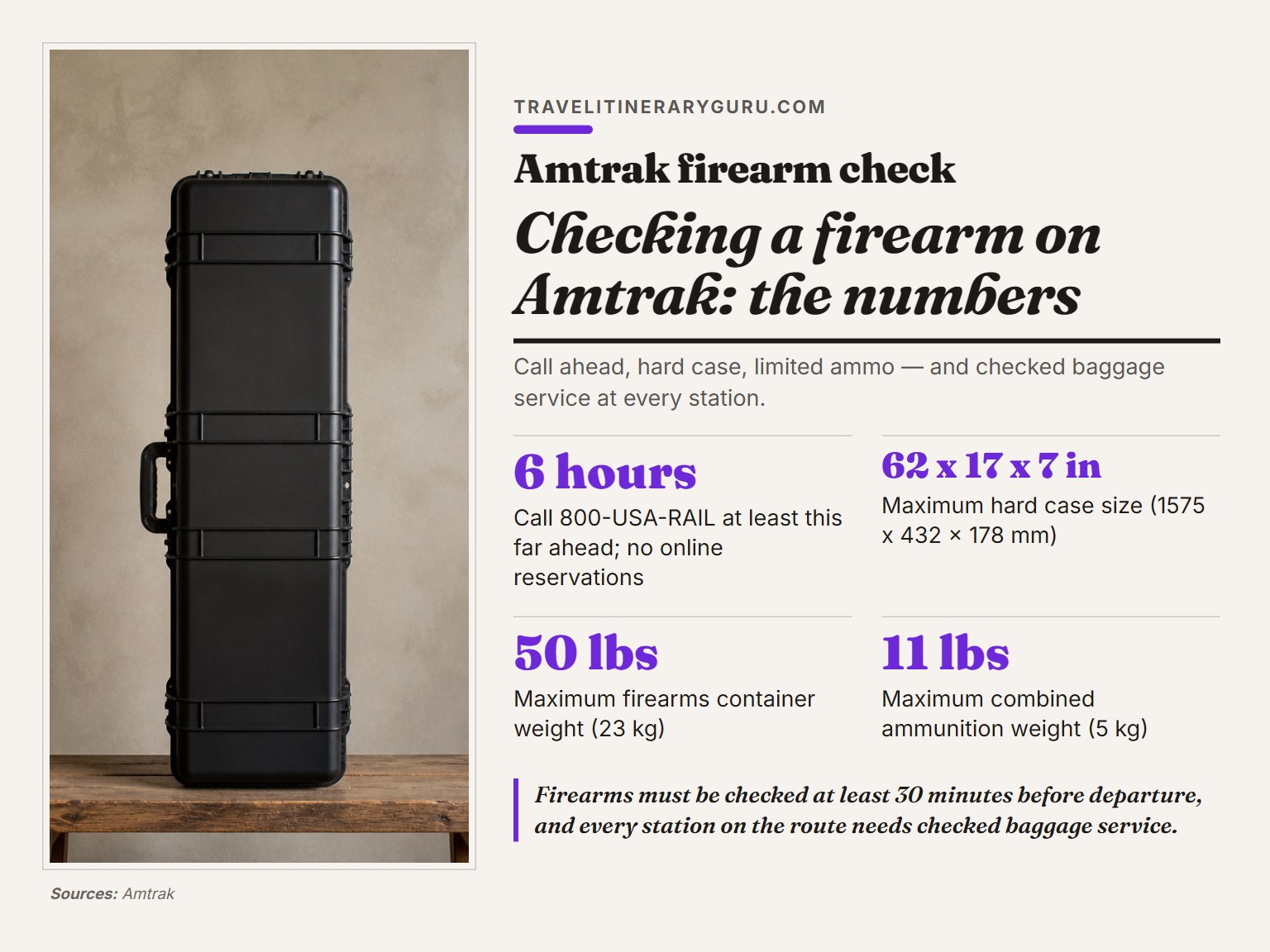
Six hours. That’s how far ahead you have to call Amtrak to check a firearm, and it’s the step people skip.
The rest of the rule is a stack of hard numbers. The hard case can’t exceed 62 inches long, 17 inches wide, and 7 inches deep (1575 x 432 x 178 mm), and the container can’t weigh more than 50 lbs (23 kg).
Ammunition is capped at 11 lbs (5 kg) combined. It has to be in the original manufacturer’s container or a fiber, wood, or metal box.
Firearms must be checked at least 30 minutes before departure. You have to notify Amtrak at least 6 hours before departure by phone at 800-USA-RAIL, and there’s no online reservation path for this at all.
The Firearm Timeline, in Order
- Call 800-USA-RAIL at least 6 hours before departure.
- Pack the firearm in a hard case within the 62 x 17 x 7 inch limit.
- Pack ammunition separately, capped at 11 lbs combined.
- Arrive and check the case at least 30 minutes before departure.
The route has to cooperate too.
Amtrak’s special items rules require checked baggage service at every station on the itinerary. Amtrak Connection bus services are excluded from firearm carriage entirely, so a trip with a bus segment won’t take one.
Roomette, Bedroom, or Family Room: Where the Bags Actually Go
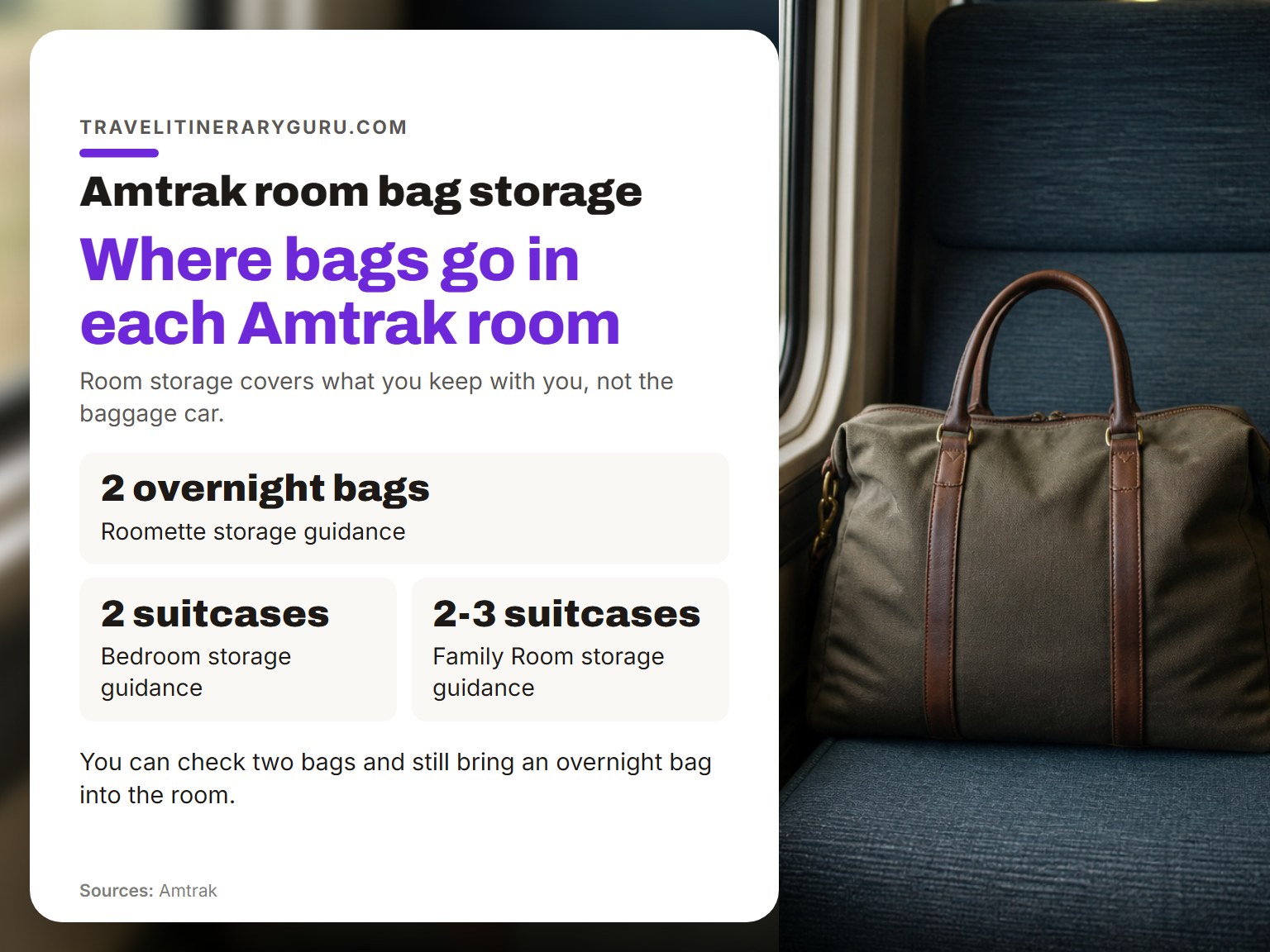
The roomette gets booked for the scenery and then abandoned for the lounge car.
That matters for packing, because the room’s storage is smaller than the view is good. Amtrak’s guidance for a Roomette is 2 overnight bags. A Bedroom takes 2 suitcases. A Family Room takes 2-3 suitcases, and an Accessible Bedroom takes 2 suitcases plus a wheelchair.
- Roomette: 2 overnight bags.
- Bedroom: 2 suitcases.
- Family Room: 2-3 suitcases.
- Accessible Bedroom: 2 suitcases plus a wheelchair.
Notice what that list is about. Room storage covers what you keep with you, not what’s in the baggage car. You can check two bags and still bring an overnight bag into the room.
Roomette versus Bedroom for a bag-heavy trip: the Bedroom wins if you’re carrying two full suitcases, and the Roomette wins if you’re carrying overnight bags and nothing else. The Family Room only wins with kids along.
I’d rather check the big bag and keep a small overnight bag in the room than try to live out of one suitcase for a long trip. The room storage numbers above are the reason.
This is where packing for Amtrak gets easier than packing for a flight. Once the big bag is in the baggage car, the room only has to hold what you need between boarding and arrival.
If you’re doing Amtrak with kids, the Family Room is the only room on that list sized for a family’s worth of suitcases.
Layovers, Connections, and Planning Around Amtrak Delays
A same-day connection is where this plan falls apart.
Amtrak requires a scheduled layover of at least 2 hours if you’re transferring checked bags between trains. That’s the carrier’s own number, and it’s a floor.
| Trip type | Check the bag | Carry it instead |
|---|---|---|
| Long-distance, both stations served | Yes, up to 2 free | Only the overnight bag |
| Corridor trip | Rarely worth the counter stop | Yes |
| Any trip with a transfer | Only with a 2-hour layover | If the layover is shorter |
| Sleeper car | The large suitcase | The room bag |
Planning around Amtrak delays is the other half of the math. A long-distance train running late pushes every downstream connection, and a checked bag moves on the train’s schedule, not yours.
Auto Train riders get a different buffer: arrive at least 2 hours before departure, against 30 minutes for everyone else.
A 2-hour scheduled layover sounds generous until you’re standing on a platform watching the board flip from a departure time to something you’d rather not read.
Easy to miss: The 2-hour layover requirement applies to moving checked bags between trains. Book a shorter connection and the bag doesn’t transfer with you.
That’s the trade. Check the bag and you need the buffer. Carry it and you need the shoulder.
Frequently Asked Questions
Can I check a bag if my departure station doesn’t offer checked baggage service?
Sometimes, but not as checked baggage on your own train. Amtrak may accept the bag on a different train or bus to the same destination, which is a workaround rather than a guarantee. Firearms are excluded from that option entirely.
How much does it cost to check extra bags on Amtrak?
Amtrak charges a flat per-bag fee for anything beyond the two free bags, and oversized bags measuring 76-100 linear inches fall into the same tier. The current amounts live on Amtrak’s own policy page, and that’s the version worth checking before a trip.
Do I need ID to check a bag on Amtrak?
Yes. Passengers must be 18 or older and present ID to check baggage, including for firearms and for station storage. It’s a step that doesn’t show up in most generic packing advice, and it’s a hard stop at the counter.
Can I check a firearm on Amtrak?
Yes, but only with planning. You have to call 800-USA-RAIL at least 6 hours before departure, the case has to fit within 62 x 17 x 7 inches, and there’s no online reservation option. The firearm also needs checked baggage service at every station on the itinerary.
What happens to my checked bag if part of my trip is on a bus?
Amtrak Connection bus services don’t carry firearms at all. For ordinary luggage, the bag needs checked baggage service at every station on the route, so a bus segment can break an otherwise workable plan.
Where do I put my bags in a sleeper car?
Amtrak’s guidance is 2 overnight bags in a Roomette, 2 suitcases in a Bedroom, 2-3 suitcases in a Family Room, and 2 suitcases plus a wheelchair in an Accessible Bedroom. Those numbers cover what stays in the room, so a checked bag doesn’t count against them.
The Bottom Line
One rule covers most of this. Before you book, confirm that both endpoint stations handle checked baggage. If either one doesn’t, the rest of the policy stops mattering, and you’re packing for a carry-on instead.
The second rule is a buffer. Amtrak’s own minimums are 30 minutes at the station, 2 hours for the Auto Train, and a scheduled 2-hour layover to move a checked bag between trains. Treat those as floors and add your own margin.
An itinerary with a 2-hour layover built into it absorbs that. One without it doesn’t.
And the concession: on a short corridor trip with one bag and no transfers, the short version of how to check bags on Amtrak is that you don’t have to. Carry it on, skip the counter, and get on the train. The checked baggage rules matter most on the long-distance routes, where they’re also the most worth using.
