
How to Travel by Amtrak With a Bicycle: Step-by-Step
This post contains affiliate links. As an Amazon Associate, we earn from qualifying purchases.
To travel by Amtrak with a bicycle, match three things: the service type (carry-on rack, trainside checked, or boxed checked baggage), your bike’s size (50 lbs or less with tires no wider than 2 inches), and whether your route requires a reservation. Folding bikes skip the rack entirely if they fit under 34 x 15 x 48 inches.
That reservation column is the part of how to travel by Amtrak with a bicycle that derails trips, because two routes waive it while the rest require one. Service type matters just as much: a rack you load yourself and a bike a crew member lifts into a baggage car are booked, boarded, and handed over differently.
What follows walks the three services, the two routes that skip reservations, the box dimensions, the four-step boxing routine, and the arrival windows that two Amtrak sources state differently.
Key Takeaways
- First-come, first-serve racks: carry-on bike service fills up, and bikes stop being accepted once it does.
- 50 lbs and 2-inch tires are the hard limits for a full-size bike in an onboard rack.
- 70 x 41 x 8.5 inches is the ceiling for a checked bike box, and the handlebars have to turn sideways.
- Three bikes per train is the Downeaster’s cap, with advance reservations for both you and the bike.
- An hour for trainside checked, 30 minutes for carry-on nationally and 15 minutes on the Downeaster. Those are the arrival windows the Amtrak sources publish.
What Are the Three Ways to Travel by Amtrak with a Bicycle?
Three services exist, and the difference between them decides your whole trip: carry-on rack, trainside checked, and boxed checked baggage.
Amtrak’s carry-on bicycle service stores a full-size bike in racks inside Coach passenger cars. Trainside checked service places the bicycle in a baggage car, loaded and secured by Amtrak crew. Boxed checked service requires partial disassembly: handlebars loosened and turned sideways, pedals removed, and the bicycle packed in a container no larger than 70 by 41 by 8.5 inches.
Here’s how they break down in practice.
- Carry-on rack service. You load it, you secure it, and you’re responsible for it. Amtrak requires you to handle the bike fully and lift it to shoulder height.
- Trainside checked service. A crew member lifts the bike into the baggage car and racks it. Passengers aren’t allowed inside baggage cars, so you hand it up and step back.
- Boxed checked baggage. The bike travels boxed, in lieu of a piece of baggage.
Carry-on rack service is the one most riders picture, and it’s the one with the hard cutoff. On every route except Pacific Surfliner, unreserved racks are first-come, first-serve, and when they fill, bikes stop being accepted onboard.
Your ticket doesn’t reserve a hook.
You can spot a full rack from the platform. Bikes sit nose-to-tail in the Coach car, front wheels turned, nothing left to clip into.
Amtrak’s bring your bicycle onboard page lists which trains offer which service, and the list is shorter than most riders expect. Full-size bicycles ride only on certain trains with designated carry-on or trainside service.
Skip carry-on rack service if you can’t lift a loaded bike to shoulder height. Amtrak states that requirement plainly, and a bike you can’t lift is a bike you can’t board.
The 50-Pound, 2-Inch Rule That Decides Carry-On vs. Checked
I spent years treating carry-on as the only respectable way to travel. Then a two-week trip through three climates had me doing laundry every other night, and I started checking a bag whenever it bought me comfort. The same arithmetic applies to how to travel by Amtrak with a bicycle.
Rack service is the light-traveler’s badge. It’s also the service that stops accepting bikes the moment the rack fills, which is why the checked options deserve a second look.
| Service | How the bike is handled | Bike limits | Best for |
|---|---|---|---|
| Carry-on rack | You load and secure it | 50 lbs, 2″ tires | Short hops, light bikes |
| Trainside checked | Crew loads into baggage car | 50 lbs, standard box | Routes with baggage cars |
| Boxed checked baggage | Boxed, in lieu of a bag | 70 x 41 x 8.5″ box | One-way moves, long trips |
| Folding bike | Folded, in lieu of a bag | Under 34 x 15 x 48″ | Mixed-mode travel days |
The 50-pound ceiling and the 2-inch tire limit eliminate bikes fastest. A loaded touring bike with racks, bottles, and a frame bag can cross 50 lbs before you’ve packed a thing. Knobby tires wider than 2 inches rule out the rack entirely.
Weigh the bike loaded, not bare.
Do you know what your bike actually weighs right now? A digital luggage scale settles the question before you leave the house, and guessing is how you end up repacking on a platform.
Boxed bikes ride under the same Amtrak baggage rules as everything else in the baggage car, which is why the box counts as a piece of baggage rather than a free extra. Pennsylvania’s PennDOT bike transit guidance splits Amtrak’s checked options into two: a box or other secure container, and a bike secured by tie-down equipment instead of boxed.
Amtrak charges a fee to check a bike in a container in lieu of a piece of baggage, and bicycle fees vary by route. Boxes are sold at most staffed stations if you don’t bring your own container. Customers may supply their own, as long as it fits the same envelope.
Skip boxed checked service if neither end of your route offers checked baggage handling. The box has to be handed over at a station that processes checked baggage, and a route without it won’t make an exception.
Which Routes Require a Bicycle Reservation, and Which Two Don’t
Reservations are the part of this system that ruins trips quietly. Two routes skip the bike reservation entirely: the Capitol Corridor and the Gold Runner (San Joaquins). Every other route on Amtrak’s bicycle list requires one.
| Route | Bike reservation required | Checked bike service |
|---|---|---|
| Downeaster | Yes | No |
| Pacific Surfliner | Yes | Select stations |
| Capitol Corridor | No | No |
| Gold Runner (San Joaquins) | No | Select stations |
| Vermonter | Yes | Select stations |
| Northeast Regional | Yes | No |
The Downeaster’s Three-Bike Cap
The Downeaster is the tightest route in the system for bikes. Bicycle space is limited to three per train, and advance reservations are required for both the passenger and the bicycle. It’s a reserved service, so there’s no walk-up option regardless.
That cap sits on a 146-mile route between Boston and Brunswick, Maine, serving 12 stations. The Amtrak Downeaster rider FAQ states the limit directly, and it’s worth reading before you build a trip around that train.
If your route requires a bike reservation, book the bike and the seat in the same transaction. Bike space tracks route, date, and existing bookings, and a full rack cancels your plans regardless of your ticket.
Multi-leg trips multiply that problem. An Amtrak rail pass is the cleanest way to hold several segments in one booking, which matters when each segment needs its own bike slot.
One useful detail for connections: if you’re using trainside checked service and connecting between two trains, the bike can sit in the baggage room free of charge during a lengthy layover.
Boxing a Bike at the Station: 4 Steps and the Tool Amtrak Won’t Hand You
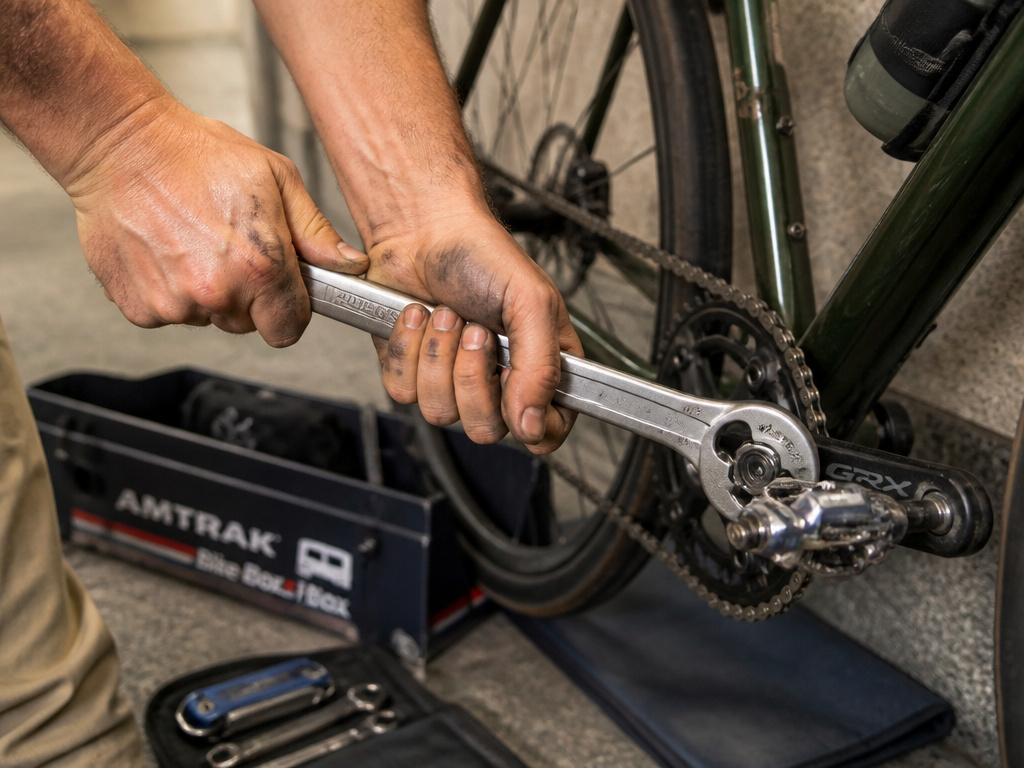
Four steps stand between your bike and the baggage car, and one of them needs a tool you have to bring yourself.
Before you start: Pedals that haven’t moved in a season can seize, and leaning hard on the wrong wrench rounds the flats off. Use a proper pedal wrench. Station floors are concrete, so set the frame down on something soft rather than dropping it. And you must be able to lift the loaded bike to shoulder height, because Amtrak’s requirement applies before any crew member touches it.
- Loosen and turn the handlebars sideways. Leave them straight and the bike won’t fit the 8.5-inch box width.
- Remove the pedals. This is the step that fights back. A pedal torqued on years ago needs steady pressure, not a jerk.
- Slide the bike in and label the box. Attach your name and address, because one bike box looks like every other bike box.
- Check in at the counter and take the claim check. At an unstaffed station, you check the bike directly with a crew member when the train arrives.
A pedal that’s been on since the bike was built doesn’t creak or warn you. You lean into the wrench, feel the metal go tight, and then it lets go all at once with a crack you feel through the handle. Then you look down and your palm is black with chain lube.
The Tool Kit Amtrak Doesn’t Provide
Amtrak doesn’t supply tools for disassembling a bike, and pedals are the part that gives riders the most trouble. A long-handled pedal wrench is the one I’d carry, because the extra length lets you avoid a cheater bar that slips.
Amtrak’s own advice is to disassemble and reassemble the bike at home first, before your trip. That’s not busywork. It’s how you find out whether your pedals come off at all.
Fair warning: for trainside checked service, you check the bicycle at the station at least an hour before departure. That hour exists because boxing takes longer than people budget.
Amtrak’s box is a slim 8.5 inches deep, and that’s a different animal from a bike travel bag built for airline holds, which swallows a whole frame with the wheels off. If your trip mixes a flight with a train, hard-shell bike cases protect the frame in the hold. The train leg still runs on Amtrak’s box.
What Actually Gets Turned Away at the Platform
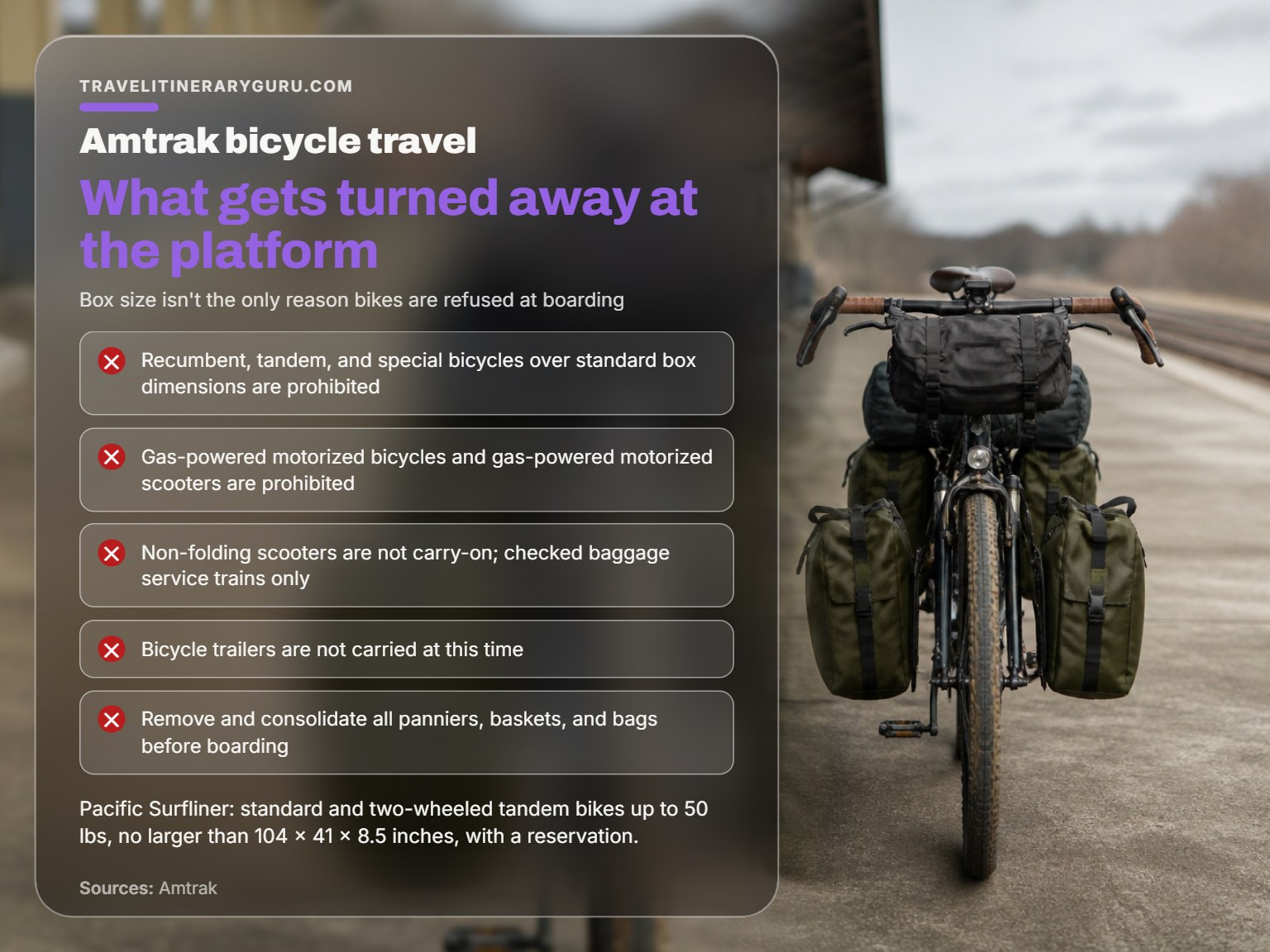
The box dimensions get all the attention. The rejections happen for other reasons.
- Recumbent, tandem, and special bicycles that won’t fit a standard box are prohibited, and tandems only ride in onboard racks on Pacific Surfliner.
- Gas-powered motorized bicycles are prohibited outright.
- Gas-powered motorized scooters are prohibited.
- Non-folding scooters aren’t carry-on items at all. They’re only accepted on trains with checked baggage service.
- Bicycle trailers can be checked in a container at stations with checked baggage service, but Amtrak isn’t carrying them at this time.
- Recumbent bikes and trikes aren’t accepted on Pacific Surfliner.
Panniers and baskets are the other quiet disqualifier. All panniers, baskets, and bags attached to the bicycle must be removed and consolidated before boarding, on both carry-on and trainside checked service.
Common mistake: Leaving a handlebar bag on the bike. Crew will ask you to strip it at the platform, and you’ll be doing it while the train sits there waiting, with your boarding window closing.
Pacific Surfliner runs its own numbers. Standard and two-wheeled tandem bikes can weigh up to 50 pounds and measure no larger than 104 x 41 x 8.5 inches, with a reservation.
How Early Do You Really Need to Arrive with a Bike?
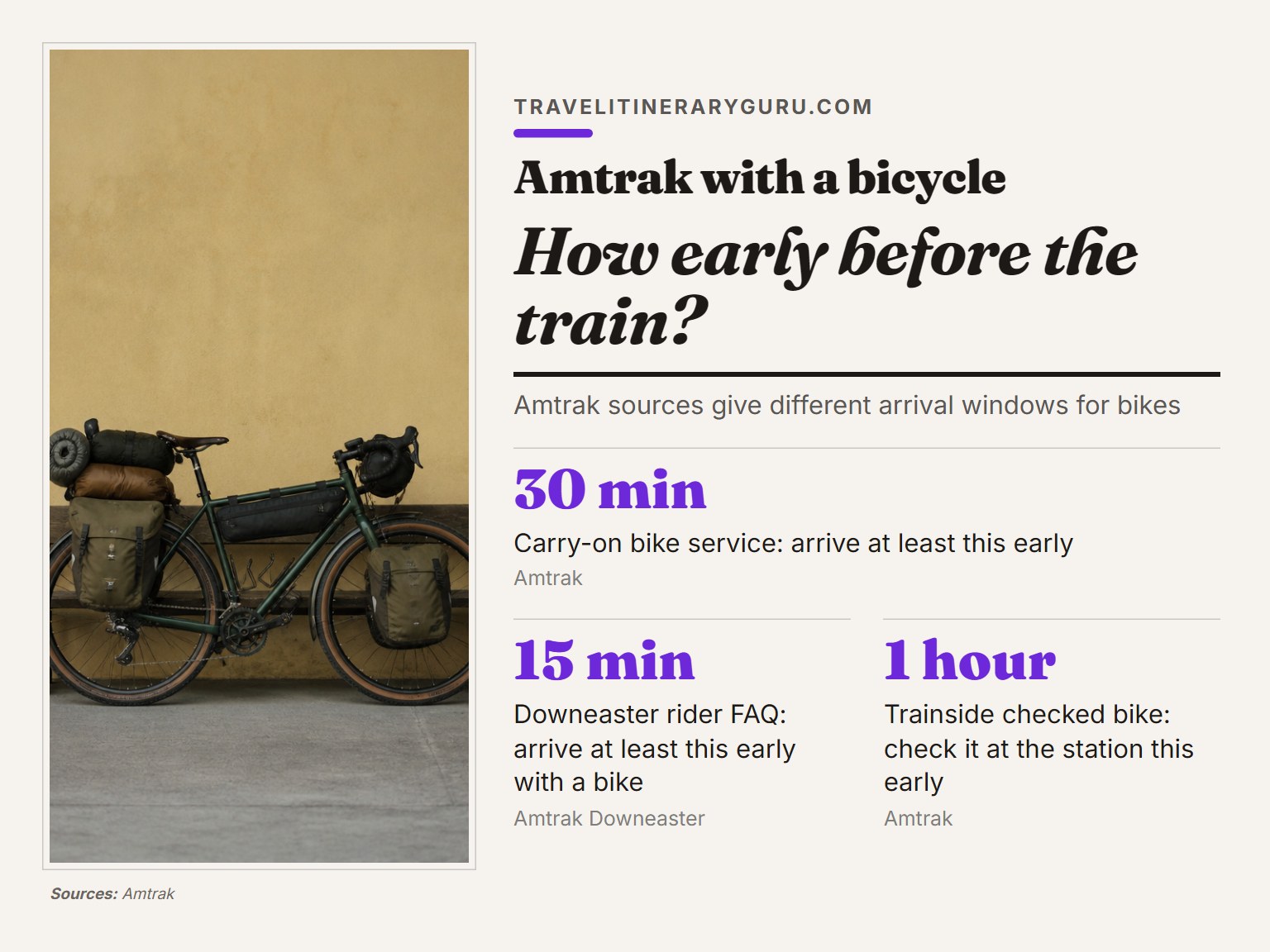
Amtrak’s national bike FAQ says 30 minutes for carry-on service. The Downeaster’s own rider FAQ says 15.
For carry-on bicycle service, Amtrak’s national bike FAQ asks passengers to arrive at the station at least 30 minutes before departure, while the Downeaster’s rider FAQ encourages passengers with bikes to arrive at least 15 minutes before departure. The Downeaster’s operator FAQ encourages passengers with bikes to arrive at least 15 minutes before departure. Both pages belong to Amtrak-affiliated sources, and neither reconciles the difference.
Trainside checked service runs on a separate clock. Amtrak asks you to check the bicycle at the station at least an hour before departure. The two figures coexist on Amtrak’s own pages without explanation, so treat the longer window as the safe one.
Front-wheel removal is the other place the sources diverge. Amtrak’s national page requires it on short-distance routes in the Northeast, while the Downeaster’s FAQ states it as a blanket rule for that train. The Downeaster’s FAQ states it as a blanket rule for that train, which is itself a Northeast route, so the regional carve-out and the route rule don’t line up. On the Vermonter, removing the front wheel and hanging the bike by the back wheel keeps it out of the corridor.
I plan around the bicycle clock rather than the departure time. When a route offers both carry-on and trainside checked, I take the trainside option and the extra half hour, because a bike already in the baggage car can’t lose a race for the last rack slot.
Padding matters more than the arrival window. Amtrak delays on long-distance routes are common, and a tight connection with a bike is a connection you’ll miss.
Amtrak’s bike FAQ puts the carry-on window at 30 minutes and confirms that bike availability varies by route, departure date, and existing bookings. That last part is the one to plan around.
The 30 minutes disappears faster than the clock suggests. Stripping a loaded touring bike takes longer than people budget, and the train doesn’t wait while you make a second trip.
Can You Bring an E-Bike or a Folding Bike on Amtrak?
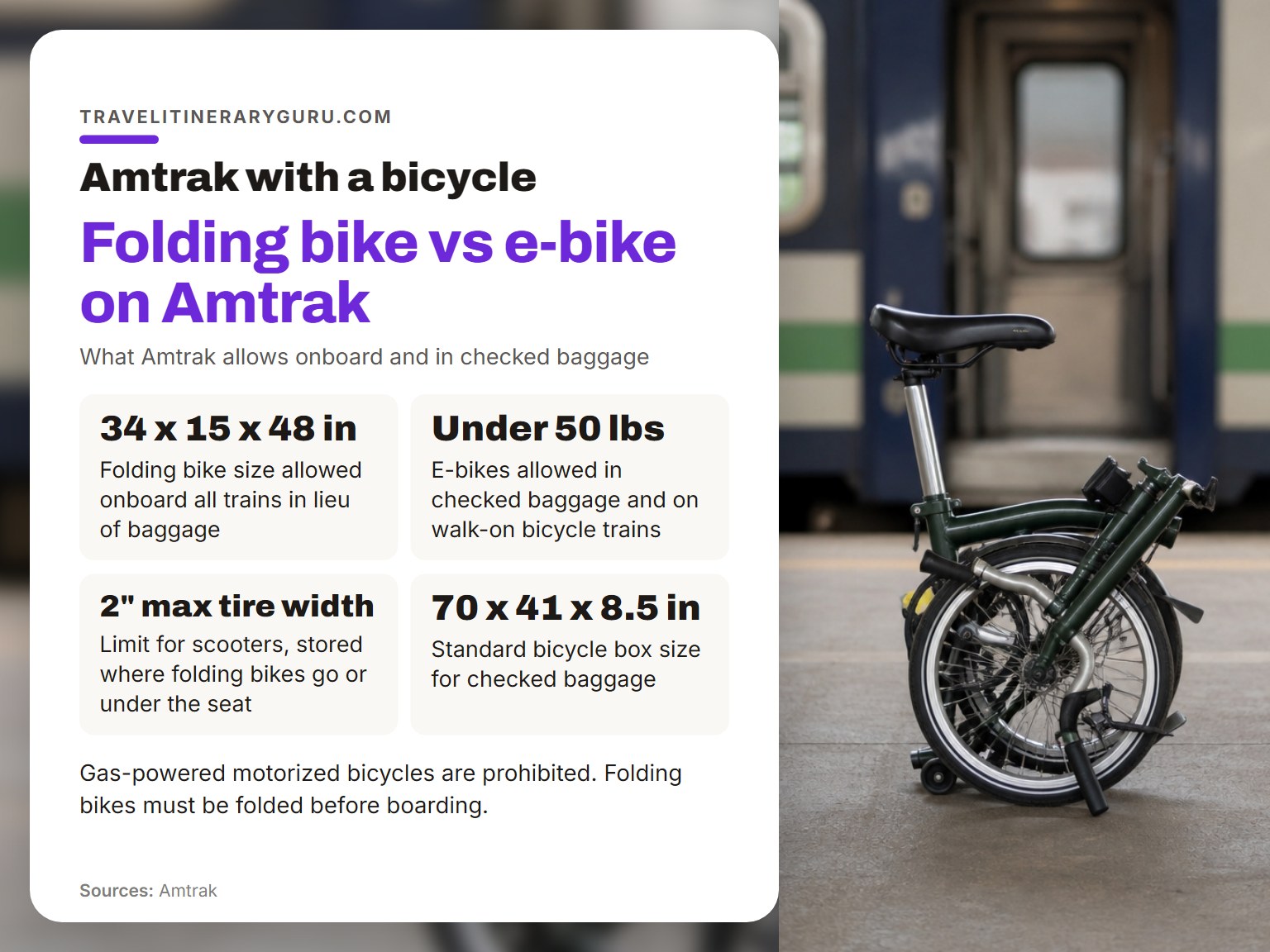
Folding bikes are the closest thing Amtrak has to a loophole, and the dimensions are generous.
Under 34 x 15 x 48 inches (860 x 380 x 1120 mm), a true folding bicycle rides in lieu of a piece of carry-on baggage on all trains. It has to be a genuine folding bike, and it has to be folded before you board.
Folding Bikes: The Carry-On Substitute
- Fold it before boarding. Amtrak requires the bike folded before you step on.
- Store it at the end of the car, or on the lower level in Superliners. Overhead racks are off limits.
- Expect the baggage car in tight luggage situations. Crew may check a folding bike if luggage space is unavailable.
E-Bikes and Scooters: Conditional Yes
E-bikes get a qualified yes. Electric bicycles under 50 lbs are allowed in checked baggage and on trains with walk-on bicycle service. Gas-powered motorized bicycles are prohibited, full stop.
Scooters follow the same 50 lb and 2-inch tire limits, and they store where folding bikes go or under the seat.
Easy to miss: A folding bike that’s over the 34 x 15 x 48 inch envelope isn’t a folding bike as far as Amtrak is concerned. It becomes a full-size bike, which means the rack, the reservation, and the 50 lb ceiling.
One more thing worth knowing: in some limited cases, a crew member will have you check your folding bicycle in the baggage car if luggage space is extremely limited or unavailable.
Packing for Amtrak gets simpler once you accept that the bike travels separately from your bags, and that everything strapped to the frame has to come off anyway.
Frequently Asked Questions
Can I bring a full-size bike on any Amtrak train?
No. Full-size bicycles ride only on certain trains with designated carry-on or trainside bicycle service, and that list is shorter than the system map. Check your specific train before you book, because bicycle availability depends on the route, the departure date, and existing bookings.
How much does it cost to bring a bike on Amtrak?
Bicycle fees vary by route and show up in the price summary when you book. The Downeaster applies a nominal bicycle fee on top of your fare. Checking a bike in a container counts in lieu of a piece of baggage, and boxes are sold at most staffed stations if you don’t bring your own.
Do I have to remove my front wheel?
It depends on the route. Amtrak’s national page requires front-wheel removal on short-distance routes in the Northeast, and the Downeaster’s FAQ states it as a blanket rule for that train. On the Vermonter, removing the front wheel and hanging the bike by the back wheel keeps it out of the corridor.
Can I bring an e-bike on Amtrak?
Electric bicycles under 50 lbs are allowed in checked baggage and on trains with walk-on bicycle service. Gas-powered motorized bicycles and gas-powered motorized scooters are prohibited. Non-folding scooters are only accepted on trains that offer checked baggage service.
I already bought my ticket. Can I add a bike?
Call 1-800-USA-RAIL to modify the reservation, and confirm first that your train offers bicycle service. Bike space isn’t guaranteed by your ticket, and on unreserved carry-on routes the rack is first-come, first-serve.
Can I leave my panniers on the bike?
No. All panniers, baskets, and bags attached to the bicycle must be removed and consolidated before boarding, on both carry-on and trainside checked service. Strip the bike at home rather than on the platform.
The Bottom Line
First step, this week: put your loaded bike on a scale and measure the tires with a ruler. Those two numbers settle half of this article before you open a booking page.
This all assumes a standard two-wheel bike under 50 lbs. If you ride a recumbent, a trike, or a cargo bike, the rack system isn’t built for you yet, and Amtrak says updates are coming. Until they arrive, the box is the only realistic path, and only if the bike fits inside 70 x 41 x 8.5 inches.
That’s the whole of how to travel by Amtrak with a bicycle in one line: match the service to the route, and match the bike to the service.
I’d rather see you book the trainside option and lose half an hour at the station than gamble on a first-come rack with a loaded touring bike. The rack doesn’t care how far you’ve come to get there.
