
How to Balance Sightseeing Time and Travel Time: 3 Rules
This post contains affiliate links. As an Amazon Associate, we earn from qualifying purchases.
To balance sightseeing time and travel time, give each day one primary anchor and one secondary stop, cluster everything by geography, and budget transit as real time. A 20-minute metro ride costs about double that once you add the walk, the wait, and the orienting. Most days that works out to two neighborhoods.
The arithmetic behind that is unforgiving. Every stop carries a fixed cost: the walk from the last one, the queue at the entrance, the look around, the walk back out. Rushing a visit trims the middle and leaves the fixed cost untouched. Knowing how to balance sightseeing time and travel time is what keeps the day from tipping toward the latter.
What follows: three rules for splitting a day, two tables of real time budgets drawn from the National Park Service and from published planning research, and the one question the research still hasn’t settled.
Key Takeaways
- One primary anchor and one secondary stop per day, according to the city planning guide. Three or four major anchors turn a day into a blur, and you’ll feel it by mid-afternoon.
- Budget a 20-minute ride as 40. Walking to the station, waiting, and reorienting on arrival double the real cost.
- Cluster by neighborhood, not by category. Places that sit close together make a comfortable half day; two clusters make a full one if the transfer is simple and you start early.
- Parking is a hard constraint at popular trailheads. Delicate Arch and Devils Garden lots can fill for hours, especially on weekends and holidays.
- Build a buffer day into the trip. It absorbs the missed train, the closed museum, and the morning you wake up wrecked.
Why Travel Time Eats More of Your Day Than You Budgeted
A metro map quotes 20 minutes. Your day pays for the walk, the wait, and the reorientation on top of it, and the real cost lands close to double.
Travel time between two stops includes more than the ride. Access walking, platform waiting, transfer time, and the orientation period after arrival all consume clock time. A published city planning guide notes that a 20-minute metro ride costs more than 20 minutes in practice, and that the real impact on a day doubles.
Adamo and colleagues built a tourist planner that moves people by car and on foot, and they handle the switch with two thresholds. If the walking time between two stops exceeds a maximum, the planner drives. If the driving time falls under a minimum, it walks. Otherwise it takes whichever mode is quicker.
That works in software. It works less well for a person, because it treats the transition itself as free.
Transit announces its cost in sound before it shows up anywhere you can measure. The chime, the doors, the shuffle of a full carriage, the announcement that this train terminates here.
The same logic applies to how you arrive. A red-eye flight can hand you an extra day on the ground, but only if you land able to function.
I once took the cheapest fare on the board and paid for it with a long layover in a small regional airport. The fare saved money. The day cost more than the money was worth, and now I compare total door-to-door time before I compare anything else.
The 3 Rules That Decide the Balance

Three rules do most of the work: one anchor per day, geography over category, and how to balance sightseeing time and travel time counted at full cost.
- One primary anchor, one secondary stop, according to the city planning guide. The primary is the thing you’d be annoyed to miss. The secondary gives the day shape without competing with it. Days with three or four major anchors become rushed, and you won’t notice until the second evening.
- Geography over category. Pin everything on a map before you schedule anything. A museum, a viewpoint, and a food street in the same district beat three museums spread across town, even if the three museums are better.
- Transit at full cost. Count the walk, the wait, the ride, and the reorientation. Add all four to the day before you decide what fits. Most itineraries fail here.
Rule two only works if you actually pin things. A mapping app is enough to start, but saving pins as layers puts the clusters on screen instead of in your head.
One neighborhood, one anchor, one backup. That structure survives a missed train, a closed museum, and a bad night’s sleep.
A step-by-step itinerary built on those three rules survives most of what a trip throws at it.
What a Realistic Stop Actually Costs in Minutes
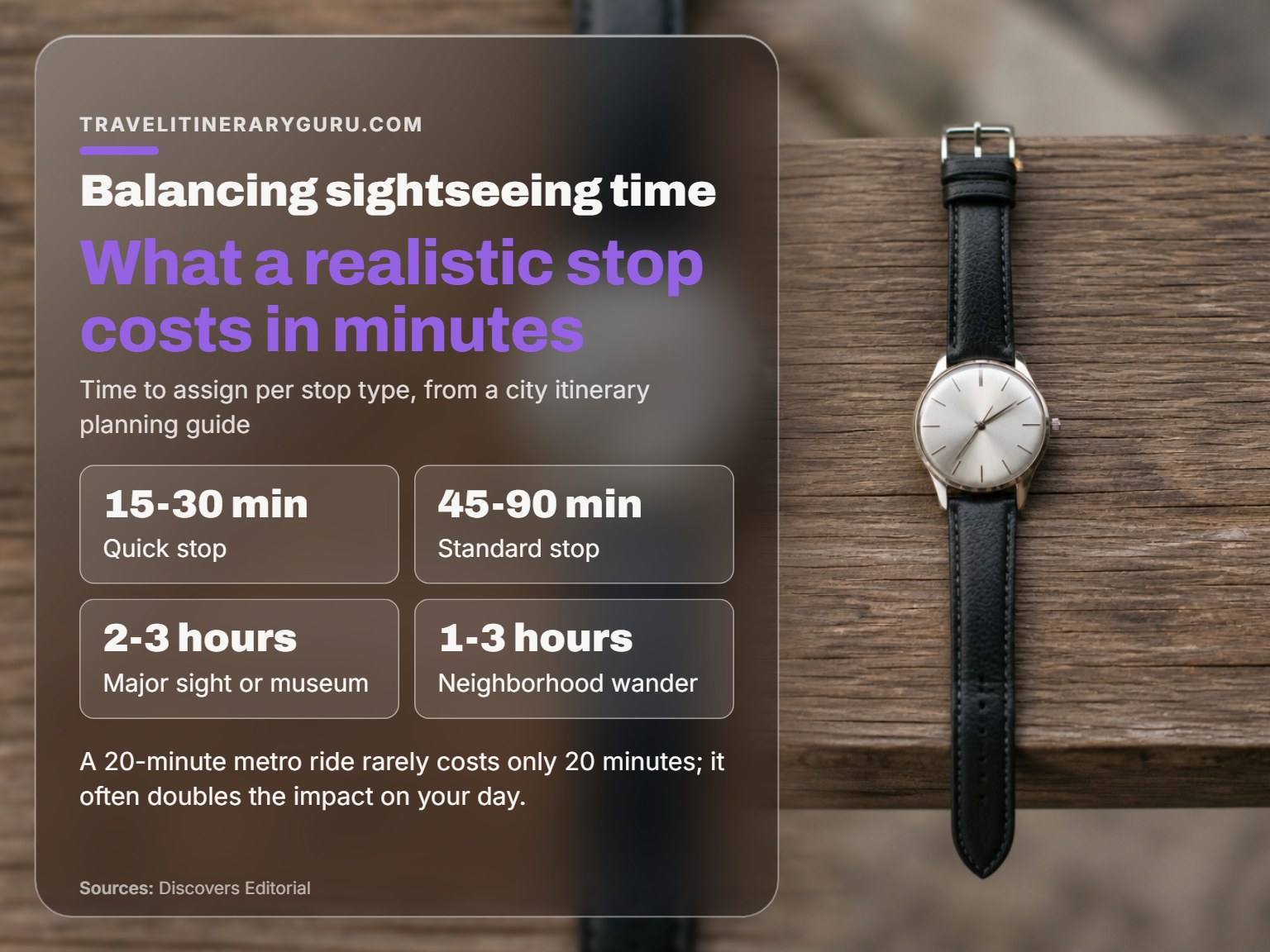
Stop durations are the easiest thing to estimate and the easiest thing to get wrong. Broad ranges beat false precision every time.
| Stop Type | Time to Assign |
|---|---|
| Quick stop | 15 to 30 minutes |
| Standard stop | 45 to 90 minutes |
| Major sight or museum | 2 to 3 hours |
| Neighborhood wander | 1 to 3 hours |
| Meal | 45 to 90 minutes |
Those ranges come from a published city itinerary planning guide, and the width is deliberate. A major sight that takes two hours for one traveler takes three for another, and the gap is mostly queue tolerance and reading speed.
Common mistake: Booking a timed museum entry and a cross-town lunch in the same block. The lunch runs long, the transit runs longer, and the entry slot closes while you’re still on the platform.
Stand at the side of a queue rather than the front of it. A line that looks short from the entrance doubles back behind a wall, and you only find out when you turn the corner.
Why the Number on the Page Is Always the Floor
Every stop has costs that sit outside the visit itself. Bag check, restroom, orientation, and the walk back to the exit all happen whether you enjoyed the place or not.
That’s why a major sight or museum is budgeted at 2 to 3 hours. The visit is two hours. The rest is overhead.
Cross-town hops are where the day leaks. If you’re driving between clusters, the same discipline that keeps a road trip route clean applies inside a city.
How Many Days Do You Actually Need? The Arches Test
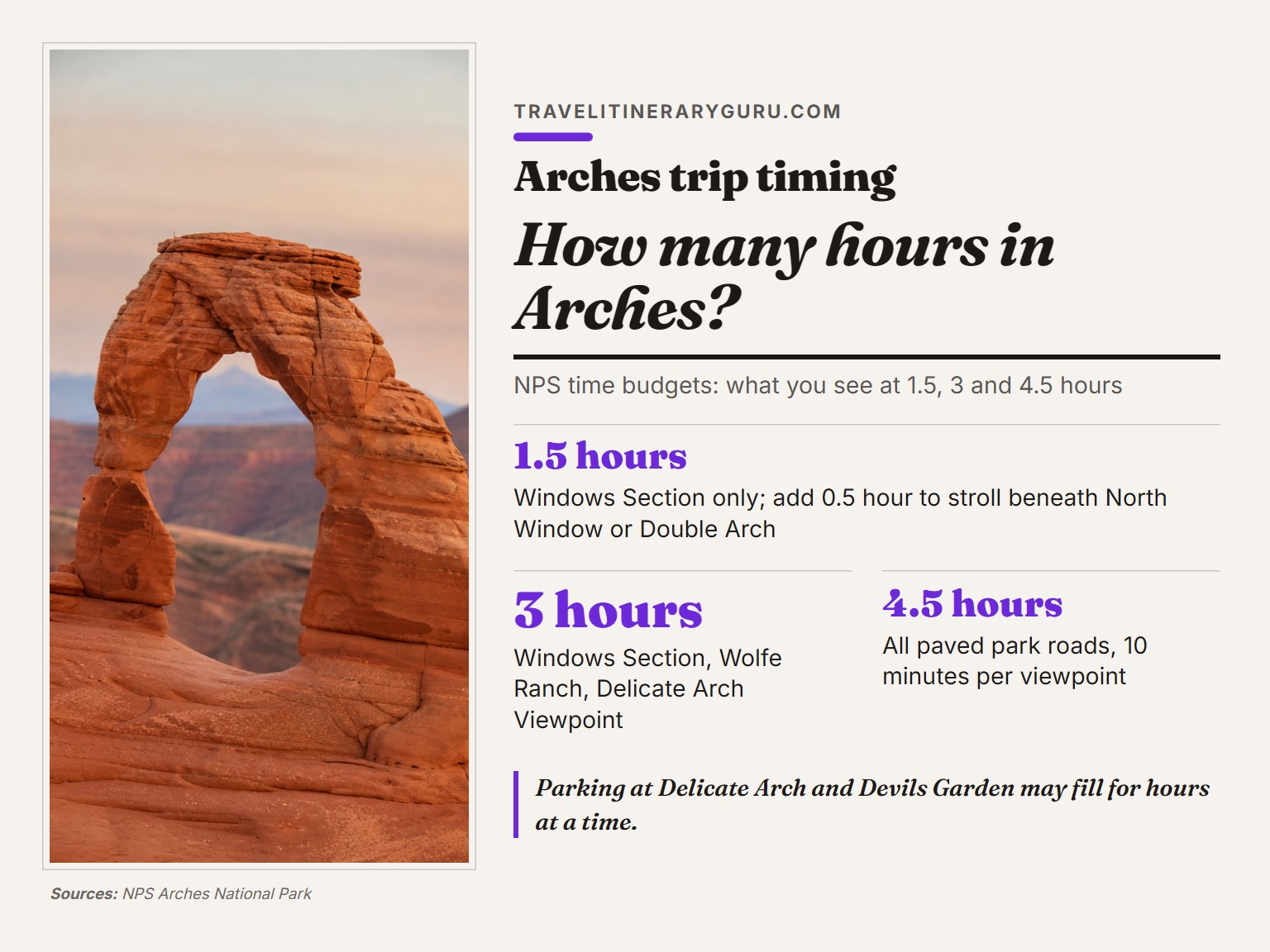
The National Park Service publishes time budgets for Arches in its Arches National Park auto touring guide, and they’re the cleanest real-world answer to how to balance sightseeing time and travel time.
| Time Budget | What You See | Who It Suits |
|---|---|---|
| 1.5 hours | Windows Section only | A drive-through stop |
| 3 hours | Windows Section, Wolfe Ranch, Delicate Arch Viewpoint | A half day with a firm exit |
| 4.5 hours | All paved park roads, 10 minutes per viewpoint | A full morning or afternoon |
Watch what changes between the budgets. The 1.5-hour version covers one area. The 3-hour version covers three named areas. The 4.5-hour version drives every paved road and spends 10 minutes at each viewpoint.
The Park Service also suggests adding half an hour if you want to stroll beneath North Window or Double Arch.
That half hour is the difference between seeing a rock and standing under it.
Here’s where the guidance splits. The city planning guide says each day should hold one primary anchor and one secondary anchor, and that three or four major anchors get rushed. The Park Service’s 3-hour Arches budget names three stops.
Both are right, and the reason is scope. Arches is one contiguous park with short drives between viewpoints, so three stops there is one anchor plus two satellites. Three stops across a city is three anchors, because each one costs you a separate transit leg.
Apply the same test to a city. How many days in Paris is the same question as how many hours in Arches, just at a different scale.
Where the Research Disagrees With Itself

Two research groups have spent years on this exact problem, and they don’t agree on how travel time should enter the math at all.
| Question | One Position | The Other |
|---|---|---|
| How to treat travel time | A tunable weight; lower values suit long tours, higher values suit short ones | A hard feasibility ceiling, with mode choice as a soft constraint |
| How many big stops per day | One primary plus one secondary; three or four gets rushed | A 3-hour park budget names three stops |
| What a 20-minute ride costs | Double, once you add walking and waiting | Fixed walk and drive thresholds, then whichever mode is quicker |
| Parking as a variable | Lots at Delicate Arch and Devils Garden fill for hours | Tracked only as “best time of day to visit” |
The BGA was evaluated using 13 different travel time weights, from 0 through 10 plus 15 and 20. The extremes performed badly. Their finding is that long tours favor lower travel time weights while short tours favor higher ones.
Adamo and colleagues take the opposite framing. Transport-mode preference is a soft constraint in their model, and travel time is a hard ceiling on the itinerary’s total duration.
The split runs deeper than weighting. One line of research uses a time-dependent satisfaction tour scheduling model with a node for every discrete time step. The other builds a multimodal tourist trip planner paper on a static graph with time windows instead.
What this means for you is simpler than it sounds. When two planning tools hand you different days from the same list of places, the disagreement above is the reason.
Neither one is broken.
How to Cluster Stops So the Day Flows
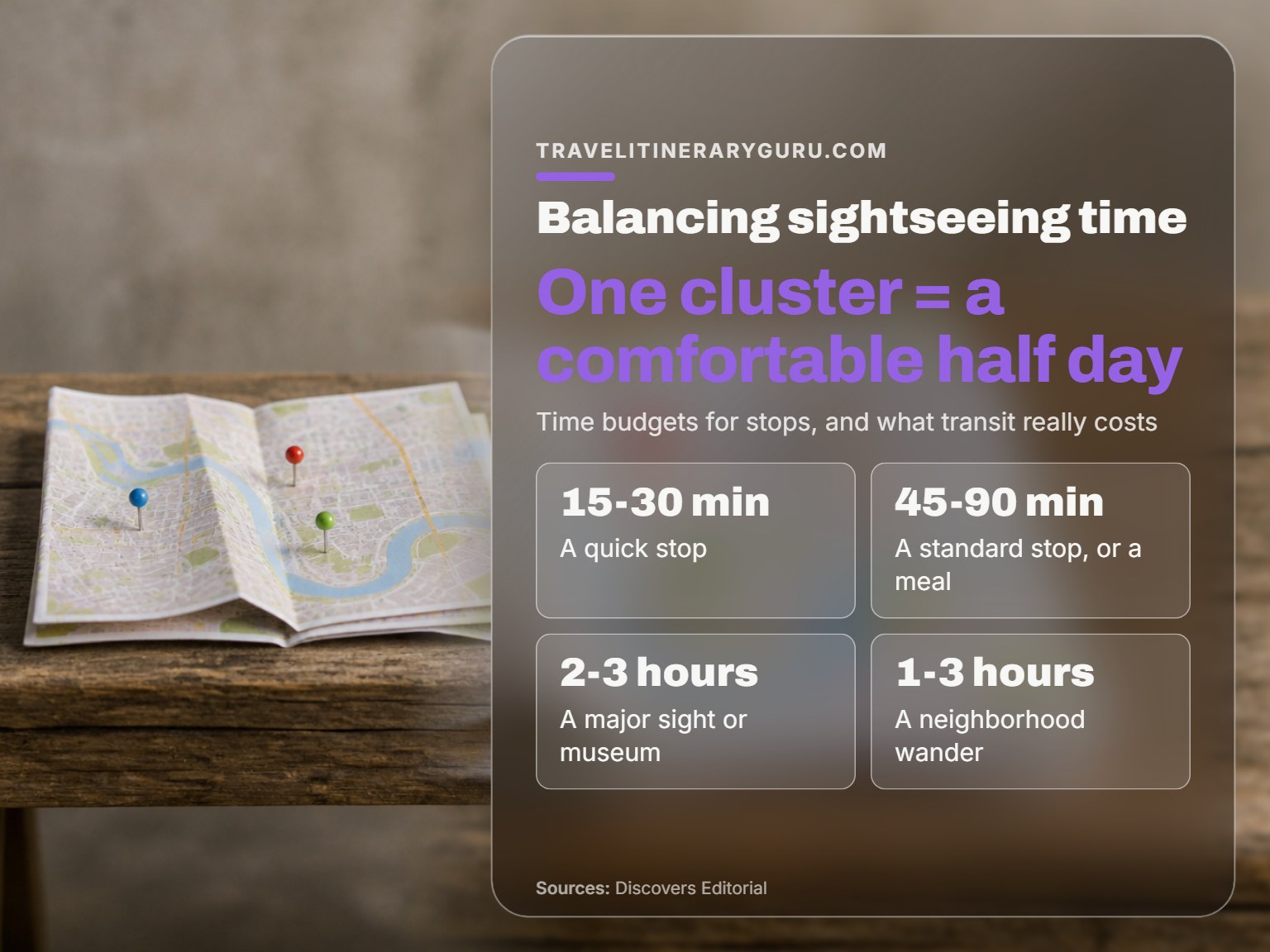
You’ve got four pins on a map and a free afternoon. Two of them sit a ten-minute walk apart. The other two are on opposite sides of the river.
Cluster by Geography, Not by Category
Pin everything first, then look for natural groups:
- Historic center highlights, walkable in one loop
- A museum district that shares a transit stop
- Waterfront or harbor areas, best handled in one block
- A food street or market, which pairs well with a late afternoon
- A residential neighborhood with slower character, good for a low-energy day
In many cities, one cluster makes a comfortable half day. Two clusters can fit into one day if the transfer is simple and your morning start is early.
When two clusters sit in different towns, compare a train against a bus against a drive before you commit to a base.
Label Each Day by Energy, Not Just by Content
High energy means long walking and multiple major sights. Moderate energy means one anchor plus local exploration. Low energy means a scenic area, a cafe, or a park.
That labeling is what stops you from stacking three high-energy days in a row and wondering why the fourth one feels like a chore.
I’ve run group trips where we split up after breakfast and met again for dinner. Everyone came back happier than on the days we stayed glued together, and free time on a group tour is now the first thing I schedule rather than the thing I leave over.
By late afternoon, the difference between a day that works and a grinding one sits in your feet. Cobblestone in a historic center feels fine at mid-morning and like a punishment by late afternoon.
I won’t put two high-energy days back to back, and I’ll rarely do it for myself. The second day always looks fine on paper and always costs you the third.
When Should You Revisit the Plan Before You Go?
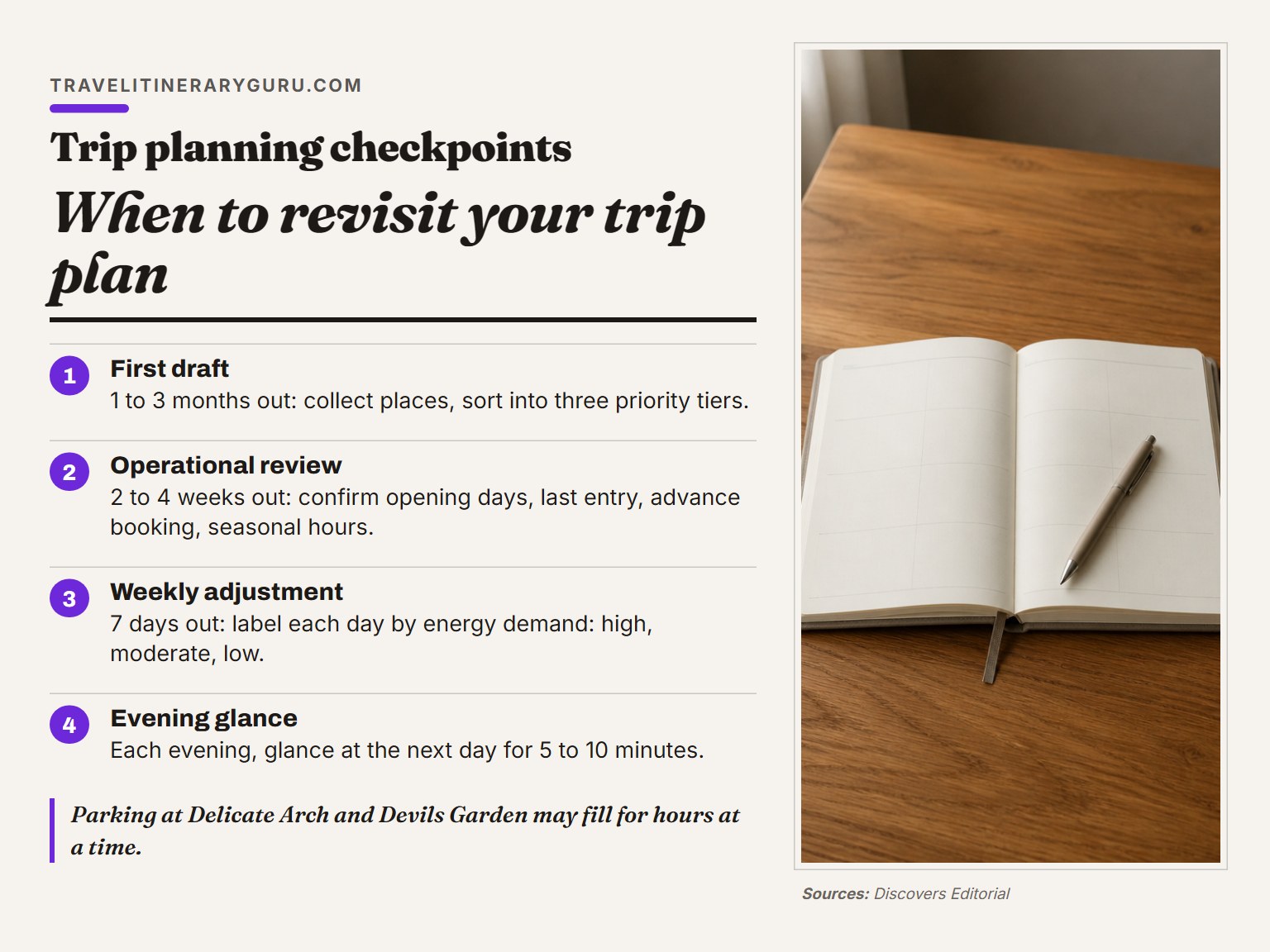
Three checkpoints do the work, and none of them takes more than an afternoon.
- First draft, one to three months out. Collect places, pin them, and sort them into must-see, strong optional, and backup. Don’t finalize times yet.
- Operational review, two to four weeks out. Confirm opening days, last entry times, timed tickets, and seasonal hours. This is where most plans quietly break.
- Weekly adjustment, seven days out. Test each day for realism. Ask whether it crosses the city more than twice, whether there’s a clear lunch plan, and whether you’d still enjoy it on a tired morning.
Then there’s the habit that does more than any of the three. Each evening, glance at the next day for five to ten minutes. Confirm the route order, the first departure time, and any booking requirement.
The part nobody mentions: Parking at Delicate Arch and Devils Garden can fill for hours at a time, especially on weekends and holidays. An itinerary that assumes arrival flexibility at those two lots has a hole in it.
A single planning page holds the whole plan, and a status column is what turns it into a tracker rather than a wish list.
If your trip includes a day trip by train, the same checkpoints apply, plus one more: verify the return service. A missed last train rewrites the whole next day.
The Buffer Day Is Not Wasted Time
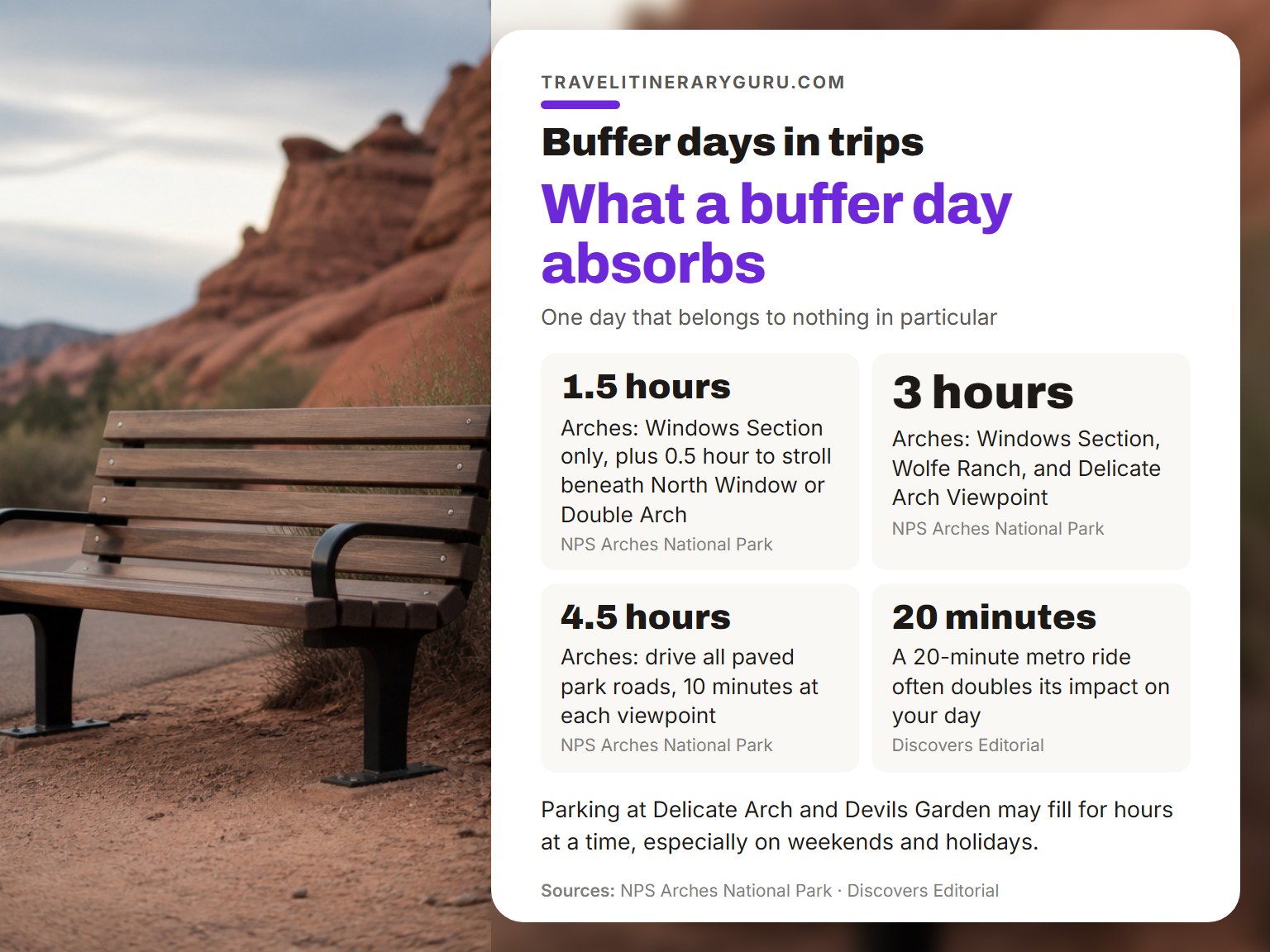
A buffer day is the highest-value day in the trip and the first one people cut. It’s the resting time in a recipe. Skip it and everything you cooked still tastes rushed.
What a buffer day actually absorbs:
- A missed connection, without cascading into the next three days
- A rainy morning that kills the outdoor cluster
- A museum closed for a reason nobody updated online
- The day you wake up exhausted and need to do almost nothing
- A local recommendation you’d never have found on a schedule
My own reflex when a plan collapses is to rebuild the plan, which is exactly the wrong move. The buffer day removes the decision.
That’s also the argument for slow travel over the packed version. Fewer bases, longer stays, and one day that belongs to nothing in particular.
If your trip spans more than one base, a multi-city trip needs its transit day treated as a transit day. Scheduling a travel morning and a sightseeing afternoon as one unit is the mistake I see most, and it produces the same result every time: you arrive somewhere beautiful and too tired to look at it.
Frequently Asked Questions
How much time should I leave between two attractions?
Leave the transit time plus slack on both ends. A standard stop needs room for the queue you didn’t expect and the exit you couldn’t find. Budget the walk and the wait as separate line items rather than folding them into the visit.
Is one big attraction per day really enough, according to the city planning guide?
For a city, the city planning guide says yes: one primary anchor plus one secondary stop is the structure that holds. The exception is a single contiguous site like a national park, where three named stops can sit inside one 3-hour budget because the drives between them are short.
Why does my itinerary always run late?
Because transit is the line item that gets rounded down. A 20-minute metro ride costs more than 20 minutes once you add walking to the station, waiting, and orienting on arrival. Several of those in a day is most of an afternoon.
Should I schedule a transit day and a sightseeing day together?
No. Arriving somewhere new and immediately sightseeing is the fastest way to waste both. Treat the travel day as the day’s work and let the evening be the reward.
How do I know if a day is overpacked?
Count the major anchors. The city planning guide says three or four major anchors in one day become rushed. If the day crosses the city repeatedly, it’s overpacked regardless of how few stops are on it.
The Bottom Line
Here’s the trigger I’d give you: if a day holds more than two major anchors, or crosses the city repeatedly, cut something before you leave home. You’ll never regret the stop you dropped. You’ll remember the one you sprinted through.
Fair warning. The first time you build a day around one anchor and one secondary stop, it will feel like you’re wasting the trip. Then you’ll get to dinner without checking your watch once.
If you’re traveling somewhere with major museums, popular viewpoints, or outdoor activities, revisit the plan weekly in the final month. If you’re building a reusable template for future city trips, revisit it quarterly instead. The cities change. The structure doesn’t have to.
And if you’re the kind of traveler who likes a plan with room in it, start with the buffer day. Build it first, then fill the days around it. Everything else gets easier once that day exists.
