
When to Visit Thailand for Dry Weather: Month by Month
This post contains affiliate links. As an Amazon Associate, we earn from qualifying purchases.
If your idea of dry weather is “anywhere in Thailand between November and February,” you are about to book a wet week. Knowing when to visit Thailand for dry weather means understanding that the dry season isn’t a national event. It’s a regional one, and the two coasts run on opposite clocks.
The rainy season starts in mid-May, when the southwest monsoon covers Thailand. That comes from the Thai government’s own seasonal guide, and it’s the same page that warns the onset can shift one to two weeks either way. So the season has a start date, roughly, and no fixed finish line.
What follows is the month-by-month version. Where the sources disagree, I’ll show you the disagreement instead of picking a side and hoping you don’t notice.
Key Takeaways
- The Gulf coast inverts the national rule. Koh Samui’s wettest month is November, at 444.6 mm on average, the same month Bangkok and Chiang Mai turn bone dry.
- November is the single best dry-weather month for most of the country. Bangkok drops from 289 mm in October to 45 mm, Chiang Mai to 41 mm, Udon Thani to just 14 mm.
- Samui’s real dry window is June to August, at 102–134 mm a month, which is when Phuket is getting soaked, though the Gulf coast begins drying from roughly January.
- Plan the Andaman side from November to February and the Gulf side from June to August, though note that when Phuket is wet, Samui is often fairly dry, and vice versa. Booking both coasts in the same month is the mistake I see most.
- Check the TMD forecast in the final week. The long-range outlook is built from climate models and statistical methods, and the department itself says to follow the daily forecast for accuracy.
Which Months Are Actually Dry in Thailand?
The honest answer is that November through February is dry for most of the country, but not all of it, and not evenly. The Thai Meteorological Department’s rainfall climatology puts national mean annual rainfall at about 1,572.5 mm, and that average hides a range up to more than 4,000 mm at the wettest stations.
The when to visit Thailand for dry weather question has two competing start dates in the official material: Thailand’s government portal puts winter at mid-October to mid-February, while the Visit Thailand monthly weather guide describes the cool, dry spell as running from about November to February. Thailand’s government portal puts winter at mid-October to mid-February. The Visit Thailand monthly weather guide describes the cool, dry spell as running from about November to February, and notes the wind doesn’t fully turn to the northeast monsoon until the second half of October.
That’s a two-week gap, and it matters if you’re booking for late October.
Thailand’s dry season begins when the northeast monsoon replaces the southwest monsoon, a transition the Thai Meteorological Department dates to the second half of October. The northeast wind is dry and cool over the north and centre, delivering the pleasant November-to-February window for Chiang Mai, Bangkok and the Andaman coast.
So the practical version: treat November 1 as the safe start for the mainland and the Andaman side according to the Visit Thailand guide, while the government portal’s mid-October start means the last two weeks of October are a coin flip. You might get the crisp morning air. You might get the tail of the monsoon. Nobody can tell you which until about ten days out.
Why Phuket and Samui Have Opposite Dry Seasons
This is the part that ruins itineraries, and it’s mechanical rather than mysterious. Thailand’s weather runs on two seasonal wind systems, and where each one dumps its moisture depends on which side of the peninsula the wind has crossed.
From mid-May, the southwest monsoon blows in off the Indian Ocean. It hits the Andaman coast hardest. Phuket, Krabi, Ranong, and leaves the Gulf side comparatively sheltered. Around the second half of October the wind reverses. The northeast monsoon is dry and cool as it crosses the north and centre, but it picks up moisture over the Gulf of Thailand and drops it on the east side of the southern peninsula: Koh Samui, Koh Phangan, Koh Tao, Surat Thani.
The result is a rule you can plan around. When Phuket is wet, Samui is often fairly dry, and the other way around.
Here’s what that looks like in numbers, using the 1991–2020 station averages published by the Thai Meteorological Department:
| Month | Phuket (Andaman) | Koh Samui (Gulf) | Which coast wins |
|---|---|---|---|
| June | 240–309 mm | 102–134 mm | Gulf |
| August | 240–309 mm | 102–134 mm | Gulf |
| November | 178 mm, still showery | 444.6 mm | Andaman |
| December | Drying fast | 330–380 mm forecast | Andaman |
| February | 24 mm, driest month | Drier than November–December | Andaman |
Read that table twice, because the November row is the one that catches people. Samui’s November average of 444.6 mm makes it the wettest month of that island’s entire year, and it lands in the exact month the rest of Thailand is celebrating the start of the dry season.
Common mistake: Booking a Gulf island for a November or December beach week because “it’s the dry season in Thailand.” Samui’s heaviest rain runs October to December. You’ll get a wet beach holiday and a dry one if you’d gone to Phuket instead.
If you’re weighing which coast deserves your days, the same logic applies to how long in Phuket you should budget versus a Gulf island, the answer changes depending on which month you’re travelling.
The Dry Season, Region by Region
No single month is dry everywhere, so build the when to visit Thailand for dry weather plan around the region you’re actually visiting rather than the country as a whole.
Bangkok’s wettest month is September, at 335.9 mm across 21.4 rain days. By November it collapses to 45 mm. That’s not a gradual taper; it’s a switch flipping, and it happens inside about six weeks.
The north peaks earlier. Chiang Mai’s wettest month is August at 223.3 mm, and Chiang Rai gets 372.9 mm in the same month. By November, Chiang Mai is down to 41 mm. Isaan follows the same curve. Udon Thani gets 299 mm in August and 14 mm in November.
The south splits in two, as covered above. The Andaman coast (Phuket, Krabi, Ranong) dries from November. The Gulf coast (Samui, Phangan, Tao) dries from roughly January, with its genuinely pleasant window running June to August, though November remains its wettest month.
I once planned a sunrise visit to a famous viewpoint for a client who wanted it crowd-free. We got there at 5:45am and saw fog. Not mist, not haze, fog you could chew. The crowd-free part was accurate. The view was not. Now I check the month’s rainfall pattern before I recommend a time of day, because a dry season doesn’t guarantee a clear morning.
That’s the difference between an itinerary and a lucky one. The dry season tells you when rain is unlikely. It doesn’t tell you what the sky will do at 6am.
If your trip falls outside the classic dry window, you’re not stuck; you’re in shoulder season, which trades a bit of rain risk for lower prices and thinner crowds.
What the Forecast Says for This Dry Season
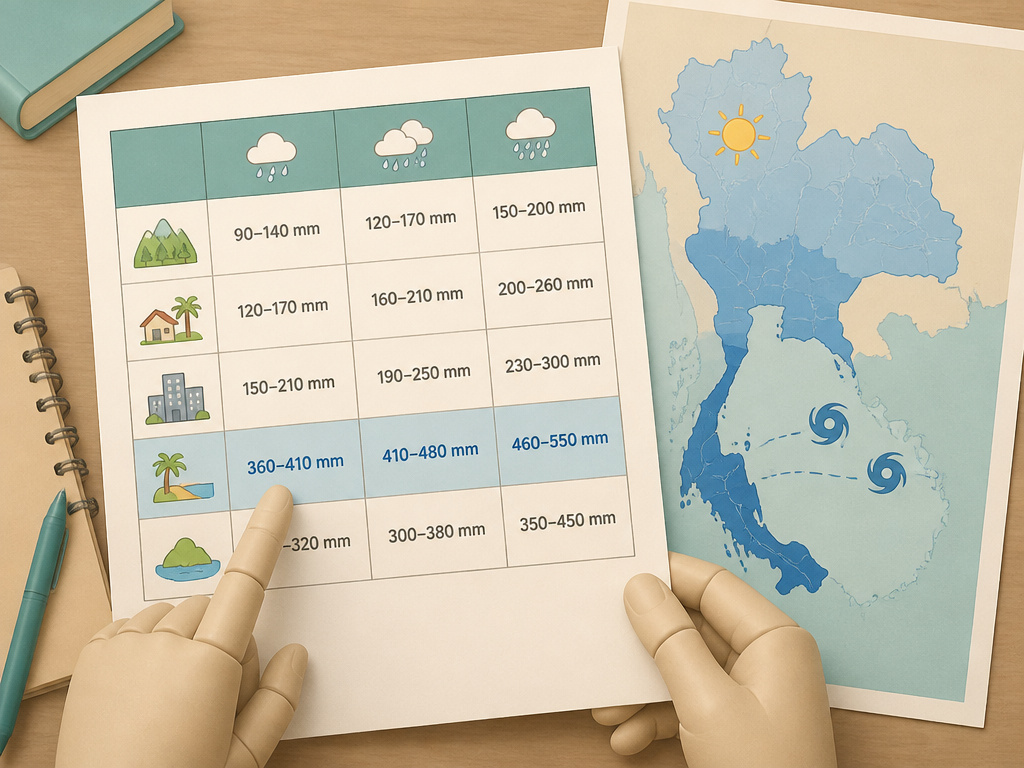
The Thai Meteorological Department issued its three-month climate prediction covering November 2026 through January 2027. Here’s how the dry-season window shapes up by region:
| Region | November 2026 | December 2026 | January 2027 |
|---|---|---|---|
| Northern | 20–40 mm, 2–4 days, near normal | 5–15 mm, 1–2 days, 20% below normal | 5–15 mm, 1–3 days, 30% above normal |
| Northeastern | 15–30 mm, 2–4 days, 10% above normal | Under 10 mm, 1–2 days, 60% below normal | Under 10 mm, 1–2 days, near normal |
| Central | 20–40 mm, 3–5 days, 30% above normal | Under 10 mm, 1–2 days, 60% below normal | Under 10 mm, 1–3 days, 20% above normal |
| Eastern | 40–70 mm, 5–7 days, 30% above normal | 5–15 mm, 1–2 days, near normal | 15–30 mm, 2–4 days, near normal |
| South (East Coast) | 360–410 mm, 15–18 days, 10% below normal | 330–380 mm, 11–13 days, 20% below normal | 130–180 mm, 7–9 days, 10% above normal |
| South (West Coast) | 190–240 mm, 15–18 days, 20% below normal | 90–140 mm, 9–11 days, 10% below normal | 50–80 mm, 5–7 days, 10% above normal |
| Bangkok and vicinity | 40–60 mm, 4–7 days, 30% above normal | 10–20 mm, 1–3 days, near normal | 15–30 mm, 2–4 days, 20% above normal |
Two things jump out. First, November is the wettest month of the entire forecast window for the Gulf coast, at 360–410 mm over 15–18 rain days. Second, the Gulf coast stays wet right through December before finally easing in January.
Where this goes sideways: Reading “10% below normal” for the Gulf coast in November and treating it as good news. Below normal for a month that averages 360–410 mm still means a lot of rain. Percentages are relative. Plan on the absolute number.
The forecast also flags a specific hazard. During November 2026, the department expects a high chance of tropical cyclones moving near Thailand or crossing the southern peninsula, which would push Gulf coast rainfall higher still. For December and January, westerly wind waves from Myanmar may cross upper Thailand, bringing thunder rain, gusty wind and possibly hail.
The department’s own caveat is worth repeating: this long-range product is built from climate models and statistical methods, and the public should follow the daily forecast for accuracy. Treat the three-month table as a planning shape, not a booking decision.
Is the Dry Season Actually Dry in the North?

Mostly, yes, but the north has two problems the rainfall table won’t show you.
The first is haze. From January onward, northern haze builds and degrades the very window that makes Chiang Mai and Chiang Rai worth visiting. Clear mountain views in December can turn into a grey soup by late January, and no rainfall figure captures that.
The second is that “dry” in the north doesn’t mean “warm.” December brings commonly chilly weather, specifically at the upper portion of the northern and northeastern parts. January is when most of Thailand meets the lowest reducing temperature in this month, with morning fog in the north and cool weather across the central and eastern regions.
If you’re packing for a northern dry-season trip, that’s a real packing problem. You need layers, not just shorts. And if you’re doing a multi-city route, a 7-day Thailand itinerary that runs Bangkok to Chiang Mai needs to account for the temperature drop between them.
I’m genuinely bad at packing for cold mornings in tropical countries. I’ve shown up in Chiang Mai in January with a single long-sleeve shirt and spent the first two mornings buying a jacket I didn’t want to carry for the rest of the trip. The temperature range across Thailand runs 18–38°C, and the low end is not theoretical.
How Many Days Should You Give Each Region?
This depends on how much of the country you’re trying to cover, and the honest answer is that most people try to cover too much. A dry-season trip that hits Bangkok, Chiang Mai and two islands in ten days is a trip spent in transit.
For Bangkok specifically, the how many days to spend in Bangkok question has a different answer in the dry season than in the wet, because you’re not losing half a day to rain delays and you can actually walk the city. Three full days is the floor for a first visit. Four is better.
For the islands, the month dictates the coast, and the coast dictates the plan. If you’re travelling November to February, the Andaman side is your answer, while the Gulf side’s window runs June to August; note that when Phuket is wet, Samui is often fairly dry, and vice versa.
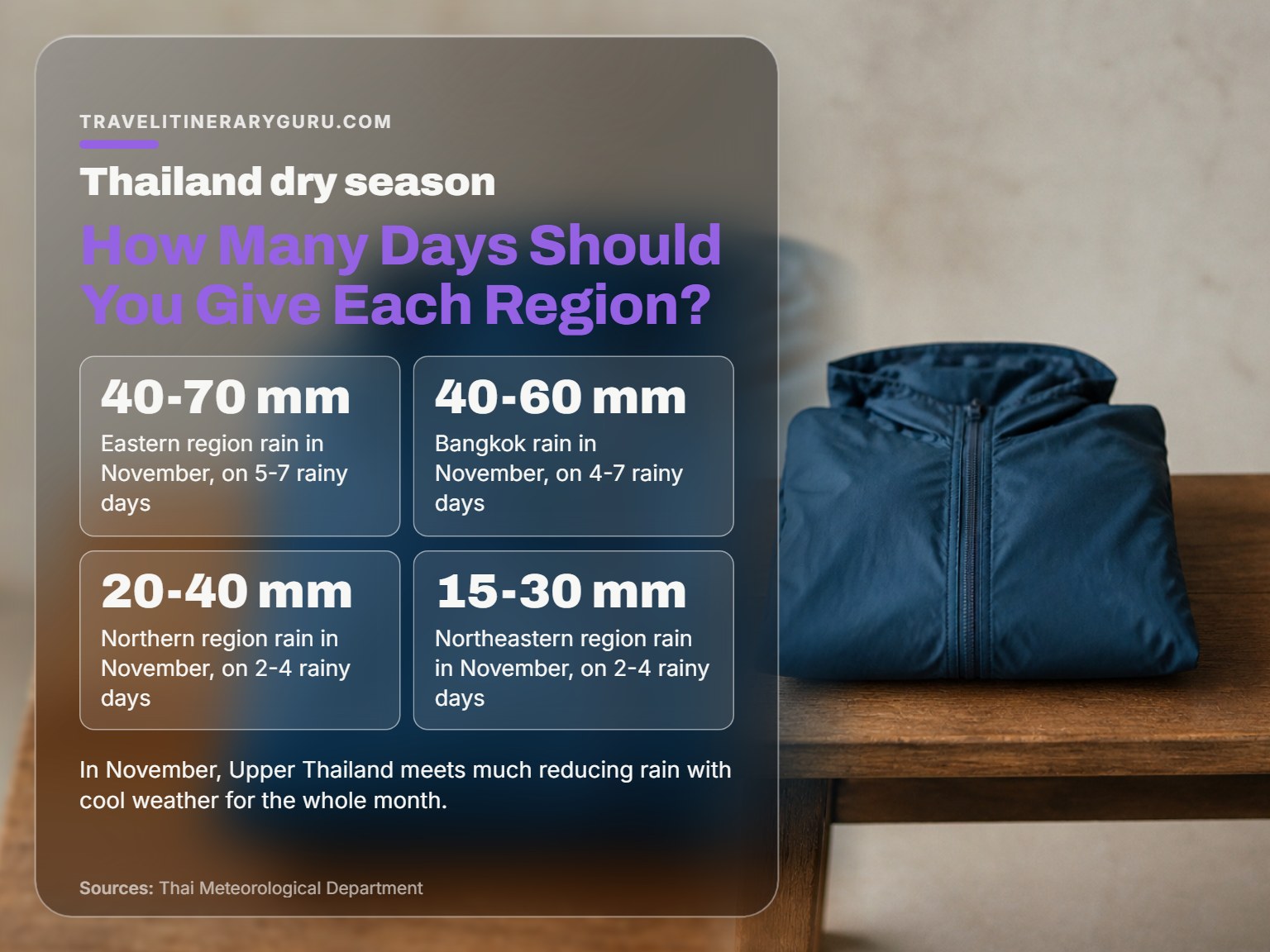
The part nobody mentions: A dry-season trip to Thailand still involves 40–70 mm of rain in the eastern region in November and 40–60 mm in Bangkok. Dry season means fewer rain days, not zero. Pack travel rain gear for the shoulder weeks and leave it at home for January.
What Else Changes in the Dry Season
Two things worth knowing before you book.
Box jellyfish. The Department of Marine and Coastal Resources has reported box jellyfish off Koh Samui, Koh Phangan and Koh Tao from July to October. That overlaps the Gulf’s dry-ish June-to-August window, which means the trade-off for a dry Gulf beach holiday in August is a jellyfish risk you should plan around.
Marine park access. The national marine parks off Phang Nga reopen in mid-October. If your Andaman trip is built around island-hopping, the reopening date is a hard constraint on the early part of the dry season.
If you’re picturing a cold-weather Christmas, the coldest you’ll get is chilly mornings in the northern mountains, which is a different thing entirely.
Frequently Asked Questions
What is the driest month to visit Thailand?
December and January are the driest months for most of the country. The northern and northeastern regions see under 10 mm in December 2026 per the Thai Meteorological Department forecast. For the Andaman coast, February is the driest month, with Phuket averaging just 24 mm.
Is November a good time to visit Thailand?
For most of the country, yes. Bangkok drops from 289 mm in October to 45 mm in November, Chiang Mai to 41 mm, and Udon Thani to 14 mm. But November is the wettest month of the year on Koh Samui, averaging 444.6 mm. If your trip includes a Gulf island, November is the wrong month for it.
Which part of Thailand is dry in December?
The northern, northeastern and central regions are all dry in December, with the central and northeastern areas forecast at 60% below normal rainfall. The Andaman coast is drying out fast. The Gulf coast is not. The east coast is forecast at 330–380 mm for the month.
How much rain does Thailand get in a year?
The Thai Meteorological Department puts national mean annual rainfall at about 1,572.5 mm. The World Bank’s Thailand climate country profile gives 1,542 mm, a 30.5 mm difference between two credible sources. Either way, the national figure hides enormous variation, up to more than 4,000 mm at Khlong Yai in Trat and in Ranong province.
Why is Koh Samui wet when the rest of Thailand is dry?
The northeast monsoon that brings dry, cool air to the north and centre picks up moisture as it crosses the Gulf of Thailand, then drops it on the east side of the southern peninsula. That’s why Samui, Phangan and Tao get their heaviest rain from October to December, exactly when Phuket and the Andaman coast are drying out.
Does the dry season start at the same time every year?
No. Thailand’s government portal puts the winter start at mid-October, while the Visit Thailand monthly guide describes the cool dry spell as running from about November to February. The rainy season onset can also shift one to two weeks earlier or later than expected. Book the first two weeks of October at your own risk.
The Bottom Line
One rule covers most of it: pick your coast by month, not your country by season.
If you’re travelling November through February, book the Andaman side. Phuket, Krabi, the Phang Nga marine parks. If you’re travelling June through August, book the Gulf side. If you’re travelling in October, wait two weeks before you commit to anything non-refundable.
Your first action this week: open the Thai Meteorological Department’s three-month outlook and find your region’s row. Read the absolute rainfall number, not the percentage. If the number is over 250 mm, that’s a properly wet month regardless of what the comparison column says.
The dry season in Thailand is real, but it’s a moving target that shifts by coast and by fortnight. Plan for the region you’re actually standing in, and the weather will mostly cooperate. Plan for the country as a whole, and you’ll spend a beach day watching rain hit the water from under a restaurant awning.
