
What Is Shoulder Season for Travel? When It Still Pays Off
This post contains affiliate links. As an Amazon Associate, we earn from qualifying purchases.
Shoulder season for travel is the stretch between a destination’s peak and off-peak periods, usually spring and fall. Crowds thin, rates drop, and availability opens up. The catch: advisors now report those discounts have compressed, and fall foliage destinations raise rates instead of lowering them.
That compression changes how you should use the what is shoulder season for travel term. If the discount has shrunk, the case for traveling in the gap rests on what money can’t buy back: shorter lines, easier reservations, and weather you can walk around in. The definition holds steady. The payoff is what’s moving.
What follows: the working definition, the months it covers region by region, the numbers behind those discounts, and the two places where shoulder season quietly breaks down.
Key Takeaways
- Two windows cover most of the world, though sources disagree: AFAR and Going.com describe two, spring (roughly March to April) and fall (September to October), with southern Europe stretching into November, while National Geographic counts three, adding January and February.
- The savings have compressed, according to some advisors. Ashley Taylor and Patrycja Kobak report that deals are less extreme because off-season demand is no longer low, while Going.com and National Geographic still list lower prices as a defining benefit.
- Fall foliage breaks the rule, according to the New Hampshire tourism office. September through November are textbook shoulder months, yet leaf-peeping demand pushes rates up instead of down, while Going.com and AFAR say shoulder season prices tend to be lower than high season.
- Weather can be a payoff. Rome and Barcelona average low 70s in October, and Orlando’s highs drop into the upper 70s by November, though sources disagree on whether shoulder season weather is reliably better.
- Check closures before you book. Some destinations shut restaurants and hotels entirely once the season ends, and campgrounds may have limited amenities such as no water, electricity, flush toilets, and trash removal.
What Is Shoulder Season for Travel, Exactly?
Shoulder season is the stretch of time between a destination’s high tourism season and its low one.
Shoulder season occupies the calendar gap between a destination’s peak tourism period and the quieter period on either side. The window varies by latitude, by hemisphere, and by what the destination is known for. Beach towns and national parks take spring and fall; ski resorts take the weeks after opening and after the natural snowpack thins.
The New Hampshire Division of Travel and Tourism Development describes it as the stretch between a destination’s high and low tourism seasons, usually fall, late winter, and early spring. AFAR frames the same idea around the Northern Hemisphere’s summer peak and winter trough. Weather.com keeps the loosest version: the time immediately before and after peak travel seasons.
The what is shoulder season for travel edges matter more than the label. AFAR excludes Labor Day and Memorial Day weekends, Thanksgiving week, and spring break from shoulder season entirely, because those behave like peak travel wearing a different name.
Here’s what falls outside the definition:
- Holiday weekends. Labor Day and Memorial Day weekends run at peak-season prices and crowds.
- Thanksgiving week and spring break. School calendars push both straight into peak territory.
- Fall foliage peak, which the New Hampshire tourism office treats as a high season of its own.
Common mistake: Treating shoulder season as a fixed set of dates. The window moves by hemisphere, latitude, and what the destination is famous for, so the same October week can be off-peak in Lisbon and peak in leaf-peeping country.
When Shoulder Season Falls, Region by Region
Three things set your window: hemisphere, latitude, and what the destination is famous for.
Going.com puts the rough window at March through April, with early May in some places, and September through October, with early November in some places. For Europe specifically, the question of when to visit Europe for fewer crowds comes down to those two windows, with southern Europe stretching into November because it stays warm later.
Asia runs a different rhythm, and sources disagree on the months. Going.com lists Japan’s shoulder season as March, late May through June, and September through mid-December, while weather.com notes Tokyo’s October highs drop into the 70s and November brings peak autumn color. China runs mid-March through April and September through October.
The rest of the region spreads out:
- South Korea: April through May, then September through October.
- Taiwan: late May through June.
- South Asia: June through November, a long window covering several distinct weather patterns.
- Central Asia: July through August, which suits mountain travel and very little else.
- Southeast Asia: March through May and November, so best time for Thailand depends on whether you want dry weather or thin crowds.
Africa splits by region too. Going.com puts East Africa and North Africa at October through November, Southern Africa at April and September through October, and West Africa at May and October.
The Asia numbers don’t fully agree across sources. Going.com’s Japan window opens in September, while weather.com notes Tokyo’s October highs drop into the 70s and November brings peak autumn color.
National Geographic’s best shoulder season travel places cluster around European capitals, US national parks, and Iceland.
Does Shoulder Season Still Save You Money?
The discount numbers are real. The advisors who book the trips say they’ve shrunk.
Start with what’s measurable.
Demand is moving the other way.
That’s the argument the trade is having right now.
| Factor | The classic promise | What advisors report now |
|---|---|---|
| Prices | Lower rates, driven by lower demand | Deals “not as extreme” as they once were |
| Crowds | Thinner, even at popular museums | Demand strong even in the off-season |
| Availability | More rooms and seats to choose from | Inventory tightening as off-season fills |
| Fall foliage | Shoulder months mean shoulder prices | Leaf demand pushes destination rates up |
The Fall Foliage Exception That Raises Rates
The New Hampshire tourism office is blunt about this one. September, October, and November are textbook shoulder-season months, but travelers on a mission to see fall foliage are unlikely to find lower prices. When the leaves draw a crowd, rates in the destination go up.
The Visit New Hampshire travel trends report carries that point alongside two advisors who say the broader discount has compressed.
Ashley Taylor of Key to the World Travel said shoulder season is still there but not as prevalent, and that the deals that used to exist aren’t as extreme because demand isn’t as low as it once was. Patrycja Kobak of It’s Worth Traveling went further: the boundary between high and shoulder season is disappearing, and strong off-season demand pushes prices up and inventory down.
Michael Schottey, a spokesperson for the American Society of Travel Advisors, told AFAR that all of its information points toward popular destinations and suppliers staying busy right through what used to be the slow time of year.
On the fare side, Going.com is built around flight-deal alerts, which suits a flexible traveler better than a fixed package does.
If the discount is your only reason for traveling in shoulder season, book a different season. Book the shoulder window for the shorter lines and the easier reservations, and treat any savings as a bonus.
Why the Ski Resort Calendar Runs Backwards
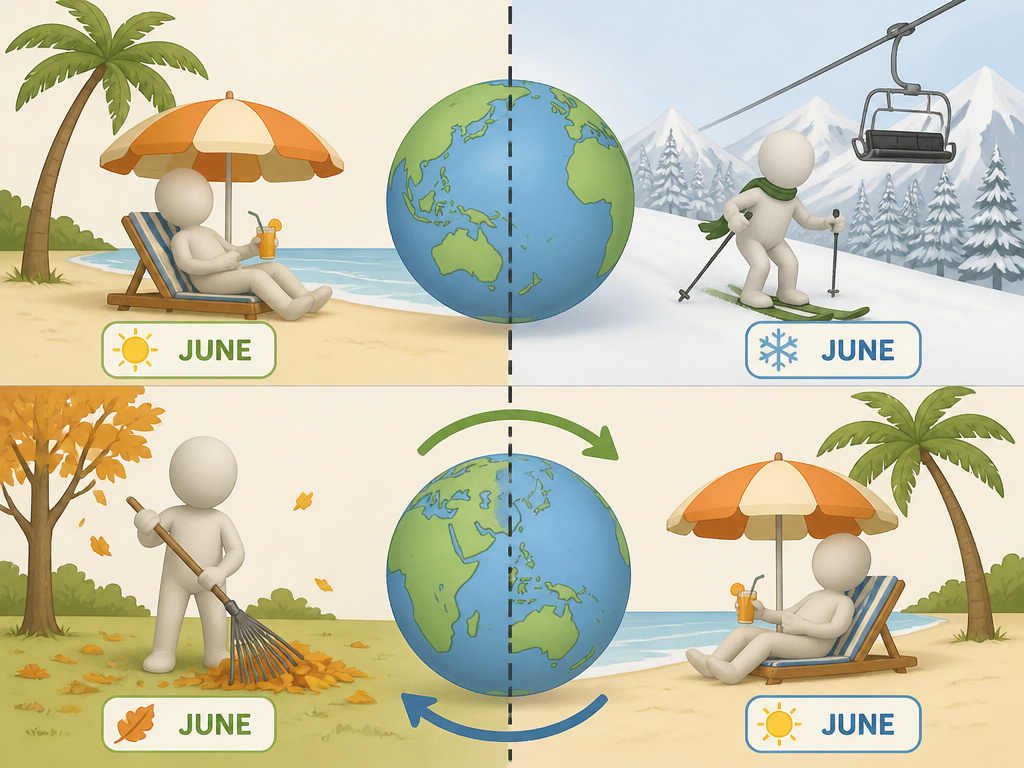
Weather.com draws that distinction directly, and it’s the cleanest illustration of why a single global definition fails. A beach town and a ski hill can sit in the same month and occupy opposite seasons.
The southern hemisphere adds a second wrinkle.
Easy to miss: The southern hemisphere keeps the same shoulder months but swaps the seasons. September is spring in Sydney and autumn in Rome, so one calendar can’t serve both.
Airlines use a third version.
What Does Shoulder Season Weather Actually Look Like?
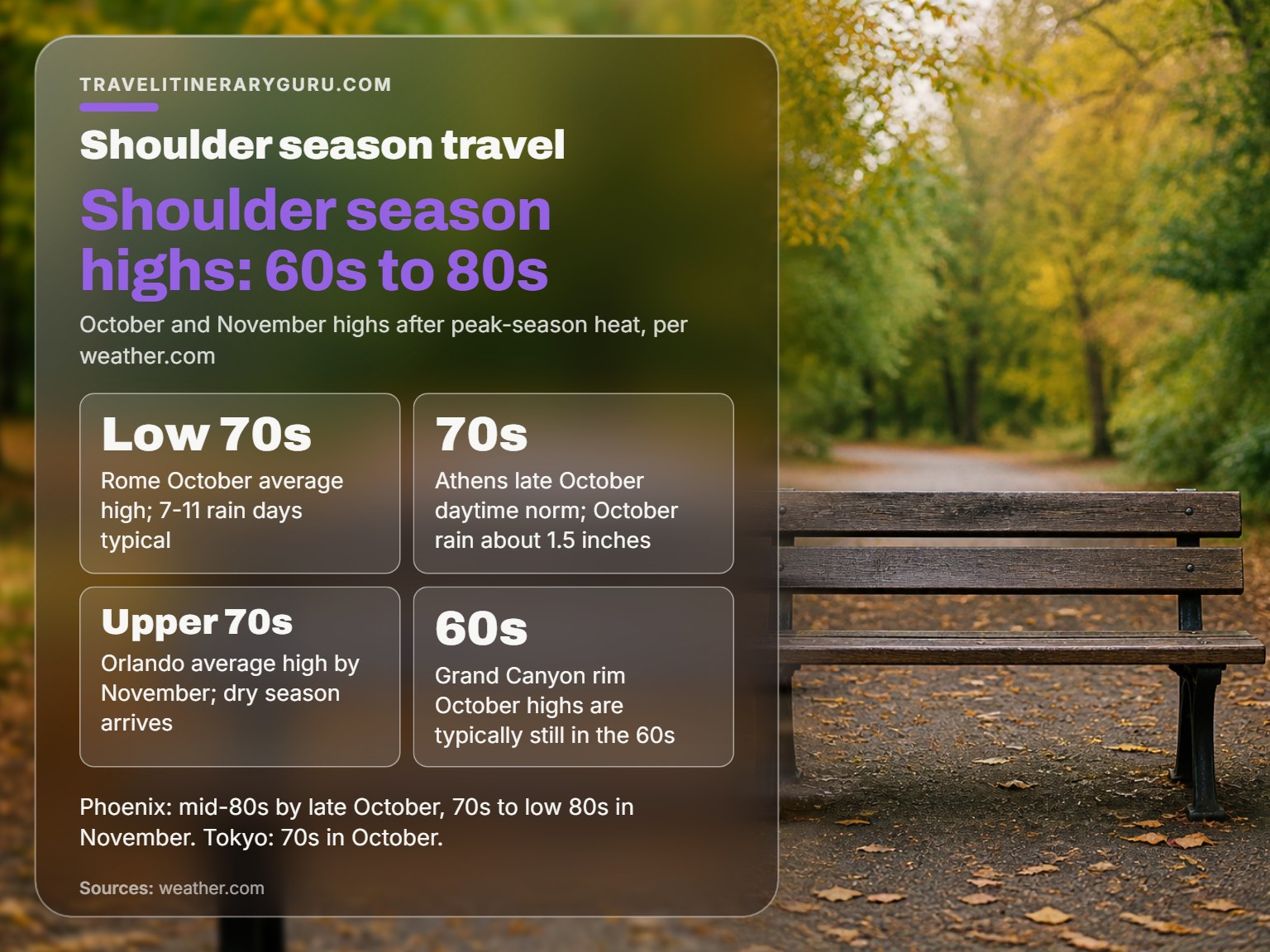
That’s World Meteorological Organization data cited by weather.com, and it’s the honest version of the shoulder-season weather pitch. You get comfortable temperatures and a real chance of rain, not a guarantee of either.
| Destination | Peak-season reality | Shoulder-season high |
|---|---|---|
| Rome | Brutally hot summers | Low 70s (October) |
| Athens | Upper 80s or 90s, June-August | 70s (late October) |
| Tokyo | Steamy summer months | 70s (October) |
| Orlando | Peak summer heat and humidity | Upper 70s (November) |
| Phoenix | Stifling heat and thunderstorms | Mid-80s (late October) |
| Grand Canyon rim | Summer heat | 60s (October) |
September on the Gulf Coast is a different calculation, which is the argument for planning around hurricane season instead of around a calendar label.
{{IMG: Recreation.gov campground availability calendar showing
Frequently Asked Questions
Does shoulder season fall on the same dates everywhere?
No. The window shifts with latitude, hemisphere, and what draws visitors to a place. A ski town and a beach town can sit in shoulder season during the same month for opposite reasons. Treat any published date range as a starting point, then confirm against the specific destination.
Why do some advisors say shoulder season deals are weaker now?
Because demand during those gap months has climbed. Travelers who once avoided spring and fall have shifted their trips there, so properties no longer need steep markdowns to fill rooms. The quiet is still real, but the price gap between peak and shoulder has narrowed in many markets.
Can shoulder season ever cost more than peak season?
Yes, in a few niche cases. Destinations built around a single seasonal event, such as leaf-peeping regions in autumn, can see rates climb rather than fall. In those places the calendar says shoulder, but the pricing behaves like peak. Always compare actual quotes instead of assuming a discount.
What should I verify before booking a shoulder season trip?
Confirm that the businesses you want are still open. Some restaurants, hotels, and campgrounds close entirely once peak ends, and limited-service campgrounds may cut water, power, and trash pickup. Check hours, shuttle schedules, and amenity lists directly with each operator before you commit.
