
US National Park Entrance Fees Explained: Who Pays What
This post contains affiliate links. As an Amazon Associate, we earn from qualifying purchases.
US national park entrance fees explained: a standard pass costs $20.00 to $35.00 per vehicle and covers seven days at most parks, while non-US residents age 16 and over pay an extra $100 at 11 named parks. At least 80 percent of that money stays in the park that collected it.
That $100 line is where trip budgets break. A family of four from outside the US, arriving at Yellowstone in a rental car, owes the standard vehicle fee plus $100 for every person aged 16 and over, which is the US national park entrance fees explained problem in one sentence. A $250 pass covers it, and plenty of visitors never hear about it.
What follows: the gap between a private-vehicle pass and a per-person pass, the two passes that genuinely save money, the seasonal rates that catch people off guard, and the parks where cash gets you turned around at the gate.
Key Takeaways
- A standard pass covers seven days and every passenger in one vehicle at most fee-charging parks.
- Non-US residents aged 16 and over pay an extra $100 per person at 11 named parks, on top of the standard fee.
- The $250 Non-Resident Annual Pass admits the holder plus everyone in the vehicle, which beats per-person fees for a group of three or more.
- Free entrance days are for US citizens and permanent residents only, and aggregator blogs keep getting this wrong.
- Yosemite and Grand Canyon take no cash at all, and Theodore Roosevelt went fully cashless on May 1, 2026.
What a Standard Entrance Pass Actually Buys You
Seven days of entry, one vehicle, everyone inside it. That’s the standard deal at most fee-charging parks, and the official wording is tighter than the summary you’ll find on most blogs.
A standard entrance pass is priced by entry method. Parks listing both a Private Vehicle and a Per Person rate charge the vehicle rate to one non-commercial vehicle and all occupants. The Per Person rate applies to visitors arriving on foot or by bicycle. Vehicle and motorcycle passengers need no separate pass.
The official National Park Service fee list scopes “Per Person” one way: it applies when you enter on a bicycle or on foot. Glacier’s park page adds a third case, covering individuals traveling together in a vehicle as a non-commercial, organized group. Read the park page if you’re arriving as a group.
What the pass doesn’t cover matters just as much:
- Camping and overnight stays, which every park prices separately
- Guided tours and concession-run activities
- Timed-entry or tour reservation fees at the parks that use them
Camping sits outside the entrance fee entirely, and national park campgrounds run on their own booking calendar. A standard pass is also built for the national park day trip that stretches into a week.
The $100 Nonresident Fee and the 11 Parks That Charge It
$100 per person, age 16 and over, on top of the standard entrance fee. That’s the number non-US visitors miss, and it applies at 11 named parks:
- Acadia National Park
- Bryce Canyon National Park
- Everglades National Park
- Glacier National Park
- Grand Canyon National Park
- Grand Teton National Park
- Rocky Mountain National Park
- Sequoia & Kings Canyon National Parks, which share one fee schedule
- Yellowstone National Park
- Yosemite National Park
- Zion National Park
For a family national park trip, this is the line that decides the pass question. Four people aged 16 and over in one car owe $400 in nonresident fees before the standard vehicle fee even lands.
No points strategy makes that fee disappear. It’s a cash cost, and it belongs in the budget from day one.
Where this goes sideways: Booking a guided tour as a nonresident and assuming the operator’s price covers park entry. The $100 fee applies to commercial tour, commercial use authorization, and concessionaire tour groups too, unless the group holds the Non-Resident Annual Pass.
What the Non-Resident Annual Pass Covers
The $250 America the Beautiful Non-Resident Annual Pass covers the entrance fee and any nonresident fees. Coverage runs three ways: the holder plus passengers in a private vehicle of up to 15 passengers, the holder plus passengers on two motorcycles, or at per-person fee sites, the holder plus three more people aged 16 and over.
That coverage is the reason the pass exists at all. Three nonresident adults in one vehicle owe $300 in nonresident fees plus the standard entrance fee, which clears $250 before you’ve parked.
The NPS entrance pass options page lists the full set of tiers, including the free and discounted passes for military, access, and fourth-grade families.
Which Pass Actually Saves You Money?
Three parks in a year is the usual break-even point for the $80 America the Beautiful annual pass, and that figure comes from ParkExpert’s national park entry fee breakdown rather than from the Park Service.
| Pass | Cost | Best For | Watch Out For |
|---|---|---|---|
| America the Beautiful Annual, resident | $80.00 | Three or more parks in 12 months | Valid 12 months from purchase, not the calendar year |
| America the Beautiful Non-Resident Annual | $250.00 | Non-US residents at a $100-fee park | Only pays off above $250 in nonresident fees |
| Senior Annual, age 62 and over | $20.00 | US citizens and permanent residents 62+ | Requires proof of age and residency |
| Senior Lifetime, age 62 and over | $80.00 | Repeat visitors 62+ | Same documentation requirement |
| Park-specific annual pass | $70.00 | One park, many visits | Valid at that park only |
Resident Annual vs Non-Resident Annual
For a US citizen or permanent resident, the $80 pass wins and there’s no argument to have. For a visitor from outside the US, the $250 Non-Resident Annual Pass wins the moment three or more people aged 16 and over ride in the same vehicle, because that’s $300 in nonresident fees alone.
Two adults in one car is the other case. Two nonresident fees plus the standard vehicle fee lands under $250, so the standard pass is the cheaper call.
Here’s how to settle it in four steps:
- Count the parks you’ll actually enter, not the ones on your wish list. Overcounting pushes you into a pass you won’t use.
- Count the nonresident adults aged 16 and over in your vehicle. Miss one and the per-person math is off by $100.
- Add the standard vehicle fee to the nonresident fees and compare that total against $250. Skip this and families buy a pass they didn’t need.
- Check whether your main park sells its own annual pass for $70. Buying the wrong annual version leaves you paying twice.
Choosing a pass works like building a soup base. The base is the parks you’ll actually enter, and everything else is seasoning. Most people over-salt by counting parks they’ll never reach.
Skip this if: You’re visiting one park for one week. A standard pass covers seven days, and an annual pass only pays off across multiple parks or multiple trips.
Entrance fees are the cheapest line in a park budget and the one people agonize over longest. They also land inside a broader US trip budget alongside flights and lodging, which is where the real money sits.
Why the Same Park Costs Different Amounts in Different Months
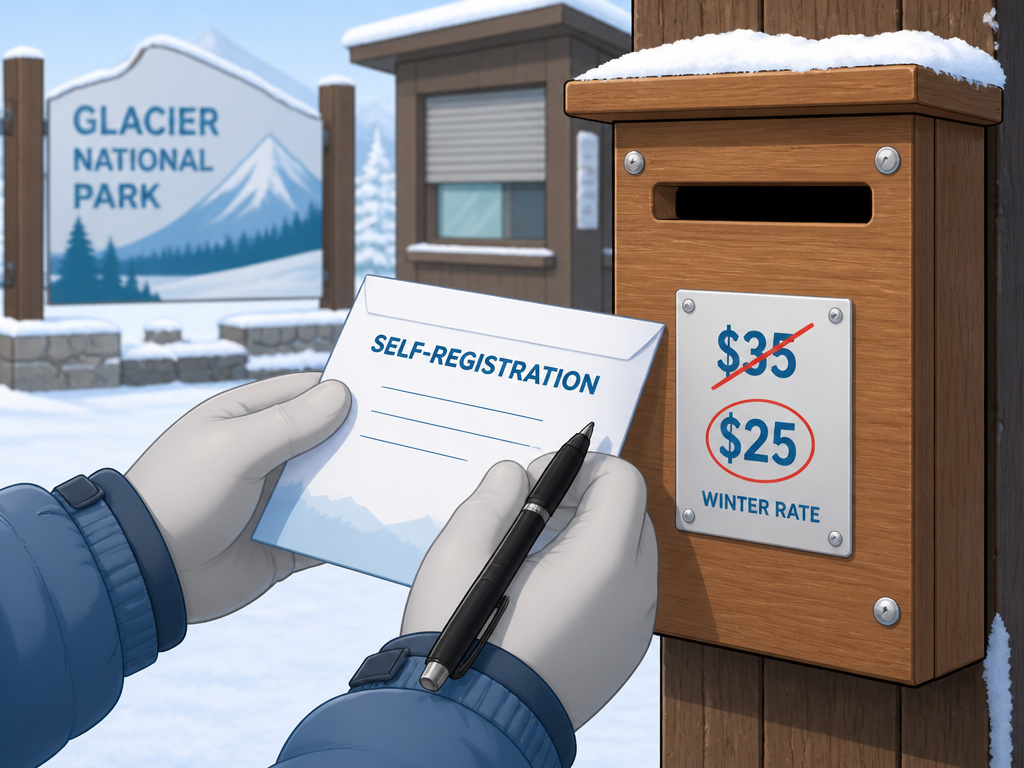
Glacier National Park drops its private-vehicle fee from $35.00 to $25.00 on November 1 and holds it there through April 30. The per-person rate moves in the same window, from $20.00 down to $15.00.
Glacier is the clearest case, but the pattern shows up elsewhere. Theodore Roosevelt National Park publishes a standard pass range of $15.00 to $30.00, which sits below the $20.00 to $35.00 range the big western parks use. That gap is real and park-level, not a rounding difference.
Rocky Mountain National Park sells a 1-day option alongside the 7-day pass at a lower rate. If you’re driving through on the way somewhere else, the shorter window is the better buy. Parks like Arches National Park sit outside the nonresident fee list entirely, which changes the math on a Utah loop.
I plan around shoulder seasons for exactly this reason. The rate drops, the entrance queue thins out, and the road I came for is still open. The trade is that services shut down, and I check that before I book anything.
In February the Glacier entrance station is often unstaffed, and the self-registration box bolted to the post holds a stack of paper envelopes you fill in by hand. That’s the winter rate in practice.
Seasonal pricing tracks demand and staffing. An unstaffed entrance can’t process a card, which is why self-registration exists and why the winter number is lower.
Can You Pay Cash at the Entrance Station?
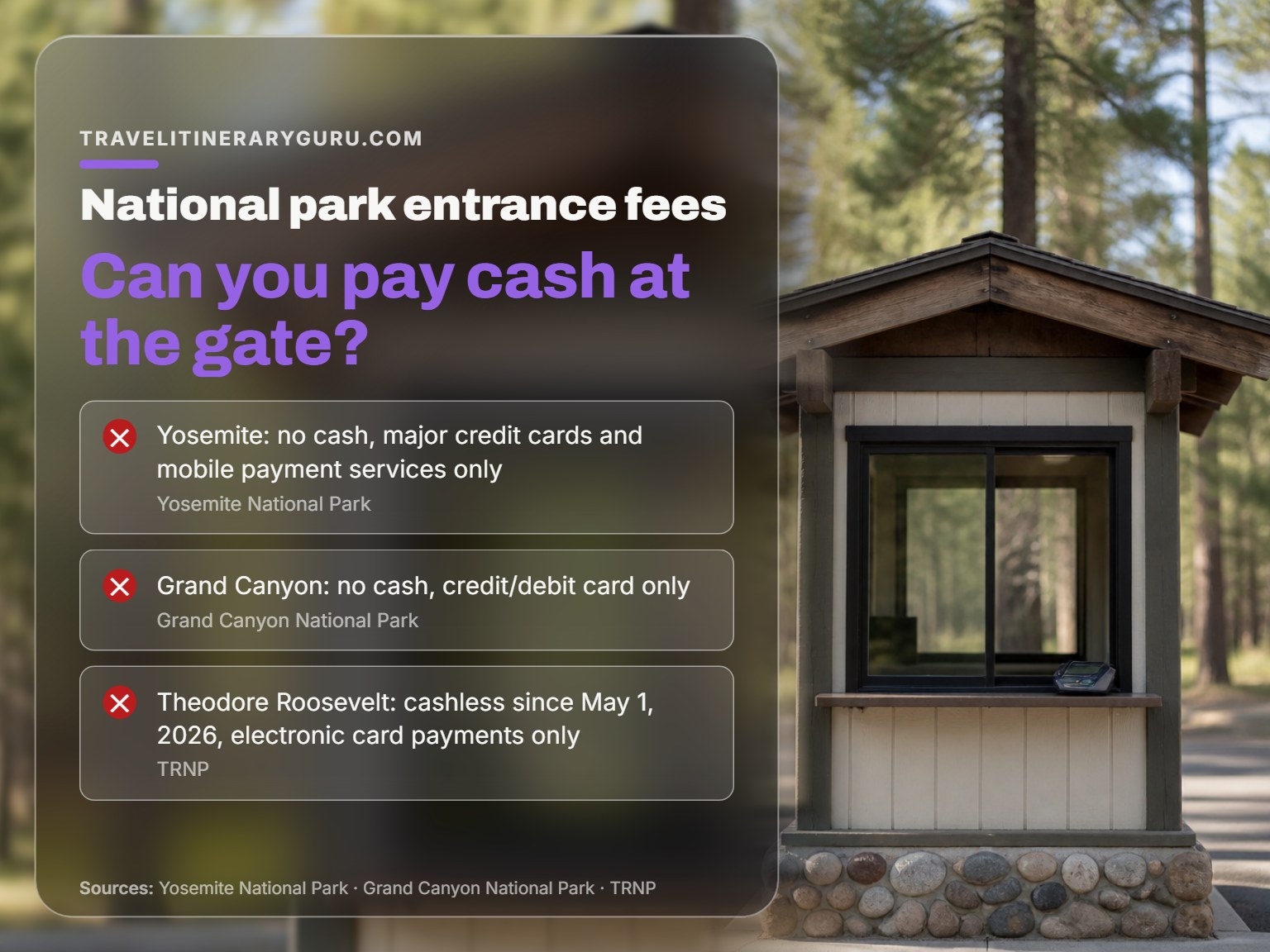
At Yosemite and Grand Canyon, no. Both take credit and debit cards only, and Theodore Roosevelt National Park went fully cashless on May 1, 2026.
| Park | Cash Accepted? | If You Only Have Cash |
|---|---|---|
| Yosemite | No, card and mobile payment only | Turned around at the gate |
| Grand Canyon | No, credit or debit only | Turned around at the gate |
| Theodore Roosevelt | No, cashless since May 1, 2026 | Pay online at Recreation.gov or at a visitor center |
| Zion | Card preferred, cash accepted | Slower line, but you get through |
| Yellowstone | Yes, cash or credit/debit | No issue at any entrance station |
The Yosemite entrance fee breakdown and the Grand Canyon entrance fee details both state the card-only rule plainly, and neither park can make an exception at the booth.
At a card-only entrance the transaction is fast. The reader chirps, the barrier lifts, and the car ahead is already rolling. That speed is the point, and it’s also why a cash-only visitor holds up the line while a ranger explains the policy.
Common mistake: Showing up at Yosemite with a wallet full of cash. The park accepts major credit cards and mobile payment services only, and there’s no workaround at the entrance station.
An RV rental changes the payment question in a different way, because the private-vehicle rate stops at a seating capacity of 15.
Free Entrance Days Come With a Catch
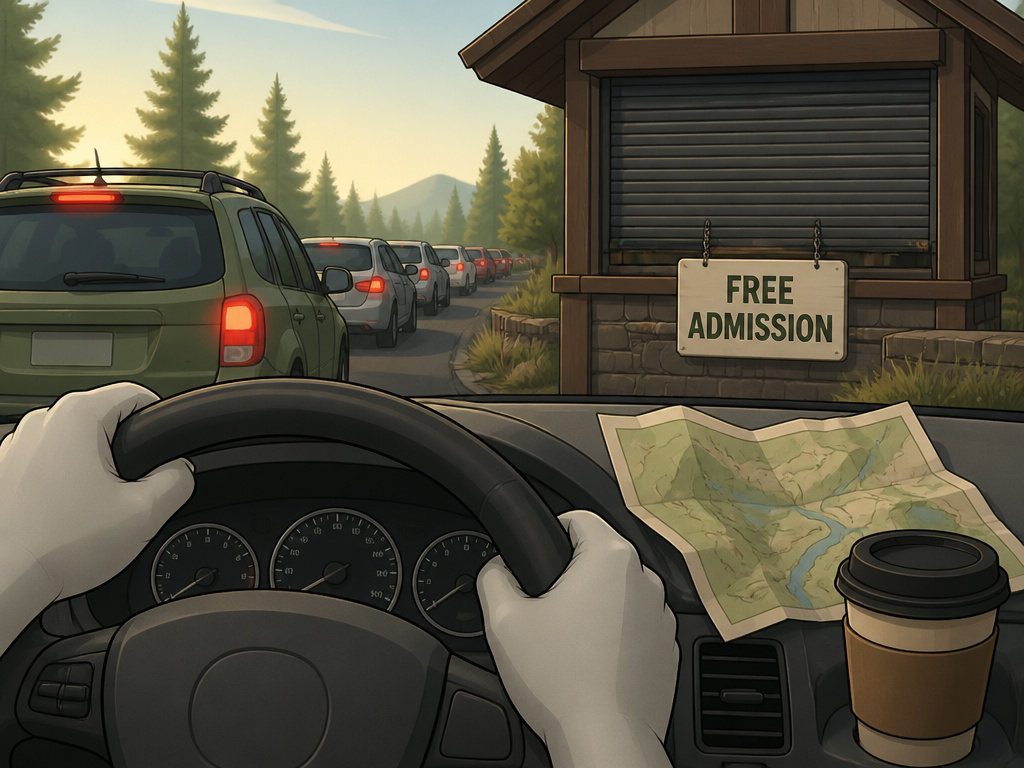
You pull up on Presidents Day, the booth is dark, the sign says free admission, and two hundred cars are already ahead of you. That’s what a fee-free day looks like from the driver’s seat.
Free entrance days apply only to US citizens and permanent residents. The National Park Service states this directly, and nonresidents must pay entrance and any nonresident fees unless they hold the Non-Resident Annual Pass.
Aggregator lists treat free days as open to everyone. They’re repeating an assumption rather than the rule.
If a park charges nothing to enter, it still charges for something. Free entrance days waive the gate fee and nothing else, and reservation fees still apply.
I once forgot to check a national holiday and showed up to find the museums shuttered and the streets jammed with domestic tourists. The lesson stuck, and a holiday check now goes into every itinerary before anything else gets booked. Fee-free days land on federal holidays, so the free day is also the busiest day of the month.
A self-guided tour puts you in charge of that arrival time, which is the one lever you actually control.
What Happens If You Lose Your Pass or Cross Into a Second Park
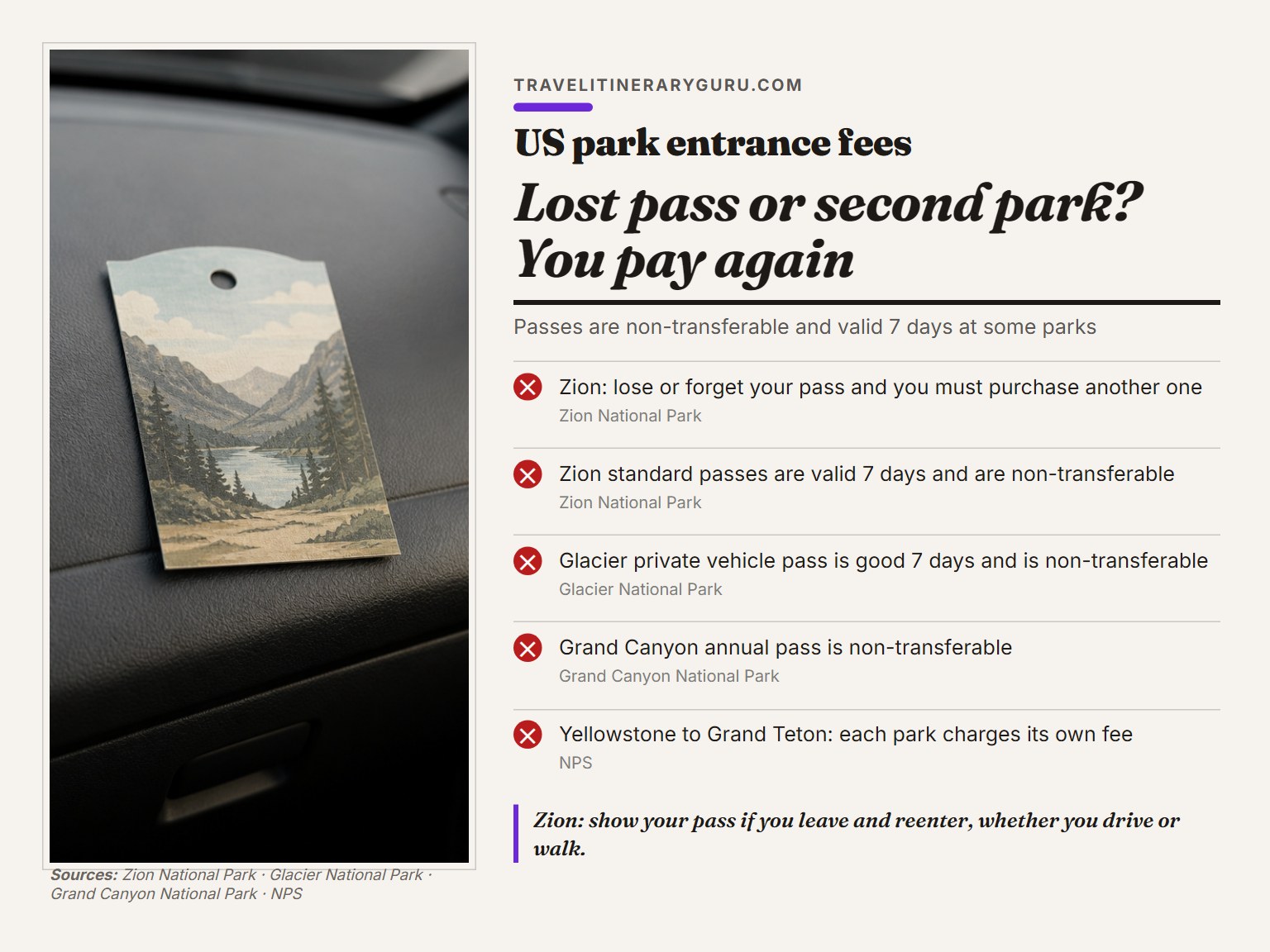
Fair warning. Zion will not replace a lost pass, and its standard passes are non-transferable.
Glacier’s private vehicle pass carries the same non-transferable language, and so do the annual passes at Grand Canyon and Zion. The Yellowstone entrance fee details add a related rule: the park’s private vehicle pass is non-transferable.
The Two-Park Transit Trap
Driving out of Yellowstone’s South Entrance toward Jackson, Wyoming, puts you through Grand Teton National Park. Each park charges its own fee, and neither credits the other.
The pass you bought at Yellowstone’s gate covers Yellowstone. It does not cover the Tetons.
Zion adds a related quirk. You don’t display the pass in your vehicle, but you’ll need to show it if you leave the park and reenter later, whether you drive or walk. Leave it in the glovebox, park in Springdale, and you’re walking back to the entrance to sort it out.
Easy to miss: Standard passes expire after seven days at most parks and can’t be transferred. A two-week stay means buying a second pass unless you step up to the $70 park-specific annual version.
Where Your Entrance Fee Actually Goes
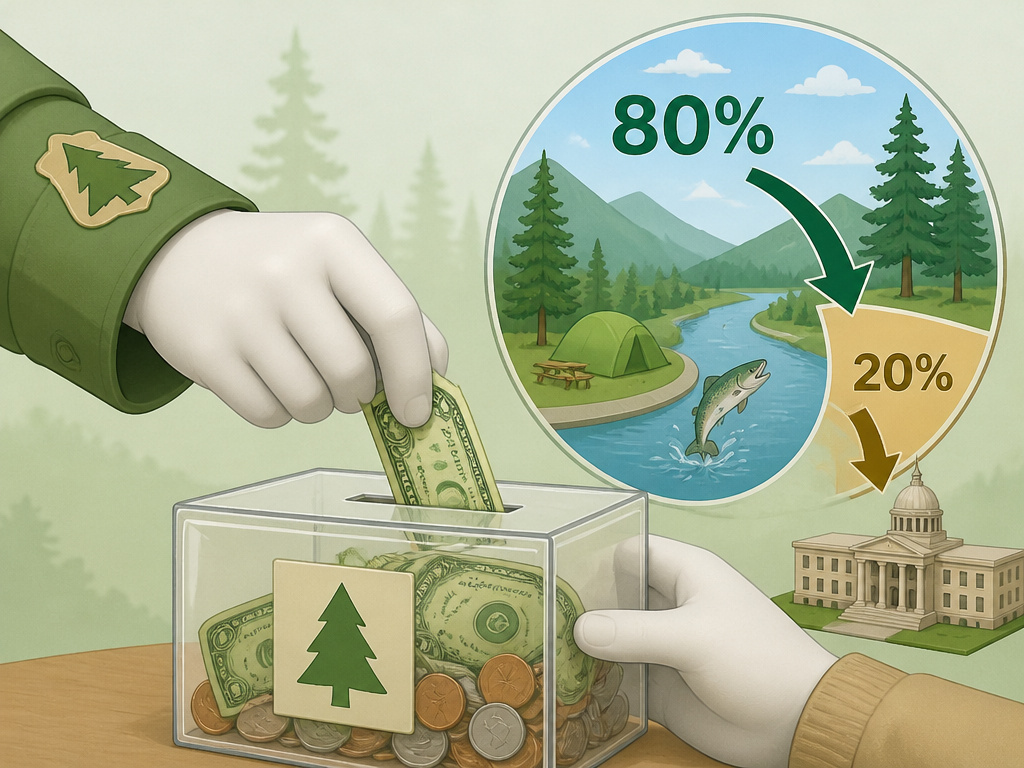
The Federal Lands Recreation Enhancement Act is the reason your entrance fee stays local. Public Law 108-447 gives the Park Service authority to collect and retain fee revenue, and at least 80 percent of it stays in the park where it was collected.
Yellowstone is the clearest example of what that money does. Fee revenue there provides $12.1 million a year on average for accessibility improvements, campgrounds, infrastructure, roads, native fish restoration, and aquatic invasive species mitigation.
Fee waivers exist, but the rules are narrow:
- School and academic groups visiting for non-commercial educational purposes, by application
- Groups of children under 16 with a reasonable number of chaperones, drivers, and teachers
- Hospital in-patients involved in medical treatment or therapy
Entrance station personnel aren’t authorized to grant a waiver when you arrive. That’s US national park entrance fees explained from the other side: the money goes back into the pavement, campgrounds, and native fish restoration you just drove past.
Frequently Asked Questions
How much does it cost to enter a national park?
Standard pass costs $20.00 to $35.00 per vehicle at most fee-charging parks and covers seven days. Per-person rates run $20.00 at parks that list them, and Glacier’s winter rates drop to $25.00 per vehicle and $15.00 per person between November 1 and April 30.
Do international visitors pay more to enter US national parks?
Yes, at 11 parks. Non-US residents aged 16 and over pay a $100 nonresident fee on top of the standard entrance fee at Acadia, Bryce Canyon, Everglades, Glacier, Grand Canyon, Grand Teton, Rocky Mountain, Sequoia & Kings Canyon, Yellowstone, Yosemite, and Zion. The $250 Non-Resident Annual Pass covers the holder and vehicle passengers instead.
Are national park entrance fees good for more than one day?
At most parks, yes. A standard pass covers seven days from purchase, and Zion’s window runs 1 to 7 days. Passes are non-transferable, so one pass covers one vehicle and its occupants, not a second car arriving later.
Can I use cash at national park entrance stations?
At some parks, no. Yosemite and Grand Canyon accept credit and debit cards only, and Theodore Roosevelt National Park went fully cashless on May 1, 2026. Zion prefers cards but still takes cash, and Yellowstone accepts both.
Is the America the Beautiful pass worth it?
For US citizens and permanent residents, the $80 annual pass usually pays for itself across three parks in a year. Non-US residents have a separate option: the $250 Non-Resident Annual Pass, which beats per-person nonresident fees once three or more people aged 16 and over share a vehicle.
Do free entrance days apply to everyone?
No. Free entrance days apply only to US citizens and permanent residents. Nonresidents still pay entrance and any nonresident fees unless they hold the Non-Resident Annual Pass.
The Bottom Line
One number decides most of this. If you’re a non-US resident traveling with three or more people aged 16 and over, buy the $250 Non-Resident Annual Pass before you leave home, because the per-person fees will cost you more at the gate.
If you’re a US citizen or permanent resident visiting three or more parks in a year, the $80 annual pass is the answer. The $70 park-specific versions only beat it when you’re staying inside one park.
Here’s the concession. Everything above assumes a staffed entrance and a working card. If your trip runs through a park in winter, or you arrive at a remote entrance after hours, the self-registration box and the park’s own page matter more than any general rule here.
So do the one thing this week: pull up the fee page for the most expensive park on your route and check two details, the current rate and the payment method. Entrance fees are the base of the pot. They aren’t the meal, but everything else tastes wrong if the base is off.
