
Travel Insurance vs Credit Card Coverage: Which Wins?
This post contains affiliate links. As an Amazon Associate, we earn from qualifying purchases.
Travel insurance vs credit card coverage is a question of two different products doing two different jobs. Premium cards bundle delay, baggage, and rental protection, and Chase Sapphire Reserve adds up to $10,000 per covered traveler for cancellation. Standalone policies add medical and evacuation coverage that cards cap low or skip entirely.
That $10,000 figure is where the trouble starts. It’s a real number, printed in Chase’s own benefit guide, and it’s the number most travelers quote when they decide to skip a policy. What the guide also says, three paragraphs later, is that the limit only applies to a covered reason. Cancel because you changed your mind, and the payout is zero.
Which means the useful question isn’t “which one is better.” It’s “which gaps does my specific trip leave exposed.” What follows walks through the actual limits on the three cards most travelers carry, the four coverage areas where cards fall short, and the trip profiles that flip the answer toward a standalone policy.
Key Takeaways
- Cards cover delay and baggage well. Chase Sapphire Reserve pays up to $500 per covered traveler after a delay over six hours, and $100 per day for five days on baggage delay.
- Medical is the real gap. Chase caps emergency medical at $2,500 with a $50 deductible; standalone plans commonly start at $50,000.
- Evacuation needs preauthorization. The $100,000 Chase limit requires advance arrangement through the benefits administrator, and first-responder transport is excluded.
- CFAR is standalone-only. Card issuers, Chase included, generally do not offer Cancel For Any Reason coverage at all.
- Buy early or lose the waiver. Most pre-existing condition waivers require purchase within roughly 10 to 21 days of your first trip payment.
What Travel Insurance vs Credit Card Coverage Actually Pays For
The two products protect against different failure modes, and the travel insurance vs credit card coverage confusion starts because both get marketed under the same phrase.
Card benefits are trip protection. They reimburse specific expenses when a specific trigger fires: a delay over six hours, a bag that doesn’t arrive, a rental car that gets scraped. Standalone policies are trip insurance. They cover the trip itself, plus the medical and evacuation exposure that follows you abroad regardless of what happens to your itinerary.
Card benefits reimburse defined expenses after a defined trigger, tied to a booking paid on the card. Standalone policies cover the trip and the traveler, including emergency medical treatment and evacuation, and they apply regardless of which card paid for the booking.
Here’s the practical split. A missed connection that costs you a hotel night is a card problem. A broken ankle in Lisbon is a policy problem. Most travelers carry one and assume it handles the other.
The comparison below is the short version. The rest of this article explains why each row reads the way it does.
| Coverage Area | Typical Card Benefit | Standalone Policy |
|---|---|---|
| Trip cancellation | $2,000–$20,000 per trip, covered reasons only | Limits matched to trip cost |
| Emergency medical | $0–$2,500 | Commonly $50,000+ |
| Medical evacuation | Up to $100,000, preauthorized | $250,000–$500,000 common |
| Cancel for any reason | Not offered | Optional upgrade, 50–75% |
Those numbers come from card benefit guides and policy schedules, not from marketing pages. That distinction matters, because the marketing pages are the ones that describe card benefits as “emergency medical care.”
The Real Limits on Chase, Amex, and Venture X
Three cards carry most of the premium travel market, and their limits are not close to each other. Pull the guides and the spread is wide enough that “my card covers it” means three different things depending on which card is in your wallet.
Chase Sapphire Reserve is the most generous on cancellation. The guide lists $10,000 per covered traveler and $20,000 per trip, with a $40,000 ceiling per 12-month account period. Trip delay pays up to $500 per covered traveler after more than six hours or an overnight stay. Baggage delay runs $100 per day for five days after six hours. Lost luggage caps at $3,000 per covered traveler.
Then the medical line: $2,500 with a $50 deductible. That’s the number that decides most arguments. One night in a European hospital can exceed it before the paperwork starts.
Amex Platinum structures cancellation differently. It pays $10,000 per covered trip with a $20,000 cap per card over 12 consecutive months, and the journey has to be round-trip. The full common-carrier cost must satisfy eligible-card payment rules, and the coverage is excess, meaning it pays after other coverage. Trip delay matches Chase at $500 per covered trip after six hours, but it’s limited to two claims per card per 12 months.
Baggage on Amex runs $2,000 checked and $3,000 combined per covered person. One exclusion catches award travelers: fare redemptions through non-Amex loyalty programs don’t qualify, and paying the award taxes alone doesn’t fix it.
Capital One Venture X is the outlier. Cancellation caps at $2,000 per insured person, and it applies only to qualifying nonrefundable common-carrier tickets. Hotels, tours, and prepaid apartments aren’t covered by that benefit. Trip delay matches the others at $500 per purchased ticket after six hours or an overnight, but it’s excess and limited to one claim per covered trip.
| Benefit | Chase Reserve | Amex Platinum | Venture X |
|---|---|---|---|
| Cancellation per trip | $20,000 | $10,000 | $2,000 |
| Trip delay | $500 per traveler | $500 per trip | $500 per ticket |
| Emergency medical | $2,500 | $0 | Not listed |
| Lost luggage | $3,000 | $3,000 combined | $3,000 per trip |
The pattern is consistent. Cards are competitive on delay and baggage, divergent on cancellation, and thin on medical.
Where the Headline Limits Don’t Apply
A limit is only as good as the conditions attached to it, and the conditions are where most claims die.
Common mistake: Assuming the cancellation limit covers any reason you cancel. Chase’s own education page states that issuers including Chase generally do not include Cancel For Any Reason coverage in standard card protections. Cancel outside the enumerated reasons and the payout is zero, no matter what the limit says.
Rental coverage carries its own trap. Chase’s $75,000 rental damage and theft benefit is generally primary, but only if the entire transaction goes on the card and you decline the rental company’s collision damage waiver. Where overseas CDW is mandatory, the coverage drops to secondary. New York residents with personal auto insurance get excess domestic coverage only.
Evacuation has the tightest conditions of all. The Chase $100,000 limit requires a trip of 5 to 60 days that takes you more than 100 miles from home, plus advance authorization and arrangement through the benefits administrator. First-responder transport is excluded. That last clause matters more than it sounds. If a local ambulance takes you to the nearest hospital, that leg isn’t reimbursed.
Where this goes sideways: Booking the trip on one card and paying the balance with another. Most card benefits require the eligible expenses to be charged to the card that provides the protection. Split the payment and you can void the benefit entirely, usually without noticing until you file.
Amex handles evacuation through Premium Global Assist, which may approve and coordinate emergency medical transport on trips more than 100 miles from home. It does not cover medical expenses, and independently arranged transport isn’t reimbursed. Canopy Press puts it bluntly: the $695 annual fee buys zero evacuation dollars in the reimbursement sense.
What Standalone Policies Add That Cards Don’t
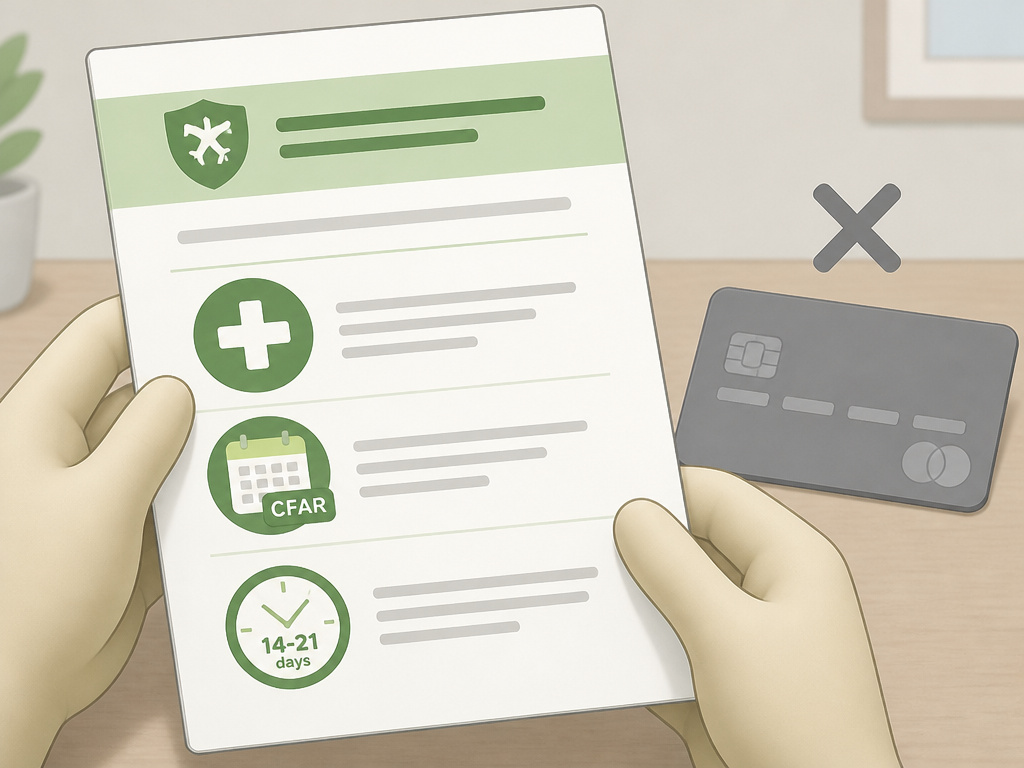
The gap isn’t just size. It’s category. Three things exist on standalone policies that have no card equivalent at all.
Emergency medical reimbursement is the first. A Travel Guard Preferred policy, Kansas product 643503 KS21, form U-TGT-1041A-KS (01/25), lists medical expenses up to $50,000 and evacuation or repatriation up to $500,000 per insured. Berkshire Hathaway Travel Protection’s ExactCare summary lists the same $50,000 medical and $500,000 evacuation structure. Those are starting points, not ceilings. Plans with $1 million in medical evacuation coverage are available from AIG Travel Guard, Trawick International, Seven Corners, and others.
Cancel For Any Reason is the second. It’s an optional paid upgrade, not a base inclusion, and the sources frame it differently. Emerge Insurance presents CFAR as a feature you only find on standalone policies. Awardlocker confirms it as an optional upgrade inside a standalone plan. Both are describing the same product from different angles: you can’t get it from a card, and you have to pay extra to get it from a policy. Reimbursement runs 50% or 75% depending on the insurer, and Travel Guard’s Kansas version caps at 50% of trip cost, requires purchase within 15 days of the initial trip payment, and requires cancellation at least 2 days before departure.
Pre-existing condition waivers are the third. Allianz uses a 120-day lookback with an exception for conditions controlled by unchanged prescriptions, and the waiver requires timely purchase within 14 days or the plan’s specified period. Atlas Direct puts the common window at 14 to 21 days of the initial deposit. Empyrean Travel says around 10 to 21 days. The exact number varies by insurer, which is the point: this is a deadline you have to hit, and it’s usually shorter than travelers assume.
If you want the longer version of how these fit together, the travel insurance coverage breakdown walks through each benefit type in order.
Why a Card Isn’t a Policy for Medical Care
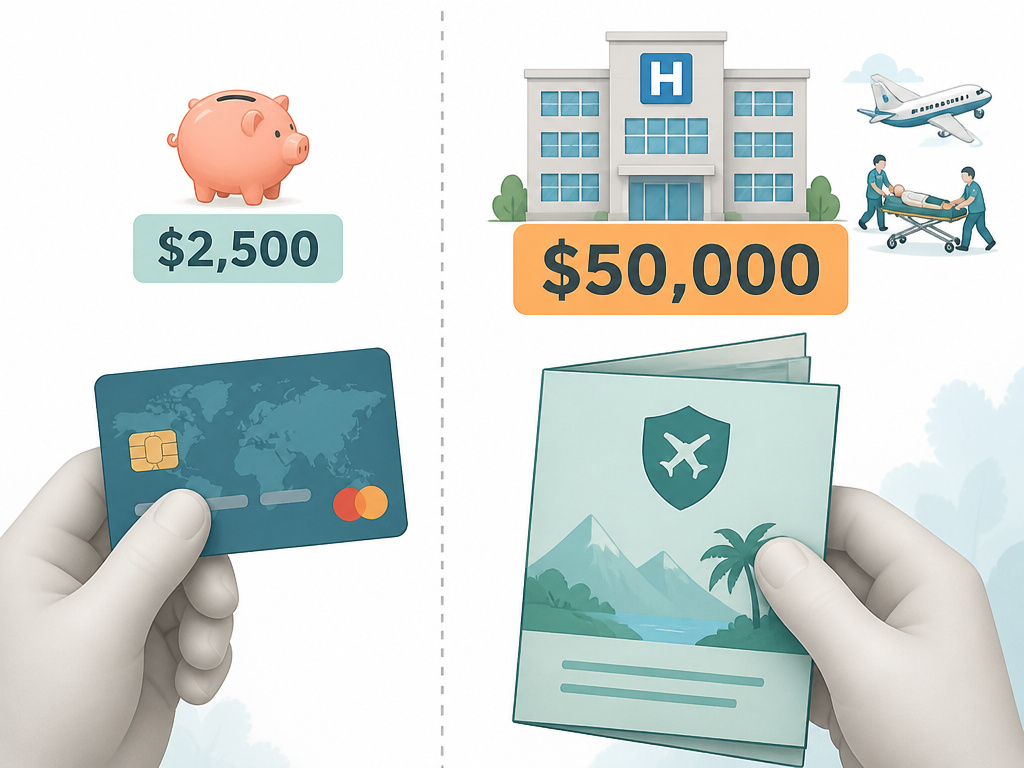
Card medical benefits and policy medical benefits aren’t the same product at different sizes. They’re different products.
A card’s emergency medical line reimburses eligible treatment costs up to a cap. Chase’s $2,500 is the most generous of the three cards here, and it’s designed for minor care: a prescription, a clinic visit, a dental emergency. It isn’t designed for an overseas ER stay, and the guide doesn’t pretend otherwise.
Standalone medical coverage is built for the hospital bill. That’s why the gap between $2,500 and $50,000 matters, and why the evacuation line matters more than either. A medical evacuation can run over $250,000, per Canopy Press. Against that number, a $100,000 cap with preauthorization requirements is a meaningful benefit and a meaningful limit at the same time.
The part nobody mentions: Card medical benefits are usually secondary. They pay after your other coverage, and you generally can’t collect twice for the same loss. If you have no other coverage abroad, you may still be waiting on a card claim while the hospital wants payment up front.
The framing disagreement between sources is worth naming. Awardlocker emphasizes that the $100,000 Chase evacuation limit is separate from the $2,500 medical benefit and requires advance authorization. Byline Travel frames card medical and evacuation coverage as categorically inadequate against standalone policies. Both are accurate. The first describes what the benefit does. The second describes what it doesn’t.
For the mechanics of what happens when something goes wrong overseas, the medical emergency abroad walkthrough covers the sequence from first call to claim.
When Card Coverage Is Genuinely Enough
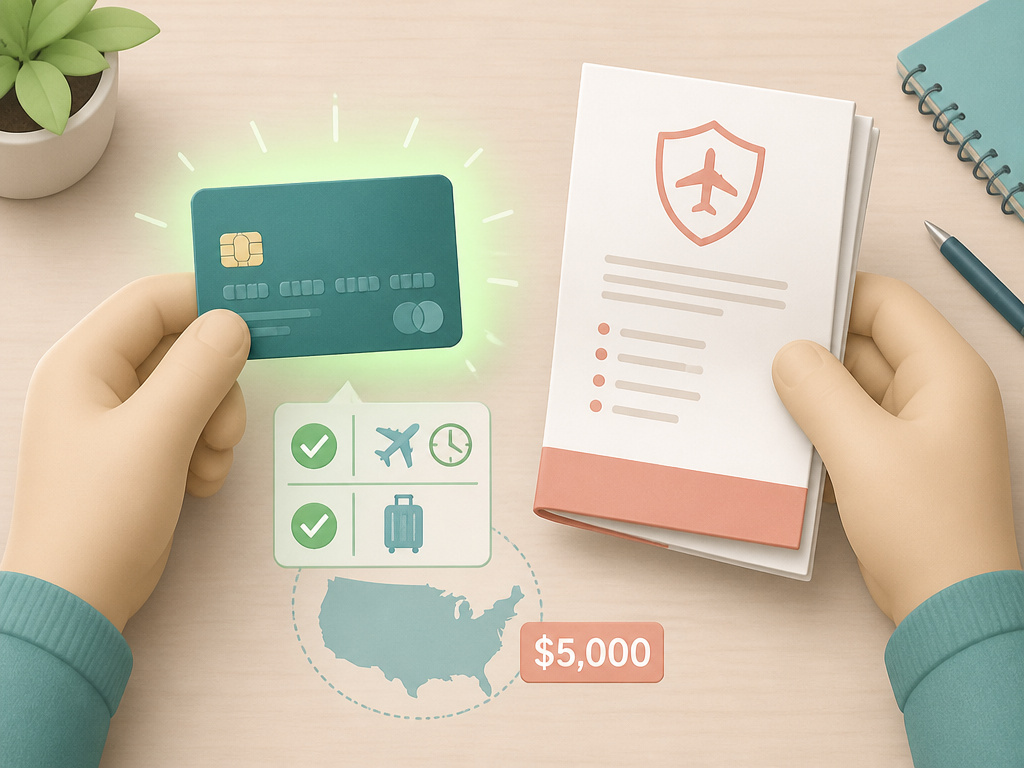
Card benefits aren’t a consolation prize. For a specific trip profile, they’re the right answer.
Canopy Press draws the line at trips under $5,000, domestic, with no remote regions involved. Atlas Direct says the same thing in different words: low-risk, short domestic trips, a card may be fine. Empyrean Travel’s side-by-side puts card coverage as best for shorter, lower-cost domestic trips and standalone policies as best for expensive, prepaid, international, or remote ones.
The profile that works: refundable bookings, a domestic itinerary, strong health coverage at home, and no prepaid tours sitting on the card. In that scenario, the delay and baggage benefits are doing real work and the medical gap never gets tested.
Skip this if: Your trip is domestic, fully refundable, and you have solid health coverage at home. The card’s delay and baggage benefits will handle the realistic failure modes, and a policy adds cost without adding much.
That’s a coupon, not a policy. It’s fine until the trip where it isn’t.
Where the card stops working is the moment any of these show up: a prepaid tour, a cruise, a remote region, an activity that falls outside standard exclusions, or a pre-existing condition you need covered. Byline Travel’s list runs long, but the load-bearing entries are tight international connections under about 90 minutes, separate tickets on different airlines, large deposits due months before travel, and travel during hurricane or monsoon season.
Cruise Trips Break the Card Math Entirely
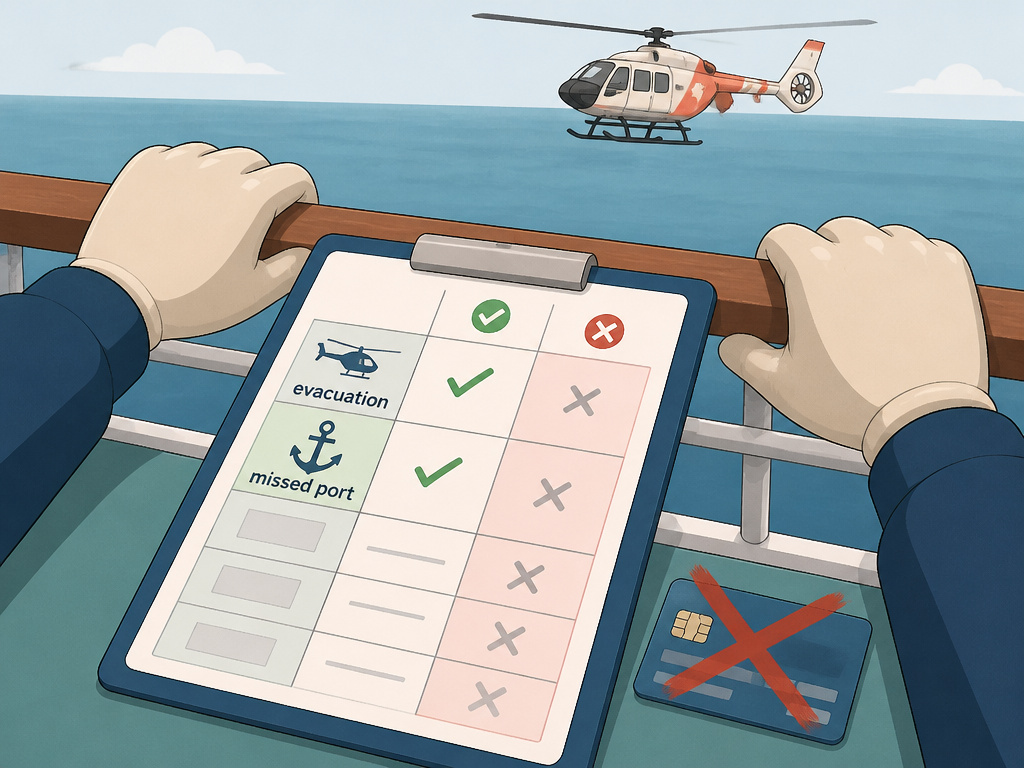
Cruise itineraries sit outside what card benefits are built for, and the gap is specific.
Two line items decide cruise coverage. The first is medical evacuation from a ship at sea, which can be costly by helicopter. The second is missed port coverage. Regular policies often skimp on both, and card benefits don’t address either.
It didn’t.
The fix is to compare family plans specifically on those two line items rather than on the headline cancellation limit. A policy with a strong cancellation benefit and no ship evacuation coverage is the wrong product for a cruise, regardless of what the summary page emphasizes.
Cruise and multi-segment package bookings appear on Byline Travel’s list of situations that raise the case for standalone insurance, alongside missed embarkation and onboard medical bills. The reasoning is structural: a cruise concentrates medical risk at sea, where the nearest hospital is a helicopter ride away.
The Source Disagreements Worth Knowing
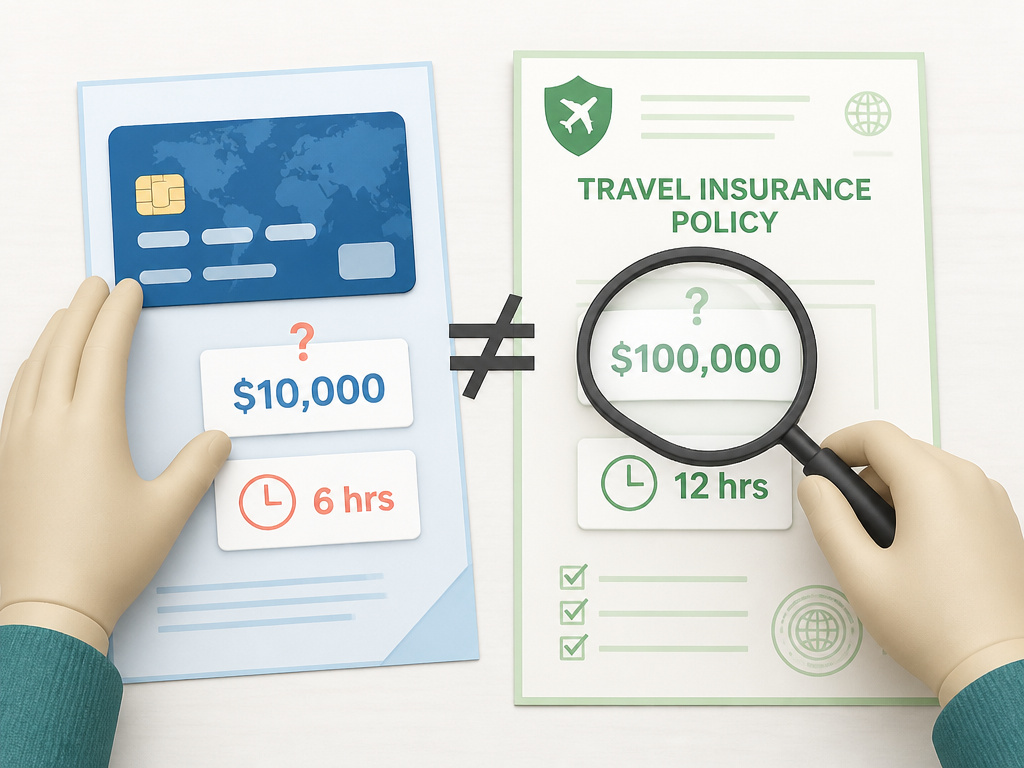
Not every number in this space is settled, and the disagreements matter because they change the decision.
Card cancellation ceilings are the clearest example. Emerge Insurance cites a flat $10,000 per trip as the typical card norm. Awardlocker documents Chase at $20,000 per trip with a $40,000 annual cap. Both are describing real cards. The “typical” figure understates premium products, and the premium figure overstates what most cards offer.
Trip delay triggers disagree too. TravelStacks states that Chase Sapphire Preferred activates at 12 hours or overnight, while the Reserve triggers at more than 6 hours. Two sibling products with different thresholds. The takeaway is narrow: don’t generalize “Chase equals six hours,” because it depends on which Chase card you carry.
Evacuation limits are framed differently across sources. Emerge Insurance states card evacuation ranges from $10,000 to $100,000 depending on the card. Awardlocker documents Chase Reserve at $100,000 but notes it’s separate from the $2,500 medical benefit. The distinction matters because a traveler reading the range might assume the two benefits stack. They don’t.
CFAR availability gets framed two ways as well. Emerge presents it as a standalone-only feature. Awardlocker confirms it as an optional paid upgrade inside a standalone plan. Same fact, different emphasis. You can’t get CFAR from a card, and you have to pay for it on a policy.
If you’re weighing whether the policy is worth the premium at all, the travel insurance pros and cons breakdown covers the trade-offs directly.
How to Layer Both Without Voiding Either
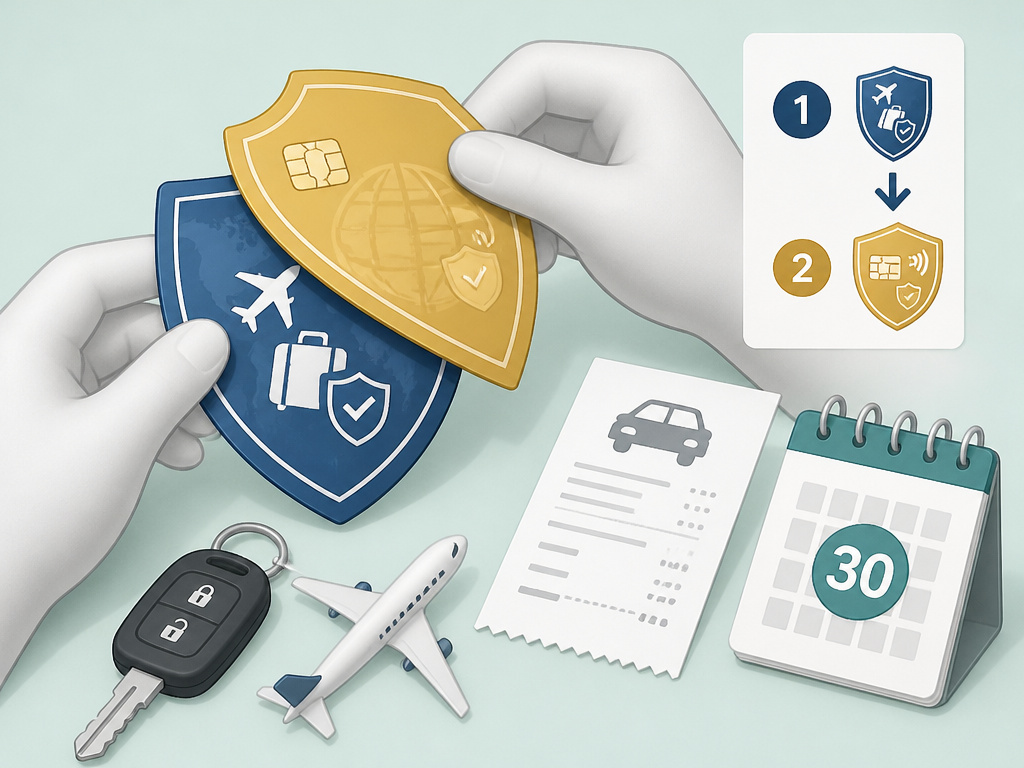
Cards and policies aren’t mutually exclusive, and layering is common. The trick is understanding which one pays first.
Card benefits are often secondary, meaning they pay after other coverage. You generally can’t collect twice for the same loss. A practical structure: buy a policy focused on medical, evacuation, and cancellation, and lean on the card for delays, baggage, and rental cars. That puts each product on the coverage it’s actually built for.
The payment rules are where layering goes wrong. Most card benefits require the eligible expenses to be charged to the card providing the protection. If you’re relying on Chase for delay coverage, the flight needs to be on the Chase card. If you’re relying on a policy for cancellation, the policy covers the trip regardless of how it was paid.
Keep receipts for everything. Both card administrators and policy carriers ask for proof of purchase, proof of the qualifying event, and expense records. Filing deadlines differ: many carriers want claims within 30 days, and standalone plans often have tighter notice requirements for medical evacuations.
Easy to miss: Understating your trip cost on a policy application. Travel Guard’s Kansas policy notes that an inaccurately understated trip cost can proportionally reduce payment. If you insure half the trip and claim the full loss, you get half.
If the trip involves a rental car, the payment conditions get more specific. The credit card rental car coverage breakdown covers the decline-the-CDW requirement and the overseas secondary-coverage rule.
Frequently Asked Questions
Does my credit card cover medical emergencies abroad?
Usually minimally or not at all. Most card protections focus on cancellation, delays, baggage, and rental cars. Chase Sapphire Reserve is the exception among the three cards here, with a $2,500 emergency medical and dental benefit and a $50 deductible. That covers minor care, not a hospital stay. Because many U.S. Health plans and Original Medicare offer little or no coverage overseas, a travel medical policy or a full-coverage policy is the safer choice for international trips.
Is travel insurance worth it if my card already has trip cancellation?
Often yes, for expensive or international trips. Card cancellation caps may not match a large prepaid deposit, the covered reasons are narrower, and medical and evacuation benefits are usually absent. Chase Reserve is the most generous at $20,000 per trip, but that limit only applies to covered reasons. If your trip is modest, domestic, and refundable, the card may be enough.
When should I buy a standalone policy?
Soon after your first nonrefundable trip payment. Many policies offer time-sensitive benefits, including pre-existing condition waivers and CFAR upgrades, only if you buy within a set window after the initial deposit. Empyrean Travel puts it around 10 to 21 days. Atlas Direct says 14 to 21 days. Allianz specifies 14 days or the plan’s stated period. Buying early also covers cancellation reasons that arise before departure, which is when many claims happen.
Can I use card coverage and a policy together?
Yes, and layering is common. Card benefits are often secondary, meaning they pay after other coverage. You may claim on your policy first and your card for what’s left, or the reverse, depending on the terms. You generally can’t collect twice for the same loss. A practical approach is to buy a policy focused on medical, evacuation, and cancellation, and lean on the card for delays, baggage, and rental cars.
What does Cancel For Any Reason actually pay?
Between 50% and 75% of eligible penalties, depending on the insurer. Travel Guard’s Kansas product caps at 50% of trip cost and requires purchase within 15 days of the initial trip payment plus cancellation at least 2 days before departure. Allianz’s Cancel Anytime upgrade pays 80% for qualifying unforeseeable reasons outside normal coverage, with full trip cost insured within 14 days of first payment. Availability varies by state.
Does Medicare cover me overseas?
Generally no. Original Medicare usually doesn’t cover health care outside the U.S., apart from a few narrow exceptions. Some Medigap plans include limited foreign travel emergency coverage, and Medicare Advantage plans vary, so check yours. If you’re on Medicare, a travel medical policy or a full-coverage policy with evacuation coverage matters more than it does for most travelers.
The Bottom Line
One rule I’d put in front of every other consideration here: if your trip cost is above $5,000, prepaid, or international, buy the policy. Canopy Press draws the line at that threshold for a reason, and the medical gap on cards is the reason. Below it, with refundable bookings and domestic travel, the card is genuinely enough.
The first step this week is a five-minute one. Pull your card’s benefit guide, find the emergency medical line, and read the number. If it’s $2,500 or lower, you now know what your card doesn’t cover, and you can decide whether that’s a risk you’re willing to carry.
At the worst possible moment.
