
How to Handle a Medical Emergency Abroad: 5 Steps
This post contains affiliate links. As an Amazon Associate, we earn from qualifying purchases.
To handle a medical emergency abroad, call the local emergency number or get to a hospital, then contact your travel insurer’s 24-hour hotline. Expect to pay upfront or hand over your policy details before treatment, because most countries won’t subsidise your care and no consular service will settle the bill.
That payment clause is where plans fall apart on the ground. In many destinations the card terminal comes out before the triage clipboard does, and the bill doesn’t wait for your insurer’s office to open.
What follows is the order that works on the ground: who to call first, the payment conversation nobody prepares for, what your existing policy really covers, and which consular help is real.
Key Takeaways
- Call local emergency services first, then the insurer’s 24-hour hotline. The embassy call comes third.
- Assume you’ll pay upfront. Smartraveller and the UK’s FCDO both warn that payment or policy details can be demanded before treatment.
- Your standard health plan might not cover the full cost of emergency care or medical evacuation, per the CDC Yellow Book.
- Consular staff hand you lists, not money. No consular service pays hospital bills, loans cash, or arranges repatriation for you.
- Ask the price before you agree to treatment. Smartraveller warns some providers inflate the figure afterwards and still expect payment.
The First Calls, in the Right Order
Emergency care starts with local emergency services. The insurer call comes second, and the embassy call comes third.
Emergency care abroad follows a payment-first protocol in most destinations. Local emergency services are contacted first, then the traveller’s insurer. Consular staff can supply lists of hospitals and English-speaking physicians, but no consular service settles medical bills or lends money. Up-front payment or insurance details are commonly required before treatment begins.
That order isn’t universal, and the sources don’t pretend otherwise. The CDC’s Yellow Book frames the how to handle a medical emergency abroad question differently from the two consular guides, routing travellers through the nearest US embassy or consulate to locate medical services and notify family.
| Source | First move | Second move |
|---|---|---|
| Smartraveller (Australia) | Call local emergency services, go to hospital | Contact your travel insurer |
| UK FCDO (GOV.UK) | Call the emergency services | Contact your insurance company |
| CDC Yellow Book (US) | Contact the nearest US embassy or consulate | Locate medical services, notify family |
Pick the one that matches your passport and move. If you can’t make the call yourself, hand the job to someone else. Smartraveller lists a travelling companion, tour guide, hotel concierge, friend, or family member as legitimate options.
Save the numbers before you fly. The Australian consular emergency centre runs 24 hours from overseas on +61 2 6261 3305. For US citizens, the CDC’s Yellow Book frames the first move as contacting the nearest US embassy or consulate to locate medical services and notify family.
If the problem isn’t urgent, the play changes. Book an appointment with a local doctor or hospital, and if you need a specialist, you may have to find a doctor abroad and get a GP referral first.
How to Handle a Medical Emergency Abroad: The 5 Steps in Order
Five steps, and the sequence matters more than the speed.
Before you start: Two things bite here. In most destinations the hospital wants payment or your policy details before treatment, so carry a card and your policy number on your body rather than in a locked suitcase. Second, an unpaid bill can lead to arrest or jail in some countries, per Smartraveller, so never walk out on a charge you can’t settle.
- Get to care. Call the local emergency number, or take whatever transport is available to the nearest hospital. Wait at the kerb for an ambulance that may never come and you’ve burned the minutes that mattered.
- Delegate the call if you can’t make it. A companion, guide, concierge, or family member can dial on your behalf. Freezing because you don’t speak the language costs time you don’t get back.
- Ring the insurer’s 24-hour line. Most policies run one, and the UK’s FCDO expects it to be staffed around the clock. Dial it before you sign anything, or you may commit to a provider your insurer won’t reimburse.
- Ask the cost before you agree to treatment. Smartraveller warns that some providers inflate the figure afterwards and still expect payment. Skip the question and you’re arguing about a number you never saw.
- Keep every bill and invoice. The CDC advises sending copies to your insurer afterwards to start reimbursement. Without them, your claim is your word against a hospital’s ledger.
Step four is the one people skip, and it decides how much of your trip you’re still paying for after you get home.
The clinical side has its own how to handle a medical emergency abroad checklist. You won’t run it yourself, but it tells you what a properly equipped emergency unit is doing while you’re filling in forms.
Who Actually Pays, and When They Ask
The bill arrives before the care does.
Smartraveller is blunt about it. You may have to pay upfront or hand over your insurance details before they’ll treat you, even if you could die without treatment. GOV.UK says the same thing in softer language, noting you’ll often pay upfront even when you’re fully insured.
Fair warning. That means the money question belongs in the first five minutes, not the last.
Ask the Price Before You Sign Anything
Ask the provider what your care will cost before they treat you. Smartraveller warns that some inflate the price afterwards and expect you to pay it anyway.
Ordering medical care abroad works like ordering in a restaurant where the menu has no prices. Ask what the dish costs before you eat, keep the receipt, and don’t expect the embassy to pick up the tab.
There’s a second reason to settle the bill. Smartraveller notes that unpaid medical bills can lead to arrest or jail, and the Australian Government can’t pay it for you.
Reimbursement is the normal path. The CDC advises paying out of pocket when services are rendered, sometimes before care is received, then submitting copies of bills and invoices to your insurer to start the claim. That route only works if your medical coverage actually extends to the country you’re standing in.
The Smartraveller urgent medical care overseas guidance also covers what to do if you can’t pay and have no insurance. If you can’t pay and you have no insurance, you’ll be calling family and friends back home for money.
What Does Your Standard Health Plan Cover Abroad?
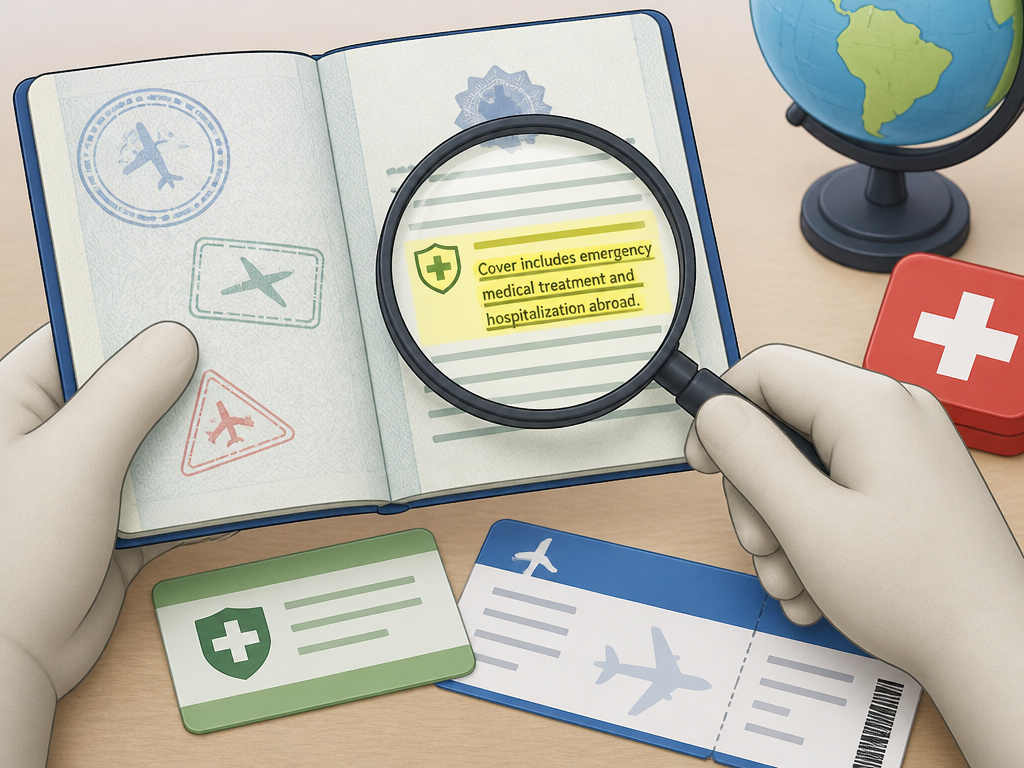
Most standard health plans might not cover the full cost of emergency medical care or medical evacuation, according to the CDC Yellow Book.
Smartraveller and GOV.UK both treat insurance as the primary payment mechanism. The CDC treats it as a partial one.
Per the CDC, travel-specific plans vary widely and might not cover the full cost of emergency care, medical evacuation, or itinerary changes needed to get treatment. Supplemental policies may cover those expenses, but they often exclude preexisting conditions.
Why the CDC Is More Sceptical Than the Consular Guides
The CDC’s position is that not all insurance plans cover emergency health care abroad. It tells travellers to check with their carrier before departure and identify any additional coverage requirements.
The CDC Yellow Book sick abroad guidance also says people travelling for work, research, or formal education should find out whether their sponsoring organisation provides travel health insurance.
Good news exists too. Supplemental plans bought before you travel often give you access to pre-selected local healthcare professionals through a 24-hour emergency hotline, or hand you a list of approved professionals. Some run nurse- or physician-backed support centres.
When you’re choosing travel insurance, the evacuation cap and the preexisting-condition clause are the two lines that decide whether the policy is worth carrying.
What Consular Staff Can and Cannot Do
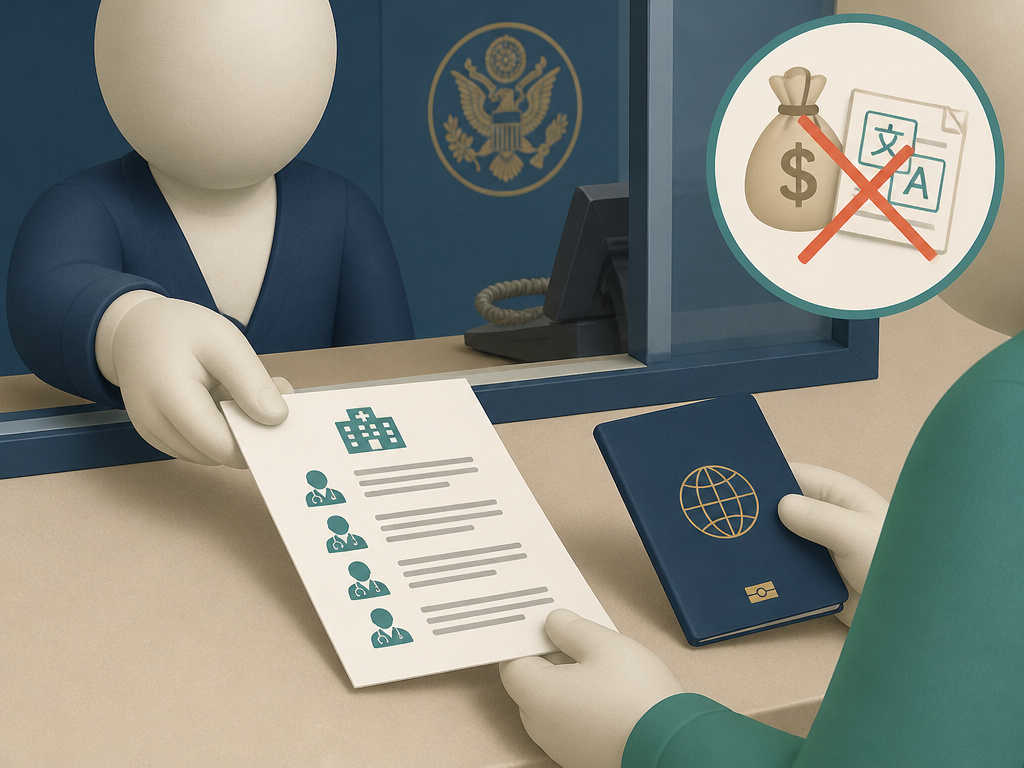
Consular staff can hand you a list of English-speaking doctors. That’s the shape of the help.
The list is genuinely useful. It’s also where the assistance stops, and the line is sharper than most travellers expect.
What they can do:
- Provide a list of local hospitals and English-speaking medical professionals.
- Provide a list of local lawyers who speak English.
- Give you some information on how and where to get prescribed medication locally.
- Contact your friends or family for you in an emergency, if you give consent.
What they cannot do:
- Pay your medical bills or loan you money. The Australian Government can’t, and the British embassy or consulate can’t either.
- Provide formal translation or interpretation of medical language documents.
- Intervene in a local legal process that results from a mental health emergency.
The part nobody mentions: The help you get depends on your passport. The British embassy cannot arrange or pay for a medical repatriation, while Canadian officials can assist with a medical evacuation and safe transfer, including liaising with service providers.
GOV.UK states plainly that the British embassy or consulate cannot arrange medical repatriation or pay for it. Canada’s guidance says officials can assist with a medical evacuation and safe transfer.
Family contact splits too. Smartraveller says consular staff can contact friends or family if you consent. Canada says officials can reach your next of kin or a person holding power of attorney. The CDC says the nearest US embassy or consulate can notify friends, family, or your employer.
Translation is another split. GOV.UK points you to your insurer to check whether medical translation or interpreting is covered. Smartraveller says consular staff can provide a list of hospitals and English-speaking medical professionals. The CDC routes it through the embassy or consulate.
What Breaks the Standard Advice? Dialysis, Pregnancy, and Remote Areas
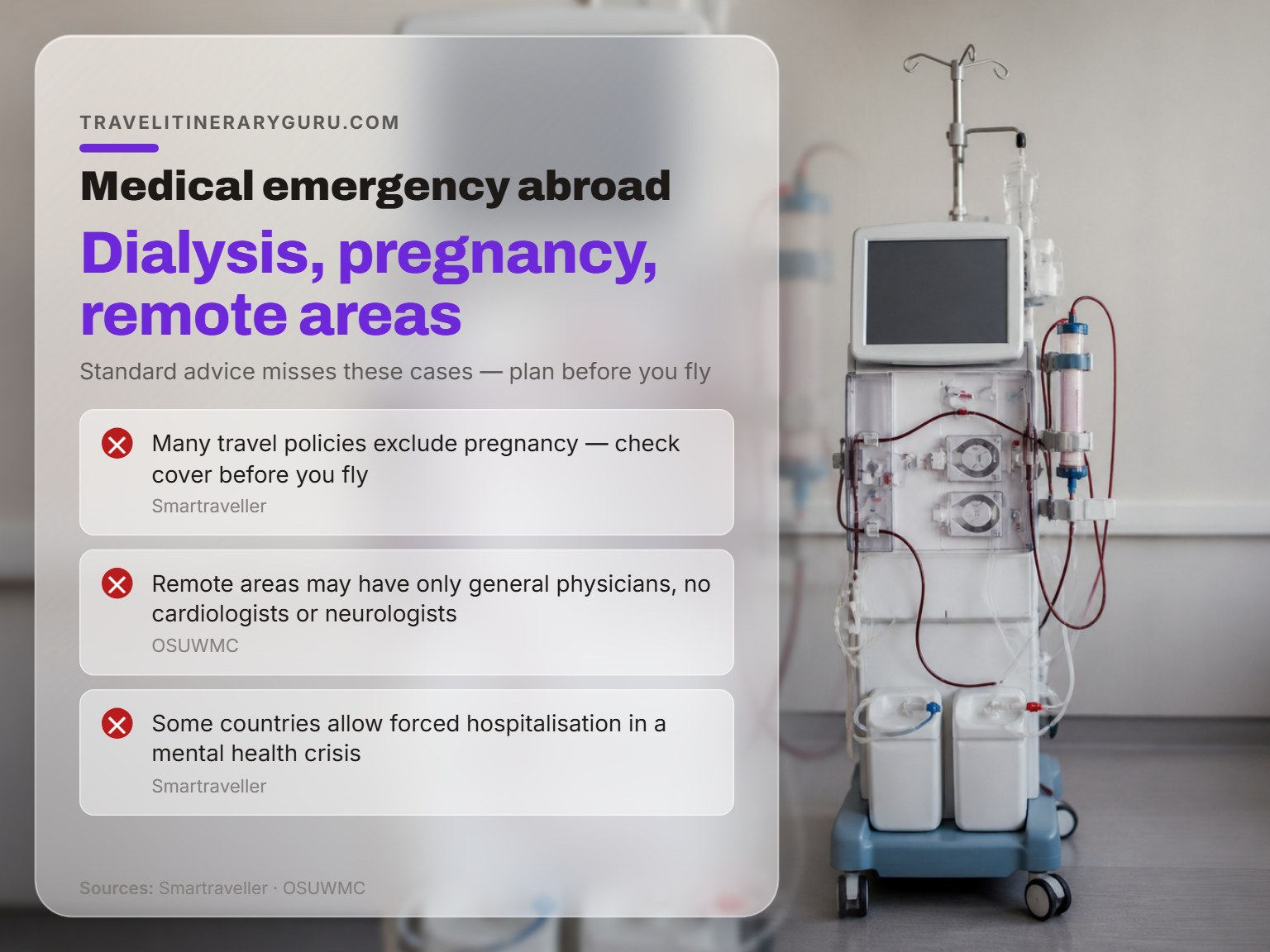
What happens if you’re on dialysis, pregnant, or travelling through a region with one general physician and no cardiologist?
| Situation | What standard advice misses | Pre-trip action |
|---|---|---|
| Dialysis | Walk-in emergency care won’t cover routine sessions | Book appointments in advance at a site with the right equipment |
| Pregnancy | Many policies exclude pregnancy | Check cover with your insurer before you fly |
| Remote areas | General physicians only, no cardiologists or neurologists | Decide before you go whether that risk is acceptable |
| Regular medication | Trade names differ between countries | Carry original labelled containers and list generic names |
| Mental health crisis | Some countries allow forced hospitalisation | Know the local emergency number and your insurer’s line |
Blood is its own problem. Serious trauma can require a transfusion of whole blood or components like platelets and fresh frozen plasma, and the CDC notes that not all countries screen blood donations accurately, reliably, and systematically. That’s why hepatitis B vaccination matters for travellers on motorcycles, adventure trips, or long stays in low- and middle-income countries.
Telemedicine is a maybe. The CDC says remote access to your US-based doctor might work for you, but it requires careful preparation and planning. Ohio State’s guidance adds a practical snag: poor cellular coverage in remote areas can block the tools you’d need.
Medication is the quiet one. The CDC advises packing an adequate supply in original, labelled containers and knowing how to get more while you’re away. Trade names vary between countries, so carry the generic name too. If you’re traveling with prescription medication, that generic list is what a foreign pharmacist reads.
GOV.UK adds a shortcut: many countries accept UK prescriptions, so speak to a local pharmacist. Smartraveller says consular staff can give you some information on where and how to get prescribed medication locally.
If you’re traveling with a chronic illness or on medication that needs monitoring, the pre-trip maths changes completely. Ohio State recommends a doctor’s visit before you go in that case. The CDC goes further, encouraging travellers likely to need care to research and identify specific professionals and facilities at their destination.
On travel vaccines, the CDC singles out hepatitis B for anyone whose trip involves motorcycles, adventure travel, or a long stay in a low- or middle-income country.
Before You Go: The Prep That Changes the Outcome
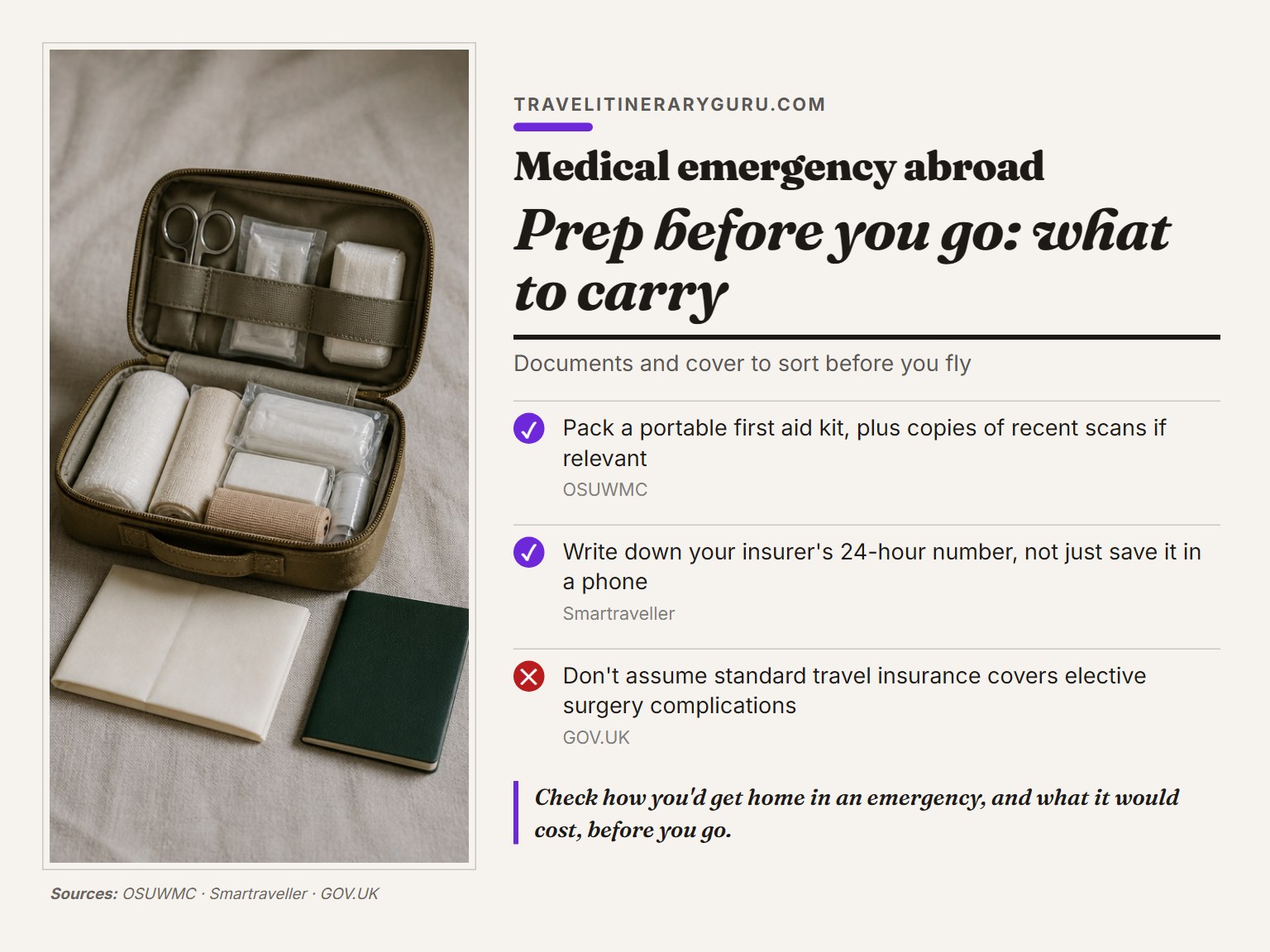
Preparation does more for a medical emergency than anything you’ll manage in the moment.
Start with the doctor question, because the sources split on it. Ohio State’s guidance says a pre-travel visit is recommended if you have preexisting conditions or take medication that requires monitoring, and not necessary if you’re healthy. The CDC takes a softer line, encouraging travellers likely to need care to research thoroughly and identify healthcare professionals and facilities at their destination.
Then learn the local emergency number. Figure out how to activate the 911-equivalent system in each region you’re visiting before you need it.
Skip this if: You’re healthy and heading to a city with modern hospitals. Ohio State’s guidance says a pre-travel doctor visit isn’t necessary in that case. Buy the insurance anyway, because the payment problem doesn’t care how fit you are.
The Documents to Carry in Two Places
- A portable first aid kit. Ohio State lists it alongside copies of any recent medical scans and end-of-life documents, if those are relevant to you.
- Your passport, in two forms. A paper copy and a digital copy, kept separately from the original. Losing it mid-trip is a slow problem to fix, and slower without copies.
- Insurance details on paper. A card is no use if it’s in a hospital locker and you’re not conscious.
- Your insurer’s 24-hour number. Written down, not just saved in a phone that may be flat.
A travel medical kit is worth building around the conditions you actually have rather than a generic pharmacy shelf. The kit matters less than the paperwork that travels with it.
If you’re travelling for work, research, or formal education, check whether your sponsoring organisation provides travel health insurance. It’s a question people forget to ask, and the cover is often already in place.
Plan the way home before you need it. GOV.UK advises checking how you’d get home in an emergency and what it would cost, because your insurer should arrange medical repatriation or evacuation, and you’ll arrange and pay for it yourself if they don’t.
Don’t travel abroad for elective surgery and assume standard travel insurance will pick up complications. It normally doesn’t cover elective surgery at all, and GOV.UK treats the whole arrangement as commercial, which means no help with disputes.
Run through a pre-trip travel checklist before you lock the flights. It’s cheaper than learning this list in a waiting room.
Frequently Asked Questions
What should I do first if I have a medical emergency abroad?
Call the local emergency number or get to a hospital immediately. Then contact your travel insurer, because most policies run a 24-hour hotline. The CDC’s Yellow Book frames the first move as contacting the nearest US embassy or consulate instead, so the order depends on which government’s guidance you follow.
Will my travel insurance pay the hospital directly?
Often not. The CDC advises travellers to be prepared to pay out of pocket when services are rendered, and sometimes before care is received, then submit bills and invoices to their insurer for reimbursement. Smartraveller and GOV.UK both warn you may have to pay upfront or hand over policy details before treatment.
Can the embassy pay my medical bill?
No. The Australian Government can’t pay your bill or loan you money, and the British embassy or consulate can’t buy or pay for your medication, medical bills, or other expenses. Canada’s guidance says the same: the Government of Canada does not pay hospital or medical bills.
What if I can’t afford treatment abroad?
Ask the provider what the care will cost before they treat you, because Smartraveller warns some inflate the price afterwards. If you can’t pay and you don’t have insurance, you’ll need to contact family and friends back home for money. Unpaid bills can lead to arrest or jail in some countries.
Do I need travel insurance if I’m healthy?
Yes, for the payment mechanics rather than the odds. The CDC notes most standard health plans might not cover the full cost of emergency medical care or medical evacuation. Ohio State’s guidance says a pre-travel doctor visit isn’t necessary if you’re healthy, but that’s a different question from whether you can cover a hospital bill.
The Bottom Line
One threshold decides most of this. If your policy’s medical evacuation cap is a fraction of what a higher-tier policy offers, that cap is the number that decides your trip. Read it before you read anything else.
If your route runs through a region with one general physician and no specialist cover, the maths changes, and the honest answer is that you should decide before you book whether that risk is acceptable.
Photograph your passport, your policy number, and your insurer’s 24-hour line, and store the images somewhere a companion can reach them.
