
Las Vegas Travel Guide for First-Time Visitors
This post contains affiliate links. As an Amazon Associate, we earn from qualifying purchases.
A Las Vegas travel guide for first-time visitors starts with three facts: the Strip’s resorts sit more than a mile apart on foot, the city runs 78 days a year at or above 100F, and resort fees push the real bill well past the rate you booked.
That mile matters more than it sounds, and it’s the first thing a Las Vegas travel guide for first-time visitors should tell you. Las Vegas Boulevard’s resort entrances sit well back from the sidewalk, and the casino floors between them force long indoor detours. Heat compounds it, because the same sun that makes a pool deck pleasant in the morning turns the pavement outside it hostile by mid-afternoon.
What follows is the version of the plan I’d hand a friend: how the Strip’s scale actually works, what the heat data says about when to walk, which transit option fits which trip, where to sleep if you don’t want a casino under your room, and the local rules that catch visitors out.
Key Takeaways
- The Strip is not walkable end to end. Resorts that look adjacent sit more than a mile apart on foot, and casino floors add indoor detours between them.
- Summer heat is a scheduling problem. The city runs 78 days a year at or above 100F (38C), so walk early or after sunset.
- Resort fees are the real rate. Lonely Planet names them as the reason a headline rate and the final bill don’t match, and it’s the only source in this set that puts a figure on them.
- Skip the rental car. The Monorail, the Deuce bus, and rideshare cover the corridor, and the one highway in and out is the region’s busiest.
- Book the show before you fly. Tickets sell out days or weeks ahead, and the same-day discount booths are a gamble rather than a plan.
The Strip Is Longer Than It Looks, and That Changes Everything
Lonely Planet’s city guide makes the point bluntly, and it’s the core warning in any Las Vegas travel guide for first-time visitors: a resort that looks three doors down may actually sit more than a mile away. Maps compress the resort corridor into colored rectangles, and feet don’t read rectangles.
Las Vegas Boulevard’s resort corridor is not one continuous walkable block. Hotel entrances sit far back from the sidewalk, and casino floors force long indoor detours between them. A property that appears adjacent on a map can sit more than a mile from the next one, measured door to door along the pedestrian route.
Three things create that gap. Resort entrances sit behind driveways and porte-cocheres, so the trip from your room to the sidewalk is itself a walk. Casino floors sit between the sidewalk and almost everything else, and you cross them whether you gamble or not.
Then there’s the surface itself. By mid-afternoon the pavement throws heat back through your soles, and the same route you covered easily at nine in the morning feels twice as long at two.
Here’s what that looks like on the ground:
- Cross at the pedestrian bridges. They cost you stairs and save you four traffic-light cycles.
- Pick one resort as your base. Treat everything else as a separate outing.
- Budget the walk as an activity of its own. It’s not the gap between two other things.
- Wear shoes you’ve already broken in. Frommer’s is blunt about this one: comfortable walking shoes are a must, because you’ll cross a 100,000-square-foot casino floor in whatever you brought.
Common mistake: Planning one morning that starts at the south end of the Strip and finishes at the north end. By the time you reach the second property, the morning is gone and you’ve seen two lobbies.
Deciding how many days you need in Las Vegas gets easier once you accept the Strip is a full day of walking by itself. Most first-timers overbook and under-walk.
How Hot Does Las Vegas Actually Get, and When?
Wikivoyage’s climate normals put Las Vegas at 78 days a year at or above 100F (38C). July is the peak month. Those figures come from the Wikivoyage Las Vegas travel guide, which draws on standard climate data, though they’re worth re-checking against NOAA before you build dates around them.
Lonely Planet frames the same season differently. Its guide calls the summer desert sun “excruciating” and puts the peak at “upwards of 104F/40C.” That’s a peak reading, not a frequency count, so the two shouldn’t be merged. Wikivoyage tells you how often the heat bites. Lonely Planet tells you how bad it gets when it does.
Before you start: Summer afternoons here cause real heat illness, and the signs creep up slowly. Sunscreen at SPF 30 or higher is the floor, per Frommer’s, and it goes on before you leave the room. Carry water on every outdoor walk, because the low desert humidity hides how fast you’re losing fluid.
The trap that catches visitors is the indoor-outdoor swing. VisitLasVegas and Lonely Planet both flag it independently: casino air conditioning runs cold enough that you’ll want a sweater in July. Frommer’s is less diplomatic and says the showrooms set it on “Siberia.”
So the working rule is a two-window day. Walk early and late. Put the middle of the day indoors, in a pool, or on a bus.
Getting Around Without a Car: Monorail, Deuce, or Rideshare?
Skip the rental car. VisitLasVegas says plainly that you don’t need one for a first visit, and AAA’s guide notes that the single major highway in and out, I-15, is also the busiest road in the region. AAA’s own framing: a trip that should take four hours between Los Angeles and Las Vegas can end up twice that, depending on the day.
The Monorail runs daily from 7 a.m., closing at midnight Monday, 2 a.m. Tuesday through Thursday, and 3 a.m. Friday through Sunday, with trains every 4 to 8 minutes, according to the official Las Vegas transport FAQ.
| Option | Best For | Where It Fails |
|---|---|---|
| Monorail | Fast hops along the east side of the Strip | Stations sit behind resorts, not at the door |
| Deuce bus | Getting from the Strip to downtown | Runs in the same traffic as everyone else |
| Rideshare | Late nights and cross-town runs | Meets you at a designated zone, not your lobby |
| Walking | Short hops between neighbouring resorts | Heat, distance, and casino-floor detours |
So which one wins? For a first visit, the Monorail takes the Strip’s east side and the Deuce takes downtown. Rideshare wins once the Monorail has closed and for anything off the corridor. Walking wins only on the short hops, and only in the cool hours.
Where Rideshare Actually Drops You
Lonely Planet warns that rideshare here has designated pickup and drop-off points, which means the car meets you at a curb behind the property rather than at the door. Budget an extra walk at both ends. That’s the failure mode: the app shows a car nearby while you’re still crossing a parking structure.
I’d skip the Monorail pass if your trip is mostly one resort. The walk to the station and back eats most of the ride. Buy it when you’re genuinely moving between three or four properties in a day.
One more option worth knowing: AAA notes the city is reachable by train from 76 different cities, with 126 trips scheduled daily.
Where to Stay When You Don’t Want a Casino Under Your Room
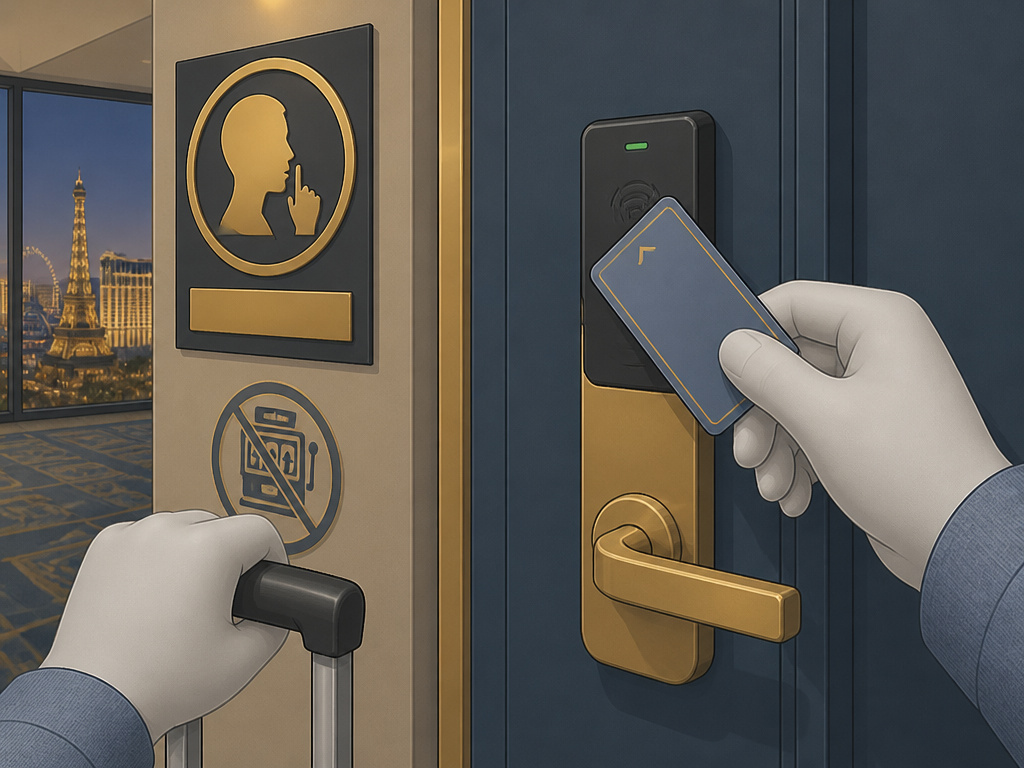
You wake at three in the morning to a slot machine chime through the wall, and the carpet has a smell you can’t place. That’s what a casino hotel sounds like at 3 a.m.
Lonely Planet names three casino-free properties on or near the Strip: the Waldorf Astoria, the Four Seasons, and Vdara. It also points to off-Strip Marriott and Hilton options for travellers who want quiet.
The standard “stay on the Strip” advice breaks the moment you want a quiet room. Here’s how to sort it:
- Casino hotel: cheapest headline rate, loudest small hours, and the walk to your room runs straight through the floor.
- Casino-free Strip property: quieter, still walkable to the corridor, and the pool scene is calmer.
- Off-Strip chain hotel: the quietest option, and the one that turns a car or a rideshare into a daily habit.
If you’re heading downtown instead, know what you’re booking. Circa’s Stadium Swim puts a 40-foot HD screen over the pool deck, per Lonely Planet, which is the opposite of quiet and worth checking before you take a room facing it.
Resort Fees: The Line Item That Rewrites Your Budget
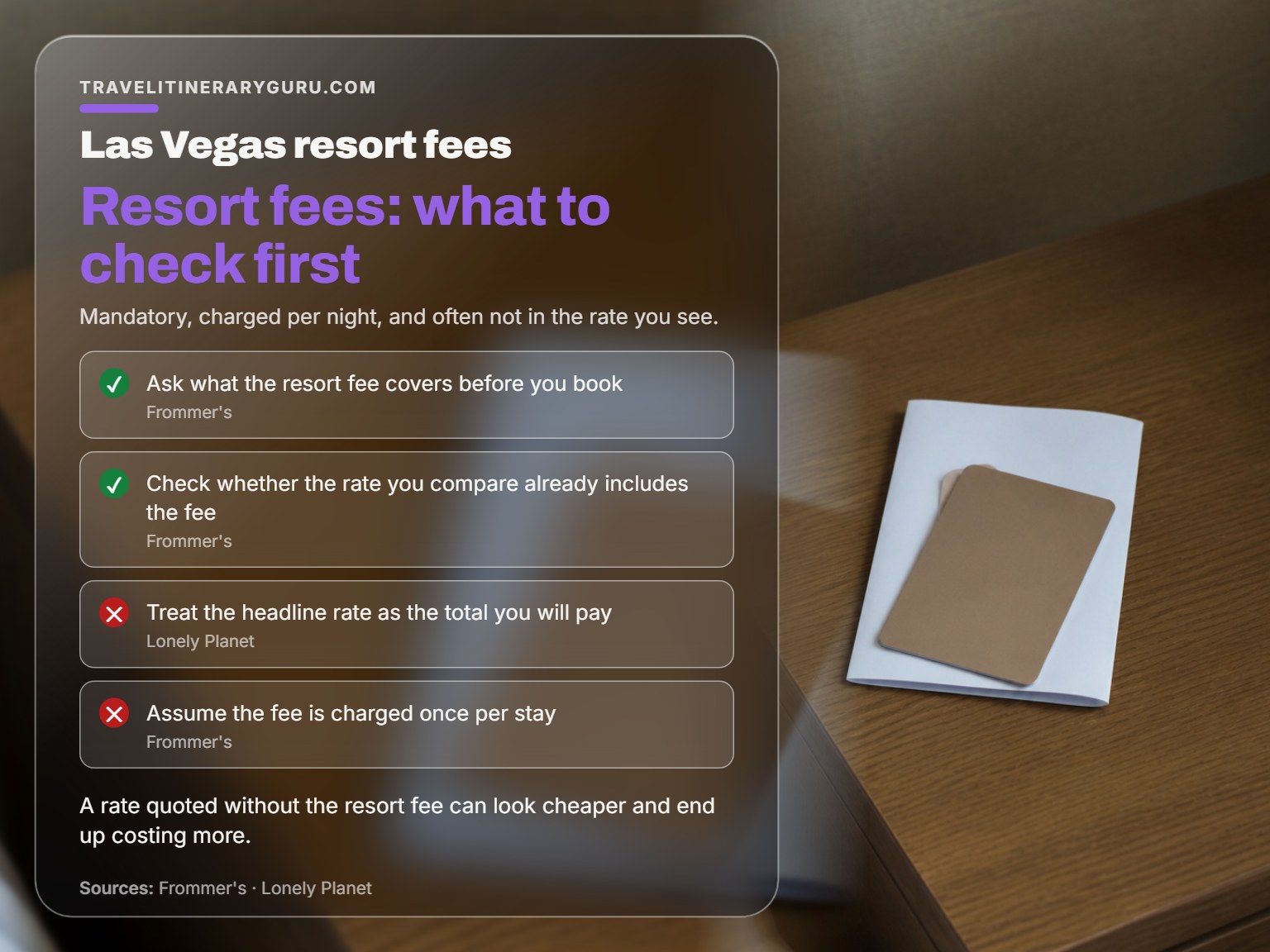
Lonely Planet names resort fees as the mechanism that turns a headline rate into a much bigger bill, and it is the only source in this set that puts a number on them. Treat any rate you see as a starting point rather than a total.
What a Resort Fee Usually Covers
Frommer’s notes that most major hotels fold wireless access into the nightly resort fee, though some still charge separately for it. The fee is mandatory and charged per night rather than per stay, so it stacks up over a longer trip.
Ask two questions before you book: what the resort fee covers, and whether the rate you’re comparing already includes it. Two properties can look far apart on a search page and land in the same place once the fee is added.
Worth knowing before you start: A rate quoted without the resort fee can look like the cheaper room and end up the more expensive one. Check the fee before you compare anything else.
When to Go, and Why the Calendar Beats the Weather
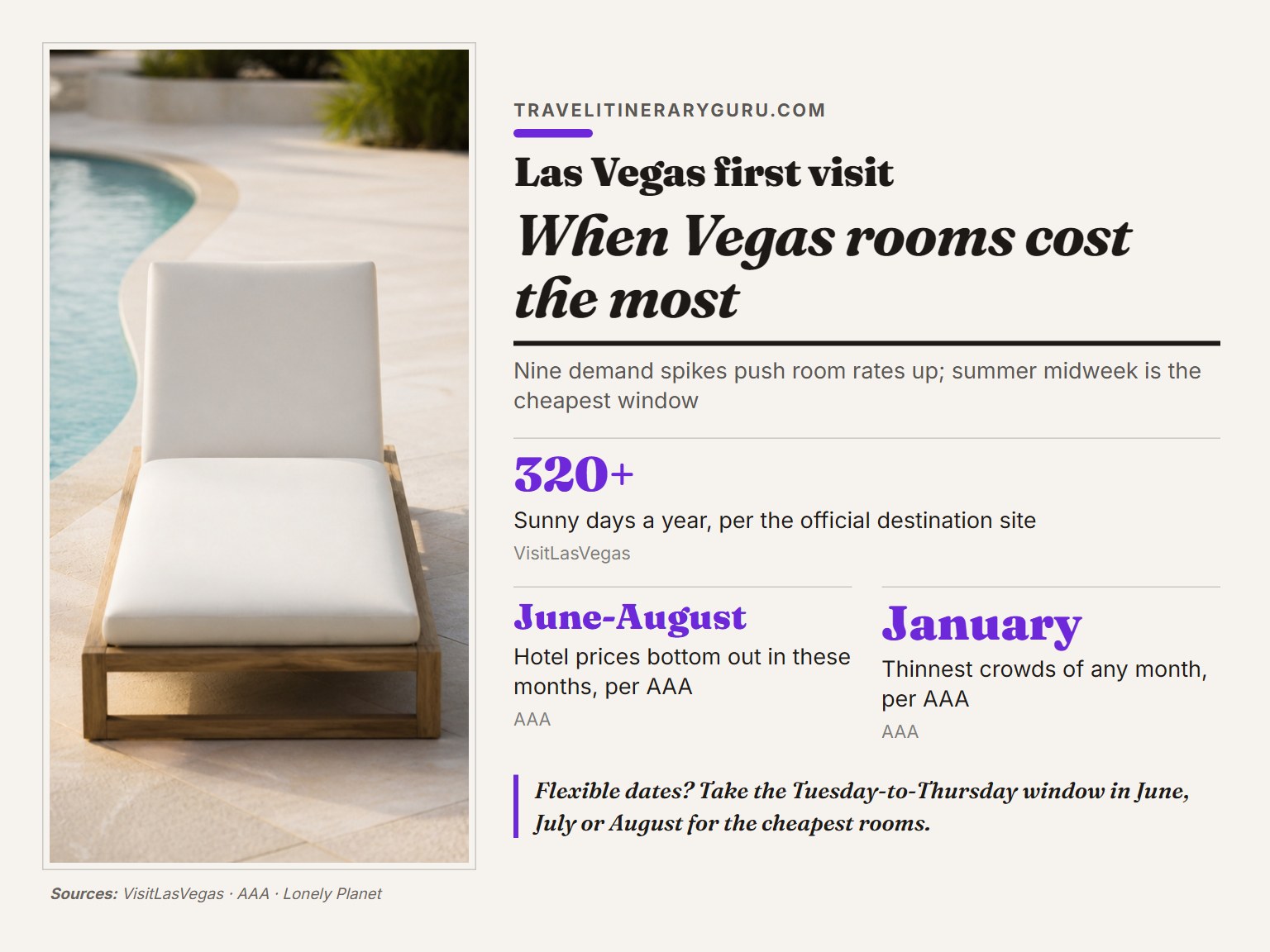
Lonely Planet lists nine demand spikes that push room rates up: Super Bowl weekend, the NCAA college basketball tournament, the NBA finals, Martin Luther King Day, Presidents’ Day, Memorial Day, July Fourth, Labor Day, and CES.
The ones that hurt most for a first visit:
- CES. The Consumer Electronics Show pulls international traffic, and Lonely Planet notes the airport adds flights to handle it.
- Super Bowl weekend and the NCAA tournament. Both fill the corridor solid.
- Federal holiday weekends. Memorial Day, July Fourth, and Labor Day draw travellers from across the country.
The Summer Discount Nobody Mentions
Summer midweek is the cheapest window of the year, and the reason is the heat. Lonely Planet treats the summer desert sun as a scheduling constraint and says midweek summer visits cut resort prices. AAA agrees that hotel prices bottom out between June and August, and adds that January sees the thinnest crowds of any month.
The official destination site takes a different tone. VisitLasVegas leads with the fact that the city gets more than 320 sunny days a year and frames summer as a matter of carrying water and sunblock. Lonely Planet calls the same sun “excruciating.” Both are describing the same weather. One is selling it.
If your dates are flexible, take the Tuesday-to-Thursday window in June, July, or August. You trade real heat for the cheapest rooms of the year, and the pools and indoor attractions are built for exactly that trade.
If you’re locking dates now, sketch the days before you book anything. A 3-day Las Vegas itinerary is the right length to test whether your plan survives contact with the walking.
What Goes Wrong on a First Vegas Trip, and How to Fix It
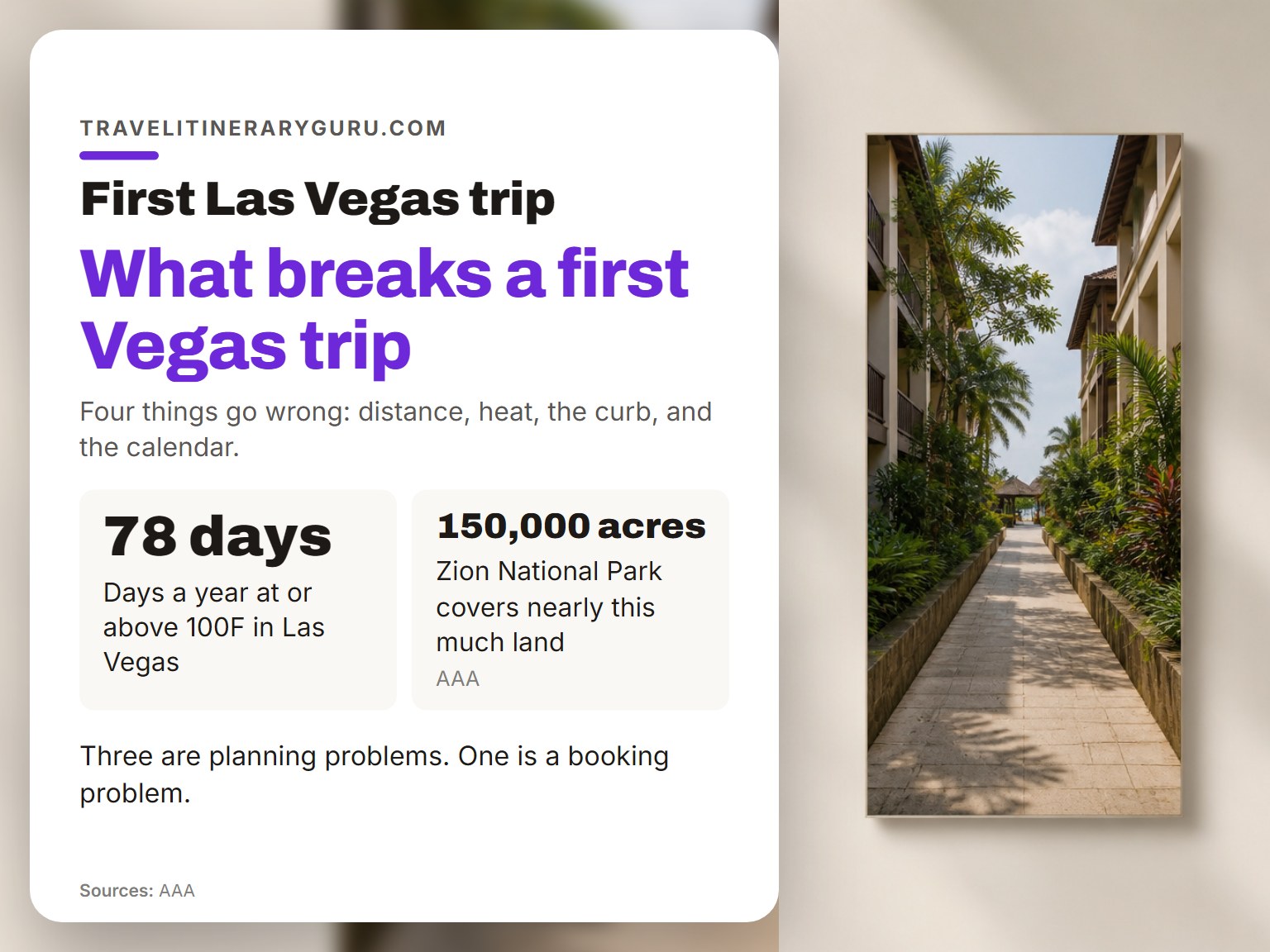
Four things break a first Vegas trip: distance, heat, the curb, and the calendar. Three are planning problems. One is a booking problem.
| What Goes Wrong | Why | The Fix |
|---|---|---|
| The day runs out of time | Resorts sit more than a mile apart on foot | Two anchors a day, not five |
| Midday walking wrecks you | 78 days a year at or above 100F | Walk early and after sunset |
| Rideshare can’t find you | Designated pickup zones behind resorts | Walk to the zone before you request |
| The show you wanted is gone | Tickets sell out days or weeks ahead | Book before you fly |
Where this goes sideways: Booking a day tour the morning you want to go. The early departures are gone by then, and you end up on a coach that reaches the rim at the hottest hour.
Day trips are the other thing first-timers get wrong. Zion National Park sits just over two hours from Las Vegas and covers nearly 150,000 acres, per AAA, which makes it a full day at minimum and a two-day trip if you want more than one trail. The day tours from Las Vegas market splits into coach trips and small-group vans, and the difference shows up in how long you actually get on the ground.
If the Grand Canyon is the point of the trip, give it its own block of days. A Grand Canyon from Las Vegas run needs an overnight to be worth the drive.
And if Vegas is one stop on a longer run, plan it as part of the American Southwest rather than a standalone city break. The drives to Zion and the Grand Canyon are why most people come.
The Rules, the Heat, and the Two Things You’ll Be Glad You Packed
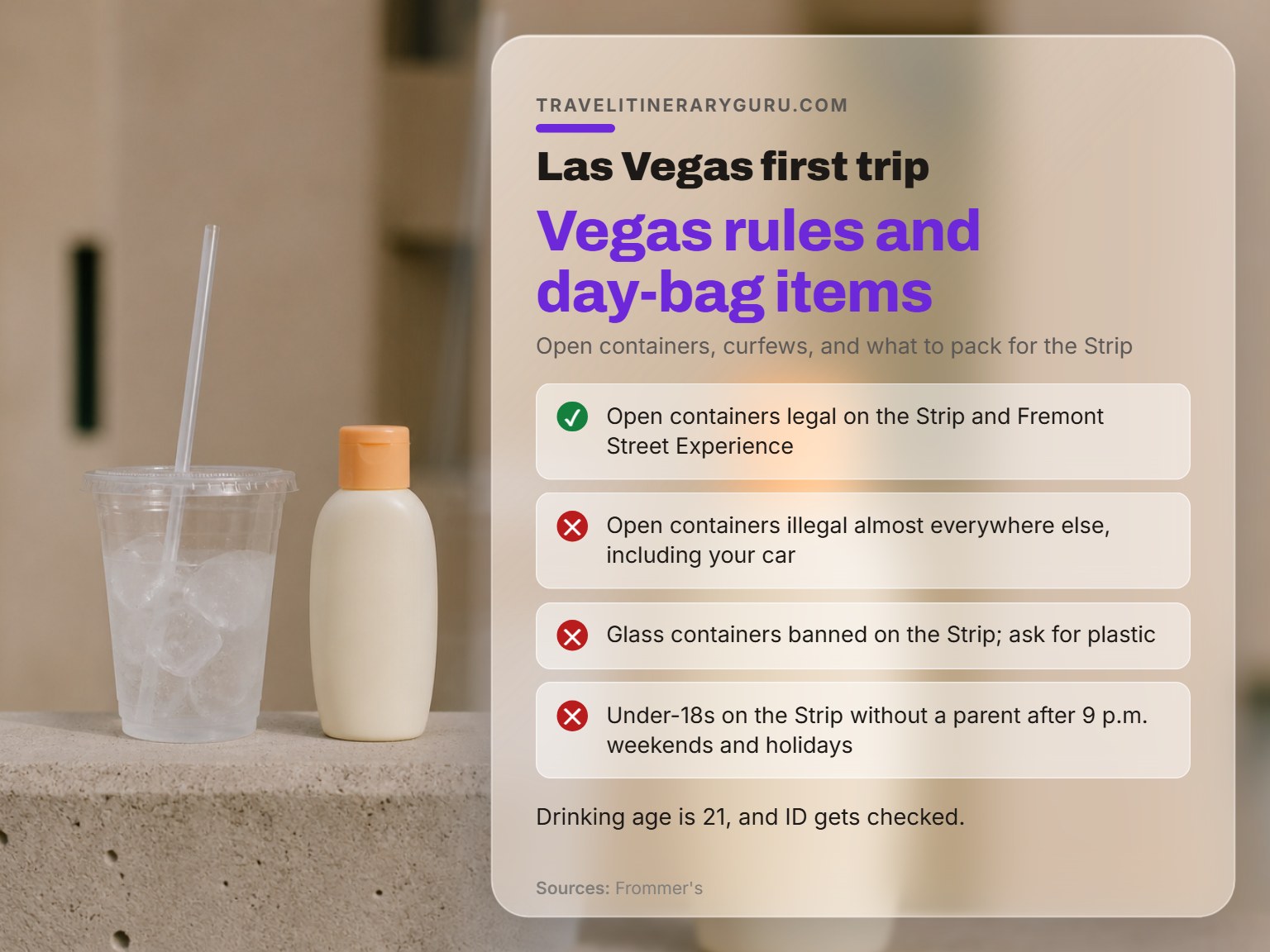
Las Vegas has a short list of local rules that catch visitors flat, and most of them are about alcohol.
Frommer’s lays out the ones that matter. Open containers are legal on the Strip and the Fremont Street Experience, and illegal almost everywhere else, including your car. Glass containers are banned on the Strip, so ask the bartender to move your drink into plastic. The drinking age is 21, and ID gets checked.
There’s a curfew too. Under-18s aren’t allowed on the Strip without a parent after 9 p.m. On weekends and holidays, per Frommer’s. In the rest of the county the line runs to 10 p.m. On school nights and midnight on weekends.
If something goes wrong, the Las Vegas Metropolitan Police Department tourist safety page publishes the contact hierarchy: 9-1-1 for emergencies, 3-1-1 for non-emergencies from a local line, and (702) 828-3111 for non-emergencies from outside the local exchange. Save those before you land.
For medical issues, Frommer’s names two options near the Strip: Sunrise Hospital on Maryland Parkway, and Las Vegas Strip Urgent Care, which runs an on-call doctor around the clock who will come to your hotel room.
The Day Bag, Item by Item
- Sunscreen at SPF 30 or higher. Frommer’s sets that as the minimum, and it applies on the walk between two hotels, not just at the pool.
- A refillable water bottle. Low desert humidity hides how much fluid you’re losing.
- A light layer for indoors. Casino air conditioning runs cold enough to need one in July.
- Broken-in walking shoes. Not new ones.
- A small flashlight. Frommer’s suggests one, and it earns its place in a hotel with 4,000 rooms.
One more thing worth knowing. Frommer’s notes that norovirus outbreaks have hit Las Vegas hotels, and that the virus spreads by contact. Wash your hands after you’ve been on the machines.
If Vegas is your first stop in the country rather than a standalone trip, the arrival paperwork changes the plan. Sort out your first trip to the USA details before you worry about the Strip.
Frequently Asked Questions
Do I need a car in Las Vegas?
No, and for a first visit it works against you. VisitLasVegas says you don’t need one, and AAA notes the single highway in and out is the region’s busiest. The Monorail, the Deuce bus, and rideshare cover the corridor. A car only pays off if you’re planning day trips to Zion or the Grand Canyon on your own schedule.
How many days should a first Vegas trip be?
Give the Strip a full day of walking before you add anything else. Most first-timers overbook and spend the trip in transit. Build in one afternoon with nothing scheduled, and treat Zion or the Grand Canyon as a separate block rather than squeezing either into a Strip day.
Is the Strip actually walkable?
Parts of it are, and the whole of it isn’t. Lonely Planet points out that a resort which looks three doors down may sit more than a mile away. Casino floors force indoor detours between properties, and entrances sit well back from the sidewalk. Walk short hops and ride the longer ones.
What is the best month for a first visit?
It depends on whether you’d rather fight heat or crowds. AAA says hotel prices bottom out between June and August, when the heat peaks, and that January sees the thinnest crowds of the year. Lonely Planet flags midweek summer as the cheapest window for the same reason. Pick the trade you can live with.
Can I walk around with a drink?
On the Strip and the Fremont Street Experience, yes, if you’re 21 or over. Frommer’s notes that open containers are illegal almost everywhere else, including in your car, and that glass containers are banned on the Strip. Ask for plastic before you leave the bar.
The Bottom Line
Here’s the rule that decides most first Vegas trips: if your plan has more than two anchors in a day, cut it. Two is the number that survives the walking, the heat, and the queue at the door.
The first thing to do this week is pick your base resort and find out what its resort fee actually covers. Everything else in the plan hangs off those two decisions, and both are cheaper to change now than after you’ve booked flights.
This all assumes a warm-weather visit. Come in January and the heat stops being a factor entirely while the crowds thin out, which makes it the easiest month to learn the city. Come in July and you’re planning around the sun instead.
I’d rather see you skip one must-see than sprint through four. The Strip rewards the person who sits down twice.
