
How to Use Basic Phrases in a Foreign Language
This post contains affiliate links. As an Amazon Associate, we earn from qualifying purchases.
You can learn how to use basic phrases in a foreign language by learning a small set of fixed expressions, matching each one to the right social situation, and practicing them out loud until they come without the textbook. The Council of Europe’s Tool 33, a refugee language-support list built on CEFR chapter 3, organizes these expressions by numbered communicative function, from 2.1 Thanking through 4.4 Confirming.
Most how to use basic phrases in a foreign language lists hand you a flat inventory and wish you luck. Tool 33 does something different: it tells you which function each phrase serves, and the reference numbers are identical across every language version of the list. That’s the mechanism for cross-language lookup.
So the list you memorize isn’t the point. The mapping is.
This guide walks through the greeting block on page 4 of Tool 33, the register restrictions that LSI flags and most lists ignore, the formal/familiar split that breaks Spanish in half, and a five-phrase method you can run in an afternoon. By the end you’ll know which phrases survive contact with a real conversation.
Key Takeaways
- Learn five phrases, not fifty. Tool 33’s function 2.1 covers thanking with one fixed string; you don’t need a vocabulary list to survive a cafe.
- Register matters more than vocabulary. LSI warns that “How’s it going?” is casual and shouldn’t be used in formal situations like a job interview.
- Spanish splits every greeting in two. The SIS booklet gives “How are you? (familiar) Como estas?” and “(formal) Como esta usted?” as separate entries.
- Direct translation requests are contested. Lifelearner says don’t ask “How do you say thank you?”; Tool 33 has a whole function (3.2) for exactly that question.
- Practice out loud until you can do it without peeking. That’s LangMedia’s instruction, not mine.
Which Greetings Actually Work Without Sounding Like a Textbook?
Tool 33’s greeting block sits on page 4 and lists “How are you?” under function 2.4 Greeting with no register restriction at all. It sits right next to formal address forms: “Good morning/afternoon/evening” and “Mr/Mrs/Miss + [name].”
That flat treatment is the problem. A learner reading Tool 33 would think “How are you?” is safe everywhere. LSI disagrees.
Tool 33 organizes expressions by communicative function, with reference numbers identical across every language version of the list. Function 2.4 covers greeting; function 2.5 covers answering greetings. The list is derived from CEFR chapter 3 and national Reference Level Descriptions, and was selected on the basis that refugees often have specific urgent needs when communicating in another language.
The disagreement is worth sitting with. LSI is a language school with a commercial product. Tool 33 is a Council of Europe publication with a standards lineage. Neither is wrong about the phrase itself, but they’re answering different questions: LSI is telling you when it sounds odd, and Tool 33 is telling you which function it performs.
Here’s the practical read. “How are you?” is fine with a shopkeeper, a hostel host, or someone your own age. It gets awkward with a professor, a customs officer, or a hotel manager you’ve just met. The phrase isn’t the issue. The room is.
For actual travel planning, this matters more than the phrase list does. If you’re already thinking about how you’ll handle cultural differences on a trip, the greeting question is the first one you’ll hit.
What’s Up? And How’s It Going? Are Not the Same Phrase
LSI treats “What’s up?” as a distinct casual greeting that requires only a minimal reply. “Not much. Just studying.” That’s it. You don’t explain what you’re doing.
Tool 33 has no equivalent item at all. Its nearest function is 4.2 Getting information, which covers “What did you say? Who is that?”, a genuine information request, not a phatic greeting.
So you have two sources, one phrase, and zero how to use basic phrases in a foreign language agreement on what it does. That’s not a research failure. That’s the actual state of the language.
The safest move: learn “What’s up?” as a phrase you recognize but don’t deploy. If someone greets you with it, “Not much” works as a reply. If you’re the one opening the conversation, use something with a clearer function.
Worth knowing before you start: “What’s up?” has no clean equivalent in most phrase lists because it’s doing two jobs at once, greeting and small talk. If you use it with someone who expects a real answer, you’ll get a confused look and a long pause.
The Spanish Formal/Familiar Split That Breaks Fixed Phrases
Spanish doesn’t let you memorize one version of “How are you?” and move on. The SIS Phrase Booklet, published by the Government of Trinidad and Tobago in 2008, gives both forms side by side: “How are you? (familiar form) Como estas?” and “(formal) Como esta usted?”
Same English string. Two Spanish answers. Pick wrong and you’ve just told a 60-year-old shopkeeper you consider them a peer.
It gets worse. “Where are you from?” splits the same way: “De donde es usted? / De donde eres (tu)?” The formal usted form is the default with strangers and elders. The familiar tu form is for people your own age or younger, and for anyone who’s invited you to use it.
The Illinois CLACS booklet, a four-language parallel table from the University of Illinois, shows a different kind of gap. It maps “Good morning,” “Good afternoon,” and “Good evening” all to the single Quechua form “Rimaykullayki.” Then it maps “Good night” to a different form entirely, “Paqarinkama.”
That collapse contradicts the one-to-one time-of-day mapping that SIS and LSI both assume. In Quechua, the three daytime greetings are one phrase. The nighttime one is separate. If you’re building a phrase list from an English template, you’ll get this wrong.
| English | Spanish (SIS 2008) | Quechua (CLACS) |
|---|---|---|
| Good morning | Buenos dias | Rimaykullayki |
| Good afternoon / Good evening | Buenas tardes | Rimaykullayki |
| Good night | Buenas noches | Paqarinkama |
| How are you? | Como estas / Como esta usted | Imaynalla kachkanki? |
| Thank you | Gracias | Kusikunim |
The table isn’t a translation tool. It’s a map of where the one-to-one assumption breaks.
If you’re heading somewhere with a very different greeting structure, it’s worth reading up on local customs in Japan or Middle East customs before you land, because the bow-vs-handshake-vs-cheek-kiss question is the one you’ll answer in the first thirty seconds.
Should You Ask “How Do You Say Thank You?” Directly?
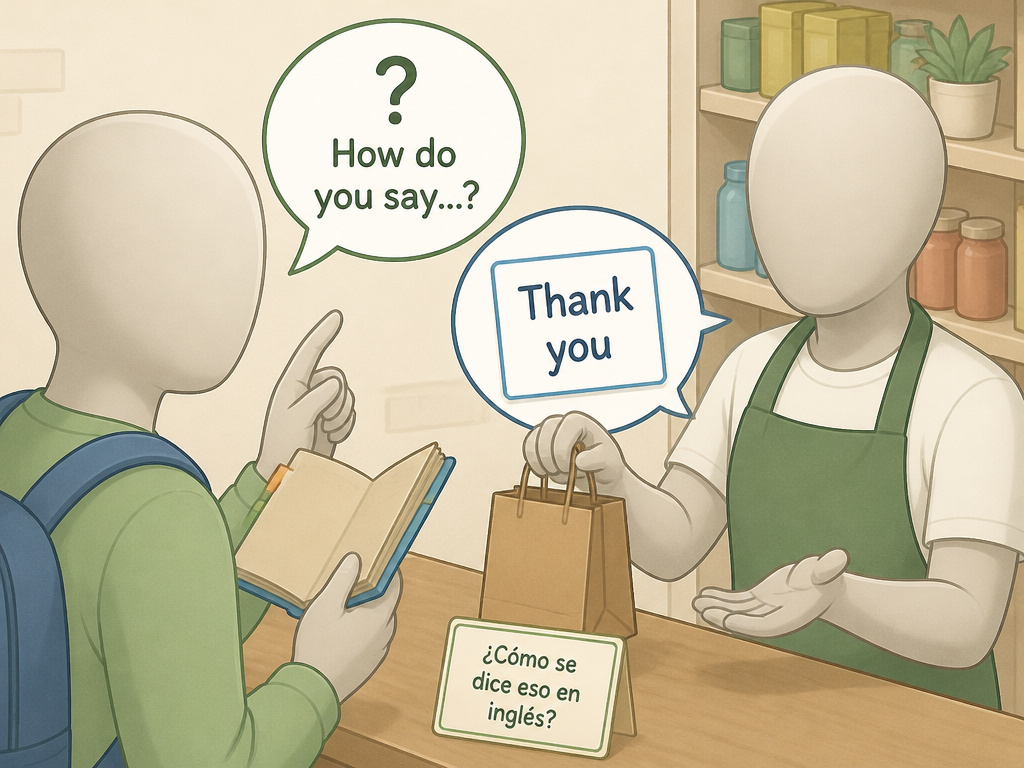
Two sources in this space give opposite answers, and both are worth hearing.
Lifelearner Network instructs learners not to ask for direct translations. Their example: don’t ask “How do you say thank you?” Ask “If you wanted to thank someone for doing something nice for you, what would you say?” The reasoning is that a direct translation gives you a phrase that’s grammatically correct but socially off.
Tool 33 does the opposite. It supplies a fixed phrase, “Thank you. Thank you very much.”, mapped to function 2.1, and separately provides function 3.2 for asking “How do you say… In English?” That’s a dedicated slot for the direct translation request. The Council of Europe treats it as a legitimate communicative act, not a learner error.
I see this advice a lot, and here’s why it falls apart on the ground: the right answer depends on who you’re asking. If you’re asking a language partner who can give you context, the Lifelearner approach wins. If you’re asking a shopkeeper in a hurry, “How do you say thank you?” is faster and gets you a usable phrase.
The SIS booklet includes the Spanish for exactly this situation: “Como se dice eso en ingles?” That’s a phrase you can use to ask about a phrase. Meta, but useful.
Common mistake: Asking a stranger for a direct translation and then using it immediately without checking register. You’ll get a correct word and the wrong tone.
A Five-Phrase Method You Can Run This Week
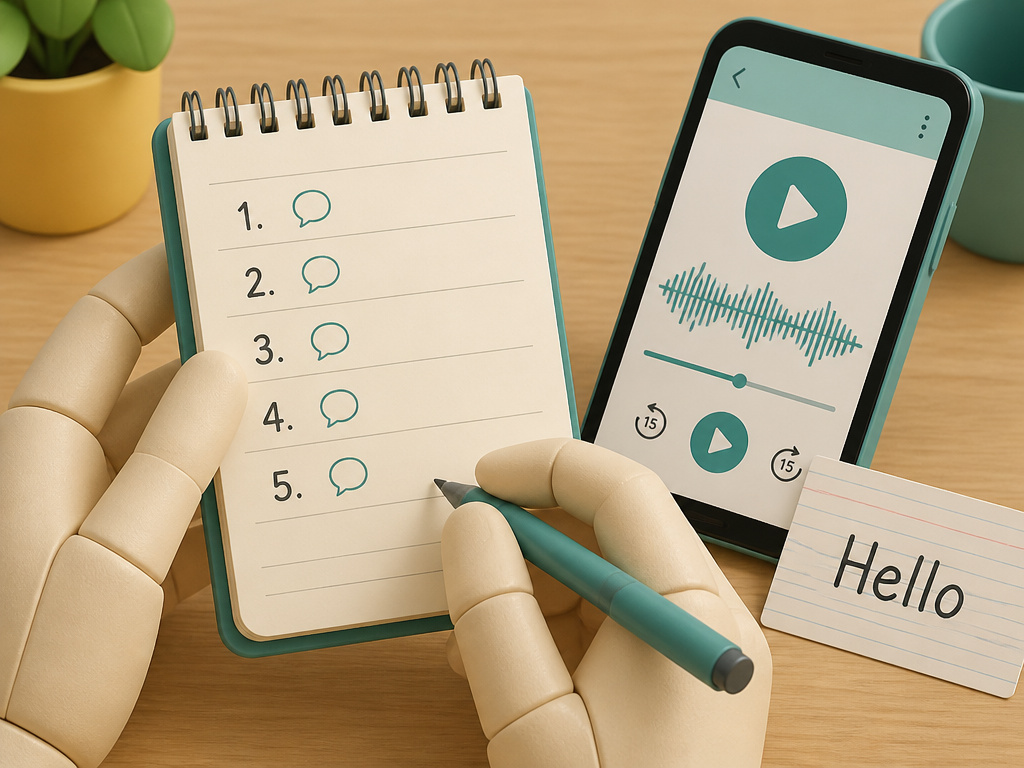
LangMedia’s instructions are specific and a little old-school. Memorize all the greetings, partings, and related phrases from your textbook. Use audio recordings to practice pronunciation. Pick a person and practice greeting them over and over until you can do it from memory without peeking. Then keep practicing throughout the week.
That’s the spine. Here’s how I’d compress it into five phrases you actually use.
- The greeting. Pick one. “Hello” or its local equivalent. Not three variants, one. You’ll use it fifty times a day and the repetition is what makes it stick.
- The thank-you. Tool 33’s function 2.1 gives one fixed string. Learn it as a single unit, not as two words you’re assembling. If you’re building a phrase list for a country where you don’t speak the language at all, this is an essential phrase.
- The excuse-me. Function 2.3 Attracting attention. You’ll use this more than you expect, to get past someone in a crowd, to flag a waiter, to interrupt a stranger politely.
- The “I don’t understand.” SIS gives “No entiendo / no comprendo” for Spanish. Tool 33’s function 3.2 covers asking how to say something. Both belong in your five.
- The “please speak more slowly.” SIS renders this as “Mas lento, por favor / Mas despacio, por favor.” Two versions, same meaning. Learn one.
That’s it. Five phrases. Not a vocabulary project.
Skip this if: You’re staying a very short time in a country where English is widely spoken at your hotels and restaurants. Five phrases will still help, but the return on the last three is small.
Why Practice Out Loud Beats Reading the List

LangMedia asks learners to consider whether they’re greeting one person or multiple people, a variable the textbook forms don’t cover. It also asks them to pay attention to cultural information about etiquette, hand and body gestures, and how far apart people stand.
Those aren’t decoration. They’re the difference between a phrase that lands and a phrase that doesn’t.
A greeting delivered at the wrong distance can be inappropriate. A thank-you said with the wrong hand gesture can be misunderstood. The words are only part of the exchange.
The practicing-out-loud instruction isn’t about pronunciation accuracy. It’s about building the muscle memory so you’re not reading off a card while someone waits. LangMedia’s specific ask, practice until you can do it from memory without peeking, is the whole method.
If you’re going to lean on apps, conversation translators can carry you through the moments where your five phrases run out. But they don’t replace the initial moments of a conversation.
Do You Need a Translator App or Just a Phrasebook?
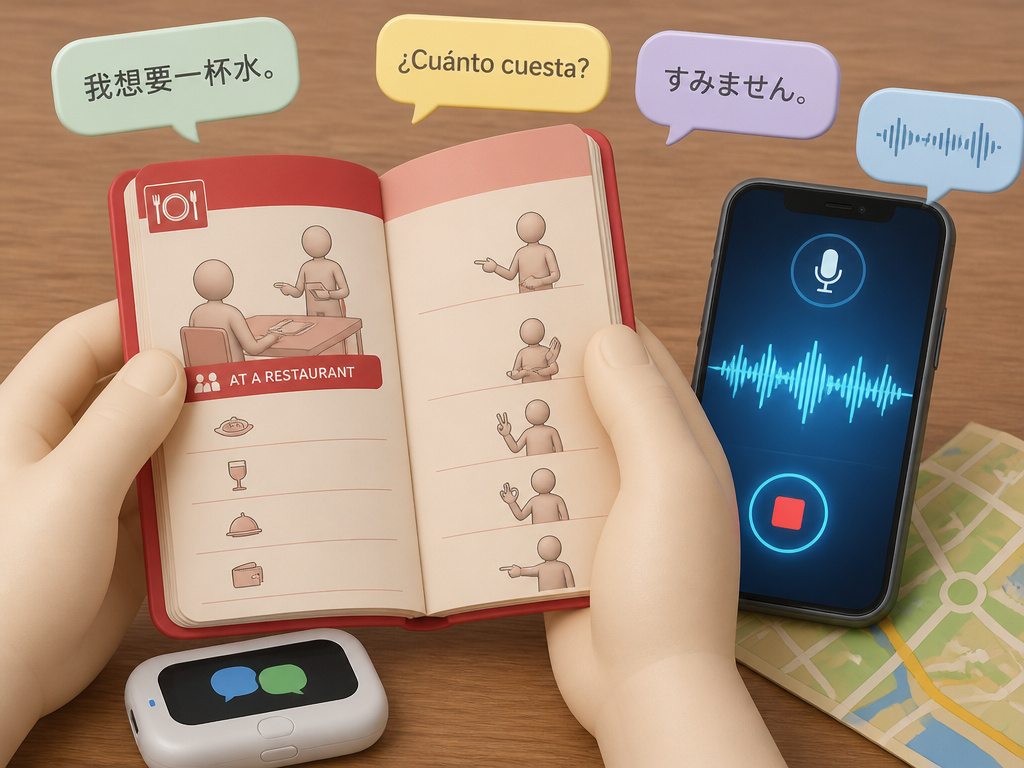
Both, and the answer depends on which failure mode you’re more worried about.
| Tool | Best For | Breaks Down When |
|---|---|---|
| Phrasebook | Offline, no battery, structured practice | You need a phrase not in the book |
| Conversation translator | Real-time back-and-forth with a local | Signal drops or the app mishears |
| Offline translator device | Remote areas, no data plan | You need nuance, not word-for-word |
| Voice translator | Quick questions, directions, transactions | The room is too loud to hear you |
The travel pocketbooks worth carrying are the ones that organize by situation, not alphabetically. A phrasebook sorted A-to-Z is not helpful when you’re standing in a pharmacy trying to describe a headache.
For the app side, language translators have gotten good enough that a quick typed question usually works. The weak spot is voice, voice translators still struggle with accents, background noise, and any language that isn’t on the top-20 list.
If you’re going somewhere with patchy signal, offline translators are worth the space in your bag. Download the language pack before you fly. The app that works perfectly at home may fail in a remote area.
When Not to Use Your Phrases
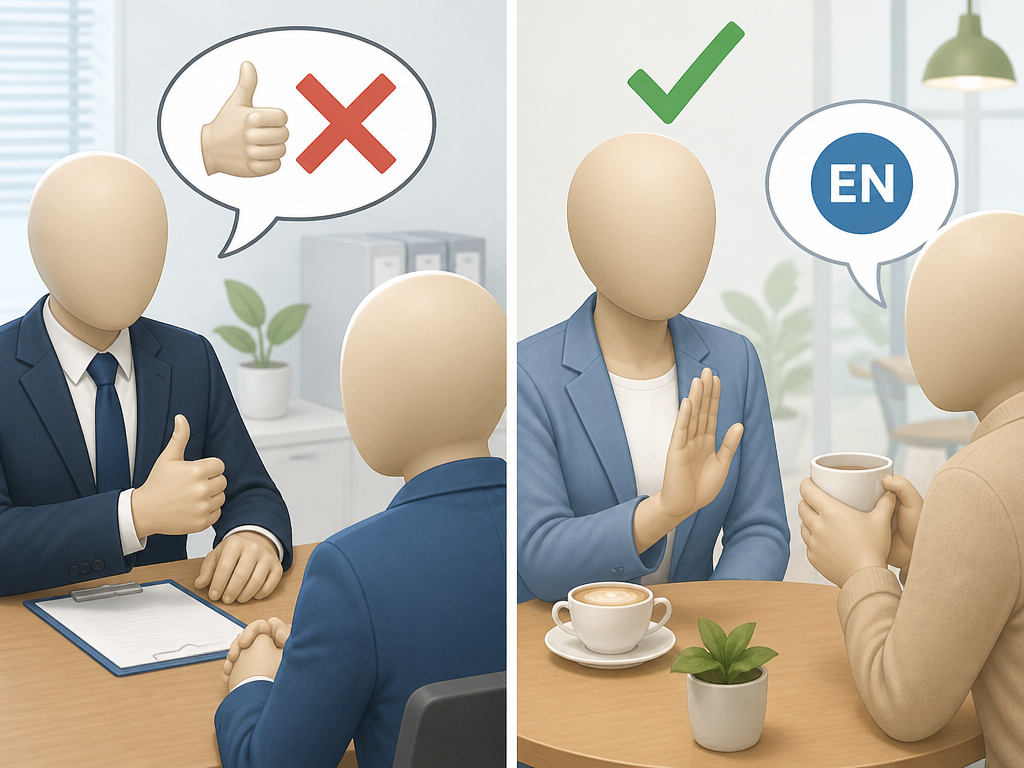
Two situations where the phrase you learned will actively hurt you.
First, in a formal or high-stakes setting. If you’re meeting a host family’s grandparents or a business contact, the casual register that works at a cafe may not be appropriate. LSI’s warning about “How’s it going?” in a job interview applies everywhere, the phrase is fine, the room is wrong. Watch what people around you do before you open your mouth.
Second, when you’ve been answered in English. If someone switches to English, they may be trying to help. Forcing the phrase you learned may not be helpful.
Where this goes sideways: Repeating a phrase louder when you’re not understood. Volume doesn’t fix vocabulary. If the first attempt didn’t land, slow down and try the “please speak more slowly” phrase, in their language, not yours.
Frequently Asked Questions
How many phrases do I actually need for a trip?
Five gets you through most of a two-week trip: hello, thank you, excuse me, I don’t understand, and please speak more slowly. Tool 33’s function list runs to dozens of items, but the list was built for refugees with urgent communication needs, not tourists. Five is enough to be polite and to signal effort.
Is it rude to use a translator app instead of speaking the language?
No, and the framing is wrong. A translator app is a tool, the same way a phrasebook was thirty years ago. What matters is whether you’re making an effort to connect. Using an app to ask a real question is effort. Using an app to avoid saying hello is not.
Why does my phrasebook give two versions of the same Spanish phrase?
Because Spanish has formal and familiar second-person forms, and they’re not interchangeable. The SIS booklet gives “How are you?” as both “Como estas?” (familiar) and “Como esta usted?” (formal). Use the formal with strangers, elders, and anyone in a service role. Use the familiar with people your own age who’ve invited it.
What do I do if I mispronounce a phrase badly?
Correct yourself and move on. Tool 33’s function 3.2 covers asking how to say something, which can help you correct yourself. The same principle works in reverse. A quick “sorry, let me try again” in their language resets the moment.
Do I need a different phrase list for every country?
For most of the world, no. The core five phrases translate cleanly. The exceptions are languages with register systems that split every greeting. Spanish, Japanese, Korean, and most of Southeast Asia. For those, learn the formal version first and let locals invite you into the casual one.
Are the numbered functions in Tool 33 useful for a traveler?
They’re useful as a mental map, not as a study list. Function 2.4 is greeting, 2.6 is leave-taking, 2.3 is attracting attention. Knowing which function a phrase serves tells you when to use it. Knowing the phrase alone doesn’t.
The Bottom Line
Here’s the part nobody tells you. The phrase list is the easy part. The hard part is reading the room.
Tool 33 gives you the functions. LSI gives you the register warnings. SIS gives you the formal/familiar split. LangMedia gives you the practice method. None of them can tell you whether the person in front of you wants a “How are you?” or a nod and a smile.
So learn five phrases. Practice them out loud. Then spend time in every new situation watching what the locals do, and copy that.
One specific thing to do this week: write your five phrases on an index card. The card doesn’t need a battery, and pulling it out at a border checkpoint takes three seconds instead of thirty.
