
How to Prevent Mosquito-Borne Illness While Traveling
This post contains affiliate links. As an Amazon Associate, we earn from qualifying purchases.
To learn how to prevent mosquito-borne illness while traveling, match three things: an EPA-registered repellent at the right concentration, permethrin-treated clothing and gear at 0.5%, and a net that stays tucked and taut. The CDC states plainly that none of these strategies protects 100% of the time, which is why you layer them instead of picking one.
That 0.5% permethrin figure isn’t a suggestion you can round up. The CDC specifies clothing and gear treated at exactly that concentration, and it names boots, socks, and tents as the items worth treating.
The rest of this walks through the concentration disagreements between agencies, the biting-time split that catches people who only guard dusk to dawn, and the night-time setup that decides whether any of it works while you sleep.
Key Takeaways
- Treat clothing and gear at 0.5% permethrin per CDC guidance; the net and the shirt are separate layers, not substitutes for each other.
- UKMEAG puts DEET at 50% as its first choice, NZ SafeTravel recommends 20-50%, and the CDC lists DEET with no percentage at all. Pick your agency and follow its number.
- Reapply when mosquitoes start landing, not on a timer. UKMEAG’s operational rule exists because packaging longevity rarely survives field conditions.
- Travellers apply roughly half the amount a repellent was tested at, according to UKMEAG, which is why stated protection windows fall short.
- Carry repellent from home. UKMEAG advises it specifically because of in-country shortages.
Why Dusk-to-Dawn Protection Is the Wrong Frame
The biting window depends on which mosquito you’re dealing with, and the agencies split on this. UKHSA separates the two groups cleanly: the mosquitoes spreading chikungunya, dengue, West Nile virus, yellow fever, and Zika mainly bite during the day and at dusk, while the malaria vectors mainly bite in the evening and at night.
Then UKMEAG adds the regional wrinkle. Biting of several major malaria vectors in Africa peaks at and just after midnight, so protection in bed carries the most weight there. In many parts of South America and South-East Asia, the greatest risk from malaria vectors lands in the evening, before people retire indoors.
That’s two different problems wearing the same name. A traveller who builds a how to prevent mosquito-borne illness while traveling routine and sleeps soundly is covered for the African pattern and partially exposed for the South-East Asian one.
Malaria-transmitting mosquitoes bite mainly in the evening and at night, while the mosquitoes spreading dengue, chikungunya, Zika, West Nile virus, and yellow fever bite during the day and at dusk. Protection measures are required across the full 24-hour cycle in affected regions.
Daytime precautions matter indoors as well as outdoors. UKMEAG notes that other mosquito species bite during daylight, so the “I’m inside, I’m fine” assumption doesn’t hold in a room without screens.
Which Repellent Concentration Actually Matches Your Destination
Here’s where the sources genuinely disagree, and I’d rather show you the split than pretend one number wins. The table below lays out what each agency actually publishes.
| Agency | DEET | Icaridin / Picaridin |
|---|---|---|
| UKMEAG (UK) | 50% as first choice | 20% preparation |
| NZ SafeTravel | 20-50% recommended | 20-25% recommended |
| CDC (US) | Listed, no percentage | Listed as picaridin (KBR 3023) |
Three positions on one variable. UKMEAG states 50% DEET as its named first choice. NZ SafeTravel gives a range. The CDC lists DEET as an active ingredient and goes no further than that.
The same split shows up on icaridin, which is the same chemical as picaridin under a different name. UKMEAG advises a 20% preparation if a traveller elects to use it for how to prevent mosquito-borne illness while traveling. NZ SafeTravel recommends 20-25%.
Where both agencies do converge is on icaridin’s performance at the 20% mark. UKMEAG states that icaridin has repellent properties comparable to DEET, with a comparable duration of protection, when both are used at 20%.
IR3535 is the third option, and UKMEAG is honest about its limits. In some studies it has shown a shorter duration of protection against mosquitoes than DEET at the same concentration, though it has been in safe and effective use for more than 25 years.
Common mistake: Buying a repellent without checking the active ingredient percentage on the label. “Contains DEET” tells you nothing about whether you’re carrying a 10% formulation or a 50% one, and the protection window scales with the number.
The Reapplication Rule That Beats the Label
Manufacturer packaging states a longevity window. UKMEAG says that window may not be achieved in the field, and more frequent application will be required.
The reason is partly physical and partly behavioural. UKMEAG lists the factors: mosquito biting pressure, sweat and run-off, swimming, mosquito species, and the attractants each individual produces. Several of those you can’t control.
One you can. UKMEAG identifies the amount of repellent applied to exposed skin as one of the most important factors affecting longevity, and notes that travellers tend to apply almost half the amount at which a product was tested under current protocols.
So the practical rule isn’t a clock. UKMEAG’s operational guidance is to reapply repellents when the mosquitoes begin to land, to ensure they don’t bite. That’s a behavioural trigger, and it’s more reliable than a stated longevity window you probably didn’t dose for in the first place.
I see this advice a lot, and here’s why it falls apart on the ground: people spray once at breakfast, feel protected, and stop paying attention by mid-afternoon. The mosquitoes tell you when the layer has thinned. Watch for them landing.
Permethrin-Treated Clothing and the 0.5% Spec
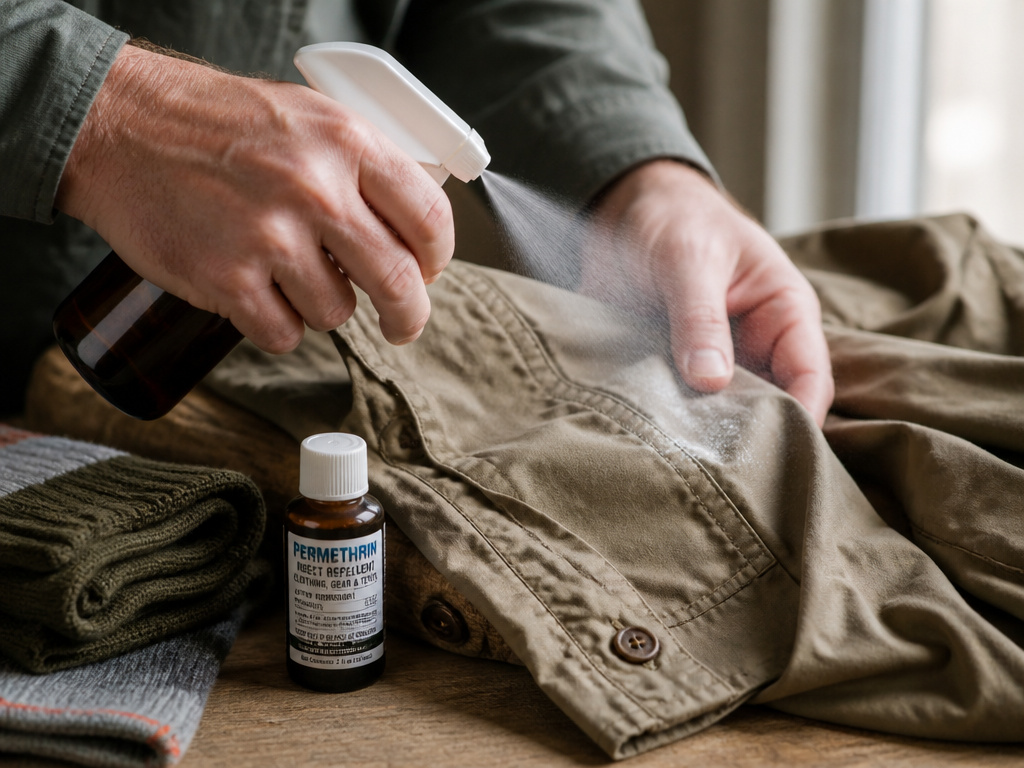
This is the layer most travellers skip, and it’s the one the CDC is most specific about. Clothing and gear, including boots, socks, and tents, treated with 0.5% permethrin is the stated concentration.
UKHSA confirms that permethrin-treated clothing and bed nets provide additional protection against biting mosquitoes. The word “additional” is doing real work there. It sits on top of repellent, not in place of it.
The CDC adds a clothing detail that matters more than people expect: wear loose-fitting, long-sleeved shirts and pants, because mosquitoes may bite through thin clothing.
UKHSA’s clothing list is specific too: long sleeves, trousers, skirts and dresses, socks and shoes.
Do Bed Nets Still Work, and Where Do They Fail?
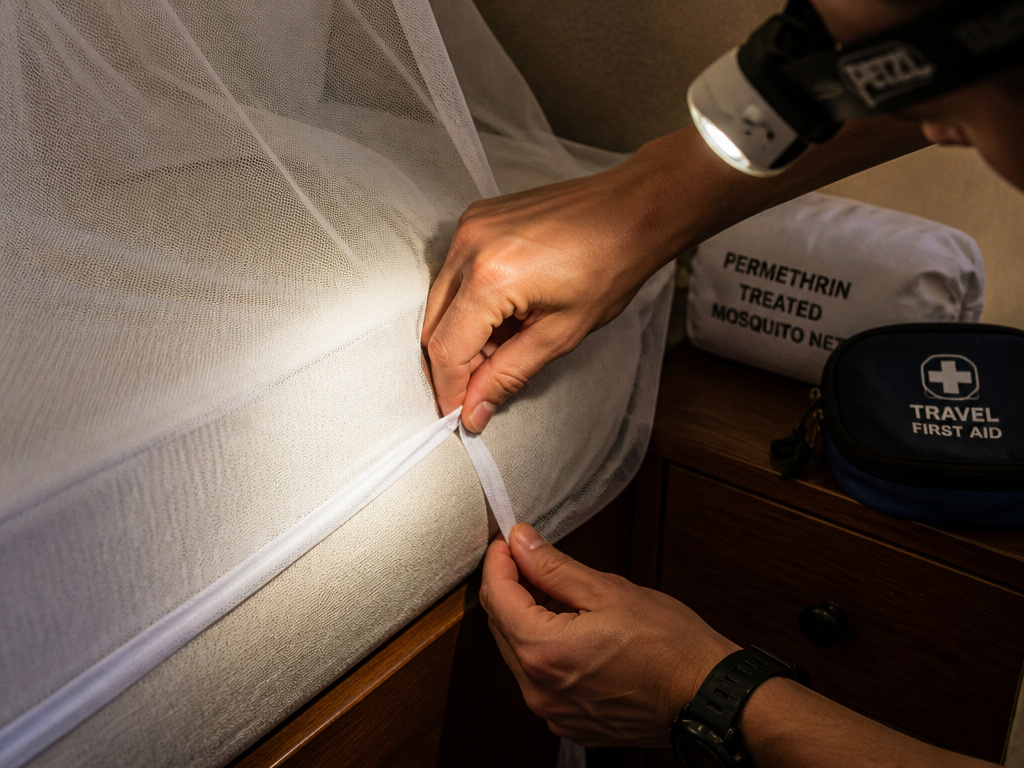
A net works when it’s set up correctly, and fails quietly when it isn’t. UKMEAG’s requirements are specific: free of tears, tucked in under the mattress, and taut rather than drooping.
Pyrethroid-impregnated nets add a second mechanism. UKMEAG explains that the insecticide helps prevent biting through the net on the parts of your body touching it.
Lifespan varies by net type. Long-lasting impregnated nets have an expected useful life of at least 3 years. Impregnated nets that aren’t LLINs need re-impregnation every 6 to 12 months, depending on how often the net gets washed.
Then there’s the midge problem, and NZ SafeTravel is the only source that flags it. The midges transmitting Oropouche virus are much smaller than mosquitoes, so traditional mosquito nets won’t protect against their bites. The CDC recommends permethrin-treated bed nets without that caveat.
If you’re choosing between net styles for a trip, the best mosquito nets for travel are the ones that match your sleeping setup. Check the mesh spec against where you’re actually going.
Air Conditioning, Screens, and the Room Re-Check
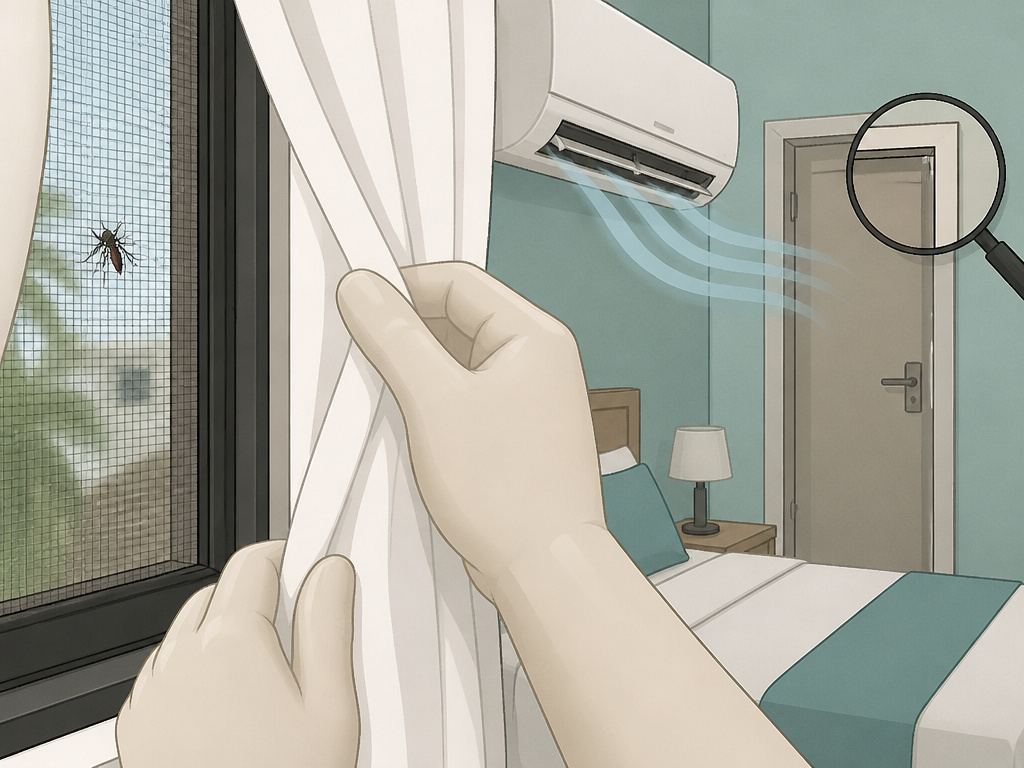
Air conditioning counts as protection, but only under conditions UKMEAG spells out. It permits sleeping without a net only in a well-screened room, or in a room with switched-on functioning air conditioning that mosquitoes can’t enter.
And then the clause most people miss: if the door has been opened, the room must be re-checked for mosquitoes.
NZ SafeTravel is looser here, advising travellers to turn on the air conditioning if available because cool air keeps mosquitoes away. Both point the same direction, but UKMEAG’s version has the re-check requirement attached.
The CDC’s framing on accommodation is the simplest version: look for lodging with screens or air conditioning, or pack a mosquito net. NZ SafeTravel advises staying in places with screens on windows and doors.
What Doesn’t Work, and Why It Keeps Selling
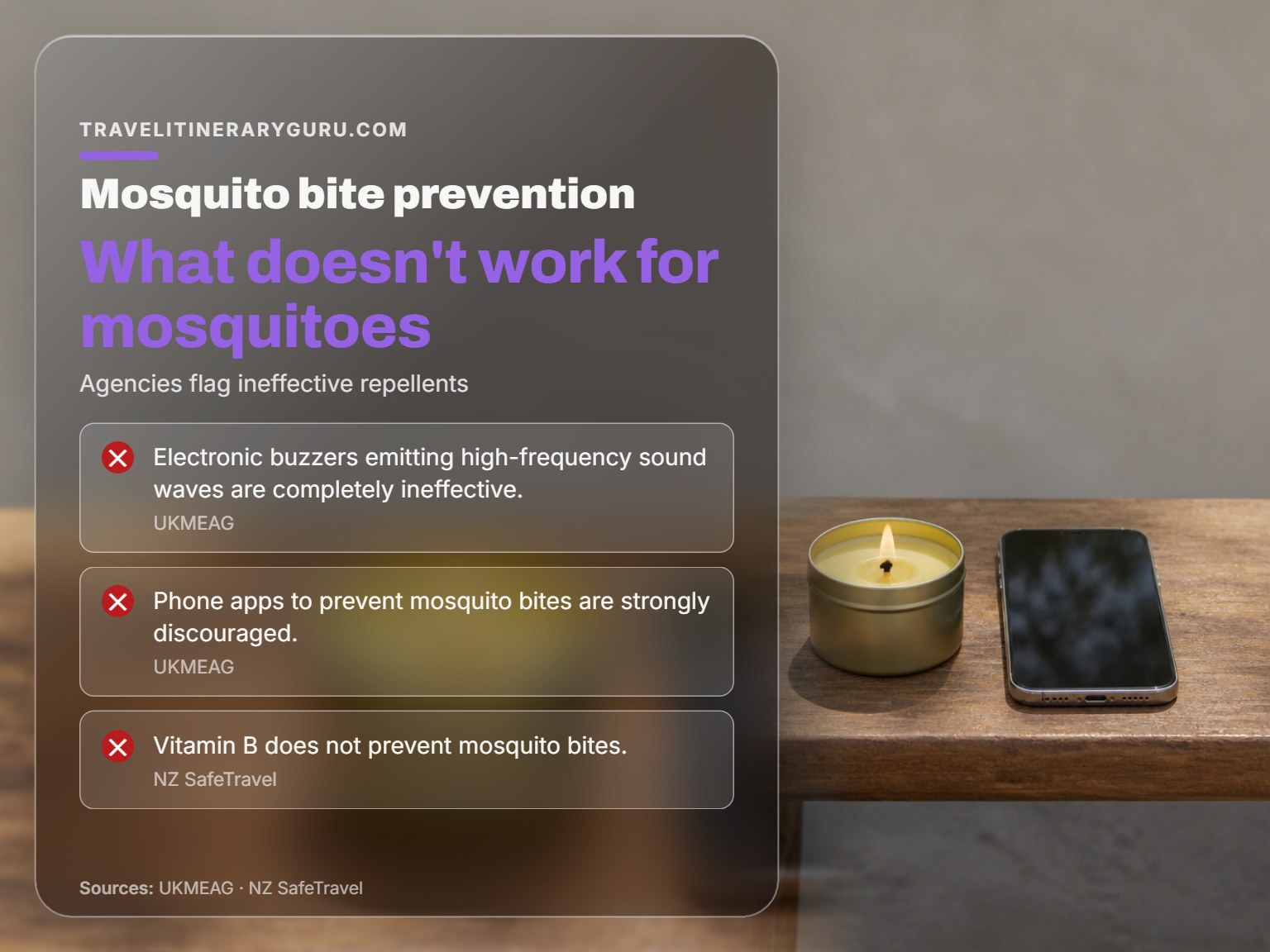
Electronic buzzers emitting high-frequency sound waves are completely ineffective as mosquito repellents. UKMEAG states this flatly and advises they shouldn’t be used.
Phone apps designed to prevent mosquito bites get the same treatment. UKMEAG strongly discourages them.
Vitamin B gets a single, clean denial from NZ SafeTravel: it does not prevent mosquito bites. The CDC and UKMEAG don’t mention it at all, which is silence rather than endorsement.
Plant-derived repellents sit in a genuine disagreement between agencies. The CDC lists oil of lemon eucalyptus and 2-undecanone among EPA-registered active ingredients that are proven safe and effective when used as directed. UKMEAG says volatile plant oils including citronella are usually short-lasting, and that there’s insufficient data to support blends of those oils as reliable repellents.
Both positions can be true. OLE is a registered active with a defined concentration. A citronella blend candle is not the same product, and UKMEAG is dismissing the blend category, not the registered actives.
Where this goes sideways: Relying on a citronella blend as your only layer. UKMEAG rates volatile plant oils as usually short-lasting, so the protection window collapses well before a long evening outdoors ends.
Vaccines, Antimalarials, and What to Sort Before You Fly
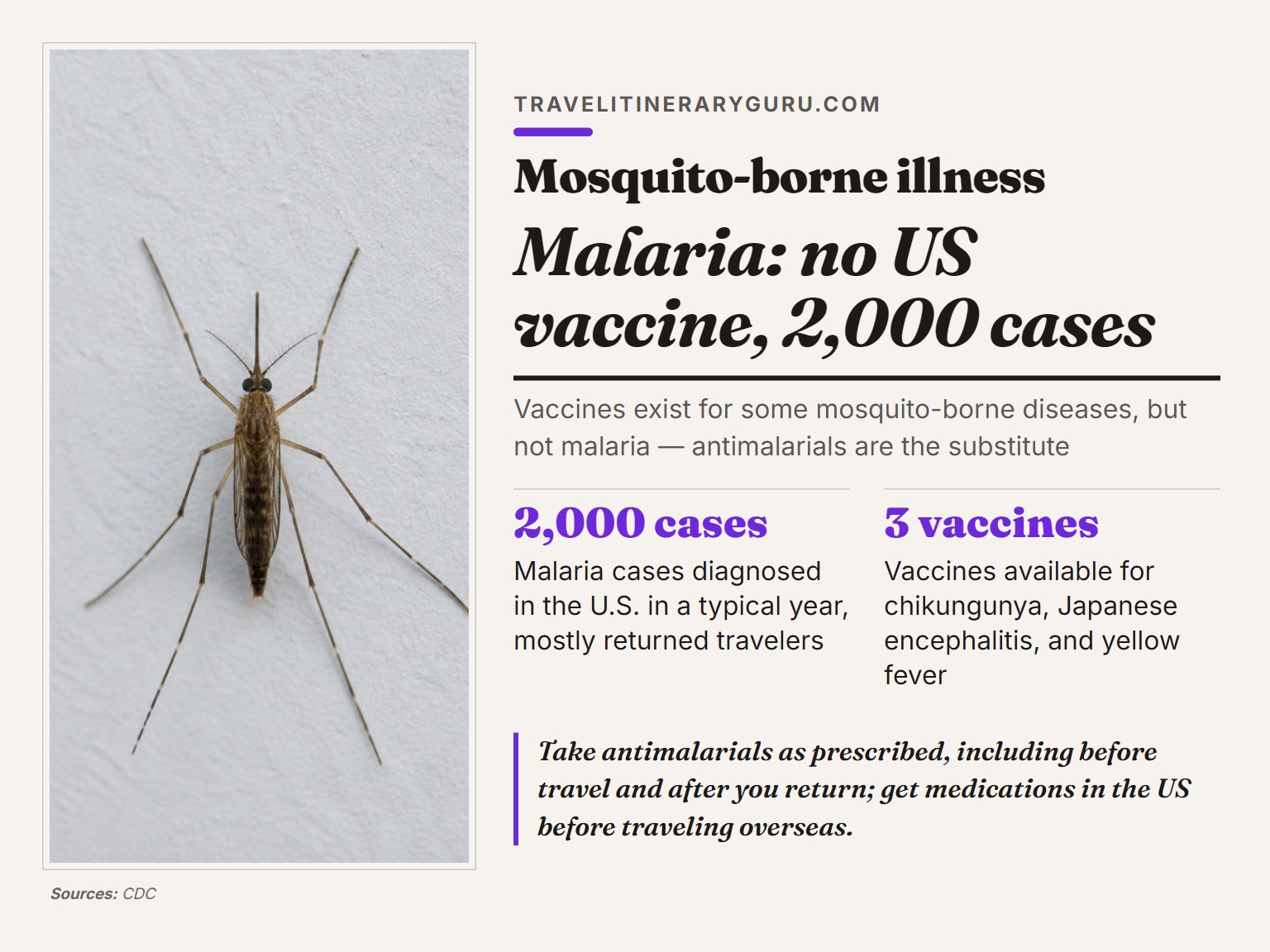
Vaccines exist for some of these diseases and not others. The CDC lists chikungunya, Japanese encephalitis, and yellow fever as vaccine-preventable, and advises travellers to find out if vaccines for mosquito-borne diseases are available.
Malaria is the exception. There is no vaccine for malaria currently available in the US, per the CDC.
Antimalarials are the substitute, and the CDC’s instructions are strict: take them as prescribed, including the period before travel and after you return. The CDC also warns that counterfeit or substandard drugs are sold in some countries where malaria spreads, and advises getting all medications, including antimalarials, in the US before traveling overseas.
Bite prevention doesn’t stop because you’re medicated. The CDC states you should avoid mosquito bites even if you’re taking medications to prevent malaria, as an added layer.
One more thing worth knowing: acquired immunity to malaria weakens the longer you’re away from an area where it’s widespread. The CDC notes that if you’ve been away from your country of origin, even a short time, you can lose protective immunity quickly and should use the same measures as any other traveller.
If you’re weighing which shots are worth the appointment, the travel vaccine guide walks through matching vaccines to your actual itinerary.
After You Land: The Three-Week Rule Most People Skip
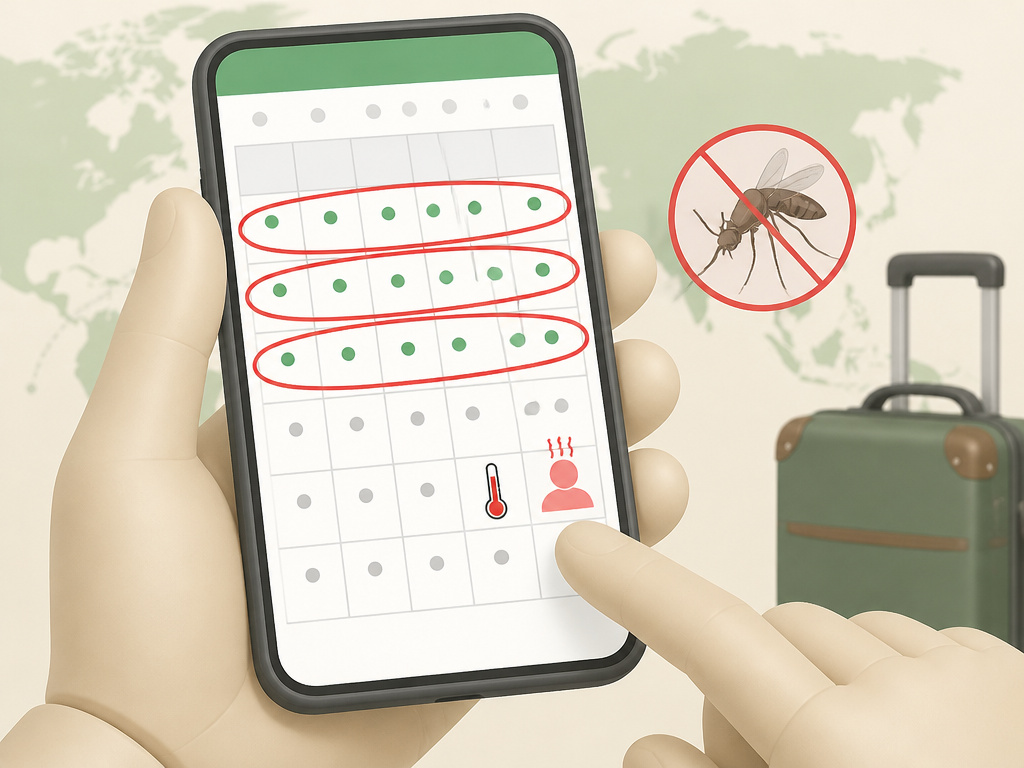
The CDC’s post-trip guidance is the one that gets ignored because the holiday is over. After your trip, prevent mosquito bites for 3 weeks to avoid spreading dengue, chikungunya, and Zika to uninfected mosquitoes.
Three weeks. That’s the CDC’s stated window for preventing mosquito bites after your trip to avoid spreading dengue, chikungunya, and Zika to uninfected mosquitoes.
The CDC also asks travellers to watch for symptoms after returning. If you have a fever or flu-like illness while traveling in an area where malaria spreads, or after returning home for up to one year, seek immediate medical attention.
That one-year figure is not a typo. It’s the CDC’s stated window for seeking medical attention for fever or flu-like illness after return.
Worth knowing before you start: Fever after a malaria-region trip is a medical appointment, not a wait-and-see. The CDC’s guidance is immediate medical attention, with your travel history stated up front.
If something does go wrong on the road, knowing how to handle a medical emergency abroad before you need it is worth planning for.
Frequently Asked Questions
What percentage of DEET should I use?
It depends which agency you follow. UKMEAG states 50% DEET as its first choice for malaria prevention. NZ SafeTravel recommends 20-50%. The CDC lists DEET as an active ingredient without specifying a percentage.
Can pregnant women and young children use DEET?
UKMEAG permits DEET at up to 50% for pregnant women, including the first trimester, and states that 20% DEET used in the second and third trimesters was not associated with adverse effects on infants followed for up to 12 months after birth. DEET may be used at up to 50% by women who are breastfeeding and for infants and children aged over 2 months.
Do mosquito nets actually work?
Yes, when they’re set up correctly. UKMEAG requires nets to be free of tears, tucked under the mattress, and taut rather than drooping. Pyrethroid-impregnated nets add protection against biting through the fabric where your body touches it. The exception is Oropouche regions, where NZ SafeTravel warns that the midges are much smaller than mosquitoes so traditional mosquito nets will not protect against their bites.
Is icaridin as good as DEET?
At 20%, UKMEAG rates icaridin’s repellent properties as comparable to DEET, with a comparable duration of protection when both are used at that concentration. UKMEAG advises a 20% preparation if you choose icaridin. NZ SafeTravel recommends 20-25% picaridin, which is the same chemical under its other name.
Do I still need bite prevention if I’m taking antimalarials?
Yes. The CDC states you should avoid mosquito bites even if you’re taking medications to prevent malaria, describing bite prevention as an added layer. UKMEAG states that effective bite prevention should be the first line of defence against malarial infection.
Does vitamin B keep mosquitoes away?
No. NZ SafeTravel states directly that vitamin B does not prevent mosquito bites. NZ SafeTravel states directly that vitamin B does not prevent mosquito bites.
The Bottom Line
Three layers, in this order: permethrin-treated clothing and gear at 0.5%, an EPA-registered repellent at a concentration your chosen agency publishes, and a net that’s tucked in and taut. Get those right and you’ve covered the CDC’s guidance, UKMEAG’s emphasis on protection in bed, and NZ SafeTravel’s advice to take protective measures throughout the day.
Here’s the threshold I’d give you. If your destination is in sub-Saharan Africa, the midnight biting peak means your in-bed protection is the layer that carries the most weight. If you’re heading to South America or South-East Asia, note that the greatest risk from malaria vectors is in the evening before people retire indoors, and don’t drop your daytime precautions either.
And the one step to take this week: check the active ingredient percentage on whatever repellent you already own. If the label says “contains DEET” and nothing else, you don’t know what you’re carrying. Buy a formulation with a stated concentration from a source you trust, and pack it in your hand luggage so it travels with you.
Fair warning on the rest. I’m a planner, not a clinician, and the concentration disagreements above are real. Pick the agency that governs your travel health advice, follow its number, and treat everything else as a second opinion.
