
How to Choose a Food Tour for Vegetarians: 5 Questions
This post contains affiliate links. As an Amazon Associate, we earn from qualifying purchases.
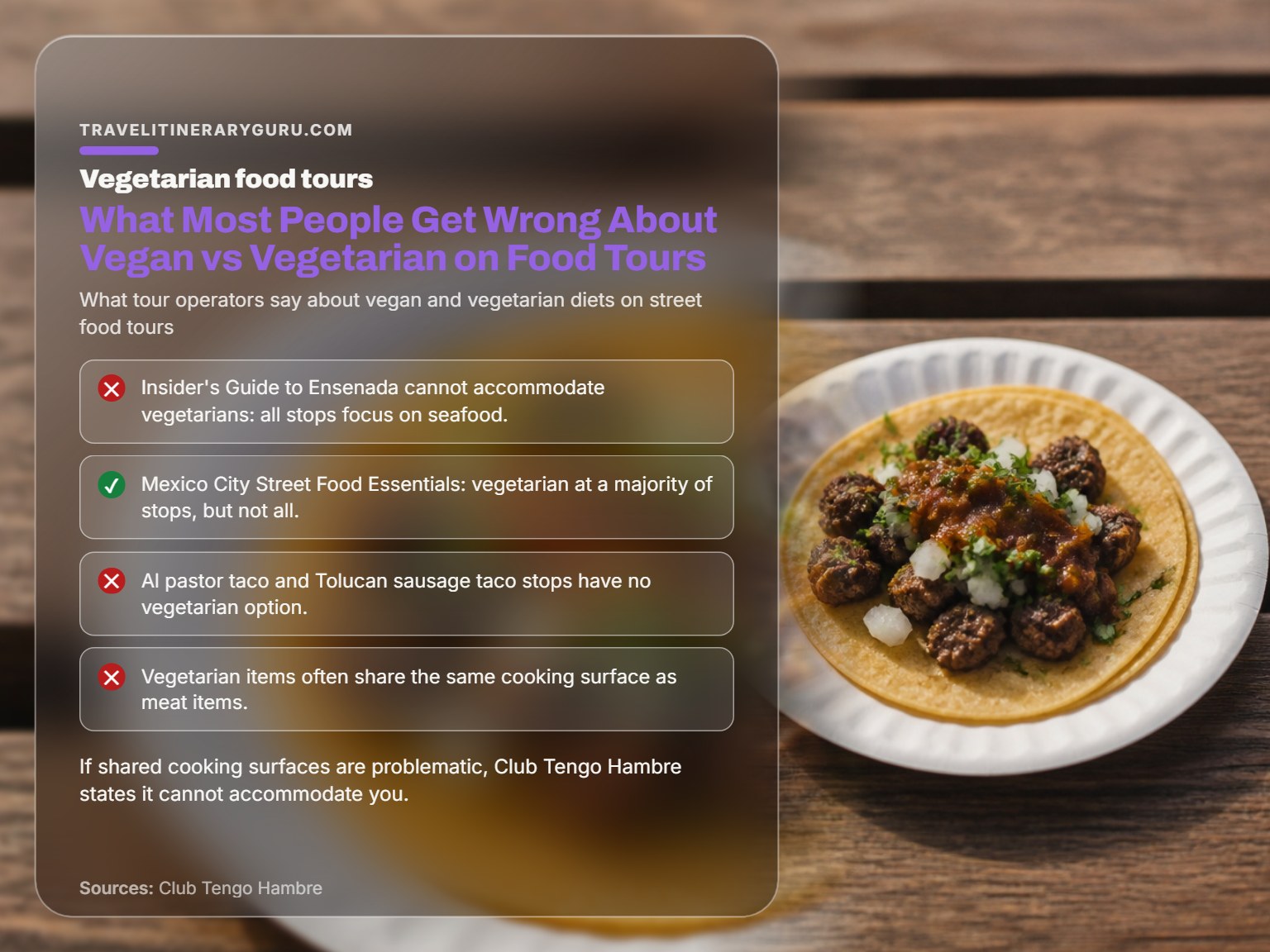
Vegetarian accommodation on a food tour is not a yes-or-no question. Club Tengo Hambre confirms vegetarian options at a majority of stops on its Mexico City Street Food Essentials tour, but not all. The al pastor taco stop and the Tolucan sausage taco stop have no vegetarian option at all. The operator’s stated workaround: load vegetarian guests up at the stops that do have options.
What follows is the operator-by-operator breakdown, the questions that actually surface answers, and the one category of stop that no amount of advance notice can fix. It is also a practical guide to how to choose a food tour for vegetarians.
Key Takeaways
- Ask for a stop-by-stop list, not a policy statement. “We can accommodate most diets” tells you nothing. Club Tengo Hambre names its exceptions; most operators don’t.
- Single-item stops cannot be adapted. The al pastor taco stop is built around one dish. Notice in advance doesn’t create a vegetarian version of a dish that doesn’t have one.
- Pork fat is the hidden variable. Club Tengo Hambre discloses that pork fat is often used as a cooking oil for vegetarian ingredients and as a flavoring agent in beans and salsas. Most operators don’t mention this.
- Vegan is a different question entirely. Club Tengo Hambre states it cannot accommodate vegan diets because street food items are cooked alongside or near non-vegan ingredients.
- Allergies are a hard no at some operators. Club Tengo Hambre states it cannot accommodate food allergies of any kind. Food Tours of America says it can usually accommodate most dietary requests. Those are opposite positions.
Which Food Tour Operators Actually Say Yes to Vegetarians?
Two operators publish enough detail to compare, and they land in very different places. Club Tengo Hambre names specific stops and specific exceptions. Food Tours of America offers a general formula: accommodation is “subject to partner restaurants’ capability and with advance notice.”
A food tour operator that publishes a stop-by-stop dietary policy is giving you a document you can act on. An operator that publishes a general accommodation statement is giving you a promise. The difference shows up on the day, when the guide is standing in front of a single-item taco stand and you are the one asking what you can eat.
The honest read on how to choose a food tour for vegetarians: Club Tengo Hambre is harder to book with as a strict vegetarian, but you know exactly what you’re getting. Food Tours of America is easier to book with, but you’re relying on the advance-notice system to work across multiple partner restaurants you’ve never seen.
Here’s the practical wisdom. A restrictive disclosure you can plan around beats a permissive general statement you can’t verify.
The Single-Item Stop Problem
Some stops are built around one dish. The al pastor taco stop on Club Tengo Hambre’s Mexico City tour is one. The Tolucan sausage taco stop is another. The barbacoa taco stop on the Oaxaca Street Food Essentials tour is a third.
At those stops, there is no vegetarian version. The dish is the stop. You can’t ask the kitchen to hold the meat because the meat is the entire reason the tour stops there.
Where this goes sideways: Assuming advance notice fixes every stop. It doesn’t. Notice gives the operator time to plan around a fixed menu; it cannot rewrite a menu that has one item on it.
This is the part of the vegetarian food tour conversation that gets skipped. Most advice says “contact the operator in advance.” That advice is correct and incomplete. Advance notice works at stops with a menu. It does nothing at stops with a dish.
What “We Load Vegetarian Guests Up” Actually Means
Club Tengo Hambre’s stated practice is to over-serve vegetarian guests at the stops that do have options. That’s a real accommodation, and it’s also a structural compromise. Your itinerary is uneven by design.
Think about how this plays out.
Foodtours.com.au makes a related point in its dietary guide: ask whether substitutions are equivalent or whether you will receive something smaller. That’s the right question. “We’ll make it up at other stops” is an answer, but it’s an answer about volume, not about parity.
How Do You Ask a Tour Operator About Vegetarian Options Without Getting a Vague Answer?
You ask for specifics the operator can’t dodge. A general policy question gets a general policy answer. A stop-by-stop question gets a stop-by-stop answer or an admission that the operator doesn’t have one.
I am interested in joining this food tour on [date]. I follow a vegetarian diet and do not eat meat, poultry, fish, or meat-based broths. Could you list which stops can accommodate me, what substitutions are available, and whether shared cooking surfaces are a concern? Are there any tastings I would need to skip? Please also confirm whether there is advance notice required and whether substitutions affect the booking.
The last two sentences do the work. “Which stops can accommodate me” forces a list. “Whether shared cooking surfaces are a concern” forces a disclosure that most operators would rather not make.
If you get back a paragraph that says “we can accommodate most dietary requests with advance notice,” you have your answer. That operator doesn’t know, or won’t say.
The Questions That Separate Real Answers From Marketing
- Which specific stops cannot accommodate a vegetarian? If the answer is “none,” ask them to name the stops. If they can’t name the stops, they haven’t checked.
- Are the vegetarian items cooked on the same surface as meat items? This is the cross-contact question. Club Tengo Hambre discloses that vegetarian items often share the same cooking surface as meat items.
- Is pork fat or any animal fat used as a cooking medium? Club Tengo Hambre states that pork fat is often used as a cooking oil for vegetarian ingredients and as a flavoring agent in everything from beans to salsas. Most operators don’t disclose this.
- If a stop has no vegetarian option, what do I receive instead? “Nothing” is a valid answer. You want to know before you’re standing there.
- Are substitutions equivalent in size and quality? Foodtours.com.au recommends this question specifically. A smaller plate at the same stop is a different experience than a full plate.
- What happens if a venue can’t provide the alternative on the day? Recipes and staffing change. A written answer from booking time isn’t a guarantee about the plate in front of you.
The best operators answer all six when you ask how to choose a food tour for vegetarians. The rest give you the general formula.
Why Gluten-Free Is Sometimes Easier Than Vegetarian on a Mexican Food Tour

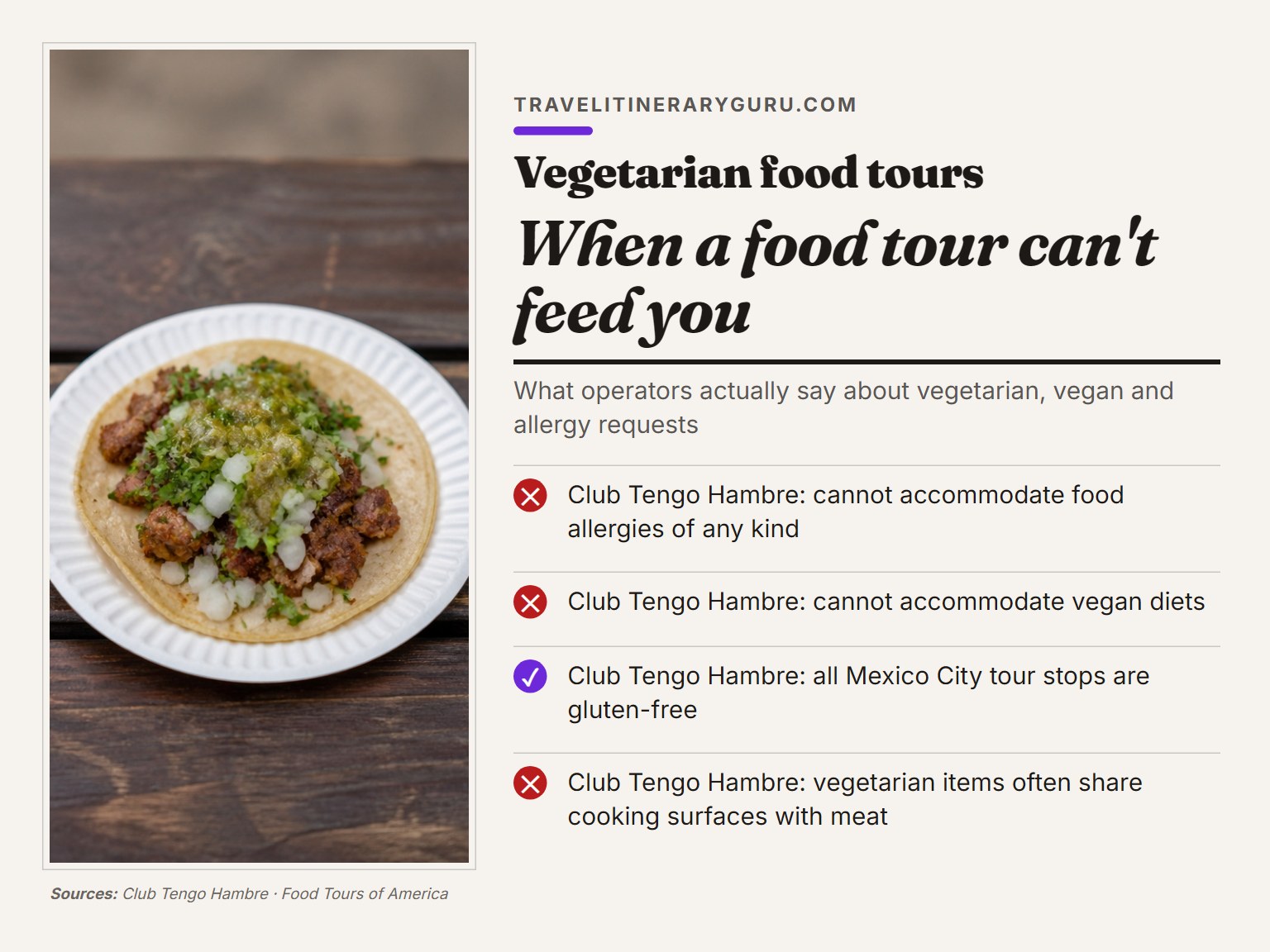
This is the counterintuitive part, and it’s worth sitting with. Club Tengo Hambre states that all of the stops on its Mexico City tours are gluten-free, so wheat-free diets can be accommodated without issue. The same operator cannot accommodate vegans at all.
Read that again. A wheat-free guest eats everywhere. A vegan guest eats nowhere.
The reason is structural. Mexican street food is built on corn: tortillas, tlacoyos, tamales, quesadillas made with corn masa. Corn is naturally gluten-free. So the default menu is already wheat-free. The operator doesn’t have to do anything.
Vegetarian is harder because the same food culture uses meat and animal fat as defaults. Beans might be cooked with pork fat. Salsas might be flavored with it. The tortilla is fine; what’s inside it and what it’s cooked in is the problem.
Easy to miss: Gluten-free is the default, not an accommodation, on corn-based Mexican street food tours. Vegetarian requires the operator to actively intervene at each stop. Those are different levels of effort, and the results reflect that.
Foodtours.com.au takes the opposite position on gluten-free in general, rating bakery, pastry, and dessert tours “Poor for coeliac or gluten-free” and warning that cross-contact is likely. Both positions are correct. The operator that says gluten-free is easy is talking about corn-based tours. The operator that says gluten-free is hard is talking about wheat-based tours.
| Tour Type | Vegetarian Ease | Gluten-Free Ease | Why |
|---|---|---|---|
| Mexican street food (corn-based) | Moderate | High | Corn is naturally GF; meat/fat is default |
| Market tours | Often good | Variable | Produce is easy; prepared items vary |
| Seafood tours | Poor | Variable | All stops focus on seafood |
| Bakery and pastry tours | Variable | Poor | Wheat is the whole point |
| Multicultural neighborhood walks | Often good | Variable | Depends on the specific cuisine |
Foodtours.com.au rates multicultural neighborhood walks as “often good” for vegetarians, especially in areas known for Indian, Middle Eastern, Vietnamese, or Chinese food. That matches the logic: cuisines with strong vegetarian traditions have vegetarian dishes as menu items, not as substitutions.
What Most People Get Wrong About Vegan vs Vegetarian on Food Tours
Vegan is not vegetarian with the cheese removed. On a street food tour, the two categories have almost nothing in common.
Club Tengo Hambre states it cannot accommodate vegan diets because of the nature of street food, with items being cooked alongside non-vegan ingredients or near non-vegan items. That’s a structural limitation, not a policy choice. If the beans are cooked in pork fat and the salsa is flavored with it, the beans and salsa are not vegan no matter how the plate is assembled.
Foodtours.com.au makes the same point from a different angle: vegan options are less consistent because dairy, eggs, honey, and fish sauce turn up in many dishes.
Skip this if: You’re a vegetarian who eats eggs and dairy. The vegan problem is not your problem. But if you’re a vegetarian who avoids animal fats and broths, you’re closer to the vegan category than to the standard vegetarian category, and you should ask vegan questions.
“Flexible vegetarian” is Club Tengo Hambre’s own term. It means you eat what’s offered at the stops that have vegetarian options, you accept that those items share a cooking surface with meat, and you’re comfortable with the possibility that some dishes are flavored with animal fat.
If that’s not you, the operator’s policy is clear: “If this is problematic, we can not accommodate you.”
When to Skip the Food Tour and Plan Your Own
Sometimes the answer is that no operator can give you what you need. That’s not a failure of the industry. It’s a structural limit of the format.
Food allergies are the clearest case. Club Tengo Hambre states it cannot accommodate food allergies of any kind on its tours. Food Tours of America says it is usually able to accommodate most dietary requests, subject to partner restaurants’ capability. These are not reconcilable positions. One operator treats allergies as out of scope; the other treats them as a request to be managed.
If you have a serious allergy, the operator that says no is doing you a favor. The operator that says “we’ll try” is asking you to accept a risk you may not want to accept.
What most people get wrong: Assuming a permissive allergy policy is better than a restrictive one. A permissive policy that can’t be enforced at the venue level is worse than an honest refusal. You want the operator who tells you what they can’t do.
Frequently Asked Questions
Can food tours accommodate vegetarians?
Some can, and the range is wide. Club Tengo Hambre accommodates “flexible vegetarians” at a majority of stops on its Mexico City and Tijuana tours, and at nearly all stops on its Oaxaca tour. The same operator cannot accommodate vegetarians at all on its Insider’s Guide to Ensenada tour because every stop focuses on seafood. The operator’s own policy is the only reliable source.
Do I need to tell the operator in advance?
Yes, and in writing. Food Tours of America states that accommodation is subject to partner restaurants’ capability and requires advance notice. Foodtours.com.au is more direct: tell the operator in writing when you book, and never rely on a last-minute request on the day. Venues prepare tastings in advance, and a request on the day may mean you miss a stop or receive a much smaller alternative.
Are vegetarian items cooked separately from meat items?
Not always, and this is the disclosure most operators skip. Club Tengo Hambre states that vegetarian items often share the same cooking surface as meat items, and adds that if this is problematic, they cannot accommodate you. Foodtours.com.au notes that small kitchens may not be able to fully separate ingredients and recommends asking about cross-contact directly.
Is pork fat used in vegetarian dishes on Mexican food tours?
It can be. Club Tengo Hambre discloses that pork fat is often used as a cooking oil for vegetarian ingredients and as a flavoring agent in everything from beans to salsas. A vegetarian who accepts “no meat” but not “no animal fat” needs to ask this question explicitly, because the answer changes which stops are actually available.
Are gluten-free diets easier to accommodate than vegetarian diets?
On corn-based Mexican street food tours, yes. Club Tengo Hambre states that all stops on its Mexico City tours are gluten-free, so wheat-free diets can be accommodated without issue. The same operator cannot accommodate vegan diets at all. On bakery or pastry-focused tours, the situation reverses: Foodtours.com.au rates those tours “Poor for coeliac or gluten-free” and warns that cross-contact is likely.
What if the operator can’t answer my questions specifically?
Treat that as your answer. An operator who can’t name which stops accommodate you, can’t describe how substitutions are prepared, and can’t confirm whether shared cooking surfaces are used is telling you they haven’t checked. “We can accommodate most diets” is less informative than a stop-by-stop explanation.
The Bottom Line
One rule most guides skip: if you’re a strict vegetarian, ask for the stop list before you book, and count the stops that have no vegetarian option. You’re paying for a tour, not a compensatory eating schedule.
The operators that publish specific policies are the ones worth booking with, even when the policy is restrictive. Club Tengo Hambre tells you exactly which stops won’t work. Food Tours of America tells you accommodation depends on partner restaurants. Both are giving you information you can act on. The operators that say nothing specific are asking you to find out on the day.
Here’s the practical wisdom on timing. Book the tour early in your trip, not on the last day.
One more thing, and this one I’ll defend.
