
How to Choose Between Australia and New Zealand for a First Trip
This post contains affiliate links. As an Amazon Associate, we earn from qualifying purchases.
To choose between Australia and New Zealand for a first trip, match the country to the days you actually have: New Zealand fits a two-week trip, while Australia needs you to pick one region and fly between bases. The two sit about a three-hour flight apart, so they work as two separate trips.
That three-hour flight crosses roughly 2,000 km of the Tasman Sea, and no regular ferry makes the crossing, which is why travelers often ask how to choose between Australia and New Zealand for a first trip. Plan them as two separate trips that happen to share an airline network.
What follows is the order I would work through it: how far apart they really are, how many days each one needs, and the government paperwork that catches people at the gate.
Key Takeaways
- Pick one country if you have two weeks. Lonely Planet says New Zealand fits a two-week trip; Voykit puts the minimum for either country alone at 10 to 14 days.
- Combining both needs three weeks or more, and Voykit says an open-jaw ticket is the way to do it.
- Plan Australia region by region. Lonely Planet calls it “really a continent of nations,” and a single national route does not work.
- New Zealand’s two islands each deserve at least ten days by car, per Voykit. Two weeks for both means living behind the windscreen.
- An Australian driver’s licence is not approved ID for alcohol in New Zealand. Carry your passport, an NZ driver’s licence, a Hospitality NZ 18+ Card, or a Kiwi Access Card.
How Far Apart Are Australia and New Zealand, Really?
The Tasman Sea between them runs about 2,000 km wide, and Sydney to Auckland is roughly 2,150 km of it. That works out to a three-hour flight.
The Tasman Sea separates Australia and New Zealand by roughly 2,000 km. Sydney to Auckland measures about 2,150 km, a flight of around three hours. No regular ferry crosses the Tasman. Australia covers about 7.7 million sq km of land; New Zealand covers about 268,000 sq km, an area similar to the United Kingdom or Colorado.
That distance is why the how to choose between Australia and New Zealand for a first trip question makes the two countries behave like separate holidays rather than one loop. Seasonal cruises run the Tasman. Flights run it year-round.
Here is where the scale stops being trivia and starts costing you days. Australia’s land area is about 7.7 million sq km. New Zealand’s is about 268,000 sq km (103,475 sq mi), which is roughly the size of the UK or Colorado. Same ocean, wildly different planning units.
The airline matters less than the schedule, because the flight is short.
The airline matters less than the schedule, because the flight is short. The same reasoning I use for choosing an airline on any long-haul booking applies here: take the departure time that protects your first day.
Three hours. That is the whole crossing.
What Each Country Actually Gives a First-Timer
Australia and New Zealand reward different travellers, and the how to choose between Australia and New Zealand for a first trip difference shows up fastest on day three of a trip.
Australia is the bigger, older, drier landmass. New Zealand is young, steep and restless, sitting on the boundary between the Pacific and Australian plates.
| What You Are Choosing | Australia | New Zealand |
|---|---|---|
| Land area | About 7.7 million sq km | About 268,000 sq km |
| How you move | Fly between regions, explore from a base | Road trip; slow, winding roads |
| Signature walk | 12 Great Walks, five in Tasmania | 11 Great Walks |
| Highest point | Kosciuszko, 2,228 m | Aoraki/Mt Cook, 3,724 m |
| Wildlife | Marsupials, loud birds, reef life | Birds, marine mammals, bats only |
Lonely Planet’s two writers split on this, and the piece runs as a documented argument rather than a merged verdict. Sarah Reid makes the case for Australia’s living Indigenous culture, its wildlife and Sydney’s food scene. Tasmin Waby makes the case for New Zealand’s landscapes, from volcanic Tongariro to moody Fiordland.
The wildlife split is the sharpest one. Lonely Planet says Australia wins on animals and that New Zealand’s Great Walks are “generally lacking” it, with the memorable aside that sheep do not count.
That is a fair summary of the walking, and it undersells the coast.
New Zealand’s native land mammals are bats, three species with one extinct. Everything else that moves on land was introduced. That is why you will see traps along the tracks and fenced sanctuaries where native birds have returned to a city valley.
The history behind the culture is worth twenty minutes of reading before you go. Aboriginal and Torres Strait Islander peoples have lived in Australia for at least 65,000 years. Maori arrived in New Zealand from eastern Polynesia around 1250 to 1300 AD, and in 1840 more than 500 chiefs signed the Treaty of Waitangi with the British Crown.
If two countries are a three-hour flight apart, they are two trips. The only question is which one you are taking this year.
So which one wins? For a first trip built around walking and scenery, New Zealand wins. For a first trip built around wildlife, food and cities, Australia wins. Nobody wins a two-week trip that tries to do both.
The same side-by-side method works for choosing between Thailand and Vietnam, and the rule is identical: name what you actually want to do, then see which country does it better.
How Many Days Do You Actually Need?
Voykit puts the minimum for one country at 10 to 14 days. Lonely Planet says New Zealand fits a two-week trip.
Those two numbers are close enough to agree in practice. Where the sources genuinely part company is what happens when you try to do both.
| Scenario | Time the Source Gives | Source |
|---|---|---|
| One country, minimum | 10 to 14 days | Voykit |
| New Zealand, highlights | Two weeks | Lonely Planet |
| New Zealand, both islands by car | At least ten days per island | Voykit |
| Australia, two weeks | Three bases at most | Voykit |
| Both countries | Three weeks or more | Voykit |
| Australia, a single visit | Narrow to one region | Lonely Planet |
Read that table twice, because the disagreement is real and neither side is wrong. Lonely Planet’s position is that New Zealand’s highlights fit a week or two. Voykit’s position is that the two islands each deserve at least ten days behind the wheel. Both are describing the same country with different ambitions.
The tell is what you want from the trip. If you want the highlights, two weeks in New Zealand works. If you want to drive it properly, Voykit’s ten days per island is closer to the truth, and that is a three-week trip before you add a single rest day.
I will not book a two-country trip for anyone with under three weeks. The itinerary always looks fine on paper and always falls apart on day four, when the internal flight eats the morning you had planned for the thing you flew there to see.
I have written separately about days in New Zealand, and the short version is that the South Island eats time in a way the map does not show.
Voykit’s line about Australia is the one people ignore: two weeks allows three bases at most, and every flight between them costs half a day.
Half a day. Per hop.
The short version: two weeks buys one country, three weeks buys two, and anything in between buys a compromise.
The Two-Week Two-Country Delusion
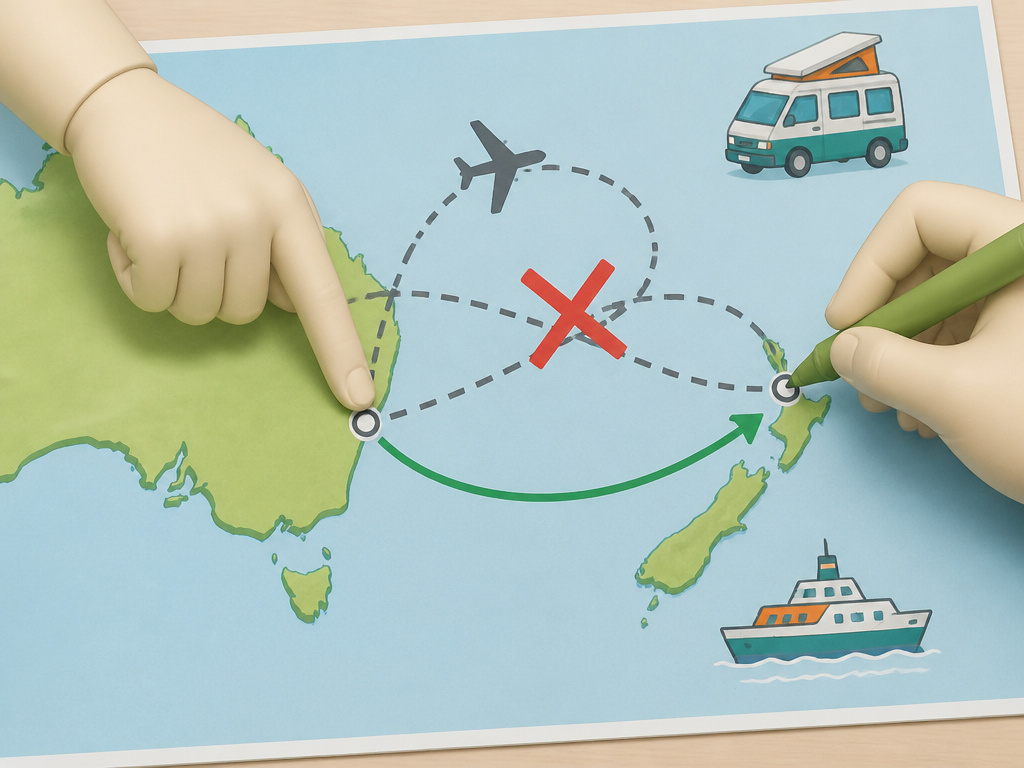
Two weeks is not enough for two countries.
I have had at least a dozen clients ask me to fit Australia and New Zealand into the same fortnight. I stopped arguing about it years ago. Now I send them a map with the Tasman Sea drawn to scale and wait for the silence. It arrives every time.
The arithmetic behind that silence is simple. Long-haul flights eat a day in each direction, and the Tasman crossing is another half day on top. A standard return ticket forces you to backtrack across 2,000 km of ocean to get home.
Lonely Planet’s advice is blunt: you will likely have to choose one over the other. Voykit takes the opposite view and says you can combine them, provided you commit three weeks or more and book an open-jaw ticket.
If you are combining them anyway, do it in this order:
- Apply for the Australian ETA or eVisitor and the NZeTA separately, and remember the New Zealand levy. Get the levy wrong and your boarding pass will not help you at the gate.
- Book the long-haul legs as an open-jaw pair: into Sydney and out of Auckland or Christchurch, or the reverse. A standard return ticket makes you retrace the Tasman, which costs a full day.
- Reserve campervans and Cook Strait ferries early for summer. Summer demand takes the good stock first, and the ferry books out with it.
- Book Great Walk huts the moment the booking season opens. Miss the window and your walk becomes a day hike from a town two hours away.
Common mistake: Booking a return ticket to Sydney and then bolting on a New Zealand leg. You cross the Tasman twice, which adds a full travel day you could have spent walking.
One country. That is the rule.
Australia: Pick One Region, Then Fly Between Bases
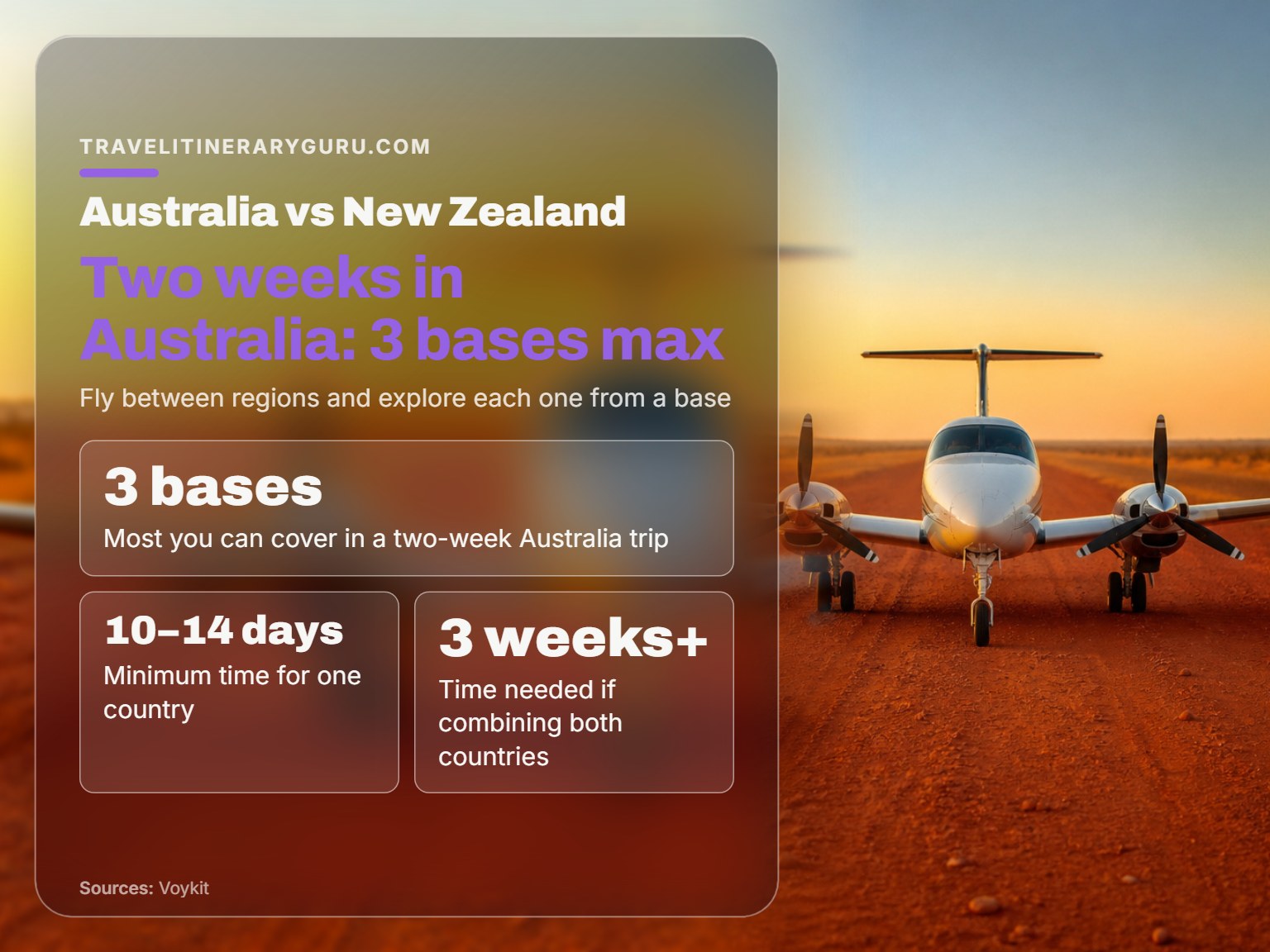
Lonely Planet calls Australia “really a continent of nations,” and that phrase should decide your whole itinerary.
Voykit’s advice is to fly between regions and explore each one from a base.
- Two weeks buys you three bases at most. Sydney, the reef, Uluru, Melbourne, Tasmania and the Kimberley are each a flight apart, and every hop costs half a day.
- The south is best in spring, summer and autumn.
Wildlife viewing runs on the same schedule as the driving hazard. Many Australian animals are nocturnal or active at dusk, so dawn and dusk are both the best viewing times and the worst driving times.
Little penguins come ashore at dusk at Phillip Island, near Melbourne. That is a genuinely good evening, and it is also the hour when you should be slowest behind the wheel.
The East Coast Route
If you are building a route rather than a wish list, the Australia east coast is the most forgiving first-timer option, because the towns sit close enough together to move by road.
Getting the season right matters just as much, which is why I wrote a separate piece on when to visit Australia.
Choosing a Great Barrier Reef Operator
Marine heatwaves have caused several mass bleaching events since 2016, and some areas recover while others lose coral.
Voykit’s advice on reef operators is worth following: choose one with Eco certification and follow their rules on touching and fins.
Bondi is the one Sydney stop I would trade for a quieter beach further along the coast. Tasmania is the underrated one.
Where this goes sideways: Booking a single national itinerary. Australia does not work as one route; Lonely Planet’s point is that you narrow to one region and accept the rest is for next time.
Fly, do not drive.
New Zealand: One Island at a Time
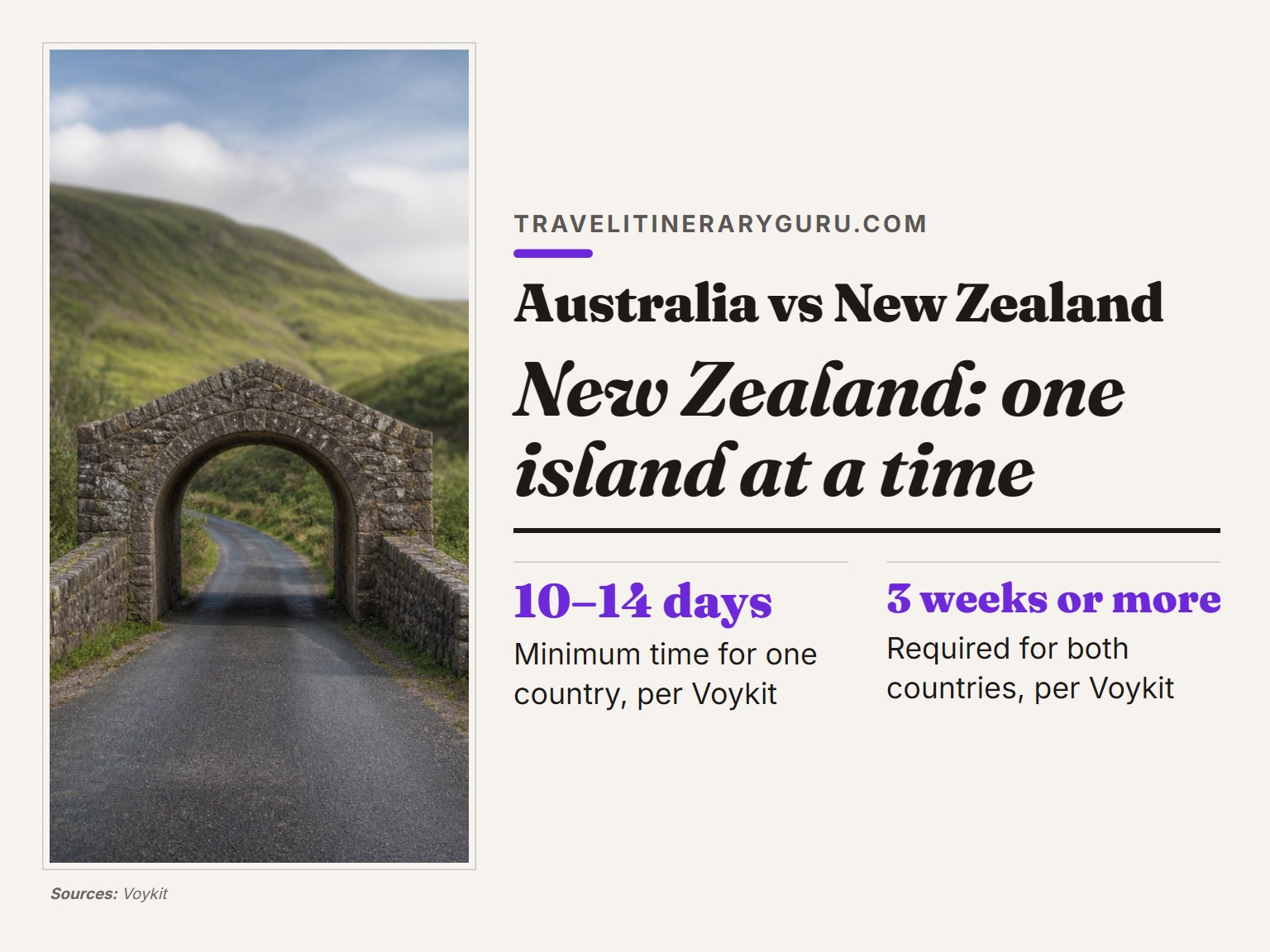
New Zealand gets sold as a single destination. Plan it as two, because the Cook Strait ferry is a commitment rather than a hop.
Voykit’s position is that the two islands each deserve at least ten days by car, and that trying both in two weeks leaves you on the road and waiting for the ferry. Lonely Planet disagrees, arguing you can tour the highlights in a week or two.
Both are right about different trips. A highlights tour of New Zealand is a real two-week holiday. A road trip that covers both islands properly is closer to three weeks.
The roads are the reason. New Zealand’s state highways are slow and winding, and single-lane bridges are normal. You slow down, check for oncoming traffic, and cross.
The scenery changes every hour of driving, which is the whole appeal and also the reason your daily distance estimate will be wrong.
North Island or South Island?
The North Island’s volcanic plateau holds active volcanoes, geysers and Lake Taupo.
Wool layers do more work than anything else in the bag, and a rain jacket earns its space in both countries.
If you are doing one island properly, a New Zealand road trip is the natural shape of the trip.
The same one-island discipline applies when choosing between Maui and Kauai: two islands on one short trip means two half-experiences.
Skip this if: You have under ten days. Pick one island; the Cook Strait crossing plus the drive to and from it eats a full day of a short trip.
One island. Two at most.
What the Australian Government Actually Warns You About
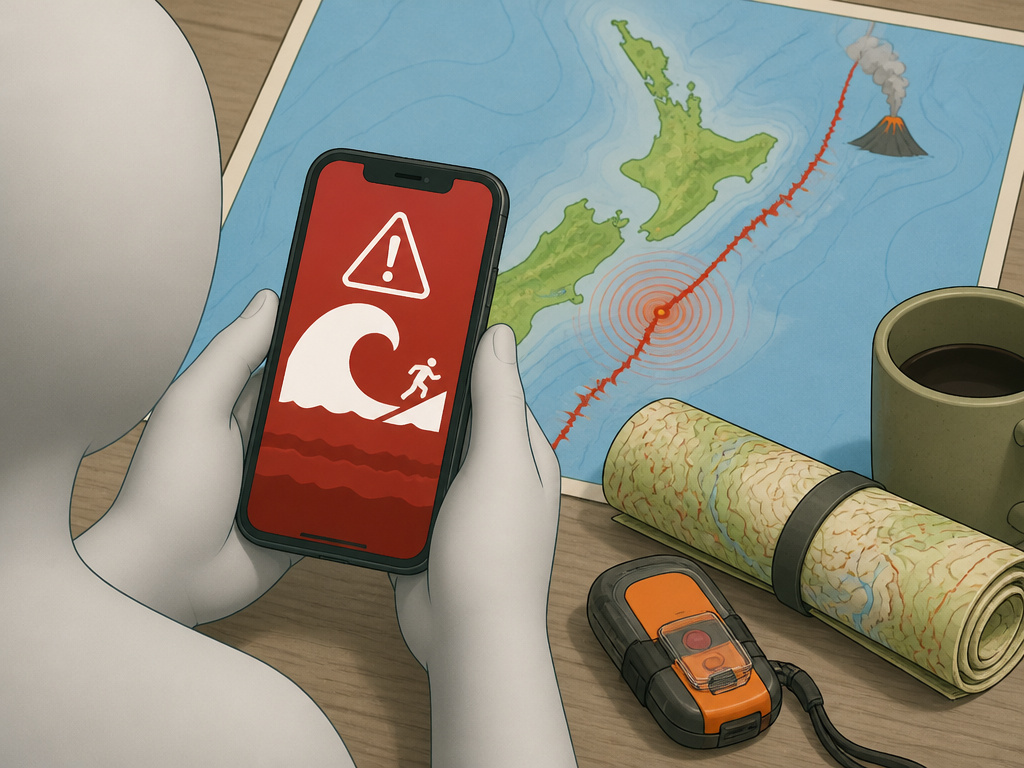
Smartraveller’s advice for New Zealand sits at “Exercise normal safety precautions,” and the list underneath that rating is longer than the rating suggests.
Before you start: New Zealand’s coastline carries tsunami risk everywhere, so move to high ground immediately rather than waiting for an official alert. Volcanic alert levels can rise quickly and evacuations can be ordered at short notice. If you are hiking or in a remote area, contact the Department of Conservation and carry a personal locator beacon.
Earthquakes are a constant risk, and large damaging quakes can happen at any time. Christchurch lost much of its centre in 2011, and Wellington plans its buildings around the next big one.
This is where the travel press and the government part company. Lonely Planet’s framing is that New Zealand’s wildlife is not trying to kill you, which is true and also beside the point. Smartraveller’s risk list for New Zealand is geological: earthquakes, tsunami, volcanoes and weather that changes fast enough to strand you.
Read the Smartraveller New Zealand travel advice before you book anything, not the week before you fly.
Crime is the least of it. Smartraveller rates New Zealand’s crime rates as similar to Australia’s, and notes that thieves target vehicles. Do not leave valuables in your car or campervan, and the risk drops to almost nothing.
Services Australia publishes the reciprocal health care agreements in full, and the exclusions are worth ten minutes of your time.
Read it early.
The Paperwork That Stops People at the Gate
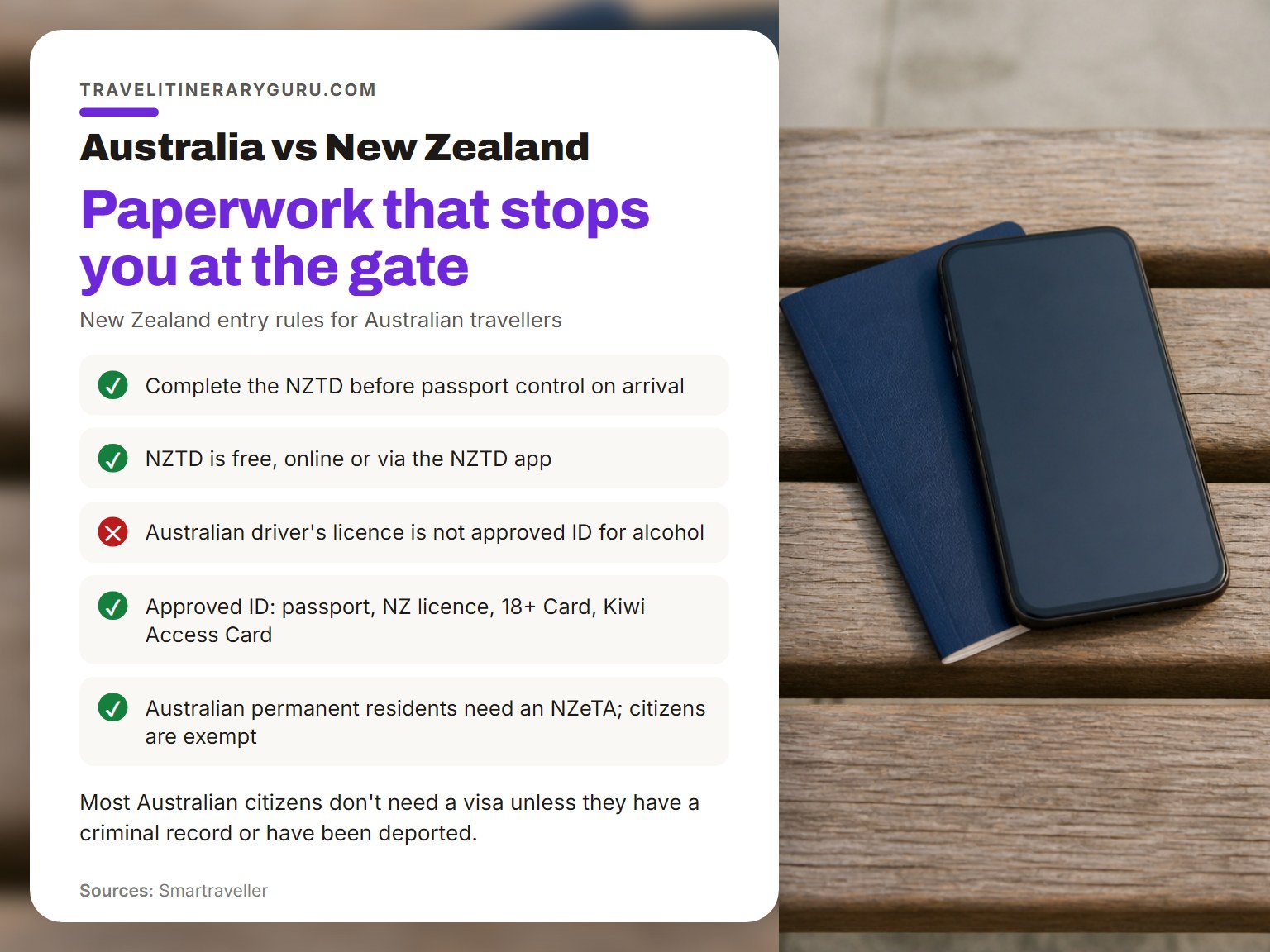
The New Zealand Traveller Declaration Form has to be completed before passport control on arrival, not after.
It is free, and you can complete it online or through the NZTD app. The questions cover your trip and what you are bringing into the country. Skip it and you are filling it in at the airport, on your phone, with a queue behind you.
Most Australian citizens do not need a visa for New Zealand unless they have a criminal record or have been deported from any country. Australian permanent residents do need a New Zealand Electronic Travel Authority (NZeTA), applied for online. Citizens are exempt from that.
The form is free, and the official New Zealand Traveller Declaration form is where you complete it.
Approved ID for Alcohol in New Zealand
The ID rule catches more people than the visa rule. An Australian driver’s licence is not an approved form of ID under the NZ Sale and Supply of Alcohol Regulations.
Approved ID is:
- Your passport
- A New Zealand driver’s licence
- An existing Hospitality NZ 18+ Card
- A Kiwi Access Card
Carry one of those and you are fine. Carry only your Australian licence and you will be explaining yourself at the bar.
Check the expiry date before you book anything, because a passport that expires too soon can stop the trip outright.
If Australia is the first stop, get the Australian visa sorted before you book flights, so nothing is waiting on paperwork.
Passport first.
Frequently Asked Questions
How long do you need for a first trip to Australia or New Zealand?
Voykit puts the minimum for one country at 10 to 14 days. Lonely Planet says New Zealand fits a two-week trip. If you want to combine both, Voykit’s figure is three weeks or more, and Lonely Planet’s advice is to pick one instead.
Can you visit Australia and New Zealand in two weeks?
Not properly. The Tasman crossing is about 2,000 km, and a three-hour flight each way plus long-haul days in and out eats a large share of a fortnight. Voykit’s threshold for both countries is three weeks or more.
Is an Australian driver’s licence valid ID in New Zealand?
No. Under the NZ Sale and Supply of Alcohol Regulations, an Australian driver’s licence is not approved ID. Carry your passport, a New Zealand driver’s licence, a Hospitality NZ 18+ Card, or a Kiwi Access Card.
Do Australians need a visa for New Zealand?
Most Australian citizens do not, unless they have a criminal record or have been deported from any country. Australian permanent residents do need an NZeTA, applied for online. Citizens are exempt from that requirement.
Is New Zealand safer than Australia?
Crime rates are similar, according to Smartraveller. The difference is geological: all of New Zealand’s coastline carries tsunami risk, earthquakes are a constant risk, and the country has several active volcanoes.
What is the NZTD and when do you complete it?
The New Zealand Traveller Declaration Form. It must be completed before passport control on arrival, it is free, and you can do it online or through the NZTD app.
The Bottom Line
One rule decides this whole question. If your trip is two weeks, you go to one country.
Voykit’s minimum for a single country is 10 to 14 days, and both countries together need three weeks or more. Lonely Planet’s two-week framing fits New Zealand, and its distances are small enough to drive. The South Island alone will fill a fortnight without a single rushed morning.
Here is the threshold I would use: under ten days, pick one island or one Australian region and stay put. Two to three weeks, pick one country. Three weeks or more, and the open-jaw ticket Voykit describes becomes the right call.
One honest limitation. Everything above assumes a long-haul origin. If you are crossing from Australia on a short hop, the Tasman stops costing you a day and the maths changes.
Balance the icons with the local gems, and you will get more out of either country than the highlights reel promises.
