
How to Plan a Trip to Egypt: Visas, Costs, Timing
This post contains affiliate links. As an Amazon Associate, we earn from qualifying purchases.
How to plan a trip to Egypt comes down to four decisions you can lock down before you book anything: your passport needs six months of validity past your arrival date and one blank page, your visa route depends on your arrival airport and how long you’re staying, you carry cash in US dollars and Egyptian pounds rather than relying on cards, and you accept that the Sinai resort exemption has edges that trip people up.
The edges are the part worth slowing down for when you compare a how to plan a trip to Egypt. A free entry stamp at Sharm el-Sheikh covers a stay under 15 days inside the resort areas, and the UK Foreign Office and Egypt’s own tourism portal describe the boundary of that zone differently. Get it wrong and you’re buying a visa you didn’t need, or worse, standing at a checkpoint without one.
What follows: the passport rule, the visa routes and their real prices, the Sinai exemption and where it stops, what to pack for heat and for mosques, how tipping actually works, and the FCDO advisory zones drawn to the kilometre.
Key Takeaways
- Passport validity is six months past arrival, plus at least one blank page. This is checked at the counter, not at immigration.
- Visa on arrival is US$30 cash at approved airport kiosks according to the UK FCDO, valid 30 days, while Experience Egypt, National Geographic and Lonely Planet all quote US$25 instead.
- A free entry stamp covers Sinai resort stays under 15 days at Sharm el-Sheikh, Dahab, Nuweiba or Taba. Ras Mohamed National Park is outside it.
- Tap water is not safe to drink. Both National Geographic and Lonely Planet say so outright; bring a filter bottle.
- Cash runs this country. Cards work at some high-end hotels and restaurants, and almost nowhere else.
What Passport Validity Does Egypt Actually Require?
Your passport needs an expiry date at least six months after the date you arrive in Egypt, and at least one blank page for the entry stamp. The UK Foreign Office states this as Egypt’s own rule, so it applies to you regardless of which passport you carry or which source you read.
Six months is measured from your arrival date, not your departure date and not the date you book. A passport with five months and three weeks left will get you turned away at the check-in desk, and the airline is the one enforcing it because they carry the cost of flying you home.
Egypt requires a passport expiry date at least six months beyond the date of arrival, along with one blank page for the entry stamp. Airlines verify both at check-in because carriers bear the cost of returning a passenger denied entry. The requirement applies to all nationalities and is independent of visa type or arrival airport.
I’ve watched people discover this at the airport, which is the worst possible place to discover it. Renew early. A passport with under eight months left is a passport you should be replacing before you book the flight, not after.
The Visa Route You Take Depends on Where You Land
Three separate routes exist and they are not interchangeable, which is the how to plan a trip to Egypt question in miniature. Which one applies to you depends on your arrival airport, your nationality, and whether your trip stays inside the Sinai resort areas.
The standard route is a physical visa on arrival at approved airports, bought at kiosks before you reach the immigration counters. UK Foreign Office guidance puts it at US$30 cash only, valid for up to 30 days, while Experience Egypt, National Geographic and Lonely Planet quote US$25. Cash only is not a suggestion. There are ATMs, but the kiosks take dollars.
Two things complicate that. From 1 August 2026, Cairo International Airport runs card-only self-service machines priced at US$36. So at one airport you now have two official prices for the same product, split by payment method.
The second complication is that the other sources quote a different base price. Experience Egypt, the Egyptian state tourism portal, says US$25 from the bank counter in the passport control area. National Geographic says a single-entry tourist visa costs US$25. Lonely Planet says USD$25 for a renewable single-entry visa on arrival, valid 30 days, while the UK FCDO says US$30 cash only.
Worth knowing before you start: Budget for US$30 and treat anything under it as a pleasant surprise. Four sources give two different prices, and no single figure is wrong, they describe different counters at different airports.
A tourist e-visa, applied for online before you travel, is available through Egypt’s official portal.
| Visa route | Cost | Validity |
|---|---|---|
| Visa on arrival, airport kiosk | US$30 cash | 30 days |
| Digital visa on arrival, Cairo only | US$36 card | 30 days |
| Visa on arrival, Taba Heights | US$35 cash | 30 days |
| Visa on arrival, Nuweiba | US$30 cash | 30 days |
| Tourist e-visa, online in advance | Varies by portal | Up to 3 months |
Eligibility splits too, and the sources frame it differently. Experience Egypt says over 180 nationalities qualify for a visa on arrival if the passport holder already holds a valid and used visa for the USA, UK, Schengen Area, Japan, Canada, Australia or New Zealand. It separately says 78 nationalities qualify for a visa on arrival or an electronic visa through its portal. Lonely Planet frames it as “if you’re eligible,” without a number. Check your own nationality against Egypt’s official portal rather than a blog, including this one.
The Sinai Exemption Has Edges, and the Sources Don’t Agree Where They Are
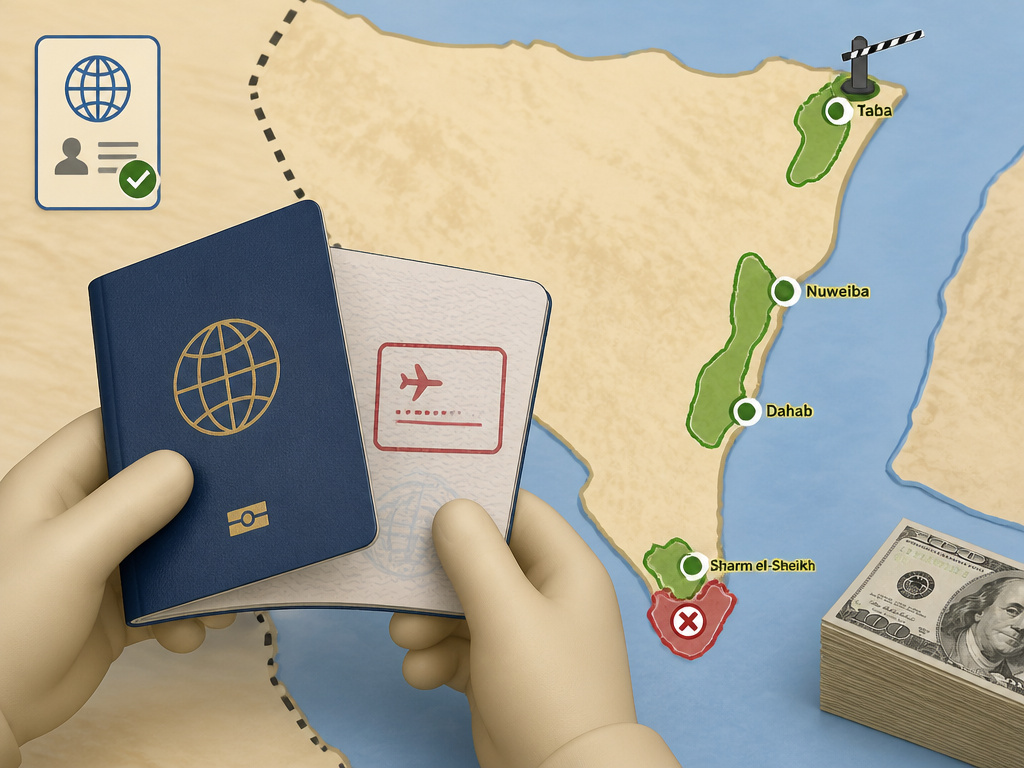
Arrive by air at Sharm el-Sheikh and stay under 15 days at resorts in Sharm El Sheikh, Dahab, Nuweiba or Taba, and you don’t need a visa. You get a free entry permission stamp on arrival. That’s the UK Foreign Office position, and National Geographic agrees on the substance: fewer than 15 days in the Sinai resort towns, no visa, permission stamp at Sharm el-Sheikh International Airport.
Then the two texts diverge. The FCDO describes the stamp as covering resorts in those four places, and says travel outside the resort areas requires a visa. Experience Egypt describes it as applying to travel to Sharm al-Sheikh, Dahab, Nuweiba and Taba, phrasing them as destinations rather than resort zones. Those are not the same boundary.
National Geographic settles the practical question with an example that matters: even Ras Mohamed National Park, at the southern tip of Sinai, is off limits without the full visa. So the resort zone is genuinely a zone, and the national park sits outside it.
Where this goes sideways: Assuming the stamp covers all of Sinai. It doesn’t. Ras Mohamed National Park is outside the permitted area, and a day trip there without a full visa is a problem you discover at the gate.
If you’re staying more than 15 days, or leaving the Sinai Peninsula at all, including a flight from Cairo or Hurghada, you need an entry visa. Buy it at Sharm el-Sheikh Airport or online before you fly.
Entering by Land from Israel
The Taba Border Crossing runs on its own rule set, separate from the airport stamp process. The FCDO recommends bringing at least US$170 cash per person, with extra dollars for further expenses.
That border can also close without warning. The FCDO says international borders in Israel and Palestine could close at short notice, including Taba, and the Rafah crossing is currently closed. If your itinerary depends on crossing, build a day of slack around it.
What to Pack for Egypt’s Heat, Mosques and Water
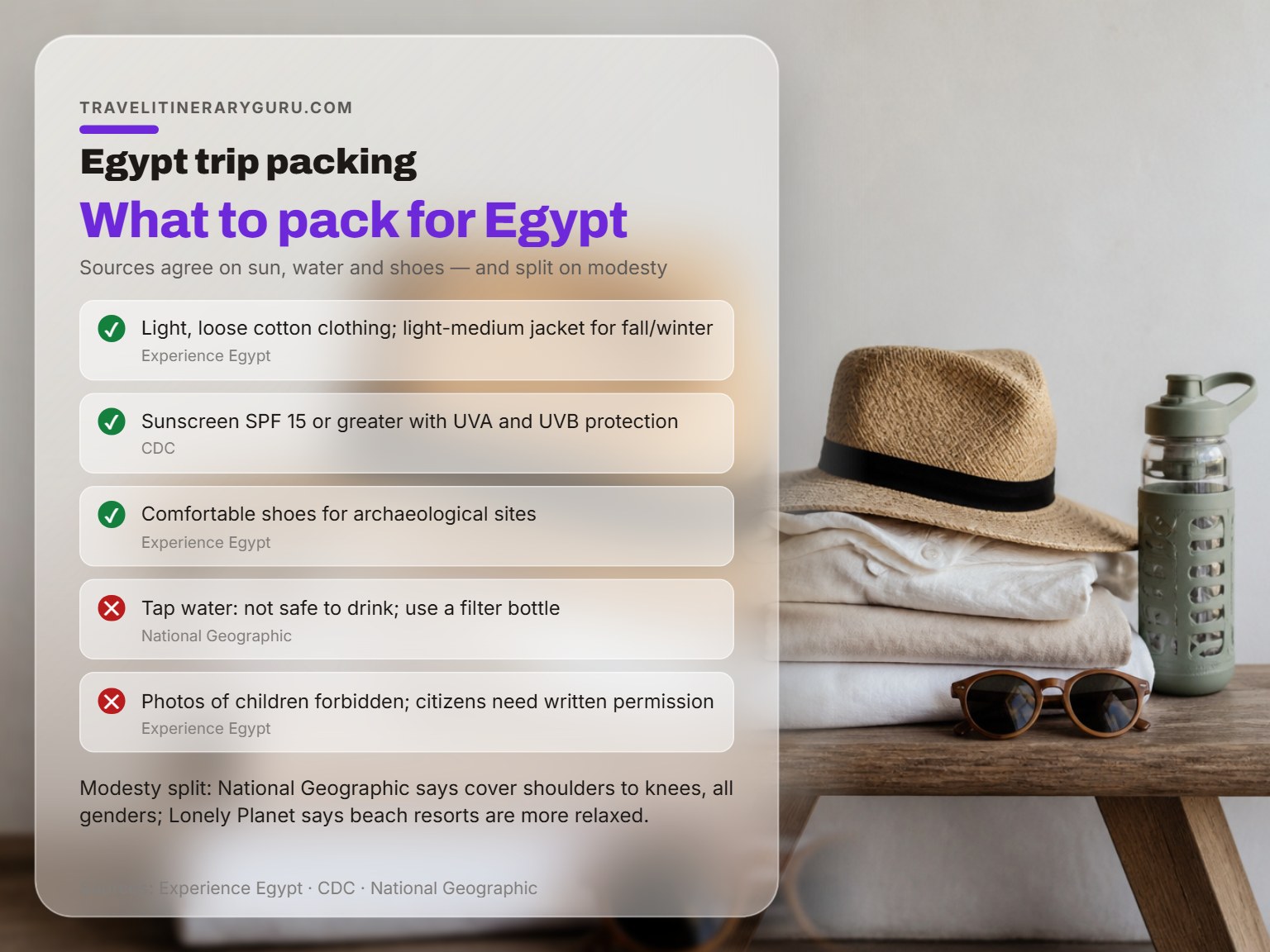
Pack light, loose cotton. Experience Egypt recommends it directly, and Lonely Planet says the same thing in different words: airy, breathable, loose clothing. A light-to-medium jacket or windbreaker covers you for fall and winter.
For sun, the CDC’s Egypt packing list specifies sunscreen at SPF 15 or greater with UVA and UVB protection. Experience Egypt adds lip balm, a hat and sunglasses to that list. Comfortable shoes for archaeological sites are essential, you will be walking on stone, sand and gravel for hours.
Tap water is where the sources align in practice. National Geographic states plainly that Egyptian tap water is not safe to drink and recommends a filter bottle such as those from Lifestraw. Lonely Planet says avoid tap water, and separately suggests saving the tourism police number, 126, for emergencies.
Common mistake: Filling a bottle from the hotel tap because the hotel is five-star. Tap water safety doesn’t scale with room rate. Filter it or buy sealed bottles.
Modesty is where the sources genuinely disagree, and the disagreement is worth reading carefully rather than averaging.
| Source | Position on dress |
|---|---|
| National Geographic | Cover everything between shoulders and knees, all genders |
| Experience Egypt | Loose cotton; cover arms and legs at mosques, churches, synagogues |
| Lonely Planet | Modest in cities; beach resorts more relaxed; men can wear tank tops if comfortable with stares, short shorts not advisable |
The practical read: National Geographic says cover everything between shoulders and knees for all genders, Lonely Planet says men can wear tank tops if comfortable and beach resorts are more relaxed, and Experience Egypt says loose cotton with arms and legs covered at religious sites. Experience Egypt specifically asks visitors to bring a headscarf and dress modestly at mosques, churches and places of worship, with shoulders and legs covered. That’s the floor, not the ceiling.
Two photography rules from Experience Egypt that catch people out: taking photos of children is forbidden, and Egyptian citizens can only be photographed with their written permission. Both are stated as rules, not preferences.
How Tipping Actually Works, and Why You Need Small Bills
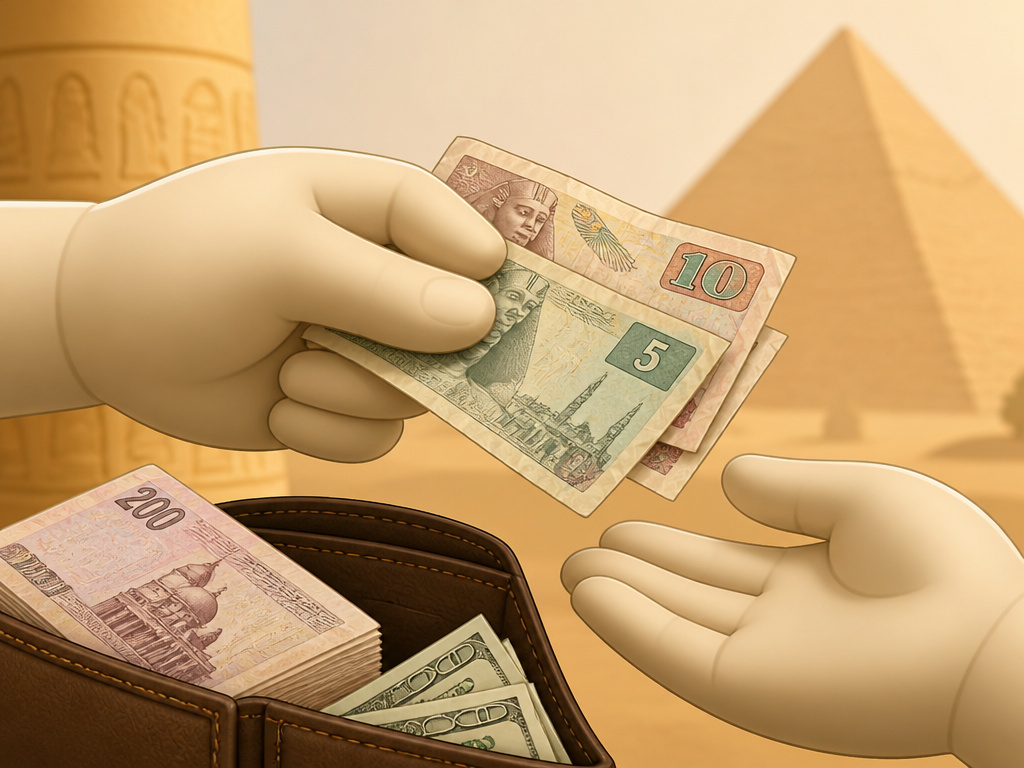
Baksheesh is not optional in the way a restaurant tip is optional in some countries. National Geographic puts it bluntly: it’s customary to tip nearly everyone you come in contact with, even for services you don’t want or require. Keep small change for toilet attendants, porters, mosque caretakers, and guards at temples and tombs.
Lonely Planet gives the numbers. Tips range from 5 EGP to 100 EGP, depending on who you’re paying and where. At restaurants and cafes, 10% to 15% of the bill is customary. For street food, loose change is the norm. Higher tips go to people providing long-term services, drivers and tour guides.
The mechanical problem is that you can’t tip 5 EGP if your smallest note is 200. Lonely Planet’s advice is to pick up both large and small bills when you exchange currency. Do that at the airport, not at a hotel desk.
Cash itself is the other half of this. National Geographic says cash reigns supreme and cards work at some higher-end hotels and restaurants. For bigger expenses it recommends bringing US dollars, described as the most, and sometimes only, accepted foreign currency. Lonely Planet notes Egypt is largely cash-oriented.
The posted fare mechanism and the practice on the street are not the same thing.
What the FCDO Advises Against, and Why It Matters to Your Insurance
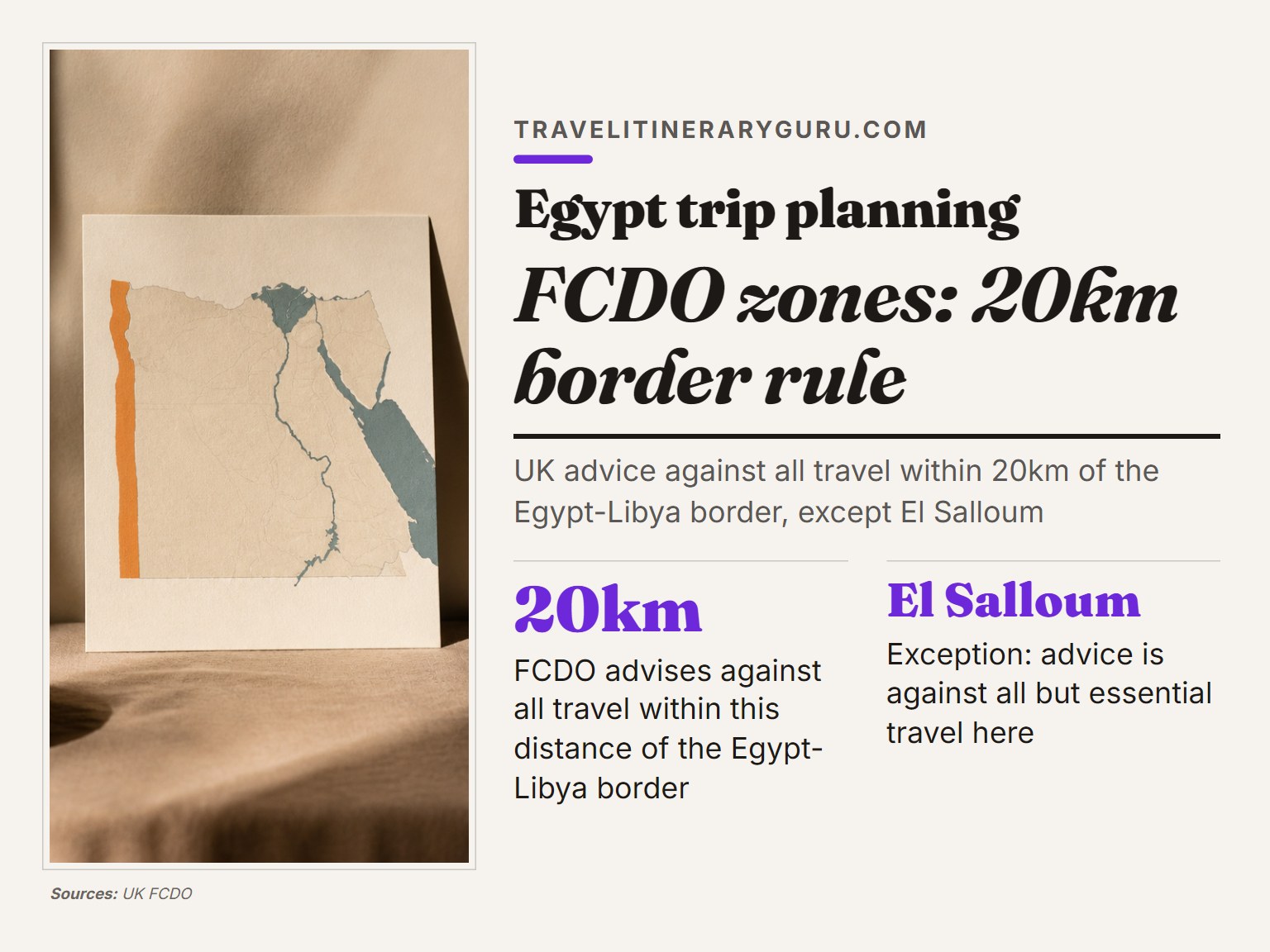
The UK Foreign Office advises against all but essential travel to parts of Egypt, and against all travel to specific areas. These are not vague regions. They’re drawn to the kilometre, and they matter because travelling against FCDO advice can invalidate your travel insurance even though the advice isn’t law.
The all-travel zones include within 20km of the Egypt-Libya border, except El Salloum, where the advice is against all but essential travel.
The insurance point is the one people miss. The FCDO is explicit that if you choose to travel, you should research your destinations and get appropriate travel insurance covering your itinerary, planned activities and emergency expenses. An insurer can decline a claim for an incident that happened in a zone the FCDO told you to avoid.
Skip this if: You’re staying on the Nile corridor and the Red Sea coast. The advisory zones sit well away from Luxor, Aswan, Cairo and Hurghada. Check the map once, then stop worrying about it.
When to Go, and the Two Sides of Egypt’s Weather
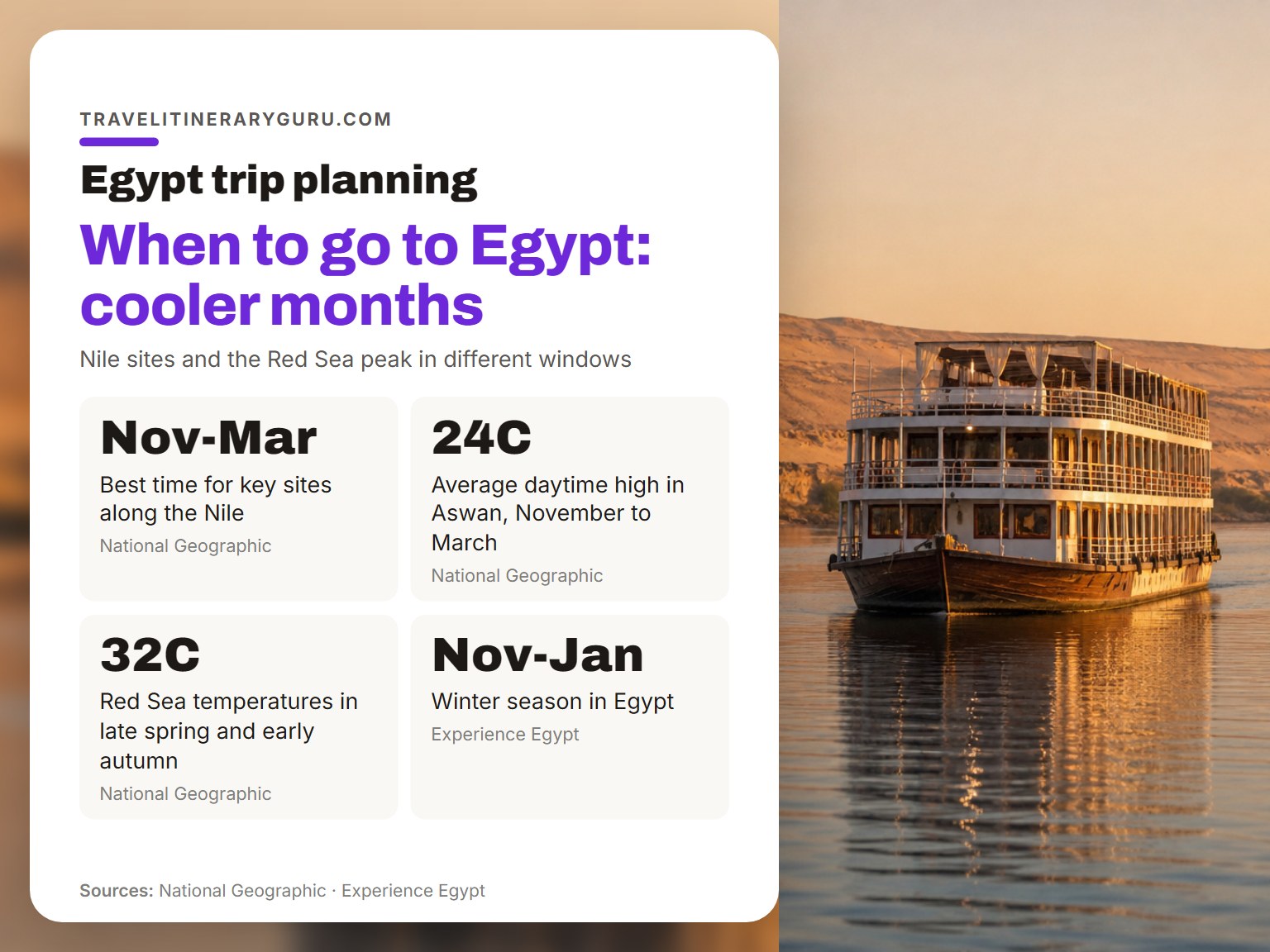
National Geographic puts the best window for key sites along the Nile at November to March, when daytime highs in Aswan average 24C. For the Red Sea, it names late spring and early autumn as ideal, with temperatures around 32C.
Experience Egypt frames the seasons differently: winter falls between November and January, and peak summer between June and August. That overlaps with National Geographic’s window rather than contradicting it, and both point at the same conclusion, go in the cooler months.
One caution on the state portal’s language. Experience Egypt describes Egypt as “generally warm and sunny,” and the wider marketing around Egyptian tourism leans on a 365-days-of-sunshine line. Pack the windbreaker.
Should You Book a Guide, or Go It Alone?
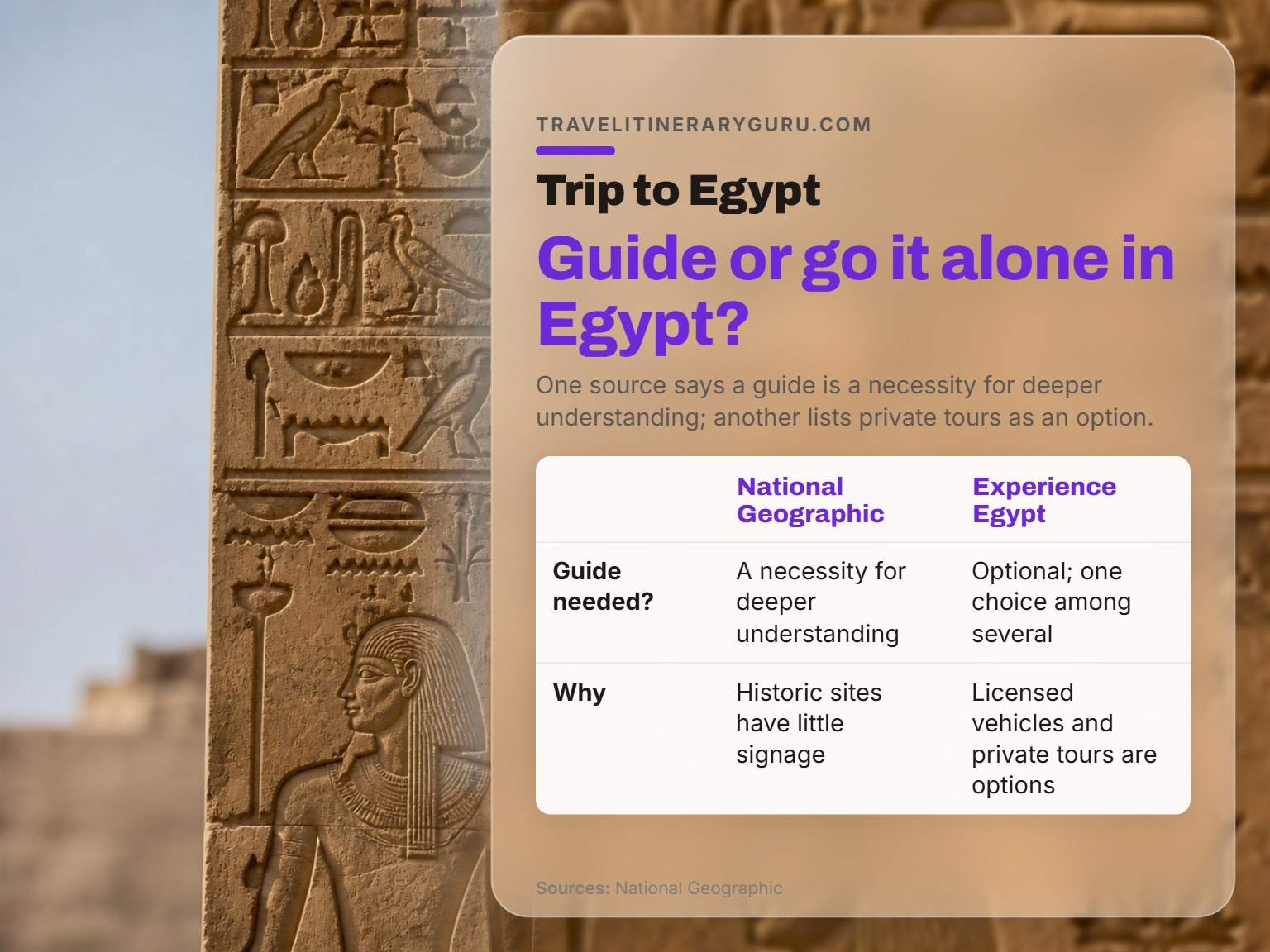
This is an open disagreement between two credible sources, and you should know which position you’re choosing.
National Geographic takes the strong line: Egypt’s historic sites have little signage, making a tour guide a necessity for deeper understanding, while Experience Egypt says guides are optional. Experience Egypt takes the opposite view, saying guides are optional and licensed tourist vehicles and private tours are one choice among several.
I get it, the signage problem is real. Stand in front of a temple wall with no labels and no context and you’re looking at carved stone, not history. But “necessity” is doing a lot of work in that sentence. The middle path is a guide for the dense sites. Karnak, the Valley of the Kings, the Egyptian Museum, and your own feet everywhere else.
That’s the same logic behind planning a self-guided tour for the parts you can handle. You’re not choosing between guided and unguided. You’re choosing which days deserve a person who knows the wall.
If you’re building the Egypt leg into a wider regional route, the same sequencing logic applies as when you plan a multi-city trip route, anchor the long-haul flights, then work outward. And if Jordan is on the same ticket, visiting Petra deserves the same treatment Egypt gets here: a full day, not an afternoon.
How Long Do You Need in Egypt?
Long enough that you stop moving.
Cairo specifically is the trap. It’s where most itineraries try to compress a museum, a pyramid complex, a market and a dinner into one day, and it doesn’t work.
For the wider trip shape, the travel itinerary approach I use is the same one I’d apply here: two anchors per day, real space between them, and one day with nothing scheduled at all. Egypt will fill that empty day for you. It always does.
Frequently Asked Questions
Do I need a visa for Egypt?
British passport holders normally do, with one exception. Arrive by air at Sharm el-Sheikh and stay under 15 days at resorts in Sharm El Sheikh, Dahab, Nuweiba or Taba, and you get a free entry permission stamp instead. Anything longer, or any travel outside those resort areas, requires a visa.
How much is a visa on arrival in Egypt?
The UK Foreign Office says US$30 cash at approved airport kiosks, valid 30 days, while Experience Egypt, National Geographic and Lonely Planet all quote US$25. From 1 August 2026, Cairo International Airport also runs card-only machines at US$36, which includes a US$6 digital service fee. Budget for US$30.
Is Egypt tap water safe to drink?
National Geographic states the tap water is not safe to drink and recommends a filter bottle such as those from Lifestraw, while Lonely Planet says avoid it. Use sealed bottled water or a filter, and skip ice in drinks from street vendors.
What should I wear in Egypt?
Cover everything between your shoulders and knees in cities and at religious sites. Experience Egypt asks visitors to bring a headscarf and dress modestly at mosques, churches and places of worship. Lonely Planet notes beach resorts are more relaxed, so pack a swimsuit for the coast.
How much should I tip in Egypt?
Lonely Planet gives the range as 5 EGP to 100 EGP depending on who you’re paying, with 10% to 15% of the bill customary at restaurants and cafes. National Geographic advises tipping nearly everyone you come into contact with and keeping small change for attendants, porters and guards. Carry small notes.
Is it safe to travel to Egypt right now?
The UK Foreign Office advises against all but essential travel to parts of Egypt, and against all travel to specific zones including within 20km of the Egypt-Libya border and the North Sinai Governorate. The Nile corridor and Red Sea coast sit outside those zones. Travelling against FCDO advice can void your travel insurance.
The Bottom Line
The airport kiosk queue is real, the cash-only requirement catches people without dollars, and the price is genuinely unsettled across four sources. An e-visa removes all three problems at once.
Then check your passport tonight. Six months past arrival, one blank page. If it’s short, that’s the first task on your pre-trip checklist.
Fair warning on the rest: this is a country where the fixed plans and the good days are different things. Build the visa, the passport and the advisory check properly, then leave the middle of the trip loose. The travel checklist handles the paperwork. The rest you improvise, and that’s where the trip actually happens.
