
Great Lakes Travel Guide for First-Time Visitors
This post contains affiliate links. As an Amazon Associate, we earn from qualifying purchases.
You can visit the Great Lakes on a first trip, but only if you understand three things first: the parks keep hard operating windows, the water sits cold enough to cause hypothermia, and most beaches have no lifeguard at all. A Great Lakes travel guide for first-time visitors should cover those three points. Get those three right and the region opens up.
Isle Royale, the most isolated of the bunch, is open April 16 through October 31 and closed the rest of the year. Apostle Islands water runs around 50°F, which is cold enough to cause hypothermia. And Michigan state parks have no beach guards — you swim at your own risk.
That gap between the brochure and the beach is where the Great Lakes travel guide for first-time visitors question goes wrong. The photos show dunes and lighthouses. The fine print shows a park that shuts for the winter, a ferry that cancels on Lake Superior weather, and a swim area that stops being a designated swim area the moment the buoys come out.
So here is how to build this itinerary step by step, starting with the part that trips up almost everyone: which parks you can actually reach without owning a boat.
Key Takeaways
- Isle Royale closes November 1 through April 15. Ferry service only runs mid-May through the end of September.
- Do not book anything important for a few days after your scheduled departure. NPS says delays of multiple days are possible.
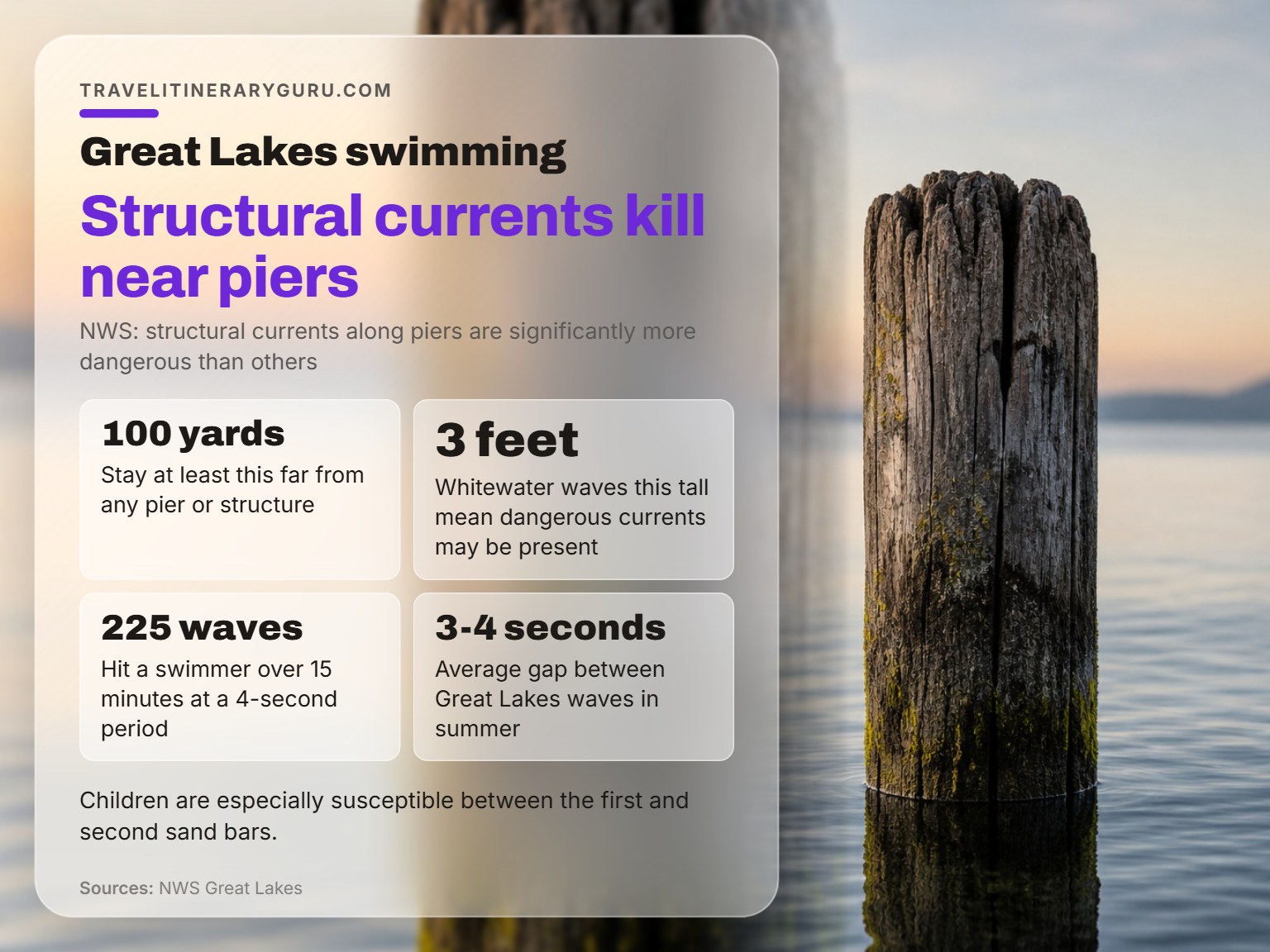
- Swim at least 100 yards from any pier or structure. Structural currents along piers are significantly more dangerous.
- Buoys in place means designated swim area. Buoys absent means it is not one. Cold water and wind can delay spring buoy placement, and the designation goes with them.
- The double-red flag closes the water, with one carve-out. Michigan’s Land Use Order 5.1.6 permits surfers on wind-powered or self-propelled boards to enter at their own risk.
Which Great Lakes parks can you actually reach without a boat?
Isle Royale is the one park in this region that you cannot drive to, walk to, or bike to. Every visitor crosses Lake Superior by boat or seaplane, and no vehicles, bicycles, wagons, strollers, or portaging carts are allowed on the trails once you are there.
That single fact reshapes the whole Great Lakes travel guide for first-time visitors. You are not packing a car. You are packing a backpack.
Isle Royale National Park sits in Lake Superior and is reachable only by boat or seaplane. Seaplane crossings take 35 to 45 minutes one-way. Ferry crossings range from 1.5 to 7 hours one-way, depending on the departure and arrival ports. Private boaters need a permit before traveling to the park.
The other three parks on a first-timer’s shortlist are mainland parks. Pictured Rocks National Lakeshore, Sleeping Bear Dunes National Lakeshore, and Apostle Islands National Lakeshore are all on the mainland.
Pictured Rocks is the one I would put first on a driving trip. It has 10 inland lakes and nearly 100 miles of trails.
If you are still deciding how the region fits into a longer trip, multi-city USA itineraries are worth a look before you commit to dates.
The Isle Royale window that catches everyone off guard
April 16 to October 31 is not a suggestion. The park is closed November 1 through April 15, full stop, and the transportation window is even tighter: ferry and seaplane service runs mid-May through the end of September.
NPS warns that services are limited in April, May, early June, September, and October. Park stores and visitor centers may not stock what you need.
Worth knowing before you start: Pack your critical supplies before you board. In the shoulder months, the store on the island may not have what you assumed it would.
The bigger planning trap is what happens after your trip. NPS tells visitors not to schedule important life or work events within a few days of their scheduled departure, because delays of multiple days are possible. Ferry crossings get delayed or cancelled by Lake Superior weather. Seaplane services get delayed or cancelled by fog, storms, and wind on either the mainland or the island.
Transportation can sell out at any time during the season, so the practical move is to secure your crossing as soon as your dates are firm. The Isle Royale first-timer’s guide lays out the full window, and it is the page I would read before booking anything.
One more thing that does not get said enough: emergency medical response and evacuation are limited and take time. You rely on your own skills and equipment. Plan the itinerary around the least experienced person in your group.
What the 50°F water actually does to a swimmer
Apostle Islands’ official brochure states it plainly: the 50°F waters can cause hypothermia. That is the park’s own language, not a warning label added for drama.
Cold water changes the timeline of a swim. It does not change it by a little. It changes it by a lot, and the change happens faster than most first-timers expect.
If you are paddling or boating in the Apostles, marine channel 7 at 162.525 MHz carries USCG Bayfield reports.
The Great Lakes weather safety guide from the National Weather Service is where the wave numbers live, and they are worth memorizing. Whitewater waves of 3 feet or greater indicate dangerous currents may be present. Waves come in rapid succession, every 3 to 4 seconds on average in summer.
Based on an average period of 4 seconds, 225 waves will hit a swimmer over 15 minutes.
The beach flag system, and what happens when the buoys are gone
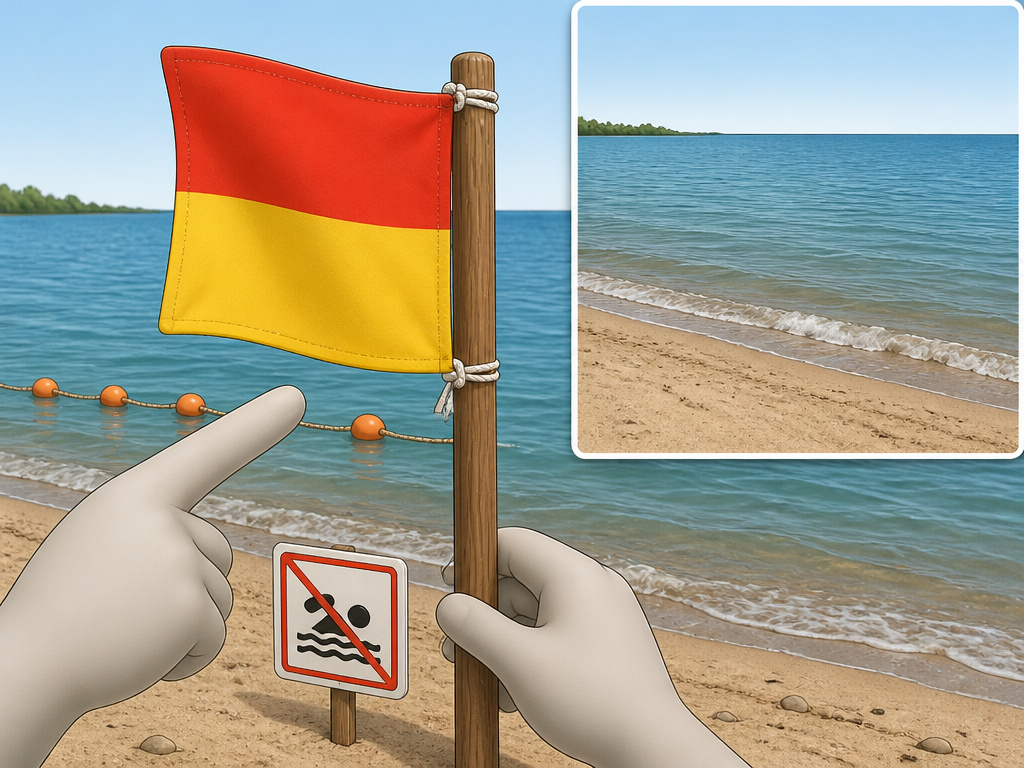
Michigan state parks along the Great Lakes use the beach flag warning system at all buoyed swim areas. Wisconsin state park properties do not have lifeguards or beach guards.
The buoyed areas themselves are placed in water typically less than 5 feet deep and are inspected and adjusted roughly every two weeks. Buoys are in place Memorial Day weekend through Labor Day.
Cold water temperatures and wind can delay spring buoy placement in a given year. When the buoys are absent, the area is no longer a designated swim area.
| Condition | What it means | Who enforces it |
|---|---|---|
| Buoys in place | Designated swim area, flag system active | Michigan DNR |
| Buoys absent | Not a designated swim area | Michigan DNR |
| Double-red flags | Water access closed | Land Use Order 5.1.6 |
| No guards | Swim at your own risk | Michigan and Wisconsin DNR |
Michigan cites Land Use Order 5.1.6 as the water-access closure rule. The same order permits surfers on wind-powered or self-propelled wave-riding boards to enter at their own risk during a double-red closure.
Where the agencies actually disagree on the first step
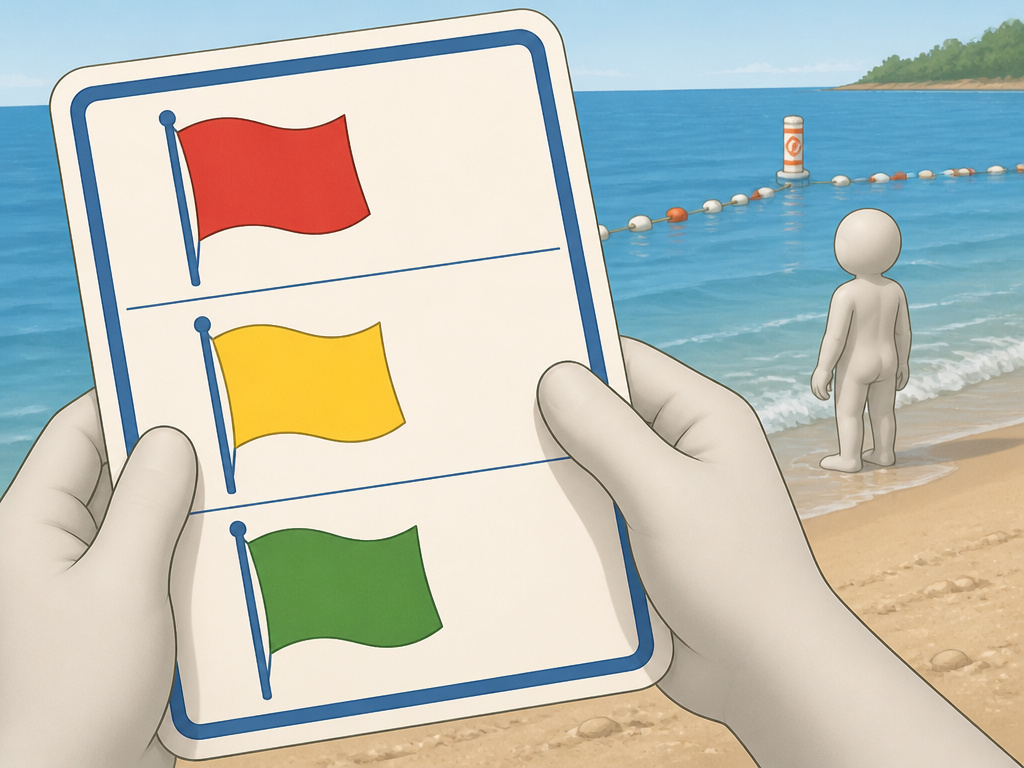
Here is where I would push back on the standard advice. Two agencies give different first-step guidance for the same beach, and a first-timer deserves to know that.
Michigan DNR’s position is that buoyed areas are placed where currents and waves are lower-risk, and that the areas are inspected roughly every two weeks. The National Weather Service’s position is that most Great Lakes beaches are unguarded, and that you should talk to a lifeguard or beach patrol first.
The two positions differ: Michigan DNR says buoyed areas are placed where currents and waves are lower-risk and are inspected roughly every two weeks, while the National Weather Service says most Great Lakes beaches are unguarded and you should talk to a lifeguard or beach patrol first.
The Wisconsin DNR beach safety guide is blunt about the stakes. According to the Great Lakes Surf Rescue Project, there have been nearly 1,500 Great Lakes drownings since 2010.
It is also the reason I would not swim at an unguarded beach without knowing the flag colors before I walk down to the sand.
Reading the water: five currents and the one that kills near piers
Swimmers in the Great Lakes can encounter different types of currents. They behave differently, and the difference matters for where you get in.
- Structural currents flow along piers and breakwalls. NWS calls these significantly more dangerous than the others.
- Outlet currents form where rivers and streams empty into the lakes.
- Rip currents pull away from shore and are the ones most people have heard of.
- Channel and longshore currents move water along the beach and can push you down the shoreline over time.
Children are especially susceptible to currents between the first and second sand bars. That is a specific zone to watch, not a general caution.
Where this goes sideways: Swimming near a pier because the water looks calmer there. Structural currents run along the pier and are significantly more dangerous than open-water currents. Stay at least 100 yards from any pier or structure.
If you do get caught in a current, the escape sequence is three steps: FLIP onto your back and float, FLOAT to keep your head above water and conserve energy, and FOLLOW the safest path out. Do not fight the current. Swim perpendicular to the flow.
What to do when someone else is in trouble
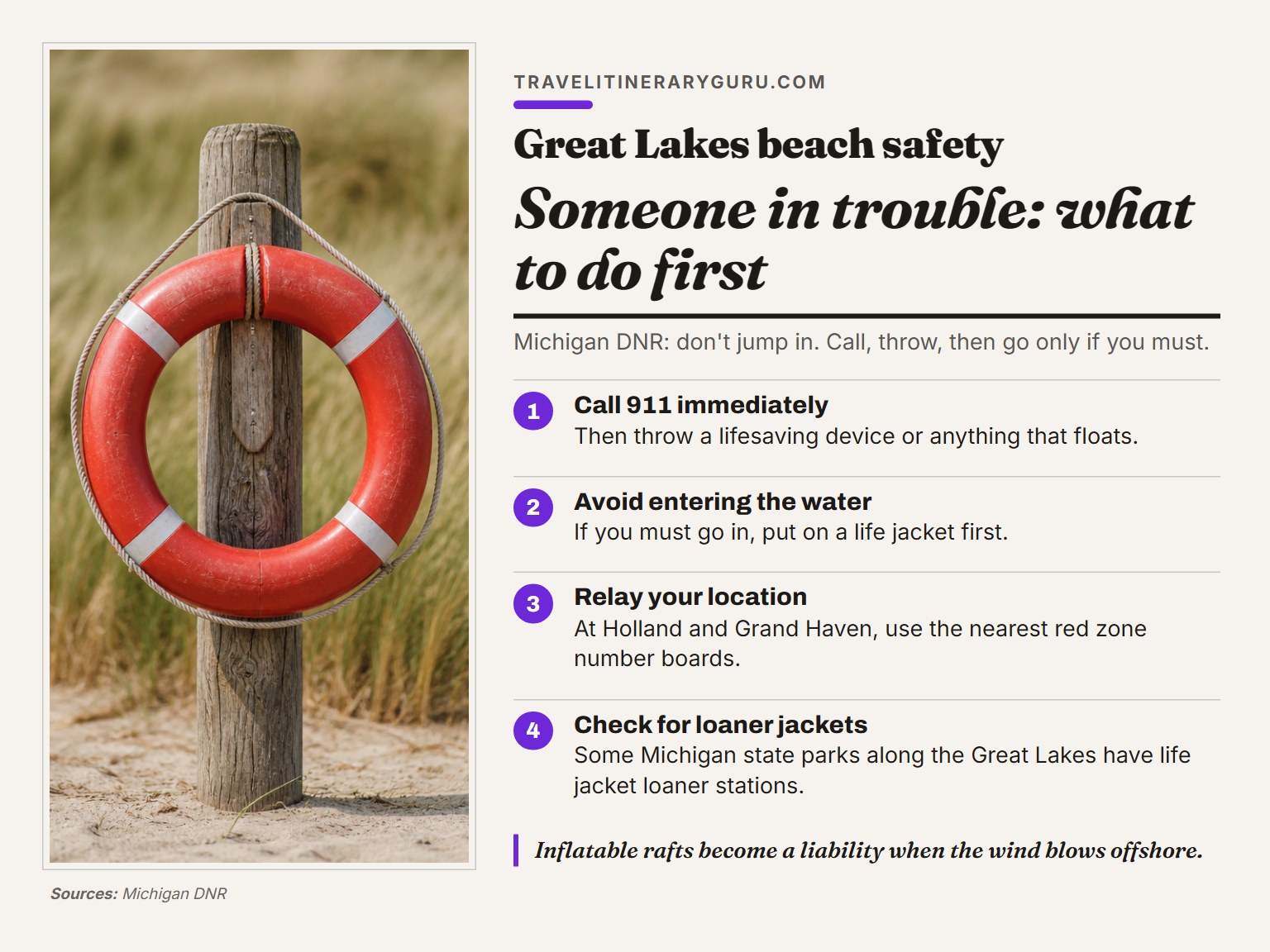
The instinct to jump in is the wrong first move, and both Michigan and Wisconsin DNR say so directly.
Call 911 immediately. Then throw a lifesaving device or anything that floats. Avoid entering the water if you possibly can. If you have to go in, put on a life jacket first.
At Holland and Grand Haven state parks, use the nearest red zone number boards on the beach to relay your location. Those boards exist so a dispatcher can find you on a shoreline that looks identical in every direction.
Some Michigan state parks along the Great Lakes have life jacket loaner stations available. If you are traveling with kids and did not pack jackets, that is worth checking before you assume you need to buy.
| Situation | First action | What not to do |
|---|---|---|
| Someone in trouble | Call 911, throw flotation | Enter the water |
| You are caught in a current | FLIP, FLOAT, FOLLOW | Fight the current |
| Strong offshore winds | Get out of inflatables | Float on a raft |
| Emergency on the beach | Call 911, use red zone boards | Guess your location |
Easy to miss: Inflatable rafts and flotation devices become a liability when the wind blows offshore. Both Michigan and Wisconsin DNR advise caution or avoiding them entirely in those conditions.
Land rules that change what you pack
Pictured Rocks and Sleeping Bear Dunes both require an entrance pass, and both have rules that affect what goes in your bag.
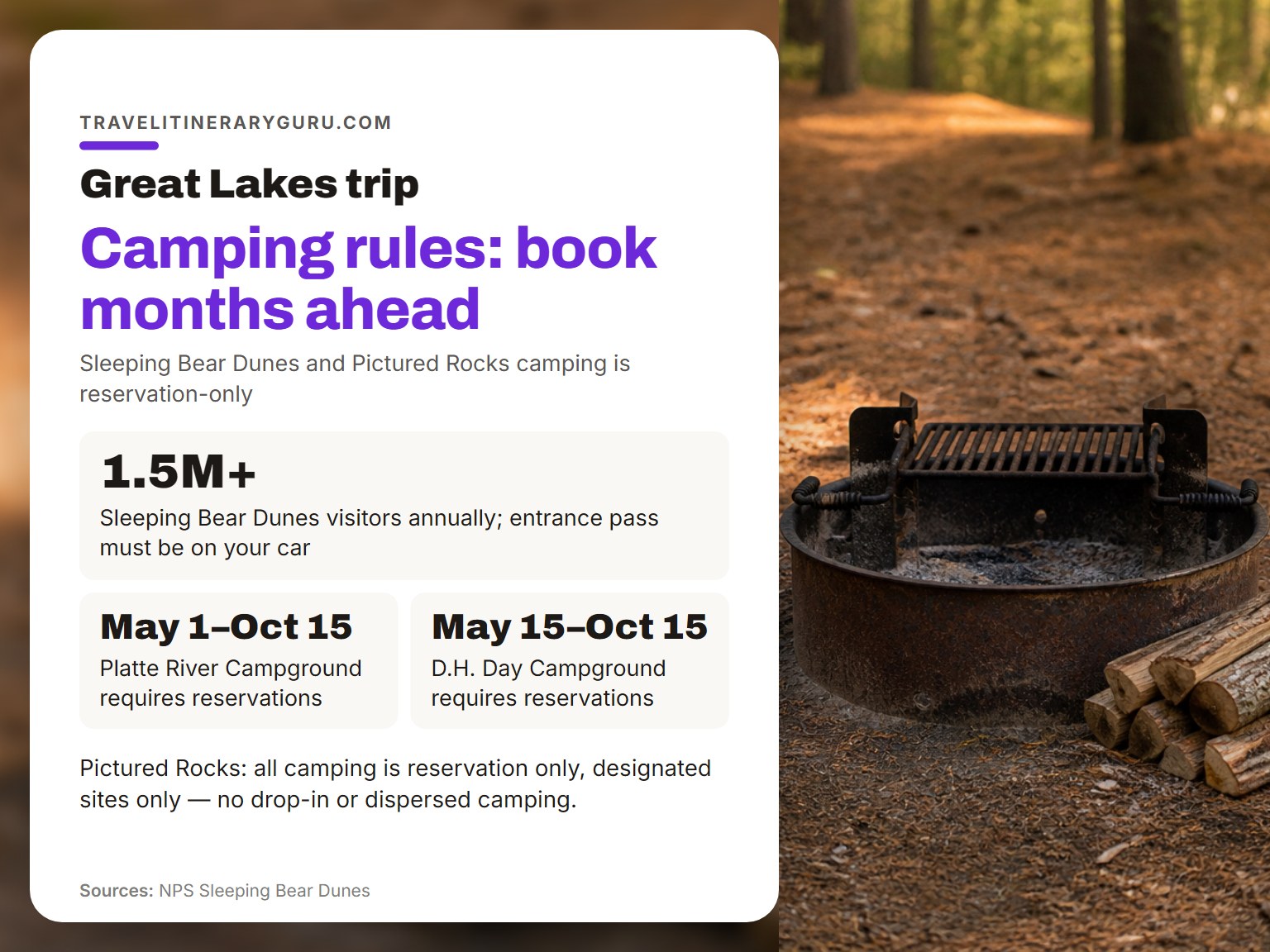
At Sleeping Bear Dunes, all visitors must have an entrance pass displayed on their car. The park sees over 1.5 million visitors annually, and summer brings lines at the popular areas. Buy the pass online before you arrive and skip the entrance station queue.
Camping at Sleeping Bear Dunes is reservation-only in practice, even where it is not stated that way. Platte River Campground requires reservations from May 1 to October 15. D.H. Day Campground requires them between May 15 and October 15. Sites are reservable up to six months in advance, and NPS says they are likely to be booked before you arrive. Have a plan B.
Pictured Rocks is stricter. All camping is by reservation only and only in designated sites. No drop-in camping, no dispersed camping. Entrance pass prices range from free to $80, and the America the Beautiful pass is accepted at both parks.
Bears are present at Pictured Rocks. Store food and anything with a scent in a vehicle, and use the designated receptacles for trash.
A few more things worth knowing before you pack:
- A beach wheelchair is available at Pictured Rocks, free to use, and must be reserved in advance.
- Non-motorized wheelchairs are permitted on Isle Royale trails, but the trails are narrow, rocky, and boardwalk-heavy.
- All fishing in Pictured Rocks follows State of Michigan regulations.
- The safest way to kayak on Lake Superior at Pictured Rocks is with a guide.
If you are building the driving leg of this trip and want a longer route to hang it on, the Amtrak Empire Builder runs the northern edge of this region and pairs well with a mainland park loop. For the water side, the Michigan DNR Great Lakes boating guide covers harbor rules and reservations, though the DNR is explicit that the page is not for navigational use. Bring actual charts.
Frequently Asked Questions
Do I need a reservation to camp in the Great Lakes parks?
At Pictured Rocks and Sleeping Bear Dunes, yes in practice. Pictured Rocks allows camping only in designated sites by reservation, with no drop-in or dispersed camping. Sleeping Bear Dunes sites are reservable up to six months out and are likely to be booked before you arrive, so have a backup plan.
Can I drive to Isle Royale?
No. Isle Royale is reachable only by boat or seaplane, and no vehicles, bicycles, wagons, strollers, or portaging carts are allowed on the trails. Private boaters need a permit before traveling to the park. Everyone else books a ferry or a seaplane seat.
Is the water really too cold to swim in?
It is cold enough to cause hypothermia, which is the exact language in Apostle Islands’ official brochure for 50°F water. That does not mean you cannot swim. It means the safe window is shorter than you think, and the flag system and buoyed areas exist for that reason.
What does a double-red flag mean at a Michigan state park?
It means water access is closed under Land Use Order 5.1.6. There is one carve-out: surfers on wind-powered or self-propelled wave-riding boards may enter at their own risk. If you are swimming or wading, the closure applies to you.
Do Great Lakes beaches have lifeguards?
Michigan state parks have no beach guards, and Wisconsin state park properties have no lifeguards either. Visitors swim at their own risk. That is why checking the flag color and staying inside the buoyed area matters more here than at a guarded ocean beach.
How far ahead should I book transportation to Isle Royale?
As soon as your dates are firm. NPS says transport can sell out at any time during the season. Ferry and seaplane service only runs mid-May through the end of September, so the bookable window is narrower than the park’s own operating season.
The Bottom Line
One rule most guides skip: if your trip to Isle Royale has a hard deadline on the other end, do not book it. NPS says delays of multiple days are possible and tells visitors to avoid scheduling important events within a few days of their scheduled departure. A first trip to a park with no easy bail-out options is not the trip to run on a tight clock.
For the mainland parks, the calculus is different. Pictured Rocks, Sleeping Bear Dunes, and the Apostle Islands mainland unit all work on a normal driving schedule, and the state park system around them is where I would spend the extra days. Fewer crowds, same water, and you can leave when you want.
Fair warning on one thing. The first afternoon at any of these parks, you will want to swim. Check the flag, find the buoys, and if the buoys are not there yet, treat that stretch of beach as open water rather than a swim area. The lake does not care that your trip is short.
