
How to Compare Family Travel Insurance Plans: 6 Checks
This post contains affiliate links. As an Amazon Associate, we earn from qualifying purchases.
To compare family travel insurance plans, check four things: the child age ceiling, how many travelers one policy covers, whether limits apply per person or per policy, and the total premium against trip cost. InsureMyTrip puts premiums at 4% to 10% of prepaid, nonrefundable expenses; NAIC says 5% to 10%.
The per-person versus per-policy distinction is the one that quietly decides how much cover a family actually holds. A benefit written per person multiplies across every insured traveler. The same figure written per policy sits still no matter how many names you add. Knowing how to compare family travel insurance plans means checking which basis each benefit uses.
What follows is the six-check comparison I run on every family policy: cost as a share of the trip, child age ceilings, traveler caps, limit units, activity exclusions, and the claims path when something goes wrong abroad.
Key Takeaways
- Free child cover still needs the child on the policy. Enter every traveler at quote stage and confirm each name appears on the issued documents.
- Age ceilings vary by provider. Squaremouth free child cover stops at 17; UK policies run to 18, or 23 in full-time education.
- Traveler caps vary by provider. Squaremouth allows up to 10 family members on one plan; World Nomads (USA) allows up to seven dependent children; InsureYonder says parties of ten or more need a group policy.
- Read the limit unit before the number. InsureMyTrip flags four distinct allocation units, per person, per incident, per trip, and per policy, that pay out very differently.
- Adventure activities often sit outside standard cover. Uswitch and the NAIC list skiing, snowboarding, bungee jumping, and white-water rafting as common exclusions, though World Nomads covers 150+ activities and SafetyWing has limited adventure activity coverage.
The 6 Checks I Run Before Buying a Family Policy
Cost comes first because it frames every other decision. InsureMyTrip publishes a range of 4% to 10% of prepaid, nonrefundable trip expenses, and the NAIC publishes 5% to 10% of total trip price.
Insurers price family travel insurance as a percentage of prepaid, nonrefundable trip cost rather than a flat rate. Published ranges differ: InsureMyTrip reports 4% to 10% of prepaid, nonrefundable expenses, while marketplace customer data for international trips averaged near 6% of insured trip cost. The percentage applies to the nonrefundable portion, so refundable bookings reduce the insured base.
The two ranges don’t match because they measure slightly different bases. One works from prepaid, nonrefundable expenses. The NAIC’s NAIC travel insurance consumer article works from the total trip price, which includes refundable pieces.
Comparison marketplaces let you check coverage levels, pricing structures, and support features across multiple providers when you compare a how to compare family travel insurance plans. Squaremouth and InsureMyTrip both publish their best travel insurance plans side by side, which beats opening multiple insurer sites in separate tabs.
Here’s the order I run them in, and what each one costs you when it’s wrong:
- Cost as a share of the trip. Compare the premium against the money you’d actually lose if you cancelled, not against the policy’s sticker number.
- Child age ceiling. Free child cover ends at a different age with every provider, and an over-age child needs a separate policy.
- Traveler cap. One plan covers a set number of people, and the number moves with the provider; Squaremouth and World Nomads both require same-state residency.
- Limit unit. Per person and per policy produce very different payouts from the same headline figure.
- Activity exclusions. Uswitch and the NAIC list common exclusions including skiing, snowboarding, bungee jumping, and white-water rafting, though World Nomads covers 150+ activities.
- Claims path. InsureYonder says good travel insurance includes 24-hour emergency assistance, and Uswitch warns that an undeclared pre-existing condition likely won’t be covered.
The premium follows the trip cost, so compare the premium against the money you’d actually lose if you cancelled.
The Child Age Ceiling Decides Who Is Actually Covered
Age thresholds for children move by provider. Squaremouth’s “Kids Covered Free” pricing protects children 17 years or younger at no additional cost. Uswitch reports a ceiling of under 18, extended to 23 for children in full-time education.
| Plan or source | Free child cover ceiling | Family cap on one policy |
|---|---|---|
| Squaremouth “Kids Covered Free” | 17 years or younger | up to 10 family members |
| World Nomads (USA) | dependent children included | up to 7 dependent children |
| TravelEx family plan | under 17 | not stated |
| SafetyWing | under 10 | up to 2 children |
| Uswitch (UK policies) | under 18, or 23 in full-time education | not stated |
Free carries a condition that catches families every year. InsureMyTrip states it plainly: a free child slot doesn’t mean you can leave the child off the policy. Enter every traveler when you request a quote, then confirm each person appears on the policy documents.
What most people get wrong: Treating a free child slot as automatic. A child who never gets entered at quote stage won’t appear on the certificate, and an unlisted traveler has no cover when the claim is filed.
The travel insurance coverage that actually protects your family is defined by the policy wording, not by the plan’s marketing name. Read the eligibility rules for each child before you compare anything else.
Babies, Newborns, and the 14-Day Rule
Infants need their own eligibility check. Squaremouth notes that some policies won’t cover babies until they are at least 14 days old. If you’re flying with a newborn in the first month, that threshold decides whether cover exists at all.
How Many Travelers Fit on One Family Policy?
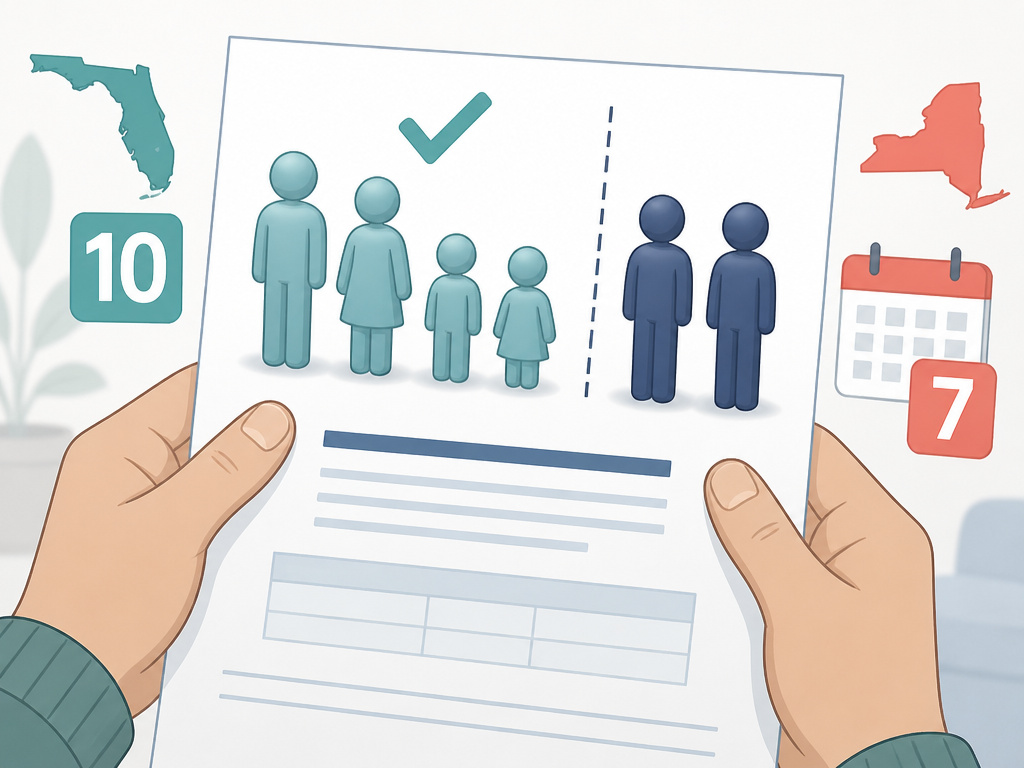
Squaremouth reports that you can typically insure up to 10 family members on a single plan, provided everyone resides in the same state.
World Nomads (USA) sets its own ceiling lower, at seven dependent children, and requires same-state residency plus at least one adult legal guardian traveling. InsureYonder points parties of ten or more toward a group travel insurance plan instead.
So the cap varies by provider.
InsureMyTrip adds a wrinkle for families with different home states, travel dates, or itineraries. Members with different home states, different travel dates, or different itineraries may need separate policies. A multi-generational family trip is where this bites hardest, because family members in different states may need separate policies.
The Limit Unit Changes What the Headline Number Is Worth

A cancellation limit means nothing until you know what it’s measured against in how to compare family travel insurance plans. InsureMyTrip flags four distinct allocation units: per person, per incident, per trip, or the entire policy. The same headline figure behaves very differently depending on which one applies.
| Limit unit | What it means | Where it bites |
|---|---|---|
| Per person | Every insured traveler gets the full limit | One child’s hospital bill |
| Per incident | One event draws one limit | Two children sick on the same trip |
| Per trip | The whole policy shares a single limit | Long multi-stop itineraries |
| Per policy | One pot covers everything | Families of five or more |
A family with a per-person limit holds multiple times the cover of the same family on a per-policy limit. That’s the difference between one hospital stay and one ruined holiday.
How to Check the Unit in Under a Minute
Open the benefit table and find the word “per”. If it reads per person, the limit multiplies across every insured traveler. If it reads per policy, one pot covers the whole family.
Then check the excess, because Uswitch notes that a higher excess usually brings a cheaper premium, and you pay that amount toward every claim.
Adventure Activities Are Where Family Policies Stop
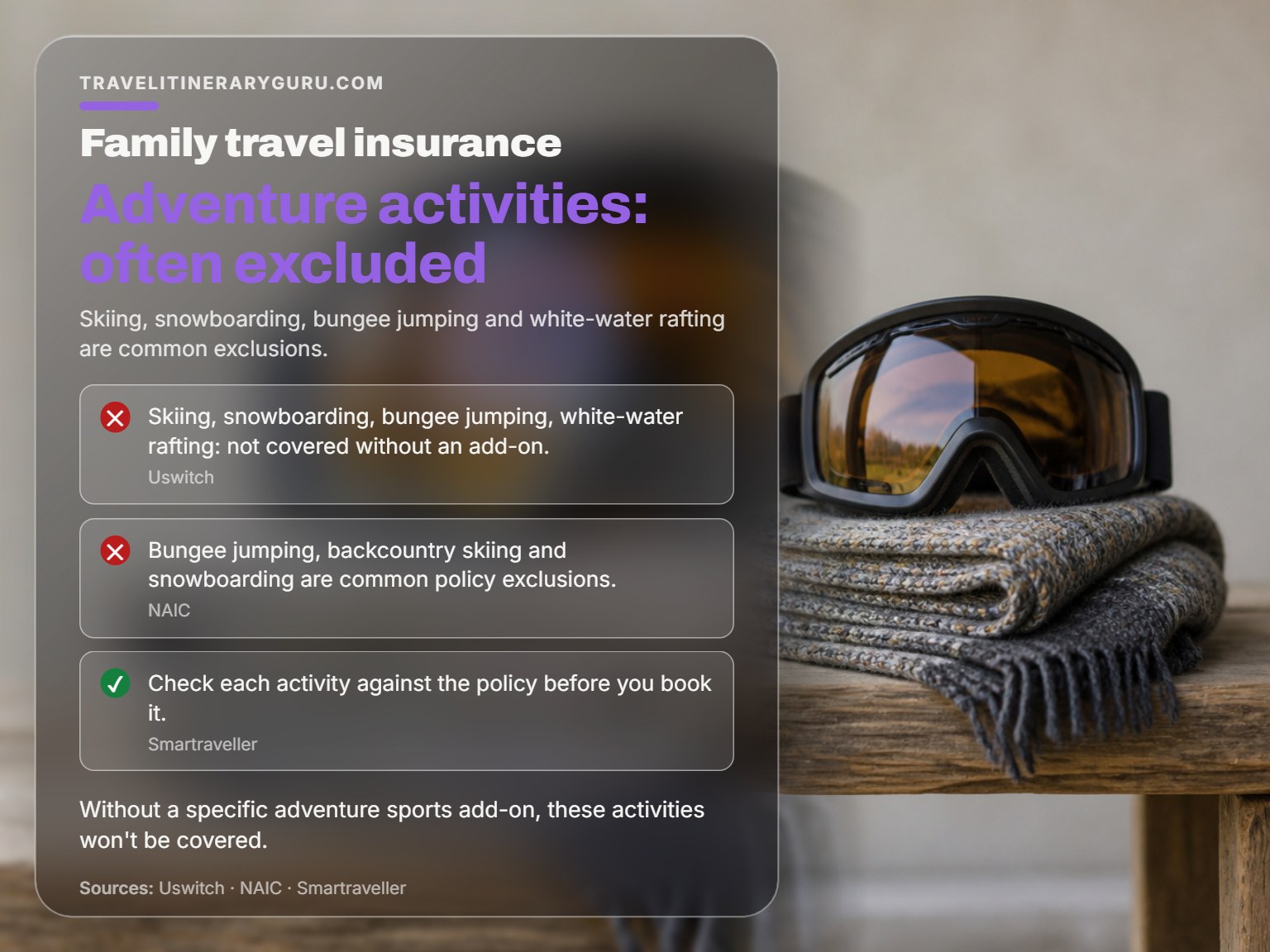
Skiing, snorkeling, and cycling are three of the most common family holiday activities, and three of the most commonly excluded.
Uswitch is direct about it. Without a specific adventure sports add-on, activities such as skiing, snowboarding, bungee jumping, and white-water rafting won’t be covered. The NAIC lists bungee jumping, backcountry skiing, and snowboarding among common travel policy exclusions.
Squaremouth pushes the warning wider. Even family-friendly activities like hiking, snorkeling, and cycling get classed as high-risk by some insurers and are often excluded. TravelEx’s family plan does not cover adventure activities at all.
Before you assume an activity is covered, check it against the policy:
- Skiing and snowboarding. Excluded by Uswitch and the NAIC unless you buy a specific add-on.
- Bungee jumping and white-water rafting. Named exclusions in both sources.
- Hiking, snorkeling, and cycling. Squaremouth warns some insurers class these as high-risk and exclude them.
- TravelEx family plans. No adventure activity cover at all, per the plan comparison.
This is where reading the common travel insurance exclusions list before you book activities saves a claim later.
I check the activity list before I check anything else. A family that books a catamaran snorkel trip and only then discovers snorkeling sits on the exclusion list has already spent the money. Wrong order.
The Claims Path: What Gets Paid and What Gets Denied
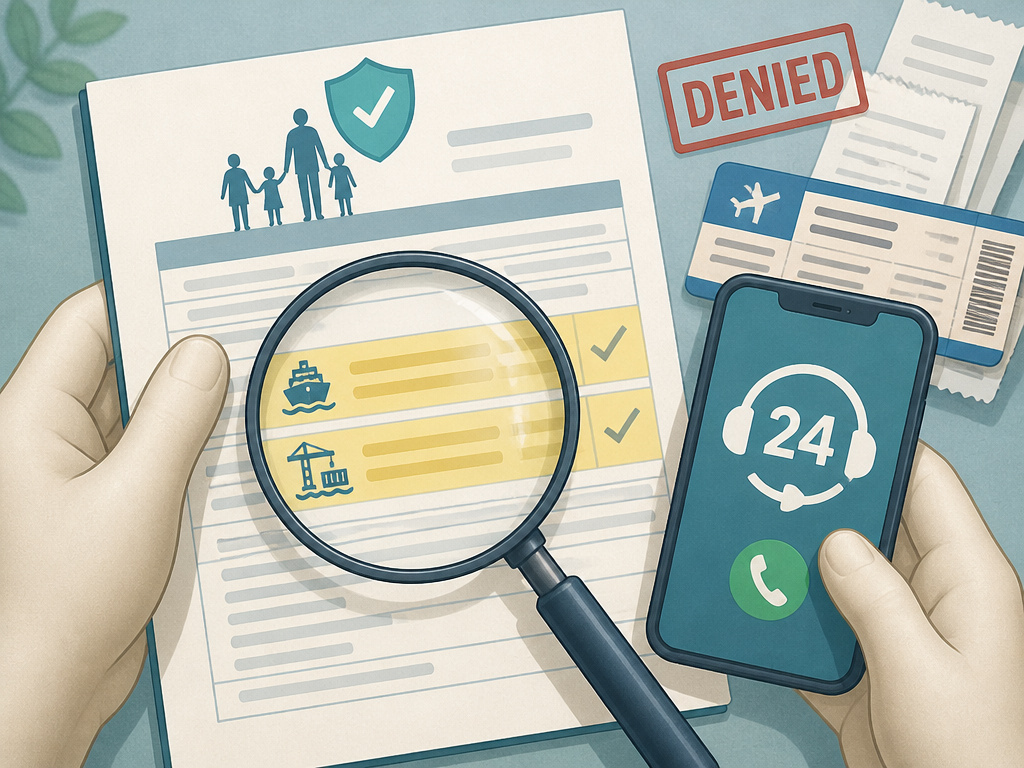
A client missed a port in Cozumel when weather closed the harbor, and assumed the policy would cover the excursion they’d prepaid. The claim came back denied. Trip interruption and missed port cover are two different clauses, and the policy only carried the first one. That gap cost them the whole excursion.
That’s why I now compare family plans on two cruise-specific line items: medical evacuation from a ship at sea, and missed port coverage. Both are easy to skip and expensive to need. Anyone booking a sailing holiday should compare cruise insurance on those two lines before anything else.
Emergency assistance is the other half of the claims path. InsureYonder’s guidance is that good travel insurance includes access to emergency assistance services operating 24 hours a day. Those teams coordinate medical care, arrange transport, and walk families through the claim.
Emergency Assistance vs Emergency Medical Cover
These are two separate benefits and families mix them up constantly. Emergency medical cover pays the hospital bill. Emergency assistance is the 24-hour phone line that finds the hospital in the first place.
InsureMyTrip recommends checking two specifics before you buy. First, whether the plan transports the traveler to the nearest suitable facility or offers a hospital-of-choice benefit. Second, whether a parent or guardian can accompany a hospitalized child, and whether the plan helps with a bedside visit or returning dependent children.
Ask these four questions before the policy is issued:
- Hospital choice. Does the plan transport to the nearest suitable facility, or does it offer a hospital-of-choice benefit?
- A parent at the bedside. Can a parent or guardian accompany a hospitalized child?
- Dependents. Will the plan return dependent children home if the adult is hospitalized?
- Bedside visits. Does it pay for a relative to fly in?
When a claim does happen, the order matters:
- Call the emergency assistance line first, because the 24-hour team coordinates care and transport.
- Keep every receipt, including taxi fares and pharmacy slips.
- Get a written diagnosis from the treating doctor before you leave the country.
- Submit through the insurer’s channel and keep a copy of everything you send.
The travel insurance claims process rewards paperwork discipline more than it rewards urgency.
Pre-existing conditions are the most common reason a claim dies. The NAIC lists pre-existing health conditions among the standard travel policy exclusions, and Uswitch is blunt about the consequence: if you fail to declare a pre-existing medical condition, you likely won’t be covered for a claim relating to it.
Squaremouth offers the counterweight. Some policies do cover travelers with a health issue that existed before the policy was purchased, through a Pre-Existing Condition waiver that removes the exclusion.
Easy to miss: A waiver can remove the exclusion, and waivers carry conditions. In my experience, families buy the policy in the last week before departure and then read those conditions for the first time.
If anyone in the family has an ongoing condition, read the pre-existing conditions rules before you compare premiums, because the waiver conditions are the whole game.
Is Credit Card Travel Insurance Enough for a Family?
Have you actually read what your card covers, or just the headline on the benefits page?
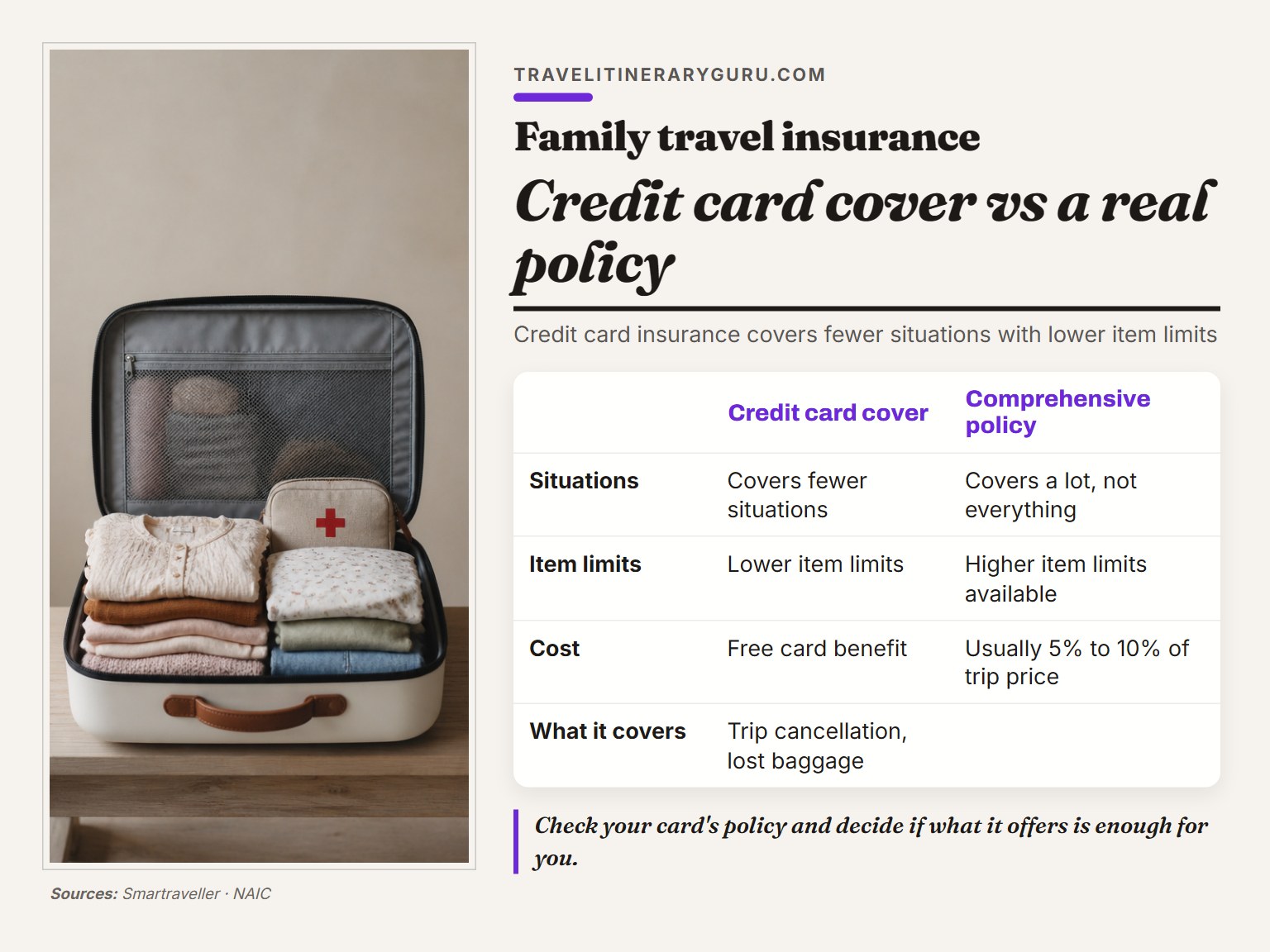
The NAIC’s position is measured. Some credit cards offer trip cancellation and lost baggage coverage, and the advice is to check your card’s policy and decide whether what it offers is enough for you.
Smartraveller is less generous. It states that credit card insurance differs from most full policies, covering fewer situations with lower item limits. The same page warns against defaulting to the free option without checking that it suits your needs. The Australian government travel insurance advice is worth reading in full before you decide a free card benefit replaces a paid policy.
My position, and this is an opinion rather than a finding: credit card cover is better than nothing and worse than a real policy. The limits are built for a lost suitcase, not for a child’s hospital stay abroad.
If you’re weighing the two, compare the credit card coverage on item limits and cancellation reasons, because those are where the gap shows up.
Single Trip or Annual: Match the Policy to Your Travel Year
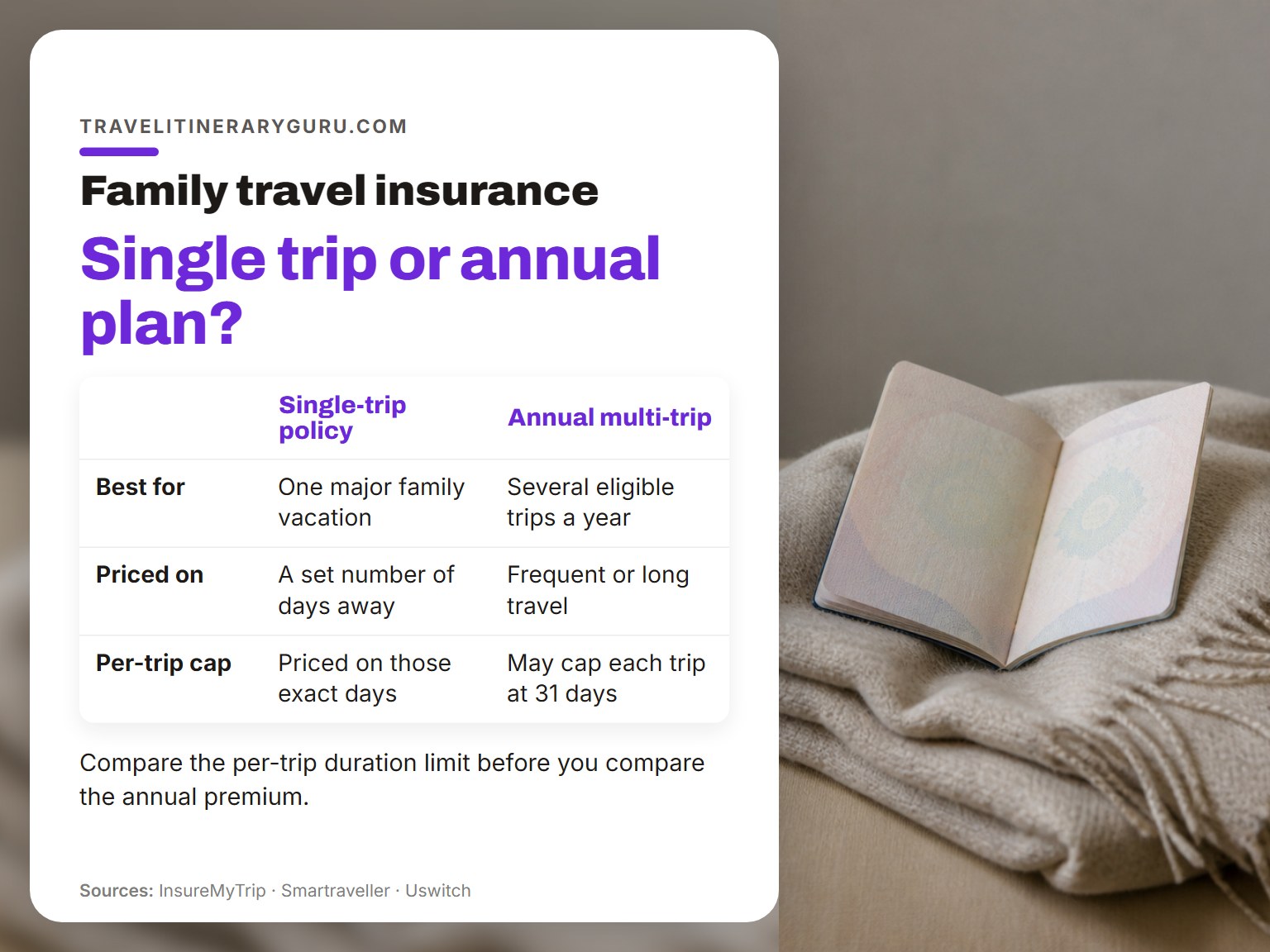
Trip count decides the policy type, not the destination.
InsureMyTrip’s guidance is that a single-trip full policy fits one major family vacation well, and an annual plan is worth comparing when the household takes several eligible trips each year.
Smartraveller frames the same choice around duration. Insurers quote based on how many days you’ll be away, so a one-off policy for a set number of days suits a quick trip, while an annual multi-trip policy suits frequent or long travel.
Annual cover carries a catch. Uswitch reports that annual policies may cap each individual trip at 31 days, and Smartraveller adds that multi-trip and credit-card policies restrict the length of each trip, with extra days sometimes purchasable.
When an Annual Policy Is the Wrong Buy
One long summer trip plus one weekend away is the classic case where annual cover looks clever but fails on the duration limit. If your single trip runs past the per-trip cap, you’re buying two policies and using one.
Skip this if: Your only trip this year runs longer than the annual policy’s per-trip limit. A single-trip policy priced on those exact days does the same job without the cap.
Compare the per-trip duration limit before you compare the annual premium. An annual policy that caps each trip at 31 days is a single-trip policy with extra paperwork for a family taking one long holiday.
Frequently Asked Questions
Can I put my whole family on one travel insurance policy?
Yes, when everyone meets the plan’s eligibility rules and shares the same travel dates and itinerary. Squaremouth reports a typical ceiling of 10 family members on one plan, provided everyone lives in the same state. World Nomads (USA) sets its own limit at seven dependent children. Travelers in different states or on different itineraries may need separate policies.
Does free child cover mean I can leave my child off the policy?
No. InsureMyTrip is explicit that free doesn’t mean you can skip the child at quote stage. Enter every traveler when you request a quote, then confirm each person appears on the policy documents. An unlisted traveler has no cover when a claim is filed.
What age does family travel insurance stop covering my children?
It depends on the provider. Squaremouth’s free child pricing covers children 17 years or younger. Uswitch reports a UK ceiling of under 18, extended to 23 for children in full-time education. TravelEx includes children under 17 at no additional cost, and SafetyWing covers up to two children under 10 per family free.
Are pre-existing conditions ever covered?
Sometimes, through a waiver. The NAIC lists pre-existing health conditions among common travel policy exclusions, and Uswitch warns that an undeclared condition likely won’t be covered. Squaremouth notes that some policies offer a Pre-Existing Condition waiver that removes the exclusion.
Is travel insurance worth it for a short domestic trip?
That depends on what you’d lose. If your prepaid, nonrefundable spend is small and your health cover already works at the destination, the case is weak. The CDC advises travelers to find out whether their regular health insurance covers care outside the United States and to consider additional health and evacuation coverage when it doesn’t.
Do I need a separate policy for a cruise?
Check two line items specifically: medical evacuation from a ship at sea, and missed port coverage. Standard family plans often skimp on both. Trip interruption and missed port cover are separate clauses, so a weather diversion can leave the excursion unreimbursed.
The Bottom Line
One rule I’d write on the front of every family policy: read the itinerary change clause and the activity list before you compare premiums. Those two lines cause more denials than anything else I see.
Here’s the trigger for action. If your prepaid, nonrefundable spend is large enough that losing it would change your year, and if anyone in the family has an ongoing medical condition, stop comparing on premium and start comparing on waiver conditions and medical limits.
This all changes if your regular health insurance already covers you abroad and your trip is short. In that case a modest cancellation benefit does most of the work, and the cheapest compliant policy is the right answer.
I’d rather see a family buy a mid-tier policy with the condition declared than a top-tier policy where nobody checked the waiver conditions. The second one looks better on paper and can pay nothing at the hospital.
