
How to Choose an Accessible Guided Tour: What to Ask
This post contains affiliate links. As an Amazon Associate, we earn from qualifying purchases.
To choose an accessible guided tour, ask the operator for the measurable route data first: heights, widths, weight capacities, slopes and lighting levels, then get the answers in writing before you pay. That list isn’t my invention. It’s the audit set the UNWTO implementation guide for ISO 21902:2021 tells tour operators to collect. If a provider can’t produce those numbers, you’re booking a mood, not a route.
The word “accessible” on a booking page can mean a flatter walk, or it can mean nothing at all. Some operators plan for step-free boarding, realistic pacing, hearing support, verbal wayfinding, and staff who can adjust when conditions change. Others are repeating a phrase they saw on a competitor’s site. Knowing how to choose an accessible guided tour starts with asking what the operator actually provides.
So the whole how to choose an accessible guided tour job comes down to one move: replace the label with measurements, and replace the promise with a written answer you can carry to the meeting point.
What follows is the audit set, the questions that produce real answers instead of vague ones, and the two structural traps almost nobody warns you about: data that goes stale between booking and arrival, and accessibility information that lives on a page you’d never think to open.
Key Takeaways
- Ask for five measurements — heights, widths, weight capacities, slopes, lighting levels. An operator who can’t supply them hasn’t audited the route.
- Get it in writing and save it with your reservation. A clear “not suitable” beats an uncertain promise every time.
- Re-verify the week you travel. Weather, construction, and venue changes can invalidate published access data.
- Check the third-party channel separately. Accessibility details on reseller listings drift from the operator’s own information.
- Measure your own aid first — width, turning radius, and seat height. You can’t match a door to a chair you haven’t measured.
What Should an Accessible Tour Description Actually Tell You?
A usable description explains how people move through the route, how they’ll hear or follow the guide, where they can pause, and what can be adapted on the day. If a listing only repeats “wheelchair friendly” or “easy walk,” you still don’t know enough to book with confidence.
An accessible tour description states the route sequence, the surface and gradient of each leg, the location and dimensions of restrooms and seating, the method of audio delivery, and the conditions under which the itinerary changes. Providers should publish measured values for heights, widths, weight capacities, slopes and lighting levels rather than descriptive adjectives.
That block is the standard in plain language. The measurement list comes straight from the UNWTO guidance for operators working to ISO 21902:2021, the international standard for accessible tourism.
One small citation mess worth knowing about, because you’ll see it if you go looking. The UNWTO guide’s body text refers to “ISO 21902:2022.” Its own footnote and the ISO catalogue both give 2021. The Spanish adoption is designated UNE-ISO 21902:2021. Same document, and the year on the cover is 2021.
Here’s the part that matters for your booking. The guide gives operators the five things to measure, then defers the numeric tolerances to “technical criteria defined in international standards.” So there’s no universal minimum door width an operator can quote you from this document alone. What you get instead is a framework, and you have to supply the numbers that fit your own equipment.
Which means you measure your own gear before you make a single call.
The Three Questions I Ask Before I Trust Any Access Page
I call every venue directly. Three questions, every time: door width, bathroom turning radius, and whether the accessible entrance is actually staffed during the hours the tour runs.
That last how to choose an accessible guided tour question is the one that gets people. A venue can have a beautiful step-free entrance that’s locked after 4 p.m. Because the staff member who holds the key went home. The website won’t tell you. The phone call will.
Door width and turning radius are the two numbers that decide whether your day works or collapses at the threshold. Ask for them in centimetres or inches, whichever the operator uses, and write down what they say.
Fair warning: some operators will answer with “it’s accessible, don’t worry.” That’s your signal to slow down and ask again with a specific number attached. “What’s the clear opening width of the narrowest doorway on the route?” is a question that can’t be answered with reassurance.
If you want the fuller version of this interrogation, the questions before booking a tour that I work from cover transport, restrooms, and day-of contact alongside the physical measurements.
Why “Accessible” Means Different Things to Different Travelers
Accessibility splits into at least six separate concerns: mobility, hearing, vision, stamina, communication support, and sensory needs. A tour that nails one can fail badly at another.
A route can be fully lift-accessible and still be tiring, noisy, crowded, badly lit, or short on seating. Step-free access gets you through the door. It doesn’t get you through the day.
The U.S. National Park Service publishes a list of what parks should disclose for visitors who are blind or have low vision, and it reads like a checklist for any operator: whether audio description is offered and how it’s accessed, whether trails or waysides carry audio description, accessible parking and notable terrain barriers between the lot and the entrance, tactile models and orientation maps, and where designated accessible seating sits in the amphitheater.
Notice what’s on that list. Terrain barriers between the parking lot and the door. That’s the leg of the trip people forget to ask about, and it’s often the hardest one.
Easy to miss: The walk from the drop-off point to the meeting point. Operators describe the tour and skip the approach, so a 300-metre cobbled stretch with no bench becomes the part of the day that ruins the rest of it.
For travelers with sensory needs, the specific artifact to ask for is a sensory map: a document noting noisy areas, flashing lights, and toilet facilities along the route. Fáilte Ireland’s accessible tourism checklist names it directly. If an operator has never heard the term, that tells you something about how much thought went into the experience.
What Nobody Tells You About Stale Access Data
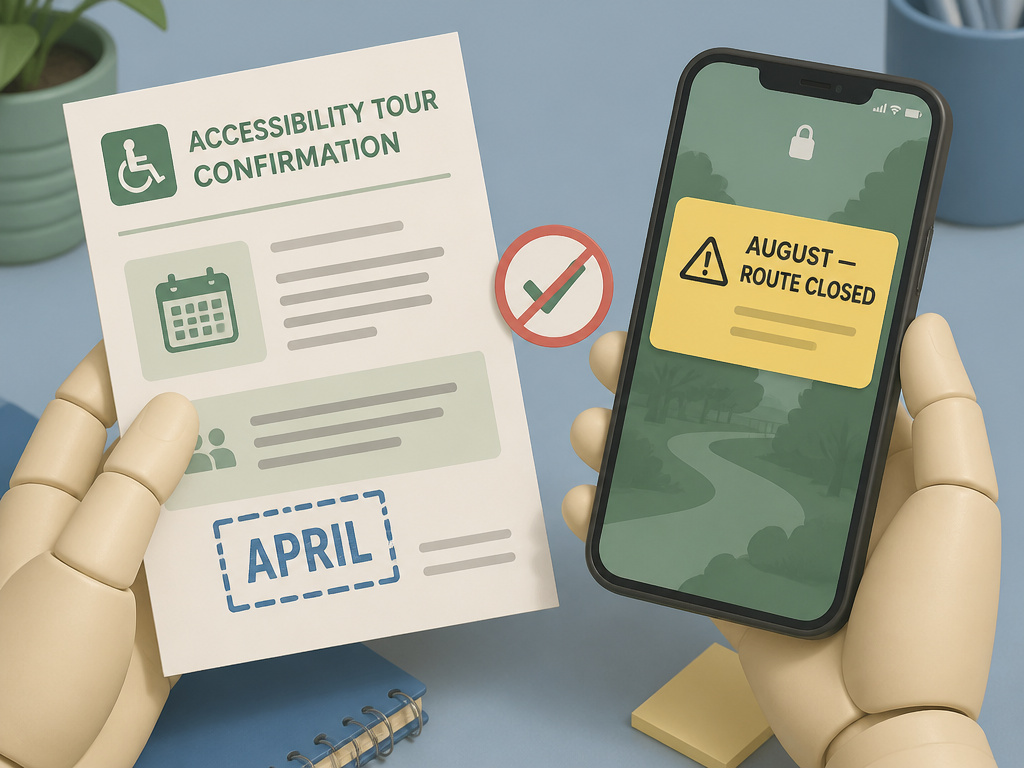
Published accessibility information goes out of date, and it goes out of date faster than you’d expect.
The National Park Service says it plainly on its NPS accessibility for low vision guidance: parks may have alerts on current conditions whenever weather or other factors like construction have altered accessibility. In other words, the federal agency that publishes the data is also telling you not to fully trust it on the day.
That’s a real tension, and it’s the one I’d flag hardest. Two credible sources take opposite positions here. Fáilte Ireland and the UNWTO guide both push written, measured documentation you can rely on when you book. The Park Service pushes you back to the individual park page to re-verify, because the published version may already be wrong.
Both are right, and the resolution is a two-step process rather than a choice.
| Stage | What you do | Who’s telling you to |
|---|---|---|
| Booking | Get measured answers in writing, save them | Fáilte Ireland, UNWTO Guide 03 |
| Week of travel | Re-confirm route and conditions directly | U.S. National Park Service |
The practical habit: review the listing and make contact before you plan the season, then confirm the key details again shortly before departure. A route that worked in April may not be the same route in August.
What most people get wrong: Treating the booking confirmation as the final word. Construction, seasonal crowds, temporary exhibits, and equipment repairs all change routes, and none of them show up in the confirmation email.
Where to Look When the Operator’s Own Page Is Thin
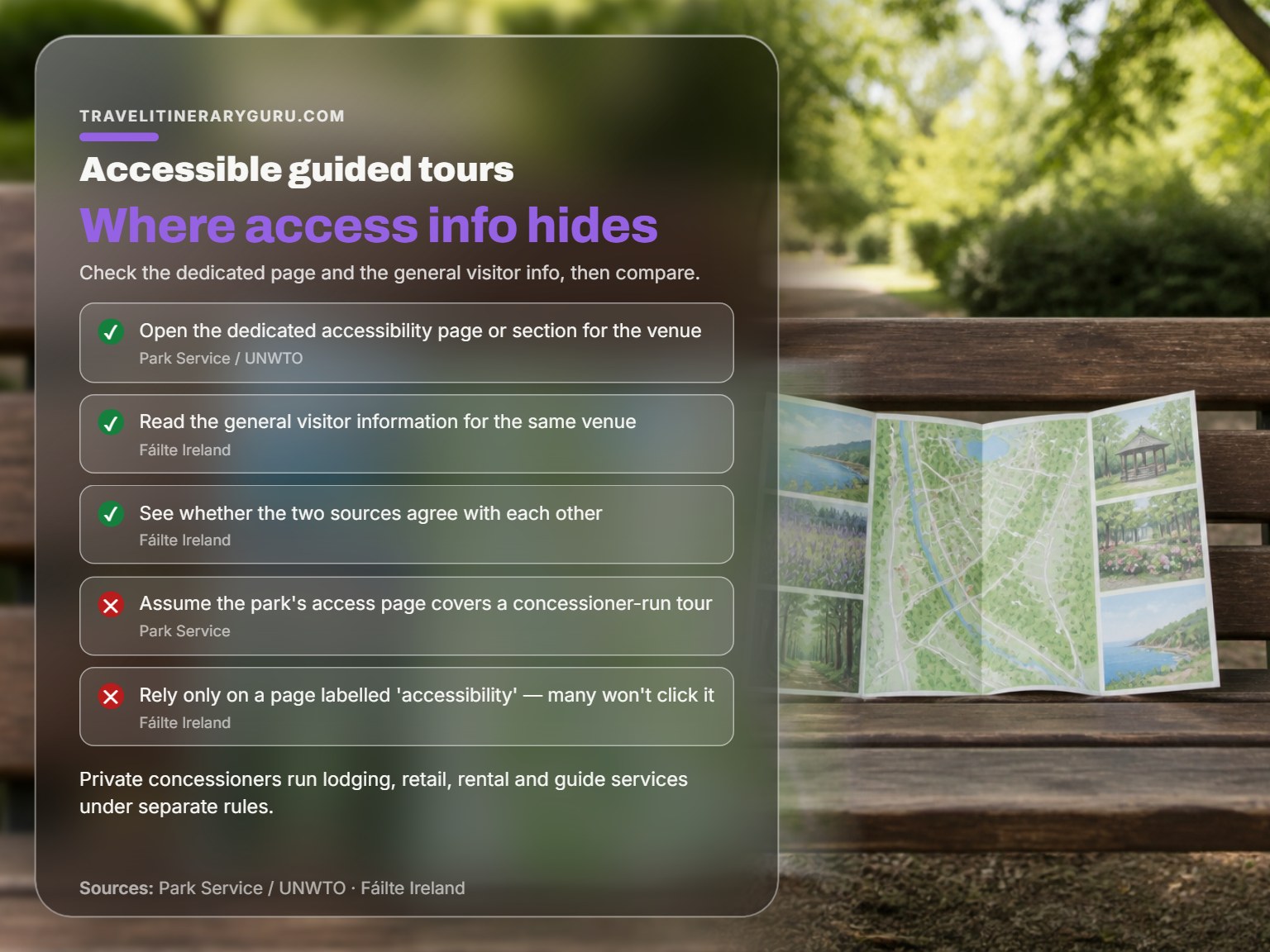
Accessibility information hides in places you wouldn’t think to open, and it’s missing from places you would.
Fáilte Ireland makes a point that reframes the whole search. People “will not always identify themselves as having accessibility needs.” A parent with a pushchair reading a garden’s visitor page is looking for the same terrain, surface, and restroom information as a wheelchair user, and they’ll never click a link labelled “accessibility.”
That conflicts directly with how the Park Service and the UNWTO guide both structure things, routing visitors to dedicated accessibility pages or sections. A dedicated page is easier to maintain and easier to find when you know to look for it. It’s also invisible to everyone who doesn’t self-identify.
So check both. Open the dedicated access page, then read the general visitor information for the same venue and see whether the two agree.
Where you’re dealing with a national park or similar public land, there’s a second trap. The Park Service notes that private concessioners run lodging, retail, rental, and guide services under separate accessibility regulations. The park’s own accessibility page may not cover the tour you’re actually booking. If the operator is a concessioner, you need their information, not the park’s.
Skip this if: You’re booking a tour inside a single modern building with one operator. The concessioner and third-party channel problems mostly apply to multi-venue routes, historic sites, and public land.
For the wider trip, accessible hotel rooms and accessible restrooms along the route deserve the same treatment as the tour itself. The tour is one leg. The day is the whole thing.
How Do You Compare Two “Accessible” Tours Head to Head?
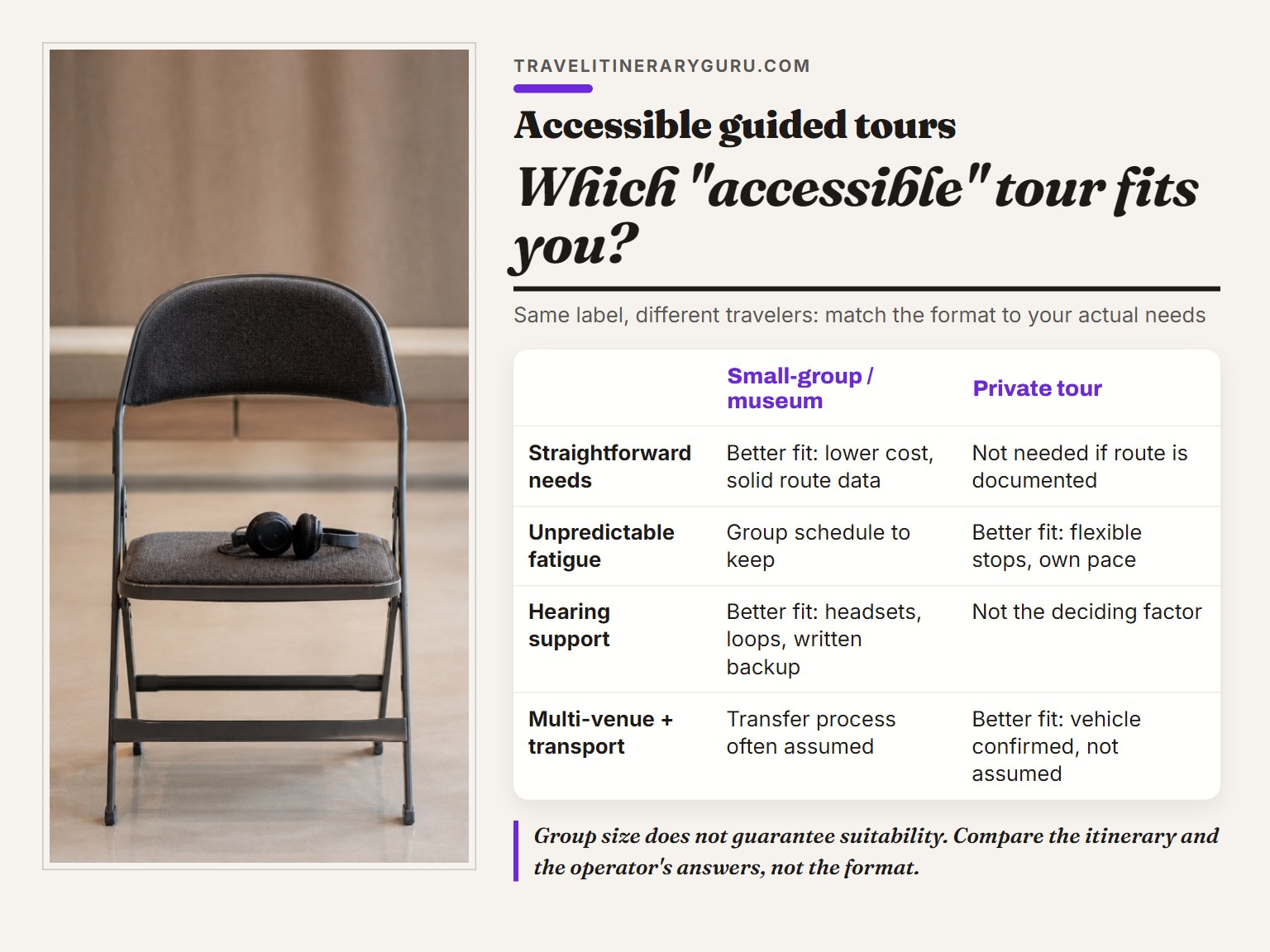
You compare them on measured answers, not on labels or price tiers. Two tours can both call themselves accessible and be built for completely different travelers.
Here’s the comparison framework I use. It commits to a winner per situation rather than hedging.
| Situation | Better fit | Why |
|---|---|---|
| Straightforward needs, well-documented route | Small-group or museum tour | Lower cost, published route data is usually solid |
| Unpredictable fatigue or pacing | Private tour | Flexible stops, no group schedule to keep |
| Hearing or communication support needed | Museum or indoor tour | Headsets, loops, and written backup are standard |
| Multi-venue route with transport | Private tour with confirmed vehicle | Transfer process gets checked, not assumed |
| Sensory sensitivity | Off-peak or relaxed session | Quieter, dimmer, fewer people |
A private tour earns its cost when pace, transport, fatigue, or communication support are hard to predict. When your needs are straightforward and the operator documents the route properly, a well-run small-group or indoor tour does the same job for less.
The one thing group size does not guarantee is suitability. A small group on a bad route is still a bad route. Compare the actual itinerary and the quality of the operator’s answers, not the format.
If you’re comparing formats across a whole trip, the same logic applies to choosing a guided tour in general. Accessibility is one axis. Pace, group size, and interpretation quality are the others.
When the Standard Advice Falls Apart
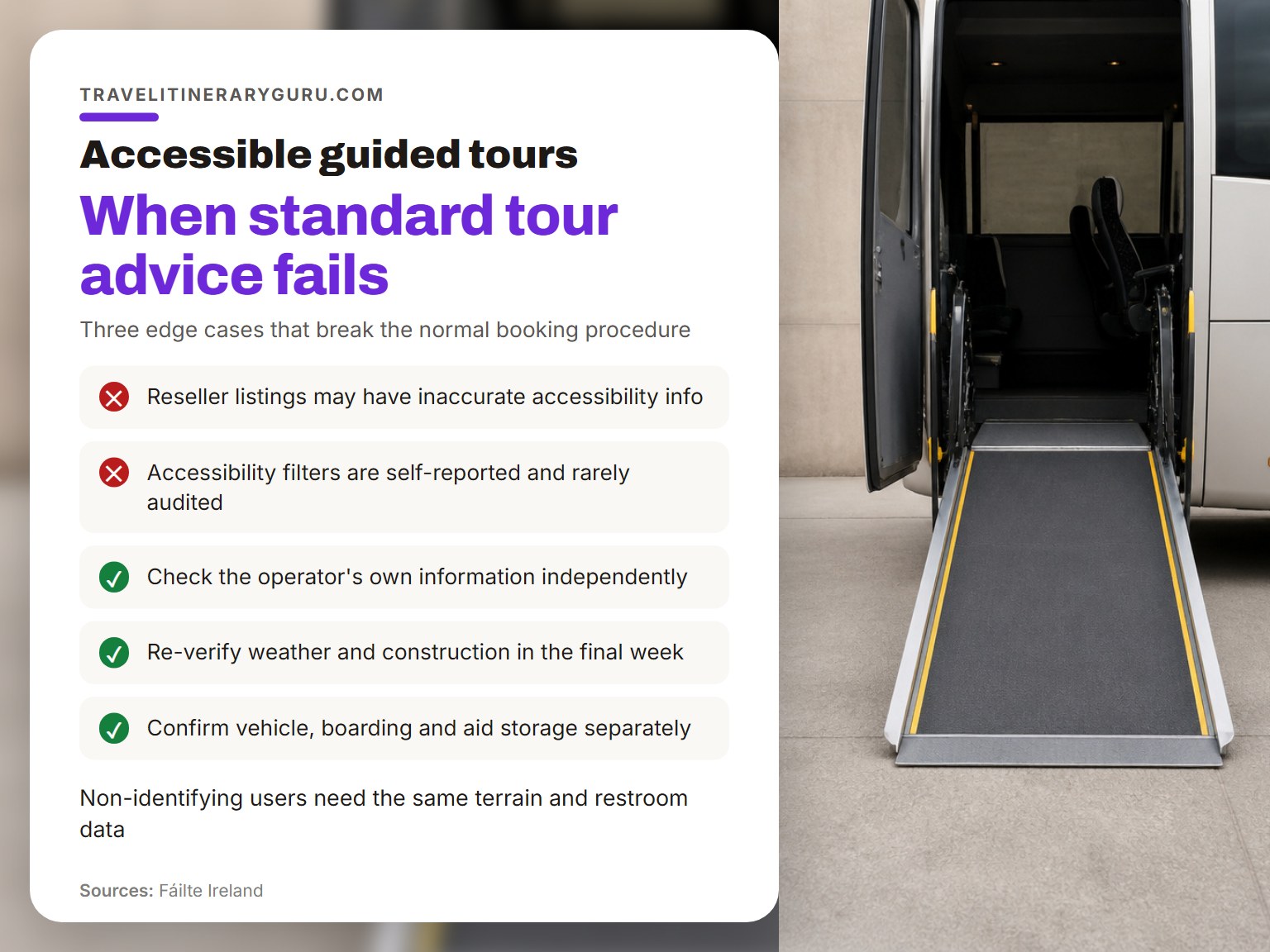
Three edge cases break the normal procedure, and each one has a workaround.
Weather and construction. Covered above, but it deserves restating because it’s the most common failure. Re-verify in the final week.
Third-party booking channels. If you book through a reseller rather than the operator, the accessibility information on that listing may be inaccurate. Fáilte Ireland flags this directly. Check the operator’s own information independently, even when the booking platform has an accessibility filter.
On that filter: treat it as a starting point and nothing more. Accessibility checkboxes on booking sites are self-reported and rarely audited. A filter narrows the list. It doesn’t verify anything on it.
Non-identifying users. The pushchair parent, the traveler with a heart condition, the person recovering from surgery. None of them will search under “accessibility,” and all of them need the same terrain and restroom data.
Where this goes sideways: Booking a multi-venue tour without confirming the transfer. The vehicle, the boarding process, and the storage space for your aid are three separate answers, and operators often only have one of them.
Does a Written Answer Actually Protect You?
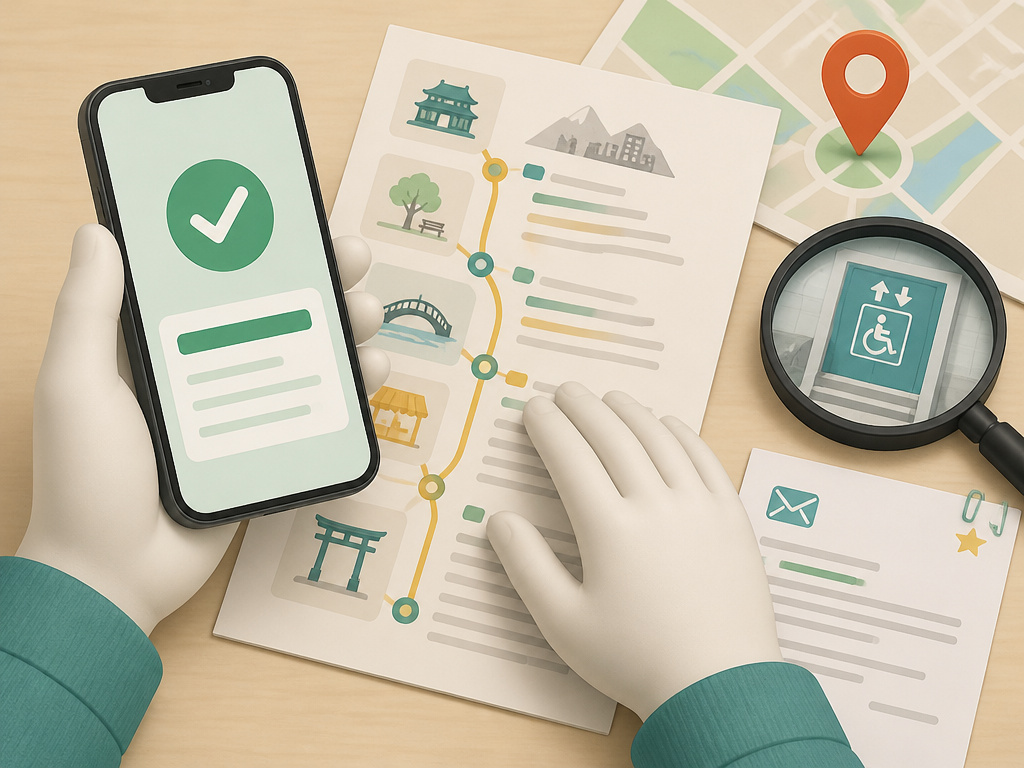
Yes, and it’s the single highest-value thing you can do before paying.
Ask the operator to confirm the answers in writing through the booking platform or by email, then save the response with your reservation. If the reply is vague, ask for a route sequence or a description of the specific obstacle you’re worried about.
A clear “not suitable” is more useful than an uncertain promise. That’s not a consolation prize. It’s information you can act on, and it frees you to find an operator who can actually deliver the day.
I learned the hard way that the first leg of any tour is where the plan breaks. Early on, I booked a sunrise tour without checking the meeting point distance from my hotel, and I spent an hour lost before dawn. Now I map the first leg the night before, every time. It takes ten minutes and it has saved me twice since.
That habit scales directly to accessibility. The meeting point, the drop-off, the step-free station exit, and the walk between them are the leg that decides whether the rest of the day works.
If public transport is part of that leg, accessible public transit is worth planning as its own separate task, because station-level access is a patchwork in most cities rather than a system-wide guarantee.
Frequently Asked Questions
Is “accessible” a standardised term on tour listings?
No. There’s no enforced definition behind the word on a booking page. ISO 21902:2021 gives operators a framework and a measurement set, but it’s a standard rather than a regulation, and it’s currently under systematic review. Treat the label as a prompt to ask questions, not as a verified claim.
What measurements should I ask for?
Heights, widths, weight capacities, slopes, and lighting levels. That five-item set comes from the UNWTO implementation guide for tour operators. Add door clear-opening width, bathroom turning radius, and the gradient of the steepest leg of the route, since those are the numbers that decide whether your equipment fits.
What if the operator won’t give me numbers?
That’s an answer in itself. An operator who has audited a route can produce measurements, and one who is repeating marketing language can’t. Ask once more with a specific question attached. If you still get adjectives instead of numbers, book elsewhere.
Do I need to re-check after booking?
Yes. The National Park Service warns that weather and construction can alter accessibility conditions, which means published data can be stale by the time you arrive. Re-confirm the route and conditions in the week before you travel, and ask who to contact on the day.
Does a step-free route mean the tour is accessible for me?
Not on its own. A route can be lift-accessible and still be tiring, noisy, crowded, badly lit, or short on seating. Step-free access solves one barrier. Pacing, rest stops, seating, audio delivery, and sensory conditions are separate questions with separate answers.
What about tours booked through a third-party site?
Check the operator’s own information independently. Third-party booking channels may carry inaccurate accessibility details, and the site’s accessibility filter is self-reported rather than audited. The operator’s direct answer is the one to save with your reservation.
The Bottom Line
One rule most guides skip: if the operator can’t give you a number, you don’t have a booking yet. You have a hope with a confirmation email attached.
Start with what you love, then build the days around it — but build the first leg first. Before you pay for anything, measure your own aid, ask for the five measurements plus door width and turning radius, and get the answers in writing. That’s a single afternoon of calls, and it’s the difference between a tour and a gamble.
The concession worth making: this whole approach assumes a tour with a fixed route and a reachable operator. If you’re booking a same-day experience through a platform with a slow-responding host, you won’t get written answers in time, and the calculus changes. In that case, narrow your search to experiences with a clearly stated itinerary and treat the booking as provisional until you’ve spoken to someone directly.
And if you’re planning the wider trip around a mobility need, wheelchair accessible trip planning covers the transport, hotel, and restroom layers that sit underneath the tour itself. The tour is one good day. The trip is the thing you’re actually building.
