
How to Travel With a Chronic Illness: Plan Early
This post contains affiliate links. As an Amazon Associate, we earn from qualifying purchases.
Traveling with a chronic illness takes more planning than a standard trip, and the single most important step happens weeks before you leave: a pre-travel consultation with your doctor. Learning how to travel with a chronic illness starts there. Book that visit 4 to 6 weeks before departure so immunizations have time to take effect, new medications can be trialed, and any devices or supplies can be sourced, and review our guide to traveling with prescription medication.
That window is where the published guidance splits, and I’ll get to the split below, because it changes your booking date.
The rest of this walks through the how to travel with a chronic illness parts that actually go wrong on the ground: oxygen logistics, medication buffers, device screening at security, and the destination research that most itineraries skip entirely. I’ve planned enough of these trips to know the medical side is the part people under-plan and then panic about at the gate.
Key Takeaways
- Book the doctor’s visit 4 to 6 weeks out per the CDC Yellow Book; the German federal health portal says at least 2 months, so treat 2 months as the safer floor.
- Notify your airline 2 weeks before travel if you need in-flight oxygen, and confirm the flight actually offers it at least 72 hours before departure.
- Pack more medication than the trip requires. The CDC says twice what you think you need; Northwestern Medicine says at least 3 extra days.
- Ask for a hand inspection of insulin pumps and CGMs at security instead of disconnecting them; X-ray machines can damage both.
- Deferral windows are condition-specific and short. A sickle crisis within 9 days, chest surgery within 10 days, or a seizure within 24 hours all mean staying home.
How Far Ahead Should You Book a Doctor’s Visit?
Two credible sources give two different answers, and pretending they agree would be dishonest. The CDC Yellow Book chronic illness travel chapter puts the pre-travel consultation at 4 to 6 weeks before departure. The German federal health portal gesund.bund.de says to discuss travel plans with a doctor in good time before booking and at least 2 months before traveling.
Pre-travel medical consultation for travelers with chronic illness should occur 4 to 6 weeks before departure, allowing immunizations to take effect, new medications to be trialed, and devices or supplies to be acquired. The German federal health portal recommends discussing travel plans at least 2 months before traveling. Travelers should consult their physician before paying for non-refundable trips.
The practical read on how to travel with a chronic illness: 2 months is the safer floor, and the CDC’s 4-to-6-week figure is the earlier option. Both sources agree on one thing that matters more than the number. Consult your doctor before you pay for anything non-refundable. That sequencing protects you from losing money on a trip your body isn’t ready for, and it’s worth understanding travel insurance for pre-existing conditions before you book.
Why the Gap Between 4 Weeks and 2 Months Exists
The two windows are measuring different things. The CDC’s 4-to-6-week figure is built around vaccine series and medication trials, which need weeks, not months, to take effect. The German portal’s 2-month figure folds in the broader logistics: adjusting doses for time zones, assembling a travel medical kit, sourcing consumables, and working out how to handle a medical emergency abroad.
If your trip involves a destination with required vaccinations, the longer window wins by default. If it’s a short domestic flight and your condition is stable, 4 to 6 weeks is workable.
Worth knowing before you start: Booking flights before the consultation is the most common sequencing error. The CDC explicitly advises consulting your doctor before paying for non-refundable trips, because a deferral recommendation after you’ve booked leaves you negotiating with an airline instead of planning a vacation.
The Four Questions That Decide Whether You Can Fly
Air travel isn’t automatically off the table with a chronic condition, but four specific situations require a provider conversation before you book anything. MedlinePlus lists them plainly: if you’re short of breath most of the time, if you get short of breath walking 150 feet (46 meters) or less, if you’ve been hospitalized for breathing problems recently, or if you use oxygen at home even just at night or with exercise.
The MedlinePlus breathing problems travel guide also flags a history of pneumonia, chest surgery, or a collapsed lung as reasons to check in with your provider first. And if your destination sits at high altitude, that’s a separate conversation. Colorado, Utah, Peru, and Ecuador all count.
So the honest answer to “can I fly” is: usually yes, with a provider’s sign-off, and sometimes no. The determination isn’t yours to make alone.
Condition-Specific Deferral Windows
This is the part of the CDC guidance that reads like a triage sheet, and it’s the most useful thing on the page. The Yellow Book lists explicit windows for when travel should be deferred, by condition. Here are the ones most likely to affect a planned trip:
| Condition | Deferral Window | What It Means |
|---|---|---|
| Sickle cell disease | Sickle crisis within previous 9 days | Wait past day 9 before flying |
| Chest surgery (uncomplicated) | Less than 10 days before departure | Stable and cleared first |
| Cranial surgery | Less than 9 days before departure | Cranium air can take a month to clear |
| Seizure disorder | Event within 24 hours before departure | Delay until stable on medication |
| Recent pulmonary embolism | Less than 4 days since the event | Plus stable anticoagulation required |
Notice the units. Days, not weeks. These aren’t “give it a month and see how you feel” windows. They’re hard calendars, and a trip booked six months out can land inside one of them if your health shifts.
Where this goes sideways: Scheduling a flight within two weeks of a cardiac event. The CDC’s guidance for recent cardiac episodes says medications should remain unchanged for at least 2 weeks before long-distance travel, and clearance has to come from your cardiologist, not from how you feel on the day.
Oxygen on a Plane: What the Sources Actually Disagree On
Here’s the disagreement that could strand you at a gate, so read it carefully. MedlinePlus states that in the United States, you can usually bring your own oxygen on a plane. The CDC Yellow Book states that patients are not allowed to bring their own oxygen onboard flights.
Both are describing the same decision point and reaching opposite conclusions. What’s almost certainly happening is a definitional gap: MedlinePlus is talking about portable oxygen concentrators and personal oxygen equipment that some airlines permit, while the CDC’s framing covers compressed oxygen cylinders, which airlines generally prohibit. The CDC does note that some airlines permit only FAA-approved portable oxygen concentrators, and that many airlines don’t permit POCs at all and may require you to use the airline’s own oxygen system.
The takeaway is blunt. Don’t assume. Ask the specific airline, for the specific aircraft, on the specific flight.
The Ground-Oxygen Gap Nobody Plans For
This is the failure mode that catches travelers mid-journey. Airlines and airports will not provide oxygen while you are not on an airplane. That includes before the flight, after the flight, and during a layover. The CDC says the same thing from the clinical side: patients must arrange their own oxygen supplies while on the ground, at departure, during layovers, and upon arrival.
A layover in a hub airport is ground time. So is the jet bridge, the baggage claim, and the taxi queue. If you use oxygen and you’re connecting through a large airport, you need a plan for that window that doesn’t depend on the airline.
MedlinePlus suggests calling your oxygen supplier to find out whether they can provide oxygen in the area you’re traveling to. That call belongs on the same checklist as the airline call, not after it.
The Paperwork and Timing Checklist
The administrative requirements for flying with oxygen are specific, and missing any one of them can end the trip at the check-in desk.
- Get the prescription and the provider letter. MedlinePlus is explicit that you need both. The CDC adds that the letter should be on office letterhead and include your conditions, medications with generic names and doses, allergies, equipment required, and your provider’s name and contact information.
- Notify the airline 2 weeks before travel. MedlinePlus sets this as the practical deadline and notes the airline may not be able to accommodate you if you tell them less than 48 hours before your flight.
- Verify in-flight oxygen availability at least 72 hours before departure. The CDC sets this specific window for confirming whether the aircraft or flight actually offers supplemental oxygen.
- Complete the online medical application. The CDC notes this must be done with input from your treating physician.
- Arrive at least 120 minutes before your flight. MedlinePlus sets this window for travelers using oxygen.
- Carry an extra copy of the letter and prescription on travel day. MedlinePlus lists this as a day-of item, which tells you the original has a way of ending up in the wrong bag.
That’s a lot of steps for one flight. It’s also the difference between boarding and turning around.
How Much Extra Medication Should You Pack?
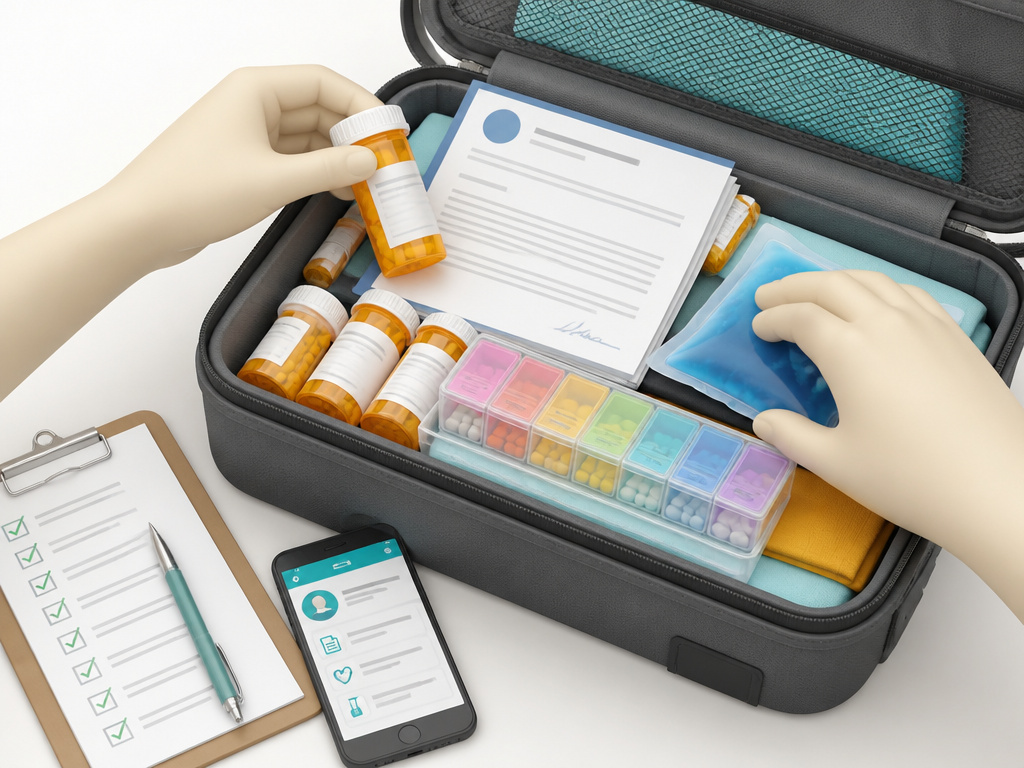
Three sources give three different answers, and the spread is wider than you’d expect. The CDC’s diabetes travel page says to pack twice as much medicine as you think you’ll need. Northwestern Medicine’s traveling with a chronic condition guide specifies at least 3 extra days of medicine for emergency delays. The CDC Yellow Book says to take enough medication to cover several days afterward, without fixing a number.
| Source | Extra Medication Buffer |
|---|---|
| CDC (diabetes page) | Twice what you think you’ll need |
| Northwestern Medicine | At least 3 extra days |
| CDC Yellow Book | Several days afterward (open-ended) |
The way to reconcile them is to treat the largest figure as your floor. Twice your expected need covers a 3-day delay and then some. Three extra days covers a missed connection. “Several days” covers neither if your trip home gets rerouted through two cities.
Easy to miss: Medication packed only in checked baggage. The CDC warns that checked baggage can get too cold, and that insulin and other medicines should be kept out of hot cars, direct sunlight, and direct contact with ice. A gel-pack cooler in your carry-on is the specified workaround.
The Documents That Travel With the Medication
The CDC’s medical letter standard is the one to build from, because it covers what a foreign clinician would actually need to treat you. Office letterhead. Existing conditions. Medications listed by generic name and dose, not brand. Allergies. Equipment required. Provider name and contact information.
Two additions sit outside that letter. The CDC advises checking the destination’s U.S. Embassy or consulate, because some countries don’t allow visitors to bring certain medications, especially narcotics and psychotropic medications. And for travelers with heart conditions, the CDC recommends carrying a current EKG or placing it with your medical history in an app, website, or email you can reach from anywhere.
That second one is the kind of preparation that looks excessive until you’re in an emergency room in a country where nobody has your records.
What Changes at Airport Security?

Diabetes supplies get a specific exception that most travelers don’t know about. The CDC tips for traveling with diabetes page states that people with diabetes can bring over 3.4 ounces of liquids through security in their carry-ons. That covers liquid medicines, fast-acting sugar sources like juice, and gel packs to keep insulin cool.
The device rule matters more. Insulin pumps and continuous glucose monitors could be damaged by X-ray machines. The CDC’s instruction is to ask for a hand inspection rather than disconnecting your devices. Disconnecting a pump to send it through the scanner is the wrong move, and it’s the one people make when they’re rushed and the line is long, so pack supplies in one of the best diabetic travel cases.
The Northwestern Medicine chronic condition travel entry frames this as a pre-trip call, not a day-of question.
For ostomy supplies, the CDC specifies that pouching supplies must travel in original containers in carry-on. Original containers, not repacked. That’s a screening requirement, not a packing preference.
Does Your Destination Have the Care You’ll Need?

This is where trip planning and medical planning merge, and it’s the section most itineraries skip. MedlinePlus is direct about it: have a name, phone number, and address of a provider where you’re going, and don’t go to areas that don’t have good and accessible medical care.
That’s a destination filter, not a packing tip. It means the question “is this a place where I can get the care I need” has a medical answer that sits alongside the budget answer.
Those rules are country-specific and they don’t move on your timeline.
Heat, Altitude, and the Things That Shift Your Numbers
Travel changes your body’s baseline, and the sources are specific about how. The CDC notes that high temperatures, dehydration, and even sunburns can affect blood sugar.
MedlinePlus flags high-altitude destinations by name: Colorado, Utah, Peru, Ecuador. If any of those are on your list and you have a breathing condition, that’s a provider conversation before booking, not after.
Movement, Food, and the Cruise Buffet Problem
Two rules cover most of the in-transit risk. The CDC says to take breaks from road trips to stretch your legs and walk around, and if you’re flying or traveling by train, to walk up and down the aisles every hour or two to prevent blood clots. That’s not generic wellness advice. The CDC Yellow Book identifies air travel as a risk factor for venous thromboembolism beginning at 4 hours of flight duration, and notes that a past history of VTE increases recurrence risk on flights of 4 hours or more.
If you have a VTE history, the CDC recommends discussing anticoagulation with your specialist for prolonged air, car, or train travel of 4 hours or more. Graded compression stockings are listed as effective at decreasing risk.
On food, the CDC’s guidance for diabetes is to bring options like fruit or nuts so you’re not forced into convenience foods, and to moderate portions, especially at cruise buffets.
Skip this if: You’re on a short domestic trip with a stable condition and no device or oxygen needs. The full pre-travel protocol is built for international and long-haul travel. A two-hour flight with medication in your carry-on doesn’t require a 2-month lead time.
What About Cruises and Age-Based Requirements?
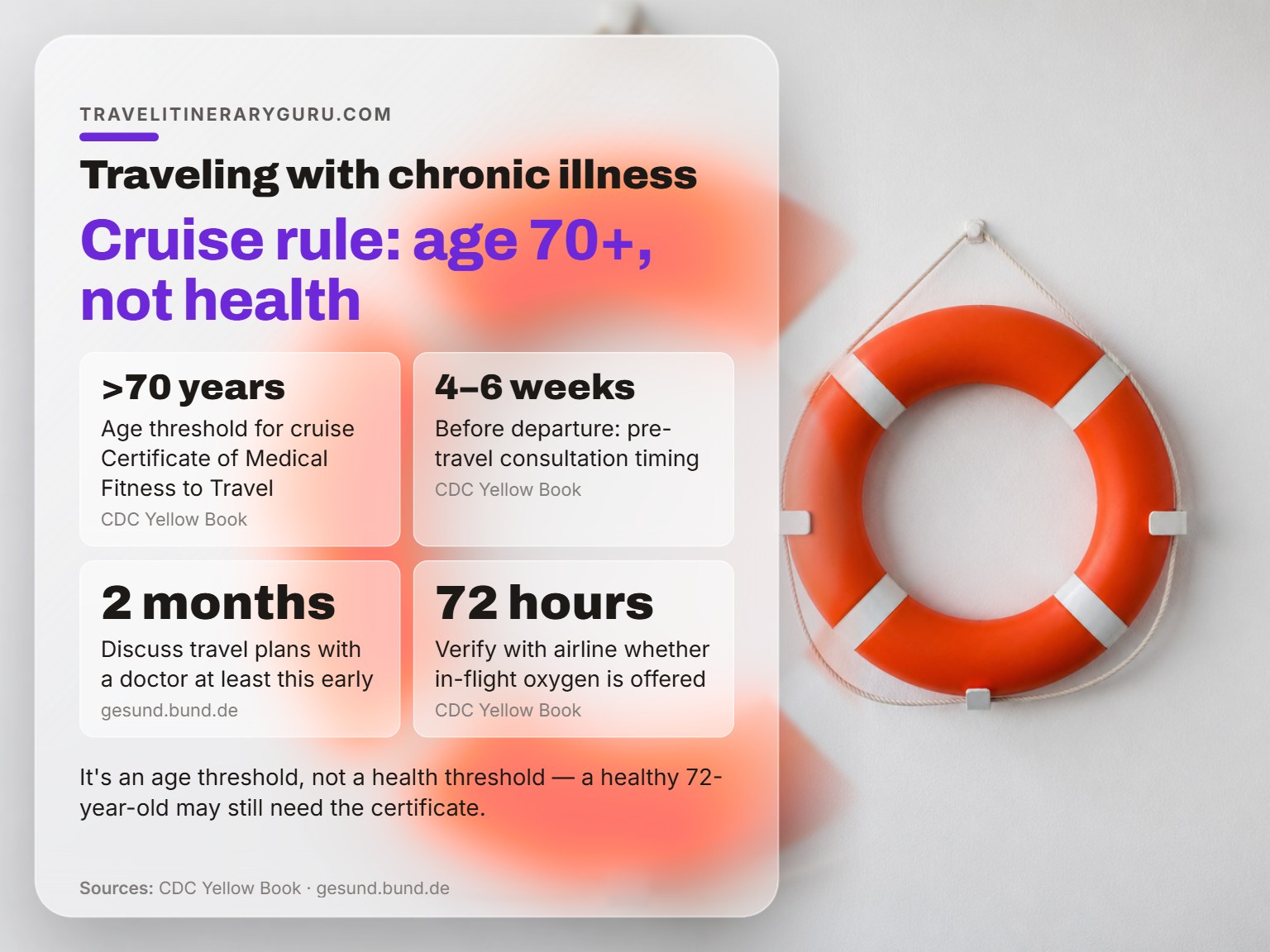
Cruise lines have their own medical clearance rules, separate from airline requirements. Since 2023, many cruise lines require a Certificate of Medical Fitness to Travel before embarkation for passengers aged over 70, regardless of whether chronic conditions are present.
That “regardless of whether chronic conditions are present” clause is the part people miss. A healthy 72-year-old may still need the certificate. It’s an age threshold, not a health threshold.
For travelers with cognitive impairment, the CDC draws a line between mild-to-moderate impairment and more serious presentations. Mild to moderate impairment is considered safe to travel with focused, specific advanced planning, and the CDC suggests considering whether the traveler should be accompanied throughout transport and travel activities. Environmental changes can trigger wandering or confusion. Travel should be deferred if paranoia, delusions, or aggressive or disinhibited behaviors are present.
Frequently Asked Questions
How far in advance should I see my doctor before traveling with a chronic illness?
The CDC Yellow Book recommends 4 to 6 weeks before departure, while the German federal health portal recommends at least 2 months. Both agree you should consult your doctor before paying for non-refundable trips. If your trip involves vaccinations or medication changes, use the longer window.
Can I bring my own oxygen on a plane?
The sources disagree, and the disagreement matters. MedlinePlus states that in the United States you can usually bring your own oxygen on a plane. The CDC Yellow Book states that patients are not allowed to bring their own oxygen onboard flights. The likely distinction is portable oxygen concentrators versus compressed cylinders, but the only reliable answer comes from asking your specific airline about your specific flight.
How much extra medication should I pack?
Three sources give three figures. The CDC says to pack twice as much medicine as you think you’ll need. Northwestern Medicine says at least 3 extra days. The CDC Yellow Book says several days afterward. Treat the largest figure as your floor and keep it all in your carry-on, not checked baggage.
Will airport security damage my insulin pump or CGM?
They could be damaged by X-ray machines, according to the CDC. The instruction is to ask for a hand inspection rather than disconnecting your devices. People with diabetes can also bring over 3.4 ounces of liquids through security in carry-ons, which covers liquid medicines, juice, and gel packs.
What should a medical letter from my doctor include?
The CDC specifies office letterhead, existing conditions, medications listed with generic names and doses, allergies, equipment required, and your provider’s name and contact information. Carry an extra copy on travel day, and consider keeping a current EKG accessible by app, website, or email if you have a heart condition.
Can I travel after recent surgery?
It depends on the surgery and the date. The CDC lists deferral windows of less than 10 days for uncomplicated chest surgery and less than 9 days for cranial surgery. For cranial surgery beyond 9 days, cranium air can take up to a month to clear, and you’d need medical clearance from your surgeon before flying.
The Bottom Line
One number should drive your booking calendar: 2 months. That’s the earliest window any of the sources recommends for a pre-travel consultation, and it’s the one that leaves room for vaccine series, medication adjustments, and the oxygen paperwork that takes weeks to assemble. The CDC’s 4-to-6-week figure is a floor, not a target.
Here’s your first step this week, and it’s one phone call. Ask your doctor whether you’re fit to travel given your specific condition, and ask specifically about the deferral windows that apply to you. If you’re within 9 days of a sickle crisis, 10 days of chest surgery, or 24 hours of a seizure, the answer is already no, and no amount of itinerary planning changes it.
The concession worth stating plainly: everything above assumes a stable condition and a destination with accessible medical care. If either of those isn’t true, the calculus shifts entirely, and the right move may be a different trip rather than better preparation for this one. I’ve watched travelers push through that decision because the flights were already paid for. It’s the worst trade in travel.
Plan the trip your body can actually take. Then build the days around it.
