
What to Expect on a Multi-Day Guided Tour: Day by Day
This post contains affiliate links. As an Amazon Associate, we earn from qualifying purchases.
What to expect on a multi-day guided tour: a guide reserved for your group for the whole trip, transport between sites, meals and overnight gear run to a published standard, and days that vary by product. Expect the operator to adjust the plan when weather moves in.
That published standard is the part nobody hands you at booking. Inside national parks, operators work under the National Park Service’s guided land tour standards, a graded checklist covering camping gear, water purification, emergency medical equipment, trash containment, and wildlife briefings. Outside park boundaries, the rules come from the operator and the local authority instead, and they vary far more than the brochures admit.
What follows walks through the shape of a real tour day, the standards your operator is held to, where those standards disagree about your gear, and the questions worth settling before you pay a deposit.
Key Takeaways
- Your guide stays with you. Zion Guru reserves a guide exclusively for your group for the duration of a multi-day tour, which is a different arrangement from the meet-you-at-camp model.
- Tour buses narrate; shuttle buses don’t. The National Park Service lists narration as a tour bus feature, and shuttle drivers carry no such requirement.
- Overnight gear is a contract item. Standard 68 requires camping equipment to be appropriate, adequate, clean, and well-maintained.
- Seasons close doors. Yosemite’s Grand Tour operates May–September, conditions permitting, and Grand Canyon’s South Rim bike tours run April 1 to October 31.
- Who supplies what can stay genuinely unclear. The national standard and some park contract language point in different directions.
What to Expect on a Multi-Day Guided Tour, Start to Finish
The van pulls out before the visitor center opens. Your guide called the evening before to walk through logistics, and by the time the doors shut, the shape of the day is already set.
Under the National Park Service guided land tour standards, overnight camping equipment must be appropriate, adequate, clean, and well-maintained. Water purification kits must be operational, and water storage must be adequate for the trip’s duration and passenger count. Emergency medical equipment, including splints and inflatable casts, must be maintained and ready.
Day length is the number worth checking before you book. Denali alone runs four bus products on one road, and the round-trip times spread from a half day to a full one.
| Denali bus option | Round trip | Narrated? | Best for |
|---|---|---|---|
| Shuttle bus | 6 to 12 hours by route | No | Hikers who want to get off and walk |
| Natural History Tour | 4.5 hours | Yes | A half-day sampler |
| Tundra Wilderness Tour | 8 hours | Yes | Wildlife and deep scenery |
| Kantishna Experience | 12 hours | Yes | The full road, end to end |
Narration is the other split, and the agency is blunt about it. Shuttle drivers carry no narration requirement. Tour buses are narrated, and narrated trips cost more than the non-narrated transit buses.
The National Park Service Denali trip plan lists a minimum recommended itinerary of two nights in the area, which gives you one full day and part of two others. That math is why free time on a group tour matters more than the brochure suggests.
A tour bus at a wildlife pullout goes quiet in a way a shuttle doesn’t. The engine cuts, the narration keeps running, and forty people turn the same direction at once.
Twelve hours is a long day.
What the Operator Is Actually Held To
The 10-GLA standard is a numbered list of what to expect on a multi-day guided tour, not a promise. It covers standards including 68 through 81, and each line carries a requirement.
The NPS guided land tour standards cover many aspects of a trip, including water purification, emergency equipment, and trash containment.
What Standard 68 Covers at Camp
Camping equipment has to be appropriate, adequate, clean, and well-maintained. Water purifying kits have to be operational, and water storage has to be adequate for the duration of the trip and the number of passengers and staff.
Overnight emergency medical equipment has to be well-maintained and operational. The standard names what that can include: back boards, neck restraints, splints, and inflatable casts.
What the Standard Says About Food, Trash, and Wildlife
- Tableware and drinkware are disposable, and recyclable, compostable, or bio-degradable materials are preferred. Styrofoam isn’t permitted.
- Trash gets collected after each meal service, held in a water- and wildlife-proof container, and carried off-site.
- Radios aren’t allowed.
- Noise stays low so it doesn’t disturb other visitors or wildlife.
- No smoking on trails or within 25 feet of the vehicle.
Some of this reads like housekeeping. It’s operational, and it’s graded.
The trash rule exists because food waste attracts wildlife, and the standard requires passengers to be briefed on avoiding unwanted interactions. Staff report sightings to the park when required.
The Department of Transportation handles vehicle inspections. These standards evaluate the visitor service side instead, which is why the list can serve as a set of guided tour red flags you can check yourself.
Honestly, most tour marketing never mentions any of this. That’s the floor, not the sales pitch.
Who Supplies Your Overnight Gear, and Who Decides?
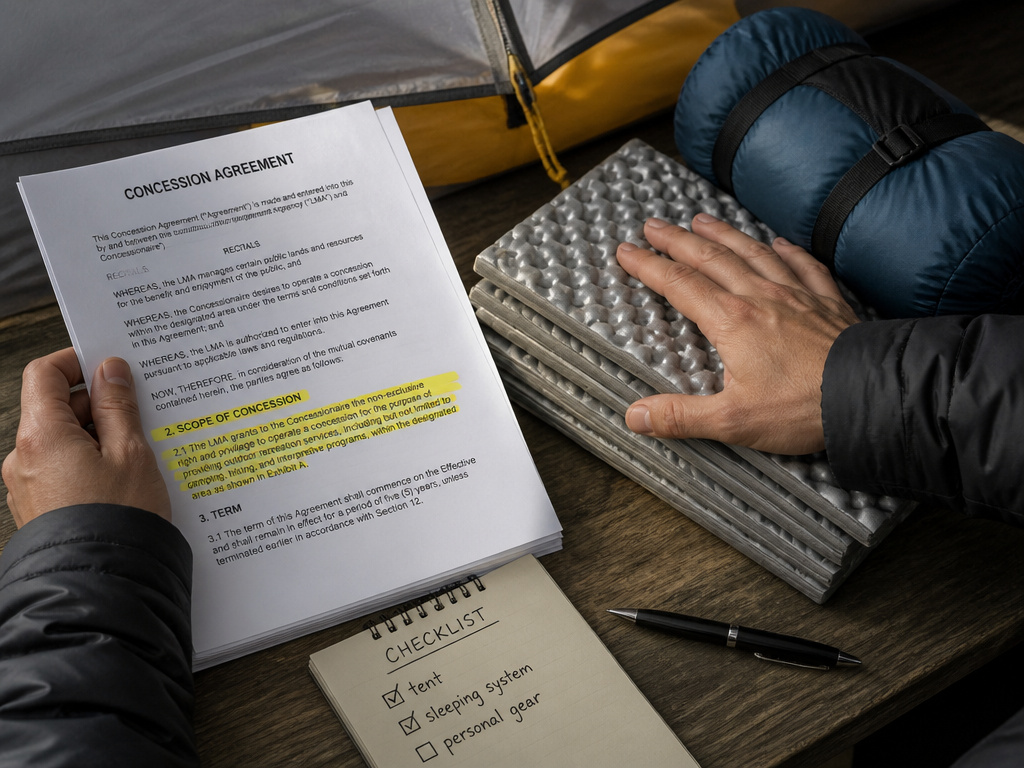
Two documents from the same agency point in different directions on the same question.
Standard 68 puts camping equipment squarely on the concessioner. Overnight gear has to be appropriate, adequate, clean, and well-maintained. Some park concession contracts phrase the obligation differently, requiring the concessioner to make sure clients have the necessary equipment. That wording leaves the supply burden sitting ambiguously between operator and guest.
The safe assumption is that the operator supplies the tent and the sleeping system, and that you supply everything that touches your skin. Ask which one it is in writing before you pack.
Subcontracting is the second gap. The Canyonlands operating plan addresses subconcession and third-party provision of overnight tours. The national standard says nothing about it, which makes the rule contract-specific rather than system-wide.
Whether you’re packing for a group tour or buying gear on arrival, settle this one first. If the answer comes back vague, treat that as the answer.
Get it in writing.
Why the Season Decides More Than the Itinerary
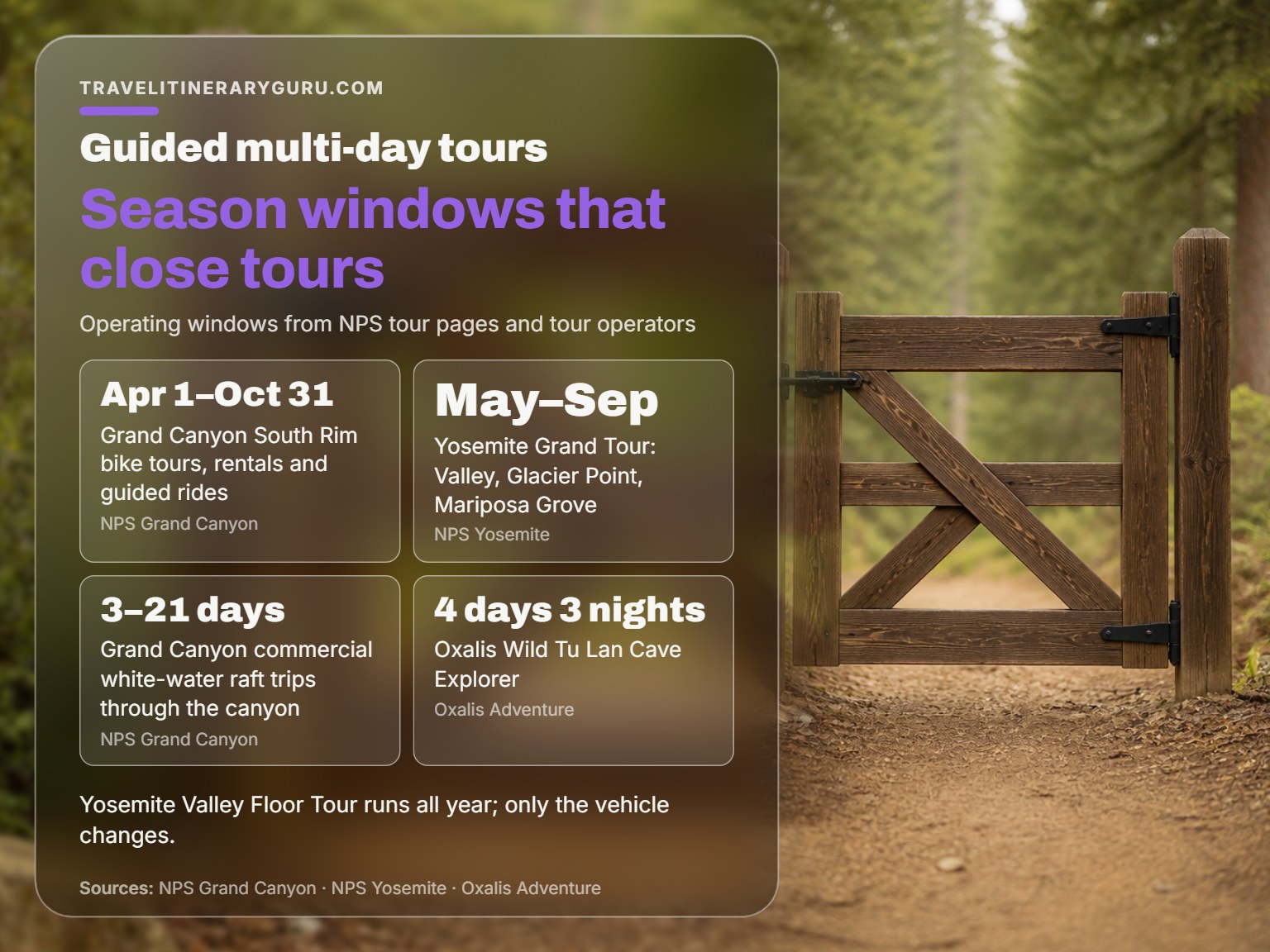
April 1 to October 31 is the window for guided bike tours on the Grand Canyon’s South Rim. Outside that window, rentals and guided rides are not available.
National Park Service tour pages are full of operating windows, and they aren’t suggestions. Yosemite’s Valley Floor Tour runs all year, but it changes shape: an open-air tram roughly April through October, weather permitting, then a bus tour from around October through March.
| Tour or activity | Operating window | What changes if you miss it |
|---|---|---|
| Yosemite Valley Floor Tour | All year | Nothing; only the vehicle changes |
| Yosemite Glacier Point Tour | Late May into November, road permitting | The four-hour round trip stops entirely |
| Yosemite Grand Tour | May through September | The Valley, Glacier Point, and Mariposa Grove day is off |
| Yosemite Tuolumne Meadows Hikers Bus | July to early September | The all-day Tuolumne run is off |
| Grand Canyon South Rim bike tours | April 1 to October 31 | Rentals and guided rides stop |
| Oxalis Wild Tu Lan Cave Explorer | Mid-November to mid-September | The four-day cave trip closes |
Half-day and one-day raft trips below Glen Canyon Dam are not offered during the winter months, while commercial white-water raft trips through the canyon last 3 to 21 days and require reservations well in advance.
Zion Guru frames spring (March through May) and fall (September through November) as the ideal seasons, with summer tours typically scheduled earlier or later in the day to avoid peak heat and winter tours highlighting quieter landscapes and striking seasonal scenery.
Skip this if: You’re locked to a school holiday window and the tour you want runs May through September only. Booking around a closed season wastes a deposit and a leave request.
Long days are the other seasonal variable. The Yosemite National Park tours guide lists the Grand Tour at about eight hours.
If a long walking tour is one of your days, build the rest of the itinerary around it rather than the other way round.
Is a Guide Worth It, or Are You Buying Narration?
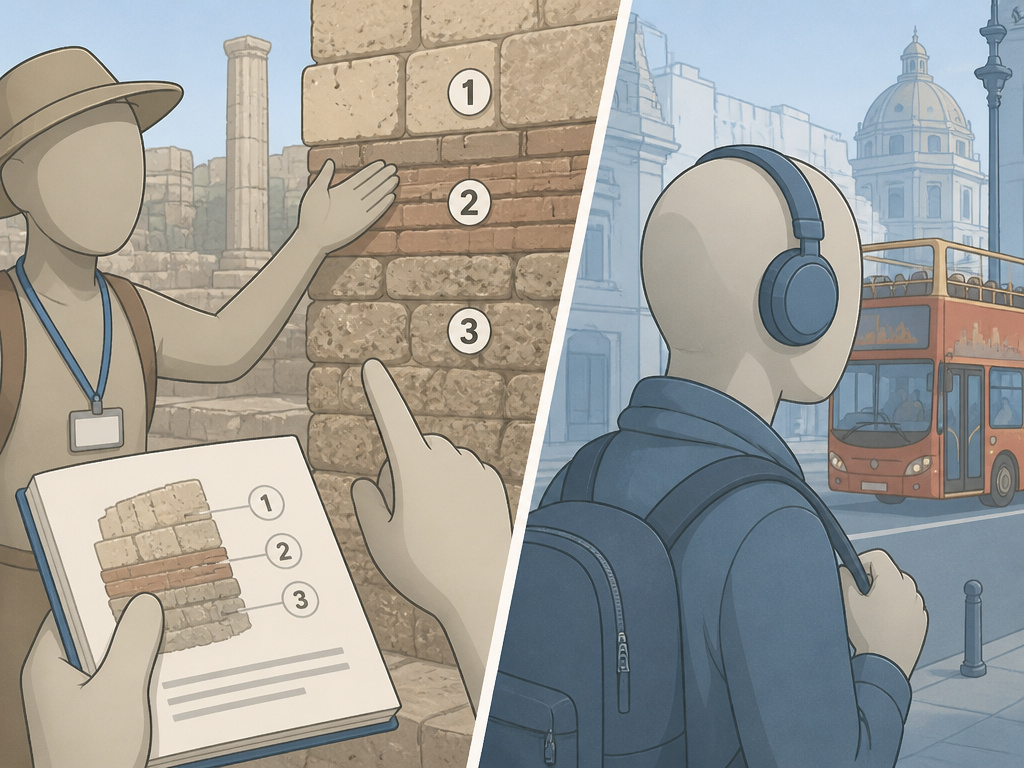
Does the guide change what you’re looking at, or just how you get there?
I spent years treating guided tours as something other people booked. Then a guide walked me through a layered historical site, and the sequence did the work: which wall to look at first, why the drainage ran where it did, what the rebuild got wrong. I’ve booked guides for context-heavy sites ever since.
Where Narration Changes What You See
The National Park Service draws the line cleanly on its own Denali page. Shuttle drivers aren’t required to narrate, and tour buses are. That’s the whole distinction, stated by the agency that runs the road.
Where It Doesn’t
Half-day city loops and hop-on, hop-off buses are transport with headphones. You’re paying for a seat and a map, and the commentary is filler between stops.
If you can walk the district yourself, walk it. Save the guide for the places where context changes what you’re looking at: ruins, complex museums, layered neighborhoods, and anywhere the signage is thinner than the story.
I won’t book a three-hour walking tour for the first morning of a jet-lagged trip. You’ll retain almost nothing, and you’ll pay for a guide while running on no sleep. Put it on day two.
Guided tours also put a fixed schedule around you. That can be a feature on a longer trip and a nuisance on a shorter one.
Where only two operators serve an area, how to choose a guided tour becomes an inclusions question. The multi-day tour pros and cons shift with the destination too.
Guided tours span a wide range, and some are free while others charge a fee, per the National Park Service guided tours article.
Walk it yourself.
What Goes Wrong, and How Fast
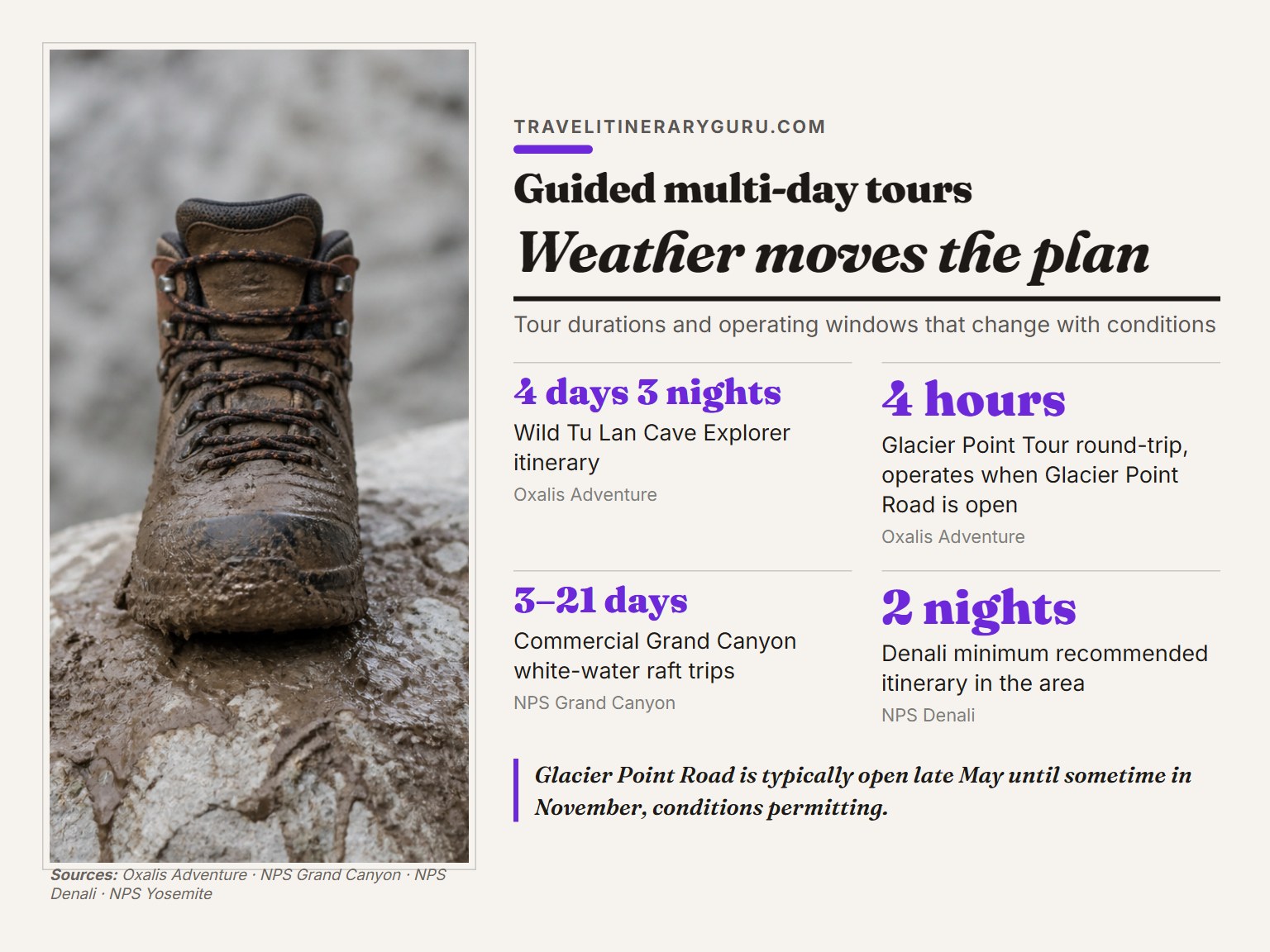
Weather moves the plan.
Oxalis states that the Wild Tu Lan itinerary may be adjusted according to weather conditions. That’s a four-day, three-night trip with a moderate difficulty rating and an age range of 16 to 70.
Muddy and slippery means something specific underfoot: slick clay over limestone, the kind that can take your footing on a downhill without warning.
National Park Service listings carry the same caveat: conditions permitting. Yosemite’s Glacier Point Tour runs when the road is open, typically late May until sometime in November.
Before you start: Three things go wrong on overnight tours. A failed water filter mid-trip means boiling every litre, so check the kit before you leave. Emergency medical gear has to be maintained and operational, and that’s on the operator. And human waste disposal follows park and public health rules, so the toilet box travels with the group.
Park authorities can also change a tour. Operating plans give the Service room to delay, cancel, or reschedule a trip for reasons including resource protection or visitor safety.
How to Handle a Tour Itinerary Change
- Read the operator’s adjustment language before you book, not after. If the itinerary can change for weather, you want to know that on page one.
- Keep one flexible day in the plan. A weather day with nothing booked is the difference between a reroute and a wasted trip.
- Ask what happens to prepaid inclusions if the route changes. Meals, permits, and equipment are the usual sticking points.
- Save the guide’s number. Zion Guru’s guides reach out the evening before, and that call is where last-minute changes surface.
- Don’t rebuild the whole trip around one closed road. If Glacier Point Road is shut, the Valley Floor Tour still runs all year.
A tour itinerary change is easiest to absorb when you’ve already decided which day you’re willing to lose.
The Grand Canyon guided tours page notes that ranger-led day hikes and walks may be offered in spring and summer of 2026, free and with no advanced sign-up, while commercial raft trips need reservations well in advance.
Before You Pay a Deposit: What to Nail Down
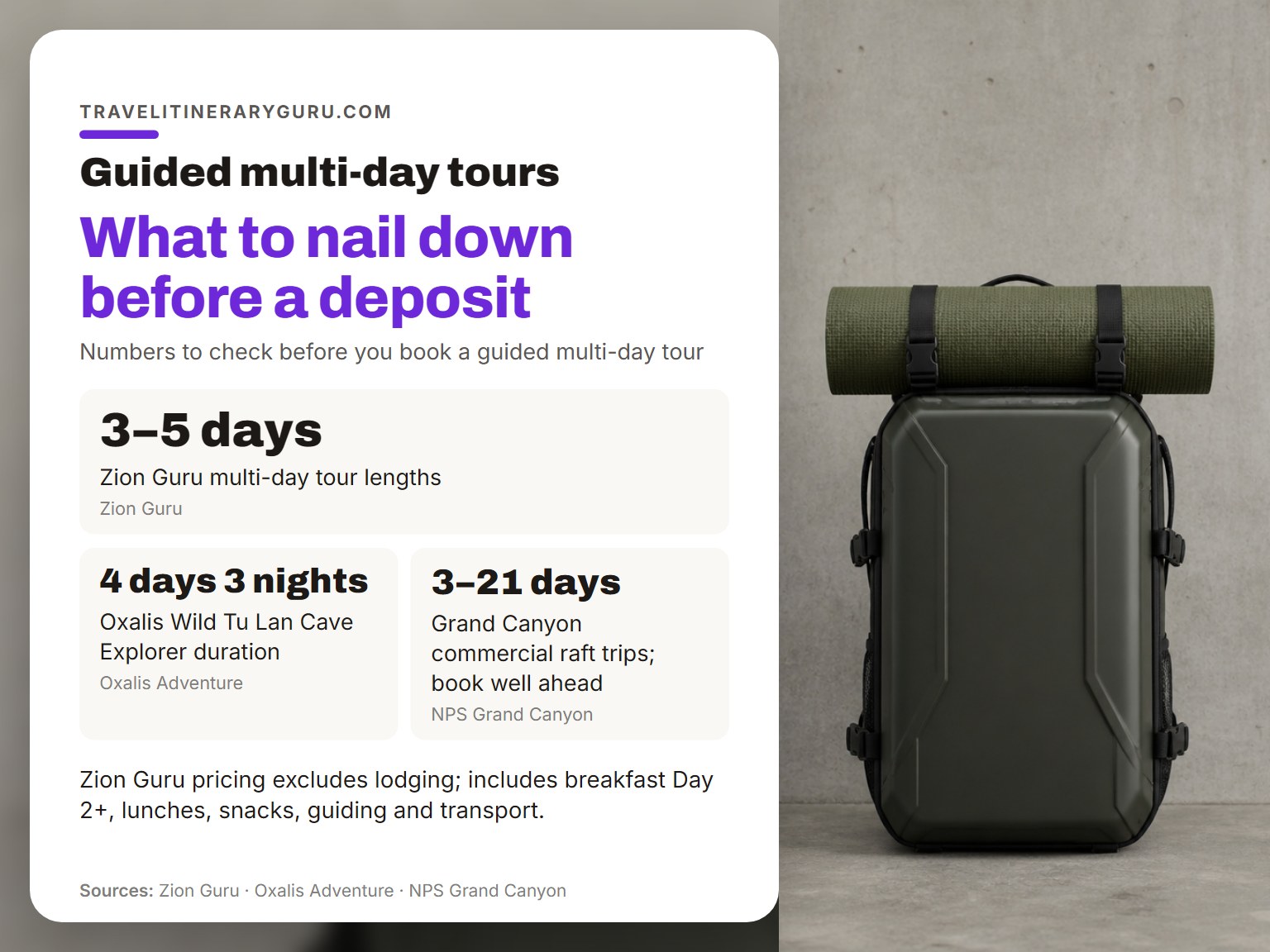
The deposit is the easy part. The questions you ask before it are what shape the trip.
Five Questions to Settle First
- Who supplies overnight gear, and is a third party running the overnight portion?
- What’s excluded? Zion Guru’s pricing covers breakfast from day two onward, packed lunches and snacks on all days, guided experiences and equipment, guide service, and all transportation, but not lodging.
- What are the daily start and finish times, and how long is the longest day?
- What are the group size and age limits? Oxalis caps the Wild Tu Lan Cave Explorer at 10 customers on a join-in basis, with an age range of 16 to 70.
- What happens if the park cancels?
Those five cover most of the surprises. The sixth question is about the other travelers.
The questions to ask before booking a guided tour often start with size, and that’s a reasonable instinct.
The part nobody mentions: A join-in tour means you don’t choose your group. Oxalis runs the Wild Tu Lan Cave Explorer as a 10-person join-in, and a private tour trades the other way: more control, less company.
What the Difficulty Rating Actually Means
Difficulty ratings are the last thing to check. Oxalis rates the Wild Tu Lan Cave Explorer as Moderate. Read that as a real fitness bar.
Booking windows are the final variable. Commercial raft trips through the Grand Canyon run 3 to 21 days and require reservations well in advance.
Ask in writing.
Frequently Asked Questions
How long is a day on a multi-day guided tour?
It depends on the product. Denali’s bus options run from 4.5 hours round trip on the Natural History Tour to 12 hours on the Kantishna Experience, with the shuttle bus taking 6 to 12 hours depending on the route. Yosemite’s Grand Tour is about eight hours.
Do multi-day tours include meals and lodging?
Sometimes one and not the other. Zion Guru includes breakfast from day two onward, packed lunches and snacks on all days, guided experiences and equipment, guide service, and all transportation, but lodging isn’t included. Oxalis includes meals on the Wild Tu Lan Cave Explorer. Ask specifically which meals and which nights.
What happens if weather changes the itinerary?
Operators write the flexibility in. Oxalis states the Wild Tu Lan itinerary may be adjusted according to weather conditions, and warns that paths go muddy and slippery on rainy days. National Park Service tours carry the same caveat as conditions permitting.
Is a multi-day tour suitable for a first-timer?
The moderate-rated trips are built for it. Oxalis rates the Wild Tu Lan Cave Explorer as Moderate and describes it as suitable for people who stay active through regular sport, with an age range of 16 to 70. The trip still covers 4 days and 3 nights, so fitness matters.
Do you need your own camping gear?
That’s the question the standards don’t fully settle. Standard 68 makes the concessioner responsible for overnight gear being appropriate, adequate, clean, and well-maintained. Some park contract language instead requires the concessioner to make sure clients have the necessary equipment, which leaves the split less clear. Get it in writing.
How far ahead should you book?
Further than you think for anything permit-based. Commercial white-water raft trips through the Grand Canyon run 3 to 21 days and require reservations well in advance. Tours with fixed operating windows, like Yosemite’s Grand Tour from May through September, fill around those dates.
The Bottom Line
One habit covers most of this: if your tour crosses a park boundary, read the operating standards before you read the reviews.
If the operator can’t tell you who supplies the overnight gear and what happens when the route changes, treat that as your answer and keep looking. The standards exist, they’re published, and any operator working inside a national park is already being measured against them.
I’ll admit the bias here. I plan trips for a living, and I still put a guided day on the calendar only where context changes what I’m looking at. A city I can walk, I walk.
So here’s your first move this week: pull the operator’s operating window and inclusions list, and check them against the season you can actually travel. If the window doesn’t line up, you’ve saved yourself a deposit and a rearranged calendar.
