
How to Handle a Cruise Itinerary Change: What You Get
This post contains affiliate links. As an Amazon Associate, we earn from qualifying purchases.
To handle a cruise itinerary change, read your contract of carriage first, then check the calendar: before your final payment due date you can usually cancel or reschedule without penalty, and after it you’re negotiating goodwill. What you’re owed depends on where you’re sailing, what caused the change, and whether the line cancelled the voyage outright.
That calendar matters more than anything the line tells you at the desk. The same skipped port produces a refund for one passenger and a shipboard credit for the next, and the deciding factor is usually the date on your reservation, not the reason for the change. Knowing how to handle a cruise itinerary change starts with that date.
The rest of this walks the two rule sets that actually govern how to handle a cruise itinerary change, the compensation you can realistically ask for, and the complaint clocks that expire whether you’re paying attention or not.
Key Takeaways
- Before final payment, you may have room to negotiate. USA TODAY says you can generally cancel and get a refund or reschedule before the final payment due date, while Yahoo Travel notes the line might offer a refund or rebooking before embarkation day but it’s not always guaranteed.
- The EU election doesn’t cover cruises. The right to choose reimbursement or re-routing on a cancelled sailing applies to ferries, not cruise passengers.
- The FMC only steps in at three days. Nonperformance means the line cancelled or delayed the voyage by three or more calendar days.
- Complaint clocks are short. Two months to file with the carrier under EU rules; 180 days before you can claim against the line’s financial instrument in the US.
- Port charges come back even when nothing else does. A skipped destination means money back for that port, per AAA.
Do Cruise Lines Owe You Anything When the Port Changes?
Legally, very little. The contract of carriage you agreed to when you booked gives the line broad latitude to change ports, and AAA’s Scott Campbell put it plainly: the contract says passengers aren’t owed anything if the itinerary changes, and the line can change it at any time.
The passenger ticket contract grants the carrier discretion to alter ports of call, substitute destinations, or cancel a voyage. Compensation for those alterations is discretionary rather than contractual, which is why identical itinerary changes produce different outcomes across cruise lines and booking dates.
That’s the baseline. It’s also not the whole picture, because two specific entitlements survive the fine print.
The first is port charges. Campbell notes guests can expect money back for port charges at a destination the ship doesn’t visit. You paid those fees for a specific port, and if the ship never docks there, the line didn’t incur the cost.
The second is shore excursions booked through the line. Cruise lines typically work to replace cancelled ports and automatically refund excursions booked there. If you went through a third-party operator, you’re checking their cancellation policy instead, and that’s where the money gets stickier.
What Are You Actually Owed When a Port Disappears?
The honest answer to how to handle a cruise itinerary change splits by jurisdiction, and the split is wider than most passengers expect. I get why people assume a cancelled port means a refund. That assumption comes from ferry rules, and cruises sit outside them.
Under EU Regulation 1177/2010, if a service is cancelled, the carrier must offer you a choice between reimbursement and re-routing. A delay at departure over 90 minutes triggers the same choice. That’s a genuine election with real teeth.
Then the regulation does something cruise passengers rarely hear about.
The right to choose between reimbursement and re-routing does not apply to passengers travelling on a cruise.
Same regulation, same cancelled sailing, different remedy depending on whether you booked a ferry or a cruise. The connecting-transport information duty is carved out the same way, and so is the right to compensation. The EU rule that looks like it protects you mostly doesn’t, if you’re on a cruise.
US passengers get a different shape of nothing. The Federal Maritime Commission states outright that it doesn’t adjudicate disputes between passengers and cruise lines, and doesn’t regulate customer service issues like itinerary changes at all.
| Situation | EU ferry passenger | EU cruise passenger |
|---|---|---|
| Cancelled service | Choice of reimbursement or re-routing | Election does not apply |
| Delay over 90 minutes | Same choice triggered | Election does not apply |
| Missed connection info | Carrier must make reasonable efforts | Duty does not apply |
| Statutory compensation | Applies | Does not apply |
The Three-Day Rule That Decides Whether the FMC Can Help
Here’s where the FMC’s actual jurisdiction sits, and it’s narrower than the complaint form suggests. The Commission regulates cruise lines’ evidence of financial responsibility for nonperformance of transportation, and for death or injury on a voyage embarking at a US port. That’s it.
Nonperformance means the line cancelled or delayed a voyage by three or more calendar days. A port swap in the middle of a sailing isn’t nonperformance. A one-day delay isn’t either.
If your situation clears that bar, the sequence runs like this:
- Submit a written claim to the cruise line first, following the line’s own claims procedure. Skipping this step gets your FMC claim bounced.
- Wait for resolution. The line has 180 days after the nonperformance, or a shorter window if its own claims procedure specifies one. File against the financial instrument before that window closes and you lose the option.
- If the claim is denied or the window passes unresolved, you may submit a claim against the cruise line’s financial instrument through the Bureau of Certification and Licensing.
- If your cruise was cancelled and you still haven’t seen a refund after more than 90 days, you can file a dispute resolution request with the Commission’s Consumer Affairs and Dispute Resolution Services.
That fourth step is the one worth remembering. A cancelled cruise with no refund after 90 days is the specific trigger for FMC assistance, and it’s a narrower trigger than “I’m unhappy about my itinerary.”
There’s a jurisdiction line that trips up a lot of travellers too. The Commission has no jurisdiction over cruises that don’t embark from a US port. If you sailed from Barcelona or Southampton, the FMC is the wrong door entirely, and the state consumer protection agency route only applies where the company operates or is headquartered.
Weather Reroute or Mechanical Reroute: Does It Change What You Get?
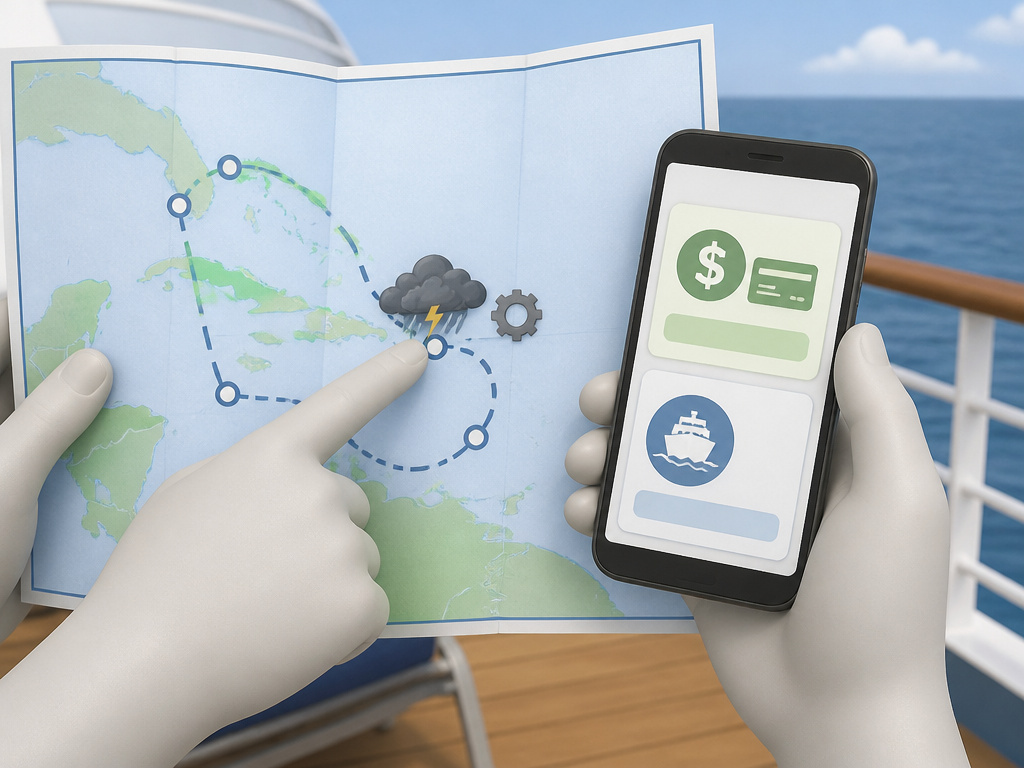
It changes what you can ask for, and this is the part that separates a productive phone call from a wasted one. Weather is one of the most common reasons itineraries change, and the number of changes rises in the Caribbean and Bahamas during Atlantic hurricane season, which runs June through November.
If the change came from weather, a port closure, or anything else outside the line’s control, don’t count on a refund unless the cruise is cancelled outright, but if a mechanical failure prompted the change, the line might offer at least a portion of your money back. If a mechanical failure prompted the change, the line might offer at least a portion of your money back.
That distinction is worth stating out loud when you’re asking. A stabiliser breakdown is a different conversation from a storm.
Where this goes sideways: Asking for a full refund after a weather reroute. The line owes you port charges and nothing more, and pushing for the rest burns the goodwill you’ll want for the next request.
Compensation, when it comes, takes a few standard forms. Onboard credit is the most common and usually appears for minor changes, though the line isn’t required to offer it. A future cruise credit shows up for major changes. In some cases the line lets you rebook to a different sailing date at no extra cost.
Carnival Valor‘s cruise to nowhere in September is the clearest recent example of what a line will actually do. Guests got a portion of their fare refunded for the missed day, refunds on Wi-Fi and drink packages bought for that day, a $100 onboard credit, a 50% future cruise credit, and compensation for associated expenses like flight change fees. That’s a generous package, and it’s also discretionary. Nothing in the contract required any of it.
What the Final Payment Date Actually Controls
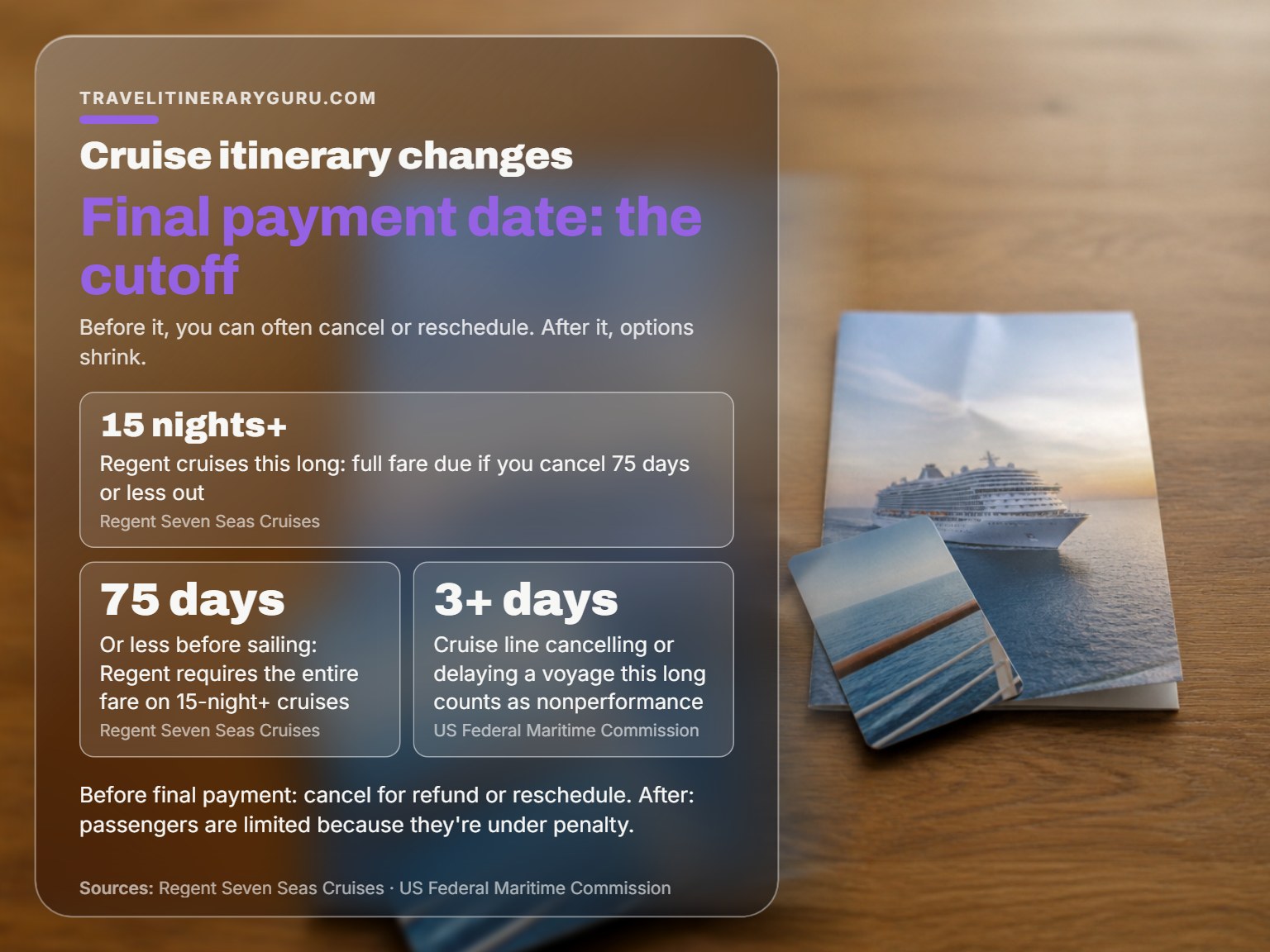
The final payment due date is the hinge the whole decision swings on. USA TODAY says if you learn about itinerary changes before that date, you can generally cancel and get a refund or reschedule, while Yahoo Travel says the line might offer the option to cancel for a refund or rebook before embarkation day but it’s not always guaranteed. Once it’s passed, passengers are limited in their options because they’re under penalty.
The penalty structure varies by line and by sailing length. Regent Seven Seas requires passengers booked on cruises of 15 nights or more to pay the entire fare if they cancel 75 days or less before the sail date. That’s an extreme end of the range, and it’s worth checking your own line’s numbers before you assume yours is similar.
What you do with the window depends on how much the itinerary mattered.
- If the specific port was the reason you booked, cancel before final payment and rebook on a sailing that still goes there.
- If you’re flexible on destinations, take the change and ask for onboard credit once you’re aboard.
- If the change is major and pre-sailing, ask about rebooking to a different date at no cost before you ask for money, though if there is a major itinerary change, cruise lines could also offer a future cruise credit.
- If you’ve already paid in full, USA TODAY says passengers are limited in their options because they’re under penalty, while Yahoo Travel says the line might offer the option to cancel for a refund or rebook before embarkation day but it’s not always guaranteed.
That last point is where most people waste a call. USA TODAY says after final payment passengers are limited in their options because they’re under penalty, while Yahoo Travel says the line might offer the option to cancel for a refund or rebook before embarkation day but it’s not always guaranteed.
Should You Take the Future Cruise Credit?
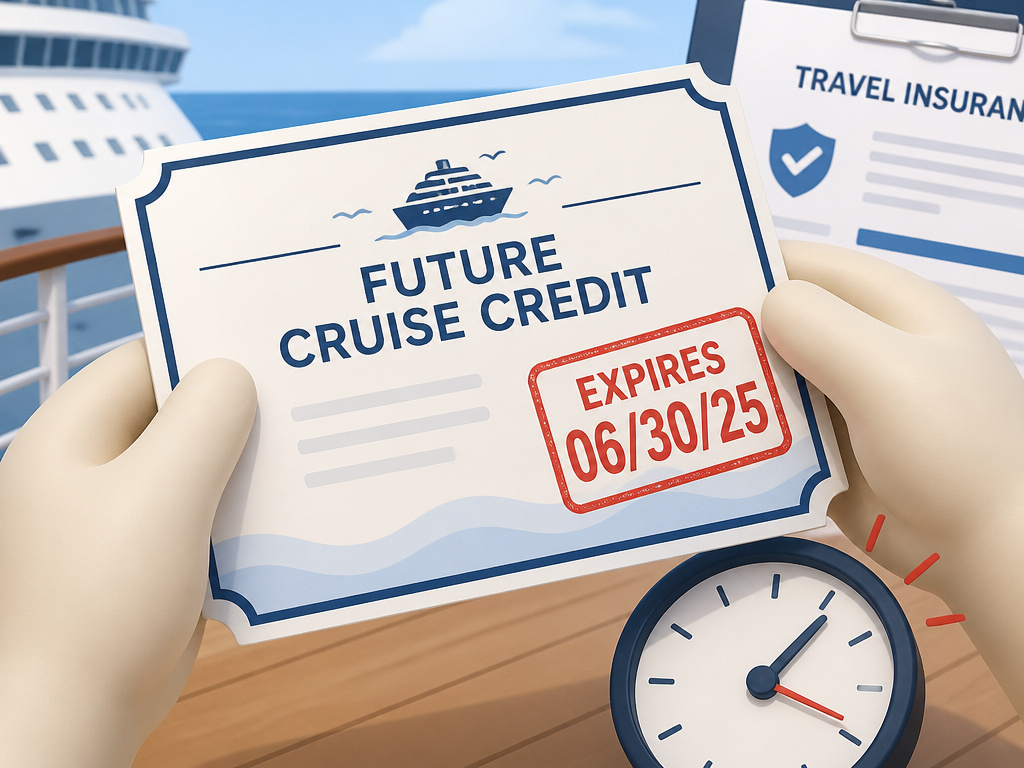
Take it, but read the expiry date first. Future cruise credit is often a percentage of the fare you paid, or a set dollar amount, loaded into your cruise line account or issued as a certificate. It applies to a future booking with the same line.
The trap is the clock. Future cruise credit frequently carries an expiration date, and accepting it without checking whether you can actually sail again inside that window turns a compensation offer into a loss. Ask how long you have to redeem it before you say yes.
There’s a second trap that catches people with insurance. If you receive compensation like a credit or refund, it can affect what your travel insurance policy reimburses. Your insurer may reduce the payout by whatever the line already gave you, which means a future cruise credit you’ll never use could cost you a cash claim you would have collected.
This is where cruise travel insurance earns its place in the planning, not the aftermath. USA TODAY says policies bought through the cruise line tend to cover less than third-party options, while Yahoo Travel says travel protection offered by cruise lines is often not the same as travel insurance and generally doesn’t offer as much coverage, and the coverage that matters here is the inconvenience benefit some plans carry for itinerary changes after departure.
If you’d prepaid something at a port that got cut, that’s the claim to file, and it only works if the cause was outside your control, though itinerary changes for Israel on upcoming cruises would likely not be covered, partly because it’s a ‘known issue.’ Inclement weather or mechanical failure of the ship, documented, is the shape of a covered claim, though itinerary changes for Israel on upcoming cruises would likely not be covered, partly because it’s a ‘known issue.’ A change the insurer considers a known issue when you bought the policy usually isn’t, though you have to be able to prove the itinerary change was due to inclement weather or mechanical failure of the cruise ship, and those would all be covered.
One more thing worth knowing: USA TODAY says asking the line for compensation doesn’t forfeit your insurance claim, while Yahoo Travel says if you receive compensation, like a credit or refund, it could affect what your travel insurance policy will reimburse. They’re not mutually exclusive. File both and let them sort out the overlap.
The Two Complaint Clocks You Need to Watch
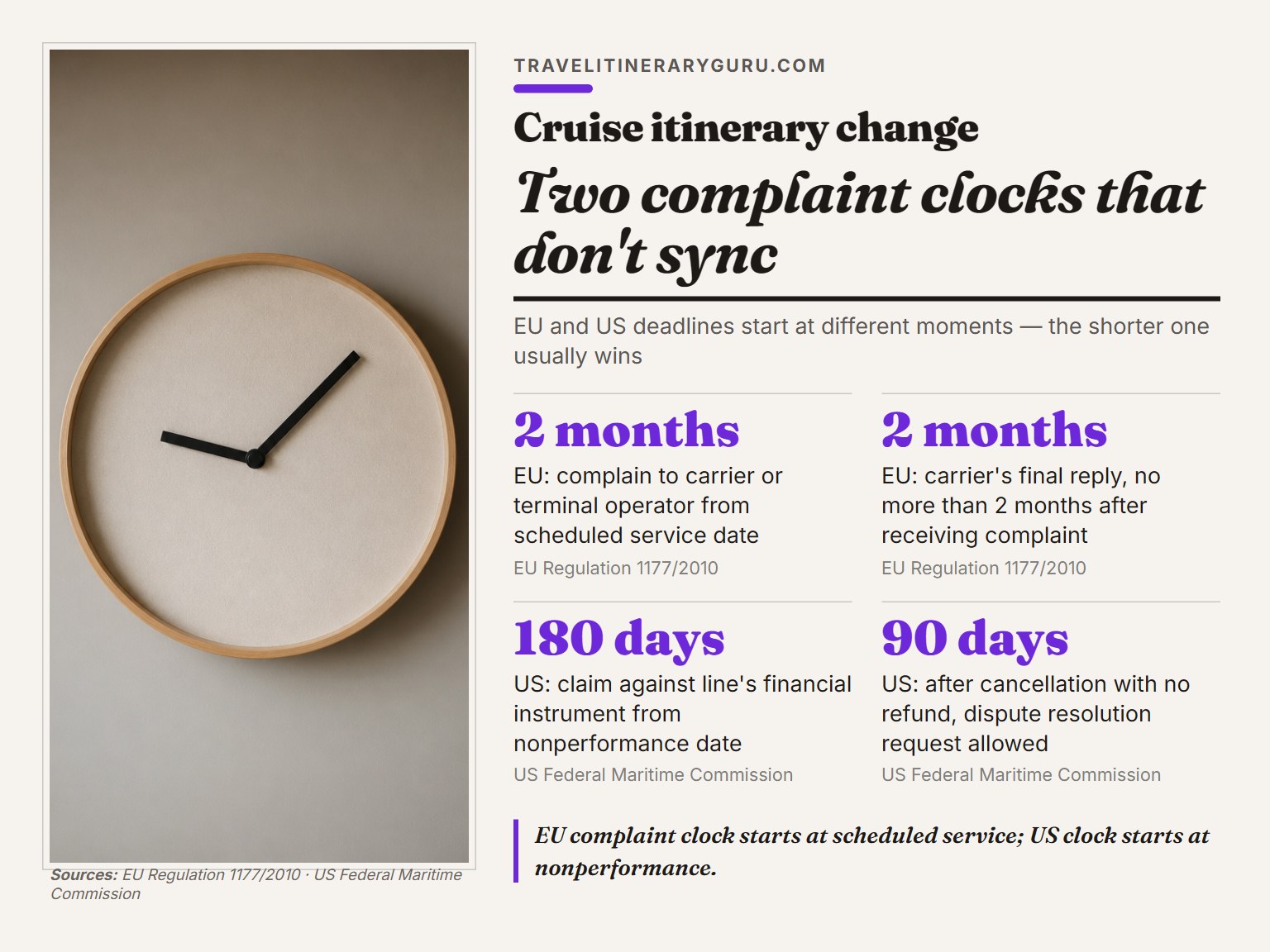
Two deadlines run in parallel and they don’t sync up. Miss either and the option disappears.
Under EU rules, if you think your rights haven’t been respected, you complain to the carrier or terminal operator within two months of the scheduled service where the problem occurred. The carrier then has one month to react and must give a final reply no more than two months after receiving your complaint. If you’re not satisfied with that reply, you can escalate to the relevant national authority in your country, which should provide a non-binding legal opinion on how to proceed.
On the US side, the 180-day window for claiming against the line’s financial instrument runs from the nonperformance, not from your complaint. Those two clocks start at different moments, and the shorter one usually wins.
| Clock | Starts | Deadline |
|---|---|---|
| EU complaint to carrier | Scheduled service date | 2 months |
| Carrier final reply | Receipt of complaint | 2 months |
| FMC financial instrument claim | Nonperformance date | 180 days |
| FMC refund dispute | Cancellation date | After 90 days, no refund |
How Do You Plan Around a Change Before It Happens?
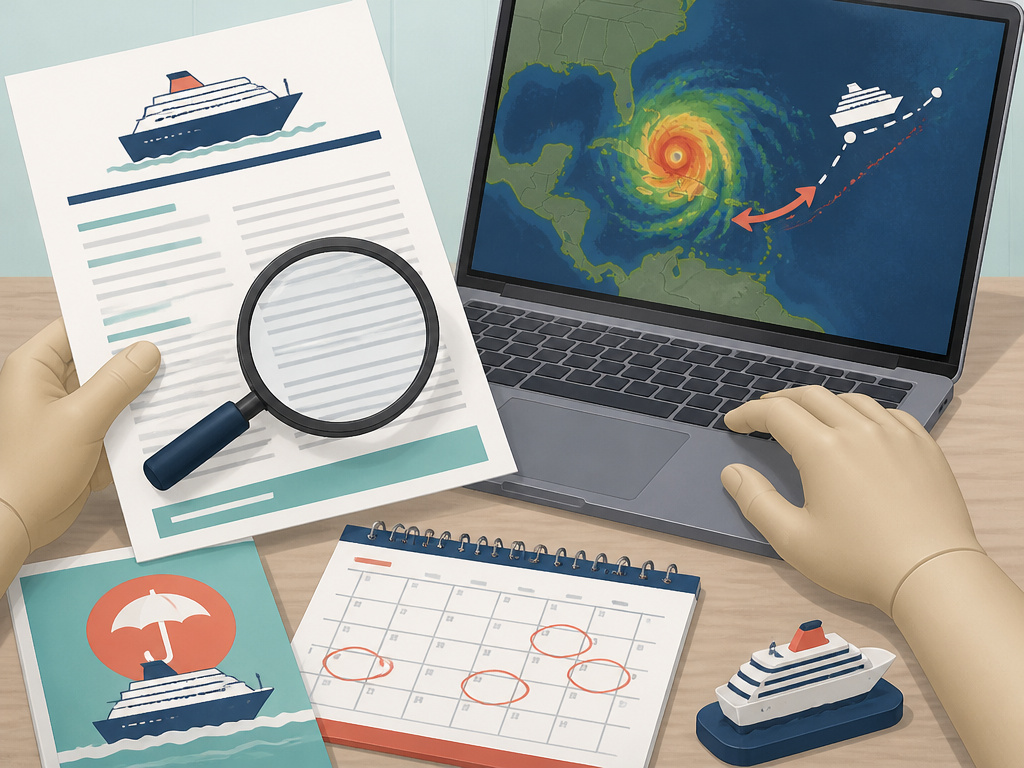
You plan for the change, not around it. Weather is the most common cause, so if you can, pick a destination and travel dates less likely to be affected. Booking a cruise to see one specific port is the setup for disappointment, and if that one place is the whole point, a land-based trip there is the better fit.
Read the contract of carriage. It’s tedious and full of legalese, and it’s also the document that tells you what the line is responsible for when something disrupts your sailing. Ten minutes with it before you book beats an hour on the phone after.
Then protect the parts you can control. That means cruise travel insurance from a third-party provider, a contingency plan for a delayed return, and a booking strategy that treats the ship as the destination rather than the transport, though USA TODAY says passengers can also buy insurance policies through the cruise line, but those tend to cover less than policies from third-party providers.
If you’re weighing a first sailing and want to reduce the odds of this whole article applying to you, picking a cruise itinerary with fewer tender ports and a shorter weather window does more for you than any compensation claim will. And if you’re planning a Caribbean sailing, planning around hurricane season isn’t paranoia; it’s the single biggest variable in whether your itinerary survives intact.
Port days are where the change hurts most, which is why planning shore excursions on a cruise through the line protects you in a way independent operators can’t match, though if you’ve booked through a third-party provider, you’ll need to check their cancellation policy. USA TODAY says cruise lines typically work to replace canceled ports and automatically refund shore excursions booked there, while Yahoo Travel says if you’ve booked through a third-party provider, you’ll need to check their cancellation policy. Third-party operators answer to their own policy.
That’s the practical wisdom: the itinerary is a plan, not a promise, and the passengers who handle changes best are the ones who insured the plan and never treated any single port as the reason for the trip.
Frequently Asked Questions
Can I get a refund if my cruise itinerary changes?
Rarely in cash. Cruise contracts allow lines to change ports without owing compensation, and refunds are discretionary unless the voyage is cancelled outright. What you can usually count on is money back for port charges at a destination the ship doesn’t visit, plus automatic refunds on shore excursions you booked through the line for that port, though if you’ve booked through a third-party provider, you’ll need to check their cancellation policy.
Does EU law protect cruise passengers on a cancelled sailing?
Partly, and less than most people assume. EU Regulation 1177/2010 grants ferry passengers a choice between reimbursement and re-routing on cancellation, but the regulation explicitly excludes cruise passengers from that election, from the connecting-transport duty, and from the right to compensation. The rules still require the carrier to inform you of new departure and arrival times.
How long do I have to complain about a cruise itinerary change?
Two months from the scheduled service date if you’re complaining to the carrier under EU rules. The carrier must react within one month and give a final reply no more than two months after receiving your complaint. On the US side, the FMC window for claiming against a line’s financial instrument is 180 days from the nonperformance.
Can the FMC help me if my cruise skips a port?
Usually not. The Commission doesn’t regulate itinerary changes or customer service issues, and it has no jurisdiction over cruises that don’t embark from a US port. Its role is limited to financial-responsibility claims when a line cancels or delays a voyage by three or more calendar days, and to refund disputes where a cancelled cruise hasn’t been refunded after more than 90 days.
Is a future cruise credit worth accepting?
Yes, if you’ll actually sail again before it expires. Future cruise credit is often a percentage of the fare you paid or a set dollar amount, and it frequently carries an expiration date. Check the redemption window before you accept, and remember that taking compensation can reduce what your travel insurance policy reimburses.
What if I booked my shore excursion through a third party?
You’re checking that operator’s cancellation policy, not the cruise line’s. USA TODAY says cruise lines typically work to replace canceled ports and automatically refund shore excursions booked there, while Yahoo Travel says if you’ve booked through a third-party provider, you’ll need to check their cancellation policy. USA TODAY says cruise lines typically work to replace canceled ports and automatically refund shore excursions booked there, while Yahoo Travel says if you’ve booked through a third-party provider, you’ll need to check their cancellation policy.
The Bottom Line
One rule most guides skip: if your cruise was cancelled and you haven’t seen a refund after more than 90 days, stop waiting on the line and file a dispute resolution request with the FMC, though the Commission does not adjudicate disputes between passengers and cruise lines and does not regulate cruise customer service issues (e.g., itinerary changes). That 90-day mark is a specific trigger, and it opens a channel that polite emails to guest services won’t, though the Commission does not adjudicate disputes between passengers and cruise lines and does not regulate cruise customer service issues (e.g., itinerary changes).
For everything short of a cancellation, the realistic first step this week is simpler, though the Commission does not adjudicate disputes between passengers and cruise lines and does not regulate cruise customer service issues (e.g., itinerary changes). Pull up your booking, find your final payment due date, and write it somewhere you’ll see it. That date decides whether you have options or you’re asking for favours, and it’s the one number in this whole process you can still control.
I’ll be honest about where my advice runs thin. I plan trips around geography and energy, not around compensation claims, so if you’re chasing a specific payout, the FMC’s own pages and your line’s claims procedure will serve you better than I can. What I can tell you is that the passengers who come out of a reroute without a story to tell are the ones who insured the trip, read the contract, and never booked a cruise for a single port. That’s the part nobody puts in the caption.
