
How to Rent an RV for a National Park Trip: Step-by-Step
This post contains affiliate links. As an Amazon Associate, we earn from qualifying purchases.
To rent an RV for a national park trip, match the rig to the park’s posted length and campground rules before you book: a 25-foot Class C fits almost everywhere, a 30-foot model sits right at Yosemite’s Glacier Point Road limit, and anything longer gets locked out of specific roads and loops. Confirm generator policy and who holds the campsite reservation before you pay.
The length number on the rental listing is the easy part. The park’s rule is what actually decides whether you sleep inside the boundary or in a commercial lot twelve miles out. Knowing how to rent an RV for a national park trip means checking that rule before you book.
What follows is the sequence I use: pick the rig by park rule rather than by sleeping capacity, verify the campground’s generator and delivery rules in writing, and lock the reservation in your own name. I’ve learned this the hard way.
Key Takeaways
- Measure the rig against the park, not the group. A 30-foot Thor Quantum sleeps seven and sits right at Yosemite’s Glacier Point Road limit; a 25-foot View sleeps five and fits more loops.
- Generator policy is a campground rule, not a rental feature. Zion’s Watchman Campground bans generators at all times, so a generator-equipped rental buys you nothing there.
- The visitor holds the campsite reservation. Commercial RV companies and private renters cannot book sites in the Zion delivery program.
- Cassette toilets dump constantly. A 5-gallon cassette versus a 41-gallon black tank is a difference of an order of magnitude in dump frequency.
- Download the offline map before you lose signal. Six hours of dead zone is normal inside park boundaries.
Which RV Length Actually Fits a National Park?
Yosemite’s own guidance is the clearest starting point: most roads handle RVs and travel trailers, but Glacier Point Road, Mariposa Grove Road, and Hetch Hetchy Road carry restrictions that affect some RVs and most trailers. Glacier Point specifically caps vehicles at 30 feet and shorter.
That single number eliminates half the rental fleet. The Thor Quantum LC28 runs 30 feet exactly. The Winnebago Sunflyer 24GG runs 27 feet 1 inch. The Nexus Triumph 24TS sits at 25 feet 2 inches. The Winnebago View 24D is 25 feet 6 inches.
National park roads generally accommodate recreational vehicles and travel trailers, but specific corridors carry length restrictions that exclude longer rigs and most trailers. Glacier Point Road in Yosemite limits vehicles to 30 feet or shorter, while Mariposa Grove Road and Hetch Hetchy Road impose additional restrictions on oversized vehicles.
Rental operators frame this differently. Blacksford describes its 21-foot Solis PX as “typically small enough to meet most national park length limits” and tells renters to verify per park. That’s a reasonable hedge from a company that doesn’t want to promise something a ranger can contradict.
Here’s the practical version. If your trip hits one park, look up that park’s road restrictions and campground loop limits before you book. When you compare a how to rent an RV for a national park trip, book the shortest rig your group can tolerate.
| Model | Length | Sleeps | Black Tank |
|---|---|---|---|
| Solis PX | 21 ft | 4 | 5 gal cassette |
| Winnebago EKKO pop-top | 23 ft | 4 | 5 gal cassette |
| Winnebago View 24D | 25.6 ft | 5 | 41 gal |
| Winnebago Sunflyer 24GG | 27 ft 1 in | 4-5 | 41 gal |
| Thor Quantum LC28 | 30 ft | 7 | 26 gal |
That table is the whole decision in one screen. The two shortest rigs have the smallest black capacity by a factor of eight.
The Cassette Toilet Trap Nobody Mentions at the Counter
A 5-gallon cassette toilet is not a small black tank. It’s a different system with a different rhythm, and it changes how your whole trip runs.
The Solis PX and the Winnebago EKKO pop-top both use cassettes. The Winnebago View 24D and the Sunflyer 24GG carry 41-gallon black tanks. Same category of vehicle, wildly different maintenance cadence.
The part nobody mentions: A 5-gallon cassette needs dumping roughly every day or two with four people aboard. A 41-gallon tank runs a week. Renters who book by price discover this on day three, at a dump station, in the rain.
I underweight this myself when I’m planning. I plan routes and campgrounds and forget that the vehicle’s plumbing dictates the schedule. Fair warning: it does.
The fix is straightforward. If your itinerary has a dump station every night, a cassette is fine. If you’re boondocking or moving daily through parks with limited services, the how to rent an RV for a national park trip answer is to pay for the bigger tank.
Why Generator Rules Beat Generator Features
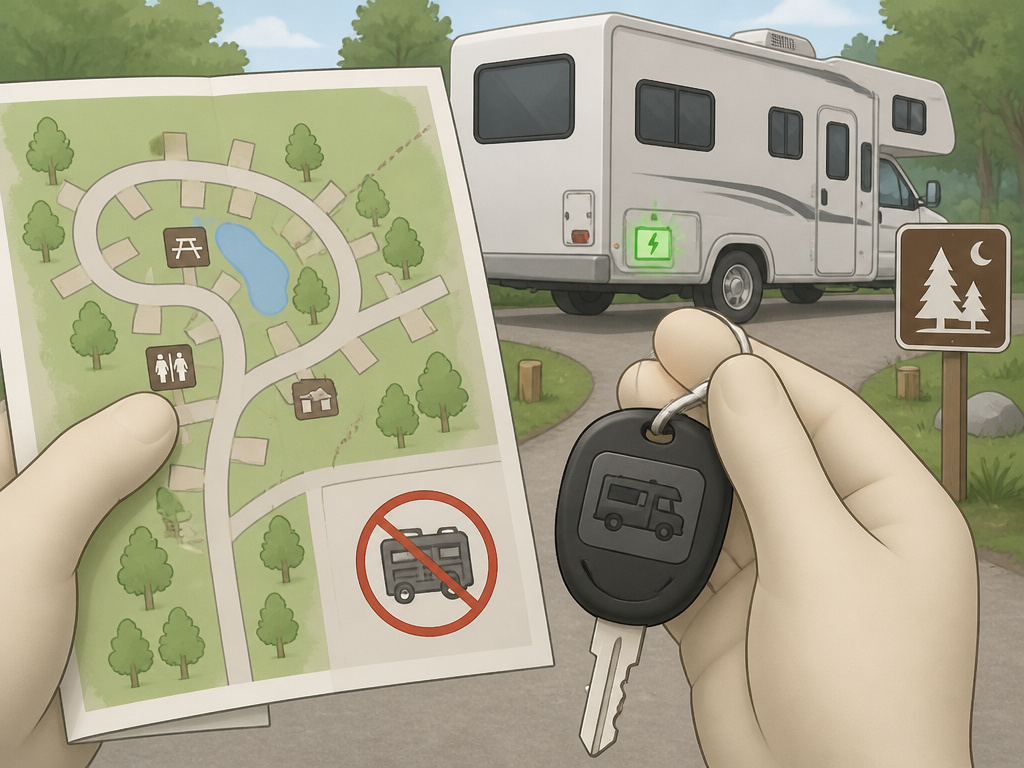
Blacksford lists generators as a feature on most of its fleet. Zion’s Watchman Campground prohibits generator use at all times. Both statements are true, and together they mean a generator-equipped rental is worth nothing at that specific campground.
This is the kind of conflict that never makes it into the rental company’s marketing page. It lives in the park’s operating documents, and you have to go find it.
The Zion program is unusually strict. RVs are authorized only in A and B loops. One RV per site. Delivery cannot happen before noon on arrival day, and removal must be complete by 11:00 a.m. On departure day. If the park issues an emergency notification, the commercial operator has 12 hours to remove the trailer.
Skip this if: You’re planning to run the generator for air conditioning in a no-generator campground. The EKKO pop-top ships without a generator and relies on two lithium-ion batteries, which is fine for lights and a fridge and useless for A/C.
Read that as a design constraint rather than a defect. The EKKO exists for people who want to camp in quiet, generator-free loops. It just won’t keep you cool in July in Utah.
Who Actually Holds the Campsite Reservation?
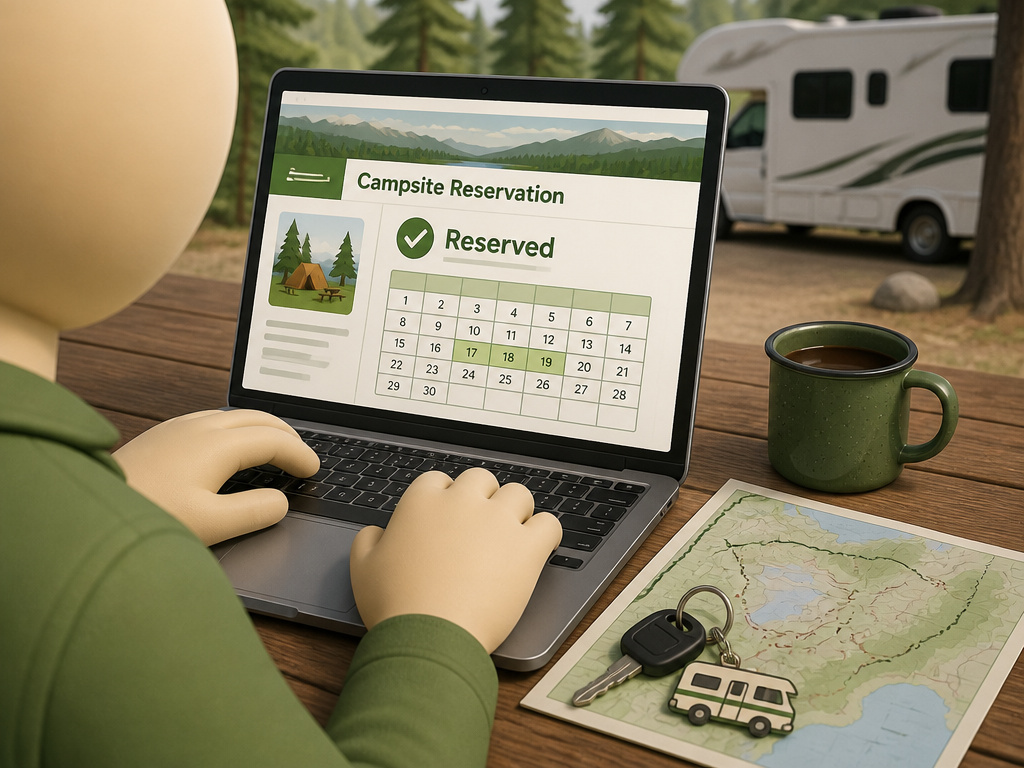
The Zion operating plan is blunt about this: commercial RV companies and private renters cannot reserve campsites in the delivery program. The visitor holds the reservation.
That single line reshapes how you book a delivered RV. You cannot hand the whole trip to a rental company and expect them to sort the campsite. You book the site, in your own name, on the park’s reservation system, and the delivery company shows up to a site you already control.
The national park campgrounds on the popular loops fill months out. Zion’s Watchman is not an exception.
If you’re weighing the cost of the whole trip, the national park road trip cost math changes once you’re paying for a campsite, a delivery fee, and a rental separately. It’s not cheaper than driving your own rig. It’s just easier.
And the park entrance fees stack on top of all of it. Budget the America the Beautiful pass if you’re hitting three or more parks.
Where this goes sideways: Assuming the rental company will handle the campsite because they handle the delivery. They can’t. The operating plan forbids it, and you’ll arrive to a site that was never reserved.
What Breaks First on a Park Trip
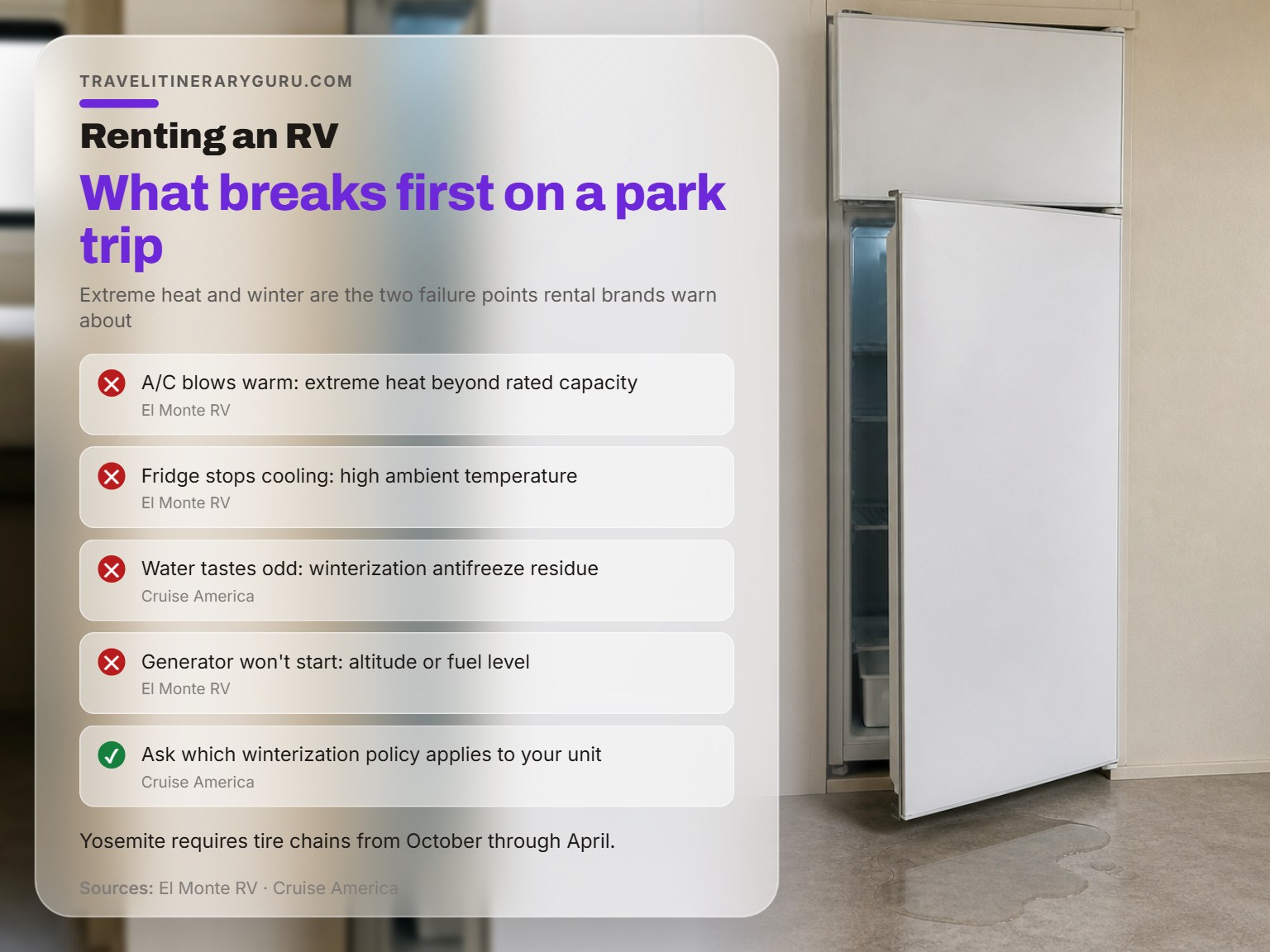
Extreme heat is the most common failure point. El Monte RV explicitly disclaims guaranteed performance of roof A/C, dash A/C, generator, and refrigerator under extreme summer temperatures. That’s a rental company being honest about a real limitation, and it matters in parks where July afternoons sit above 100°F.
Winter is the other end. Yosemite requires tire chains from October through April. Cruise America states that motorhomes in harsh-winter locations are winterized seasonally and that antifreeze in water and holding tanks may be required. El Monte’s position is different: systems are “maintained for all-weather travel, but performance under extreme conditions cannot be guaranteed.”
Two rental brands, two different winterization philosophies. One prescribes active winterization. The other disclaims performance without prescribing a procedure. If you’re renting in shoulder season, ask which policy applies to your specific unit.
| Symptom | Likely Cause | Fix |
|---|---|---|
| A/C blows warm | Extreme heat beyond rated capacity | Drive early, park in shade |
| Fridge stops cooling | High ambient temperature | Switch to propane, add ice |
| Water tastes odd | Winterization antifreeze residue | Flush tanks twice at first hookup |
| Generator won’t start | Altitude or fuel level | Check oil, hold prime 30 seconds |
That last row is worth knowing before you’re at 8,000 feet with a dead generator and a fridge full of food.
The 3 Documents That Decide Your Trip
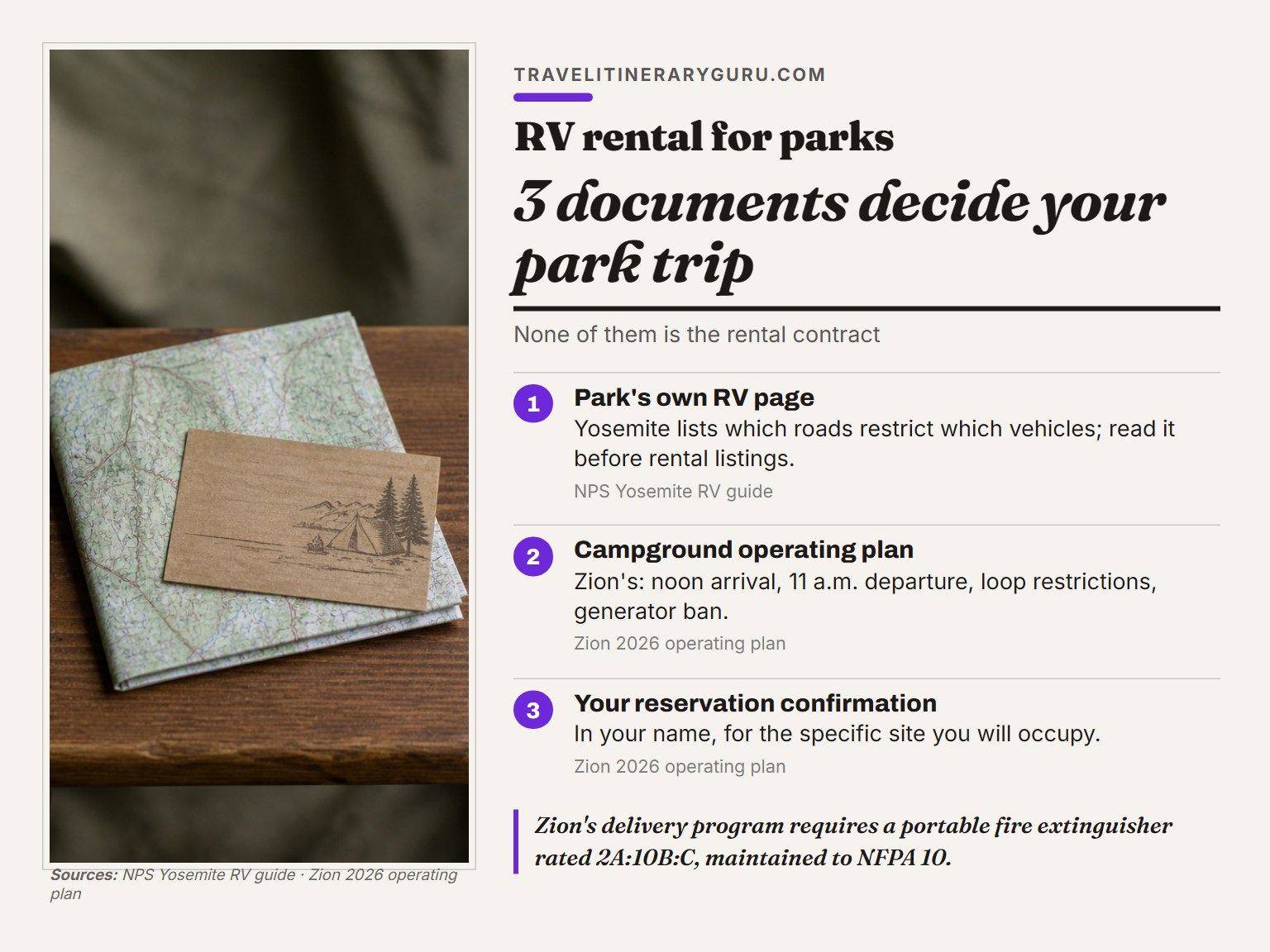
Three documents govern whether your park trip works. None of them are the rental contract.
The first is the park’s own RV page. Yosemite publishes one, and it tells you which roads restrict which vehicles. The NPS Yosemite RV trip planning guide is the primary source, and it’s worth reading before you look at a single rental listing.
The second is the campground’s operating plan. Zion’s is public, and the Zion 2026 RV delivery operating plan lays out the noon arrival, 11 a.m. Departure, loop restrictions, and generator ban in plain language. Most parks publish something similar.
The third is your own reservation confirmation, in your name, for the specific site you’ll occupy.
Worth knowing before you start: Zion’s delivery program requires a portable fire extinguisher rated 2A:10B:C, maintained to NFPA 10. That’s the standard for commercial kitchen and vehicle extinguishers, and it’s not something you’ll find on a rental company’s feature list.
What to Do Before You Leave the Lot
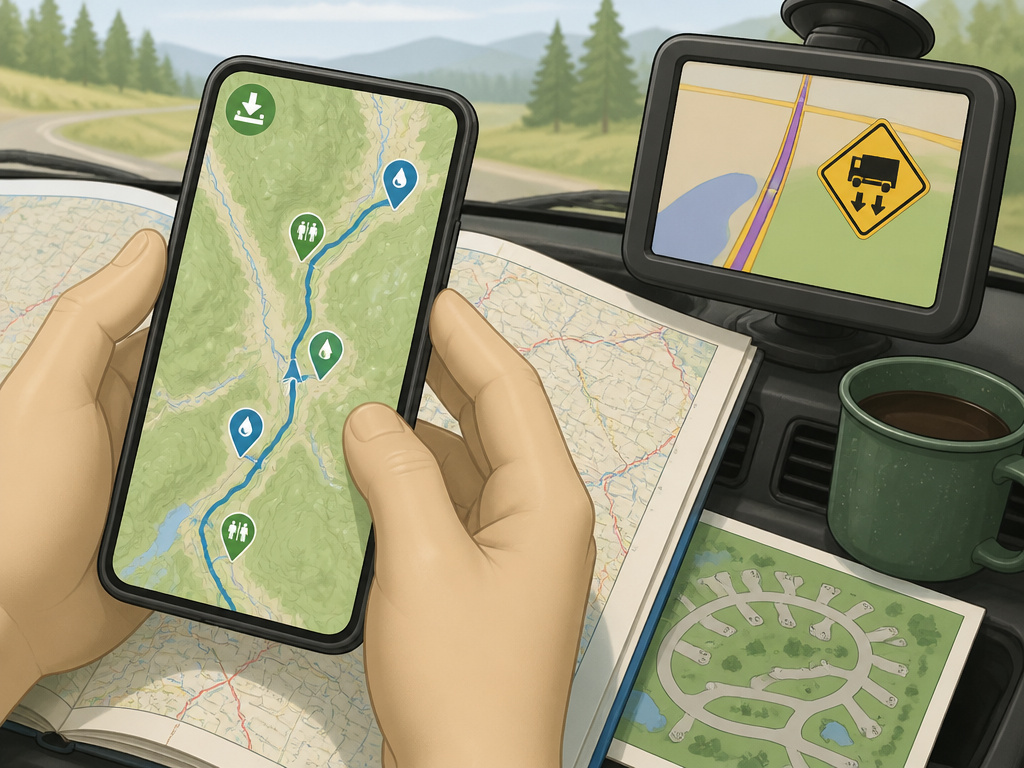
A self-guided park tour lives or dies on what you set up before you lose signal. I learned this the hard way, and I keep relearning it.
Last spring I downloaded an offline map of a park before driving in. Six hours later, still inside the boundary, I had no bars. The map worked. The one time I forgot to download it, I spent 40 minutes walking the wrong direction on a fire road before I noticed the sun was on the wrong side.
The fix is boring. Drop pins at every water refill and bathroom before you leave the hotel. Download the offline map. Screenshot the campground loop map.
An RV GPS helps with the driving side, especially for clearance and weight restrictions that phone navigation ignores. A camping packing list covers the rest, though most of it is stuff you already own.
Common mistake: Trusting cell service inside park boundaries. Dead zones of 30 to 60 miles are normal on remote sections, and the park’s own signage won’t warn you.
Frequently Asked Questions
Do I need a special license to drive a rental RV?
No. Cruise America requires drivers to be 21 or older with a valid license and a major credit card, and no special endorsement is needed. Temporary or digital licenses are not accepted. All drivers must be present at pickup and sign the rental agreement.
Can I use a generator in a national park campground?
It depends entirely on the campground. Zion’s Watchman Campground prohibits generator use at all times, even though rental companies list generators as a standard feature. Check the specific campground’s rules before you assume you can run one.
Who books the campsite if I’m renting a delivered RV?
You do. The Zion operating plan prohibits commercial RV companies and private renters from reserving campsites, so the visitor must hold the reservation. Book the site in your own name on the park’s reservation system, then arrange delivery separately.
What happens if I return the RV with empty tanks?
El Monte RV requires gray and black tanks returned empty, and a paid dumping service may be available at the rental center. Fuel and propane also need to be at pickup levels, or charges apply. The security deposit covers these deductions if you skip them.
Is winterization a problem for shoulder-season rentals?
It can be. Cruise America winterizes motorhomes in harsh-winter locations and may use antifreeze in water and holding tanks. El Monte RV maintains systems for all-weather travel but disclaims guaranteed performance in extreme conditions. Ask which policy applies to your unit.
How far in advance should I book the RV and the campsite?
Campsites on popular loops fill months ahead, and the RV rental should be locked once you know the park’s length limits. Booking the RV first and discovering it doesn’t fit the park’s roads is the mistake that costs the most to fix.
The Bottom Line
One rule most guides skip: if your group is larger than four and you’re targeting a park with a 30-foot road limit, you have a math problem, not a rental problem. A 30-foot Thor Quantum sleeps seven and sits right at Glacier Point Road’s limit, but it’s the ceiling. Anything longer and you’re driving around the park instead of through it.
The first thing to do this week: pull up the specific park’s RV page and write down the length limit and the campground’s generator rule. Two numbers. That’s the whole filter.
This all changes if you’re delivering rather than driving. The delivery program rules are stricter than the road rules, and the reservation has to be in your name. If that’s your plan, start with the operating plan document, not the rental listing.
And if the plan falls apart mid-trip, which it will, resist the urge to rebuild the spreadsheet from the passenger seat. The detour is usually the part you remember.
