
European Train Ticket Types Explained: A Booking Guide
This post contains affiliate links. As an Amazon Associate, we earn from qualifying purchases.
European train ticket types explained: the ticket you buy decides when you can change it, when you can get money back, and how much of that money you actually see. Three families cover almost every journey. Advance, flexible (Anytime and Off-Peak), and passes, and the real differences live in the cut-off dates and exchange windows, not the names.
Here’s where the names start lying to you. “Advance” means one thing on a Chiltern Railways service and something looser on the Office of Rail and Road’s own guidance, which only says there are “restrictions on refunds” and never spells out what they are.
So what do you actually do with that? You stop shopping by ticket name and start shopping by the rules attached to the specific fare in front of you. What follows: the three families, the exchange windows that run after departure, and the two places where every generic guide quietly gets it wrong.
Key Takeaways
- Advance fares are the cheapest and the most locked-down, restricted to a specific train, and carry restrictions on refunds.
- Flexible fares (Anytime, Off-Peak) are refundable, though an administration fee may apply depending on the operator.
- Group bookings refund on a sliding scale, 80% up to 31 days out, 50% from 30 to 9 days, nothing from 8 days.
- Interrail Global and One Country Passes are not the same product, and the difference bites hardest in your own country.
What Are the Main European Train Ticket Types?
Three families cover nearly everything you’ll book. The first is the Advance family: cheap, limited in number, tied to one specific train, and sold out fast on popular routes, so see our tips on finding cheap train tickets.
The Office of Rail and Road, the UK’s rail regulator, notes that Advance tickets are usually available from up to 12 weeks before the date of travel. Chiltern Railways closes Advance sales at 23:59 the day before travel. Those two facts sit in the same national market and describe different ends of the same window.
Advance tickets restrict the passenger to a specific departure time and to boarding or alighting only at the stations printed on the ticket. Availability is capped, and the fare carries restrictions on refunds. Booking opens well ahead of travel, but sales close the day before departure on at least one UK operator.
The second family is flexible: Anytime and Off-Peak. Anytime tickets allow travel at any time, the price doesn’t change based on when you buy, and they’re fully refundable, though an administration fee may apply. Off-Peak restricts you to less busy times of day and is generally cheaper, which suits a day trip by train nicely.
The third family is passes. Interrail, mostly, and it behaves nothing like the other two.
Why the Ticket-Type Names Don’t Travel Well
The four-type model you’ll read on UK sites (Advance, Anytime, Off-Peak, Super Off-Peak) is a British taxonomy. It doesn’t map cleanly onto the continent.
SNCF Connect’s conditions list six ticket formats: IATA Paper, ISO Paper, e-ticket/M-ticket, Value, Printed, and Electronic. That’s a document-medium taxonomy, not a flexibility taxonomy. It tells you what the ticket looks like, not what you can do with it.
PolishTrains uses a third model entirely: Reserved, Open, and Mixed.
Three systems, three vocabularies. Merging them into one tidy list is how bad guides get written.
| Taxonomy | Who uses it | What it actually sorts |
|---|---|---|
| Advance / Anytime / Off-Peak / Super Off-Peak | UK operators, ORR | Fare flexibility |
| IATA Paper / ISO Paper / e-ticket / Value / Printed / Electronic | SNCF Connect | Ticket medium |
| Reserved / Open / Mixed | PolishTrains | Whether a seat is locked |
When Can You Actually Change a European Train Ticket?
The exchange window is the number most European train ticket types explained guides bury, and it’s the one that decides whether a cheap fare was a good idea, especially when weighing bus vs train travel. Eurostar is the clearest example because the carrier publishes both ends of the scale.
Standard and Plus tickets can be exchanged up to one hour before your original departure time, with no fee. You can’t change the destination. You can upgrade to Plus, but not to Premier.
Premier tickets exchange up to 48 hours after the original departure time, no fee. Read that again. You can change a Premier ticket after the train has already left.
That gap between “one hour before” and “48 hours after” is where the entire price difference lives.
Fair warning. A ticket exchanged less than seven days before departure to a new, later date becomes non-refundable in all circumstances. The exchange itself is free. The refund rights are what you lose.
The Refund Ladder, Operator by Operator
Refund rules are where the European train ticket types explained sources genuinely disagree, and the disagreement is worth naming rather than smoothing over. The Office of Rail and Road says only that Advance tickets have “restrictions on refunds.” Chiltern Railways states flatly that Advance is non-refundable. GWR’s own FAQ doesn’t address Advance refunds at all.
Three UK sources, three different levels of precision on the same national ticket type.
Chiltern adds a detail worth knowing: refunds are only permitted up until 23:59 the day before the ticket becomes valid, and a £5 admin fee applies. If you choose not to travel because of rail industry disruption, you can apply for a refund up to 28 days after the ticket’s expiry date.
Where this goes sideways: Buying a non-refundable Advance to save money, then needing to move the trip. You don’t lose the ticket value on the spot, you lose it the moment you try to change anything, and by then the cheaper flexible fare has sold out too.
What Does a Refund Actually Cost You?
On Eurostar, the fee is £25 per person for each individual leg of the trip, or £50 per person for a full return refund. That applies seven days or more before departure. Less than seven days out, Standard and Plus are non-refundable.
Premier refunds with no fee up until 48 hours after the original departure time. Past that, nothing.
The pattern across the network is consistent: the closer you get to departure, the more the refund costs, and at some point it stops being a refund at all and becomes a forfeit, which matters most if you’re booking a night train.
| Operator / ticket | Exchange window | Refund terms |
|---|---|---|
| Eurostar Standard & Plus | Up to 1 hour before departure | £25/leg or £50/return, 7+ days out |
| Eurostar Premier | Up to 48 hours after departure | No fee, up to 48 hours after |
| Eurostar group (10–20) | Up to 31 days before departure | 80% / 50% / 0% sliding scale |
| SNCF TGV INOUI | Free up to 7 days out | €19 withheld from 6 days out |
| SNCF INTERCITÉS (no booking required) | Free up to 7 days out | 40% withheld, max €15 |
The Group Booking Rules Nobody Reads Until It’s Too Late
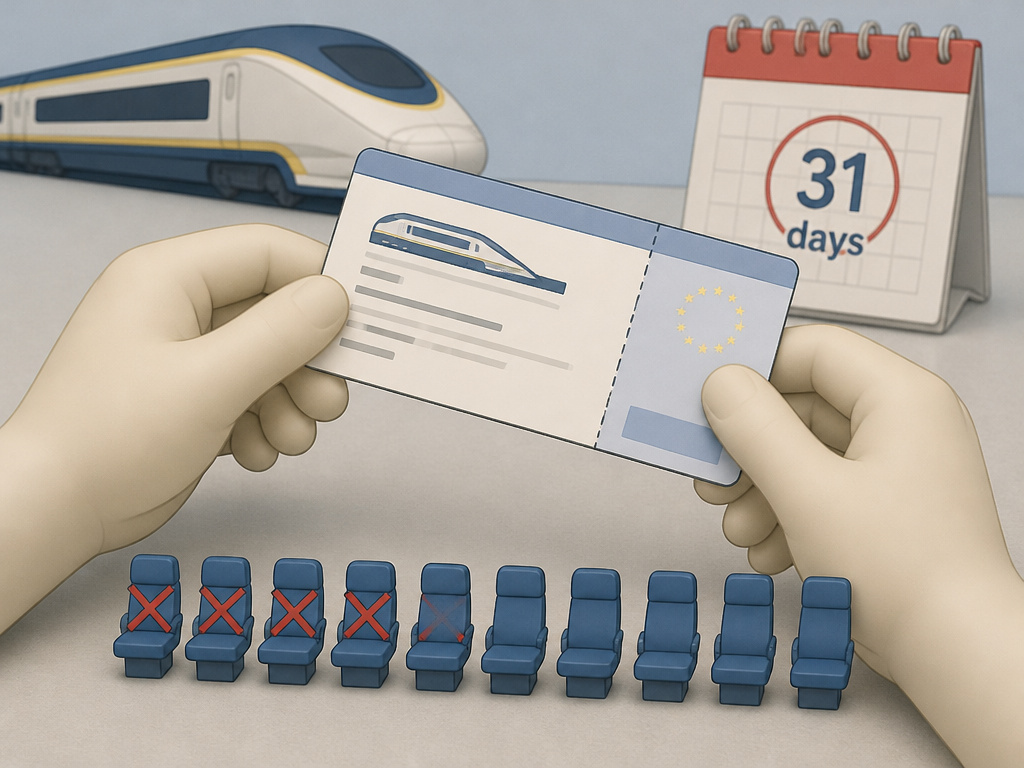
Groups of 10 to 20 can book or request a quote online on Eurostar. Groups of 21 or more need a quote request. At least 10 people have to travel together on both the outbound and the return.
The exchange window for groups is up to 31 days before departure, with no fee. After that, changes aren’t available. Not “cost more”, unavailable.
Refunds follow a ladder: 80% up to 31 days before departure, 50% between 30 and 9 days, and nothing from 8 days out. And refunds apply to the whole journey only. You cannot cancel individual legs separately.
The part nobody mentions: Group refunds are all-or-nothing. If four people drop out of a 14-person booking, you’re still paying for 14 seats or cancelling the other ten.
Interrail Global Pass vs One Country Pass: What’s the Difference?
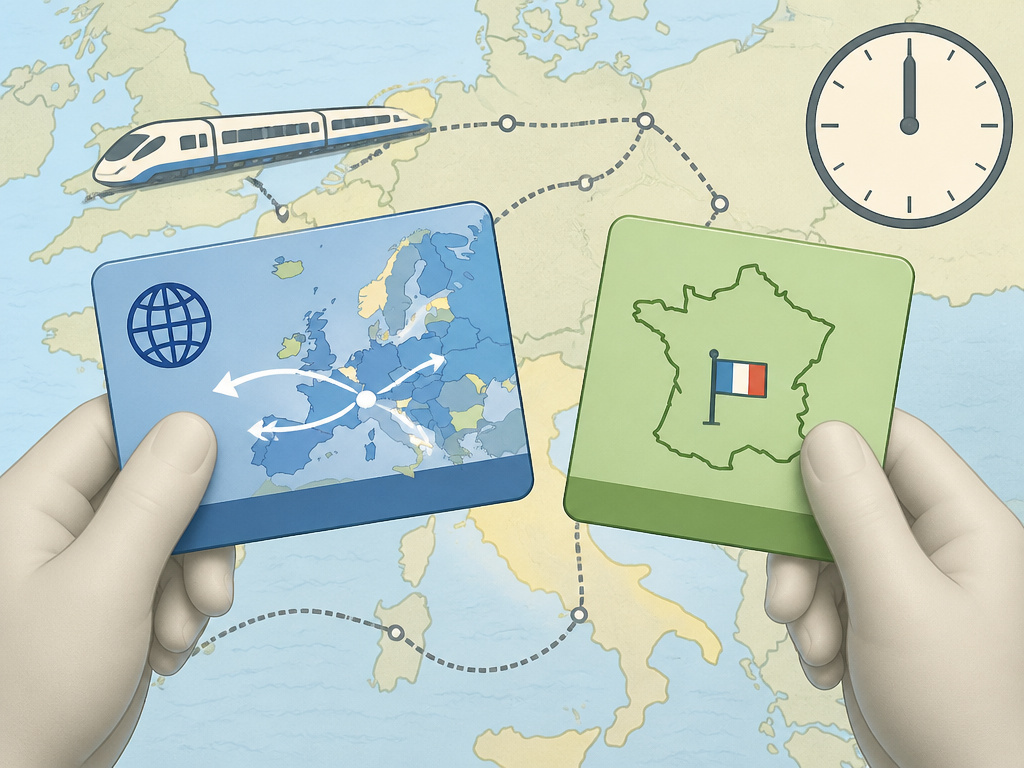
This is the comparison that catches people who’ve done their homework everywhere else. The Global Pass is valid for travel with all companies in the Interrail Pass Network, and it can be used to travel out of and back into your country of residence.
The One Country Pass is valid for rail travel within a single country, or sometimes a group of countries. It cannot be used to travel to that country in the first place, and it cannot be used in your country of residence at all.
How Interrail Validity Actually Runs
A Continuous Pass allows travel to begin after 00:00 on the first date of validity, and the last trip must finish by 23:59 on the last date of validity. Flexi Pass travel days run midnight to midnight.
The pass is valid for the number of days in the month it was activated. Activate on 6 February and it runs for 28 days, until 5 March at 23:59. In a leap year, 29 days.
One more thing that trips people up: a 1st class Pass is also valid in 2nd class carriages, but a 2nd class Pass is not valid in 1st class. And there’s no refund for 1st class holders who travel in 2nd.
Easy to miss: To travel with Eurostar on an Interrail Pass, the pass must be valid in both the country of departure and the country of arrival. A One Country Pass for Belgium won’t get you from London to Brussels.
Why Do Some Tickets Only Work on Certain Trains?
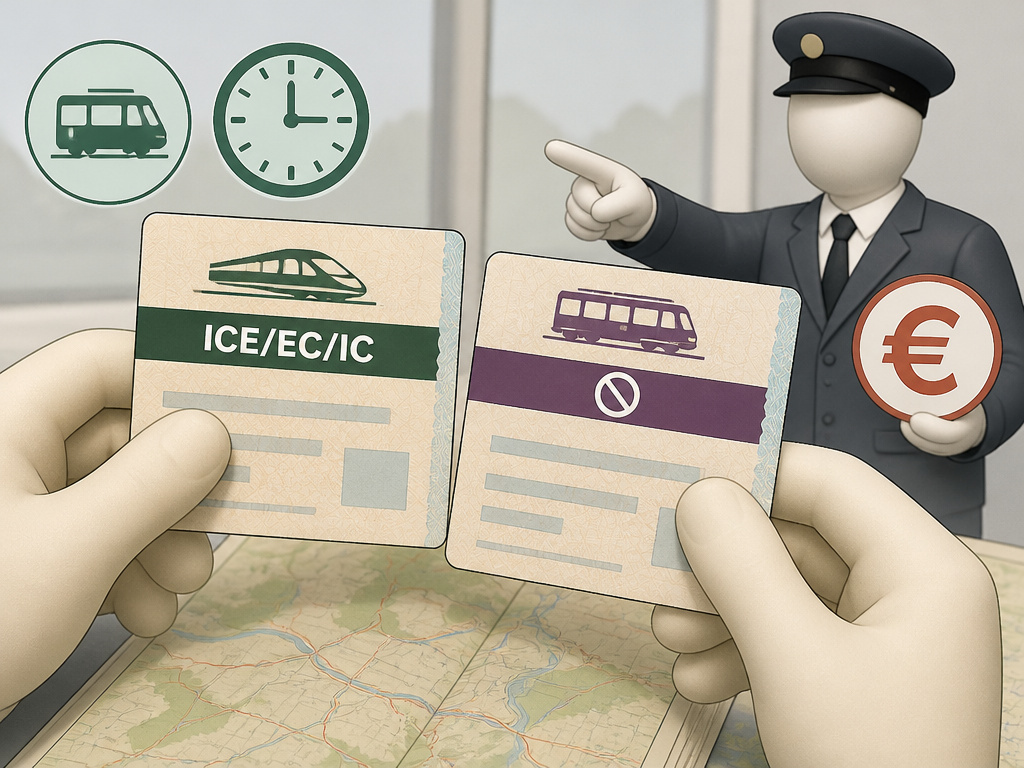
Because the reservation is baked into the fare, and using the wrong train type triggers a surcharge rather than a polite warning. DSB’s international ticket conditions spell this out precisely.
A ticket issued for an ICE train is valid on ICE, EC, IC, and regional trains. A ticket issued for EC or IC is valid on EuroCity, InterCity, and regional trains. A ticket with no ICE/EC/IC marking is valid on regional trains only.
Use a different train type than the one specified and you pay an on-board surcharge.
SNCF runs a similar rule from the other direction. A ticket must be used for a departure on the same day, and the trip must be completed within 24 hours of the date and time of departure. If a stop during the trip exceeds 24 hours, the journey gets divided into separate tickets, and that can increase your cost.
Booking on INTERCITÉS is valid only on the train and day indicated on the ticket. No flexibility, no exceptions.
Mixed-Format Journeys
Two documents, one journey, two collection methods.
Booking Direct vs Booking Through a Platform

A cross-border discounted product can carry two different names depending on which side of the border you’re booking from. DSB calls it Orange Europa between Denmark and Germany, and Sparpreis Europa between Germany and other countries. DSB also notes these tickets are not specifically searched for in its own webshop, which means the cheapest fare on a route may not surface in a search at all.
A cheap ticket you can’t use is the most expensive ticket on the trip.
Skip this if: You’re travelling on a fixed date with no chance of a change. Non-refundable Advance is genuinely the right call, and the flexibility premium is money you don’t need to spend.
What About Children and Discount Cards?
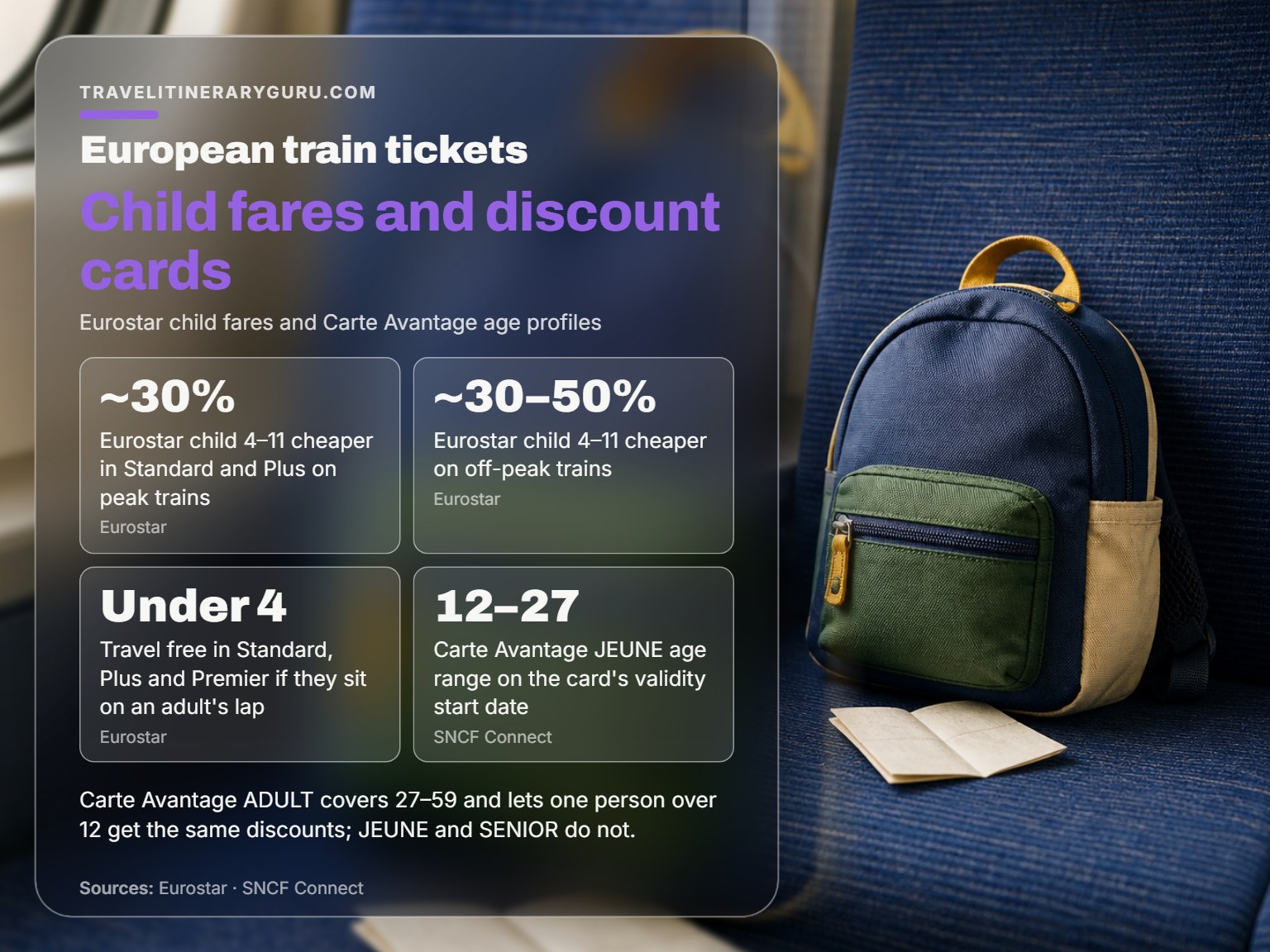
Eurostar fares for children aged 4 to 11 are approximately 30% cheaper in Standard and Plus on peak trains, with roughly 30% to 50% off on off-peak trains. The exact discount differs by route: on Belgium, France, Germany, and Netherlands routes, the published figure is approximately 50% cheaper in Standard and Plus. This doesn’t apply to Premier.
Children under 4 travel free in Standard, Plus, and Premier, provided they can sit on an adult’s lap.
Exchange and refund conditions for children up to 11 are the same as the accompanying adult’s ticket. No separate rules to learn.
On the French side, the Carte Avantage comes in three profiles. JEUNE covers ages 12 to 27, ADULT covers 27 to 59, and SENIOR covers 60 and over, assessed on the card’s validity start date. The ADULT card gives one person over 12 travelling with the cardholder the same discounts, as long as they travel together and buy tickets at the same time. The JEUNE and SENIOR cards don’t offer that accompanying-person discount.
There’s a limit worth knowing: Carte Avantage discounts don’t apply to trips made entirely on the Ile-de-France network.
Frequently Asked Questions
Are Advance train tickets refundable in Europe?
It depends on the operator, and the sources don’t agree. The Office of Rail and Road says only that there are restrictions on refunds. Chiltern Railways states that Advance tickets are non-refundable. GWR’s FAQ doesn’t address Advance refunds at all. Check the specific operator’s terms before you book, not the national guidance.
Can I change my Eurostar ticket after the train has left?
On Eurostar Premier, yes. You can exchange the date and time up to 48 hours after your original departure time with no fee. On Standard and Plus, the window closes one hour before departure. The destination can’t be changed on any class.
What’s the difference between an Interrail Global Pass and a One Country Pass?
The Global Pass is valid across the whole Pass Network and can be used to travel out of and back into your country of residence. A One Country Pass covers a single country, or a group of countries, but can’t be used to travel to that country or within your own country of residence.
How far in advance can I buy a European train ticket?
The Office of Rail and Road says Advance tickets are usually available from up to 12 weeks before travel. Chiltern Railways closes Advance sales at 23:59 the day before travel. Eurostar releases all tickets across its network at the same time when booking in advance.
What happens if I take a different train than my ticket specifies?
On DSB international tickets, using a different train type than specified triggers an on-board surcharge. A ticket with no ICE/EC/IC marking is valid on regional trains only. On SNCF INTERCITÉS, the booking is valid only on the train and day indicated.
Do children get cheaper train tickets in Europe?
On Eurostar, children aged 4 to 11 get roughly 30% off in Standard and Plus on peak trains, and roughly 30% to 50% off on off-peak trains. On Belgium, France, Germany, and Netherlands routes, the published figure is approximately 50%. Children under 4 travel free if they can sit on an adult’s lap.
The Bottom Line
The ticket name is the least useful thing on the page. What matters is the exchange window, the refund ladder, and whether the fare is tied to a specific train.
One rule to take into this week: before you book any non-refundable fare, write down the date you’d need to change it and check whether that date sits inside or outside the operator’s window. If it’s outside, pay for flexibility or pick a different departure.
Two caveats. And if your plans are genuinely fixed, the cheap fare is the right fare, don’t let a guide talk you into paying for a window you’ll never use.
It’s drier than anything you’ll read here, and it’s the version that counts.
