
Underrated Cities to Visit in the United States: By Type
This post contains affiliate links. As an Amazon Associate, we earn from qualifying purchases.
The honest answer is that “underrated cities to visit in the United States” is a phrase four major outlets define four different ways, and the lists they produce barely overlap. CNN caps its “towns” at about 225,000 residents and picks 10. National Geographic sorts 30 small cities into three population bands. Lonely Planet runs six. None of them agree on what the word means.
That disagreement is the useful part. Once you see how each outlet builds its list of underrated cities to visit in the United States, you can stop hunting for the one true ranking and start reading the map yourself.
The word “underrated” carries a hidden assumption: that somewhere out there is an objective ranking, and these cities got cheated. U.S. News says the opposite, plainly, that calling a destination underrated is hard because a spot that slipped under one reader’s radar might be a well-known favorite for another. That’s not a hedge. That’s the whole problem stated in one sentence. What follows is how the four definitions actually work, where they contradict each other, and how to use that to plan a trip that doesn’t feel like a queue.
Key Takeaways
- CNN caps “towns” at ~225,000 residents and evaluates on attractions, food, nightlife, identity, proximity, and “wow factor”, it sidesteps the word “underrated” entirely.
- National Geographic sorted 30 cities into three bands (40K-100K, 100K-200K, 200K-600K) with help from Resonance Consultancy.
- Two credible outlets name different New Mexico cities. Lonely Planet picks Albuquerque, GetYourGuide picks Taos. Same state, opposite reasoning.
- The most-cited “underrated cities” gallery was last updated in 2016. Citing it in 2026 means citing decade-old editorial.
- Skip the list entirely and ask a local where they eat on their day off. The answer is almost never in a guidebook.
What Makes a US City “Underrated” in the First Place?
Four outlets, four methods, and only one of them bothers to say what it’s measuring.
CNN’s approach is the cleanest. It avoids “underrated” as a term and runs a “Best Towns” feature instead, selecting 10 towns from contributor nominations and evaluating on attractions, food and beverage, nightlife, identity, proximity, and “wow factor.” The finalist size range is roughly 50,000 to 225,000 residents. That’s a disclosed methodology, which is more than most of the competition offers.
Underrated is a comparative claim with no fixed baseline. A city is underrated only relative to some assumed ranking of what deserves attention, and no two outlets use the same ranking. CNN avoids the term and evaluates towns on attractions, food, nightlife, identity, proximity, and wow factor. National Geographic uses population bands and social media data. Condé Nast Traveler publishes a gallery with no stated method at all.
National Geographic went a different route. It partnered with Resonance Consultancy to identify top U.S. Small cities based on unconventional metrics. National Geographic sorted the results into three population groups and published 30 cities.
Then there’s Lonely Planet, which runs the word “underrated” in the headline and supplies concrete specs, square miles, populations, acreage, without stating how the six cities were chosen.
And Condé Nast Traveler, whose “underrated cities” gallery treats ‘underrated’ as a gallery format with no stated methodology. No methodology. A decade of drift.
The Population Band Problem That Breaks Every List
Here’s where the lists stop agreeing with each other on facts, not just vibes.
CNN caps its towns at about 225,000 residents. Lonely Planet’s list includes Providence, Rhode Island, at ~190,000, and Buffalo, New York, described as New York’s second-largest city. Buffalo sits well above CNN’s band. Providence sits just under it, but the framing is different. Lonely Planet calls these “cities,” CNN calls its picks “towns.”
That’s not a nitpick. It means the two lists of underrated cities to visit in the United States are answering different questions. If you want a walkable downtown with a real food scene and you don’t care whether the place has 80,000 people or 280,000, both lists work. If you specifically want a small city, CNN’s band is the one to trust.
Wyoming makes the same problem worse in a different direction. The state’s official tourism site runs a “Cities” section that promotes towns. Cheyenne, Jackson, Green River, Sundance, and dozens more, rather than cities. Wyoming has only 588,000 residents spread across more than 97,000 square miles and the second-lowest population density in the U.S. The state’s own guide breaks the keyword it’s filed under.
Easy to miss: “City” and “town” get used interchangeably across every major outlet, but the population gap between the two categories can run past 100,000 residents. Check the number before you trust the label.
Where Two Credible Sources Name Different Cities in the Same State
New Mexico is the cleanest example of the whole problem, and it’s worth sitting with.
Lonely Planet lists Albuquerque as underrated because it is overshadowed by the cultural cachet of state capital Santa Fe. That’s a real mechanism. By Lonely Planet’s logic, the city qualifies because a more famous neighbor steals its attention.
GetYourGuide names Taos instead, not Albuquerque, as the underrated New Mexico pick, calling it one of the best but underrated ski destinations in the US. Visit between late November to early April to enjoy the ski season.
Two outlets, one state, opposite picks, both defensible. Neither is wrong. They’re measuring different things, one is measuring attention theft by a nearby city, the other is measuring raw visitor volume against what the destination offers.
Which means the honest answer to “which New Mexico city is underrated” is: depends on whether you want a mid-size city with a real downtown or a mountain town with a ski season. That’s a decision you make, not a decision a list makes for you.
The Self-Contradicting Entry That Should Make You Skeptical

Bend, Oregon, is on Lonely Planet’s underrated list. The same entry calls Bend something that “might fly under the radar” and, in the same breath, concedes it is “often cited as a top destination” and “isn’t exactly a hidden gem.”
Read that twice. The list item fails its own inclusion criterion.
I get why it happens. Writers get assigned a list, they need a Pacific Northwest entry, Bend is genuinely lovely, and the piece ships. But it’s a useful tell: when a source can’t hold its own premise for a single paragraph, the rest of the list deserves a second look.
This is the part of “underrated” content that nobody audits. A city can be simultaneously over-covered and under-visited. Bend has a real case for that, given how much editorial it attracts versus how many people actually book a trip. But the list format can’t hold that nuance, so it just asserts both things and moves on.
What most people get wrong: Treating any single list as the ranking. Every outlet in this space has an angle, a word count, and a deadline. The list is a starting point, not a verdict.
Why the 2016 Gallery Still Shows Up in Search
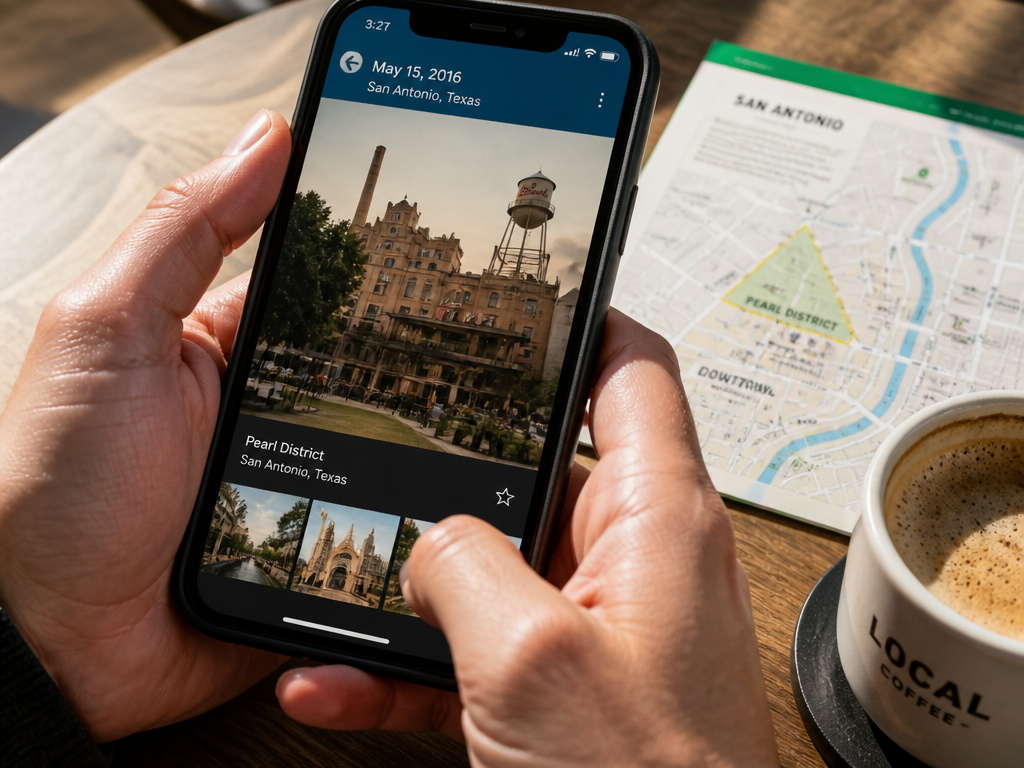
Condé Nast Traveler’s “underrated cities” gallery treats ‘underrated’ as a gallery format with no stated methodology. It still ranks. It still gets cited. And it’s a decade stale.
The entries themselves are fine as historical documents. San Antonio’s Pearl District is described as a 16-block, 23-acre brewery complex turned multi-use campus. That’s a substantial, checkable description, and it was accurate when it was written.
The problem is what the staleness does to the reader’s decision. A 2016 food hall recommendation is a 2026 gamble. Restaurants close. Neighborhoods shift. The “18 months behind the gentrification curve” neighborhood from a decade ago is now the trendy one.
Worth knowing before you start: Check the last-updated date on any travel gallery before you build a trip around it. A 2016 list is a historical document, not a current recommendation.
The “Day Off” Question That Beats Every List

Here’s the method I actually use, and it’s the one piece of advice here I’d defend in an argument.
Stop asking locals where you should eat. Everyone gives you the tourist answer out of politeness, the place they think you want, the place that’s safe, the place with the English menu. Ask instead: “Where do you go on your day off?”
The answers are almost never in a guidebook, and about half the time it’s a place with no website at all. Best meal of the trip. Not a single influencer in sight, and I’ve never seen the place written up anywhere.
That’s the whole technique. It works because it asks about a person’s life instead of their city. “Where should I eat” invites a performance. “Where do you go on your day off” invites an answer.
Skip this if: You’re on a two-day trip and you’ve already booked every meal. The day-off method needs slack in the schedule to work. If you’re running a tight itinerary, this isn’t the trip for it.
The Second-Tier Neighborhood Rule for Repeat Visitors

For anyone heading back to a city they’ve already done. New York, San Francisco, Chicago, the move is one neighborhood past the trendy one. The place that’s about 18 months behind the gentrification curve.
You get the same food quality at two-thirds the price, and you can actually get a table. Tourists never make it that far, which is exactly the point.
The mechanism is simple. A neighborhood gets “discovered,” rents rise, the original tenants get priced out, and the food quality either drops or moves. The neighborhood next door picks up the displaced talent. If you’re planning a trip more than a year out, aim one ring outward from wherever the current lists point.
Which Underrated Cities Actually Deliver, by Type
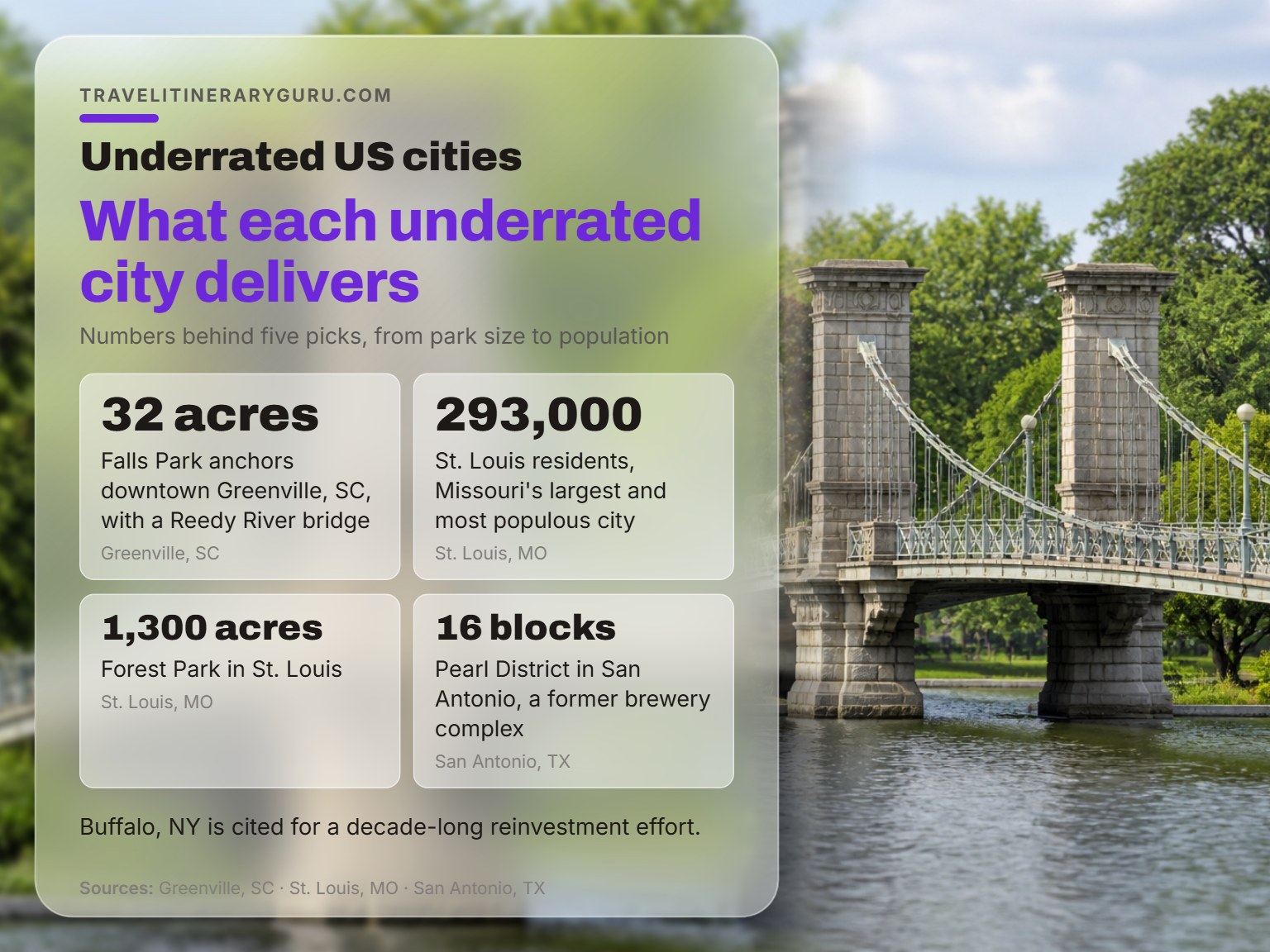
Here’s where the four definitions produce genuinely different picks, and where you can start matching cities to what you actually want.
| What You Want | City | Why It Qualifies |
|---|---|---|
| Walkable downtown + food scene | Greenville, SC | 32-acre Falls Park with a suspension bridge over the Reedy River |
| Big-city amenities, smaller crowds | St. Louis, MO | 293,000 residents, 1,300-acre Forest Park, strong live-music scene |
| Genuine urban renewal story | Buffalo, NY | New York’s second-largest city, decade-long reinvestment effort |
| Ski season + cultural depth | Taos, NM | Sangre de Cristo Mountains, UNESCO World Heritage pueblo |
| Attraction density per dollar | San Antonio, TX | 16-block Pearl District, River Walk, historic Spanish missions |
Greenville, South Carolina, is the cleanest small-city pick on the board. Its downtown is anchored by a 32-acre Falls Park with a suspension bridge over the Reedy River. That last detail matters if you’re building a multi-city USA itinerary. Greenville pairs naturally with an Asheville stop without adding a flight.
St. Louis is the one I’d argue hardest for against the crowd. It’s Missouri’s largest and most populous city, with some 293,000 residents estimated at last count.
Buffalo is cited by Lonely Planet for a decade-long reinvestment effort. That’s the kind of thing that doesn’t photograph well and doesn’t trend on social, which is precisely why it stays affordable.
The Parks Version of the Same Problem
The same logic that breaks city lists breaks park lists, and the payoff is bigger.
I’ve tracked my own visits, and the second-tier parks consistently deliver most of the scenery with far fewer people. Same rainforest drama, a fraction of the traffic, and you can actually hear yourself think on the trail.
The pattern holds because attention concentrates. A park gets a viral photo, the parking lot fills, the permit system kicks in, and the experience degrades for everyone including the people who showed up because of the photo. The park next door has the same geology and no line.
If you’re building a trip around parks, the same math applies as with cities: the second-tier option is usually the better trip, and it’s almost always cheaper.
How to Use the Disagreement Instead of Fighting It

The four definitions aren’t a problem to solve. They’re a menu.
If you want a small town with a walkable core, use CNN’s band, 50,000 to 225,000 residents, and its six evaluation criteria. If you want a small city with genuine cultural infrastructure, use National Geographic’s 30-city list and pay attention to the population band you’re shopping in. If you want a mid-size city with a real downtown, Lonely Planet’s six picks are a reasonable starting set. If you want a gallery of options with named restaurants and neighborhoods, Condé Nast Traveler works, just check the date.
What none of them will tell you is which one matches your trip. That part is on you, and it’s the part that actually determines whether the trip is good.
Frequently Asked Questions
What is the most underrated city in the United States?
There’s no defensible single answer, because the major outlets don’t agree on the definition. Lonely Planet names Albuquerque as the underrated New Mexico pick. GetYourGuide names Taos instead. CNN sidesteps the term and runs a “Best Towns” feature with a disclosed methodology. The honest answer is that “most underrated” depends on what you’re measuring, attention relative to nearby cities, visitor volume relative to attractions, or value relative to cost.
Why do “underrated cities” lists disagree with each other?
Because they’re answering different questions. CNN evaluates on attractions, food and beverage, nightlife, identity, proximity, and “wow factor” within a 50,000-to-225,000 population band. National Geographic uses population bands and social media data from Yelp and Instagram. Lonely Planet publishes concrete specs without stating a method. Condé Nast Traveler publishes a gallery with no stated methodology at all. Four methods, four lists.
Is Bend, Oregon actually underrated?
Lonely Planet’s own entry is self-contradictory on this. It calls Bend something that “might fly under the radar” while conceding it is “often cited as a top destination” and “isn’t exactly a hidden gem.” Bend has a real case for being over-covered and under-visited at the same time, but the list format can’t hold that nuance.
How do I find underrated places that aren’t already ruined?
Ask locals where they go on their day off, not where you should eat. The answers are almost never in a guidebook, and about half the time it’s a place with no website. The second technique is the second-tier neighborhood rule: for repeat visits to major cities, aim one neighborhood past the trendy one, roughly 18 months behind the gentrification curve. Same food quality, lower prices, and you can get a table.
Should I trust a travel gallery that hasn’t been updated in years?
Check the last-updated date before you build a trip around it. Condé Nast Traveler’s “underrated cities” gallery treats ‘underrated’ as a gallery format with no stated methodology. The descriptions may have been accurate when written, but restaurant recommendations and neighborhood character shift over a decade. Treat a stale gallery as a historical document, not a current recommendation.
Do I need a car to visit these cities?
It depends on the city and how you’re routing the trip. Greenville, St. Louis, and San Antonio all have walkable cores and are reachable by air. If you’re stringing multiple cities together, the routing decision matters more than the driving decision, a home base for a multi-city trip will often save you more time than any single transport choice.
The Bottom Line
Here’s the practical wisdom I’d hand you if we were sitting across a table: pick your definition before you pick your city.
If you want a small town, use CNN’s band. If you want a small city with cultural infrastructure, use National Geographic’s 30. If you want a mid-size city with a real downtown, Lonely Planet’s six are a fair starting set. And whatever list you use, check the date, a 2016 gallery is a decade of drift.
One thing I’ll concede: this whole approach assumes you have the slack in your schedule to actually use it. If you’re on a four-day trip with two cities and a flight between them, the day-off method and the second-tier neighborhood rule both fall apart. You need room to wander for either to work. Plan the trip with that room built in, or plan a different trip.
And if you want one concrete thing to do this week: next time you’re in a city you think you know, walk into a coffee shop, order something, and ask the person behind the counter where they go on their day off. Write it down. Go there. That’s the whole method, and it beats every list on this page.
