
How Many Days to Spend in Aruba: Honest Trip Lengths
This post contains affiliate links. As an Amazon Associate, we earn from qualifying purchases.
Aruba is roughly 20 miles (32 km) long and about 6 miles (10 km) wide at its widest point, and most first-timers land on 5 to 7 nights as the honest default when deciding how many days to spend in Aruba. Seven nights is the most commonly booked length for the island. Three to four nights works for a long weekend with close to zero slack.
That 20-mile figure does more work than any other number in the how many days to spend in Aruba decision. It means you can drive the whole island in an afternoon, and the difference between a 5-night trip and a 10-night trip comes down to pacing.
Key Takeaways
- Five to seven nights is where most first-time visitors land, and the sources that disagree on the exact number still cluster around this window.
- Three to four nights is viable but has almost no cushion.
- Seven nights is the minimum recommended for a honeymoon or milestone trip, which inverts the usual “shorter is fine” logic.
- Ten or more nights suits divers, repeat visitors, remote workers, and snowbirds. For a first-timer planning beach day after beach day, a packed beach-only schedule can start to feel repetitive by day eight.
- Apply for the ED card 7 days before arrival and pay the US$20 sustainability fee.
How Many Days Do You Actually Need in Aruba?
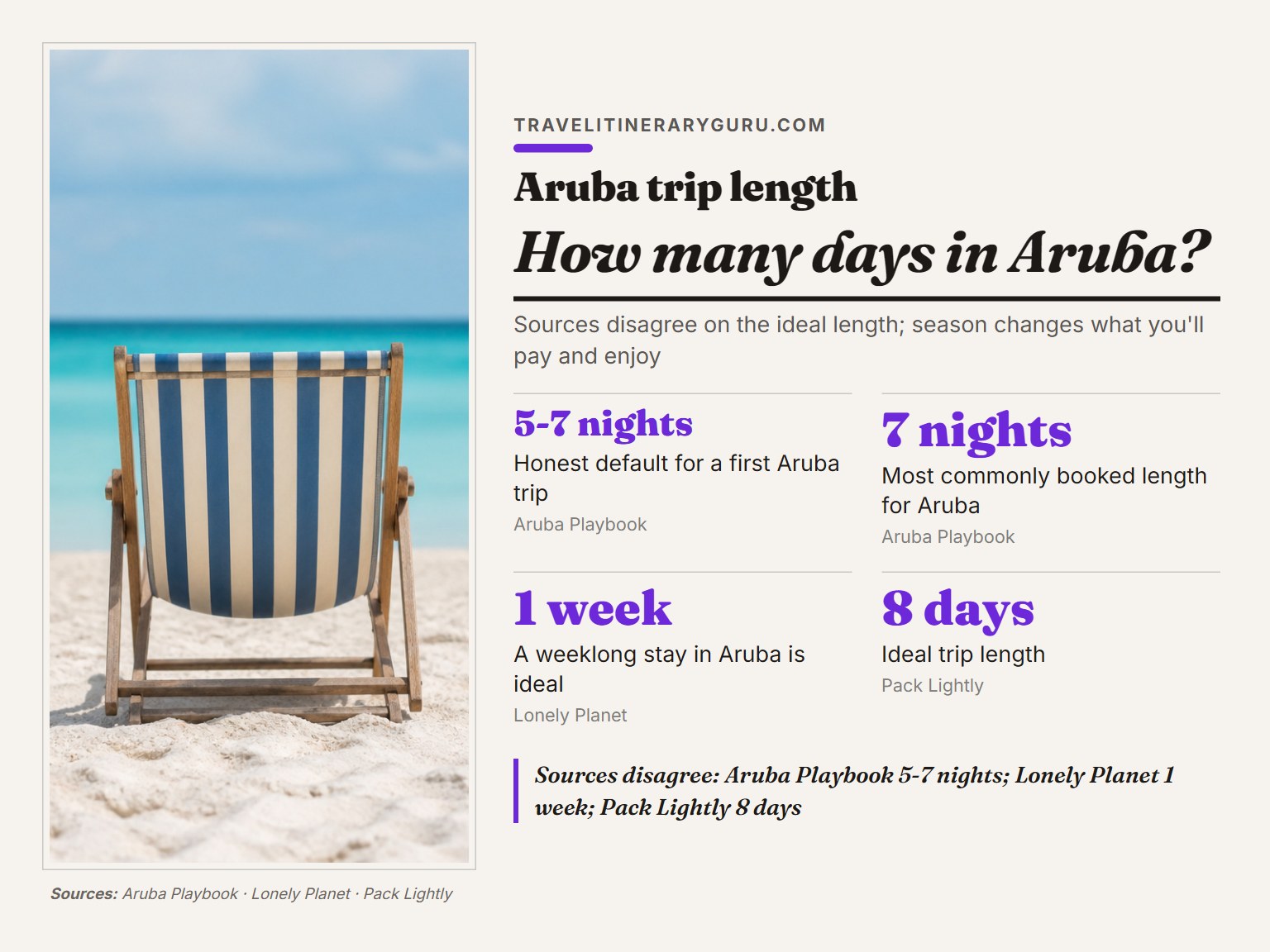
Five to seven days gives you enough time for beaches, an island tour, and a day trip without feeling rushed. That’s the position from The Aruba Guide, and it lines up with the Aruba Playbook’s call of 5 to 7 nights as the honest default for a first trip. Lonely Planet lands on a weeklong stay as ideal. Pack Lightly says 8 days.
Aruba’s west coast holds the calm swimming beaches, the hotel strip, and the airport. The east coast holds the rugged shore, the Natural Pool, and Bushiribana. A full island tour covers both in a single day, but the two coasts reward different amounts of time, which is why trip-length advice splits.
Four sources, four slightly different numbers, all inside a two-day window. That’s not a disagreement worth agonizing over. It’s a sign that Aruba is forgiving on this particular question. The real splits show up at the edges.
I’ve watched clients try to compress a week into four days, and the trip always ends the same way: they spend the last morning calculating what they’d cut if they could start over. Fair warning. Aruba doesn’t punish a short trip, but it does punish an overstuffed how many days to spend in Aruba plan.
What the 4-Day Itinerary Actually Fits
Visit Aruba publishes a full 4-day itinerary, and it works. The shape is simple: base near Eagle Beach, snorkel at Boca Catalina, and give one full day to a Jeep loop through Arikok National Park. Pack Lightly recommends the same structure, west coast plus one outback day.
That’s a real trip. It’s also a tight one.
The Aruba Playbook’s framing is the most useful here: 3 to 4 nights is a “real trade-off” with “close to zero slack.” The Aruba Guide agrees that beach-and-chill types can feel satisfied in 4 days, but draws the line there for anyone else.
Which Travelers Need 6 to 7 Days Minimum
Adventure-seekers who want the Natural Pool, Arikok, Baby Beach, and the California Lighthouse will want 6 to 7 days minimum. That’s The Aruba Guide’s threshold, and it holds up against the geography.
Arikok National Park covers about 20% of the island, and it requires a purchased day pass at the visitors center. The rugged east-coast sites, the Natural Pool, Bushiribana, effectively require a jeep or a guided tour. You’re not fitting that into a half day.
If you’re planning a honeymoon or celebrating a milestone trip, 7 days is the minimum recommended. That’s the same source, and it’s a useful counterpoint to the “shorter is fine” instinct. Milestone trips want margin.
The Trip-Length Comparison, Source by Source
| Source | Recommended Length | Reasoning |
|---|---|---|
| Aruba Playbook | 5-7 nights | Honest default for first-timers |
| The Aruba Guide | 5-7 days | Sweet spot for a first trip |
| Lonely Planet | 1 week | Ideal; 10+ days for depth |
| Pack Lightly | 8 days | Covers beaches, Arikok, San Nicolas |
The spread is two days wide at most. If you’re choosing between 5 and 7, you’re not making a mistake either way. If you’re choosing between 4 and 10, you’re answering a different question.
Is a Week in Aruba Too Long?
No. Seven nights is the most commonly booked length for Aruba, and the Aruba Playbook’s reasoning is worth repeating: a week adds real margin on top of the 5-night trip. A second free beach day. Room to swap plans if the weather turns. Space to try a restaurant you weren’t sure about.
The only real trade-off is cost. That’s arithmetic, not a travel problem.
Where the week starts to strain is pacing, not length. A packed beach-only schedule can start to feel repetitive by day eight. That’s the Aruba Playbook’s threshold. If every day is another beach day on the same stretch of sand, the island starts to feel small around day eight.
The fix lies in better distribution.
What most people get wrong: Treating a 7-night trip as seven identical beach days. Mix in Arikok, San Nicolas, and one snorkel trip, and the same week feels twice as full.
When 10 Nights Stops Making Sense
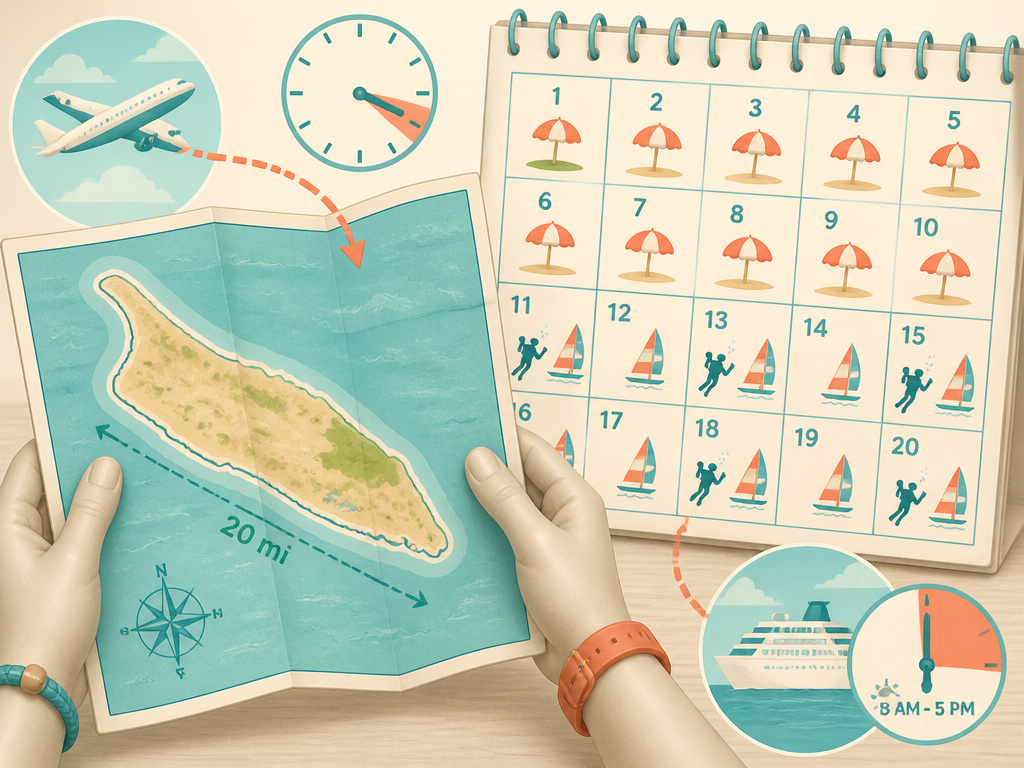
Ten or more nights suits divers, repeat visitors, remote workers, and snowbirds. That’s the Aruba Playbook’s position, and it’s the sharpest edge in the whole debate. Lonely Planet frames 10+ days as time to explore, wind down, hike, and try a new sport like scuba diving or windsurfing.
Pack Lightly goes further in the other direction: the island is only 20 miles / 32 km long, so a two-week stay is mostly repeat beach time. That’s a longer tolerance than the Aruba Playbook’s day-eight threshold, which is worth noting. The two sources disagree on where repetition sets in, and the honest answer is that it depends on what you’re doing with the days.
If you’re taking a PADI certification course, devote 3 or 4 days to just that, ideally more. That single activity changes the math entirely.
The 3-4 Day Trip: Worth It or Not?
Three to four nights works well for a long weekend, a trip bolted onto business travel, or a genuine short reset. The Aruba Guide calls 3 days a viable long-weekend trip, especially with an early Friday arrival from the East Coast or Midwest.
The honest trade-off is slack. Close to zero.
Where this goes sideways is the flight. Flight times run roughly 3 to 4.5 hours each way from the US East Coast and South Florida, which barely affects a short trip. From further away, the travel day itself takes a bigger bite out of a 3 to 4 night trip.
Cruise Port Days Are a Different Animal
Most cruise port days run from about 8am to 5pm. That’s enough for a beach morning at Eagle Beach, a quick lunch, and a short Oranjestad walk. It is not enough for a full island tour.
Lonely Planet raises a point worth sitting with: cruise ships call on Aruba with passengers disembarking for half-day trips, and the environmental and local-economic impact of that model is worth thinking about. If you’re choosing between a cruise stop and a land trip, that’s part of the comparison.
Should You Visit Aruba in Hurricane Season?
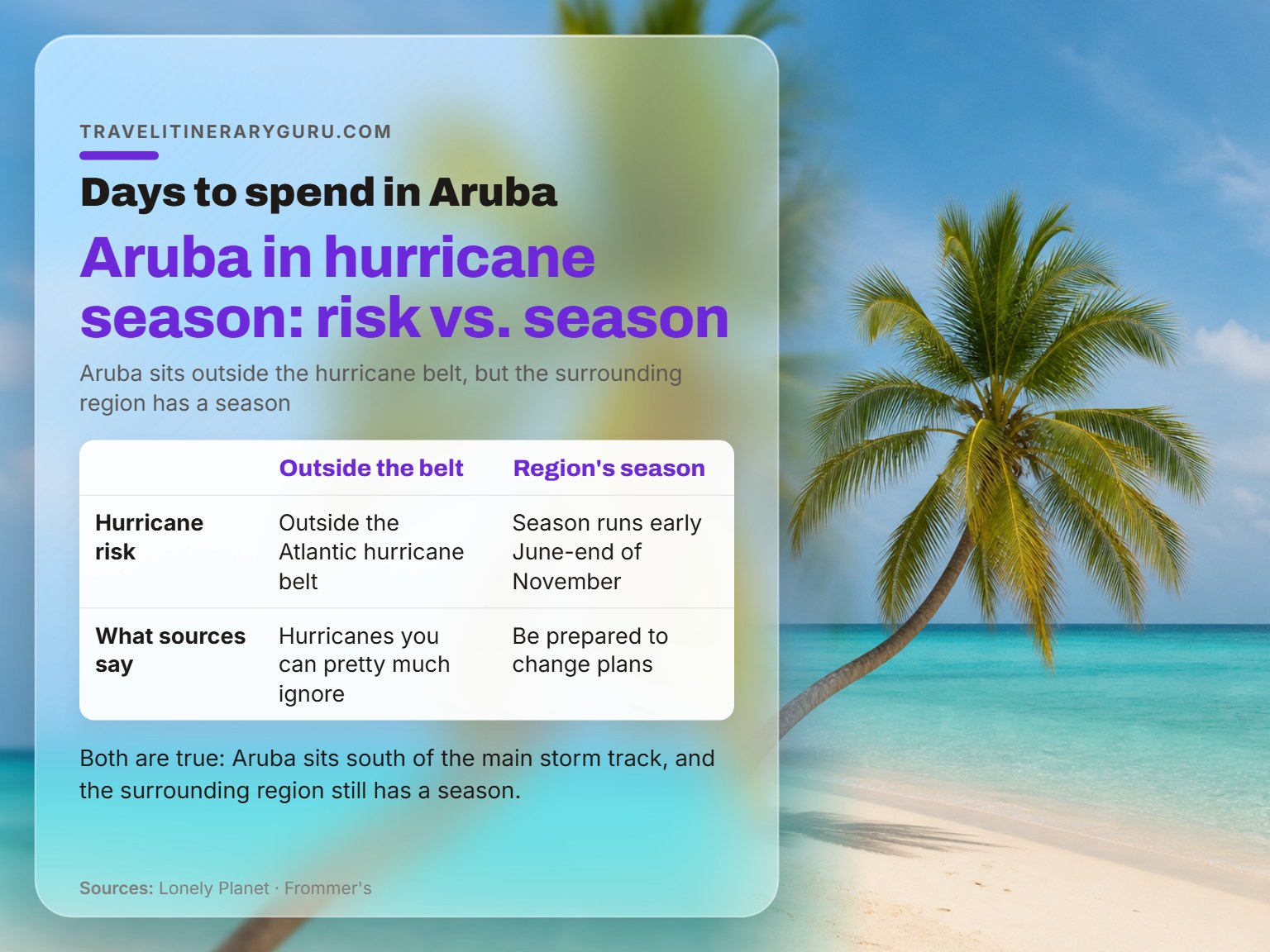
Lonely Planet and Frommer’s say Aruba lies outside the Atlantic hurricane belt, which minimizes the risk of storms, while the Government of Canada notes that hurricane season runs from early June to the end of November in the surrounding region and advises travelers to be prepared to change plans. Lonely Planet and Frommer’s both say so directly. Frommer’s puts it bluntly: hurricanes are something you can pretty much ignore.
The Government of Canada’s advisory takes a different angle. It notes that hurricane season runs from early June to the end of November in the Atlantic, Caribbean Sea, and Gulf of Mexico, and advises travelers to be prepared to change plans on short notice, including cutting a trip short.
Both are true. Aruba sits south of the main storm track, and the surrounding region still has a season. The practical read: don’t cancel a June-to-November trip over hurricane risk, but do buy travel insurance and keep your dates flexible if you can. That’s the sensible middle.
When to Go, and How It Changes Your Day Count
Season affects how many days you’ll actually enjoy, not just what you’ll pay.
| Season | Dates | What It Means |
|---|---|---|
| Peak | Mid-Dec to mid-Apr | Highest rates; book months ahead |
| Low | Mid-Apr to mid-Dec | Accommodations cost 20-50% less |
| Sweet spot | Late Apr-Jun, Sep-early Oct | Good weather, lower rates |
The sources disagree on the best window. Aruba.com says February to August. The Aruba Tourism Authority’s manual puts the dry season at roughly February through June, which excludes July and August from the dry-season claim. The Aruba Guide points to late April through June and September through early October as the best combination of weather and rates.
September is where the sources split most sharply: Frommer’s says to avoid it, while The Aruba Guide lists September through early October as a sweet spot. Frommer’s says to avoid it, tropical storms to the north suck away the trade winds, making Aruba as hot as any other spot in the Caribbean, with no relieving breezes. The Aruba Guide lists September through early October as a sweet spot. If heat without wind sounds miserable to you, follow Frommer’s. If you want lower rates and don’t mind the still air, The Aruba Guide’s read holds.
November is the underrated month. Lonely Planet notes the weather isn’t as hot as in summer, and there are fewer people.
Getting Around Changes the Day Math
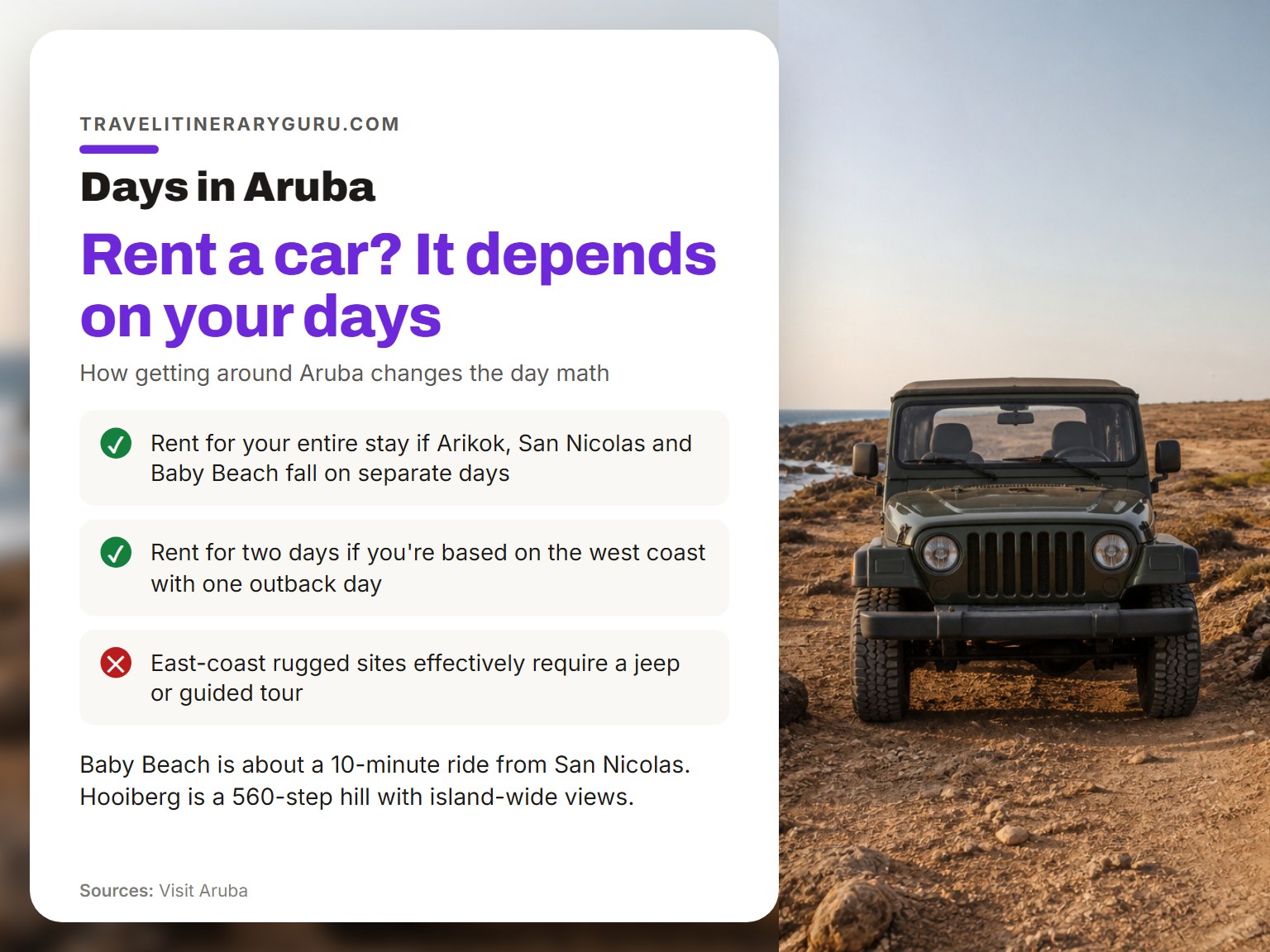
Renting a car or jeep for either two days or your entire stay is the standard recommendation. If you don’t rent, the public bus and taxis are viable alternatives for the west-coast strip.
The east coast is the exception. The rugged sites effectively require a jeep or a guided tour. That constraint shapes your itinerary more than any other logistical detail on the island.
Here’s the practical version:
- Rent for the full stay if you’re doing Arikok, San Nicolas, and Baby Beach on separate days.
- Rent for two days if you’re based on the west coast and only doing one outback day.
- Skip the rental entirely if you’re staying on the hotel strip and doing a guided island tour. The bus and taxis cover the rest.
Baby Beach is approximately a 10-minute ride from San Nicolas, which makes the south end of the island easy to pair with a mural walk. Hooiberg is a 560-step hill with island-wide views if you want a non-beach morning.
Easy to miss: The ED card. All visitors must apply online 7 days before arrival, and a US$20 sustainability fee applies.
The Itinerary Shapes That Actually Work
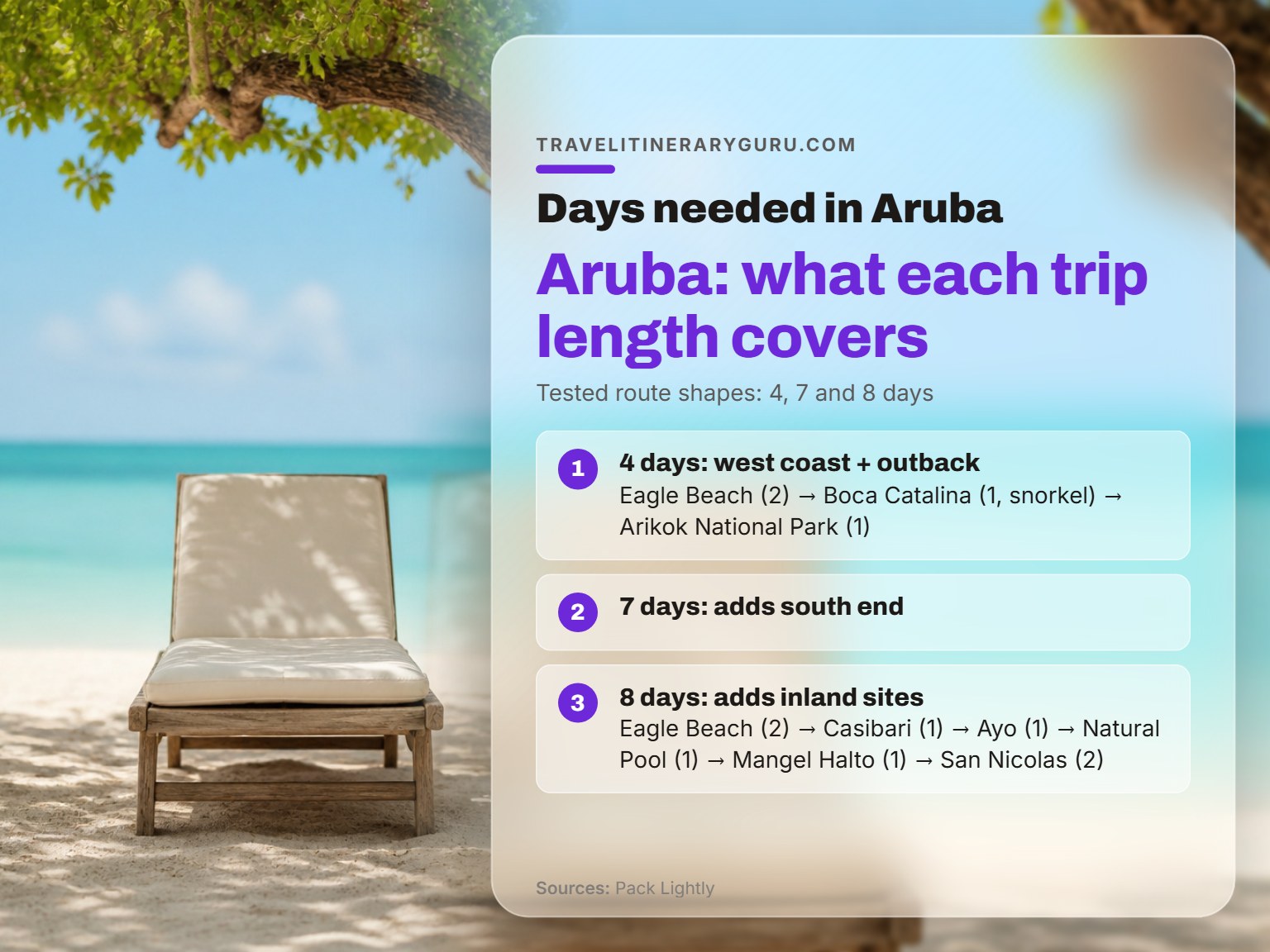
Pack Lightly’s tested routes are the cleanest reference points I’ve seen for this island:
- 4 days: Eagle Beach (2) → Boca Catalina (1, snorkel) → Arikok National Park (1)
- 7 days: Palm Beach (2) → Eagle Beach (1) → California Lighthouse (1) → Arikok National Park (1) → San Nicolas (1) → Baby Beach (1)
- 8 days: Eagle Beach (2) → Casibari (1) → Ayo (1) → Natural Pool (1) → Mangel Halto (1) → San Nicolas (2)
The jump from 4 to 7 brings the lighthouse, the south end, and a second beach zone. That’s the real content of the extra three days.
Aruba passes that test better than most. The Maldives is the counterexample: a resort island with nothing to do but the resort. If Aruba’s west-coast-plus-outback structure appeals to you, Bali runs the same play at a much larger scale, and Phuket adds a similar beach-and-inland split. For a smaller, more contained version, Fiji and Tahiti both reward shorter trips, and Zanzibar is the closest analogue to Aruba’s size-to-content ratio.
Before You Book: The Health and Entry Details
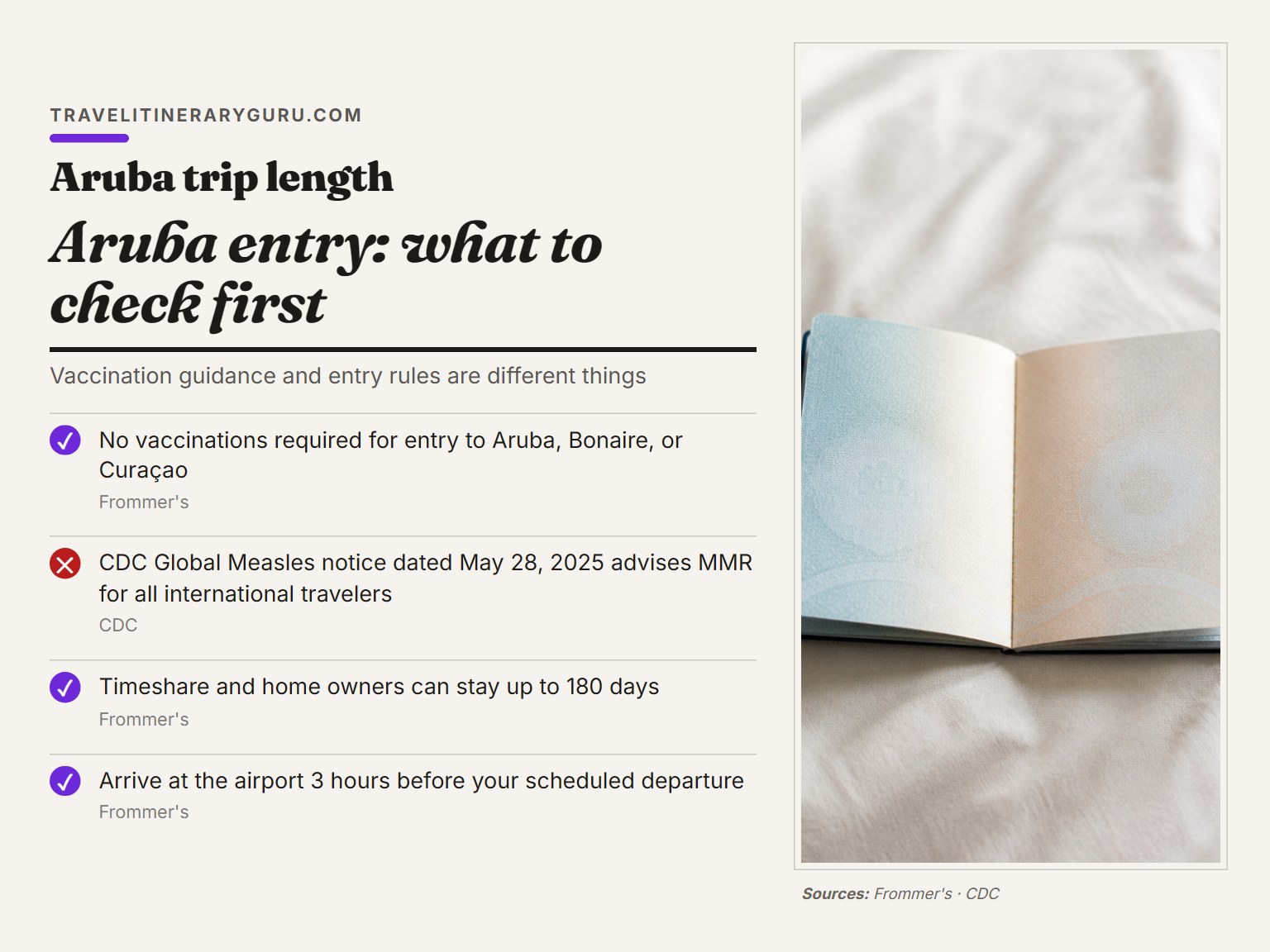
Frommer’s states there are no vaccinations required for entry to Aruba, Bonaire, or Curaçao. The CDC Aruba traveler health view carries a Global Measles notice dated May 28, 2025, advising all international travelers be fully vaccinated with MMR.
Both are accurate. Routine vaccination guidance and entry requirements are different things. Check the CDC page before you travel, and confirm your MMR status if you’re unsure.
Americans, Canadians, Australians, New Zealanders, and E.U. Nationals can stay in Aruba for up to 1 month without a visa. Timeshare and home owners can stay up to 180 days. Arrive at the airport 3 hours before your scheduled departure.
Worth knowing before you start: Reapply sunscreen throughout the day, and bring it as a cream or lotion, the trade winds blow sprays away. Pack a hat with straps and a rash guard or Lycra shirt.
Frequently Asked Questions
Is 4 days enough for Aruba?
Yes, 4 days is enough for a satisfying first trip if you stay focused. You can do the beach, one island excursion, a water activity, and a dinner in town. The trade-off is slack, there’s close to none, so one delayed flight or long excursion means cutting something.
Is 5 days too long for Aruba?
Not for most people. Five days is where most first-time visitors land, and the sources cluster tightly around it. You have room to slow down without feeling like you missed anything important.
Is a week in Aruba too much?
Full week works well for couples, honeymooners, and anyone who genuinely wants to decompress. Seven nights is the most commonly booked length for the island. If you prefer doing something every day, a week gives you room to explore without rushing.
How many days do you need to see everything in Aruba?
Realistically, 7 to 10 days covers everything Aruba offers: all the beaches, the national park, the lighthouse, the natural pool, a water excursion, Oranjestad, and a few good restaurant meals.
Do you need 10 days in Aruba?
Not for a first trip in most cases. Ten or more nights suits divers working through multiple sites, repeat visitors, remote workers, and snowbirds. For a first-timer planning every day as another beach day, 10 straight days can start to feel repetitive by the back half.
How long is the flight to Aruba?
Flight times run roughly 3 to 4.5 hours each way from the US East Coast and South Florida. From further away, including from the Netherlands, the travel day takes a bigger bite out of a short trip.
The Bottom Line
If you want one number and you’re a first-timer: seven nights. It’s the most commonly booked length, and it’s the minimum recommended for a honeymoon or milestone trip.
The concession worth making explicit: this all changes if you’re a diver. A PADI certification course alone eats 3 or 4 days, ideally more, so a diver’s 10-day trip is a different calculation from a first-timer’s 10-day trip. Same island, different math.
One concrete first step this week: apply for the ED card. It needs to be filed 7 days before arrival, and the US$20 sustainability fee is paid at that point.
