
How Many Days to Spend in Bali: Trip Lengths Compared
This post contains affiliate links. As an Amazon Associate, we earn from qualifying purchases.
You can spend 7 to 10 days in Bali on a first trip, and 5 days works if you stay in one or two areas. Beyond that, the honest answer to how many days to spend in Bali splits: Rough Guides puts a beach-and-spa holiday at 5 to 7 days, while Condé Nast Traveler’s named specialists say a first-timer needs no less than nine. The gap is real, and it comes down to how many bases you move between.
That split is the whole planning problem. A traveler who plants in Ubud for a week and does day trips is running a completely different trip from one who wants Canggu’s surf, Ubud’s temples, and a Nusa Penida cliff in the same window. Same island, same flights, different math.
What follows is the arithmetic behind each number: what a base change actually costs in hours, which sources say what, when the wet season eats a scheduled day, and how to pick your length before you book a single hotel night.
Key Takeaways
- Seven days is a common first-trip length, not the only answer. Lonely Planet’s default first-timer route runs Canggu to Ubud to Tulamben in a week, but it moves you twice.
- Each base change costs about half a day. Ubudauthority’s rule is 2 to 3 bases maximum, and I’d hold to it harder than most guides do.
- Ten days is a common recommendation when you want a beach, a temple town, and one island. If you’re stuck between 7 and 10, take 10.
- Bali’s US jet lag runs 12 to 16 hours (Rough Guides), which functionally deletes your first day. Europe’s 6 to 8 hour offset doesn’t hit the same way.
- The CDC issued a Level 2 Zika notice for Indonesia on August 07, 2026, citing returning travelers from Bali.
How Many Days Do You Actually Need in Bali?
Seven to ten days covers a first trip, and the number that fits you depends on three variables: how many bases you’ll use, whether you’re adding an island, and which season you’re flying into. Get those three right and the day count falls out on its own.
Start with the base count, because that’s where most itineraries quietly lose a day. Ubudauthority’s guidance is blunt: limit yourself to 2 or 3 bases, and remember that each change costs half a day. That half-day covers the checkout, the drive, the check-in, and the twenty minutes you spend standing in a new lobby waiting for a room that isn’t ready.
A first trip to Bali fits 7 to 10 days when the traveler uses two or three bases and stays within the south-and-center corridor. Adding the north, the east, or an island such as Nusa Penida pushes the requirement to 10 to 14 days, because each of those destinations consumes a full day of transit and a full day on the ground.
This is what trips people up. The drive from Uluwatu to Ubud runs about 2 to 3 hours depending on traffic. That’s not a scenic transfer. It’s a two-lane road with scooters, trucks, and a temple procession if you’re unlucky.
What 5, 7, 10, and 14 Days Actually Buy You
The how many days to spend in Bali question is a purchase, and the table below shows what each length actually buys in bases and activities.
| Trip Length | Bases You Can Use | What It Gets You |
|---|---|---|
| 5 days | 1 to 2 | One area done properly. Ubudauthority: enough if you stay in one or two areas. |
| 7 days | 2 to 3 | Canggu, Ubud, and one island. Lonely Planet’s default first-timer route. |
| 10 days | 3 | The week above plus Gili Trawangan or the east coast. |
| 14 days | 3 to 4 | Canggu, Ubud, Nusa Penida, and the Gilis at a relaxed pace. |
Five days is a real answer, not a compromise, provided you accept the constraint, much like our take on how many days in Tahiti. Ubudauthority says five days works if you stay in one or two areas. Pick Ubud and the south, or pick one beach and Ubud, and don’t try to see Nusa Penida. Three days, by the same source, is a stay in one place, one base, no moves, no island.
Seven days is where the disagreements start. Lonely Planet publishes a 7-day itinerary as the default first-timer route: Canggu to Ubud to Tulamben. Jacqueline Mattes of Ten Twenty Travel told Condé Nast Traveler that a first-timer should plan for no less than nine days. Those two positions can’t both be right for the same traveler, and the resolution is pace. Lonely Planet’s route is packed day by day. Mattes is describing a trip with breathing room.
Ten days is the number most sources land near, and it echoes our guide to how many days in the Maldives. Ubudauthority’s advice on the 7-versus-10 hesitation is direct: take 10. SoloNomads calls a week “a good taste” and says 10 days to two weeks is the window that lets you add the Gilis or Lombok. Lauren Benson, also a Condé Nast Top Travel Specialist, told the magazine that even ten days to two weeks will be filled with plenty to do.
Fourteen days opens the second island without rushing, the same way we break down how many days in Fiji for island-hoppers. Rough Guides puts the multi-region version. Ubud, Seminyak, Canggu, and the Gili Islands, with hiking and diving, at 10 to 14 days. SoloNomads describes two weeks as enough for Canggu, Ubud, Nusa Penida, and the Gilis at a relaxed pace.
Easy to miss: The jet-lag offset isn’t symmetrical. Rough Guides puts Bali 6 to 8 hours ahead of Europe but 12 to 16 hours ahead of the United States. A US arrival loses the first day to a fog that a European arrival doesn’t get.
Which Areas Fill Which Days?
Ubud takes 3 to 4 days on a first trip by Ubudauthority’s count, 2 rich days by Lonely Planet’s, three nights by SoloNomads’, and four days by Mattes’ outdoorsy itinerary. The spread is wide enough that you should treat it as a range, not a rule.
The reason Ubud’s number wobbles is that the town itself is small and the surrounding area is not. Lonely Planet’s 2-day figure covers Ubud’s temples, art museums, and sunset Kecak performances. That’s the town. Add the Tegallalang rice terraces, a water temple, and the Campuhan Ridge walk and you’re at three or four days without trying.
The south splits by personality. Mattes’ first-timer itinerary runs two days in Uluwatu along the cliffs, four in Ubud, and three at the beach in Canggu or Seminyak. Benson’s read on the same areas: Uluwatu is best for beaches, world-renowned surf breaks, and stunning views; Canggu has the trendy scene and nightlife; Ubud is culture and tranquility; Nusa Dua is luxury resorts and family stays; East Bali is traditional Bali and incredible nature.
Here’s where I’d push back on the standard split.
Uluwatu Temple sits on a cliff roughly 70 meters high, directly facing the Indian Ocean, per Indonesia’s Ministry of Foreign Affairs travel guide. The same guide flags the monkeys in the temple area as mischievous and warns visitors to watch their belongings. That’s not a joke about monkeys.
What most people get wrong: Booking a non-refundable Uluwatu sunset tour for your first evening. Expect around two hours in the arrival queues at Denpasar, per Condé Nast Traveler.
When Should You Add Nusa Penida or the Gilis?

Adding an island costs 10 to 14 days total by Ubudauthority’s count, and the same 10-to-14 figure shows up in Rough Guides for the Gili version. SoloNomads agrees: ten days to two weeks lets you add the Gilis or Lombok, and three weeks or a month is what you need to also reach Komodo or the volcanoes of Java.
Nusa Penida is the cheaper add because the boat is short. It’s a 30 to 45 minute fast boat from Sanur, per SoloNomads. The island’s cliffs at Kelingking, Broken Beach, and Angel’s Billabong are the draw, along with the reef manta rays at Manta Point and Manta Bay, which feed there year-round.
Two warnings on Nusa Penida, both from SoloNomads and both worth reading twice. Swimming at Kelingking beach has been banned since 2023, and people have died leaving the path, so stay at the top viewpoint. I’d add: if you’ve never ridden a scooter on a steep island road, don’t start here.
Fees changed in 2026. Visitors pay an IDR 25,000 island fee on arrival at Nusa Penida, in place since 2019, and since 1 September 2026 a cashless IDR 25,000 at each of the main sites. Bring a card or an e-wallet loaded; cash may not work at the sites.
The Gilis are a different trip. There are no motor vehicles, so you get around by bike or on foot, and SoloNomads notes e-bikes are officially banned too. If you’re building a 10-day plan, SoloNomads’ route is the week above plus a direct fast boat from Nusa Penida to Gili Trawangan for three nights.
Where this goes sideways: Booking a fast boat the morning of your flight home. SoloNomads advises a spare night back in Bali before departure, in case boats are cancelled. Rough seas in the wet season can strand you on the wrong island with a flight leaving without you.
What Does the Season Do to Your Day Count?
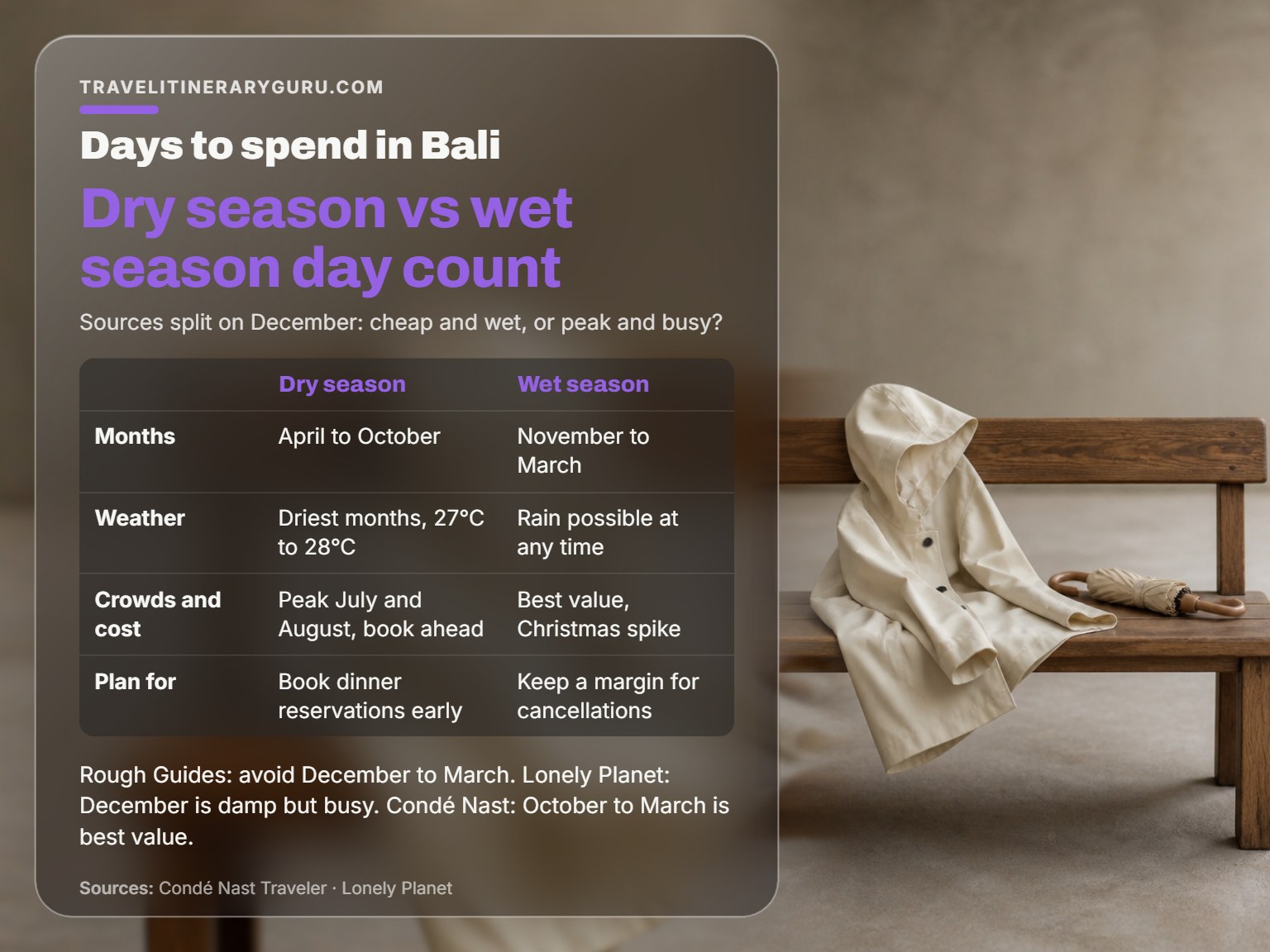
When you compare a how many days to spend in Bali against the seasons, the dry season runs April to October per Condé Nast Traveler, and Rough Guides calls May to October the best window for weather. But the day count you picked in the dry season doesn’t survive intact in the wet.
November to March is Bali’s wet season, and Lonely Planet’s advice is to bring a light raincoat or umbrella because rain is possible at any time. Ubudauthority’s version is more operational: in the rainy season, keep a margin for cancelled excursions. That margin is a day or two of slack you don’t fill with a booked tour.
Peak season is a separate problem. Lonely Planet lists high season as July, August, and December. Condé Nast Traveler narrows peak to July and August, the busiest months by far, with families traveling while school is out. Rough Guides puts July and August temperatures around 27°C to 28°C. Lonely Planet notes Bali’s average temperature only occasionally dips below 27°C (81°F) year-round, so heat isn’t the variable. Crowds are.
December is where the sources genuinely disagree, and you should know the split before you book. Rough Guides says to avoid December to March because heavy rains can derail plans. Lonely Planet describes December as often damp and cloudy but still warm and very busy with travelers escaping the northern winter. Condé Nast Traveler frames October to March as the value window, the rainy or “low” season, where you’ll get the most for your money, though prices spike again between Christmas and New Year.
Read those three together and the honest position is: December is cheap and wet, and whether that’s good depends on whether you’d rather pay peak prices for dry days or save money and gamble on rain.
| Month Window | Weather | Crowds and Cost |
|---|---|---|
| May, June, September | Dry, moderate rainfall | Shoulder season. Lower prices, smaller crowds. |
| July, August | Driest months, 27°C to 28°C | Peak. Book dinner reservations well in advance. |
| October to March | Rainy season, warm | Best value, except the Christmas-to-New-Year spike. |
| December specifically | Damp and cloudy, still warm | Busy. Sources disagree on whether to avoid it. |
The shoulder months are the sweet spot if your dates are flexible, the same logic behind how many days in Phuket. Lonely Planet calls May, June, and September the months that hit it, with lower prices, only moderate rainfall, and smaller crowds. Rough Guides adds that April to June gives the most stunning views of the rice fields.
How Many Bases Should You Actually Book?
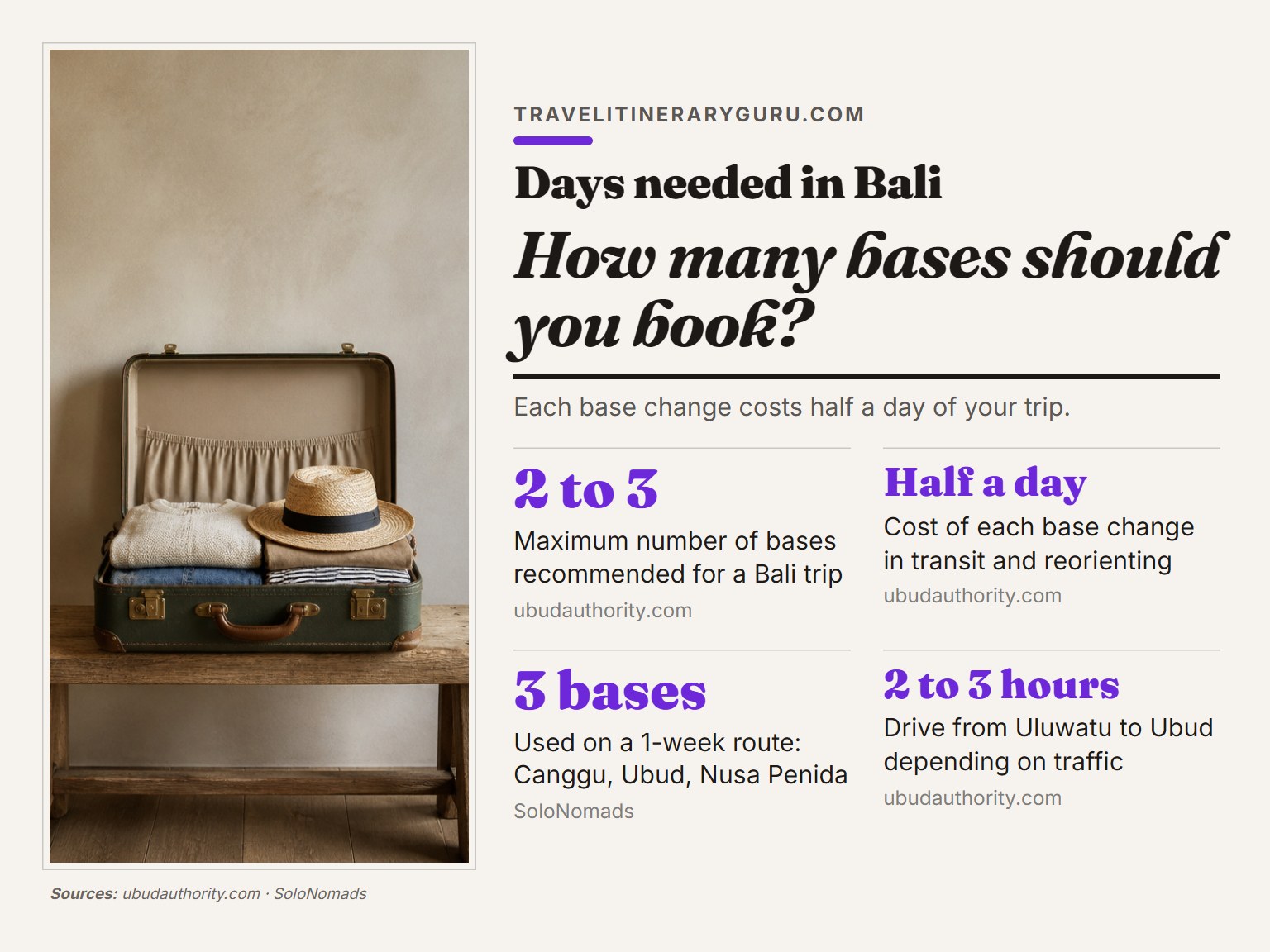
Two or three, and I’d argue for two if your trip is under ten days. Ubudauthority’s rule is 2 to 3 bases maximum. SoloNomads’ 1-week route uses three: a night or two in Canggu, three nights in Ubud, then two nights on Nusa Penida.
That third base is where the half-day cost bites. You’re paying it twice on a 7-day trip, which is a full day of your week spent in transit, checking in, and reorienting. On a 10-day trip, the same two moves cost proportionally less.
The counterargument is real. If you only use one base, you’ll spend hours a day getting to the things you came to see. That’s the failure mode on the other side, and it’s just as expensive as moving too often.
The fix is to match bases to geography. Ubud and the south are close enough that one base in each covers the center and the beaches. Nusa Penida is a separate base because it’s an island. The Gilis are a separate base for the same reason.
What Should You Book Before You Arrive?

Book hotels for the exact length you’ve chosen, then leave 1 to 2 days free for weather, tiredness, or a favorite spot. That’s Ubudauthority’s advice, and it’s the single most useful line in the whole planning pile.
The reason is that Bali’s best days are often the ones you didn’t schedule. You find a warung you like, or the rain cancels the waterfall trip, or you sleep eleven hours and wake up feeling human for the first time since the flight. A fully booked itinerary has no room for any of that.
What to book in advance: your first two nights, your flight, and any dinner reservation in July or August. Condé Nast Traveler’s advice for peak season is to book dinner reservations well in advance. That’s not a suggestion. Condé Nast Traveler advises booking dinner reservations well in advance for July and August.
What not to book in advance: tours on your arrival day, fast boats on your departure day, and anything non-refundable for your first morning. The CDC’s CDC Indonesia travel health notice is worth reading before you lock anything in; it’s a Level 2 notice dated August 07, 2026, and it specifically cites cases reported in returning travelers from Bali.
Practical gear matters more than people expect. Rough Guides calls a filter water bottle a must-have, because tap water is safe for bathing and brushing teeth in tourist areas but not recommended for drinking. Lonely Planet’s packing list is thin cotton clothing with some outfits that cover arms and legs for temples, plus warmer layers for air conditioning and bug repellent for mosquitoes. Rough Guides adds sunscreen, a wide-brimmed hat, sunglasses, and water.
Dress code at temples is not optional. Rough Guides is specific: cover your shoulders and knees, and consider a sarong and sash. If you come across a religious procession, step aside and let it pass. That’s the whole rule.
Treat it as a template, not a script.
Frequently Asked Questions
Is 5 days enough for Bali?
Yes, if you stay in one or two areas. Ubudauthority’s position is that five days works when you don’t move around, and three days is a stay in one place. The failure mode is booking five days and trying to see Ubud, Uluwatu, and an island, you’ll spend most of it in a car.
Is 7 days enough for a first trip to Bali?
It depends on which source you trust. Lonely Planet publishes a 7-day itinerary as the default first-timer route. Jacqueline Mattes of Ten Twenty Travel told Condé Nast Traveler that a first-timer should plan for no less than nine days. Both are defensible; the difference is pace and how many bases you’re willing to move between.
How many days do I need to add Nusa Penida or the Gili Islands?
Budget 10 to 14 days total. Ubudauthority puts the north, east, or an island add at 10 to 14 days, and Rough Guides gives the same range for a trip that includes the Gili Islands. SoloNomads frames 10 days to two weeks as the window for adding the Gilis or Lombok.
What’s the best month to visit Bali?
May, June, and September if your dates are flexible. Lonely Planet calls those the shoulder months that hit the sweet spot, with lower prices, moderate rainfall, and smaller crowds. July and August are the driest but also the busiest, and December is warm, damp, and crowded.
How many bases should I use in Bali?
Two or three. Ubudauthority’s guidance is to limit yourself to 2 or 3 bases, and each base change costs about half a day. On a trip under ten days, two bases is usually the better trade, you lose less time to transit and more to the place you actually came to see.
How bad is the jet lag flying into Bali?
It depends where you’re coming from. Rough Guides puts Bali 6 to 8 hours ahead of Europe and 12 to 16 hours ahead of the United States. Give yourself wiggle room, and don’t book anything non-refundable for your first morning.
The Bottom Line
One rule most guides skip: if you’re hesitating between 7 and 10 days, take 10. Ubudauthority says it outright, and the reason holds up, the road costs more time than you expect, and the extra three days absorb the transit you didn’t plan for.
Your first move this week is simple. Count your bases before you book anything. Write down where you’ll sleep each night and how many times you’ll move. If the answer is more than three moves on a 7-day trip, cut one and put the nights back into Ubud or the coast.
Here’s my concession, since I know who this advice underserves. I’m not the right person to price that trip, and I’d rather say so than pretend.
The last thing worth knowing is that Bali rewards the gap you didn’t plan. Leave one afternoon empty. That’s usually the one you remember.
