
How to Choose Between Bali and the Maldives: Which Wins?
This post contains affiliate links. As an Amazon Associate, we earn from qualifying purchases.
You choose between Bali and the Maldives by deciding whether you want to do things or escape things. Bali runs on temples, traffic, diving and cheap food across one large island. The Maldives runs on one resort island, one seaplane, and a bill that climbs fast. Most travelers get more out of Bali.
That’s the short version, and it’s the version I’d give a friend at a kitchen table. The longer version has a few moving parts that decide the answer for you: what you want to do on day four, how much you’re willing to spend on transfers, and which month you can actually travel. Those same factors shape how to choose between Bali and the Maldives.
Bali and the Maldives sit roughly 3,200 miles apart according to Rough Guides, while thisisluxurytravel.com puts the two cities about 4,840 kilometers apart, with no direct flights between them. They aren’t alternatives in the way two Caribbean islands are. One is a province with a highway system. The other is a collection of resort atolls where the airport is only halfway to your bed.
What follows is the comparison I wish more people ran before they booked: real costs, real transfer times, the season overlap that actually works, and the one booking move that saves a trip when a flight slips.
Key Takeaways
- Pick Bali if you want variety. Temples, volcano hikes, shore diving and street food all sit within a day’s drive of each other.
- Pick the Maldives if you want to stop moving. Rough Guides puts it plainly: there isn’t much nightlife or inland activity, and that’s the point.
- April is the only month both are dry. That single overlap is the cleanest window if you want to combine them.
- Book the Bali-Maldives hop on one ticket. A delay on the first leg becomes the airline’s problem, not yours.
- Leave 24 hours between your last dive and any flight. No exceptions, whichever order you travel.
How Much Does Each Destination Actually Cost?
Cost is where the two diverge fastest, and it’s the part most how to choose between Bali and the Maldives articles hand-wave. On a January 14 to 16, 2027 check, five-star Bali rooms started at about US$185 a night with taxes. Maldives overwater villas started at about US$500 a night before a 10% service charge and 17% tax.
That gap isn’t a rounding error. It’s the difference between two weeks in Bali and one week in the Maldives for the same money.
The room is only the opening line of the Maldives bill. The extras stack up in ways that catch first-timers off guard. The Maldives raised its tourism sales tax, TGST, from 16% to 17% on July 1, 2025, so any guide written before that date is quoting you a lower number than you’ll pay.
| Cost Item | Bali | Maldives |
|---|---|---|
| Entry | IDR 500,000 visa on arrival plus IDR 150,000 tourist levy | Free 30-day visa on arrival |
| Airport transfer | Taxi to Jimbaran about IDR 100,000 | Seaplane to South Ari Atoll about €300 return |
| Tax and service | 21% on prices marked ++ | 10% service plus 17% TGST, plus US$12 green tax per person per night |
| Entry-level luxury room | From about US$185 a night | Overwater villas from about US$500 before tax |
Easy to miss: The Maldives green tax of US$12 per person per night is charged at resorts on top of the room rate. A seven-night stay for two adds US$168 before you’ve ordered a single drink.
Diving is where the math flips in the Maldives’ favor, but only for a specific kind of traveler. Two shore dives at Tulamben or Amed in Bali, with guide and equipment, cost IDR 1,250,000 (about US$75) as of September 2026. A single resort dive in the Maldives runs about US$80.
A week on a Maldives liveaboard costs about US$2,200 to US$3,300 per person for seven nights with full board and around 20 dives, plus US$300 to US$450 in taxes, fuel and service charges. The same number of dives from a Maldives resort works out at about US$3,350 per person sharing a villa. If you dive hard, the boat is the bargain.
In Bali you need no boat at all. You sleep in a hotel and dive from the shore or a day boat.
The Season Overlap Nobody Mentions
Bali’s dry season runs April to October according to one source, and May to September according to another. I’m not going to pretend that disagreement resolves cleanly, because it doesn’t. Rough Guides says May through September. This Is Luxury Travel says April through October. Book in the middle of the overlap and you’re safe either way.
The Maldives is dry from December to April under the northeast monsoon, with about 25 to 75 millimeters of rain a month, and wetter from May to November. August is Bali’s driest month, with about 15 millimeters of rain in Denpasar against about 350 in January.
Put those two calendars side by side and April is the one month when both are dry. That’s the whole answer if you’re combining them.
| Month | Bali | Maldives |
|---|---|---|
| January | Wet | Dry |
| April | Dry | Dry |
| August | Dry | Wet |
| December | Wet | Dry |
Here’s the part that trips people up. You’ll read that Bali and the Maldives have “opposite seasons” because they sit in opposite hemispheres. Rough Guides states that directly. But Indonesia’s official tourism portal puts Bali at 8 degrees south of the equator, which is the Southern Hemisphere too. The opposite-seasons logic holds because of monsoon regimes, not hemispheres. The practical advice survives; the explanation doesn’t.
What most people get wrong: Assuming “dry season” means “best diving.” In the Maldives, the manta feeding at Hanifaru Bay happens in the wet season, peaking in August and September. In Bali, May is manta month at Nusa Penida, July to October is mola season, and October and November are best for nudibranchs at Tulamben and Amed.
If you’re planning a Bali itinerary around diving rather than sunshine, the calendar you want isn’t the tourist one.
What Does the Transfer Actually Look Like?
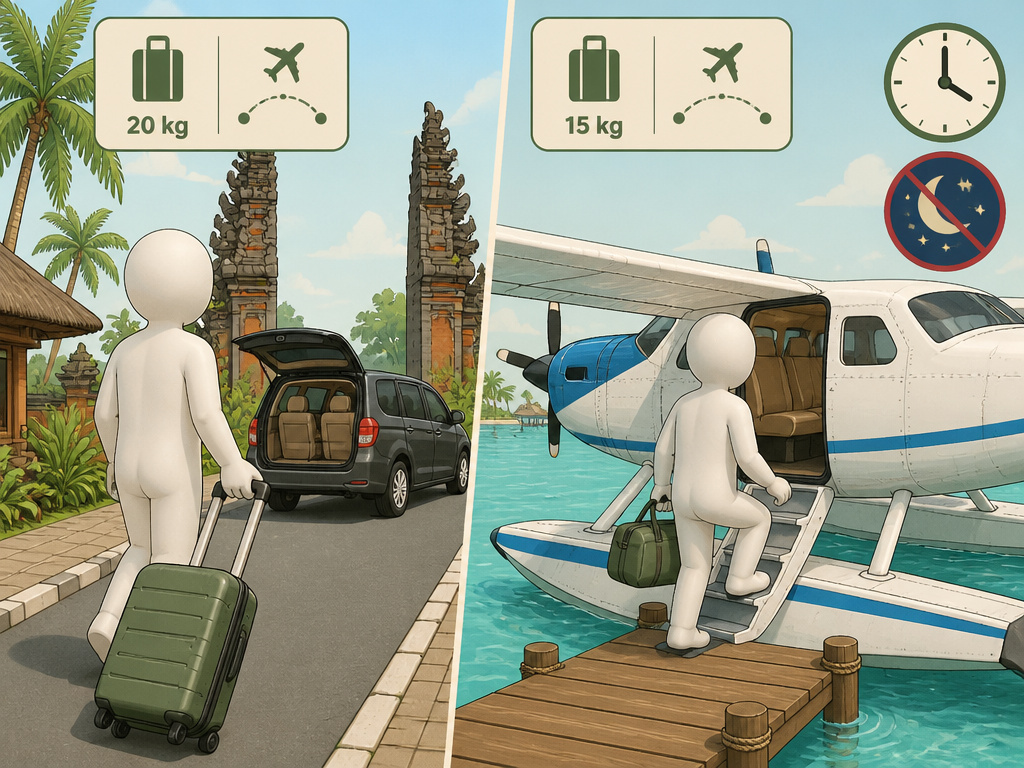
Transfers are where the how to choose between Bali and the Maldives question quietly eats a day of your trip. Not the flight. The bit after the flight.
In Bali you walk out of Ngurah Rai International Airport and get in a car. Jimbaran was about 20 minutes away on my last check. Nusa Dua runs 20 to 30 minutes. Ubud takes about an hour and a half, and North Bali runs two and a half to four hours over the mountains.
In the Maldives, the airport is only halfway. One traveler’s resort was a 25-minute seaplane flight away. The wait for that seaplane on arrival was about 70 minutes. The wait at Malé airport on the way home, before a night flight, was about seven hours.
Where this goes sideways: Maldives seaplanes fly in daylight only, and the last one usually leaves around 4pm. Land much after 3:30pm and you’ll sleep near Malé at your own cost, then fly out the next morning. That’s an unplanned hotel night on top of an already expensive trip.
I’ve seen this trip-planning mistake before, and it always looks the same. Someone books a late arrival because the fare was lower, then discovers the seaplane stopped flying three hours before they landed.
The luggage allowance on those seaplanes was 20 kilos plus 5 kilos of hand luggage. Pack accordingly.
There’s a booking rule that applies to the Bali-Maldives hop specifically. When checked on November 15, 2026, there were no nonstop flights between Denpasar and Malé. The two cities sit about 4,840 kilometers apart. The shortest routes connect in Singapore with Singapore Airlines at about seven hours of flying, or in Kuala Lumpur with Malaysia Airlines, Batik Air or AirAsia at about seven and a half, according to thisisluxurytravel.com, while Rough Guides puts the flight time between Bali and the Maldives at 10-15 hours excluding layovers. With the layover, one-stop journeys averaged about 12 hours.
Book the whole journey on one ticket. A delay on the first leg becomes the airline’s problem instead of a story you tell at a hotel bar.
Which One Wins for Divers, Families and Honeymooners?
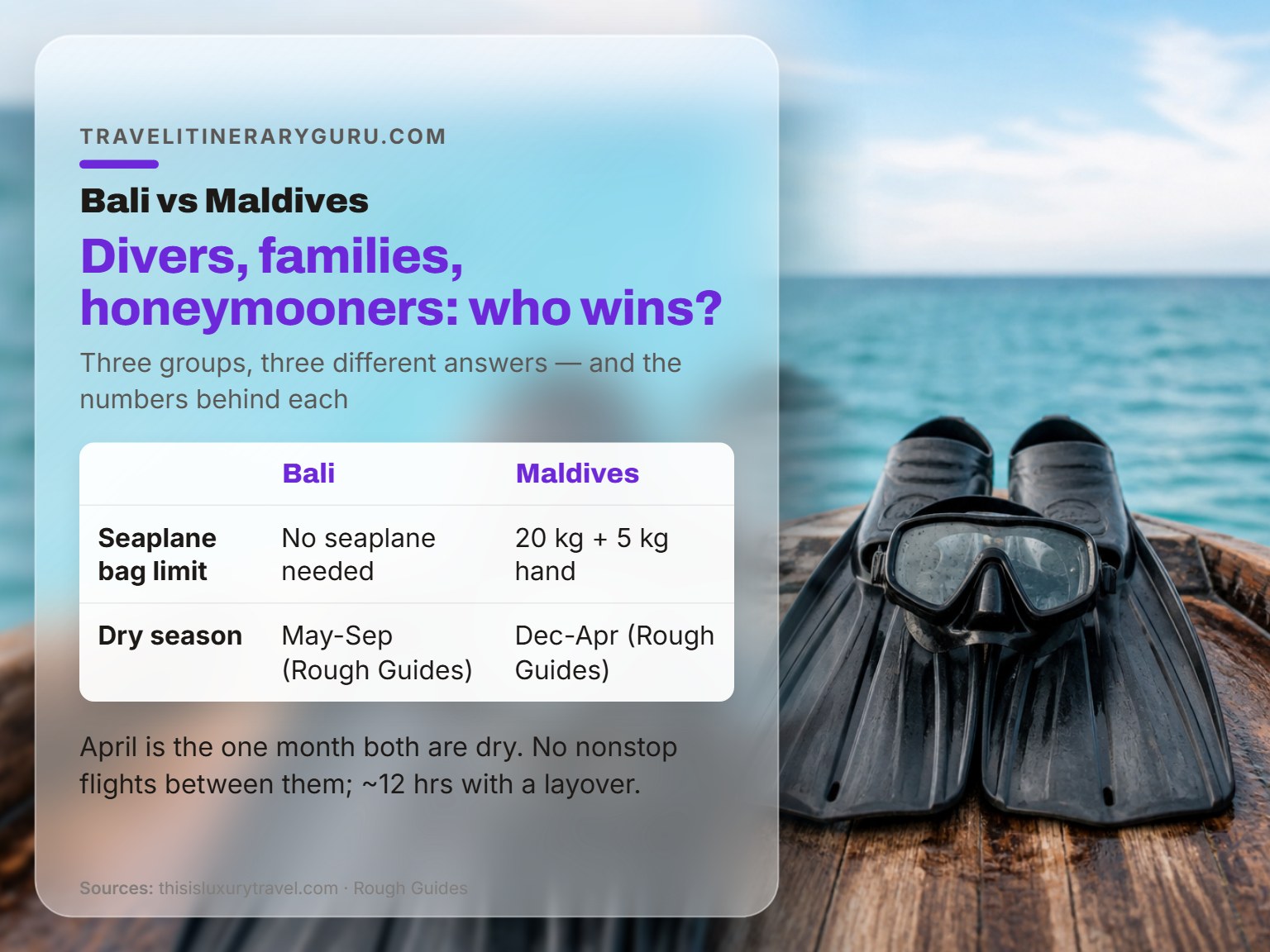
Three groups ask me this question, and they get three different answers.
Divers: the Maldives, unless you’re learning
Thisisluxurytravel.com scores diving for the Maldives on big animals, while Rough Guides frames diving as a shared strength of both and declares no winner. Sharks and mantas in numbers. Bali wins on wrecks, macro life and learning to dive from the shore. If you’re newly certified, Bali’s shore dives at Tulamben and Amed let you build confidence without a boat ride and a seasick passenger count.
Rough Guides frames diving as a shared strength and refuses to declare a winner. This Is Luxury Travel scores it for the Maldives. Both are defensible. If you want a shark count, the Maldives. If you want variety and a lower bill, Bali.
Families: Bali, and it isn’t close
Sofitel Bali Nusa Dua runs a kids’ club for children up to 12, from 9am to 6pm, with the first two hours free each day. The spring-fed pool at Jembong waterfall is the safest water for small children on the North Bali list.
Not all of Bali suits small children. Capella Ubud‘s steep paths and hanging bridges are wrong for anyone under six.
The Maldives is harder with kids. Seaplane transfers with a 20-kilo allowance, long waits at Malé, and excursions that can be rough. Thisisluxurytravel.com would take teenagers who snorkel to the Maldives. Thisisluxurytravel.com would take toddlers to Nusa Dua.
Honeymooners: depends on whether you get restless
Thisisluxurytravel.com says for a classic honeymoon, the Maldives, while viceroybali.com recommends choosing Bali if you are conscious of the honeymoon cost, want to explore various attractions easily, love diverse landscapes, seek wellness experiences, crave sustainable or vegan dining, enjoy cultural aspects, prefer dynamic nightlife, or desire luxury resorts with romantic honeymoon packages. Privacy, a water villa, nothing to organize. For couples who get bored after three days of lagoon, Bali. A tent at Capella Ubud gives you romance plus temples and restaurants, for less money.
One source recommends the Maldives for honeymoons between November and April, and Bali between April and October. Another recommends Bali between April and October and the Maldives between December and April, or August and September if mantas matter more than sunshine. The two agree on Bali. They disagree on the Maldives’ start month by roughly four weeks.
Skip this if: You’ve never traveled in Asia before and you’re considering the Maldives as your first stop.
Can You Combine Both in One Trip?
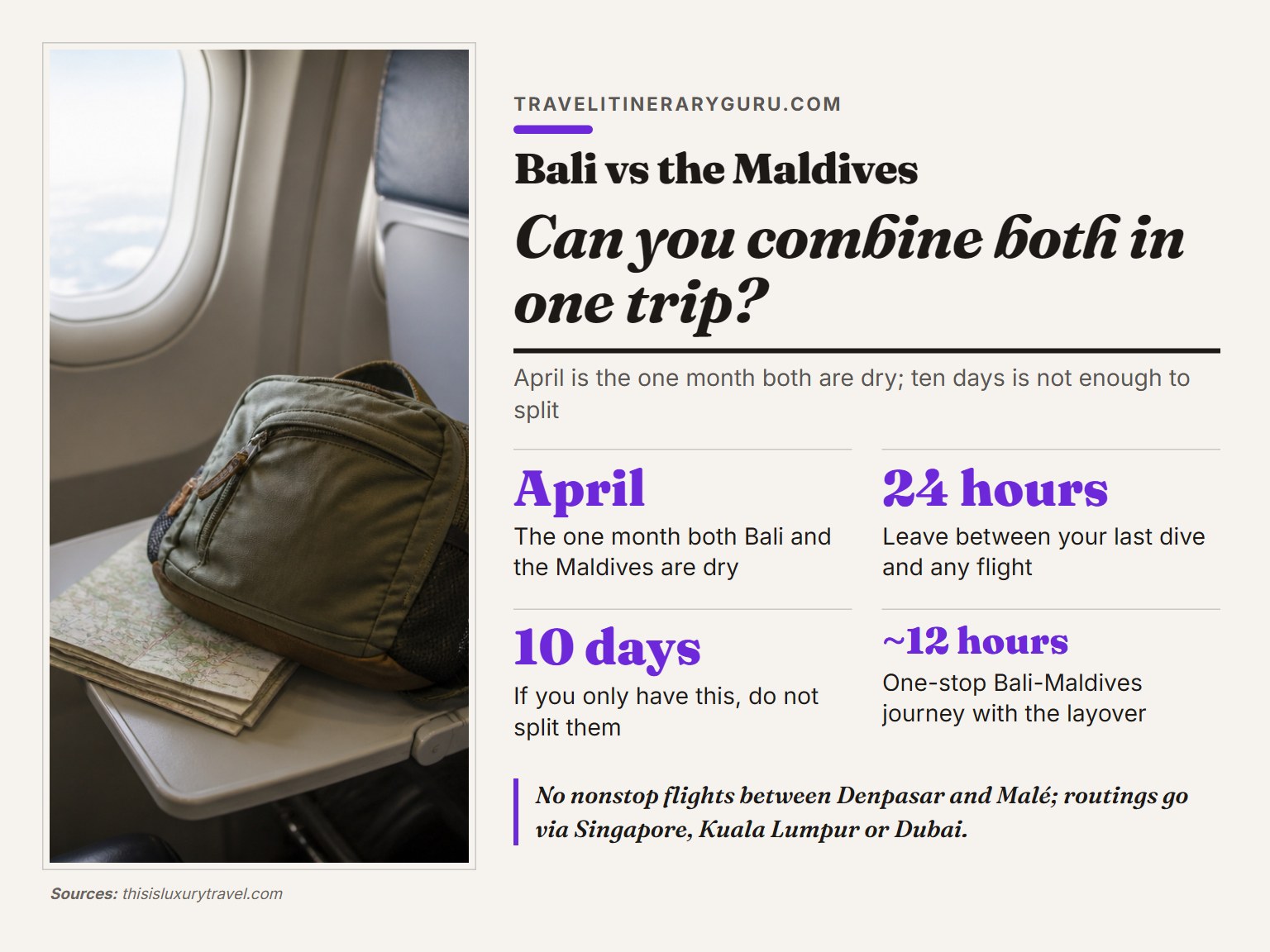
Yes, with one connection and one honest look at your calendar.
April is the cleanest answer for a beach trip because it’s the one month both are in their dry season. August or September works for divers: Bali at its driest with mola at Crystal Bay, then Hanifaru Bay for the manta feeding. Accept that the Maldives will be windier and greener, and keep a spare day before your flight home.
Late March also works. That’s the end of the Maldives’ best season, followed by Bali as the rain eases. Go to the Maldives first.
Leave 24 hours between your last dive and any flight. That rule exists for a reason and it doesn’t bend for a cheap fare.
If you only have ten days, don’t split them. Two long-haul flights, a regional connection and a seaplane take too much out of a short trip. One source frames Bali at five to seven days and the Maldives at three to five as separate short breaks, which is a different answer to a different question. If you’re combining, ten days isn’t enough.
One more booking note: book an afternoon flight out of Malé, not a late-night departure. The airport is calmer and you avoid the long wait after the last seaplane.
What Do You Actually Do Once You’re There?
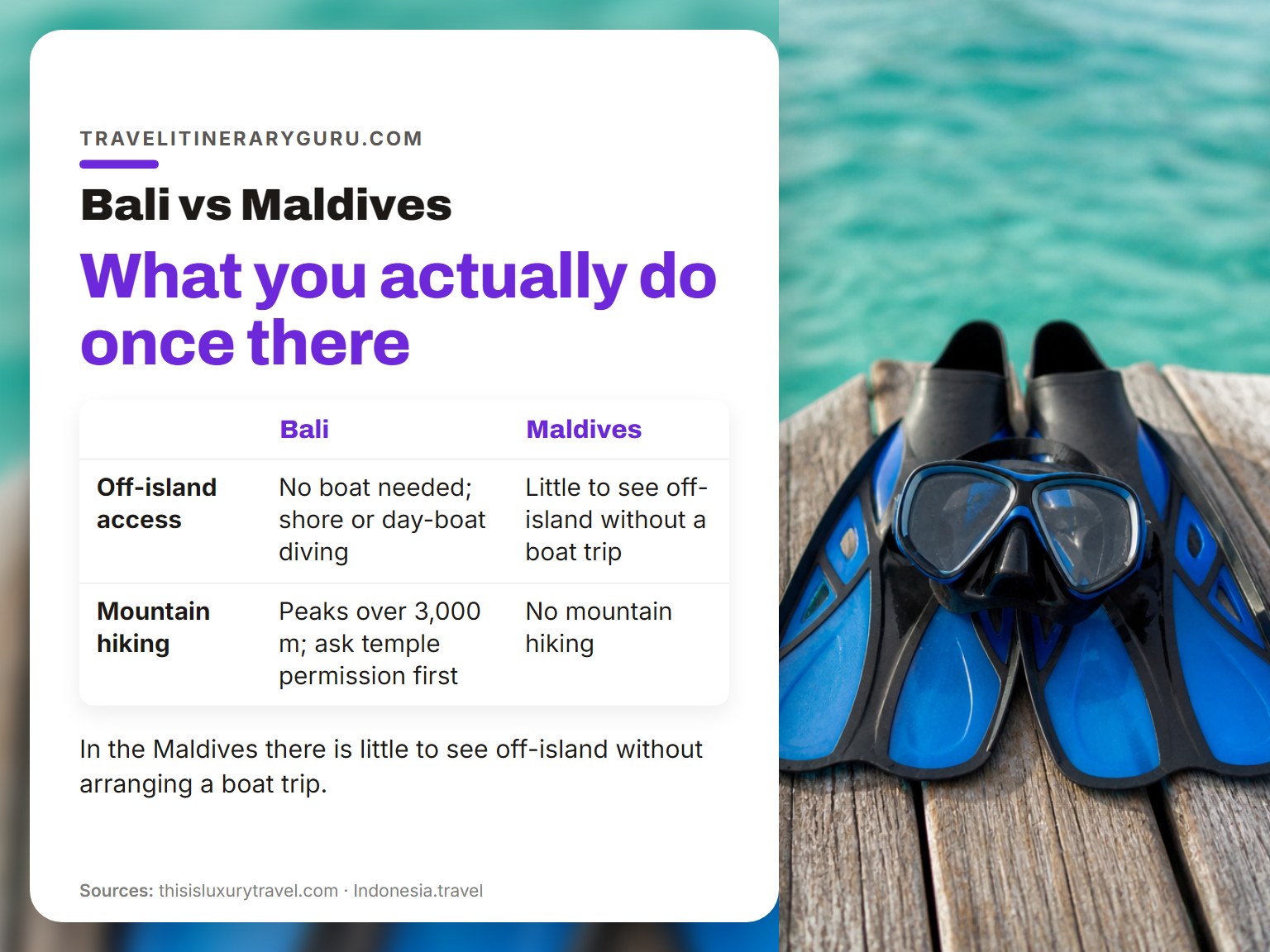
This is the question that decides the trip, and it’s the one the comparison tables skip.
Bali has temples, ceremonies, and traditional arts woven into daily life. You can surf in the morning, hike a volcano at sunrise, take a cooking class in the afternoon, or sit in a yoga studio. There’s a social side too, with beach clubs and plenty of other travelers if you want company.
The Maldives is set up for slowing down. Most people stay on private islands. You snorkel or dive right from your accommodation, and the visibility is usually excellent. Rough Guides says there isn’t much nightlife or inland activities, but that’s kind of the point, while viceroybali.com says to choose the Maldives if you love exciting nightlife, including clubs and bars.
The part nobody mentions: In the Maldives there’s little to see off-island without arranging a boat trip. That’s a structural constraint, not a preference. You’re not choosing to stay put; staying put is the only option unless you pay for an excursion.
If you’re a beach person, that’s heaven. If you’re not, it’s a very expensive resort with a very good view.
Mountain hiking exists in Bali but comes with a rule. Anyone wanting to climb Gunung Agung must ask permission first from the temple authorities, because Balinese religion prescribes that no one may stand higher than the sacred temple, especially during ceremonies. The central mountain zones have several peaks over 3,000 meters, and temperatures up there are considerably cooler with much more rainfall than the coast. Coastal dry-season advice doesn’t transfer to a volcano hike.
Frequently Asked Questions
Is Bali or the Maldives cheaper?
Five-star Bali rooms started at about US$185 a night with taxes on a January check. Maldives overwater villas started at about US$500 a night before a 10% service charge, 17% tax and a US$12 per person per night green tax.
Which is better for a first trip to Asia?
Bali.
Can I visit both in one trip?
Yes. There were no nonstop flights between Denpasar and Malé when checked in November 2026, so you connect in Singapore or Kuala Lumpur. April is the best month because it’s the only one when both are in their dry season. Book the whole journey on one ticket.
How long should I spend in each?
Bali rewards two weeks or more if you want to cover multiple regions. NDTV treats the Maldives as working beautifully as a short retreat of about three to five days, while thisisluxurytravel.com recommends choosing the Maldives for a week of rest. If you’re combining both, ten days isn’t enough to do it justice.
Is the Maldives safe?
Medical care is limited outside Malé, and serious cases may need to be flown elsewhere. The UK FCDO updated its Maldives travel advice on 12 August 2026 with new swimming safety information, and the Maldives Ministry of Tourism and Environment hotline is +960 9423131.
Do I need travel insurance for either?
Yes, for both. Insurance should cover your itinerary, planned activities and expenses in an emergency, and it should include emergency evacuation. This is the one line item I’d never cut.
The Bottom Line
Here’s the threshold I’d give you. If your trip is ten days or fewer, pick one destination and stay there. Splitting a short trip between two countries that are 3,200 miles apart, with a regional connection and a seaplane on the far end, burns days you don’t have.
By day five you’ve done the snorkeling, taken the overwater bungalow photo, and you’re staring at the same horizon. It’s also the entire trip, and the bill keeps running.
One anchor activity a day, and let the rest fill in.
And whichever you choose, buy the insurance.
