
12-Day California Itinerary Without a Car: By Rail and Bus
This post contains affiliate links. As an Amazon Associate, we earn from qualifying purchases.
A 12-day California itinerary without a car runs on three systems: the Amtrak Pacific Surfliner, the YARTS buses into Yosemite, and the free in-park shuttles. The Surfliner covers 351 miles of coastline, but YARTS service into Yosemite is seasonal and route-specific, so the order of your days matters more than the list of stops.
That seasonality is where a 12-day California itinerary without a car quietly comes apart. Visit California’s public transportation page lists YARTS buses running into the park from Merced, Mammoth Lakes, Sonora and Fresno with no season attached to any of them. The National Park Service documents Highway 120 East as a July-to-September corridor and Highway 41 as summer only. Build your dates against the NPS version and you won’t spend a night in Merced re-planning.
What follows is a day-by-day route built on the state’s rail spine, the exact YARTS corridors and their seasons, and the three spots around Yosemite you still can’t reach without a car.
Key Takeaways
- The Pacific Surfliner is the spine, running 351 miles from San Diego to San Luis Obispo with daily service.
- YARTS seasonality sets your dates: Highway 120 East runs July to September only, and Highway 41 runs summer only.
- There’s no luggage storage in Yosemite right now, so pick a base with a front desk that will hold your bag.
- Amtrak stops at Merced, and the rest of the trip into the park is a YARTS transfer rather than a through-train.
- Hetch Hetchy has no public transit at all, and Glacier Point needs a reserved, fee-based tour.
The Pacific Surfliner Is the Spine of This Route
The Pacific Surfliner covers 351 miles between San Diego and San Luis Obispo, and it runs every day of the week.
Amtrak’s Pacific Surfliner runs a 351-mile route through San Diego, Orange, Los Angeles, Ventura, Santa Barbara and San Luis Obispo counties, with sections of track hugging the Southern California coastline. Trains operate daily, and carry-on bags must be smaller than 28 by 22 by 11 inches. Cafe service, onboard Wi-Fi and checked baggage are available.
Three systems carry you on this route, and they barely overlap.
| System | What It Covers | What It Misses |
|---|---|---|
| Amtrak Pacific Surfliner | San Diego to San Luis Obispo, daily | Everything inland |
| YARTS | Merced, Fresno, Sonora, Mammoth Lakes to Yosemite | Some corridors are summer-only |
| Yosemite Valley shuttles | The valley floor, every 8 to 22 minutes depending on the route | Hetch Hetchy and Glacier Point |
The Surfliner is the only one of the three that runs on a fixed daily schedule all year, which makes it the clock the rest of your trip hangs off. Heading north out of San Diego, the ocean sits on the left side of the train for a long stretch. Book a window seat for the coastal stretch.
Which Surfliner Runs Actually Save You Time
Amtrak’s published timetable lists train 1777 at 51 minutes and train 782 at 6 hours 38 minutes. That spread is the whole planning problem in one line.
Short hops under an hour cover short station-to-station moves. Mid-length runs land between 2 hours 46 minutes and 3 hours 3 minutes. The full runs take 5 hours 59 minutes to 6 hours 38 minutes.
The rail schedule sets the shape of the trip, and everything else fits around it. Any no-car itinerary lives or dies on the same principle: transit legs come first, and the stops fill in behind them.
I plan these routes in Google My Maps before I book anything, because a rail line and a park boundary look deceptively close on a phone screen and turn out to be much farther apart than they appear. A mapping tool is the other thing I reach for when I want to see how a corridor actually bends.
Why YARTS Seasonality Decides Your Dates
Visit California’s own page makes Yosemite sound like a year-round bus ride from four different cities. The National Park Service says otherwise for most of those corridors.
The YARTS Highway 140 service out of Merced is the one that runs all year, split into a summer window and a winter window. The other three corridors close for the cold months.
| YARTS Corridor | Operating Season | Notes |
|---|---|---|
| Highway 140 (Merced) | May 22 to Sept 30, then Oct 1 to May 28 | The year-round option |
| Highway 120 East | Daily July to September | Conditions permitting |
| Highway 120 West | Daily mid-May to September | Bay Area gateway |
| Highway 41 (Fresno) | Daily during summer | Summer only |
What most people get wrong: Reading Visit California’s transit page and assuming YARTS runs from every gateway city all year. The NPS documents Highway 120 East as a July-to-September corridor and Highway 41 as summer only. Plan a January arrival around Highway 120 East and you’ll be rebooking within a day.
This is a real disagreement between two official sources, so it’s worth naming both positions rather than picking one. Visit California describes YARTS as running from Merced, Mammoth Lakes, Sonora and Fresno into the park, with no season attached. The NPS Yosemite shuttle and transit options page attaches a season to each corridor individually. When the two conflict, trust the agency that runs the park.
The same split shows up on the rail leg. Visit California says the Amtrak San Joaquin line “will take you straight into Yosemite.” The Park Service describes the identical trip as a transfer at Merced, with YARTS covering the rest. It’s one booking problem dressed as two.
Days 1 to 4: San Diego and Los Angeles on Rail and Metro
You step off the train in downtown San Diego and your hotel is a short walk away. That’s the reason to start here instead of Los Angeles.
- Day 1: Land in San Diego and stay downtown. The downtown core, Little Italy and the waterfront sit close enough to cover on foot. Book a room out in Mission Valley instead and you’ll spend your first evening waiting on a bus rather than eating dinner.
- Day 2: Stay on foot, or use the light rail for the far stops. Balboa Park is the exception worth a ride. Check whether a transit day pass covers the route before you pay per trip.
- Day 3: Ride the Surfliner north to Los Angeles. Check the timetable before you leave home. Turn up without a plan on a busy day and you may stand with your bag between your feet.
- Day 4: Los Angeles on Metro Rail. Downtown, Hollywood and Santa Monica all sit on rail lines, but they’re spread across the city. Plan a few neighborhoods per day rather than trying to cover the whole city.
Los Angeles rewards people who pick a few neighborhoods instead of crossing the whole city, which is the same advice behind any 4-day Los Angeles itinerary. Disneyland draws around 16 million visitors a year and opened in 1955, with the California Adventure park added in 2001. That number is worth holding in your head when you’re deciding whether one day belongs to a theme park.
One habit from years of this: I still carry a paper map even with a phone in my pocket. The paper version shows you the shape of a city, where the river bends and where the neighborhoods connect. It also doesn’t die when you’ve been using your phone as a camera all day.
Days 5 to 7: Santa Barbara and the Coast North
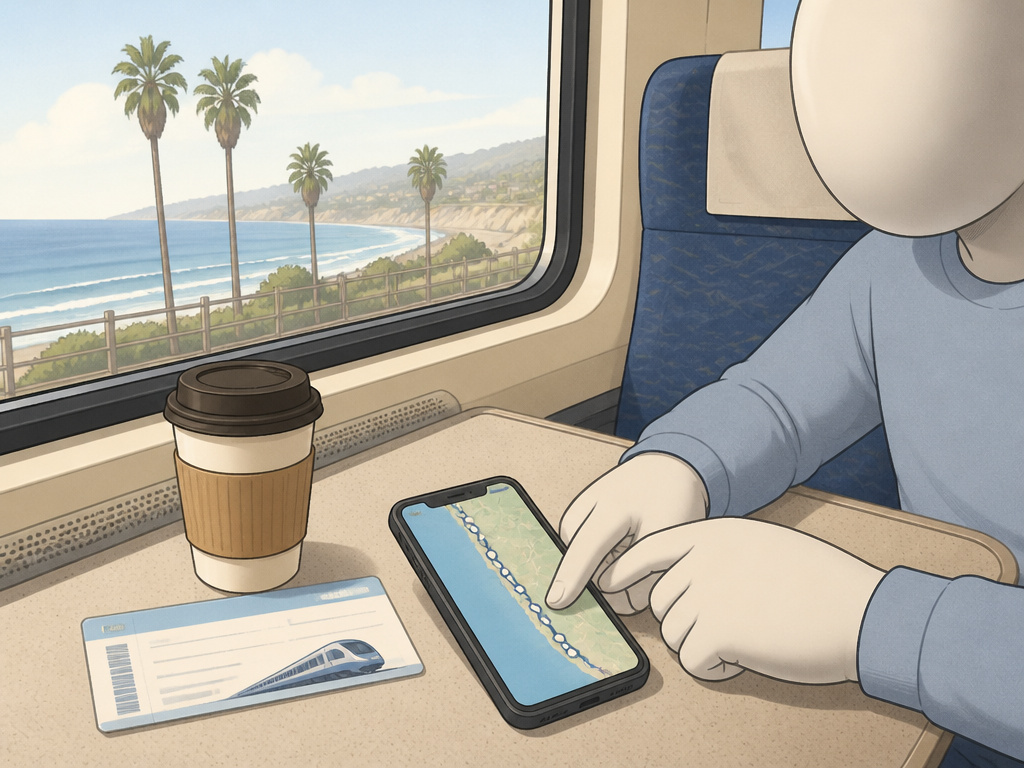
What’s a strong single day trip on this route? Santa Barbara is a strong single day trip on this route.
The Surfliner stops there, which turns a coastal town that’s awkward to reach by car into a straightforward morning. This is the trip to build around a day trip by train rather than a rental car you’d park all afternoon.
The cafe car smells like coffee and warm bread, and it’s a car where strangers actually talk to each other.
Days 6 and 7 push further up the coast toward San Luis Obispo. The California coast travel guide covers the stops in order, which helps when you’re deciding where to break the run.
If you want the longer scenic haul, the Amtrak Coast Starlight is a separate train from the Surfliner and runs its own schedule. Don’t assume you can swap between them on the same day without checking.
Balance the iconic with the authentic. A day in Santa Barbara that includes one mission and one unplanned taco counter beats a day that includes four missions.
Days 8 to 10: Getting Into Yosemite Without a Car
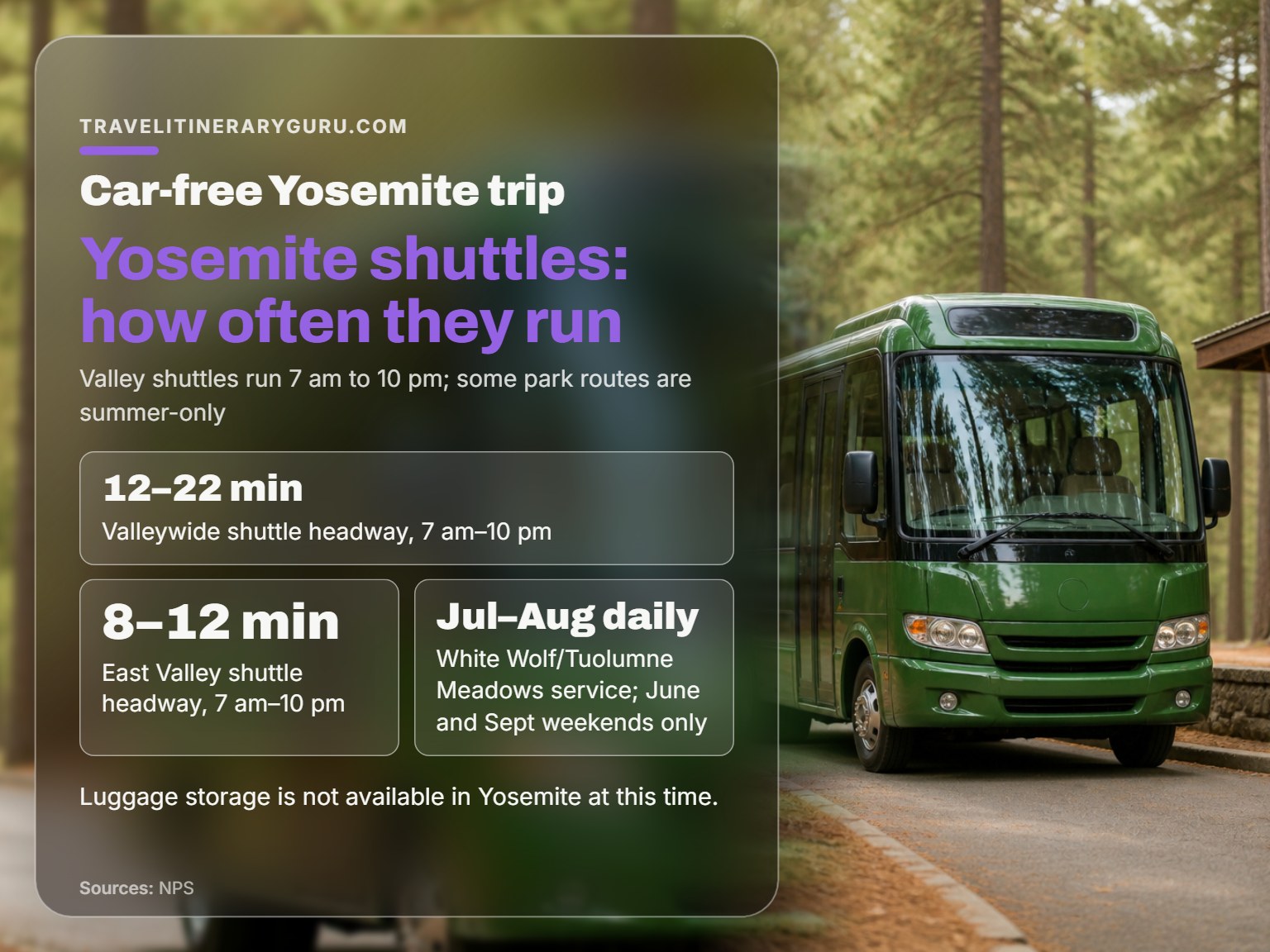
Three of Yosemite’s four YARTS corridors are summer-only or close to it, which is why the middle of this trip needs the most planning.
Before you start: Hetch Hetchy Valley has no public transportation at all, and Glacier Point is reachable only by a reserved, fee-based tour running late May or June through October. Neither is a walk-up option, and both sit inside a park where you’ll have no car to fall back on.
The Merced Transfer, Explained
- Amtrak gets you to Merced. YARTS covers the rest of the way into the park.
- Highway 140 is the corridor that runs all year, which is why Merced is the safe winter gateway.
- The Amtrak-to-YARTS handoff is a transfer, not a through-train, so treat it as two separate bookings.
- Limited White Wolf and Tuolumne Meadows service runs daily in July and August, and weekends only in June and September.
Once you’re in the valley, the shuttles do the work. Headways are short enough that waiting is rarely the problem.
- Valleywide shuttle: every 12 to 22 minutes, 7 am to 10 pm.
- East Valley shuttle: every 8 to 12 minutes, 7 am to 10 pm.
- Mariposa Grove Shuttle: no earlier than April 15 and no later than November 30, with dates varying by year.
- Badger Pass shuttle: typically mid-December through March.
The part nobody mentions: The National Park Service states plainly that luggage storage isn’t available in Yosemite at this time. Arrive with a bag you can carry onto the YARTS bus, or leave the big case at your Merced hotel and collect it on the way back.
The Tuolumne Meadows shuttle is worth checking separately, because it isn’t available every year. Mariposa Grove’s spring opening also shifts with conditions, so a fixed date in a blog post from three years ago tells you nothing.
Days 11 to 12: San Francisco on BART, Muni and Caltrain
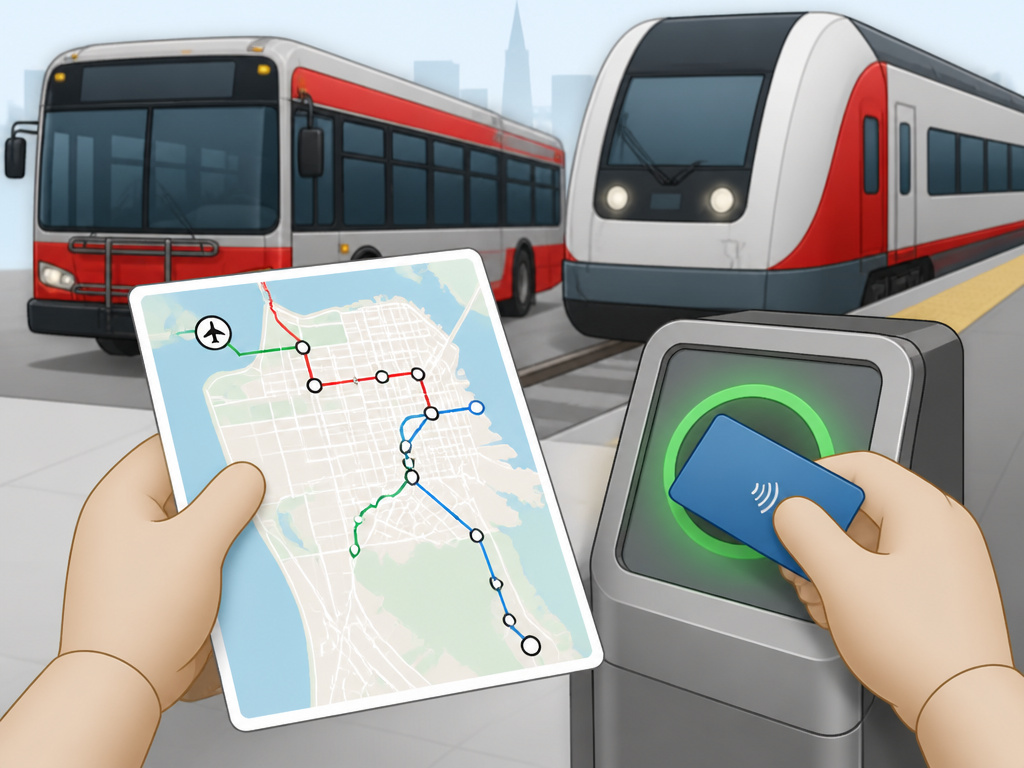
San Francisco is the easy part.
BART covers the city and the airport well, and Muni fills in the neighborhoods. Caltrain runs the peninsula, and the Go Pass bundles local transportation deals across the San Francisco Peninsula and Santa Clara Valley. If you want a fixed plan for the last two days, a 3-day San Francisco itinerary maps cleanly onto this window.
The transit day pass plus a paper map is the most underrated combination in travel. A contactless tap often gets you further in a day than a tour bus, and you actually see where you’re going. A Metro day pass and a printed map of the Mall beat a crowded tour bus every time.
Fair warning: two days is a tight window for this city. It’s enough for one neighborhood done properly and one long walk along the water.
Where a 12-Day California Itinerary Without a Car Breaks Down
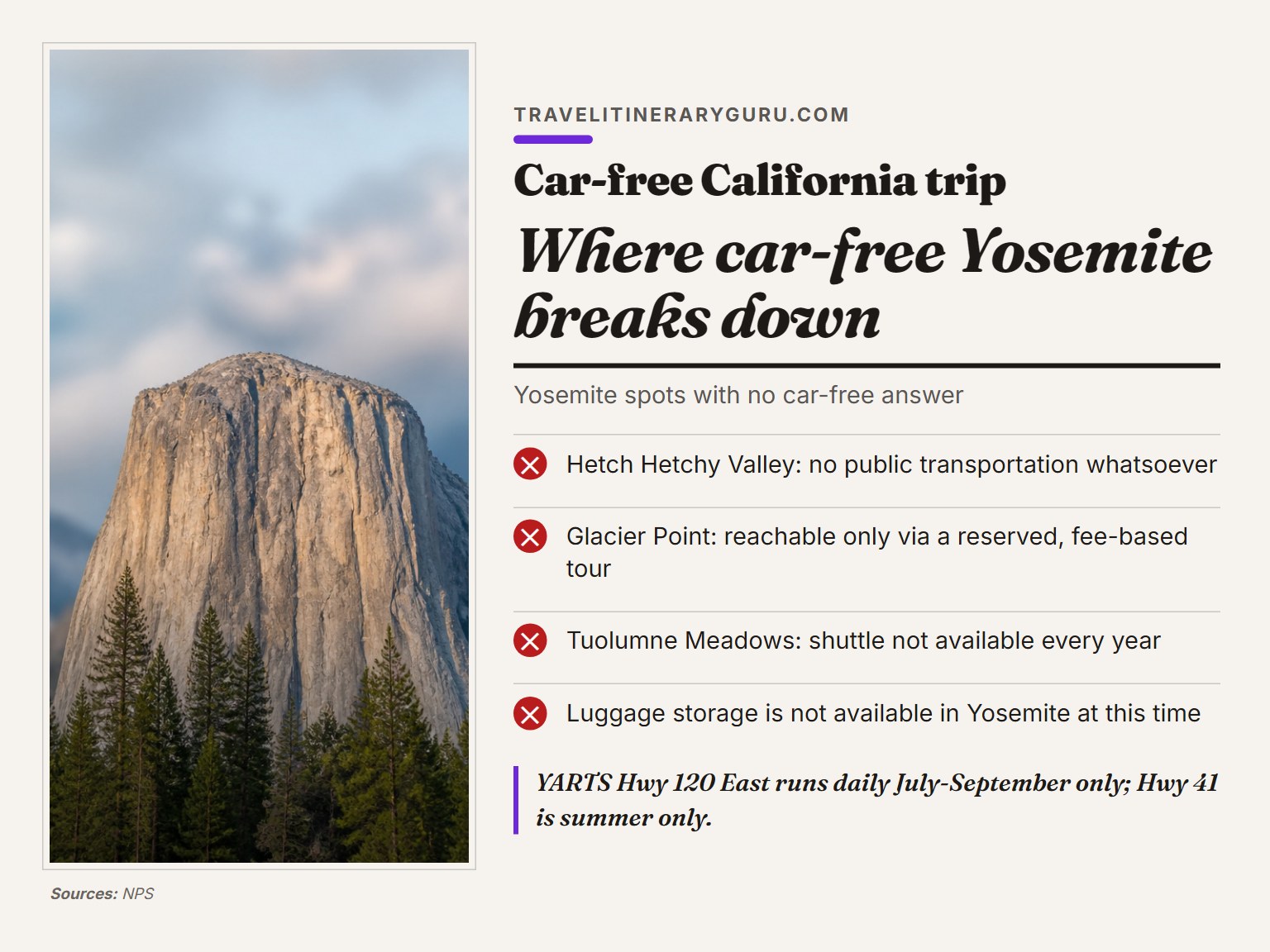
Three places in and around Yosemite have no car-free answer at all.
- Hetch Hetchy Valley has no public transportation whatsoever, per the Park Service.
- Glacier Point is reachable only via a reserved, fee-based tour.
- Tuolumne Meadows loses its shuttle in some years entirely.
That’s not a reason to skip the park. It’s a reason to know which half of it you’re actually visiting. If you’re weighing this route against a longer regional loop, a West Coast itinerary for budget travelers shows how the same rail spine stretches across two weeks.
The other failure mode is quieter. People build a plan with too many stops and then wonder why the trip felt like a commute. Balancing sightseeing and travel time is the skill that separates a car-free trip from an exhausting one, and it matters more without a car because you can’t make up lost time by driving faster.
What to Book Before You Leave
- Surfliner seats for every leg over two hours.
- YARTS Highway 140 if your dates fall outside the summer window.
- The Glacier Point tour, if you want it at all, well before arrival.
- Your Merced hotel, specifically for the bag-storage question.
And a note on the state’s own guidance: Visit California recommends buying multi-day passes for transit systems and checking ticket options online before you arrive. That advice holds. What it doesn’t do is tell you which corridors shut for winter, which is the part that actually ruins trips.
Frequently Asked Questions
Can you do a California trip entirely without a car?
Yes, on this route, with one caveat. The Pacific Surfliner, YARTS and the Yosemite Valley shuttles cover the spine of the trip. What you give up is Hetch Hetchy Valley, which has no public transportation at all, and Glacier Point, which requires a reserved, fee-based tour.
Does Amtrak go all the way to Yosemite?
No. Amtrak’s service reaches Merced, and YARTS provides the connection from there into the park. The Park Service describes this as a transfer rather than a through-train, even though Visit California’s page frames the San Joaquin line as one that takes you straight into Yosemite.
Is there luggage storage in Yosemite?
Not at this time, according to the National Park Service. That makes the Merced transfer the pinch point of the whole trip. Either travel with a bag you can carry onto the YARTS bus, or leave the large case at your Merced hotel.
How long does the Pacific Surfliner take?
It depends entirely on the segment. Amtrak’s timetable lists the shortest scheduled segment at 51 minutes and the longest full run at 6 hours 38 minutes on train 782. The mid-length runs sit between 2 hours 46 minutes and 3 hours 3 minutes.
Which YARTS corridor should you use in winter?
Highway 140 out of Merced. It’s the corridor that runs year-round, split into a May 22 to September 30 summer season and an October 1 to May 28 winter season. Highway 120 East, Highway 120 West and Highway 41 are all summer operations.
Can you reach Glacier Point without a car?
Only by booking the fee-based tour, which runs late May or June through October and requires reservations. There’s no shuttle alternative and no walk-up option, so this is a decision to make before you book anything else.
The Bottom Line
If your twelve days fall between October and mid-May, the park is still reachable, but only through Merced on Highway 140. Build that version of the trip around the Surfliner and the cities, and treat Yosemite as a two-day detour rather than the centerpiece.
If your window is June through September, the opposite is true. Yosemite can carry the middle of the trip, and the coast becomes the part you compress.
Here’s your first step, and it takes only a few minutes. Open Amtrak’s Pacific Surfliner timetable and the YARTS route page in two browser tabs, side by side, before you book a single hotel. The dates that work for both documents are the dates your trip can actually use.
Everything else is detail. An itinerary is like a stew: transport and lodging are the base, and the good parts come from what you add once it’s already simmering. Rushing the base gives you something forgettable.
